RESULTS OF OPINION POLL
  CONDUCTED AMONG STUDENTS OF PHILOLOGY
AND UNIVERSITY LECTURERS AND COLLABORATORS
 CONCERNING THE LEVEL OF ADJUSTMENT OF THE
   CONTENTS OF STUDY PROGRAMMES TO THE
               LABOUR MARKET
            Prof. Julijana Vučo, PhD
           Prof. Olivera Durbaba, PhD


                   Beograd, 15.12.2012.      1
THE OVERALL NUMBER OF
             RESPONDENTS – STUDENTS

• A total of 827 respondents participated. The majority of the
  respondents were from the University of Belgrade (61%) and
  the University of Novi Sad (16%). The University of Kragujevac
  provided 13% of the respondents, the Univerzitet of Niš 9%,
  and the University of Novi Pazar 1 % of the respondents.


                          Beograd, 15.12.2012.                 2
THE OVERALL NUMBER OF LECTURERS AND
  COLLABORATORS:
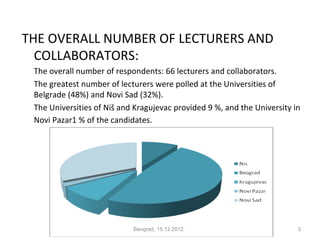
 The overall number of respondents: 66 lecturers and collaborators.
 The greatest number of lecturers were polled at the Universities of
 Belgrade (48%) and Novi Sad (32%).
 The Universities of Niš and Kragujevac provided 9 %, and the University in
 Novi Pazar1 % of the candidates.


                            Beograd, 15.12.2012.                          3
THE AGE STRUCTURE OF STUDENTS AND THE
              LENGTH OF STUDYING
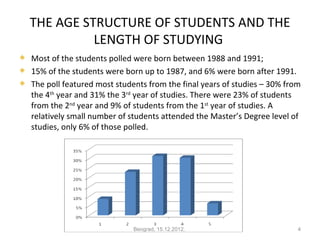
   Most of the students polled were born between 1988 and 1991;
   15% of the students were born up to 1987, and 6% were born after 1991.
   The poll featured most students from the final years of studies – 30% from
    the 4th year and 31% the 3rd year of studies. There were 23% of students
    from the 2nd year and 9% of students from the 1st year of studies. A
    relatively small number of students attended the Master’s Degree level of
    studies, only 6% of those polled.


                                Beograd, 15.12.2012.                         4
THE STRUCTURE OF LECTURERS IN TERMS OF
      ACADEMIC TITLES AND THE LENGTH OF
                EMPLOYMENT
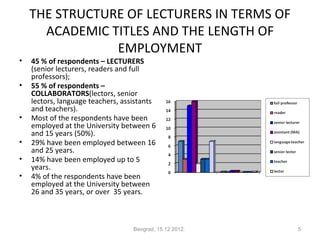
•   45 % of respondents – LECTURERS
    (senior lecturers, readers and full
    professors);
•   55 % of respondents –
    COLLABORATORS(lectors, senior
    lectors, language teachers, assistants
    and teachers).
•   Most of the respondents have been
    employed at the University between 6
    and 15 years (50%).
•   29% have been employed between 16
    and 25 years.
•   14% have been employed up to 5
    years.
•   4% of the respondents have been
    employed at the University between
    26 and 35 years, or over 35 years.


                                   Beograd, 15.12.2012.   5
DISTRIBUTION OF STUDENTS ACCORDING TO
            FACULTY DEPARTMENTS
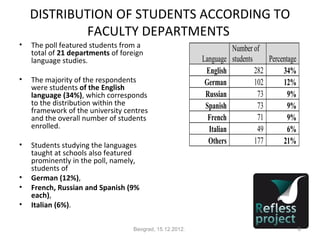
•   The poll featured students from a                                 Number of
    total of 21 departments of foreign
    language studies.                                     Language    students     Percentage
                                                           English             282      34%
•   The majority of the respondents                        German              102      12%
    were students of the English
    language (34%), which corresponds                      Russian              73        9%
    to the distribution within the                         Spanish              73        9%
    framework of the university centres
    and the overall number of students                      French              71        9%
    enrolled.                                               Italian             49        6%
•   Students studying the languages
                                                            Others             177      21%
    taught at schools also featured
    prominently in the poll, namely,
    students of
•   German (12%),
•   French, Russian and Spanish (9%
    each),
•   Italian (6%).

                                   Beograd, 15.12.2012.                                         6
DISTRIBUTION OF LECTURERS ACCORDING TO
            THEIR SCIENTIFIC AREA
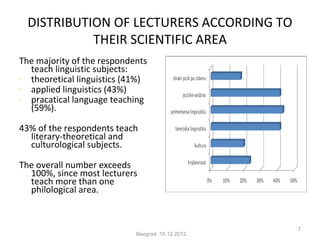
The majority of the respondents
  teach linguistic subjects:
- theoretical linguistics (41%)
- applied linguistics (43%)
- pracatical language teaching
  (59%).

43% of the respondents teach
  literary-theoretical and
  culturological subjects.

The overall number exceeds
  100%, since most lecturers
  teach more than one
  philological area.


                                                   7
                            Beograd, 15.12.2012.
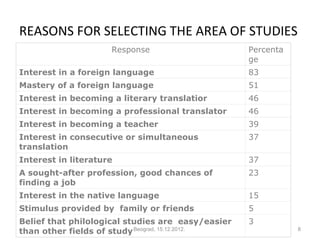
REASONS FOR SELECTING THE AREA OF STUDIES
                     Response                      Percenta
                                                   ge
Interest in a foreign language                     83
Mastery of a foreign language                      51
Interest in becoming a literary translatior        46
Interest in becoming a professional translator     46
Interest in becoming a teacher                     39
Interest in consecutive or simultaneous            37
translation
Interest in literature                             37
A sought-after profession, good chances of         23
finding a job
Interest in the native language                    15
Stimulus provided by family or friends             5
Belief that philological studies are easy/easier   3
than other fields of study Beograd, 15.12.2012.               8
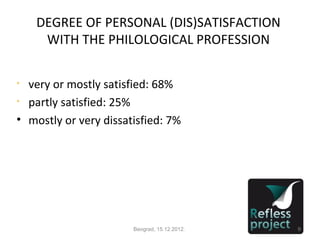
DEGREE OF PERSONAL (DIS)SATISFACTION
     WITH THE PHILOLOGICAL PROFESSION

• very or mostly satisfied: 68%
• partly satisfied: 25%

• mostly or very dissatisfied: 7%


                       Beograd, 15.12.2012.   9
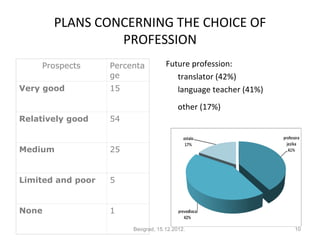
PLANS CONCERNING THE CHOICE OF
                PROFESSION
    Prospects      Percenta         Future profession:
                   ge                  translator (42%)
Very good          15                  language teacher (41%)
                                         other (17%)
Relatively good    54


Medium             25


Limited and poor   5


None               1

                        Beograd, 15.12.2012.                    10
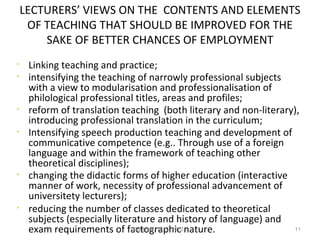
LECTURERS’ VIEWS ON THE CONTENTS AND ELEMENTS
     OF TEACHING THAT SHOULD BE IMPROVED FOR THE
        SAKE OF BETTER CHANCES OF EMPLOYMENT
•    Linking teaching and practice;
•    intensifying the teaching of narrowly professional subjects
     with a view to modularisation and professionalisation of
     philological professional titles, areas and profiles;
•    reform of translation teaching (both literary and non-literary),
     introducing professional translation in the curriculum;
•    Intensifying speech production teaching and development of
     communicative competence (e.g.. Through use of a foreign
     language and within the framework of teaching other
     theoretical disciplines);
•    changing the didactic forms of higher education (interactive
     manner of work, necessity of professional advancement of
     universitety lecturers);
•    reducing the number of classes dedicated to theoretical
     subjects (especially literature and history of language) and
     exam requirements of factographic nature.
                               Beograd, 15.12.2012.                11
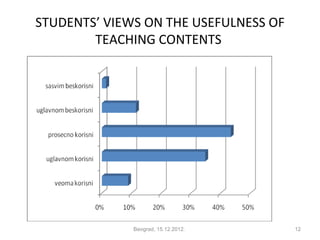
STUDENTS’ VIEWS ON THE USEFULNESS OF
        TEACHING CONTENTS


              Beograd, 15.12.2012.     12
STUDENTS’ VIEWS ON THE TEACHING
   CONTENTS IRRELEVANT FOR THEIR FUTURE
                PROFESSION
A generally negative view of subjects, mainly because of their
    general character or predominantly theoretical concept:

“I believe that some subjects are useful only if one plans to teach
     at a faculty. However, most students will never be able to
     use the majority of the knowledge they acquire in a
     professional context.”


                           Beograd, 15.12.2012.                   13
A negative view of theoretical subjects from the students’ own
   department (literature, theoretical linguistics, history of
   language):
“What’s the use of literature, anyway? It is useful only to those
   who will stay to work at the faculty, and that means one
   person in every five generations.”

STILL: there is some awareness of the function of teaching
   literature:
“For, even those subjects that we tend to refer to as ‘useless’
   (meaning literature, which has no specific use after we finish
   our studies), do provide a certain amount of knowledge,
   some general culture, which can be of use after all, both in
   translation and teaching.”

                           Beograd, 15.12.2012.                     14
A critical view on the necessity of programmatic,
   methodological or organisational innovations in the sphere
   of teaching:
“Instead of there being at least two semesters of teaching
   simultaneous/consecutive translation, we get two semesters
   of subjects totally irrelevant to students, who have opted for
   the translation vocational stream with good reason.”


                           Beograd, 15.12.2012.                     15
A critical view on the didactic methods or competence of
   lecturers and teaching collaborators, and the relevance of
   literature:
“I would say that there are contents which lecturers place too
   much emphasis on, while neglecting others. Such views of the
   lecturers make me feel that such contents are unnecessary.”


                         Beograd, 15.12.2012.                 16
A POSITIVE VIEW OF VARIETY OF PHILOLOGICAL
CONTENTS

A positive view of variety of philological contents:
“Actually, from my point of view, there is no superfluous
   information. There are contents of greater or lesser
   importance for my future profession, but there are none that
   are devoid of value altogether.”


                          Beograd, 15.12.2012.                    17
STUDENTS: CONTENTS THAT ARE NECESSARY FOR
    THEIR FUTURE WORK, BUT ARE NOT OFFERED IN THE
              COURSE OF THEIR STUDIES

      translation, simultaneous, consecutive, professional

      practice – connection between what is taught and its
      practical professional application

      contemporary programmes, contemporary forms of work

      active language teaching

      new subjects

      extracurricular activities, student exchange programmes

      equipment


                          Beograd, 15.12.2012.                  18

Refless labour market survey open space event

  • 1.
    RESULTS OF OPINIONPOLL CONDUCTED AMONG STUDENTS OF PHILOLOGY AND UNIVERSITY LECTURERS AND COLLABORATORS CONCERNING THE LEVEL OF ADJUSTMENT OF THE CONTENTS OF STUDY PROGRAMMES TO THE LABOUR MARKET Prof. Julijana Vučo, PhD Prof. Olivera Durbaba, PhD Beograd, 15.12.2012. 1
  • 2.
    THE OVERALL NUMBEROF RESPONDENTS – STUDENTS • A total of 827 respondents participated. The majority of the respondents were from the University of Belgrade (61%) and the University of Novi Sad (16%). The University of Kragujevac provided 13% of the respondents, the Univerzitet of Niš 9%, and the University of Novi Pazar 1 % of the respondents. Beograd, 15.12.2012. 2
  • 3.
    THE OVERALL NUMBEROF LECTURERS AND COLLABORATORS: The overall number of respondents: 66 lecturers and collaborators. The greatest number of lecturers were polled at the Universities of Belgrade (48%) and Novi Sad (32%). The Universities of Niš and Kragujevac provided 9 %, and the University in Novi Pazar1 % of the candidates. Beograd, 15.12.2012. 3
  • 4.
    THE AGE STRUCTUREOF STUDENTS AND THE LENGTH OF STUDYING  Most of the students polled were born between 1988 and 1991;  15% of the students were born up to 1987, and 6% were born after 1991.  The poll featured most students from the final years of studies – 30% from the 4th year and 31% the 3rd year of studies. There were 23% of students from the 2nd year and 9% of students from the 1st year of studies. A relatively small number of students attended the Master’s Degree level of studies, only 6% of those polled. Beograd, 15.12.2012. 4
  • 5.
    THE STRUCTURE OFLECTURERS IN TERMS OF ACADEMIC TITLES AND THE LENGTH OF EMPLOYMENT • 45 % of respondents – LECTURERS (senior lecturers, readers and full professors); • 55 % of respondents – COLLABORATORS(lectors, senior lectors, language teachers, assistants and teachers). • Most of the respondents have been employed at the University between 6 and 15 years (50%). • 29% have been employed between 16 and 25 years. • 14% have been employed up to 5 years. • 4% of the respondents have been employed at the University between 26 and 35 years, or over 35 years. Beograd, 15.12.2012. 5
  • 6.
    DISTRIBUTION OF STUDENTSACCORDING TO FACULTY DEPARTMENTS • The poll featured students from a Number of total of 21 departments of foreign language studies. Language students Percentage English 282 34% • The majority of the respondents German 102 12% were students of the English language (34%), which corresponds Russian 73 9% to the distribution within the Spanish 73 9% framework of the university centres and the overall number of students French 71 9% enrolled. Italian 49 6% • Students studying the languages Others 177 21% taught at schools also featured prominently in the poll, namely, students of • German (12%), • French, Russian and Spanish (9% each), • Italian (6%). Beograd, 15.12.2012. 6
  • 7.
    DISTRIBUTION OF LECTURERSACCORDING TO THEIR SCIENTIFIC AREA The majority of the respondents teach linguistic subjects: - theoretical linguistics (41%) - applied linguistics (43%) - pracatical language teaching (59%). 43% of the respondents teach literary-theoretical and culturological subjects. The overall number exceeds 100%, since most lecturers teach more than one philological area. 7 Beograd, 15.12.2012.
  • 8.
    REASONS FOR SELECTINGTHE AREA OF STUDIES Response Percenta ge Interest in a foreign language 83 Mastery of a foreign language 51 Interest in becoming a literary translatior 46 Interest in becoming a professional translator 46 Interest in becoming a teacher 39 Interest in consecutive or simultaneous 37 translation Interest in literature 37 A sought-after profession, good chances of 23 finding a job Interest in the native language 15 Stimulus provided by family or friends 5 Belief that philological studies are easy/easier 3 than other fields of study Beograd, 15.12.2012. 8
  • 9.
    DEGREE OF PERSONAL(DIS)SATISFACTION WITH THE PHILOLOGICAL PROFESSION • very or mostly satisfied: 68% • partly satisfied: 25% • mostly or very dissatisfied: 7% Beograd, 15.12.2012. 9
  • 10.
    PLANS CONCERNING THECHOICE OF PROFESSION Prospects Percenta Future profession: ge translator (42%) Very good 15 language teacher (41%) other (17%) Relatively good 54 Medium 25 Limited and poor 5 None 1 Beograd, 15.12.2012. 10
  • 11.
    LECTURERS’ VIEWS ONTHE CONTENTS AND ELEMENTS OF TEACHING THAT SHOULD BE IMPROVED FOR THE SAKE OF BETTER CHANCES OF EMPLOYMENT • Linking teaching and practice; • intensifying the teaching of narrowly professional subjects with a view to modularisation and professionalisation of philological professional titles, areas and profiles; • reform of translation teaching (both literary and non-literary), introducing professional translation in the curriculum; • Intensifying speech production teaching and development of communicative competence (e.g.. Through use of a foreign language and within the framework of teaching other theoretical disciplines); • changing the didactic forms of higher education (interactive manner of work, necessity of professional advancement of universitety lecturers); • reducing the number of classes dedicated to theoretical subjects (especially literature and history of language) and exam requirements of factographic nature. Beograd, 15.12.2012. 11
  • 12.
    STUDENTS’ VIEWS ONTHE USEFULNESS OF TEACHING CONTENTS Beograd, 15.12.2012. 12
  • 13.
    STUDENTS’ VIEWS ONTHE TEACHING CONTENTS IRRELEVANT FOR THEIR FUTURE PROFESSION A generally negative view of subjects, mainly because of their general character or predominantly theoretical concept: “I believe that some subjects are useful only if one plans to teach at a faculty. However, most students will never be able to use the majority of the knowledge they acquire in a professional context.” Beograd, 15.12.2012. 13
  • 14.
    A negative viewof theoretical subjects from the students’ own department (literature, theoretical linguistics, history of language): “What’s the use of literature, anyway? It is useful only to those who will stay to work at the faculty, and that means one person in every five generations.” STILL: there is some awareness of the function of teaching literature: “For, even those subjects that we tend to refer to as ‘useless’ (meaning literature, which has no specific use after we finish our studies), do provide a certain amount of knowledge, some general culture, which can be of use after all, both in translation and teaching.” Beograd, 15.12.2012. 14
  • 15.
    A critical viewon the necessity of programmatic, methodological or organisational innovations in the sphere of teaching: “Instead of there being at least two semesters of teaching simultaneous/consecutive translation, we get two semesters of subjects totally irrelevant to students, who have opted for the translation vocational stream with good reason.” Beograd, 15.12.2012. 15
  • 16.
    A critical viewon the didactic methods or competence of lecturers and teaching collaborators, and the relevance of literature: “I would say that there are contents which lecturers place too much emphasis on, while neglecting others. Such views of the lecturers make me feel that such contents are unnecessary.” Beograd, 15.12.2012. 16
  • 17.
    A POSITIVE VIEWOF VARIETY OF PHILOLOGICAL CONTENTS A positive view of variety of philological contents: “Actually, from my point of view, there is no superfluous information. There are contents of greater or lesser importance for my future profession, but there are none that are devoid of value altogether.” Beograd, 15.12.2012. 17
  • 18.
    STUDENTS: CONTENTS THATARE NECESSARY FOR THEIR FUTURE WORK, BUT ARE NOT OFFERED IN THE COURSE OF THEIR STUDIES  translation, simultaneous, consecutive, professional  practice – connection between what is taught and its practical professional application  contemporary programmes, contemporary forms of work  active language teaching  new subjects  extracurricular activities, student exchange programmes  equipment Beograd, 15.12.2012. 18