





Reflective
Learning
Blog
English
language
learning
<a href="http://www.freepik.com">Designed by Freepik</a>
What is it?
<a href="http://www.freepik.com">Designed by Creativeart / Freepik</a>
In our English class...
• Why write a learning blog?
• For what purpose is it set?
• What will you get out of it?
Designing and setting up
our class blog
Our
Class
Blog
https://ellblogcas.wordpress.com
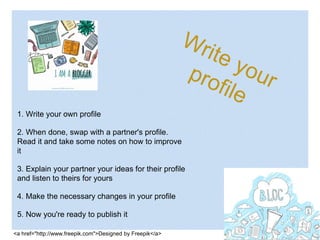
Write your profile
<a href="http://www.freepik.com">Designed by Freepik</a>
What info to include?
1. Write your own profile
2. When done, swap with a partner's profile.
Read it and take some notes on how to improve
it
3. Explain your partner your ideas for their profile
and listen to theirs for yours
4. Make the necessary changes in your profile
5. Now you're ready to publish it
<a href="http://www.freepik.com">Designed by Freepik</a>
Write your first post
• Construct
• Debate
• Explain
• Describe
• feel
• Illustrate
• Agree /
disagree
• Believe
• Think
• Surprise
• Impress
• Learn
• consider
• experience
• wonder
• remember
• discover
• Satisfy
Arrange
alphabetically
What to write in the Reflective
Learning Journal?
• Reflective learning journal writing is very different from academic assignments
that you have been writing. It is a piece of flexible, personal, informal piece of
writing.
• If you are unsure about how to start, and how to write, don’t just scrabble
something in the journal, as writing something truly “reflective” is the most
important part of the process.
Source: Reflective Learning Journal Teacher Guide
http://www.polyu.edu.hk/learn-to-
learn/es/materials/Reflective%20Learning%20Journal%20(Teacher%20Guide).
doc
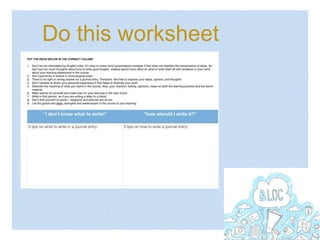
Do this worksheet
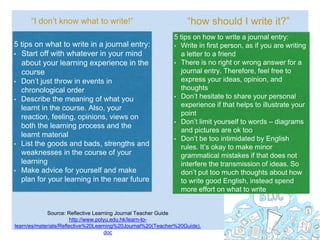
“how should I write it?”
5 tips on how to write a journal entry:
• Write in first person, as if you are writing
a letter to a friend
• There is no right or wrong answer for a
journal entry. Therefore, feel free to
express your ideas, opinion, and
thoughts
• Don’t hesitate to share your personal
experience if that helps to illustrate your
point
• Don’t limit yourself to words – diagrams
and pictures are ok too
• Don’t be too intimidated by English
rules. It’s okay to make minor
grammatical mistakes if that does not
interfere the transmission of ideas. So
don’t put too much thoughts about how
to write good English, instead spend
more effort on what to write
“I don’t know what to write!”
5 tips on what to write in a journal entry:
• Start off with whatever in your mind
about your learning experience in the
course
• Don’t just throw in events in
chronological order
• Describe the meaning of what you
learnt in the course. Also, your
reaction, feeling, opinions, views on
both the learning process and the
learnt material
• List the goods and bads, strengths and
weaknesses in the course of your
learning
• Make advice for yourself and make
plan for your learning in the near future
Source: Reflective Learning Journal Teacher Guide
http://www.polyu.edu.hk/learn-to-
learn/es/materials/Reflective%20Learning%20Journal%20(Teacher%20Guide).
doc
<a href="http://www.freepik.com">Designed by Freepik</a>

Reflective learning blog

  • 1.
  • 2.
    What is it? <ahref="http://www.freepik.com">Designed by Creativeart / Freepik</a>
  • 4.
    In our Englishclass... • Why write a learning blog? • For what purpose is it set? • What will you get out of it?
  • 5.
    Designing and settingup our class blog
  • 6.
  • 7.
    Write your profile <ahref="http://www.freepik.com">Designed by Freepik</a> What info to include?
  • 8.
    1. Write yourown profile 2. When done, swap with a partner's profile. Read it and take some notes on how to improve it 3. Explain your partner your ideas for their profile and listen to theirs for yours 4. Make the necessary changes in your profile 5. Now you're ready to publish it <a href="http://www.freepik.com">Designed by Freepik</a>
  • 9.
  • 10.
    • Construct • Debate •Explain • Describe • feel • Illustrate • Agree / disagree • Believe • Think • Surprise • Impress • Learn • consider • experience • wonder • remember • discover • Satisfy Arrange alphabetically
  • 11.
    What to writein the Reflective Learning Journal? • Reflective learning journal writing is very different from academic assignments that you have been writing. It is a piece of flexible, personal, informal piece of writing. • If you are unsure about how to start, and how to write, don’t just scrabble something in the journal, as writing something truly “reflective” is the most important part of the process. Source: Reflective Learning Journal Teacher Guide http://www.polyu.edu.hk/learn-to- learn/es/materials/Reflective%20Learning%20Journal%20(Teacher%20Guide). doc
  • 12.
  • 13.
    “how should Iwrite it?” 5 tips on how to write a journal entry: • Write in first person, as if you are writing a letter to a friend • There is no right or wrong answer for a journal entry. Therefore, feel free to express your ideas, opinion, and thoughts • Don’t hesitate to share your personal experience if that helps to illustrate your point • Don’t limit yourself to words – diagrams and pictures are ok too • Don’t be too intimidated by English rules. It’s okay to make minor grammatical mistakes if that does not interfere the transmission of ideas. So don’t put too much thoughts about how to write good English, instead spend more effort on what to write “I don’t know what to write!” 5 tips on what to write in a journal entry: • Start off with whatever in your mind about your learning experience in the course • Don’t just throw in events in chronological order • Describe the meaning of what you learnt in the course. Also, your reaction, feeling, opinions, views on both the learning process and the learnt material • List the goods and bads, strengths and weaknesses in the course of your learning • Make advice for yourself and make plan for your learning in the near future Source: Reflective Learning Journal Teacher Guide http://www.polyu.edu.hk/learn-to- learn/es/materials/Reflective%20Learning%20Journal%20(Teacher%20Guide). doc
  • 14.