REFLECTION AND TRANSITION
MADE BY: MUFAZZAL, AHAD, BILAL
INTRODUCTION
 In this lesson we are going to look at the meaning of reflection and
explore how examining our experiences and achievements enables us to
realise our self-worth.
 Understanding and practising reflection techniques helps us to see our
achievements and have more pride and professionalism while we move
towards to the next stage of our life.
WHAT IS REFLECTION
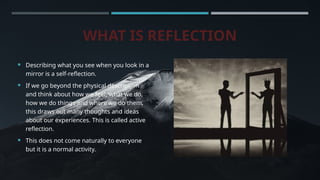
 Describing what you see when you look in a
mirror is a self-reflection.
 If we go beyond the physical description
and think about how we feel, what we do,
how we do things and where we do them,
this draws out many thoughts and ideas
about our experiences. This is called active
reflection.
 This does not come naturally to everyone
but it is a normal activity.
HOW PEOPLE REFLECT
- People often reflect on
their daily activities,
relationships, jobs,
successes, and failures.
- Reflection can occur
anywhere and anytime
(e.g.: while walking,
relaxing, bathing, or trying
to sleep).
- Many view life
experiences as isolated
- By linking and deriving meaning
from experiences, you can:
- Boost confidence and motivation.
- Increase self-awareness.
- Improve academic performance.
- Enhance professional skills and
advance your career.
WHY IS REFLECTION IMPORTANT
 1. Enhances self-awareness: Helps individuals understand their thoughts,
emotions, and behaviors more deeply.
 2. Promotes learning and growth: Encourages critical thinking and the
extraction of lessons from experiences.
 3. Improves decision-making: Increases the ability to make informed and
thoughtful choices.
 4. Boosts confidence: Recognizing past achievements builds self-assurance.
 5. Facilitates problem-solving: Enables a deeper understanding of challenges
and potential solutions.
 6. Encourages continuous improvement: Identifying areas for growth leads
to ongoing personal and professional development.
 7. Strengthens emotional intelligence: Enhances the ability to manage
THE DIFFERENT ASPECTS OF REFLECTION
 1. Self-awareness:
Understanding personal
thoughts, feelings, and
behaviors.
 2. Emotional insight:
Recognizing and processing
emotions tied to experiences.
 3. Perspective-taking:
Considering other viewpoints or
alternative interpretations.
 4. Linking experiences:
Connecting past experiences to
current situations or future
 5. Goal setting: Using reflection
to define future objectives or
areas for growth.
 6. Problem-solving: Reflecting
on challenges to develop
solutions or improvements.
 7. Personal growth: Identifying
ways to improve or evolve based
on reflections.
 8. Action planning: Using
reflection to guide future actions
and decisions.
REFLECTION IS VALUED
 Reflection is recognized as an advanced skill guiding thinking,
emotions, and actions.
 It is valued in education, employment, and everyday life.
 Educational institutions encourage students to document
reflection for professional development.
 Employers view reflection as a transferable skill beneficial to
the organization.
 A reflective practitioner applies reflection in decision-making
and other critical workplace skills.
CONSIDERING OTHER OPTIONS
 Reflection is important for learning, both at home and school.
 It helps you rethink routines and explore other options.
 Example: You wouldn’t revisit a shop with poor service.
 Similarly, you wouldn’t choose a university subject if you didn’t enjoy it at school.
 Reflection allows you to apply past learning to new situations.
 It encourages adjusting present actions based on past experiences.
BECOMING A REFLECTIVE PRACTITIONER
 To become a reflective
practitioner, you need to
reflect on your experiences
to develop effective
practices in learning. This
includes thinking about
what you are learning, how
you are learning, your
strengths and weakness,
how far you are achieving
your aims and how you may
improve on learning
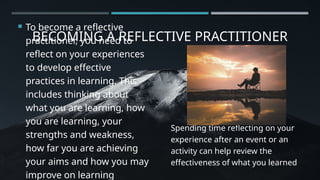
Spending time reflecting on your
experience after an event or an
activity can help review the
effectiveness of what you learned
ALTERED CONSCIOUSNESS
STATES OF ALTERED CONSCIOUSNESS INCLUDE:
 Sleep: Natural cycle with distinct
stages, including REM and non-REM
sleep.
 Dreaming: Occurs primarily during
REM sleep; vivid and often bizarre
experiences.
 Meditation: Focused awareness that
enhances relaxation and alters
perception.
 Hypnosis: Heightened focus and
suggestibility; used in therapy and
relaxation.
 Daydreaming: Mild detachment from
the immediate environment; drifting
 Psychedelic Experiences: Induced by
substances like LSD or psilocybin; intense
sensory and perceptual changes.
 Coma: Severe state of unconsciousness
due to injury or medical conditions.
 Out-of-Body Experience (OBE): Sensation
of being outside one’s physical body.
 Near-Death Experience (NDE): Profound
experience reported by some people who
were close to death.
THINKING TASK:
Think about when
your mind wanders.
See if you can
identify when this
usually happens and
why you think it
happens.
LINKING THE PAST, THE PRESENT AND
THE FURURE
 From present to past-
We can link present
experiences to our past
learning by noticing
similarities, difference
and connections. By
doing this, we can review
our previous learning and
make it stronger.
 From past to future-
We can use our past
experiences to support
our current learning and
understanding of new
events. By reflecting like
this, we can remember,
notice and evaluate our
experiences.
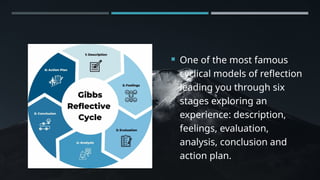
 One of the most famous
cyclical models of reflection
leading you through six
stages exploring an
experience: description,
feelings, evaluation,
analysis, conclusion and
action plan.
SHEIKH ZAYED BIN SULTAN AL NAHYAN
(MAY ALLAH HAVE MERCY UPON HIS SOUL)
 “The present we are
witnessing on this land is a
victory over the suffering
and the cruelty of the past.”
 “He who deos not know his
past cannot make the best of
his future, for it is the from
the past that we learn.”
Reflection and Transition in moral science studies

Reflection and Transition in moral science studies

  • 1.
    REFLECTION AND TRANSITION MADEBY: MUFAZZAL, AHAD, BILAL
  • 2.
    INTRODUCTION  In thislesson we are going to look at the meaning of reflection and explore how examining our experiences and achievements enables us to realise our self-worth.  Understanding and practising reflection techniques helps us to see our achievements and have more pride and professionalism while we move towards to the next stage of our life.
  • 3.
    WHAT IS REFLECTION Describing what you see when you look in a mirror is a self-reflection.  If we go beyond the physical description and think about how we feel, what we do, how we do things and where we do them, this draws out many thoughts and ideas about our experiences. This is called active reflection.  This does not come naturally to everyone but it is a normal activity.
  • 4.
    HOW PEOPLE REFLECT -People often reflect on their daily activities, relationships, jobs, successes, and failures. - Reflection can occur anywhere and anytime (e.g.: while walking, relaxing, bathing, or trying to sleep). - Many view life experiences as isolated - By linking and deriving meaning from experiences, you can: - Boost confidence and motivation. - Increase self-awareness. - Improve academic performance. - Enhance professional skills and advance your career.
  • 5.
    WHY IS REFLECTIONIMPORTANT  1. Enhances self-awareness: Helps individuals understand their thoughts, emotions, and behaviors more deeply.  2. Promotes learning and growth: Encourages critical thinking and the extraction of lessons from experiences.  3. Improves decision-making: Increases the ability to make informed and thoughtful choices.  4. Boosts confidence: Recognizing past achievements builds self-assurance.  5. Facilitates problem-solving: Enables a deeper understanding of challenges and potential solutions.  6. Encourages continuous improvement: Identifying areas for growth leads to ongoing personal and professional development.  7. Strengthens emotional intelligence: Enhances the ability to manage
  • 6.
    THE DIFFERENT ASPECTSOF REFLECTION  1. Self-awareness: Understanding personal thoughts, feelings, and behaviors.  2. Emotional insight: Recognizing and processing emotions tied to experiences.  3. Perspective-taking: Considering other viewpoints or alternative interpretations.  4. Linking experiences: Connecting past experiences to current situations or future  5. Goal setting: Using reflection to define future objectives or areas for growth.  6. Problem-solving: Reflecting on challenges to develop solutions or improvements.  7. Personal growth: Identifying ways to improve or evolve based on reflections.  8. Action planning: Using reflection to guide future actions and decisions.
  • 7.
    REFLECTION IS VALUED Reflection is recognized as an advanced skill guiding thinking, emotions, and actions.  It is valued in education, employment, and everyday life.  Educational institutions encourage students to document reflection for professional development.  Employers view reflection as a transferable skill beneficial to the organization.  A reflective practitioner applies reflection in decision-making and other critical workplace skills.
  • 8.
    CONSIDERING OTHER OPTIONS Reflection is important for learning, both at home and school.  It helps you rethink routines and explore other options.  Example: You wouldn’t revisit a shop with poor service.  Similarly, you wouldn’t choose a university subject if you didn’t enjoy it at school.  Reflection allows you to apply past learning to new situations.  It encourages adjusting present actions based on past experiences.
  • 9.
    BECOMING A REFLECTIVEPRACTITIONER  To become a reflective practitioner, you need to reflect on your experiences to develop effective practices in learning. This includes thinking about what you are learning, how you are learning, your strengths and weakness, how far you are achieving your aims and how you may improve on learning Spending time reflecting on your experience after an event or an activity can help review the effectiveness of what you learned
  • 10.
    ALTERED CONSCIOUSNESS STATES OFALTERED CONSCIOUSNESS INCLUDE:  Sleep: Natural cycle with distinct stages, including REM and non-REM sleep.  Dreaming: Occurs primarily during REM sleep; vivid and often bizarre experiences.  Meditation: Focused awareness that enhances relaxation and alters perception.  Hypnosis: Heightened focus and suggestibility; used in therapy and relaxation.  Daydreaming: Mild detachment from the immediate environment; drifting  Psychedelic Experiences: Induced by substances like LSD or psilocybin; intense sensory and perceptual changes.  Coma: Severe state of unconsciousness due to injury or medical conditions.  Out-of-Body Experience (OBE): Sensation of being outside one’s physical body.  Near-Death Experience (NDE): Profound experience reported by some people who were close to death.
  • 11.
    THINKING TASK: Think aboutwhen your mind wanders. See if you can identify when this usually happens and why you think it happens.
  • 12.
    LINKING THE PAST,THE PRESENT AND THE FURURE  From present to past- We can link present experiences to our past learning by noticing similarities, difference and connections. By doing this, we can review our previous learning and make it stronger.  From past to future- We can use our past experiences to support our current learning and understanding of new events. By reflecting like this, we can remember, notice and evaluate our experiences.
  • 13.
     One ofthe most famous cyclical models of reflection leading you through six stages exploring an experience: description, feelings, evaluation, analysis, conclusion and action plan.
  • 14.
    SHEIKH ZAYED BINSULTAN AL NAHYAN (MAY ALLAH HAVE MERCY UPON HIS SOUL)  “The present we are witnessing on this land is a victory over the suffering and the cruelty of the past.”  “He who deos not know his past cannot make the best of his future, for it is the from the past that we learn.”