Refactoring for Software Architecture Smells: 
Managing Architecture Debt
Ganesh Samarthyam, Corporate Trainer and Author
www.designsmells.com
Agenda
• Introduction &
motivation
• What is architectural
refactoring?
• Case studies in
architectural refactoring
• Challenges in architecture
refactoring
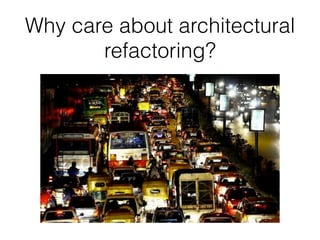
Why care about this topic?
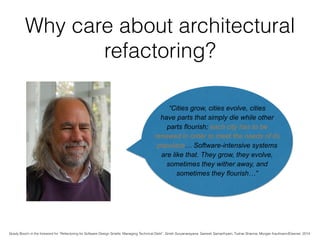
City metaphor
“Cities grow, cities evolve, cities
have parts that simply die while other
parts flourish; each city has to be
renewed in order to meet the needs of its
populace… Software-intensive systems
are like that. They grow, they evolve,
sometimes they wither away, and
sometimes they flourish…”
Grady Booch in the foreword for “Refactoring for Software Design Smells: Managing Technical Debt”, Girish Suryanarayana, Ganesh Samarthyam, Tushar Sharma, Morgan Kaufmann/Elsevier, 2014.
“Infrastructure debt”!
What is technical debt?
When,&due&to&constraints,&I&design&
quickly&and&dirty,&my&project&is&
loaded&with&technical&debt&
What is architecture debt?
…
Architecture)
debt)
Architecture)
smells)
Architecture)
viola2ons)
Design)debt)
Design)smells)
Viola2ons)of)
design)rules)
Test)debt)
Lack)of)tests)
Inadequate)test)
coverage)
Code)debt)
Sta2c)analysis)
tool)viola2ons)
Inconsistent)
coding)style)
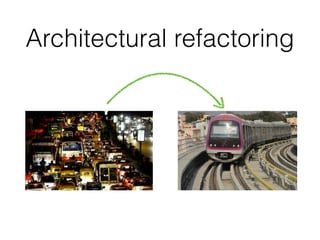
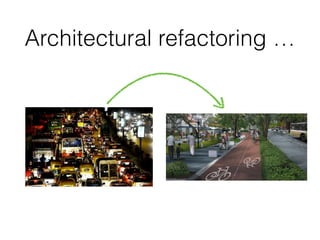
Refactoring a city?
Is this refactoring?
Architecture vs. agility?
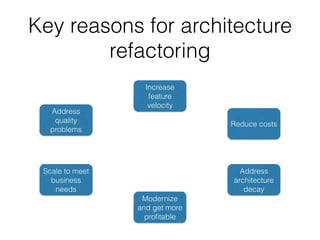
Key reasons for architecture
refactoring
Business
needs
Increase
feature
velocity
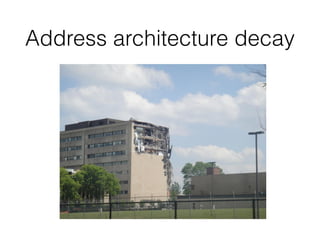
Address
architecture
decay
Realizing
NFRs
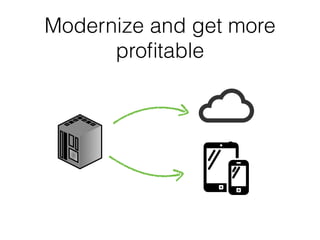
Modernize
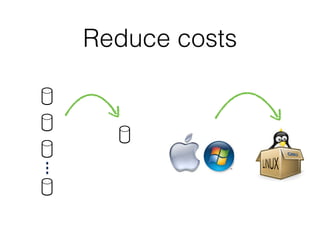
Reduce costs
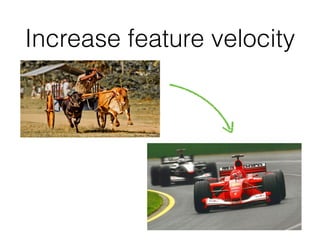
Increase feature velocity
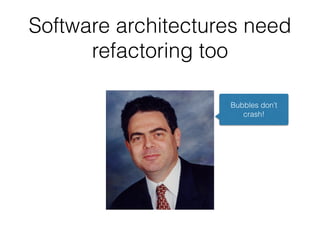
Bubbles don’t
crash!
Address NFRs
Reduce costs
Address architecture decay
Modernize and get more
profitable
What if I don’t do
architecture refactoring?
Agenda
• Introduction & motivation
• What is architectural
refactoring?
• Case studies in
architectural refactoring
• Challenges in architecture
refactoring
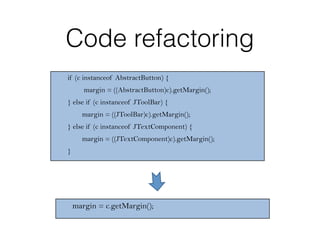
Code refactoring
margin = c.getMargin();
if (c instanceof AbstractButton) {
margin = ((AbstractButton)c).getMargin();
} else if (c instanceof JToolBar) {
margin = ((JToolBar)c).getMargin();
} else if (c instanceof JTextComponent) {
margin = ((JTextComponent)c).getMargin();
}
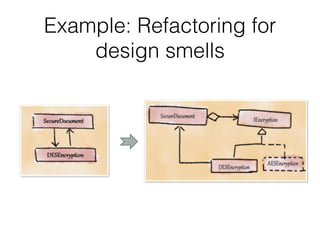
Example: Refactoring for
design smells
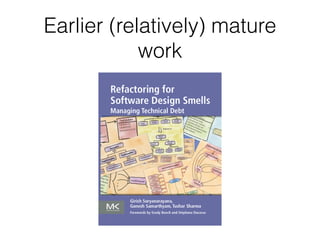
Earlier (relatively) mature
work
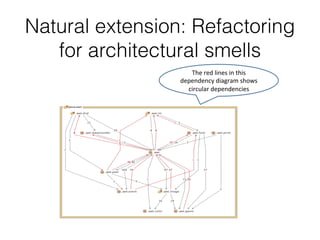
Natural extension: Refactoring
for architectural smells
The$red$lines$in$this$
dependency$diagram$shows$
circular$dependencies$
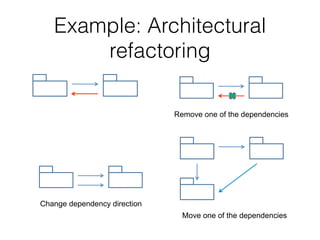
Example: Architectural
refactoring
Remove one of the dependencies
Change dependency direction
Move one of the dependencies
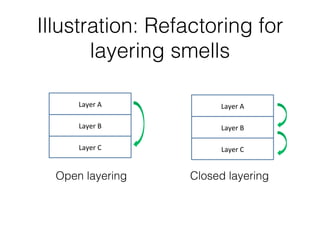
Illustration: Refactoring for
layering smells
Layer&A&
Layer&B&
Layer&C&
Layer&A&
Layer&B&
Layer&C&
Open layering Closed layering
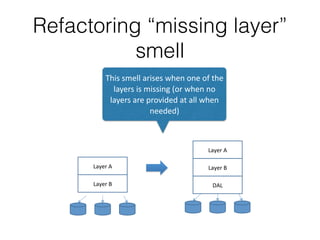
Refactoring “missing layer”
smell
This	
  smell	
  arises	
  when	
  one	
  of	
  the	
  
layers	
  is	
  missing	
  (or	
  when	
  no	
  
layers	
  are	
  provided	
  at	
  all	
  when	
  
needed)	
  
Layer&A&
Layer&B&
DAL&
Layer&A&
Layer&B&
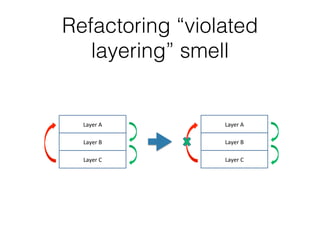
Refactoring “violated
layering” smell
Layer&A&
Layer&B&
Layer&C&
Layer&A&
Layer&B&
Layer&C&
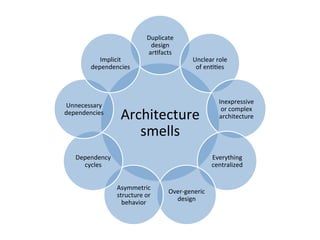
Architecture)
smells)
Duplicate)
design)
ar3facts)
Unclear)role)
of)en33es)
Inexpressive)
or)complex)
architecture)
Everything)
centralized)
Over>generic)
design)
Asymmetric)
structure)or)
behavior)
Dependency)
cycles)
Unnecessary)
dependencies)
Implicit)
dependencies)
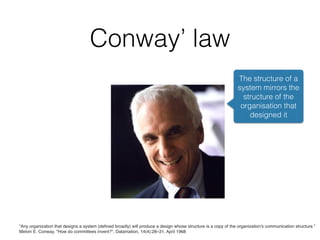
Conway’ law
The structure of a
system mirrors the
structure of the
organisation that
designed it
“Any organization that designs a system (defined broadly) will produce a design whose structure is a copy of the organization's communication structure.”
Melvin E. Conway. "How do committees invent?", Datamation, 14(4):28–31, April 1968
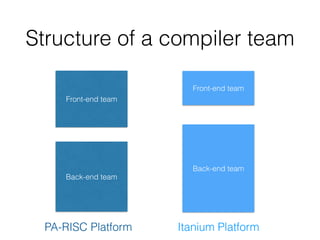
Structure of a compiler team
Front-end team
Back-end team
Front-end team
Back-end team
Platform I Platform 2
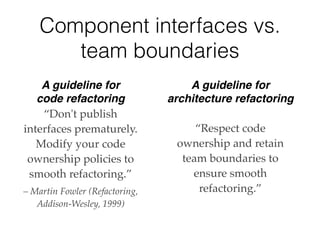
Component interfaces vs.
team boundaries
“Don't publish
interfaces prematurely.
Modify your code
ownership policies to
smooth refactoring.”
– Martin Fowler (Refactoring,
Addison-Wesley, 1999)
A guideline for
code refactoring
A guideline for
architecture refactoring
“Respect code
ownership and retain
team boundaries to
ensure smooth
refactoring.”
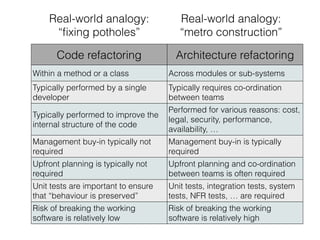
Code refactoring Architecture refactoring
A module-level or class-level concern
A system level concern that cuts across
modules or sub-systems
Impact of refactoring is within a team Impact of refactoring is often across teams
Typically performed to improve the internal
structure of the code
Performed for various reasons: cost, legal,
security, performance, availability, …
Management buy-in typically not required Management buy-in is typically required
Upfront planning is typically (relatively)
limited
Upfront planning and co-ordination
(sometimes between teams) is often required
Unit tests are important to ensure that
“behaviour is preserved”
Unit tests, integration tests, system tests,
NFR tests, … are required
Risk of breaking the working software is
relatively low
Risk of breaking the working software is
relatively high
Real-world analogy:
“fixing potholes”
Real-world analogy:
“metro construction”
Agenda
• Introduction & motivation
• What is architectural
refactoring?
• Case studies in
architectural refactoring
• Challenges in architecture
refactoring
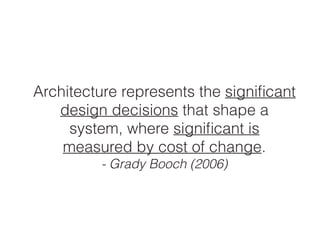
Architecture represents the significant
design decisions that shape a
system, where significant is
measured by cost of change.
- Grady Booch (2006)
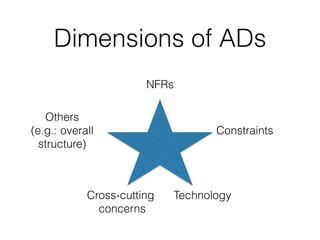
NFRs
Constraints
TechnologyCross-cutting
concerns
Others
(e.g.: overall
structure)
Dimensions of ADs
Case study: Skipping
security layer
Case study: Platform L & F
The example of “how much effort &
time” it requires to provide the feature
to change the color of a button!
Case study: OSS in a
product
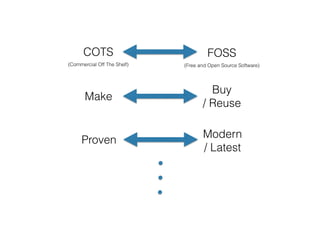
COTS
(Commercial Off The Shelf)
FOSS
(Free and Open Source Software)
Make
Buy
/ Reuse
Proven
Modern
/ Latest
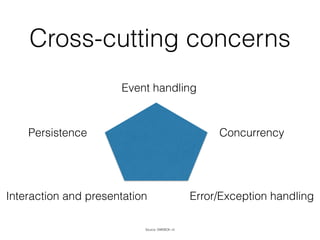
Cross-cutting concerns
Error/Exception handling
ConcurrencyPersistence
Event handling
Interaction and presentation
Source: SWEBOK v3
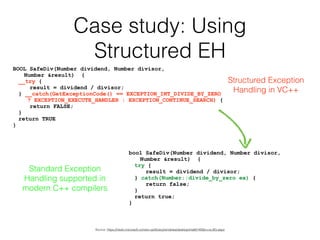
Case study: Using
Structured EH
Source: https://msdn.microsoft.com/en-us/library/windows/desktop/ms681409(v=vs.85).aspx
Structured Exception
Handling in VC++
Standard Exception
Handling supported in
modern C++ compilers
bool SafeDiv(Number dividend, Number divisor,
Number &result) {
try {
result = dividend / divisor;
} catch(Number::divide_by_zero ex) {
return false;
}
return true;
}
BOOL SafeDiv(Number dividend, Number divisor,
Number &result) {
__try {
result = dividend / divisor;
} __catch(GetExceptionCode() == EXCEPTION_INT_DIVIDE_BY_ZERO
? EXCEPTION_EXECUTE_HANDLER : EXCEPTION_CONTINUE_SEARCH) {
return FALSE;
}
return TRUE;
}
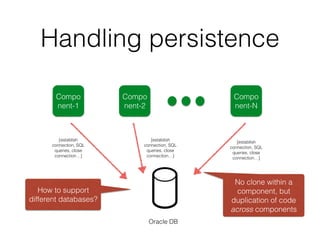
Handling persistence
Oracle DB
Compo
nent-1
Compo
nent-2
Compo
nent-N
[establish
connection, SQL
queries, close
connection…]
No clone within a
component, but
duplication of code
across components
How to support
different databases?
[establish
connection, SQL
queries, close
connection…]
[establish
connection, SQL
queries, close
connection…]
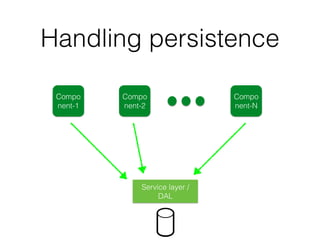
Handling persistence
Compo
nent-1
Compo
nent-2
Compo
nent-N
Service layer /
DAL
Agenda
• Introduction & motivation
• What is architectural
refactoring?
• Case studies in
architectural refactoring
• Challenges in
architecture refactoring
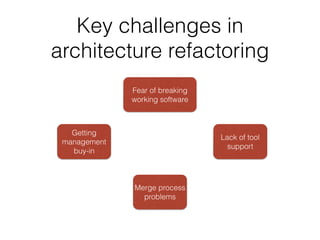
Key challenges in
architecture refactoring
Getting
management
buy-in
Fear of breaking
working software
Lack of tool
support
Merge process
problems
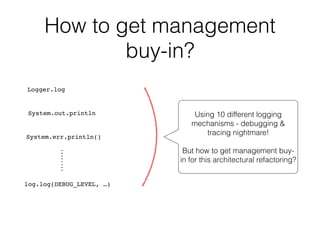
How to get management
buy-in?
logger.severe(“details”)
errlog.log(“details”)logger.error(“details”)
System.err.println(“details”)
Since ROI (Return On Investment)
is not clear, how to get
management buy-in for this
architectural refactoring?
Log4j java.util.logging custom log library SOPs
Dealing with the fear of
“breaking the working software”
Module 1 Module 2 Module N
How to validate architectural
refactoring changes?
Currently through architecture, design, and code reviews
+ running system, integration, and unit tests =>
Can still break the working software!
Lack of tool support
Unlike code refactoring, most
architectural refactoring is manual
due to lack of tool support!
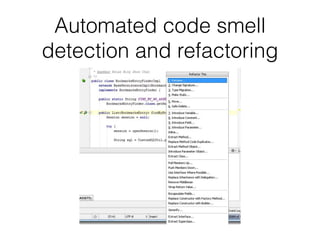
Automated code smell
detection and refactoring
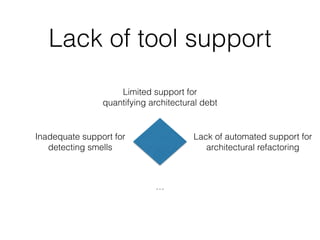
Lack of tool support
Lack of automated support for
architectural refactoring
Inadequate support for
detecting smells
Limited support for
quantifying architectural debt
…
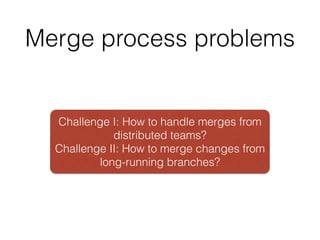
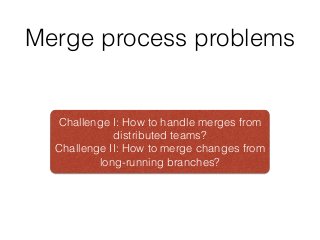
Merge process problems
Challenge I: How to handle merges from
distributed teams?
Challenge II: How to merge changes from
long-running branches?
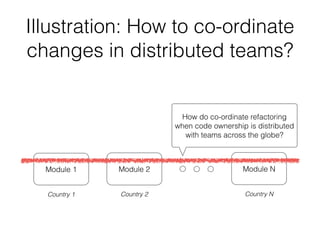
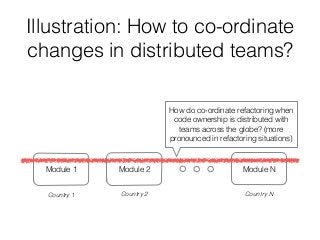
Illustration: How to co-ordinate
changes in distributed teams?
Module 1
Country 1
Module 2
Country 2
Module N
Country N
How do co-ordinate refactoring when
code ownership is distributed with
teams across the globe? (more
pronounced in refactoring situations)
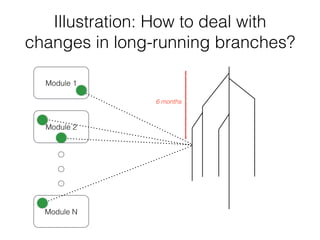
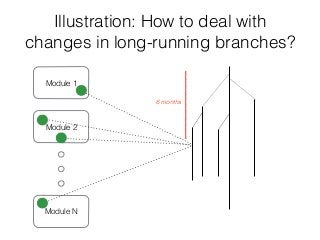
Illustration: How to deal with
changes in long-running branches?
Module 1
Module 2
Module N
6 months
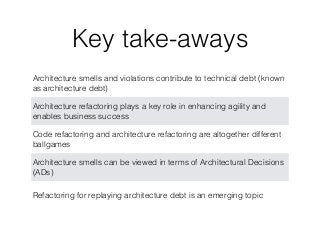
Key take-aways
Architecture smells and violations contribute to technical debt (known
as architecture debt)
Architecture refactoring plays a key role in enhancing agility and
enables business success
Code refactoring and architecture refactoring are altogether different
ballgames
Architecture smells can be viewed in terms of Architectural Decisions
(ADs)
Refactoring for replaying architecture debt is an emerging topic
Image credits
• http://sustainablecitiescollective.com/pratik-dave/244831/bangalore-exclusive-metro-india-having-profit-making-public-
transport-system
• http://www.medsoftwaresys.com/mss/wp-content/uploads/2012/04/reengineering.png
• http://topnews.in/files/Bangalore-Metro-Rail-Corporation-Ltd.jpg
• https://www.itdp.org/wp-content/uploads/2014/07/Chennai-Rendering.jpg
• http://www.vectors4all.net/preview/database-clip-art.jpg
• http://static.planetminecraft.com/files/resource_media/screenshot/1231/Windows-Vs-Mac_3072108.jpg
• http://manuel.midoriparadise.com/public_html/icons/linux-icon.png
• http://mortalpowers.com/posse/1280x1280/0DSC03205.JPG
• http://images.clipartpanda.com/server-computer-clipart-1216179635943364667jcartier_central_computer_1.svg.hi.png
• http://images.clipartpanda.com/cloud-icon-png-clouds.png
• http://www.clipartbest.com/cliparts/dc6/M5L/dc6M5LBc9.jpeg
• http://cdn.ttgtmedia.com/rms/computerweekly/refactor.jpg
• http://yellowairplane.com/Adventures/Falkland_Islands_War_Guestbook/Falkands_War_Malvinas_War_Photos/
Jet_Fighter_Mirage_2000_Takeoff_Argentina.jpg
Refactoring for Software Architecture Smells

Refactoring for Software Architecture Smells

  • 1.
    Refactoring for SoftwareArchitecture Smells:  Managing Architecture Debt Ganesh Samarthyam, Corporate Trainer and Author www.designsmells.com
  • 2.
    Agenda • Introduction & motivation •What is architectural refactoring? • Case studies in architectural refactoring • Challenges in architecture refactoring
  • 3.
    Why care aboutthis topic?
  • 4.
    City metaphor “Cities grow,cities evolve, cities have parts that simply die while other parts flourish; each city has to be renewed in order to meet the needs of its populace… Software-intensive systems are like that. They grow, they evolve, sometimes they wither away, and sometimes they flourish…” Grady Booch in the foreword for “Refactoring for Software Design Smells: Managing Technical Debt”, Girish Suryanarayana, Ganesh Samarthyam, Tushar Sharma, Morgan Kaufmann/Elsevier, 2014.
  • 5.
  • 6.
    What is technicaldebt? When,&due&to&constraints,&I&design& quickly&and&dirty,&my&project&is& loaded&with&technical&debt&
  • 7.
    What is architecturedebt? … Architecture) debt) Architecture) smells) Architecture) viola2ons) Design)debt) Design)smells) Viola2ons)of) design)rules) Test)debt) Lack)of)tests) Inadequate)test) coverage) Code)debt) Sta2c)analysis) tool)viola2ons) Inconsistent) coding)style)
  • 8.
  • 9.
  • 10.
  • 11.
    Key reasons forarchitecture refactoring Business needs Increase feature velocity Address architecture decay Realizing NFRs Modernize Reduce costs
  • 12.
  • 13.
  • 14.
  • 15.
  • 16.
    Modernize and getmore profitable
  • 17.
    What if Idon’t do architecture refactoring?
  • 18.
    Agenda • Introduction &motivation • What is architectural refactoring? • Case studies in architectural refactoring • Challenges in architecture refactoring
  • 19.
    Code refactoring margin =c.getMargin(); if (c instanceof AbstractButton) { margin = ((AbstractButton)c).getMargin(); } else if (c instanceof JToolBar) { margin = ((JToolBar)c).getMargin(); } else if (c instanceof JTextComponent) { margin = ((JTextComponent)c).getMargin(); }
  • 20.
  • 21.
  • 22.
    Natural extension: Refactoring forarchitectural smells The$red$lines$in$this$ dependency$diagram$shows$ circular$dependencies$
  • 23.
    Example: Architectural refactoring Remove oneof the dependencies Change dependency direction Move one of the dependencies
  • 24.
    Illustration: Refactoring for layeringsmells Layer&A& Layer&B& Layer&C& Layer&A& Layer&B& Layer&C& Open layering Closed layering
  • 25.
    Refactoring “missing layer” smell This  smell  arises  when  one  of  the   layers  is  missing  (or  when  no   layers  are  provided  at  all  when   needed)   Layer&A& Layer&B& DAL& Layer&A& Layer&B&
  • 26.
  • 27.
  • 28.
    Conway’ law The structureof a system mirrors the structure of the organisation that designed it “Any organization that designs a system (defined broadly) will produce a design whose structure is a copy of the organization's communication structure.” Melvin E. Conway. "How do committees invent?", Datamation, 14(4):28–31, April 1968
  • 29.
    Structure of acompiler team Front-end team Back-end team Front-end team Back-end team Platform I Platform 2
  • 30.
    Component interfaces vs. teamboundaries “Don't publish interfaces prematurely. Modify your code ownership policies to smooth refactoring.” – Martin Fowler (Refactoring, Addison-Wesley, 1999) A guideline for code refactoring A guideline for architecture refactoring “Respect code ownership and retain team boundaries to ensure smooth refactoring.”
  • 31.
    Code refactoring Architecturerefactoring A module-level or class-level concern A system level concern that cuts across modules or sub-systems Impact of refactoring is within a team Impact of refactoring is often across teams Typically performed to improve the internal structure of the code Performed for various reasons: cost, legal, security, performance, availability, … Management buy-in typically not required Management buy-in is typically required Upfront planning is typically (relatively) limited Upfront planning and co-ordination (sometimes between teams) is often required Unit tests are important to ensure that “behaviour is preserved” Unit tests, integration tests, system tests, NFR tests, … are required Risk of breaking the working software is relatively low Risk of breaking the working software is relatively high Real-world analogy: “fixing potholes” Real-world analogy: “metro construction”
  • 32.
    Agenda • Introduction &motivation • What is architectural refactoring? • Case studies in architectural refactoring • Challenges in architecture refactoring
  • 33.
    Architecture represents thesignificant design decisions that shape a system, where significant is measured by cost of change. - Grady Booch (2006)
  • 34.
  • 35.
  • 36.
    Case study: PlatformL & F The example of “how much effort & time” it requires to provide the feature to change the color of a button!
  • 37.
    Case study: OSSin a product
  • 38.
    COTS (Commercial Off TheShelf) FOSS (Free and Open Source Software) Make Buy / Reuse Proven Modern / Latest
  • 39.
    Cross-cutting concerns Error/Exception handling ConcurrencyPersistence Eventhandling Interaction and presentation Source: SWEBOK v3
  • 40.
    Case study: Using StructuredEH Source: https://msdn.microsoft.com/en-us/library/windows/desktop/ms681409(v=vs.85).aspx Structured Exception Handling in VC++ Standard Exception Handling supported in modern C++ compilers bool SafeDiv(Number dividend, Number divisor, Number &result) { try { result = dividend / divisor; } catch(Number::divide_by_zero ex) { return false; } return true; } BOOL SafeDiv(Number dividend, Number divisor, Number &result) { __try { result = dividend / divisor; } __catch(GetExceptionCode() == EXCEPTION_INT_DIVIDE_BY_ZERO ? EXCEPTION_EXECUTE_HANDLER : EXCEPTION_CONTINUE_SEARCH) { return FALSE; } return TRUE; }
  • 41.
    Handling persistence Oracle DB Compo nent-1 Compo nent-2 Compo nent-N [establish connection,SQL queries, close connection…] No clone within a component, but duplication of code across components How to support different databases? [establish connection, SQL queries, close connection…] [establish connection, SQL queries, close connection…]
  • 42.
  • 43.
    Agenda • Introduction &motivation • What is architectural refactoring? • Case studies in architectural refactoring • Challenges in architecture refactoring
  • 44.
    Key challenges in architecturerefactoring Getting management buy-in Fear of breaking working software Lack of tool support Merge process problems
  • 45.
    How to getmanagement buy-in? logger.severe(“details”) errlog.log(“details”)logger.error(“details”) System.err.println(“details”) Since ROI (Return On Investment) is not clear, how to get management buy-in for this architectural refactoring? Log4j java.util.logging custom log library SOPs
  • 46.
    Dealing with thefear of “breaking the working software” Module 1 Module 2 Module N How to validate architectural refactoring changes? Currently through architecture, design, and code reviews + running system, integration, and unit tests => Can still break the working software!
  • 47.
    Lack of toolsupport Unlike code refactoring, most architectural refactoring is manual due to lack of tool support!
  • 48.
  • 49.
    Lack of toolsupport Lack of automated support for architectural refactoring Inadequate support for detecting smells Limited support for quantifying architectural debt …
  • 50.
    Merge process problems ChallengeI: How to handle merges from distributed teams? Challenge II: How to merge changes from long-running branches?
  • 51.
    Illustration: How toco-ordinate changes in distributed teams? Module 1 Country 1 Module 2 Country 2 Module N Country N How do co-ordinate refactoring when code ownership is distributed with teams across the globe? (more pronounced in refactoring situations)
  • 52.
    Illustration: How todeal with changes in long-running branches? Module 1 Module 2 Module N 6 months
  • 53.
    Key take-aways Architecture smellsand violations contribute to technical debt (known as architecture debt) Architecture refactoring plays a key role in enhancing agility and enables business success Code refactoring and architecture refactoring are altogether different ballgames Architecture smells can be viewed in terms of Architectural Decisions (ADs) Refactoring for replaying architecture debt is an emerging topic
  • 54.
    Image credits • http://sustainablecitiescollective.com/pratik-dave/244831/bangalore-exclusive-metro-india-having-profit-making-public- transport-system •http://www.medsoftwaresys.com/mss/wp-content/uploads/2012/04/reengineering.png • http://topnews.in/files/Bangalore-Metro-Rail-Corporation-Ltd.jpg • https://www.itdp.org/wp-content/uploads/2014/07/Chennai-Rendering.jpg • http://www.vectors4all.net/preview/database-clip-art.jpg • http://static.planetminecraft.com/files/resource_media/screenshot/1231/Windows-Vs-Mac_3072108.jpg • http://manuel.midoriparadise.com/public_html/icons/linux-icon.png • http://mortalpowers.com/posse/1280x1280/0DSC03205.JPG • http://images.clipartpanda.com/server-computer-clipart-1216179635943364667jcartier_central_computer_1.svg.hi.png • http://images.clipartpanda.com/cloud-icon-png-clouds.png • http://www.clipartbest.com/cliparts/dc6/M5L/dc6M5LBc9.jpeg • http://cdn.ttgtmedia.com/rms/computerweekly/refactor.jpg • http://yellowairplane.com/Adventures/Falkland_Islands_War_Guestbook/Falkands_War_Malvinas_War_Photos/ Jet_Fighter_Mirage_2000_Takeoff_Argentina.jpg