Reduce Energy Costs by
Increasing Efficiency & Awareness


                        Presented by:
Today’s Speakers

 ►Kathryn Ward
  Applications Engineer, SchoolDude
 ►Martha Harmon
  Marketing Manager, SchoolDude

 ► Britney Thompson
  Energy and Sustainability
  Manager, Fayette County Public
  Schools, KY
The Rising Cost of Energy

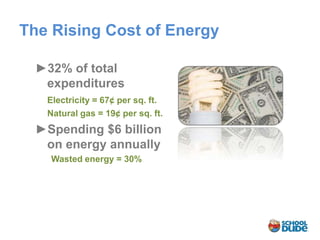
  ►32% of total
   expenditures
   Electricity = 67¢ per sq. ft.
   Natural gas = 19¢ per sq. ft.
  ►Spending $6 billion
   on energy annually
    Wasted energy = 30%
Energy Use in Schools


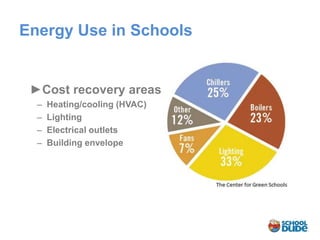
 ►Cost recovery areas
  ̶ Heating/cooling (HVAC)
   ̶ Lighting
    ̶ Electrical outlets
     ̶ Building envelope
Improve Efficiency, Reduce Costs

  ►Controllable costs in schools
      16% = Energy
  ► Cost-cutting strategies
      – Energy conservation programs
      – Heating and cooling use
      – Improving maintenance and PM
Establish a Baseline


  ►Track usage
    ̶ Inventory and observe utility consumption
     ̶ Record bills, meter readings and use data
      ̶ Identify poor performing buildings
       ̶ Analyze usage patterns and trends
Set Goals and Take Action


  ►Get to work
    ̶ Create performance targets
   ̶ Set completion timelines
     ̶ Establish a tracking system
      ̶ Assign roles and allocate resources
       ̶ Train technicians and staff
        ̶ Monitor progress
Create Awareness


  ►Speak up
   ̶ Develop communication plan
    ̶ Create incentive and rewards programs
     ̶ Involve students, teachers and staff
      ̶ Present program status to administration
       ̶ Share success through local and online media
Commit to Improving Energy
Management
►Establish a Baseline
►Set Goals and Take Action
►Create Awareness, Inspire & Motivate
                … conserve energy and
                  reduce utility costs

Creating more resources for better schools.
Success Story


►Britney Thompson
    Energy and Sustainability Manager
►Fayette County Public Schools
    Lexington, KY
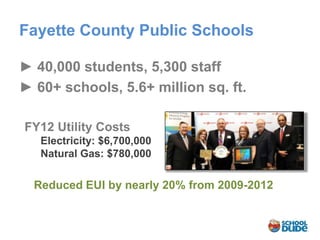
Fayette County Public Schools

► 40,000 students, 5,300 staff
► 60+ schools, 5.6+ million sq. ft.

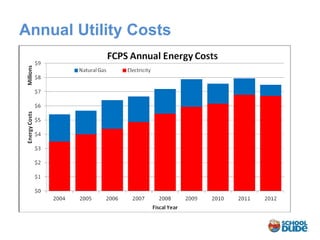
FY12 Utility Costs
   Electricity: $6,700,000
   Natural Gas: $780,000

  Reduced EUI by nearly 20% from 2009-2012
Challenges

► Accurate tracking of utility data over time
► Data to identify potential savings
► Utility consumption and cost data
► Establish baselines to benchmark
  buildings
► Buy-in for conservation program
Solution – UtilityDirect

    ► One reliable, central location for
      tracking and accessing utility data
         ̶ Multiple utilities and years
          ̶ Easy access to info for each school
           ̶ Web-based solution – anywhere/anytime
            access

    ► Dynamic reports
         ̶ Quick and easy to generate
          ̶ Identify problems and savings opportunities
           ̶ Baselines and analysis
            ̶ Measure conservation efforts
             ̶ Share info on use, costs and trends
Annual Utility Costs
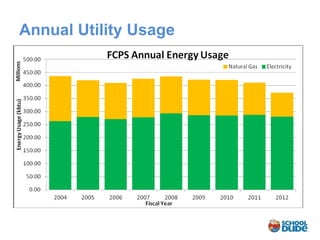
Annual Utility Usage
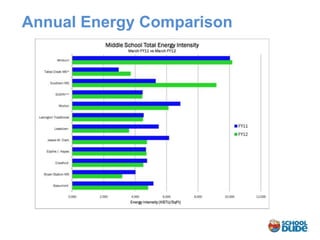
Annual Energy Comparison
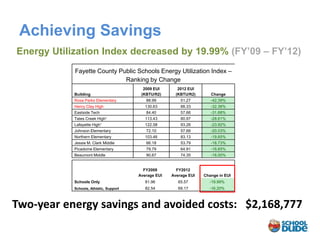
Achieving Savings
Energy Utilization Index decreased by 19.99% (FY’09 – FY’12)
            Fayette County Public Schools Energy Utilization Index –
                             Ranking by Change
                                           2009 EUI       2012 EUI
            Building                      (KBTU/ft2)     (KBTU/ft2)      Change
            Rosa Parks Elementary           88.99          51.27         -42.39%
            Henry Clay High                 130.63         88.33         -32.38%
            Eastside Tech                   84.40          57.66         -31.68%
            Tates Creek High¹               113.43         80.97         -28.61%
            Lafayette High¹                 122.58         93.26         -23.92%
            Johnson Elementary              72.10          57.66         -20.03%
            Northern Elementary             103.46         83.13         -19.65%
            Jessie M. Clark Middle          66.18          53.79         -18.73%
            Picadome Elementary             79.79          64.91         -18.65%
            Beaumont Middle                 90.67          74.35         -18.00%


                                           FY2009        FY2012
                                         Average EUI   Average EUI    Change in EUI
            Schools Only                    81.96         65.57         -19.99%
            Schools, Athletic, Support      82.54         69.17         -16.20%


Two-year energy savings and avoided costs: $2,168,777
Achieving Success

► Two-pronged team approach
    ►Britney Thompson
       Energy monitoring, data analysis and other technical areas
    ►Tresine Logsdon
       E=USE2 and other curriculum
       Student energy teams
► Involve students, teachers, community members
    Public, read-only log-in allows them to learn more about school
       energy data
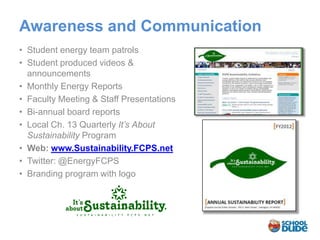
Awareness and Communication
• Student energy team patrols
• Student produced videos &
  announcements
• Monthly Energy Reports
• Faculty Meeting & Staff Presentations
• Bi-annual board reports
• Local Ch. 13 Quarterly It’s About
  Sustainability Program
• Web: www.Sustainability.FCPS.net
• Twitter: @EnergyFCPS
• Branding program with logo
Achieving More Value and Savings

• Integration with ConserveDirect
  – Automatically sends UtilityDirect data into
    ENERGY STAR Portfolio Manager account
  – Prevents manual re-entry of data
  – Effectively generating and managing ENERGY
    STAR ratings
• Also using MaintenanceDirect (work
  orders), PMDirect (preventive maintenance)
  and FSDirect (community facility use
  scheduling)
Contact
 ► Britney Thompson
   Energy and Sustainability Manager
   Fayette County Schools, KY
   britney.thompson@fayette.kyschools.us

 ► Kathryn Ward
   Applications Engineer – SchoolDude
   kathryn@schooldude.com
   1-877-868-3833
 ► Martha Harmon
   Marketing Manager – SchoolDude
   martha@schooldude.com
   1-877-868-3833
Thank You


► Additional energy resources
    www.schooldude.com/resources
      12 Steps Forward to Reducing Energy
      Energy Cost Calculator
      Sample Energy Policy

►For more SchoolDude product information
  www.schooldude.com/suites/energy-management/
     Request a demo: salesrequest@schooldude.com


Dial 1-866-740-1260 and enter 1103367# for audio

Reduce Energy Costs by Increasing Efficiency & Awareness

  • 1.
    Reduce Energy Costsby Increasing Efficiency & Awareness Presented by:
  • 2.
    Today’s Speakers ►KathrynWard Applications Engineer, SchoolDude ►Martha Harmon Marketing Manager, SchoolDude ► Britney Thompson Energy and Sustainability Manager, Fayette County Public Schools, KY
  • 3.
    The Rising Costof Energy ►32% of total expenditures Electricity = 67¢ per sq. ft. Natural gas = 19¢ per sq. ft. ►Spending $6 billion on energy annually Wasted energy = 30%
  • 4.
    Energy Use inSchools ►Cost recovery areas ̶ Heating/cooling (HVAC) ̶ Lighting ̶ Electrical outlets ̶ Building envelope
  • 5.
    Improve Efficiency, ReduceCosts ►Controllable costs in schools 16% = Energy ► Cost-cutting strategies – Energy conservation programs – Heating and cooling use – Improving maintenance and PM
  • 6.
    Establish a Baseline ►Track usage ̶ Inventory and observe utility consumption ̶ Record bills, meter readings and use data ̶ Identify poor performing buildings ̶ Analyze usage patterns and trends
  • 7.
    Set Goals andTake Action ►Get to work ̶ Create performance targets ̶ Set completion timelines ̶ Establish a tracking system ̶ Assign roles and allocate resources ̶ Train technicians and staff ̶ Monitor progress
  • 8.
    Create Awareness ►Speak up ̶ Develop communication plan ̶ Create incentive and rewards programs ̶ Involve students, teachers and staff ̶ Present program status to administration ̶ Share success through local and online media
  • 9.
    Commit to ImprovingEnergy Management ►Establish a Baseline ►Set Goals and Take Action ►Create Awareness, Inspire & Motivate … conserve energy and reduce utility costs Creating more resources for better schools.
  • 10.
    Success Story ►Britney Thompson Energy and Sustainability Manager ►Fayette County Public Schools Lexington, KY
  • 11.
    Fayette County PublicSchools ► 40,000 students, 5,300 staff ► 60+ schools, 5.6+ million sq. ft. FY12 Utility Costs Electricity: $6,700,000 Natural Gas: $780,000 Reduced EUI by nearly 20% from 2009-2012
  • 12.
    Challenges ► Accurate trackingof utility data over time ► Data to identify potential savings ► Utility consumption and cost data ► Establish baselines to benchmark buildings ► Buy-in for conservation program
  • 13.
    Solution – UtilityDirect ► One reliable, central location for tracking and accessing utility data ̶ Multiple utilities and years ̶ Easy access to info for each school ̶ Web-based solution – anywhere/anytime access ► Dynamic reports ̶ Quick and easy to generate ̶ Identify problems and savings opportunities ̶ Baselines and analysis ̶ Measure conservation efforts ̶ Share info on use, costs and trends
  • 14.
  • 15.
  • 16.
  • 17.
    Achieving Savings Energy UtilizationIndex decreased by 19.99% (FY’09 – FY’12) Fayette County Public Schools Energy Utilization Index – Ranking by Change 2009 EUI 2012 EUI Building (KBTU/ft2) (KBTU/ft2) Change Rosa Parks Elementary 88.99 51.27 -42.39% Henry Clay High 130.63 88.33 -32.38% Eastside Tech 84.40 57.66 -31.68% Tates Creek High¹ 113.43 80.97 -28.61% Lafayette High¹ 122.58 93.26 -23.92% Johnson Elementary 72.10 57.66 -20.03% Northern Elementary 103.46 83.13 -19.65% Jessie M. Clark Middle 66.18 53.79 -18.73% Picadome Elementary 79.79 64.91 -18.65% Beaumont Middle 90.67 74.35 -18.00% FY2009 FY2012 Average EUI Average EUI Change in EUI Schools Only 81.96 65.57 -19.99% Schools, Athletic, Support 82.54 69.17 -16.20% Two-year energy savings and avoided costs: $2,168,777
  • 18.
    Achieving Success ► Two-prongedteam approach ►Britney Thompson Energy monitoring, data analysis and other technical areas ►Tresine Logsdon E=USE2 and other curriculum Student energy teams ► Involve students, teachers, community members Public, read-only log-in allows them to learn more about school energy data
  • 19.
    Awareness and Communication •Student energy team patrols • Student produced videos & announcements • Monthly Energy Reports • Faculty Meeting & Staff Presentations • Bi-annual board reports • Local Ch. 13 Quarterly It’s About Sustainability Program • Web: www.Sustainability.FCPS.net • Twitter: @EnergyFCPS • Branding program with logo
  • 20.
    Achieving More Valueand Savings • Integration with ConserveDirect – Automatically sends UtilityDirect data into ENERGY STAR Portfolio Manager account – Prevents manual re-entry of data – Effectively generating and managing ENERGY STAR ratings • Also using MaintenanceDirect (work orders), PMDirect (preventive maintenance) and FSDirect (community facility use scheduling)
  • 21.
    Contact ► BritneyThompson Energy and Sustainability Manager Fayette County Schools, KY britney.thompson@fayette.kyschools.us ► Kathryn Ward Applications Engineer – SchoolDude kathryn@schooldude.com 1-877-868-3833 ► Martha Harmon Marketing Manager – SchoolDude martha@schooldude.com 1-877-868-3833
  • 22.
    Thank You ► Additionalenergy resources www.schooldude.com/resources 12 Steps Forward to Reducing Energy Energy Cost Calculator Sample Energy Policy ►For more SchoolDude product information www.schooldude.com/suites/energy-management/ Request a demo: salesrequest@schooldude.com Dial 1-866-740-1260 and enter 1103367# for audio

Editor's Notes

  • #4 In the last decade, energy costs have steadily increased as natural resources are heavily utilized. Coupled with unpredictable weather and foreign affairs, energy costs from year to year are often in flux - presenting a challenge for educational officials who are trying to minimize costs while also dealing with strained budgets. Energy accounts for a significant 32 percent of your spending – the 2nd largest portion of your budget – with the more than 75 percent of your total energy use coming from lighting, space heating, and water heating.According to ENERGY STAR, America’s schools in total spend an average of $6 billion on energy – with an overwhelming 30 percent of that usage actually being inefficient or even unnecessary (http://www.energystar.gov/ia/business/challenge/learn_more/Schools.pdf)Although better managing energy costs can seemoverwhelming, there is tremendous opportunity for you to save money by improving efficiency with no cost and low cost steps that successfully decrease usage.
  • #5 Depending on facility size and climate, the average annual energy cost for a school building is about $200,000 according to the Center for Green Schools, with the majority of spending – and the biggest opportunity for savings – around HVAC at a combined 48 percent. Lighting presents the 2nd best area of focus for reducing energy consumption and achieving greater cost-savings.(http://www.centerforgreenschools.org/Libraries/Resources_Documents/energy_efficiency_strategies_for_schools.sflb.ashx)
  • #6 With energy expenses accounting for 16% of your educational organization’s controllable costs, you have a significant opportunity to create savings with better management and improved energy awareness. In a recent survey, educational administrators revealed that their top cost-cutting strategies included reducing energy use with conservation incentives and initiatives, as well as reducing unnecessary HVAC usage. Energy efficiency can also be improved through effective maintenance management, including a preventive maintenance program, as excess energy use is often a result of aging buildings, inefficientsystems and poorly maintained or neglected equipment.(http://apps1.eere.energy.gov/buildings/publications/pdfs/energysmartschools/ess_o-and-m-guide.pdf)
  • #7 The first step to improving your organization’s energy efficiency is to implement a process for tracking usage and measuring buildingperformance. Analyzing usage and costs provides insight into your consumption patterns, identifying any trends or spikes in usage, as well as enablingyou to compare usage between similar buildings and year over year to uncover inefficiencies and savings opportunities.
  • #8 Once you have a clear understanding of your organization’s energy performance, you can begin to set goals to reduce consumption with a conservation program. You can also achieve savings by improving your maintenance and PM programs and identifying projects that increase energy efficiency in underperforming building.Establishing goals for reducing energy usewill also help drive these efficiency-focused activities, as well as provide a benchmark for measuring success and progress.
  • #9 Increasing energy efficiency is also heavily dependent on education and accountability, including improving awareness, changing behaviors and perceptions of your students, teachers, staff, and administration - and even the surrounding community.Communicate your goals, milestones, and achievements both internally and externally to inspire and motivate all your stakeholders. You can organize incentive or reward programs to get everyone involved, as well as create and share progress reports. (http://www.centerforgreenschools.org/Libraries/Resources_Documents/energy_efficiency_strategies_for_schools.sflb.ashx)
  • #10 Making a commitment to implementing an energy conservation program – through improved tracking, developing goals and action plans, and sharing goals and results – can really help you make a difference in reducing usage and costs. The US Department of Energy estimates that savings of 10-15% can be achieved just by increasing awareness, while improving maintenance and PM can help you save another 5-20%.Through a commitment to high performance, an energy efficient educational organization with 4,000 students can save as much as $160,000 a year in energy costs. In 10 years, those annual savings can grow to $1.6 million, allowing for more resources to be dedicated to further enhancing the teaching and learning environment. (http://apps1.eere.energy.gov/buildings/publications/pdfs/energysmartschools/ess_o-and-m-guide.pdf)
  • #11 Britney has been with the district and in this role since July 2010. She enjoys that her responsibility for tracking utility information and improving energy efficiency, which always brings new opportunities to identify savings.