Stephanie Hernandez
Dr. Matthew Bird
Nick Bonura
Plotting Relative Redox Potentials in
THF without Electrolyte
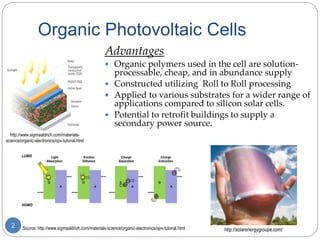
Organic Photovoltaic Cells
Advantages
 Organic polymers used in the cell are solution-
processable, cheap, and in abundance supply
 Constructed utilizing Roll to Roll processing
 Applied to various substrates for a wider range of
applications compared to silicon solar cells.
 Potential to retrofit buildings to supply a
secondary power source.
Source: http://www.sigmaaldrich.com/materials-science/organic-electronics/opv-tutorial.html2
http://www.sigmaaldrich.com/materials-
science/organic-electronics/opv-tutorial.html
http://solarenergygroupe.com/
Source: http://www.sigmaaldrich.com/materials-science/organic-electronics/opv-tutorial.html
Organic Photovoltaic Cells
3
http://www.sigmaaldrich.com/materials-
science/organic-electronics/opv-tutorial.html
http://solarenergygroupe.com/
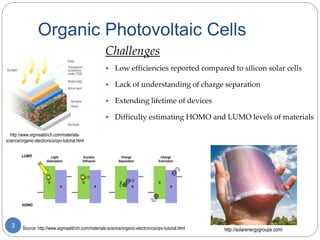
Challenges
 Low efficiencies reported compared to silicon solar cells
 Lack of understanding of charge separation
 Extending lifetime of devices
 Difficulty estimating HOMO and LUMO levels of materials
4
Purpose
To avoid propagation uncertainties in results and further aid
investigation into OPV devices by providing redox potentials of
polymers and small molecules in THF without electrolyte.
Objectives
 Develop a redox ladder using pulse radiolysis results from various
donor-acceptor solutions in THF
 Test a fit function for the change in electron transfer equilibrium
 Test several polymers studies by the OPV community for redox values
5
PCPDTBT
[TBAPF6]
CoCp2 0/+
*Information on the reduction potentials in 0.1M [TBAPF6] in THF was taken from another experiment
Creating the Ladder
p-NBz
5
[TBAPF6]
CoCp2 0/+
p-NBz
My experiment: Fill in the redox
ladder from 1,4-Dinitrobenzene
(p-NBz) to the solvated electron.
Nick’s experiment:
Test the fit function against
Cobaltocenium (CoCp2) and
p-NBz, while determining the
oxidation/reduction values.
*Information on the reduction potentials in 0.1M [TBAPF6] in THF was taken from another experiment
Creating the Ladder
PCPDTBT
6
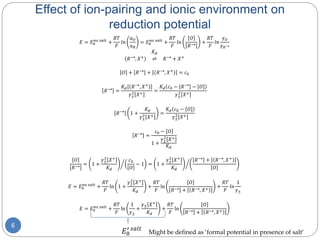
𝐸 = 𝐸0
𝑛𝑜 𝑠𝑎𝑙𝑡
+
𝑅𝑇
𝐹
𝑙𝑛
𝑎 𝑂
𝑎 𝑅
= 𝐸0
𝑛𝑜 𝑠𝑎𝑙𝑡
+
𝑅𝑇
𝐹
𝑙𝑛
𝑂
𝑅−•
+
𝑅𝑇
𝐹
𝑙𝑛
𝛾 𝑂
𝛾 𝑅−•
𝐾 𝑑
𝑅−•
, 𝑋+
⇌ 𝑅−•
+ 𝑋+
𝑂 + 𝑅−•
+ 𝑅−•
, 𝑋+
= 𝑐0
𝑅−•
=
𝐾 𝑑 𝑅−•
, 𝑋+
𝛾±
2
𝑋+
=
𝐾 𝑑 𝑐0 − 𝑅−•
− 𝑂
𝛾±
2
𝑋+
𝑅−•
1 +
𝐾 𝑑
𝛾±
2
𝑋+
=
𝐾 𝑑 𝑐0 − 𝑂
𝛾±
2
𝑋+
𝑅−•
=
𝑐0 − 𝑂
1 +
𝛾±
2
𝑋+
𝐾 𝑑
𝑂
𝑅−•
= 1 +
𝛾±
2
𝑋+
𝐾 𝑑
𝑐0
𝑂
− 1 = 1 +
𝛾±
2
𝑋+
𝐾 𝑑
𝑅−•
+ 𝑅−•
, 𝑋+
𝑂
𝐸 = 𝐸0
𝑛𝑜 𝑠𝑎𝑙𝑡
+
𝑅𝑇
𝐹
ln 1 +
𝛾±
2
𝑋+
𝐾 𝑑
+
𝑅𝑇
𝐹
ln
𝑂
𝑅−• + 𝑅−•, 𝑋+
+
𝑅𝑇
𝐹
𝑙𝑛
1
𝛾±
𝐸 = 𝐸0
𝑛𝑜 𝑠𝑎𝑙𝑡
+
𝑅𝑇
𝐹
ln
1
𝛾±
+
𝛾± 𝑋+
𝐾 𝑑
+
𝑅𝑇
𝐹
ln
𝑂
𝑅−• + 𝑅−•, 𝑋+
Effect of ion-pairing and ionic environment on
reduction potential
𝐸0
′ 𝑠𝑎𝑙𝑡
Might be defined as ‘formal potential in presence of salt’
Methods
7
0.5cm
Acceptor
Donor
Electron pulse
Light source
Filter
Detector
𝐷−∙
+ A ↔ D + 𝐴−∙
𝐾 =
𝐷 [𝐴−∙]𝛾 𝐴−∙
𝐴 [𝐷−∙]𝛾 𝐷−∙
𝐴 = 𝜀𝐶 𝑜 𝐿
𝐶 𝑜 = 𝐷−∙ + [𝐴−∙]
[𝐴−∙]
𝐷−∙
=
A 𝐷 − A 𝐷+𝐴
A 𝐷+𝐴
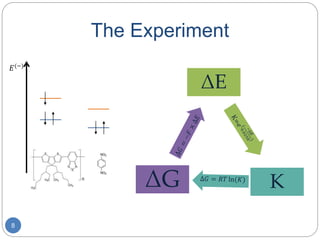
The Experiment
8
ΔE
KΔG
𝐸(−)
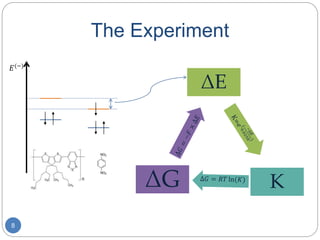
The Experiment
8
ΔE
KΔG
𝐸(−)
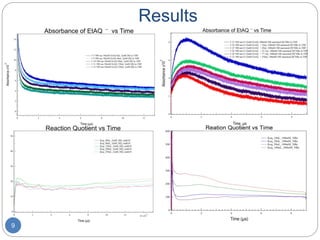
Results
9
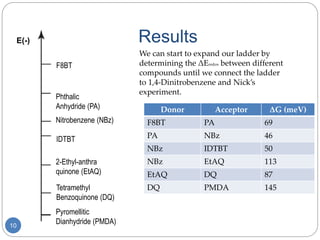
Results
10
F8BT
Phthalic
Anhydride (PA)
Nitrobenzene (NBz)
IDTBT
2-Ethyl-anthra
quinone (EtAQ)
Tetramethyl
Benzoquinone (DQ)
E(-)
Pyromellitic
Dianhydride (PMDA)
We can start to expand our ladder by
determining the ΔEredox between different
compounds until we connect the ladder
to 1,4-Dinitrobenzene and Nick’s
experiment.
Donor Acceptor ΔG (meV)
F8BT PA 69
PA NBz 46
NBz IDTBT 50
NBz EtAQ 113
EtAQ DQ 87
DQ PMDA 145
Conclusions
11
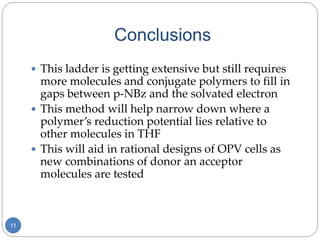
 This ladder is getting extensive but still requires
more molecules and conjugate polymers to fill in
gaps between p-NBz and the solvated electron
 This method will help narrow down where a
polymer’s reduction potential lies relative to
other molecules in THF
 This will aid in rational designs of OPV cells as
new combinations of donor an acceptor
molecules are tested
Acknowledgements
12
This project was supported by the U.S. Department
of Energy, Science Undergraduate Laboratory
Internships Program (SULI). The author also thanks
John Miller for his expertise and useful advice
without whom this project would not have been
possible. Thanks to Brookhaven National
Laboratory and the Office of Educational Programs
for hosting and granting access to the Laser
Electron Accelerator Facility (LEAF)for this project.

Redox Potentials using Pulse Radiolysis

  • 1.
    Stephanie Hernandez Dr. MatthewBird Nick Bonura Plotting Relative Redox Potentials in THF without Electrolyte
  • 2.
    Organic Photovoltaic Cells Advantages Organic polymers used in the cell are solution- processable, cheap, and in abundance supply  Constructed utilizing Roll to Roll processing  Applied to various substrates for a wider range of applications compared to silicon solar cells.  Potential to retrofit buildings to supply a secondary power source. Source: http://www.sigmaaldrich.com/materials-science/organic-electronics/opv-tutorial.html2 http://www.sigmaaldrich.com/materials- science/organic-electronics/opv-tutorial.html http://solarenergygroupe.com/
  • 3.
    Source: http://www.sigmaaldrich.com/materials-science/organic-electronics/opv-tutorial.html Organic PhotovoltaicCells 3 http://www.sigmaaldrich.com/materials- science/organic-electronics/opv-tutorial.html http://solarenergygroupe.com/ Challenges  Low efficiencies reported compared to silicon solar cells  Lack of understanding of charge separation  Extending lifetime of devices  Difficulty estimating HOMO and LUMO levels of materials
  • 4.
    4 Purpose To avoid propagationuncertainties in results and further aid investigation into OPV devices by providing redox potentials of polymers and small molecules in THF without electrolyte. Objectives  Develop a redox ladder using pulse radiolysis results from various donor-acceptor solutions in THF  Test a fit function for the change in electron transfer equilibrium  Test several polymers studies by the OPV community for redox values
  • 5.
    5 PCPDTBT [TBAPF6] CoCp2 0/+ *Information onthe reduction potentials in 0.1M [TBAPF6] in THF was taken from another experiment Creating the Ladder p-NBz
  • 6.
    5 [TBAPF6] CoCp2 0/+ p-NBz My experiment:Fill in the redox ladder from 1,4-Dinitrobenzene (p-NBz) to the solvated electron. Nick’s experiment: Test the fit function against Cobaltocenium (CoCp2) and p-NBz, while determining the oxidation/reduction values. *Information on the reduction potentials in 0.1M [TBAPF6] in THF was taken from another experiment Creating the Ladder PCPDTBT
  • 7.
    6 𝐸 = 𝐸0 𝑛𝑜𝑠𝑎𝑙𝑡 + 𝑅𝑇 𝐹 𝑙𝑛 𝑎 𝑂 𝑎 𝑅 = 𝐸0 𝑛𝑜 𝑠𝑎𝑙𝑡 + 𝑅𝑇 𝐹 𝑙𝑛 𝑂 𝑅−• + 𝑅𝑇 𝐹 𝑙𝑛 𝛾 𝑂 𝛾 𝑅−• 𝐾 𝑑 𝑅−• , 𝑋+ ⇌ 𝑅−• + 𝑋+ 𝑂 + 𝑅−• + 𝑅−• , 𝑋+ = 𝑐0 𝑅−• = 𝐾 𝑑 𝑅−• , 𝑋+ 𝛾± 2 𝑋+ = 𝐾 𝑑 𝑐0 − 𝑅−• − 𝑂 𝛾± 2 𝑋+ 𝑅−• 1 + 𝐾 𝑑 𝛾± 2 𝑋+ = 𝐾 𝑑 𝑐0 − 𝑂 𝛾± 2 𝑋+ 𝑅−• = 𝑐0 − 𝑂 1 + 𝛾± 2 𝑋+ 𝐾 𝑑 𝑂 𝑅−• = 1 + 𝛾± 2 𝑋+ 𝐾 𝑑 𝑐0 𝑂 − 1 = 1 + 𝛾± 2 𝑋+ 𝐾 𝑑 𝑅−• + 𝑅−• , 𝑋+ 𝑂 𝐸 = 𝐸0 𝑛𝑜 𝑠𝑎𝑙𝑡 + 𝑅𝑇 𝐹 ln 1 + 𝛾± 2 𝑋+ 𝐾 𝑑 + 𝑅𝑇 𝐹 ln 𝑂 𝑅−• + 𝑅−•, 𝑋+ + 𝑅𝑇 𝐹 𝑙𝑛 1 𝛾± 𝐸 = 𝐸0 𝑛𝑜 𝑠𝑎𝑙𝑡 + 𝑅𝑇 𝐹 ln 1 𝛾± + 𝛾± 𝑋+ 𝐾 𝑑 + 𝑅𝑇 𝐹 ln 𝑂 𝑅−• + 𝑅−•, 𝑋+ Effect of ion-pairing and ionic environment on reduction potential 𝐸0 ′ 𝑠𝑎𝑙𝑡 Might be defined as ‘formal potential in presence of salt’
  • 8.
    Methods 7 0.5cm Acceptor Donor Electron pulse Light source Filter Detector 𝐷−∙ +A ↔ D + 𝐴−∙ 𝐾 = 𝐷 [𝐴−∙]𝛾 𝐴−∙ 𝐴 [𝐷−∙]𝛾 𝐷−∙ 𝐴 = 𝜀𝐶 𝑜 𝐿 𝐶 𝑜 = 𝐷−∙ + [𝐴−∙] [𝐴−∙] 𝐷−∙ = A 𝐷 − A 𝐷+𝐴 A 𝐷+𝐴
  • 9.
  • 10.
  • 11.
  • 12.
    Results 10 F8BT Phthalic Anhydride (PA) Nitrobenzene (NBz) IDTBT 2-Ethyl-anthra quinone(EtAQ) Tetramethyl Benzoquinone (DQ) E(-) Pyromellitic Dianhydride (PMDA) We can start to expand our ladder by determining the ΔEredox between different compounds until we connect the ladder to 1,4-Dinitrobenzene and Nick’s experiment. Donor Acceptor ΔG (meV) F8BT PA 69 PA NBz 46 NBz IDTBT 50 NBz EtAQ 113 EtAQ DQ 87 DQ PMDA 145
  • 13.
    Conclusions 11  This ladderis getting extensive but still requires more molecules and conjugate polymers to fill in gaps between p-NBz and the solvated electron  This method will help narrow down where a polymer’s reduction potential lies relative to other molecules in THF  This will aid in rational designs of OPV cells as new combinations of donor an acceptor molecules are tested
  • 14.
    Acknowledgements 12 This project wassupported by the U.S. Department of Energy, Science Undergraduate Laboratory Internships Program (SULI). The author also thanks John Miller for his expertise and useful advice without whom this project would not have been possible. Thanks to Brookhaven National Laboratory and the Office of Educational Programs for hosting and granting access to the Laser Electron Accelerator Facility (LEAF)for this project.