(1) Review the concept of “Oxidation”
and “Reduction.”
(2)Define the term “cell potential.”
(3)Illustrate the Standard Hydrogen
Electrode (SHE) and Standard
Electrode (reduction) potentials.
1
What is Electrochemistry?
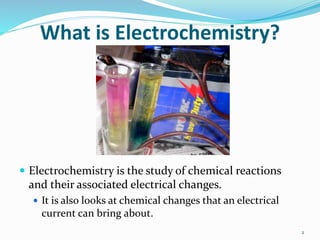
 Electrochemistry is the study of chemical reactions
and their associated electrical changes.
 It is also looks at chemical changes that an electrical
current can bring about.
2
Transfer of electrons
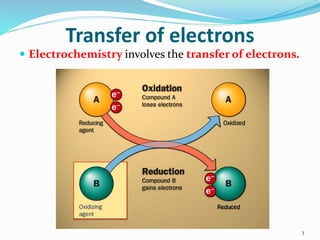
 Electrochemistry involves the transfer of electrons.
3
Cell Potential
 If a strip of metal (electrode) is placed in a solution of its
ions, the metal loses electrons to form its cation.
M(s) → Mn+
(aq) + n e-
 The cations in solution may accept some of the lost
electrons and get reduced to the metal atoms.
Mn+
(aq) + n e- → M(s)
 At equilibrium, the charge difference that develops
between the metal strip and the solution is called a
potential difference.
4
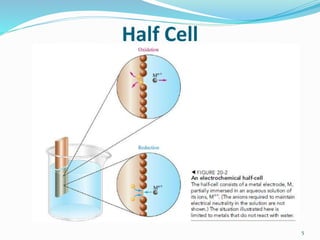
Half Cell
5
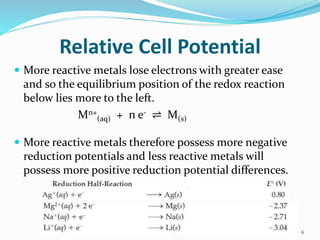
Relative Cell Potential
 More reactive metals lose electrons with greater ease
and so the equilibrium position of the redox reaction
below lies more to the left.
Mn+
(aq) + n e- ⇌ M(s)
 More reactive metals therefore possess more negative
reduction potentials and less reactive metals will
possess more positive reduction potential differences.
6
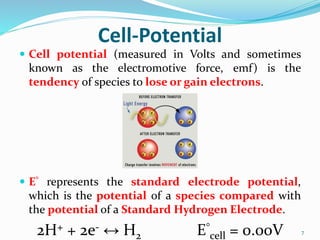
Cell-Potential
 Cell potential (measured in Volts and sometimes
known as the electromotive force, emf) is the
tendency of species to lose or gain electrons.
 E° represents the standard electrode potential,
which is the potential of a species compared with
the potential of a Standard Hydrogen Electrode.
2H+ + 2e- ↔ H2 E°
cell = 0.00V 7
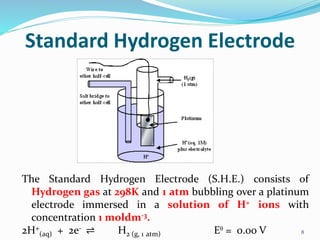
Standard Hydrogen Electrode
The Standard Hydrogen Electrode (S.H.E.) consists of
Hydrogen gas at 298K and 1 atm bubbling over a platinum
electrode immersed in a solution of H+ ions with
concentration 1 moldm-3.
2H+
(aq) + 2e- ⇌ H2 (g, 1 atm) Eᶿ = 0.00 V 8
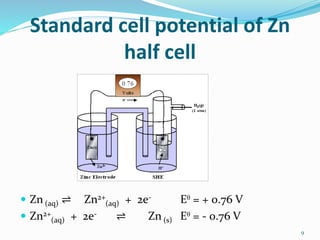
Standard cell potential of Zn
half cell
 Zn (aq) ⇌ Zn2+
(aq) + 2e- Eᶿ = + 0.76 V
 Zn2+
(aq) + 2e- ⇌ Zn (s) Eᶿ = - 0.76 V
9
Cell-Potential
 For species with a positive value, they have
a tendency to be reduced.
 They are strong oxidizing agents.
 They are usually non-metals.
 For species with a negative value, they have
a tendency to be oxidized.
 They are strong reducing agents.
 They are usually metals.
10
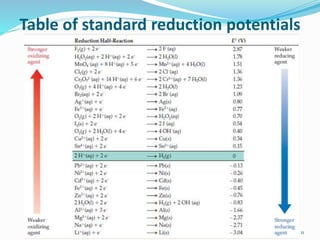
Table of standard reduction potentials
11
Cell-Potential
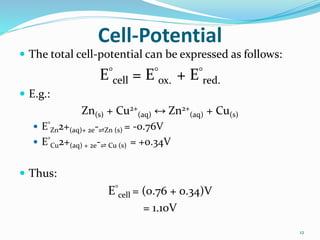
 The total cell-potential can be expressed as follows:
E°
cell = E°
ox. + E°
red.
 E.g.:
Zn(s) + Cu2+
(aq) ↔ Zn2+
(aq) + Cu(s)
 E°
Zn2+(aq)+ 2e-⇌Zn (s) = -0.76V
 E°
Cu2+(aq) + 2e-⇌ Cu (s) = +0.34V
 Thus:
E°
cell = (0.76 + 0.34)V
= 1.10V
12

redox equilibrium.pptx

  • 1.
    (1) Review theconcept of “Oxidation” and “Reduction.” (2)Define the term “cell potential.” (3)Illustrate the Standard Hydrogen Electrode (SHE) and Standard Electrode (reduction) potentials. 1
  • 2.
    What is Electrochemistry? Electrochemistry is the study of chemical reactions and their associated electrical changes.  It is also looks at chemical changes that an electrical current can bring about. 2
  • 3.
    Transfer of electrons Electrochemistry involves the transfer of electrons. 3
  • 4.
    Cell Potential  Ifa strip of metal (electrode) is placed in a solution of its ions, the metal loses electrons to form its cation. M(s) → Mn+ (aq) + n e-  The cations in solution may accept some of the lost electrons and get reduced to the metal atoms. Mn+ (aq) + n e- → M(s)  At equilibrium, the charge difference that develops between the metal strip and the solution is called a potential difference. 4
  • 5.
  • 6.
    Relative Cell Potential More reactive metals lose electrons with greater ease and so the equilibrium position of the redox reaction below lies more to the left. Mn+ (aq) + n e- ⇌ M(s)  More reactive metals therefore possess more negative reduction potentials and less reactive metals will possess more positive reduction potential differences. 6
  • 7.
    Cell-Potential  Cell potential(measured in Volts and sometimes known as the electromotive force, emf) is the tendency of species to lose or gain electrons.  E° represents the standard electrode potential, which is the potential of a species compared with the potential of a Standard Hydrogen Electrode. 2H+ + 2e- ↔ H2 E° cell = 0.00V 7
  • 8.
    Standard Hydrogen Electrode TheStandard Hydrogen Electrode (S.H.E.) consists of Hydrogen gas at 298K and 1 atm bubbling over a platinum electrode immersed in a solution of H+ ions with concentration 1 moldm-3. 2H+ (aq) + 2e- ⇌ H2 (g, 1 atm) Eᶿ = 0.00 V 8
  • 9.
    Standard cell potentialof Zn half cell  Zn (aq) ⇌ Zn2+ (aq) + 2e- Eᶿ = + 0.76 V  Zn2+ (aq) + 2e- ⇌ Zn (s) Eᶿ = - 0.76 V 9
  • 10.
    Cell-Potential  For specieswith a positive value, they have a tendency to be reduced.  They are strong oxidizing agents.  They are usually non-metals.  For species with a negative value, they have a tendency to be oxidized.  They are strong reducing agents.  They are usually metals. 10
  • 11.
    Table of standardreduction potentials 11
  • 12.
    Cell-Potential  The totalcell-potential can be expressed as follows: E° cell = E° ox. + E° red.  E.g.: Zn(s) + Cu2+ (aq) ↔ Zn2+ (aq) + Cu(s)  E° Zn2+(aq)+ 2e-⇌Zn (s) = -0.76V  E° Cu2+(aq) + 2e-⇌ Cu (s) = +0.34V  Thus: E° cell = (0.76 + 0.34)V = 1.10V 12