BACKGROUND TASKS IN NODE.JS
REDISCONF 2016
@EVANTAHLER
A Survey using Redis
WARNING
MOST OF THE IDEAS IN THIS
PRESENTATION ARE ACTUALLY VERY
BAD IDEAS.
TRY THESE AT ~, NOT ON PRODUCTION
INTRO
HI. I’M EVAN
▸ Director of Technology @ TaskRabbit
▸ Founder of ActionHero.js, node.js
framework
▸ Node-Resque Author
@EVANTAHLER
BLOG.EVANTAHLER.COM
INTRO
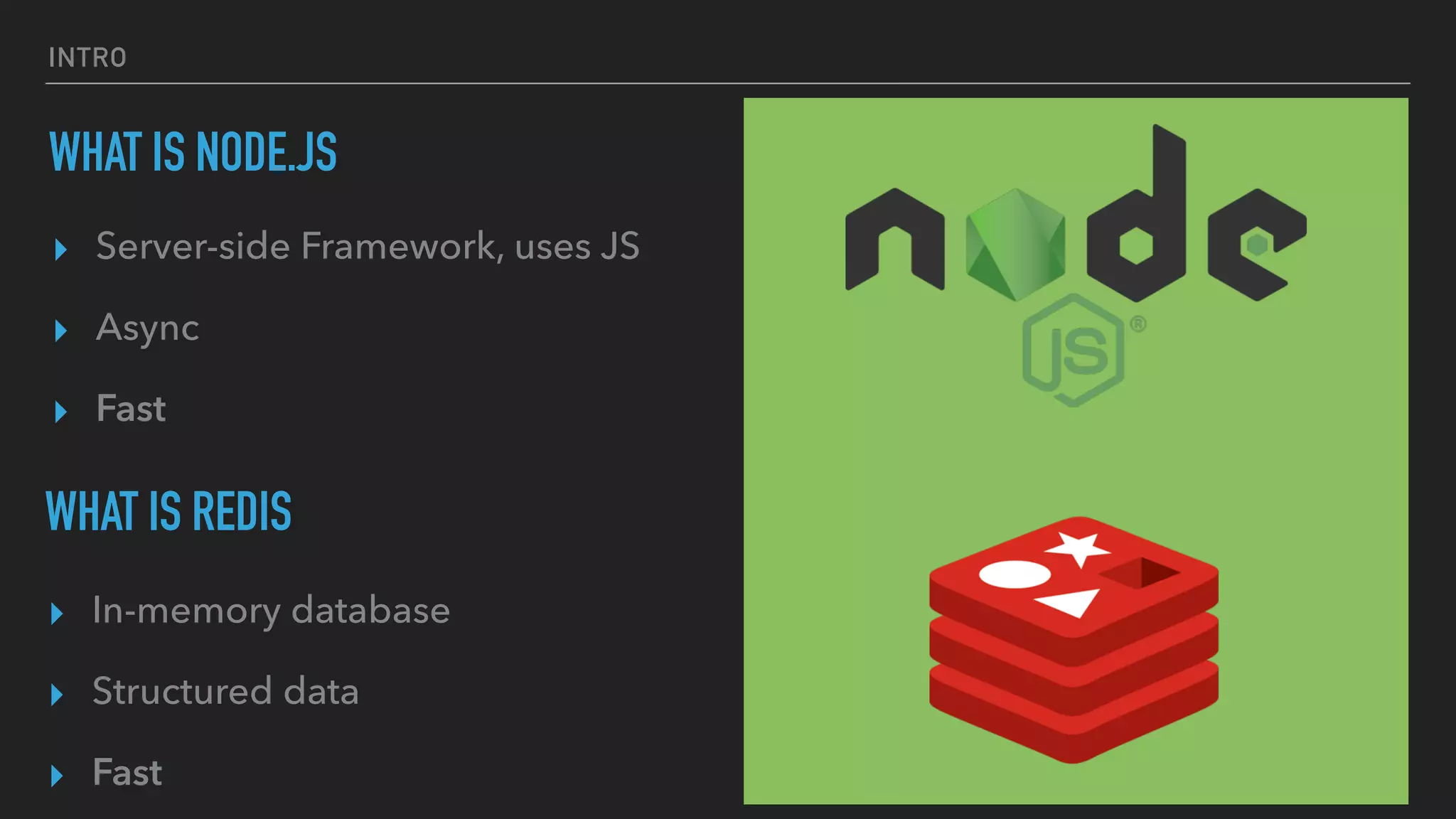
WHAT IS NODE.JS
▸ Server-side Framework, uses JS
▸ Async
▸ Fast
WHAT IS REDIS
▸ In-memory database
▸ Structured data
▸ Fast
EVERYTHING IS FASTER IN NODE…
ESPECIALLY THE BAD IDEAS
Me (Evan)
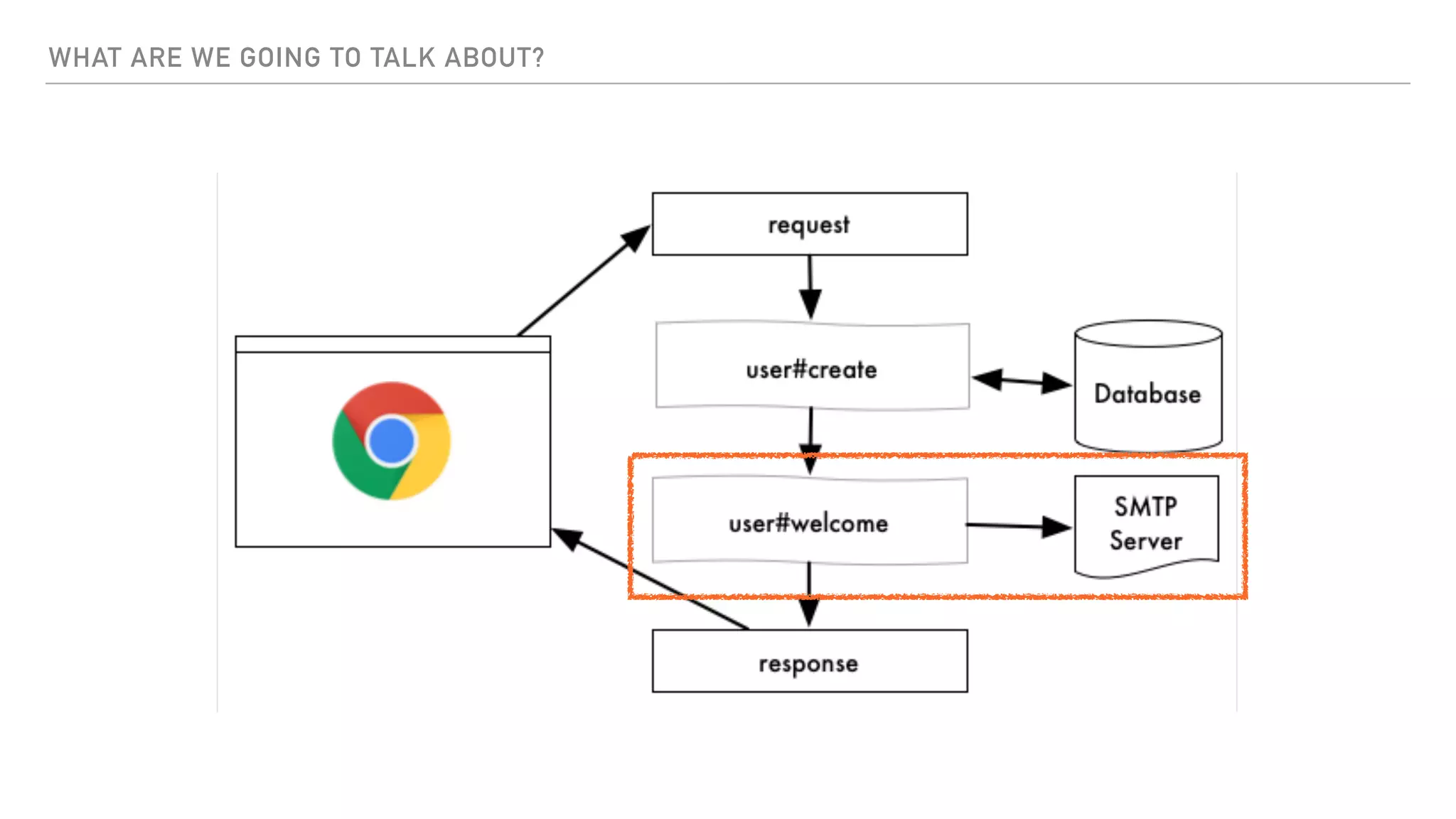
WHAT ARE WE GOING TO TALK ABOUT?
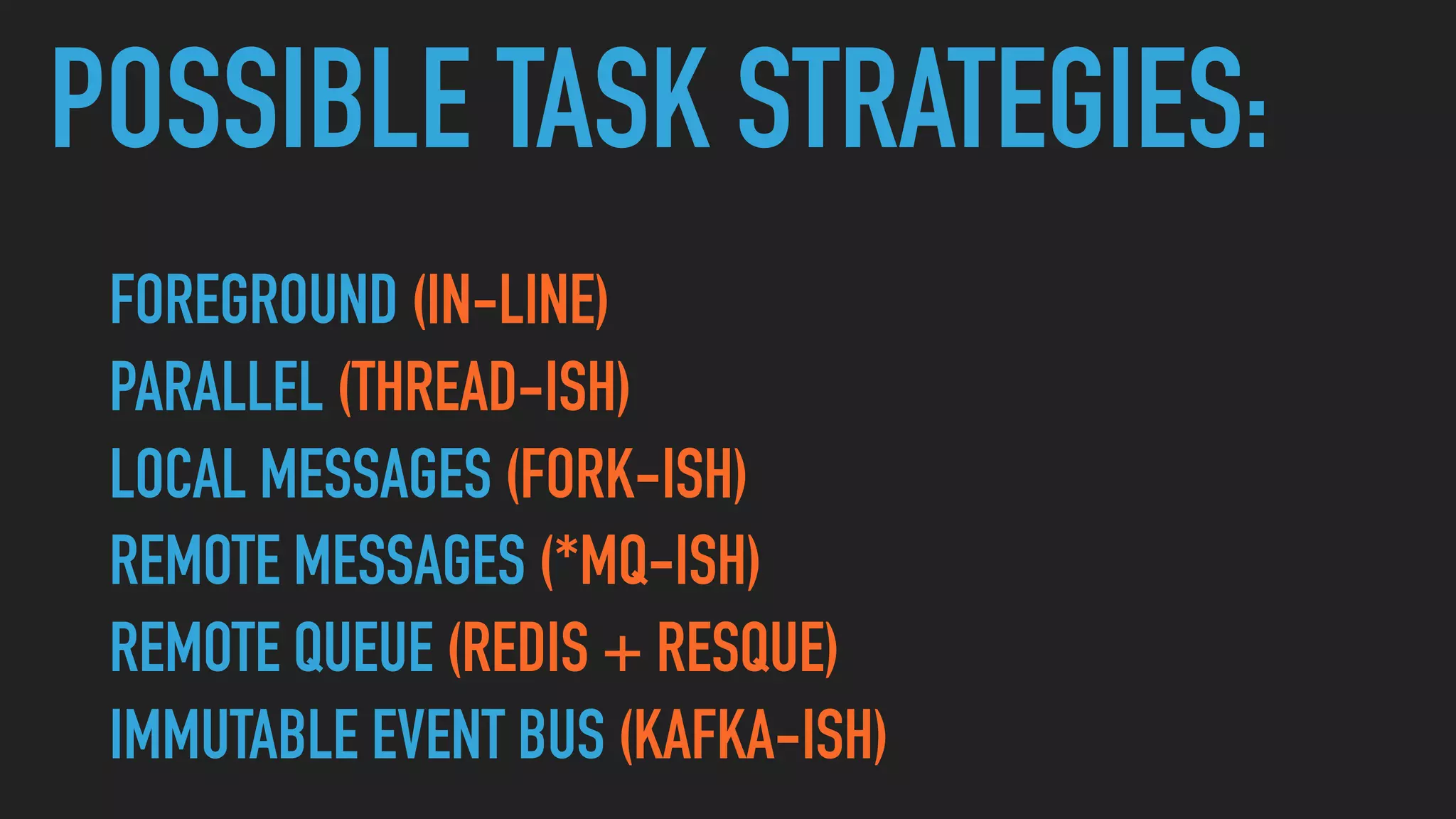
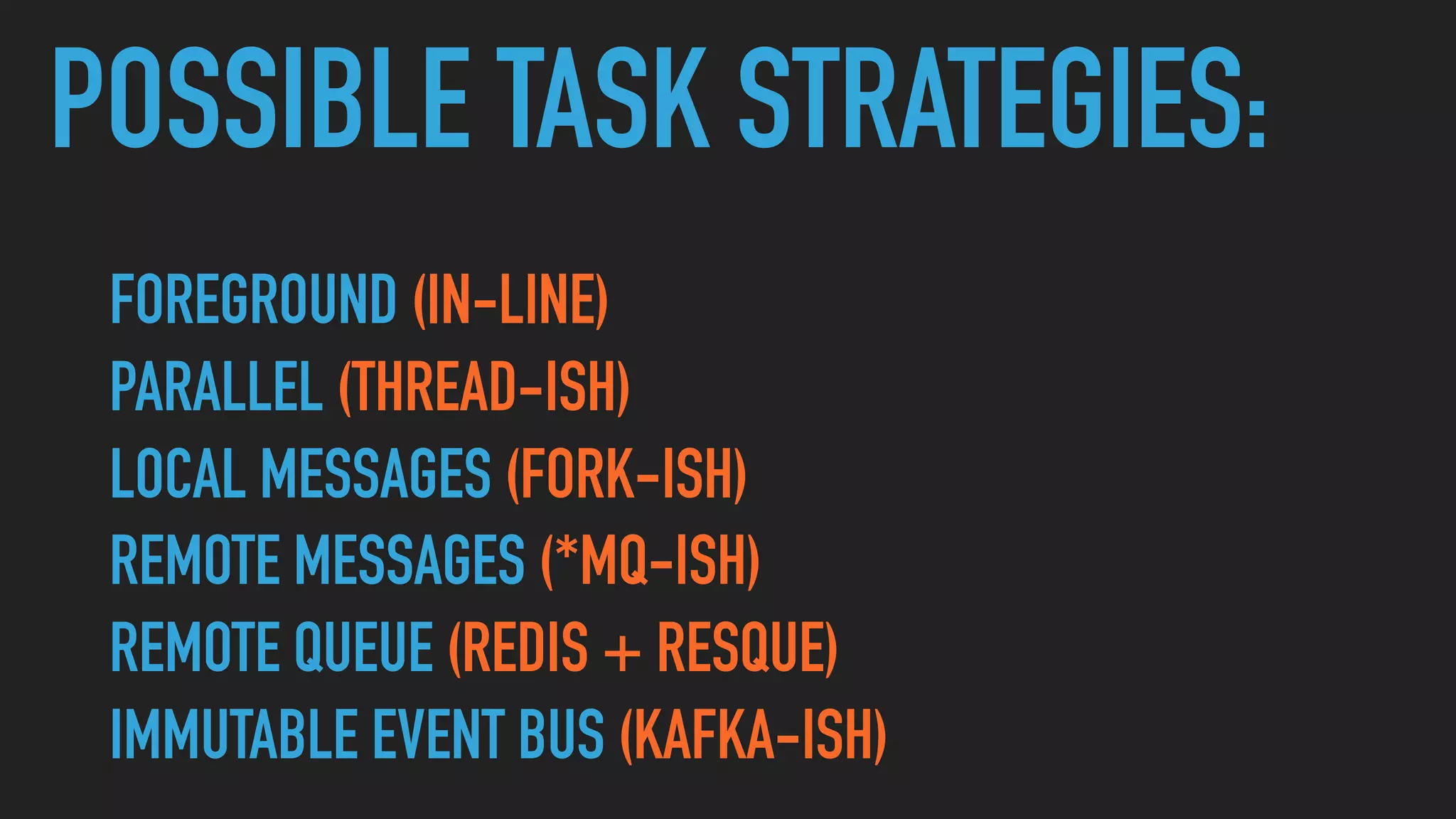
POSSIBLE TASK STRATEGIES:
FOREGROUND (IN-LINE)
PARALLEL (THREAD-ISH)
LOCAL MESSAGES (FORK-ISH)
REMOTE MESSAGES (*MQ-ISH)
REMOTE QUEUE (REDIS + RESQUE)
IMMUTABLE EVENT BUS (KAFKA-ISH)
1) FOREGROUND TASKS
FOREGROUND
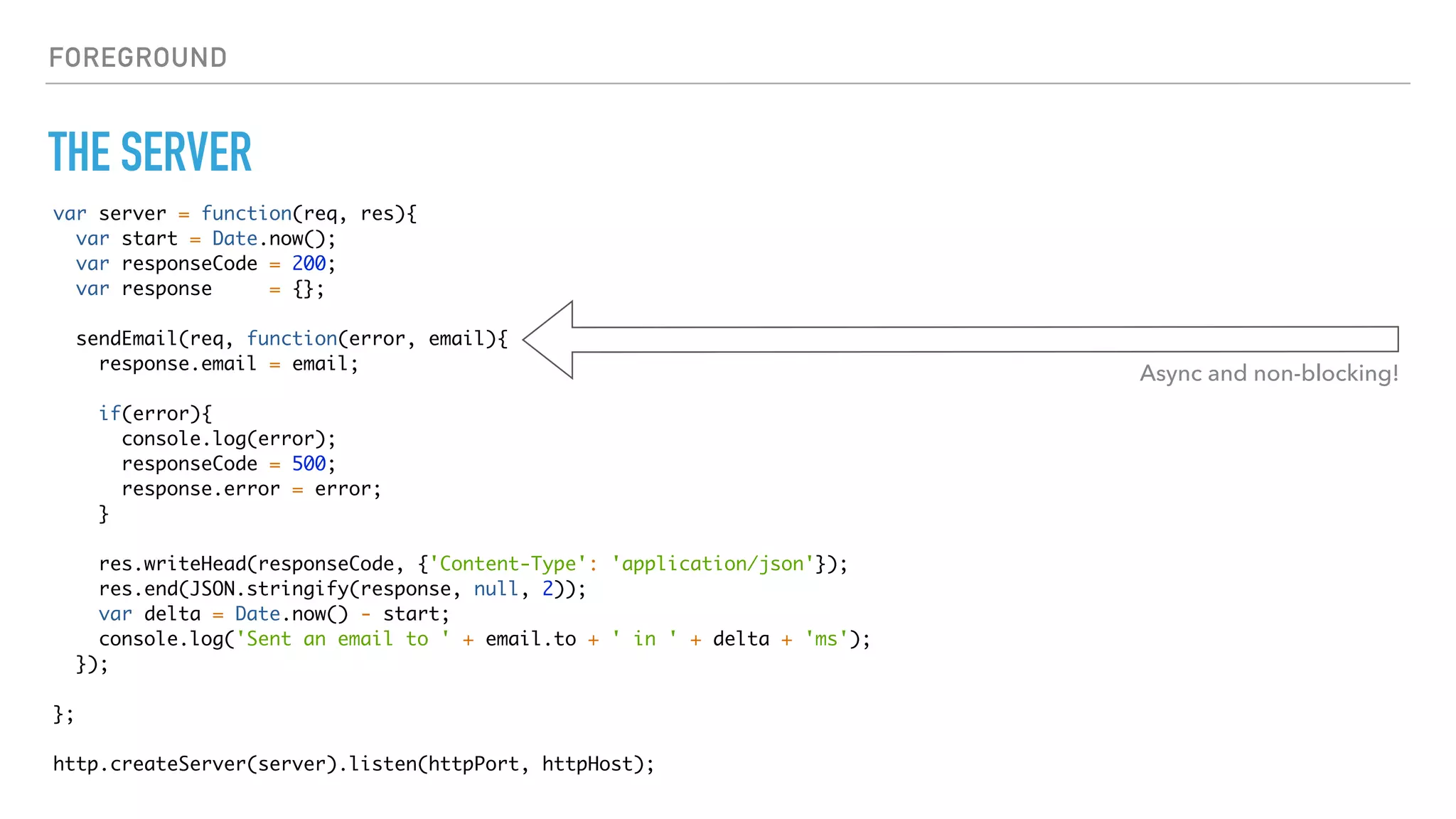
THE SERVER
var server = function(req, res){
var start = Date.now();
var responseCode = 200;
var response = {};
sendEmail(req, function(error, email){
response.email = email;
if(error){
console.log(error);
responseCode = 500;
response.error = error;
}
res.writeHead(responseCode, {'Content-Type': 'application/json'});
res.end(JSON.stringify(response, null, 2));
var delta = Date.now() - start;
console.log('Sent an email to ' + email.to + ' in ' + delta + 'ms');
});
};
http.createServer(server).listen(httpPort, httpHost);
Async and non-blocking!
FOREGROUND
SENDING EMAILS
var http = require('http');
var nodemailer = require('nodemailer');
var httpPort = process.env.PORT || 8080;
var httpHost = process.env.HOST || '127.0.0.1';
var transporter = nodemailer.createTransport({
service: 'gmail',
auth: {
user: require('./.emailUsername'),
pass: require('./.emailPassword')
}
});
var sendEmail = function(req, callback){
var urlParts = req.url.split('/');
var email = {
from: require('./.emailUsername'),
to: decodeURI(urlParts[1]),
subject: decodeURI(urlParts[2]),
text: decodeURI(urlParts[3]),
};
transporter.sendMail(email, function(error, info){
callback(error, email);
});
};
DEMO TIME
FOREGROUND
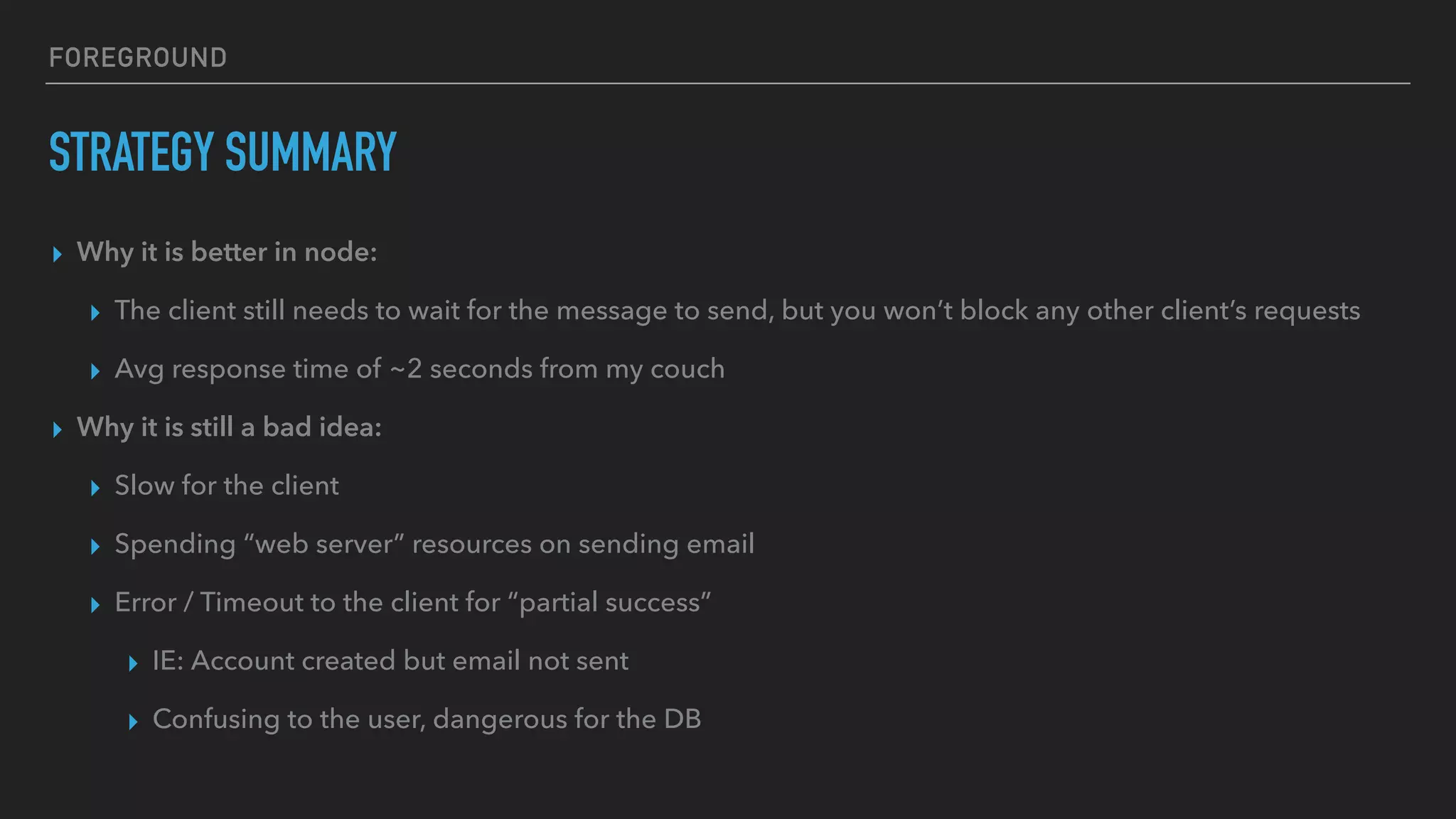
STRATEGY SUMMARY
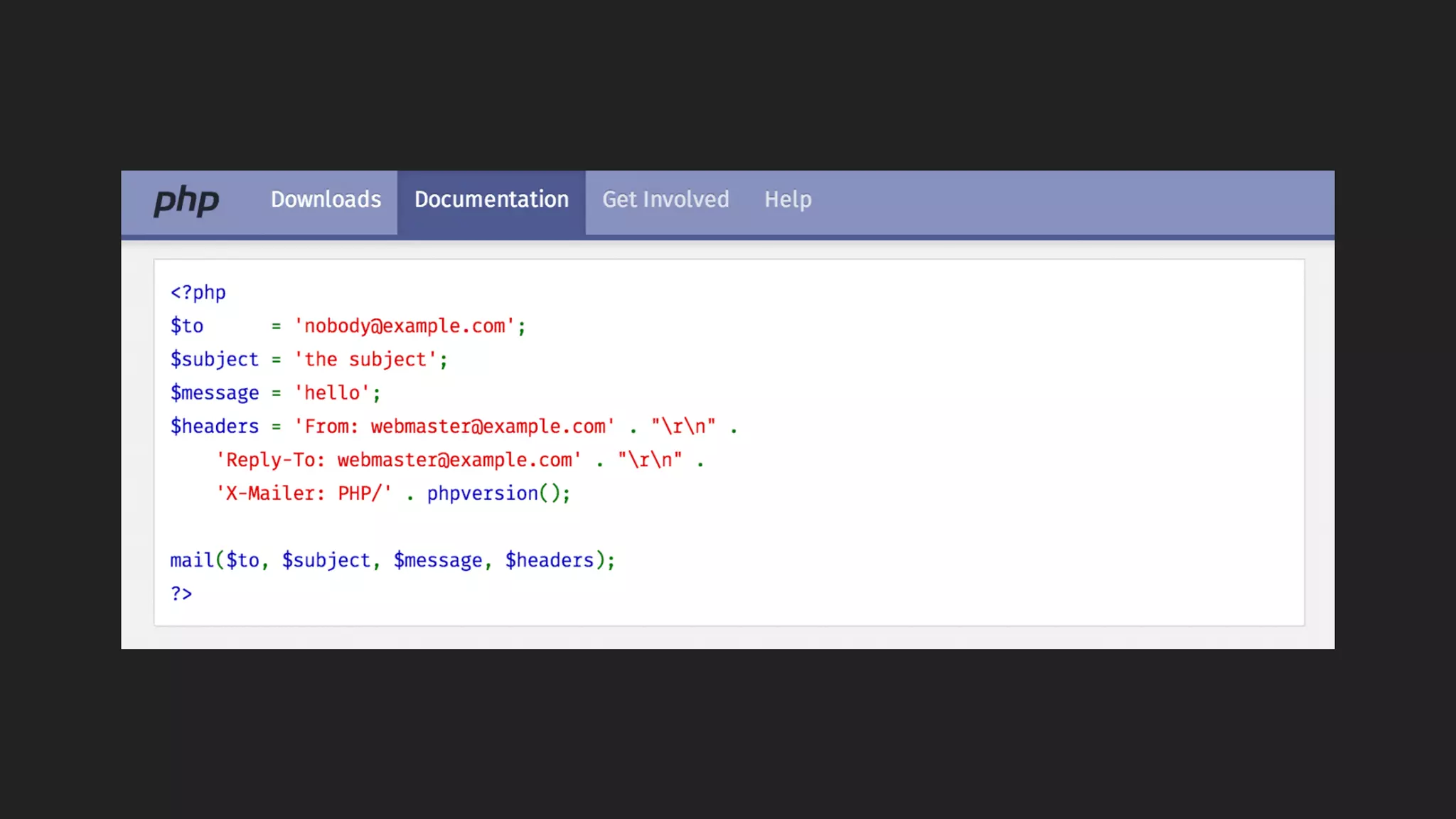
▸ Why it is better in node:
▸ The client still needs to wait for the message to send, but you won’t block any other client’s requests
▸ Avg response time of ~2 seconds from my couch
▸ Why it is still a bad idea:
▸ Slow for the client
▸ Spending “web server” resources on sending email
▸ Error / Timeout to the client for “partial success”
▸ IE: Account created but email not sent
▸ Confusing to the user, dangerous for the DB
2) PARALLEL TASKS
PARALLEL
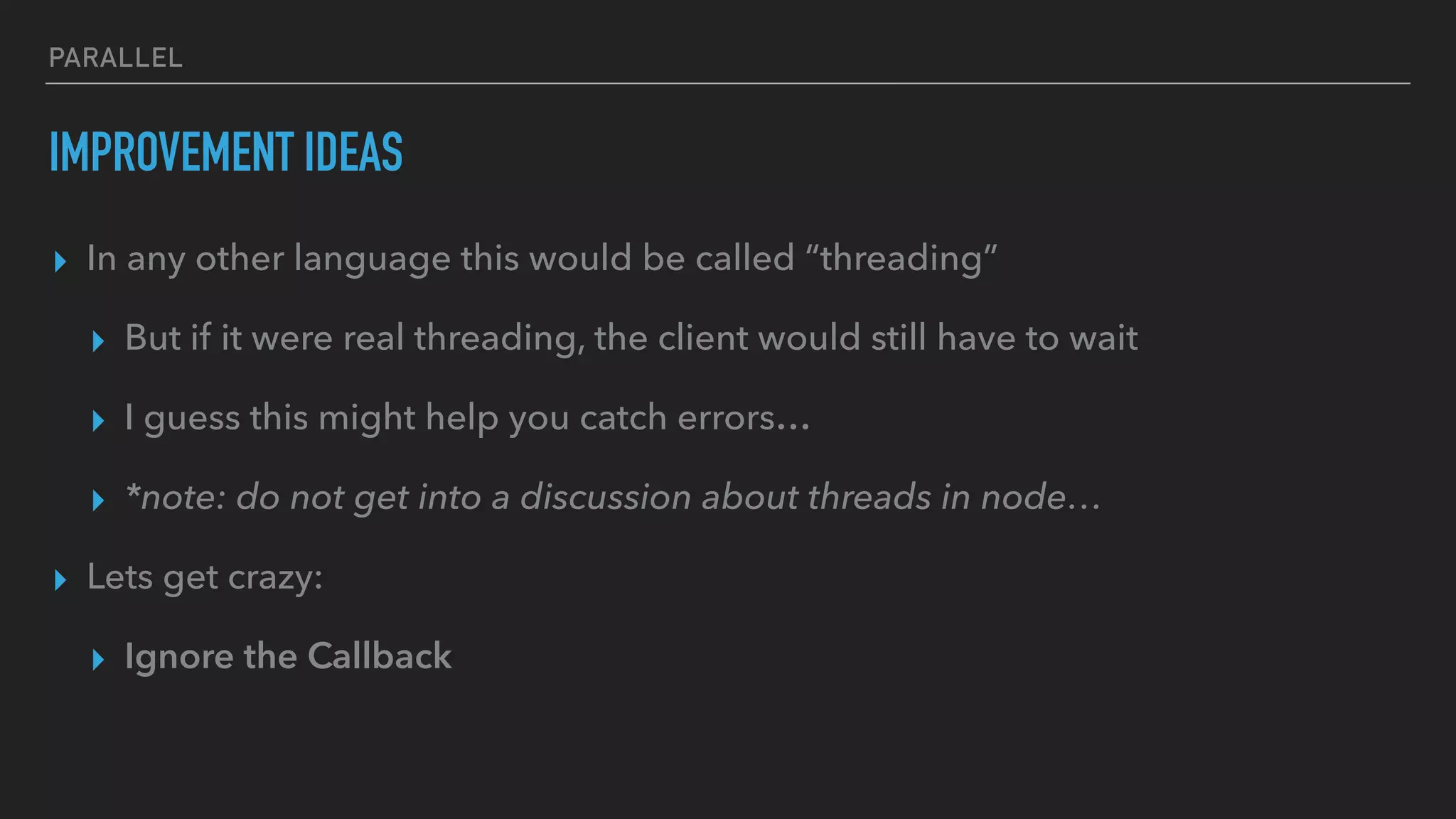
IMPROVEMENT IDEAS
▸ In any other language this would be called “threading”
▸ But if it were real threading, the client would still have to wait
▸ I guess this might help you catch errors…
▸ *note: do not get into a discussion about threads in node…
▸ Lets get crazy:
▸ Ignore the Callback
PARALLEL
IGNORE THE CALLBACK
var server = function(req, res){
var start = Date.now();
var responseCode = 200;
var response = {};
sendEmail(req);
res.writeHead(responseCode, {'Content-Type': 'application/json'});
res.end(JSON.stringify(response, null, 2));
console.log('Sent an email');
};
http.createServer(server).listen(httpPort, httpHost);
var sendEmail = function(req, callback){
var urlParts = req.url.split('/');
var email = {
from: require('./.emailUsername'),
to: decodeURI(urlParts[1]),
subject: decodeURI(urlParts[2]),
text: decodeURI(urlParts[3]),
};
transporter.sendMail(email, function(error, info){
if(typeof callback === 'function'){
callback(error, email);
}
});
};
DEMO TIME
PARALLEL
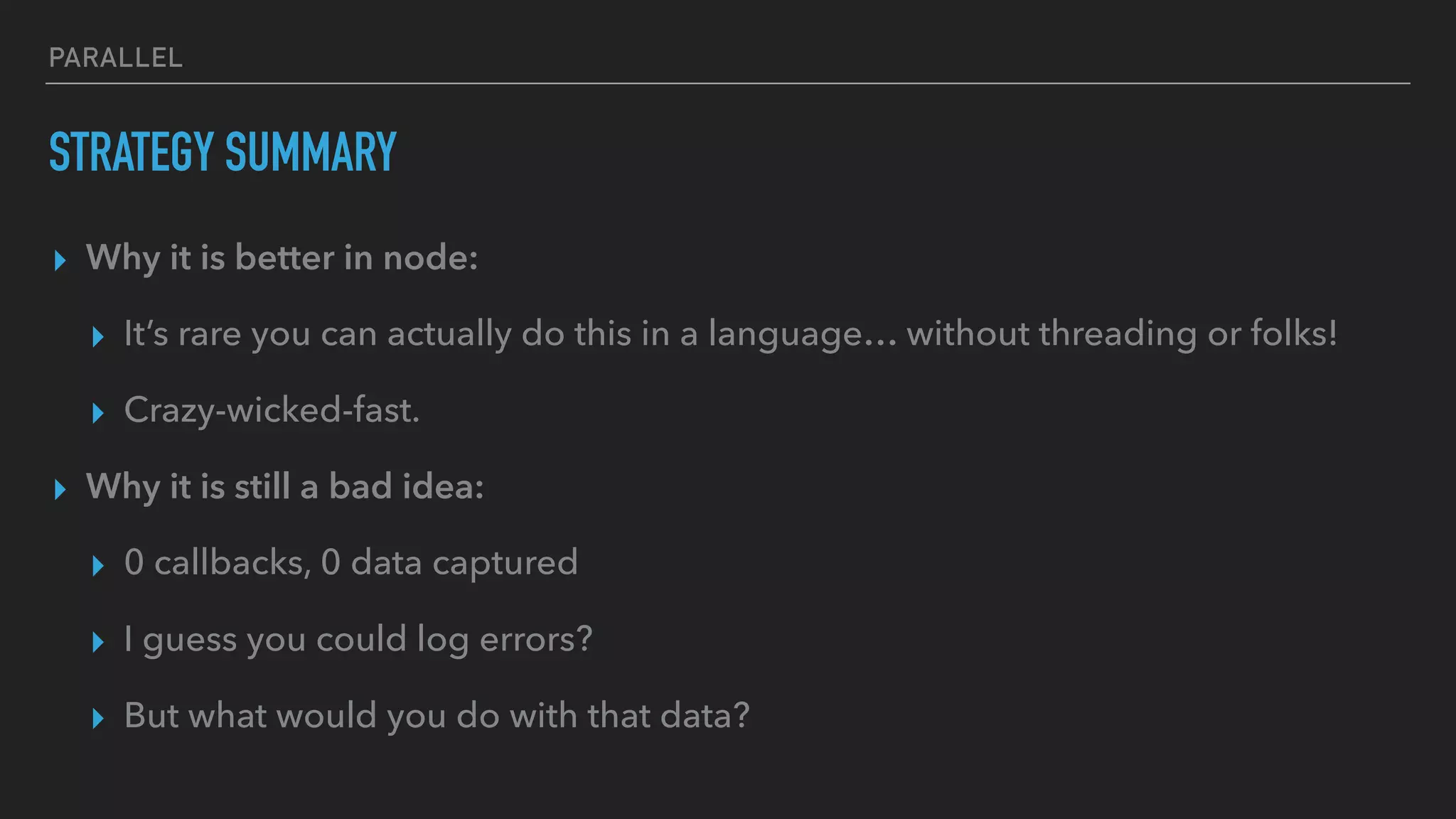
STRATEGY SUMMARY
▸ Why it is better in node:
▸ It’s rare you can actually do this in a language… without threading or folks!
▸ Crazy-wicked-fast.
▸ Why it is still a bad idea:
▸ 0 callbacks, 0 data captured
▸ I guess you could log errors?
▸ But what would you do with that data?
3) LOCAL MESSAGESor: “The part of the talk where we grossly over-engineer some stuff”
LOCAL MESSAGES
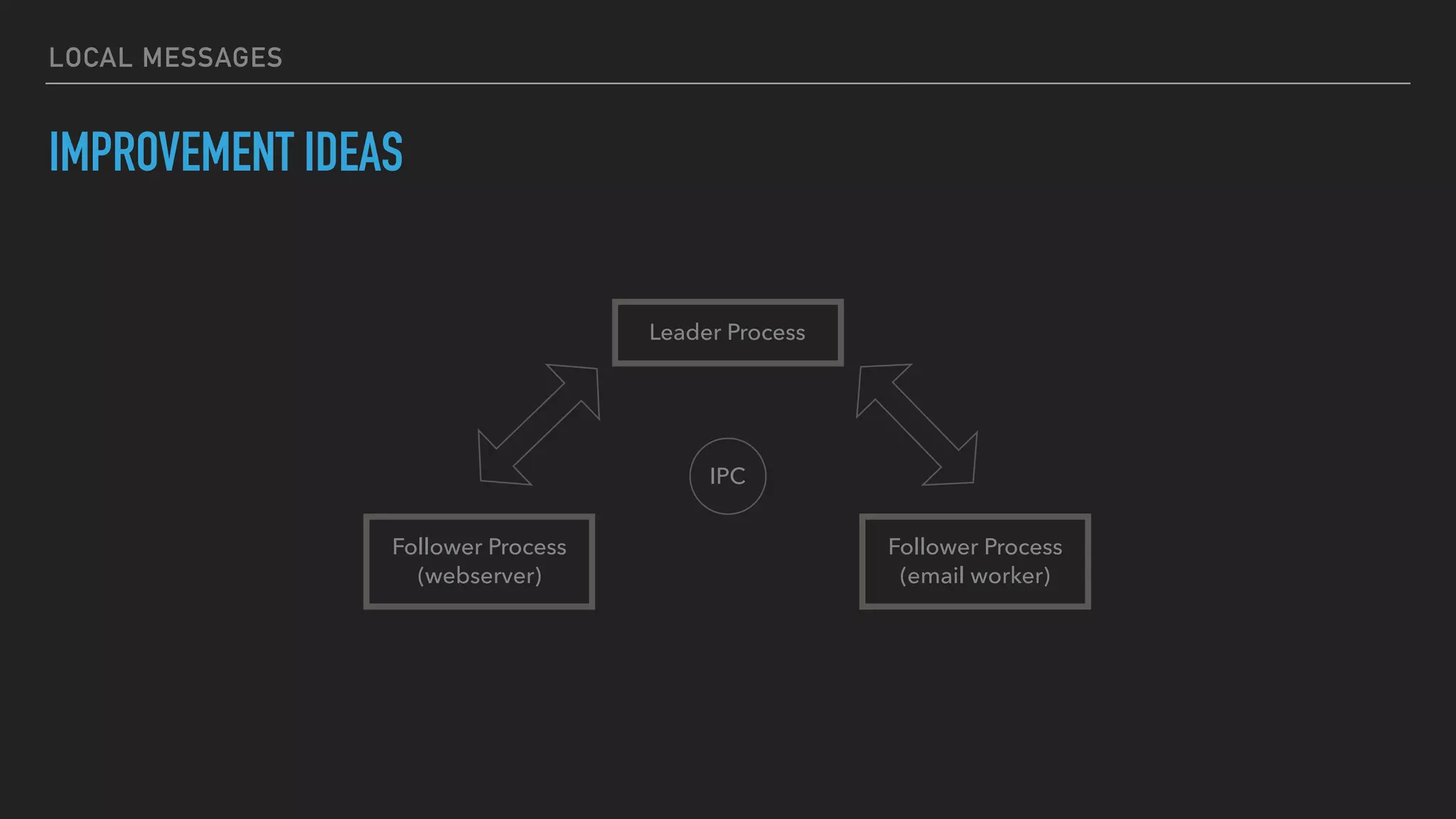
IMPROVEMENT IDEAS
Leader Process
Follower Process
(webserver)
Follower Process
(email worker)
IPC
LOCAL MESSAGES
CLUSTERING IN NODE.JS
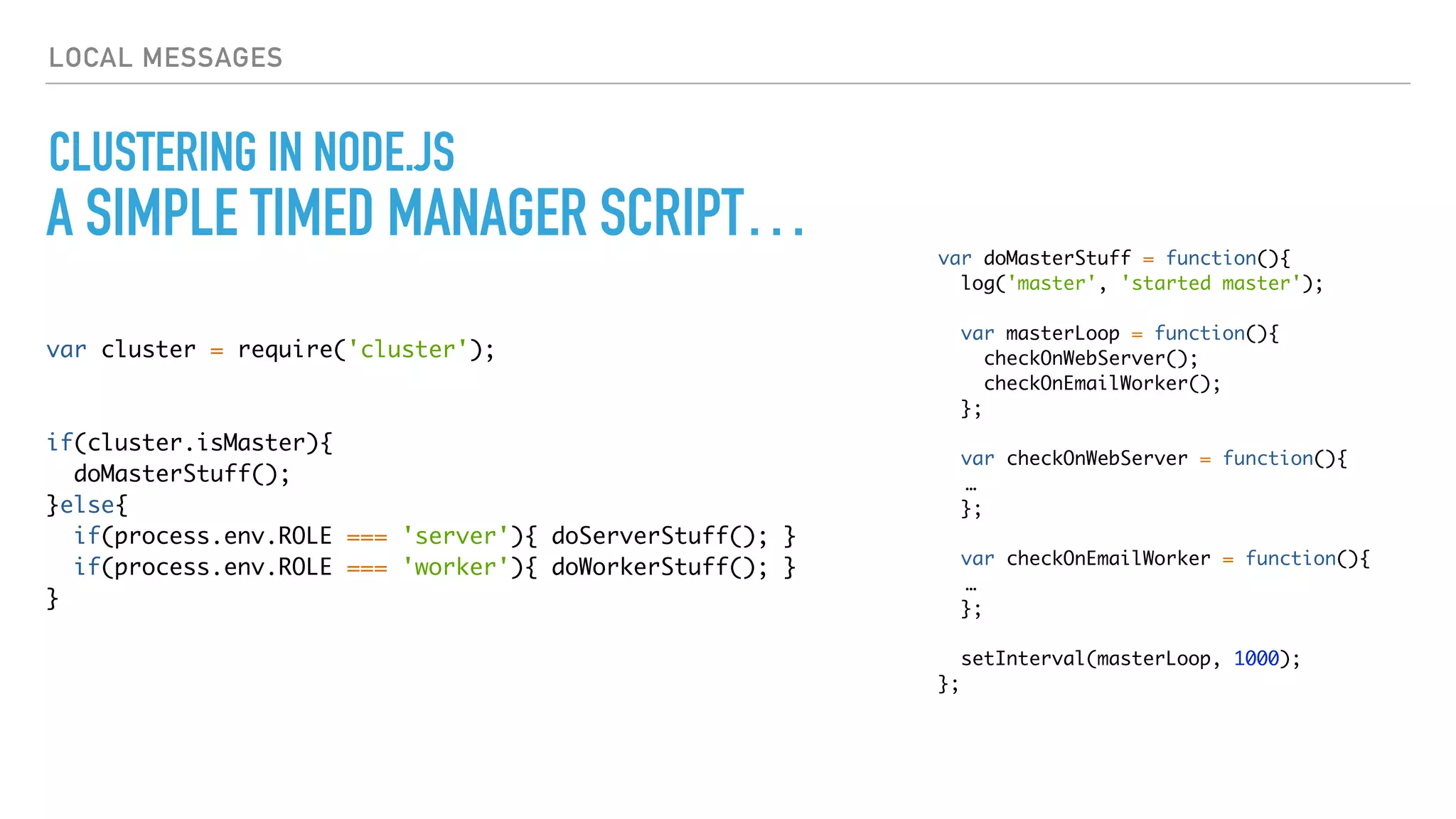
var cluster = require('cluster');
if(cluster.isMaster){
doMasterStuff();
}else{
if(process.env.ROLE === 'server'){ doServerStuff(); }
if(process.env.ROLE === 'worker'){ doWorkerStuff(); }
}
var doMasterStuff = function(){
log('master', 'started master');
var masterLoop = function(){
checkOnWebServer();
checkOnEmailWorker();
};
var checkOnWebServer = function(){
…
};
var checkOnEmailWorker = function(){
…
};
setInterval(masterLoop, 1000);
};
A SIMPLE TIMED MANAGER SCRIPT…
LOCAL MESSAGES
CLUSTERING IN NODE.JS
var doServerStuff = function(){
var server = function(req, res){
var urlParts = req.url.split('/');
var email = {
to: decodeURI(urlParts[1]),
subject: decodeURI(urlParts[2]),
text: decodeURI(urlParts[3]),
};
var response = {email: email};
res.writeHead(200, {'Content-Type': 'application/json'});
res.end(JSON.stringify(response, null, 2));
process.send(email);
};
http.createServer(server).listen(httpPort, '127.0.0.1');
};
Interprocess Communication (IPC) with complex data-types
LOCAL MESSAGES
CLUSTERING IN NODE.JS
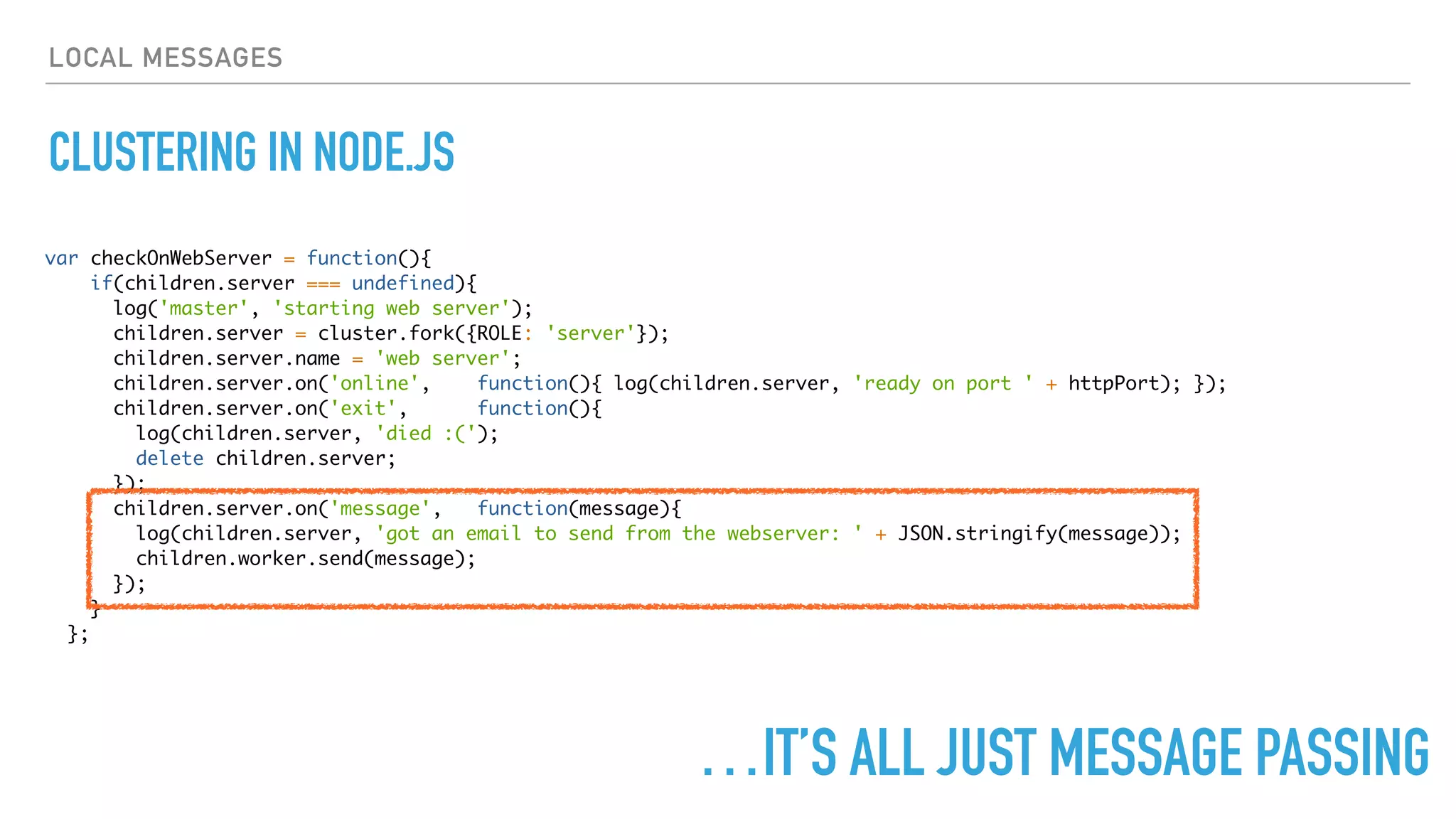
var checkOnWebServer = function(){
if(children.server === undefined){
log('master', 'starting web server');
children.server = cluster.fork({ROLE: 'server'});
children.server.name = 'web server';
children.server.on('online', function(){ log(children.server, 'ready on port ' + httpPort); });
children.server.on('exit', function(){
log(children.server, 'died :(');
delete children.server;
});
children.server.on('message', function(message){
log(children.server, 'got an email to send from the webserver: ' + JSON.stringify(message));
children.worker.send(message);
});
}
};
…IT’S ALL JUST MESSAGE PASSING
LOCAL MESSAGES
CLUSTERING IN NODE.JS
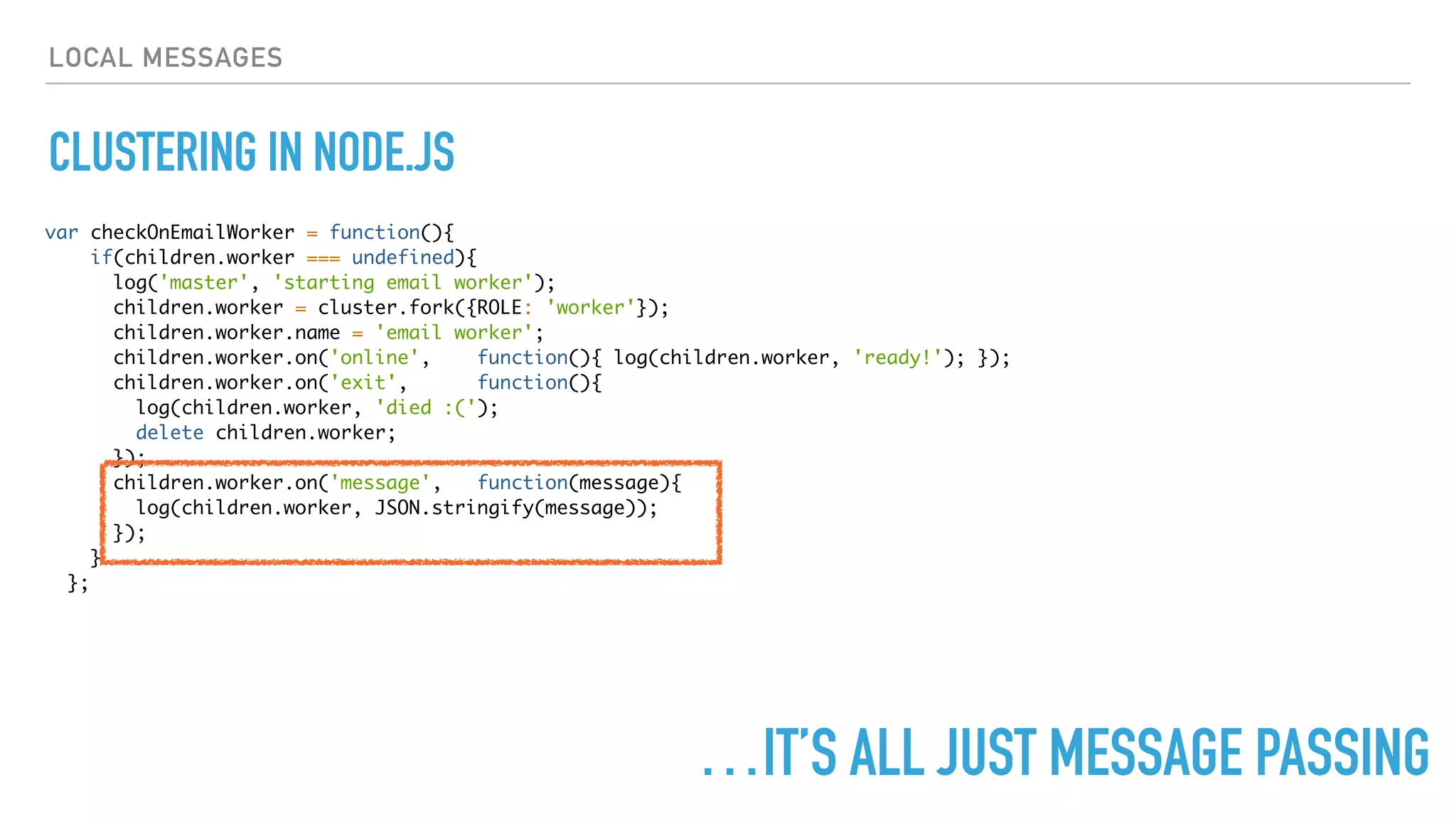
var checkOnEmailWorker = function(){
if(children.worker === undefined){
log('master', 'starting email worker');
children.worker = cluster.fork({ROLE: 'worker'});
children.worker.name = 'email worker';
children.worker.on('online', function(){ log(children.worker, 'ready!'); });
children.worker.on('exit', function(){
log(children.worker, 'died :(');
delete children.worker;
});
children.worker.on('message', function(message){
log(children.worker, JSON.stringify(message));
});
}
};
…IT’S ALL JUST MESSAGE PASSING
LOCAL MESSAGES
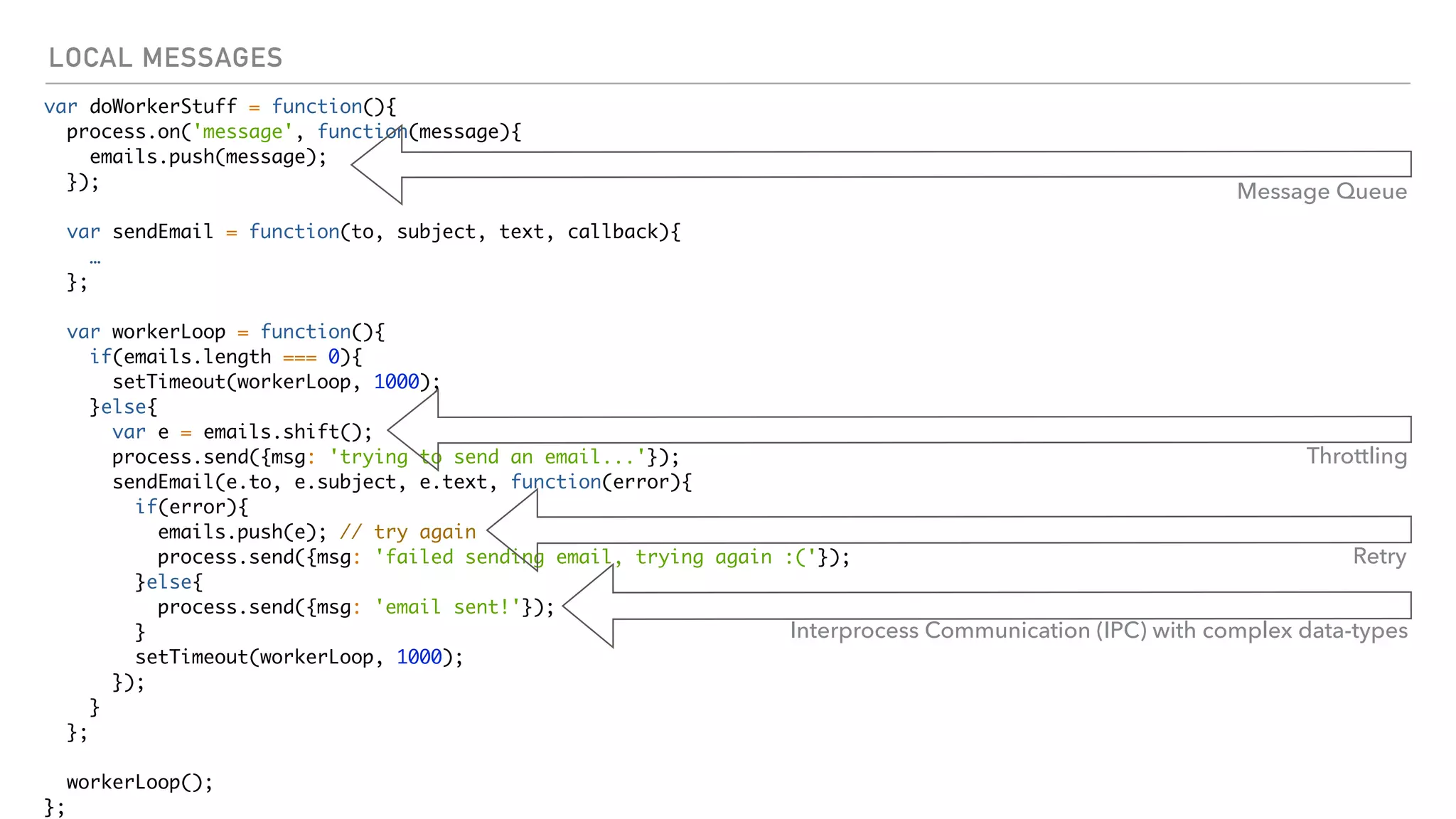
var doWorkerStuff = function(){
process.on('message', function(message){
emails.push(message);
});
var sendEmail = function(to, subject, text, callback){
…
};
var workerLoop = function(){
if(emails.length === 0){
setTimeout(workerLoop, 1000);
}else{
var e = emails.shift();
process.send({msg: 'trying to send an email...'});
sendEmail(e.to, e.subject, e.text, function(error){
if(error){
emails.push(e); // try again
process.send({msg: 'failed sending email, trying again :('});
}else{
process.send({msg: 'email sent!'});
}
setTimeout(workerLoop, 1000);
});
}
};
workerLoop();
};
Message Queue
Throttling
Retry
Interprocess Communication (IPC) with complex data-types
DEMO TIME
LOCAL MESSAGES
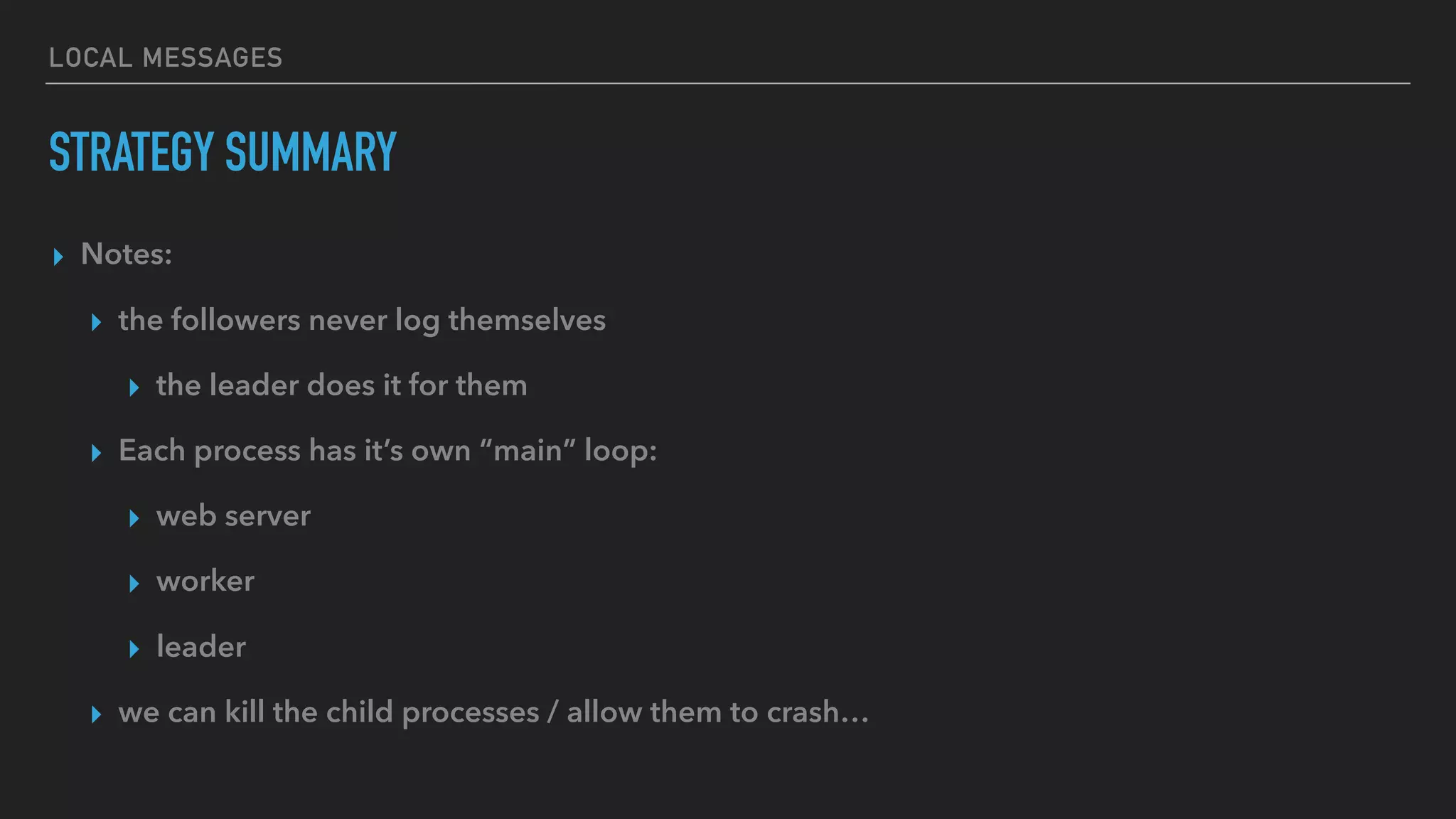
STRATEGY SUMMARY
▸ Notes:
▸ the followers never log themselves
▸ the leader does it for them
▸ Each process has it’s own “main” loop:
▸ web server
▸ worker
▸ leader
▸ we can kill the child processes / allow them to crash…
PARALLEL
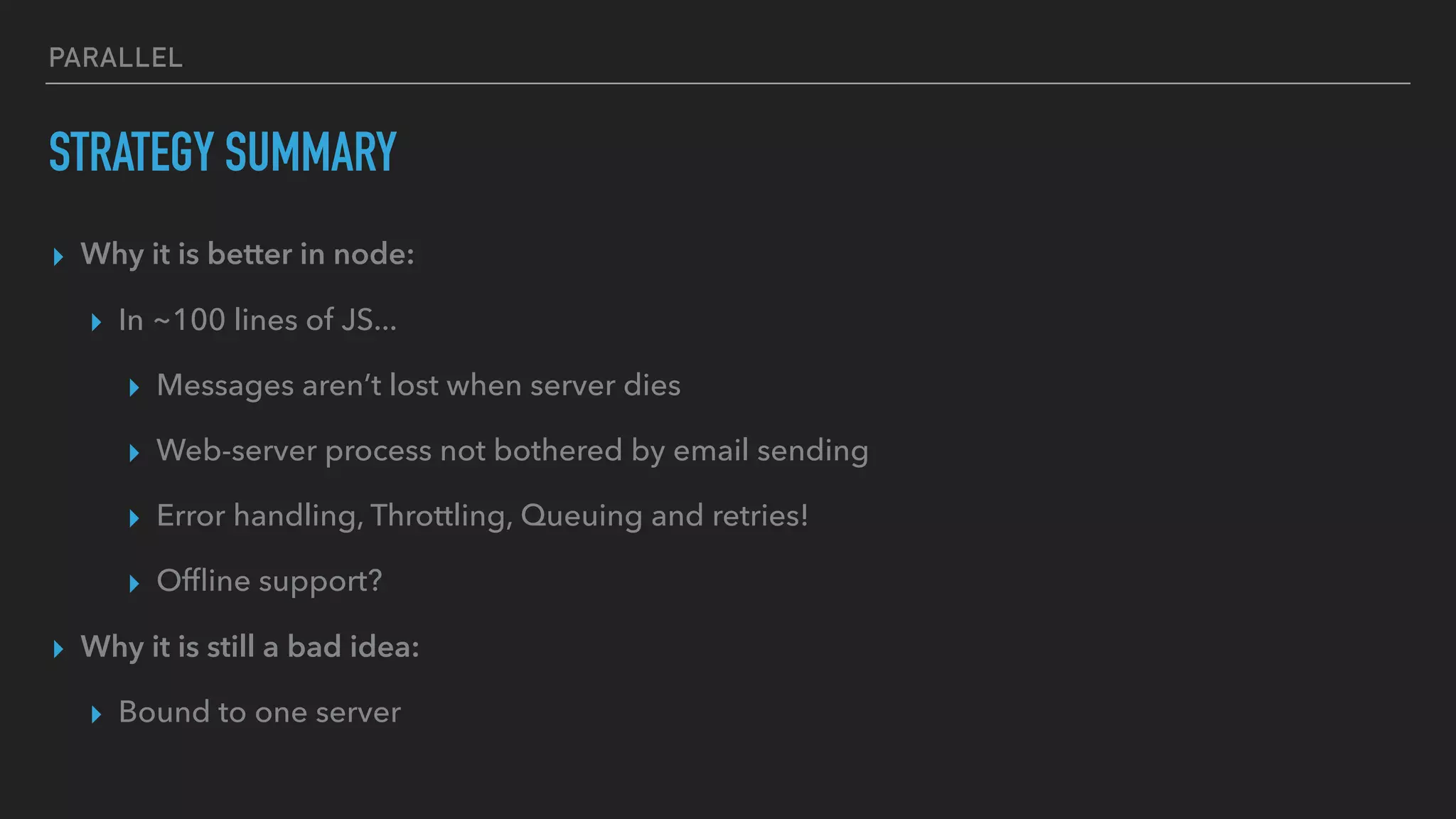
STRATEGY SUMMARY
▸ Why it is better in node:
▸ In ~100 lines of JS...
▸ Messages aren’t lost when server dies
▸ Web-server process not bothered by email sending
▸ Error handling, Throttling, Queuing and retries!
▸ Offline support?
▸ Why it is still a bad idea:
▸ Bound to one server
4) REMOTE MESSAGES
LOCAL MESSAGES
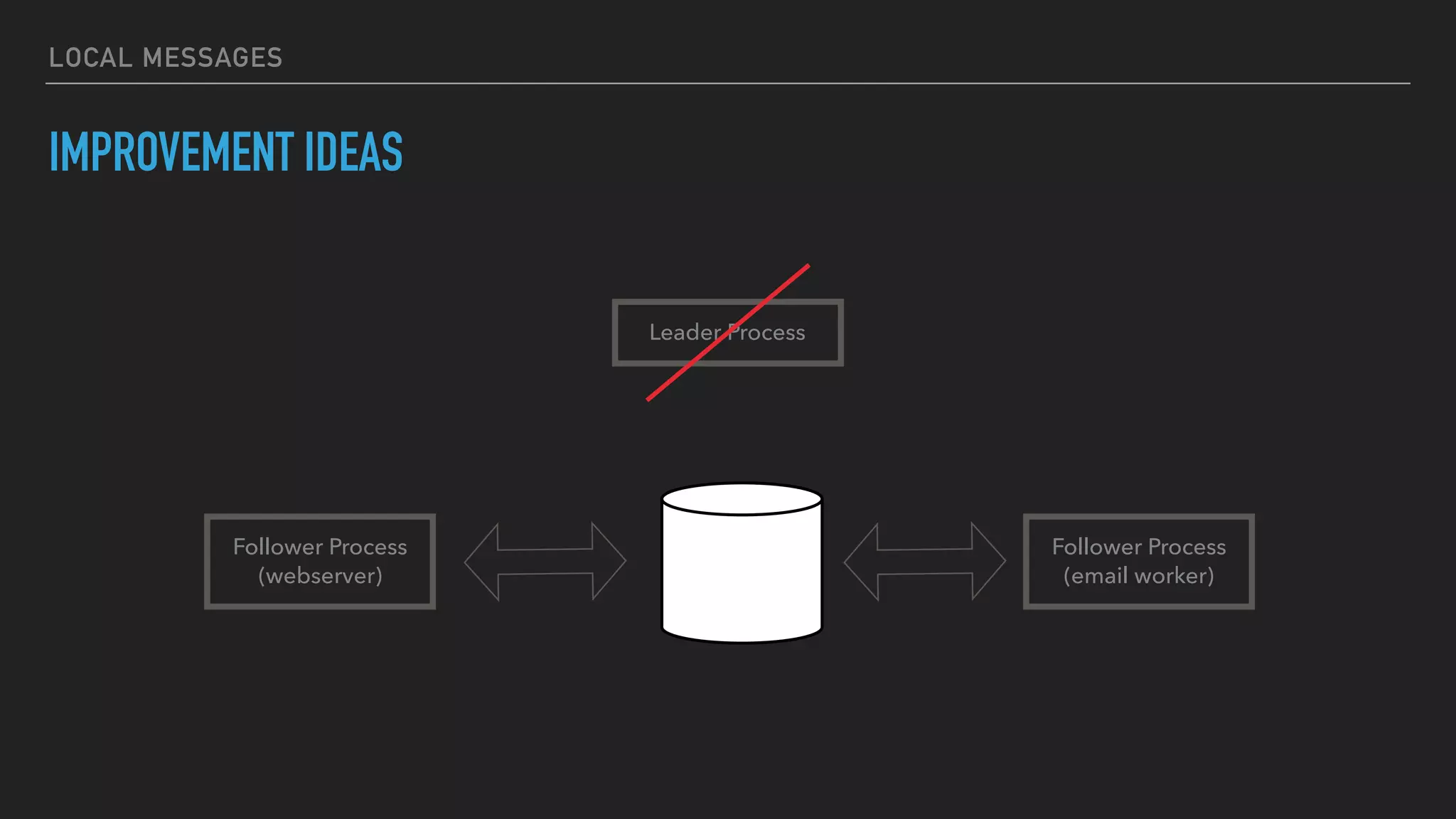
IMPROVEMENT IDEAS
Leader Process
Follower Process
(webserver)
Follower Process
(email worker)
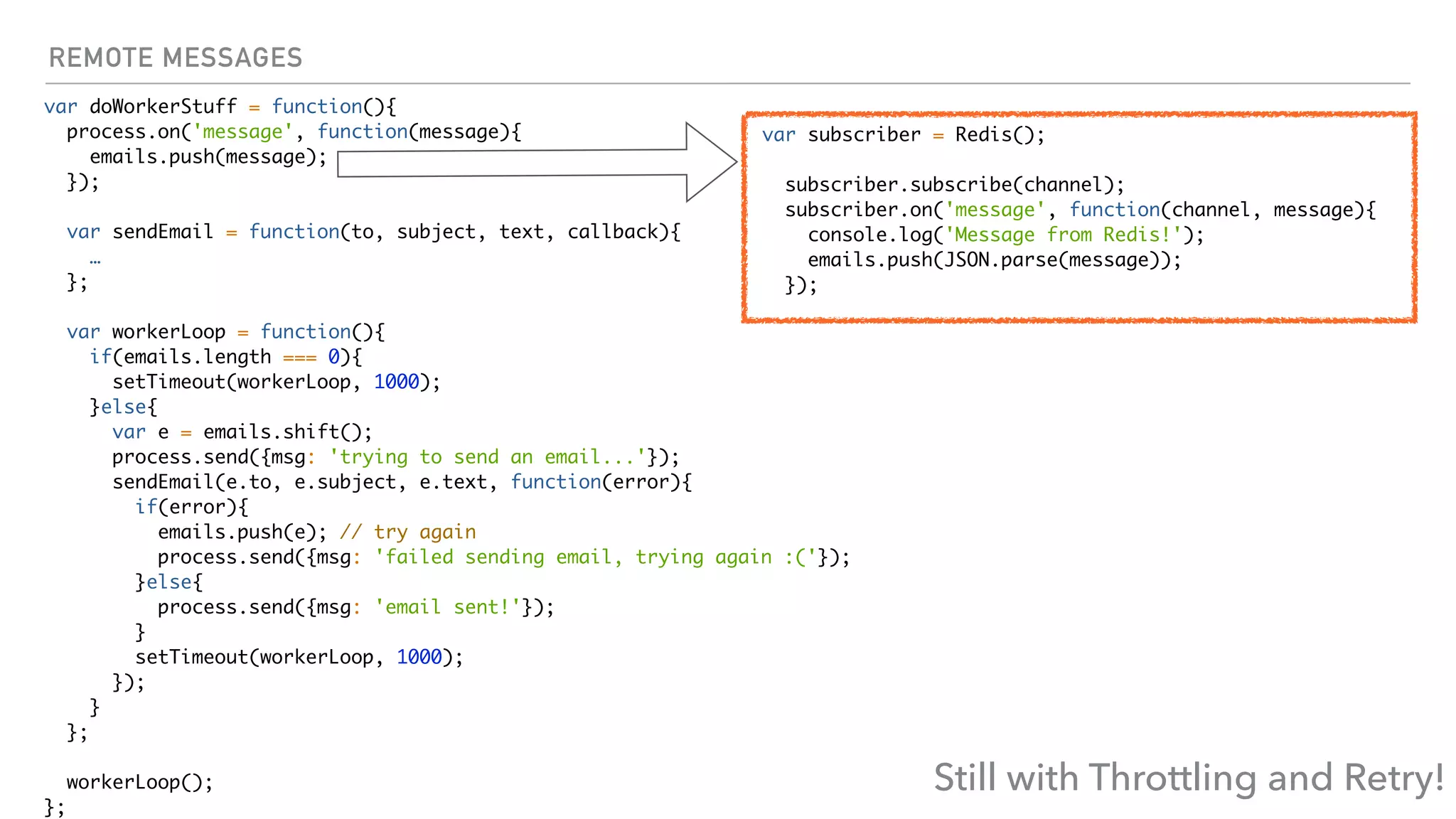
REMOTE MESSAGES
IPC => REDIS PUB/SUB
var doServerStuff = function(){
var server = function(req, res){
var urlParts = req.url.split('/');
var email = {
to: decodeURI(urlParts[1]),
subject: decodeURI(urlParts[2]),
text: decodeURI(urlParts[3]),
};
var response = {email: email};
res.writeHead(200, {'Content-Type': 'application/json'});
res.end(JSON.stringify(response, null, 2));
process.send(email);
};
http.createServer(server).listen(httpPort, '127.0.0.1');
};
var doServerStuff = function(){
var publisher = Redis();
var server = function(req, res){
var urlParts = req.url.split('/');
var email = {
to: decodeURI(urlParts[1]),
subject: decodeURI(urlParts[2]),
text: decodeURI(urlParts[3]),
};
publisher.publish(channel, JSON.stringify(email), function(){
var response = {email: email};
res.writeHead(200, {'Content-Type': 'application/json'});
res.end(JSON.stringify(response, null, 2));
});
};
http.createServer(server).listen(httpPort, httpHost);
console.log('Server running at ' + httpHost + ':' + httpPort);
console.log('send an email and message to /TO_ADDRESS/SUBJECT/YOUR_MESSAGE');
};
REMOTE MESSAGES
var doWorkerStuff = function(){
process.on('message', function(message){
emails.push(message);
});
var sendEmail = function(to, subject, text, callback){
…
};
var workerLoop = function(){
if(emails.length === 0){
setTimeout(workerLoop, 1000);
}else{
var e = emails.shift();
process.send({msg: 'trying to send an email...'});
sendEmail(e.to, e.subject, e.text, function(error){
if(error){
emails.push(e); // try again
process.send({msg: 'failed sending email, trying again :('});
}else{
process.send({msg: 'email sent!'});
}
setTimeout(workerLoop, 1000);
});
}
};
workerLoop();
};
var subscriber = Redis();
subscriber.subscribe(channel);
subscriber.on('message', function(channel, message){
console.log('Message from Redis!');
emails.push(JSON.parse(message));
});
Still with Throttling and Retry!
DEMO TIME
PARALLEL
STRATEGY SUMMARY
▸ Why it is better in node:
▸ Redis Drivers are awesome
▸ Message Buffering (for connection errors)
▸ Thread-pools
▸ Good language features (promises and callbacks)
▸ Now we can use more than one server!
▸ Why it is still a bad idea:
▸ You can only have 1 type of server
5) REMOTE QUEUE
REMOTE QUEUE
IMPROVEMENT IDEAS
▸ Observability
▸ How long is the queue?
▸ How long does an item wait in the queue?
▸ Operational Monitoring
▸ Redundancy
▸ Backups
▸ Clustering
REMOTE QUEUE
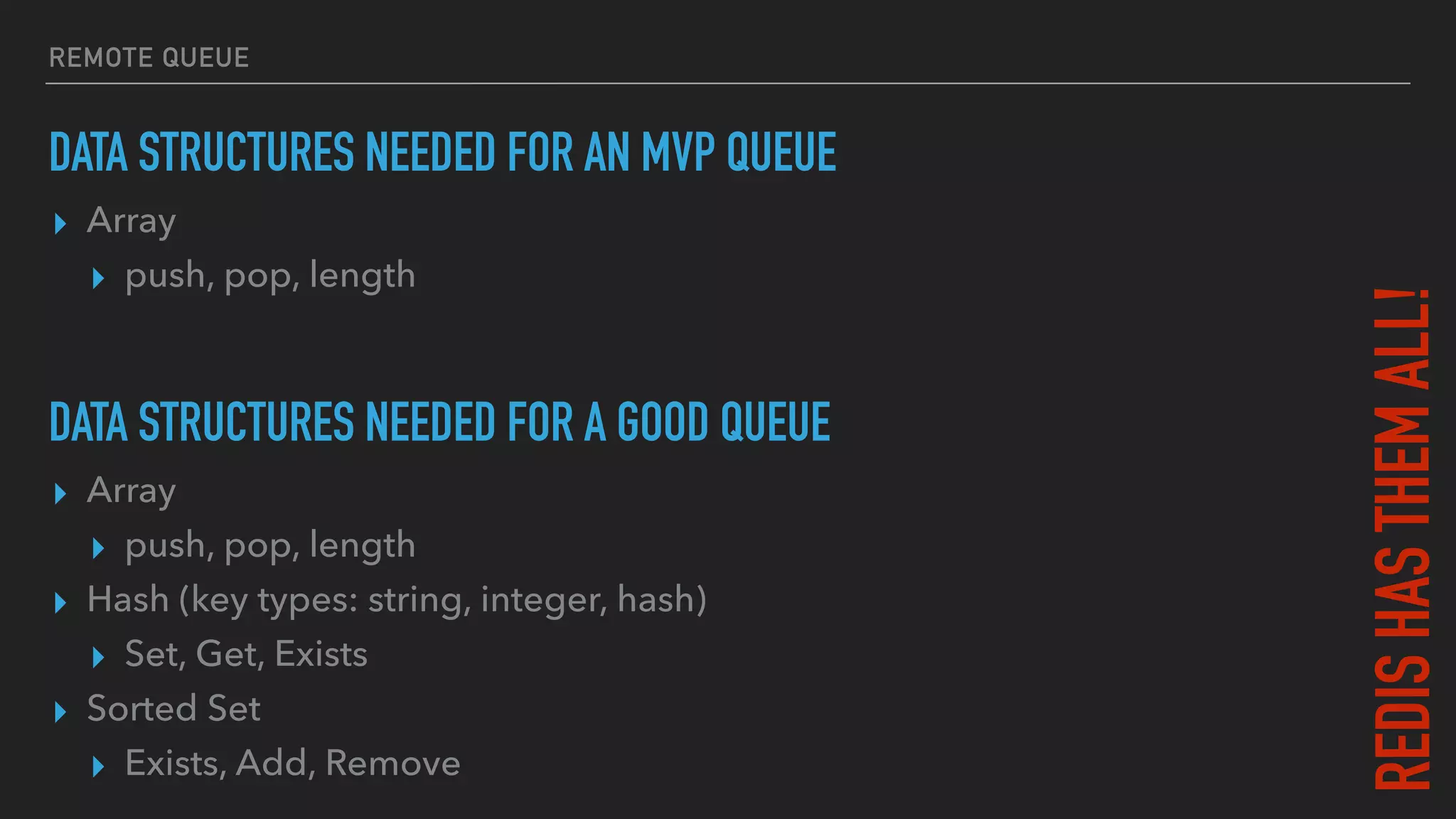
DATA STRUCTURES NEEDED FOR AN MVP QUEUE
▸ Array
▸ push, pop, length
DATA STRUCTURES NEEDED FOR A GOOD QUEUE
▸ Array
▸ push, pop, length
▸ Hash (key types: string, integer, hash)
▸ Set, Get, Exists
▸ Sorted Set
▸ Exists, Add, Remove
REDISHASTHEMALL!
LOCAL MESSAGES
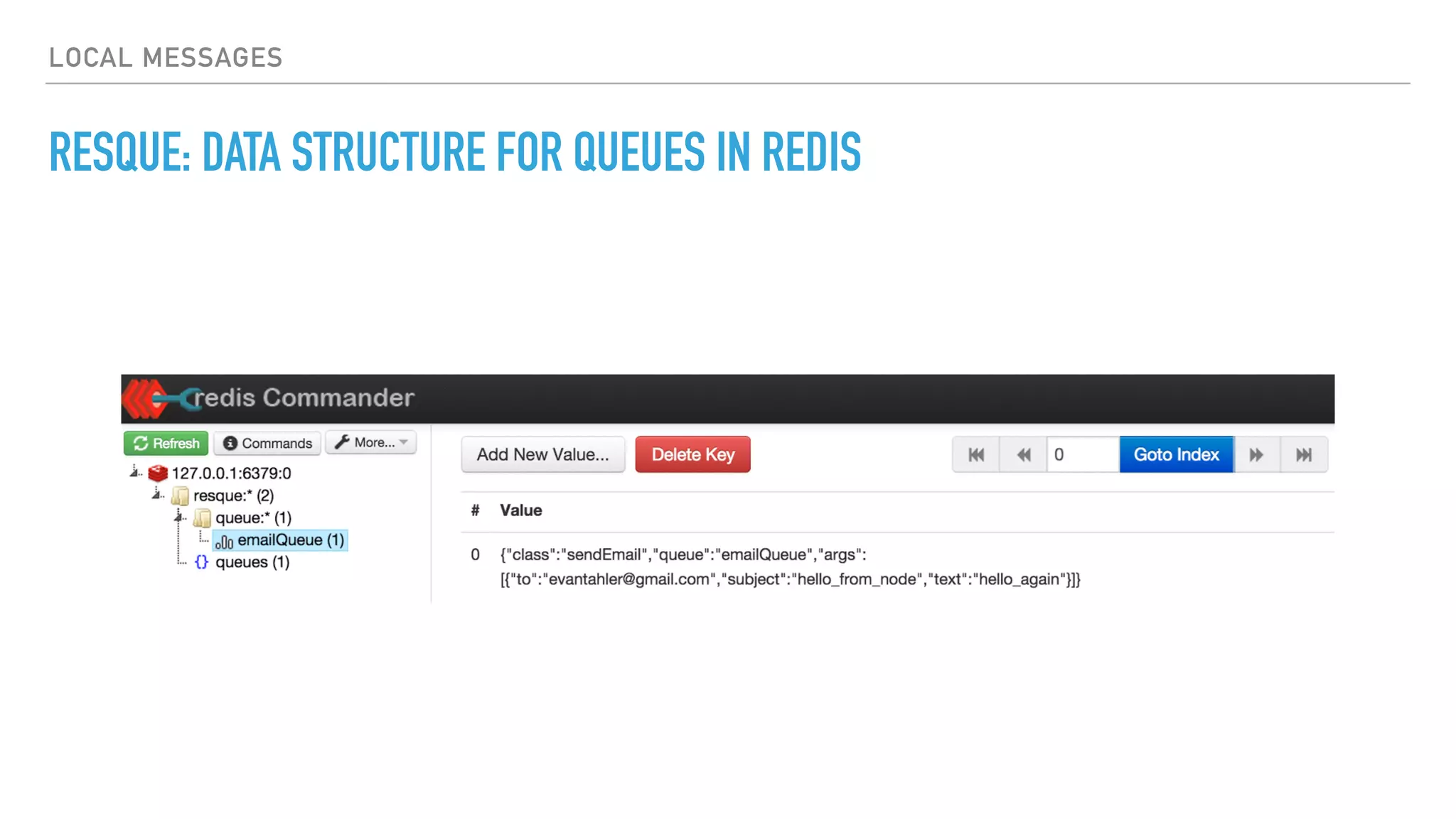
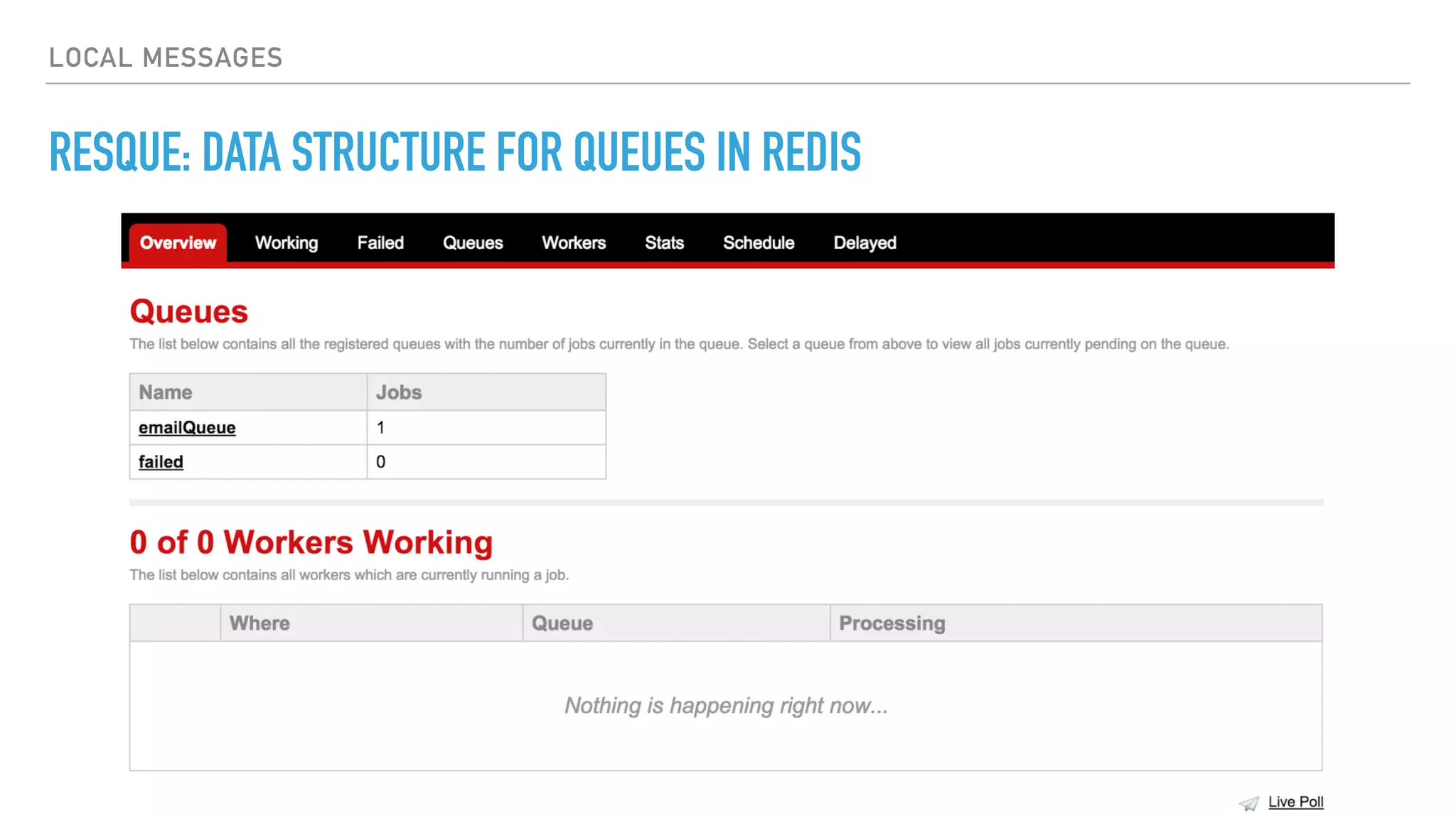
RESQUE: DATA STRUCTURE FOR QUEUES IN REDIS
var NR = require('node-resque');
var queue = new NR.queue({connection: connectionDetails}, jobs);
queue.on('error', function(error){ console.log(error); });
queue.connect(function(){
queue.enqueue('math', "add", [1,2]);
queue.enqueueIn(3000, 'math', "subtract", [2,1]);
});
delay queue method arguments
LOCAL MESSAGES
RESQUE: DATA STRUCTURE FOR QUEUES IN REDIS
LOCAL MESSAGES
RESQUE: DATA STRUCTURE FOR QUEUES IN REDIS
LOCAL MESSAGES
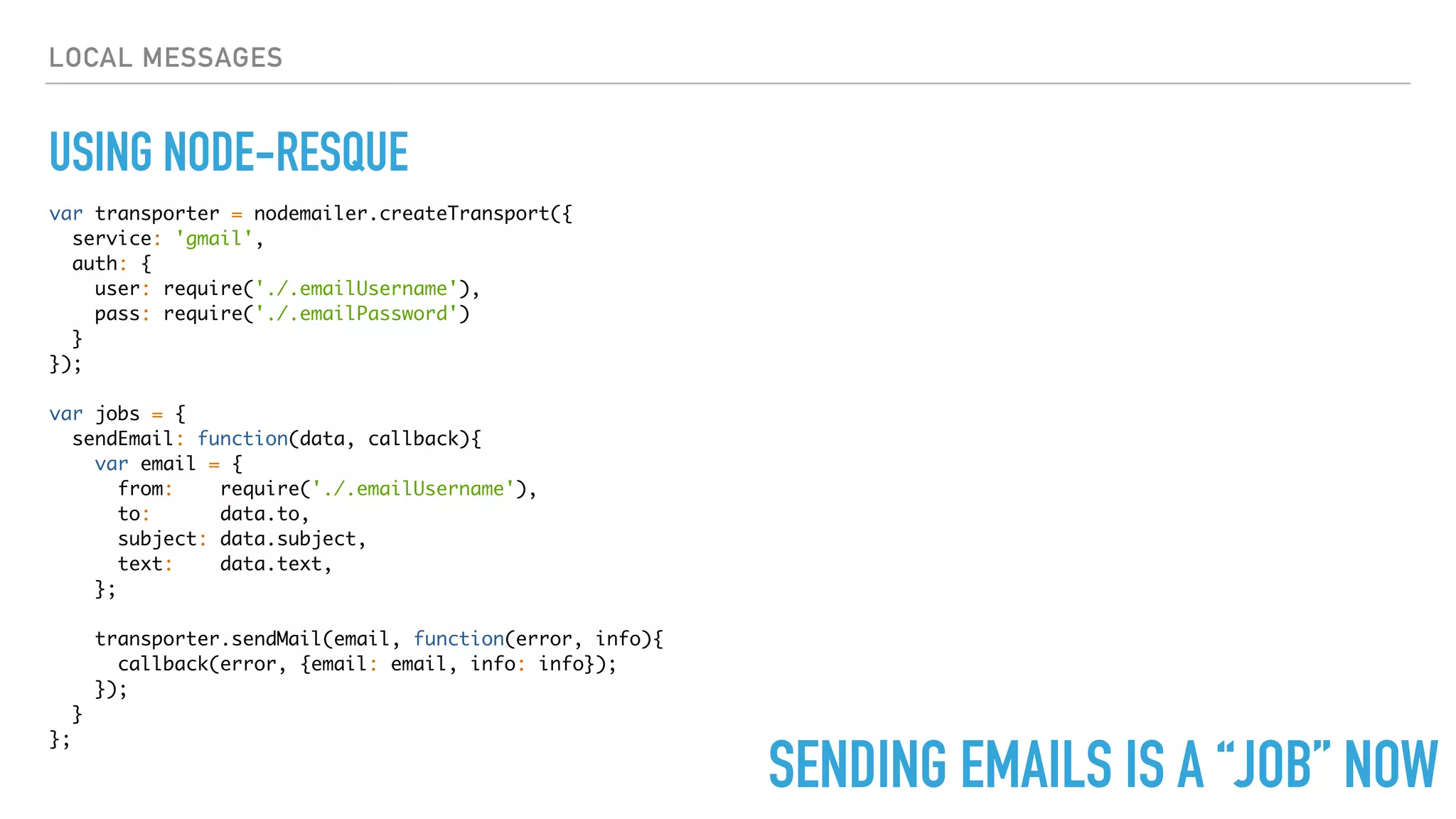
USING NODE-RESQUE
var transporter = nodemailer.createTransport({
service: 'gmail',
auth: {
user: require('./.emailUsername'),
pass: require('./.emailPassword')
}
});
var jobs = {
sendEmail: function(data, callback){
var email = {
from: require('./.emailUsername'),
to: data.to,
subject: data.subject,
text: data.text,
};
transporter.sendMail(email, function(error, info){
callback(error, {email: email, info: info});
});
}
};
SENDING EMAILS IS A “JOB” NOW
LOCAL MESSAGES
USING NODE-RESQUE
var server = function(req, res){
var urlParts = req.url.split('/');
var email = {
to: decodeURI(urlParts[1]),
subject: decodeURI(urlParts[2]),
text: decodeURI(urlParts[3]),
};
queue.enqueue('emailQueue', "sendEmail", email, function(error){
if(error){ console.log(error) }
var response = {email: email};
res.writeHead(200, {'Content-Type': 'application/json'});
res.end(JSON.stringify(response, null, 2));
});
};
var queue = new NR.queue({connection: connectionDetails}, jobs);
queue.connect(function(){
http.createServer(server).listen(httpPort, httpHost);
console.log('Server running at ' + httpHost + ':' + httpPort);
console.log('send an email and message to /TO_ADDRESS/SUBJECT/YOUR_MESSAGE');
});
LOCAL MESSAGES
USING NODE-RESQUE
var worker = new NR.worker({connection: connectionDetails, queues: ['emailQueue']}, jobs);
worker.connect(function(){
worker.workerCleanup();
worker.start();
});
worker.on('start', function(){ console.log("worker started"); });
worker.on('end', function(){ console.log("worker ended"); });
worker.on('cleaning_worker', function(worker, pid){ console.log("cleaning old worker " + worker); });
worker.on('poll', function(queue){ console.log("worker polling " + queue); });
worker.on('job', function(queue, job){ console.log("working job " + queue + " " + JSON.stringify(job)); });
worker.on('reEnqueue', function(queue, job, plugin){ console.log("reEnqueue job (" + plugin + ") " + queue + " " + JSON.stringify(job)); });
worker.on('success', function(queue, job, result){ console.log("job success " + queue + " " + JSON.stringify(job) + " >> " + result); });
worker.on('failure', function(queue, job, failure){ console.log("job failure " + queue + " " + JSON.stringify(job) + " >> " + failure); });
worker.on('error', function(queue, job, error){ console.log("error " + queue + " " + JSON.stringify(job) + " >> " + error); });
worker.on('pause', function(){ console.log("worker paused"); });
DEMO TIME
BUT WHAT IS SO SPECIAL ABOUT NODE.JS HERE?
REMOTE QUEUE
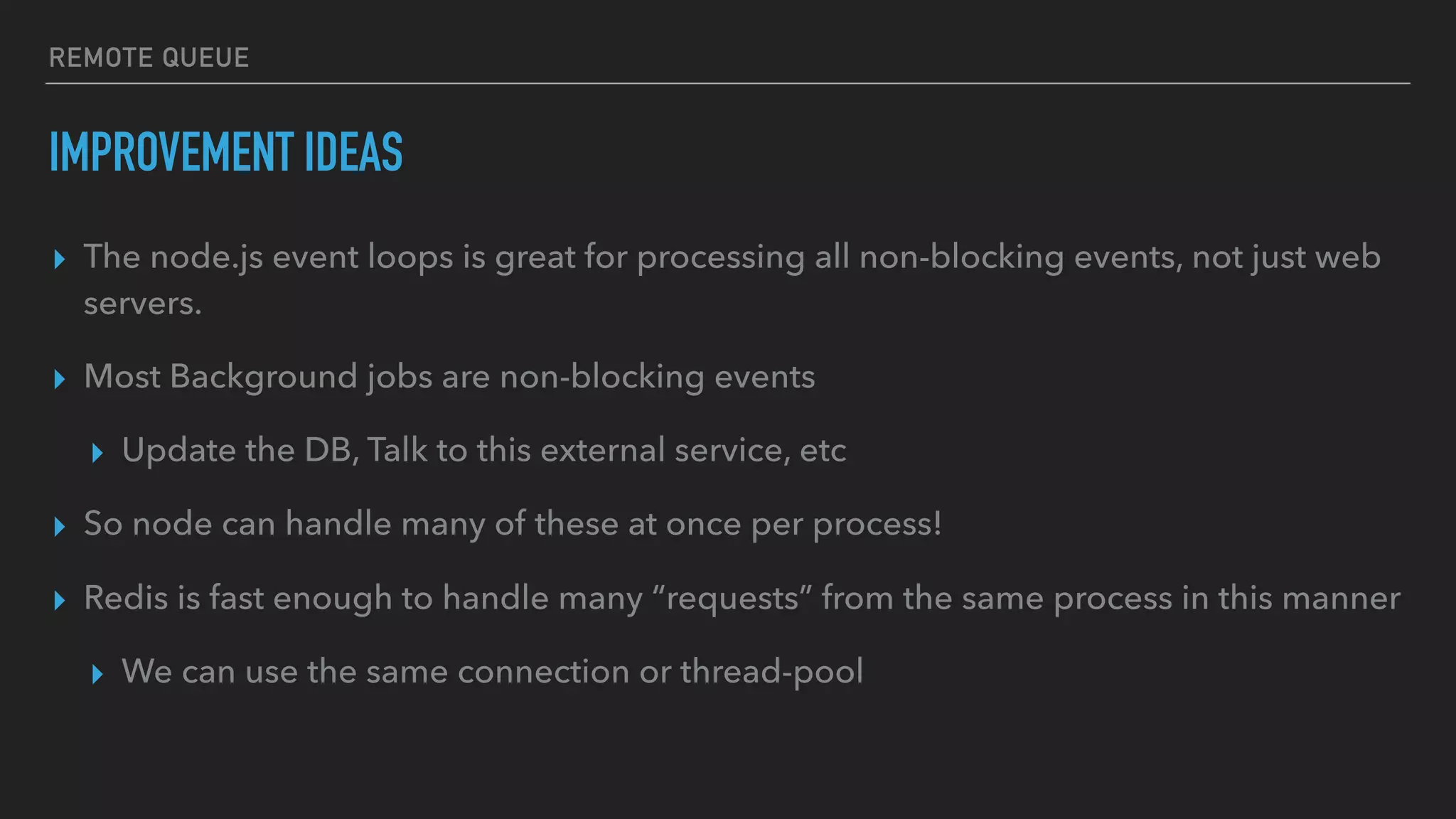
IMPROVEMENT IDEAS
▸ The node.js event loops is great for processing all non-blocking events, not just web
servers.
▸ Most Background jobs are non-blocking events
▸ Update the DB, Talk to this external service, etc
▸ So node can handle many of these at once per process!
▸ Redis is fast enough to handle many “requests” from the same process in this manner
▸ We can use the same connection or thread-pool
LOCAL MESSAGES
USING NODE-RESQUE AND MAXIMIZING THE EVENT LOOP
var multiWorker = new NR.multiWorker({
connection: connectionDetails,
queues: ['slowQueue'],
minTaskProcessors: 1,
maxTaskProcessors: 20,
}, jobs);
var jobs = {
"slowSleepJob": {
plugins: [],
pluginOptions: {},
perform: function(callback){
var start = new Date().getTime();
setTimeout(function(){
callback(null, (new Date().getTime() - start) );
}, 1000);
},
},
"slowCPUJob": {
plugins: [],
pluginOptions: {},
perform: function(callback){
var start = new Date().getTime();
blockingSleep(1000);
callback(null, (new Date().getTime() - start) );
},
},
};
non-blocking
blocking
var blockingSleep = function(naptime){
var sleeping = true;
var now = new Date();
var alarm;
var startingMSeconds = now.getTime();
while(sleeping){
alarm = new Date();
var alarmMSeconds = alarm.getTime();
if(alarmMSeconds - startingMSeconds > naptime){ sleeping = false; }
}
};
LOCAL MESSAGES
HOW CAN YOU TELL IF THE EVENT LOOP IS BLOCKED?
// inspired by https://github.com/tj/node-blocked
module.exports = function(limit, interval, fn) {
var start = process.hrtime();
setInterval(function(){
var delta = process.hrtime(start);
var nanosec = delta[0] * 1e9 + delta[1];
var ms = nanosec / 1e6;
var n = ms - interval;
if (n > limit){
fn(true, Math.round(n));
}else{
fn(false, Math.round(n));
}
start = process.hrtime();
}, interval).unref();
};
… SEE HOW LONG IT TAKES FOR THE NEXT “LOOP”
DEMO TIME
REMOTE QUEUE
REDIS
▸ Redis has unique properties that make it perfect for this type of workload
▸ FAST
▸ Single-threaded so you can have real array operations (pop specifically)
▸ Data-structure creation on the fly (new queues)
▸ Dependent on only RAM and network
PARALLEL
STRATEGY SUMMARY
▸ Why it is better in node:
▸ In addition to persistent storage and multiple server/process support, you
get get CPU scaling and Throttling very simply!
▸ Integrates well with the resque/sidekiq ecosystem
▸ This is now a good idea!
6) IMMUTABLE EVENT BUSThe Future… Maybe
IMMUTABLE EVENT BUS
IMPROVEMENT IDEAS
▸ What was wrong with the resque pattern?
▸ Jobs are consumed and deleted… no historical introspection
▸ In redis, storing more and more events to a single key gains nothing from
redis-cluster
▸ If you wanted to do more than one thing on user#create, you would need to
fire many jobs
▸ What if we just fired a “user_created” event and let the workers choose what
to do?
IMMUTABLE EVENT BUS
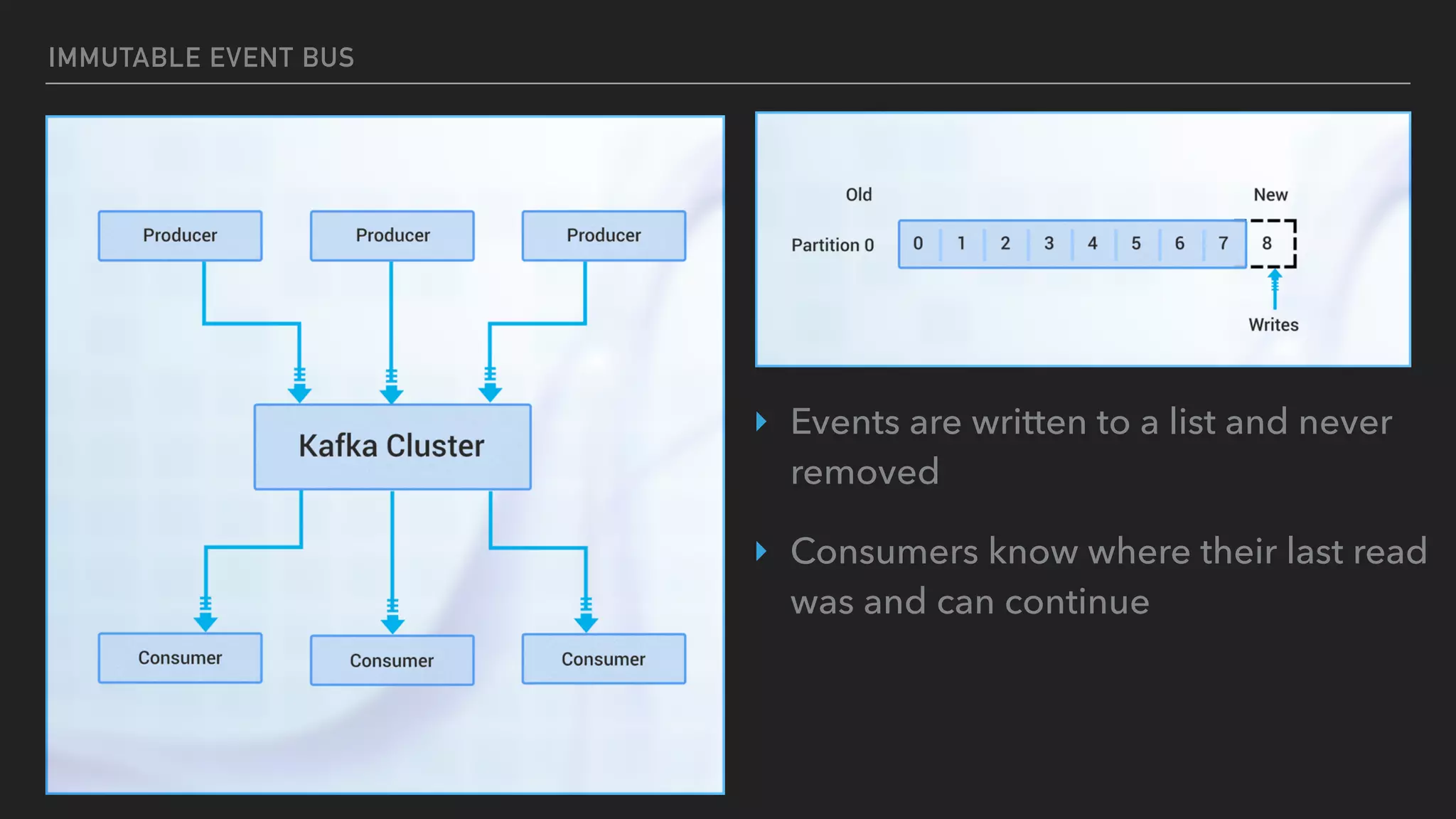
‣ Events are written to a list and never
removed
‣ Consumers know where their last read
was and can continue
IMMUTABLE EVENT BUS
IMPROVEMENT IDEAS
▸ What to we need that redis cannot do natively
▸ A “blocking” get and incr
▸ Tools to seek for “the next key” for listing partitions
… GOOD THING WE HAVE LUA!
IMMUTABLE EVENT BUS
LUA LIKE A BOSS…
local name = ARGV[1]
local partition = "eventr:partitions:" .. ARGV[2]
local coutnerKey = "eventr:counters:" .. ARGV[2]
-- If we have a key already for this name, look it up
local counter = 0
if redis.call("HEXISTS", coutnerKey, name) == 1 then
counter = redis.call("HGET", coutnerKey, name)
counter = tonumber(counter)
end
-- if the partition exists, get the data from that key
if redis.call("EXISTS", partition) == 0 then
return nil
else
local event = redis.call("LRANGE", partition, counter, counter)
if (event and event[1] ~= nil) then
redis.call("HSET", coutnerKey, name, (counter + 1))
return event[1]
else
return nil
end
end
IMMUTABLE EVENT BUS
SENDING EMAILS IS NOW A HANDLER
var handlers = [
{
name: 'email handler',
perform: function(event, callback){
if(event.eventName === 'emailEvent'){
var email = {
from: require('./.emailUsername'),
to: event.email.to,
subject: event.email.subject,
text: event.email.text,
};
transporter.sendMail(email, function(error, info){
callback(error, {email: email, info: info});
});
}else{
return callback();
}
}
}
];
var consumer = new eventr('myApp', connectionDetails, handlers);
consumer.work();
IMMUTABLE EVENT BUS
THE WEB SERVER PUBLISHES EVENTS
var server = function(req, res){
var urlParts = req.url.split('/');
var email = {
to: decodeURI(urlParts[1]),
subject: decodeURI(urlParts[2]),
text: decodeURI(urlParts[3]),
};
producer.write({
eventName: 'emailEvent',
email: email
}, function(error){
if(error){ console.log(error) }
var response = {email: email};
res.writeHead(200, {'Content-Type': 'application/json'});
res.end(JSON.stringify(response, null, 2));
});
};
var producer = new eventr('webApp', connectionDetails);
http.createServer(server).listen(httpPort, httpHost);
IMMUTABLE EVENT BUS
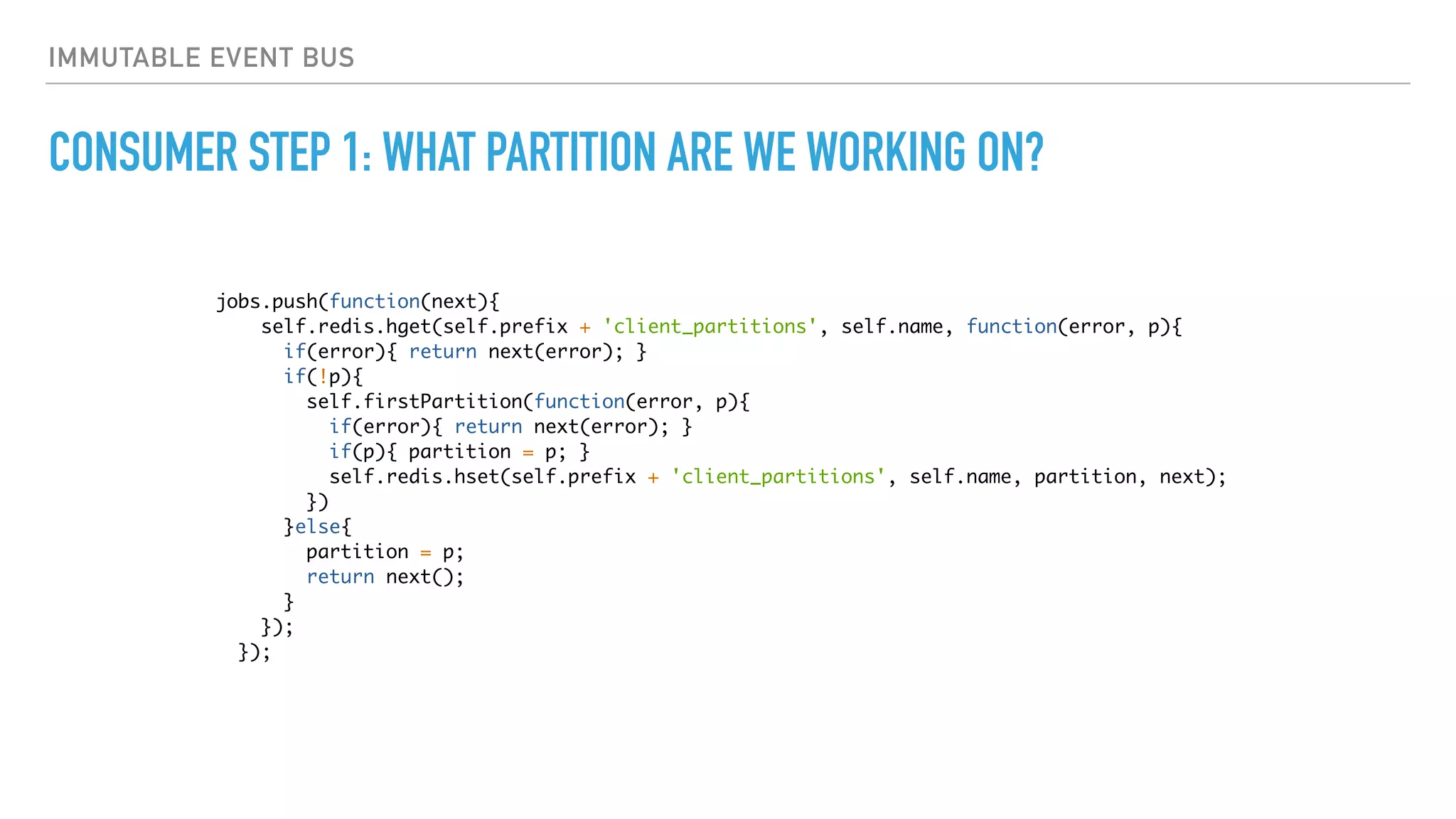
CONSUMER STEP 1: WHAT PARTITION ARE WE WORKING ON?
jobs.push(function(next){
self.redis.hget(self.prefix + 'client_partitions', self.name, function(error, p){
if(error){ return next(error); }
if(!p){
self.firstPartition(function(error, p){
if(error){ return next(error); }
if(p){ partition = p; }
self.redis.hset(self.prefix + 'client_partitions', self.name, partition, next);
})
}else{
partition = p;
return next();
}
});
});
IMMUTABLE EVENT BUS
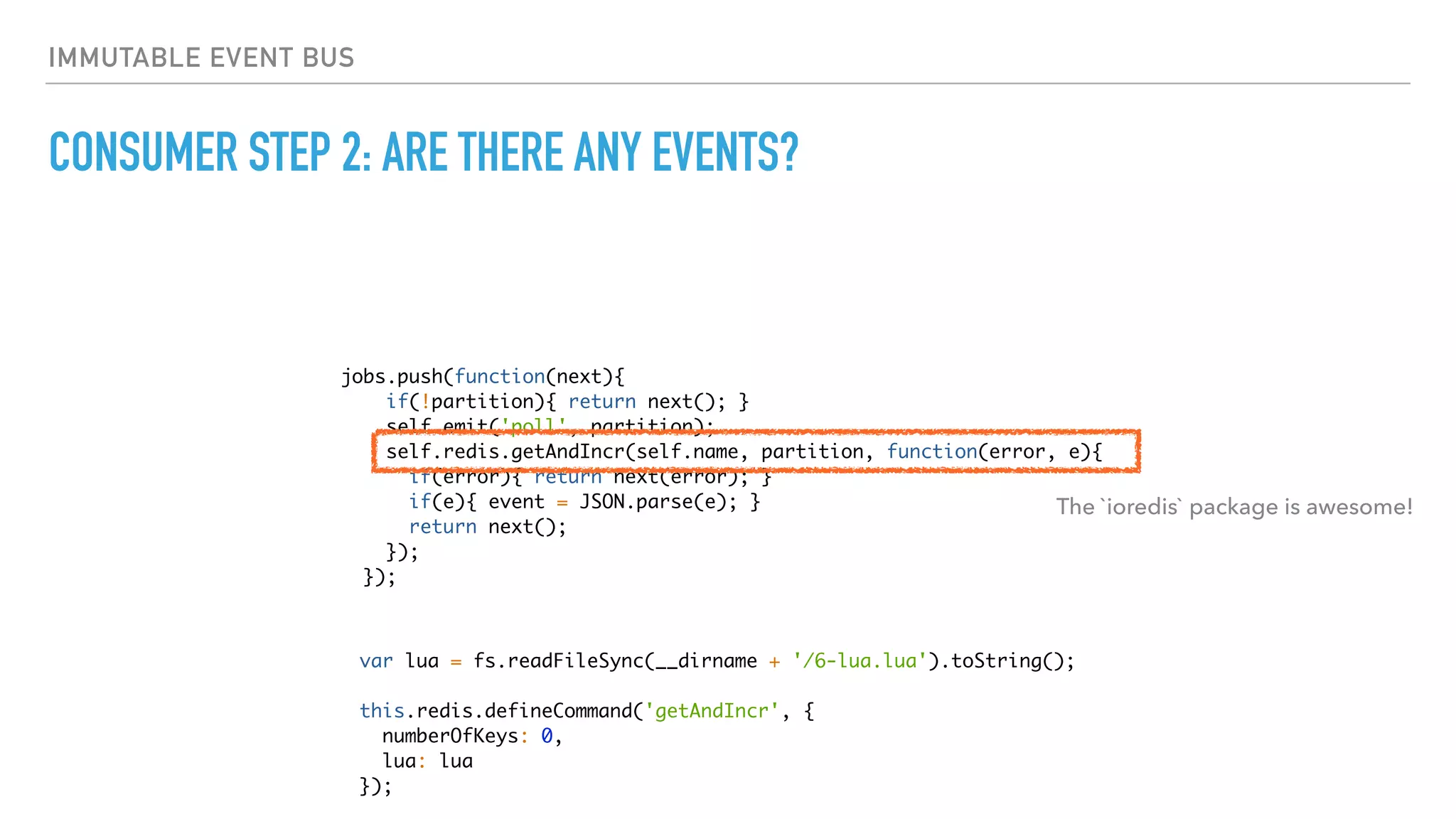
CONSUMER STEP 2: ARE THERE ANY EVENTS?
jobs.push(function(next){
if(!partition){ return next(); }
self.emit('poll', partition);
self.redis.getAndIncr(self.name, partition, function(error, e){
if(error){ return next(error); }
if(e){ event = JSON.parse(e); }
return next();
});
});
The `ioredis` package is awesome!
var lua = fs.readFileSync(__dirname + '/6-lua.lua').toString();
this.redis.defineCommand('getAndIncr', {
numberOfKeys: 0,
lua: lua
});
IMMUTABLE EVENT BUS
CONSUMER STEP 3: TRY THE NEXT PARTITION
jobs.push(function(next){
if(!partition){ return next(); }
if(event){ return next(); }
self.nextPartition(partition, function(error, nextPartition){
if(nextPartition){
self.redis.hset(self.prefix + 'client_partitions', self.name, nextPartition, next);
}else{
next();
}
});
});
eventr.prototype.nextPartition = function(partition, callback){
var self = this;
self.redis.zrank(self.prefix + 'partitions', partition, function(error, position){
if(error){ return callback(error); }
self.redis.zrange(self.prefix + 'partitions', (position + 1), (position + 1), function(error, partitions){
if(error){ return callback(error); }
return callback(null, partitions[0]);
});
});
}
DEMO TIME
PARALLEL
STRATEGY SUMMARY
▸ Why it is better in node:
▸ Just like with Resque, we can poll/stream many events at once (non-blocking).
▸ We can now make use of Redis Cluster’s key distribution
▸ Is this a bad idea?
▸ Maybe.
▸ We would need a lot of LUA. We are actively slowing down Redis to preform more operations in a
single block.
▸ Do we really need to store our history in Ram? Wouldn’t disk be better?
▸ We’ll need to delete the old keys after a while
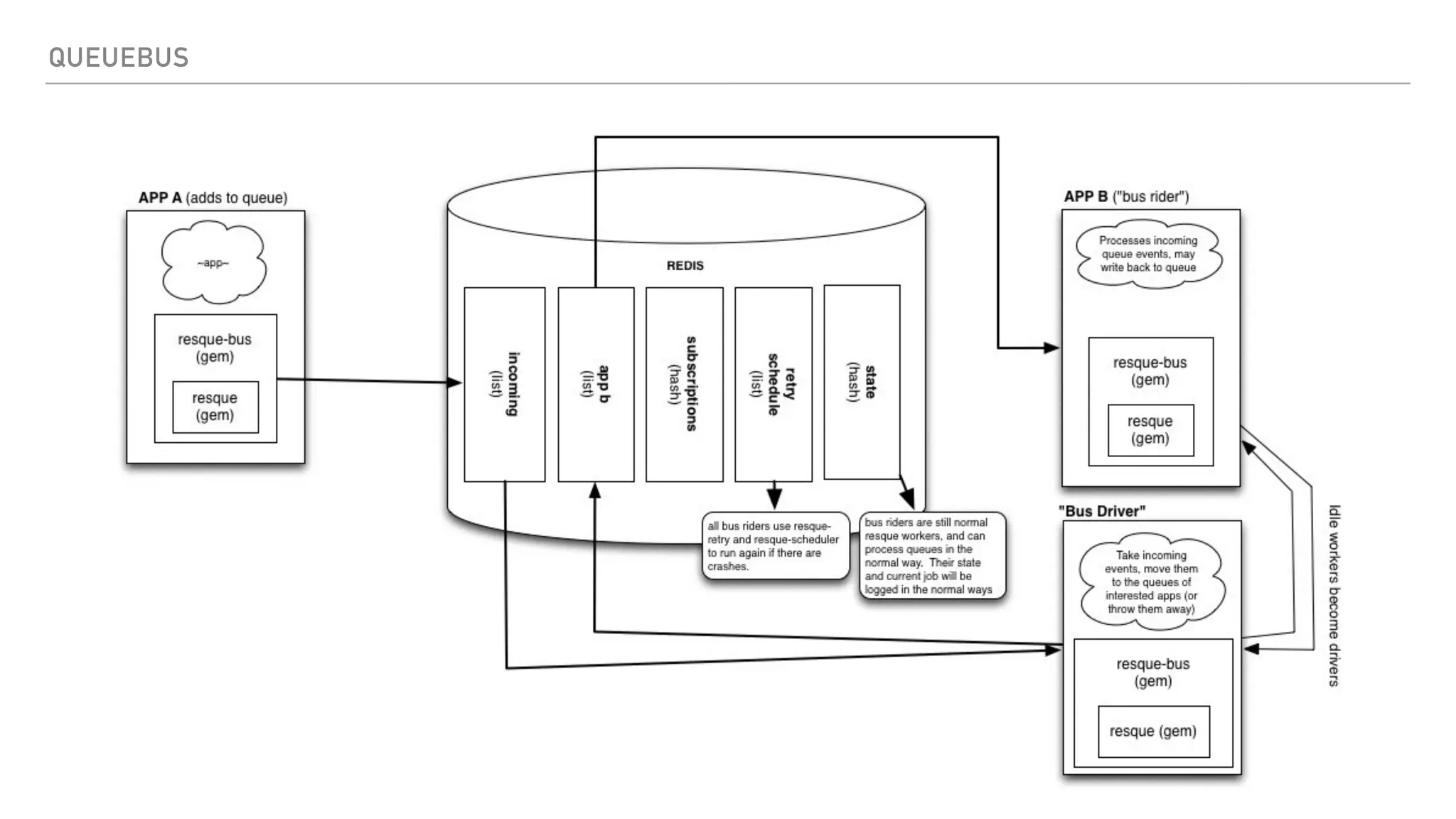
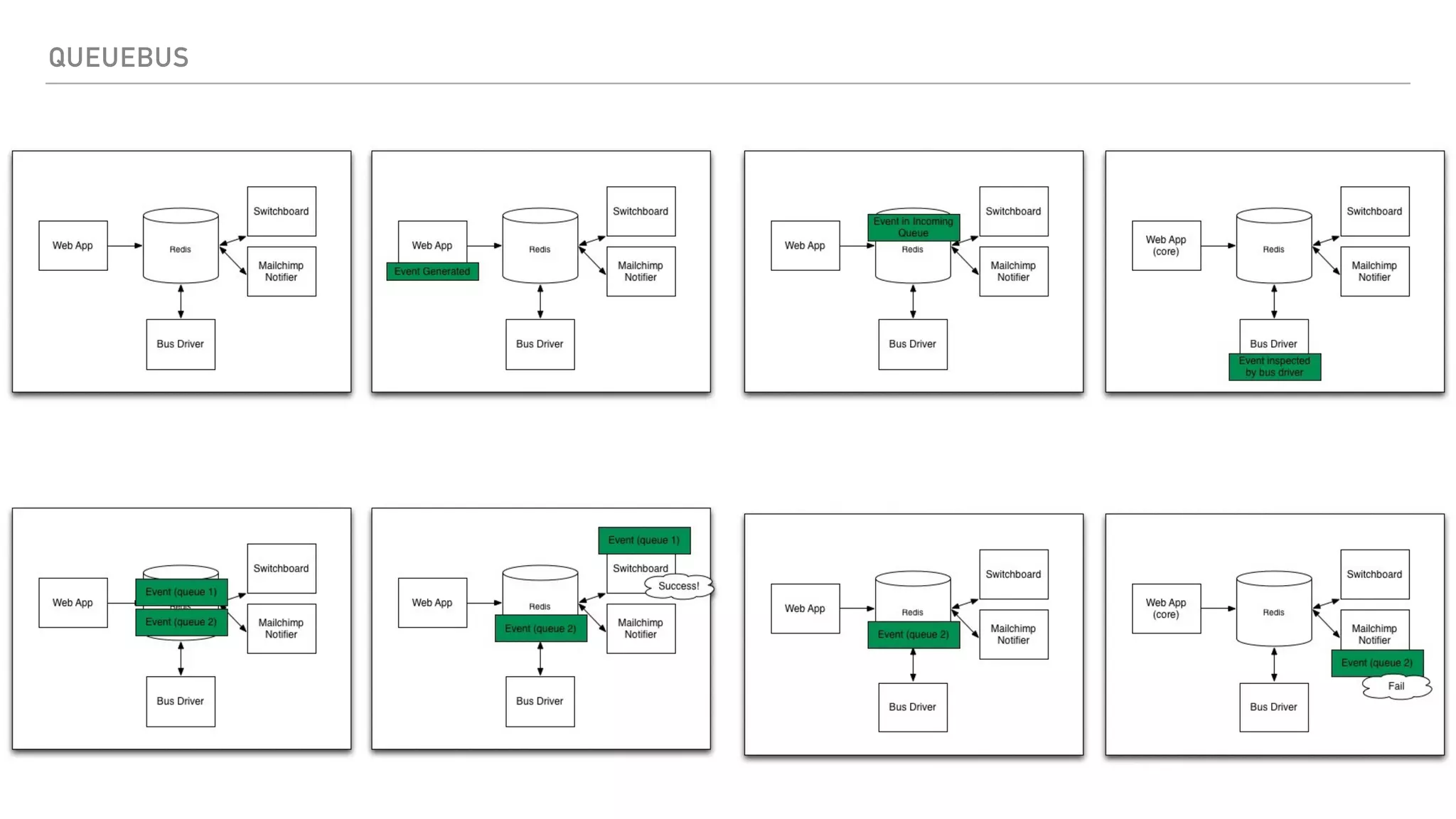
CAN WE WE MEET IN THE MIDDLE
OF “IMMUTABLE EVENT BUS” +
“RESQUE”?
QUEUEBUS
QUEUEBUS
QUEUEBUS
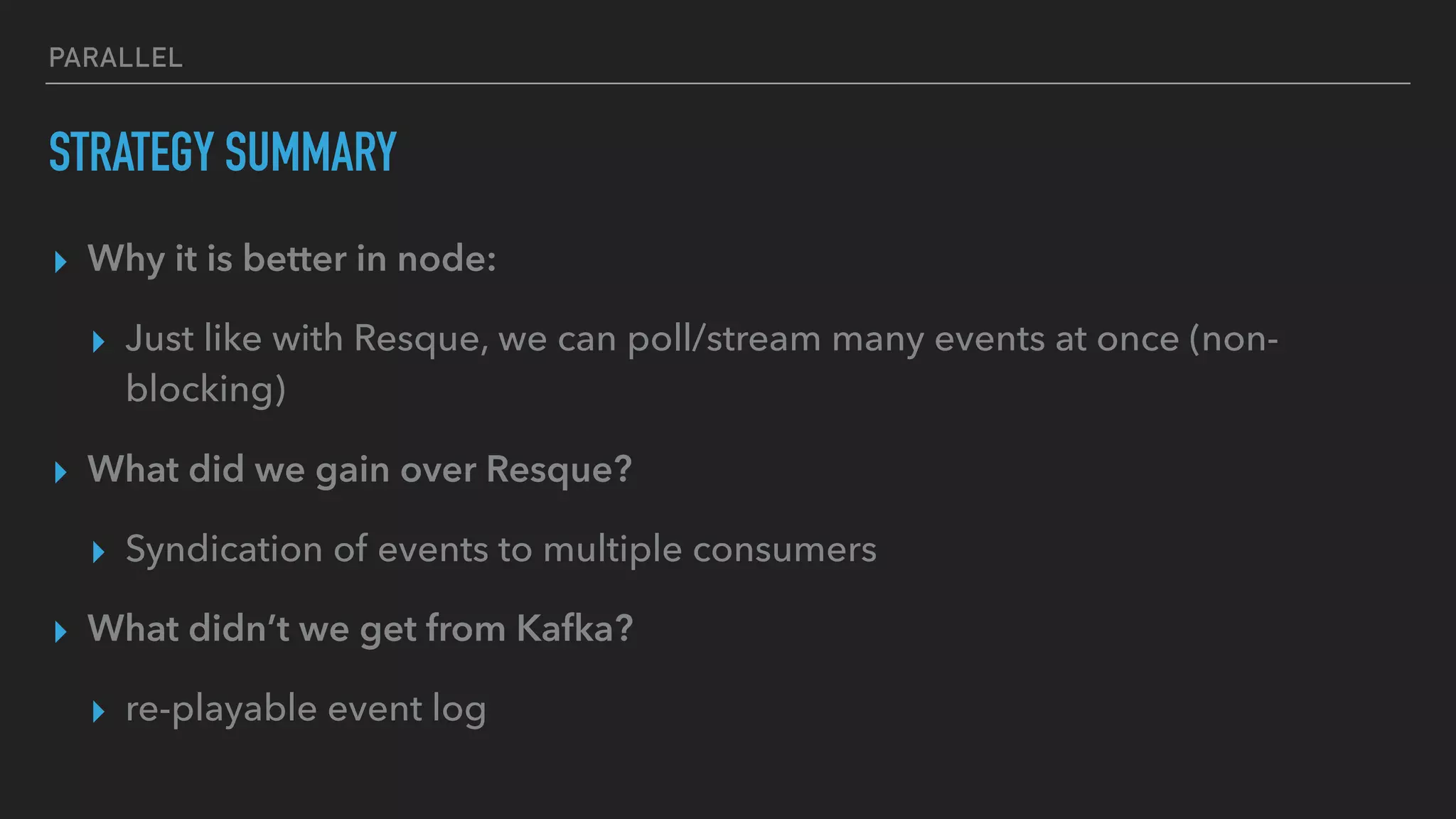
PARALLEL
STRATEGY SUMMARY
▸ Why it is better in node:
▸ Just like with Resque, we can poll/stream many events at once (non-
blocking)
▸ What did we gain over Resque?
▸ Syndication of events to multiple consumers
▸ What didn’t we get from Kafka?
▸ re-playable event log
POSSIBLE TASK STRATEGIES:
FOREGROUND (IN-LINE)
PARALLEL (THREAD-ISH)
LOCAL MESSAGES (FORK-ISH)
REMOTE MESSAGES (*MQ-ISH)
REMOTE QUEUE (REDIS + RESQUE)
IMMUTABLE EVENT BUS (KAFKA-ISH)
THANKS!
IOREDIS: GITHUB.COM/LUIN/IOREDIS
NODE-MAILER: GITHUB.COM/NODEMAILER/NODEMAILER
ASYNC: GITHUB.COM/CAOLAN/ASYNC
SUPPORTING PROJECT + SLIDES:
https://github.com/evantahler/background_jobs_node
NODE-RESQUE:
https://github.com/taskrabbit/node-resque
@EVANTAHLER
BACKGROUND TASKS IN NODE.JS
QUEUE-BUS:
https://github.com/queue-bus
$20 OFF TASKRABBIT
http://bit.ly/evan-tr

Background Tasks in Node - Evan Tahler, TaskRabbit

  • 1.
    BACKGROUND TASKS INNODE.JS REDISCONF 2016 @EVANTAHLER A Survey using Redis
  • 2.
    WARNING MOST OF THEIDEAS IN THIS PRESENTATION ARE ACTUALLY VERY BAD IDEAS. TRY THESE AT ~, NOT ON PRODUCTION
  • 4.
    INTRO HI. I’M EVAN ▸Director of Technology @ TaskRabbit ▸ Founder of ActionHero.js, node.js framework ▸ Node-Resque Author @EVANTAHLER BLOG.EVANTAHLER.COM
  • 6.
    INTRO WHAT IS NODE.JS ▸Server-side Framework, uses JS ▸ Async ▸ Fast WHAT IS REDIS ▸ In-memory database ▸ Structured data ▸ Fast
  • 7.
    EVERYTHING IS FASTERIN NODE… ESPECIALLY THE BAD IDEAS Me (Evan) WHAT ARE WE GOING TO TALK ABOUT?
  • 8.
    WHAT ARE WEGOING TO TALK ABOUT?
  • 9.
    POSSIBLE TASK STRATEGIES: FOREGROUND(IN-LINE) PARALLEL (THREAD-ISH) LOCAL MESSAGES (FORK-ISH) REMOTE MESSAGES (*MQ-ISH) REMOTE QUEUE (REDIS + RESQUE) IMMUTABLE EVENT BUS (KAFKA-ISH)
  • 10.
  • 12.
    FOREGROUND THE SERVER var server= function(req, res){ var start = Date.now(); var responseCode = 200; var response = {}; sendEmail(req, function(error, email){ response.email = email; if(error){ console.log(error); responseCode = 500; response.error = error; } res.writeHead(responseCode, {'Content-Type': 'application/json'}); res.end(JSON.stringify(response, null, 2)); var delta = Date.now() - start; console.log('Sent an email to ' + email.to + ' in ' + delta + 'ms'); }); }; http.createServer(server).listen(httpPort, httpHost); Async and non-blocking!
  • 13.
    FOREGROUND SENDING EMAILS var http= require('http'); var nodemailer = require('nodemailer'); var httpPort = process.env.PORT || 8080; var httpHost = process.env.HOST || '127.0.0.1'; var transporter = nodemailer.createTransport({ service: 'gmail', auth: { user: require('./.emailUsername'), pass: require('./.emailPassword') } }); var sendEmail = function(req, callback){ var urlParts = req.url.split('/'); var email = { from: require('./.emailUsername'), to: decodeURI(urlParts[1]), subject: decodeURI(urlParts[2]), text: decodeURI(urlParts[3]), }; transporter.sendMail(email, function(error, info){ callback(error, email); }); };
  • 14.
  • 15.
    FOREGROUND STRATEGY SUMMARY ▸ Whyit is better in node: ▸ The client still needs to wait for the message to send, but you won’t block any other client’s requests ▸ Avg response time of ~2 seconds from my couch ▸ Why it is still a bad idea: ▸ Slow for the client ▸ Spending “web server” resources on sending email ▸ Error / Timeout to the client for “partial success” ▸ IE: Account created but email not sent ▸ Confusing to the user, dangerous for the DB
  • 16.
  • 17.
    PARALLEL IMPROVEMENT IDEAS ▸ Inany other language this would be called “threading” ▸ But if it were real threading, the client would still have to wait ▸ I guess this might help you catch errors… ▸ *note: do not get into a discussion about threads in node… ▸ Lets get crazy: ▸ Ignore the Callback
  • 18.
    PARALLEL IGNORE THE CALLBACK varserver = function(req, res){ var start = Date.now(); var responseCode = 200; var response = {}; sendEmail(req); res.writeHead(responseCode, {'Content-Type': 'application/json'}); res.end(JSON.stringify(response, null, 2)); console.log('Sent an email'); }; http.createServer(server).listen(httpPort, httpHost); var sendEmail = function(req, callback){ var urlParts = req.url.split('/'); var email = { from: require('./.emailUsername'), to: decodeURI(urlParts[1]), subject: decodeURI(urlParts[2]), text: decodeURI(urlParts[3]), }; transporter.sendMail(email, function(error, info){ if(typeof callback === 'function'){ callback(error, email); } }); };
  • 19.
  • 20.
    PARALLEL STRATEGY SUMMARY ▸ Whyit is better in node: ▸ It’s rare you can actually do this in a language… without threading or folks! ▸ Crazy-wicked-fast. ▸ Why it is still a bad idea: ▸ 0 callbacks, 0 data captured ▸ I guess you could log errors? ▸ But what would you do with that data?
  • 21.
    3) LOCAL MESSAGESor:“The part of the talk where we grossly over-engineer some stuff”
  • 22.
    LOCAL MESSAGES IMPROVEMENT IDEAS LeaderProcess Follower Process (webserver) Follower Process (email worker) IPC
  • 23.
    LOCAL MESSAGES CLUSTERING INNODE.JS var cluster = require('cluster'); if(cluster.isMaster){ doMasterStuff(); }else{ if(process.env.ROLE === 'server'){ doServerStuff(); } if(process.env.ROLE === 'worker'){ doWorkerStuff(); } } var doMasterStuff = function(){ log('master', 'started master'); var masterLoop = function(){ checkOnWebServer(); checkOnEmailWorker(); }; var checkOnWebServer = function(){ … }; var checkOnEmailWorker = function(){ … }; setInterval(masterLoop, 1000); }; A SIMPLE TIMED MANAGER SCRIPT…
  • 24.
    LOCAL MESSAGES CLUSTERING INNODE.JS var doServerStuff = function(){ var server = function(req, res){ var urlParts = req.url.split('/'); var email = { to: decodeURI(urlParts[1]), subject: decodeURI(urlParts[2]), text: decodeURI(urlParts[3]), }; var response = {email: email}; res.writeHead(200, {'Content-Type': 'application/json'}); res.end(JSON.stringify(response, null, 2)); process.send(email); }; http.createServer(server).listen(httpPort, '127.0.0.1'); }; Interprocess Communication (IPC) with complex data-types
  • 25.
    LOCAL MESSAGES CLUSTERING INNODE.JS var checkOnWebServer = function(){ if(children.server === undefined){ log('master', 'starting web server'); children.server = cluster.fork({ROLE: 'server'}); children.server.name = 'web server'; children.server.on('online', function(){ log(children.server, 'ready on port ' + httpPort); }); children.server.on('exit', function(){ log(children.server, 'died :('); delete children.server; }); children.server.on('message', function(message){ log(children.server, 'got an email to send from the webserver: ' + JSON.stringify(message)); children.worker.send(message); }); } }; …IT’S ALL JUST MESSAGE PASSING
  • 26.
    LOCAL MESSAGES CLUSTERING INNODE.JS var checkOnEmailWorker = function(){ if(children.worker === undefined){ log('master', 'starting email worker'); children.worker = cluster.fork({ROLE: 'worker'}); children.worker.name = 'email worker'; children.worker.on('online', function(){ log(children.worker, 'ready!'); }); children.worker.on('exit', function(){ log(children.worker, 'died :('); delete children.worker; }); children.worker.on('message', function(message){ log(children.worker, JSON.stringify(message)); }); } }; …IT’S ALL JUST MESSAGE PASSING
  • 27.
    LOCAL MESSAGES var doWorkerStuff= function(){ process.on('message', function(message){ emails.push(message); }); var sendEmail = function(to, subject, text, callback){ … }; var workerLoop = function(){ if(emails.length === 0){ setTimeout(workerLoop, 1000); }else{ var e = emails.shift(); process.send({msg: 'trying to send an email...'}); sendEmail(e.to, e.subject, e.text, function(error){ if(error){ emails.push(e); // try again process.send({msg: 'failed sending email, trying again :('}); }else{ process.send({msg: 'email sent!'}); } setTimeout(workerLoop, 1000); }); } }; workerLoop(); }; Message Queue Throttling Retry Interprocess Communication (IPC) with complex data-types
  • 28.
  • 29.
    LOCAL MESSAGES STRATEGY SUMMARY ▸Notes: ▸ the followers never log themselves ▸ the leader does it for them ▸ Each process has it’s own “main” loop: ▸ web server ▸ worker ▸ leader ▸ we can kill the child processes / allow them to crash…
  • 30.
    PARALLEL STRATEGY SUMMARY ▸ Whyit is better in node: ▸ In ~100 lines of JS... ▸ Messages aren’t lost when server dies ▸ Web-server process not bothered by email sending ▸ Error handling, Throttling, Queuing and retries! ▸ Offline support? ▸ Why it is still a bad idea: ▸ Bound to one server
  • 31.
  • 32.
    LOCAL MESSAGES IMPROVEMENT IDEAS LeaderProcess Follower Process (webserver) Follower Process (email worker)
  • 34.
    REMOTE MESSAGES IPC =>REDIS PUB/SUB var doServerStuff = function(){ var server = function(req, res){ var urlParts = req.url.split('/'); var email = { to: decodeURI(urlParts[1]), subject: decodeURI(urlParts[2]), text: decodeURI(urlParts[3]), }; var response = {email: email}; res.writeHead(200, {'Content-Type': 'application/json'}); res.end(JSON.stringify(response, null, 2)); process.send(email); }; http.createServer(server).listen(httpPort, '127.0.0.1'); }; var doServerStuff = function(){ var publisher = Redis(); var server = function(req, res){ var urlParts = req.url.split('/'); var email = { to: decodeURI(urlParts[1]), subject: decodeURI(urlParts[2]), text: decodeURI(urlParts[3]), }; publisher.publish(channel, JSON.stringify(email), function(){ var response = {email: email}; res.writeHead(200, {'Content-Type': 'application/json'}); res.end(JSON.stringify(response, null, 2)); }); }; http.createServer(server).listen(httpPort, httpHost); console.log('Server running at ' + httpHost + ':' + httpPort); console.log('send an email and message to /TO_ADDRESS/SUBJECT/YOUR_MESSAGE'); };
  • 35.
    REMOTE MESSAGES var doWorkerStuff= function(){ process.on('message', function(message){ emails.push(message); }); var sendEmail = function(to, subject, text, callback){ … }; var workerLoop = function(){ if(emails.length === 0){ setTimeout(workerLoop, 1000); }else{ var e = emails.shift(); process.send({msg: 'trying to send an email...'}); sendEmail(e.to, e.subject, e.text, function(error){ if(error){ emails.push(e); // try again process.send({msg: 'failed sending email, trying again :('}); }else{ process.send({msg: 'email sent!'}); } setTimeout(workerLoop, 1000); }); } }; workerLoop(); }; var subscriber = Redis(); subscriber.subscribe(channel); subscriber.on('message', function(channel, message){ console.log('Message from Redis!'); emails.push(JSON.parse(message)); }); Still with Throttling and Retry!
  • 36.
  • 37.
    PARALLEL STRATEGY SUMMARY ▸ Whyit is better in node: ▸ Redis Drivers are awesome ▸ Message Buffering (for connection errors) ▸ Thread-pools ▸ Good language features (promises and callbacks) ▸ Now we can use more than one server! ▸ Why it is still a bad idea: ▸ You can only have 1 type of server
  • 38.
  • 39.
    REMOTE QUEUE IMPROVEMENT IDEAS ▸Observability ▸ How long is the queue? ▸ How long does an item wait in the queue? ▸ Operational Monitoring ▸ Redundancy ▸ Backups ▸ Clustering
  • 41.
    REMOTE QUEUE DATA STRUCTURESNEEDED FOR AN MVP QUEUE ▸ Array ▸ push, pop, length DATA STRUCTURES NEEDED FOR A GOOD QUEUE ▸ Array ▸ push, pop, length ▸ Hash (key types: string, integer, hash) ▸ Set, Get, Exists ▸ Sorted Set ▸ Exists, Add, Remove REDISHASTHEMALL!
  • 43.
    LOCAL MESSAGES RESQUE: DATASTRUCTURE FOR QUEUES IN REDIS var NR = require('node-resque'); var queue = new NR.queue({connection: connectionDetails}, jobs); queue.on('error', function(error){ console.log(error); }); queue.connect(function(){ queue.enqueue('math', "add", [1,2]); queue.enqueueIn(3000, 'math', "subtract", [2,1]); }); delay queue method arguments
  • 44.
    LOCAL MESSAGES RESQUE: DATASTRUCTURE FOR QUEUES IN REDIS
  • 45.
    LOCAL MESSAGES RESQUE: DATASTRUCTURE FOR QUEUES IN REDIS
  • 46.
    LOCAL MESSAGES USING NODE-RESQUE vartransporter = nodemailer.createTransport({ service: 'gmail', auth: { user: require('./.emailUsername'), pass: require('./.emailPassword') } }); var jobs = { sendEmail: function(data, callback){ var email = { from: require('./.emailUsername'), to: data.to, subject: data.subject, text: data.text, }; transporter.sendMail(email, function(error, info){ callback(error, {email: email, info: info}); }); } }; SENDING EMAILS IS A “JOB” NOW
  • 47.
    LOCAL MESSAGES USING NODE-RESQUE varserver = function(req, res){ var urlParts = req.url.split('/'); var email = { to: decodeURI(urlParts[1]), subject: decodeURI(urlParts[2]), text: decodeURI(urlParts[3]), }; queue.enqueue('emailQueue', "sendEmail", email, function(error){ if(error){ console.log(error) } var response = {email: email}; res.writeHead(200, {'Content-Type': 'application/json'}); res.end(JSON.stringify(response, null, 2)); }); }; var queue = new NR.queue({connection: connectionDetails}, jobs); queue.connect(function(){ http.createServer(server).listen(httpPort, httpHost); console.log('Server running at ' + httpHost + ':' + httpPort); console.log('send an email and message to /TO_ADDRESS/SUBJECT/YOUR_MESSAGE'); });
  • 48.
    LOCAL MESSAGES USING NODE-RESQUE varworker = new NR.worker({connection: connectionDetails, queues: ['emailQueue']}, jobs); worker.connect(function(){ worker.workerCleanup(); worker.start(); }); worker.on('start', function(){ console.log("worker started"); }); worker.on('end', function(){ console.log("worker ended"); }); worker.on('cleaning_worker', function(worker, pid){ console.log("cleaning old worker " + worker); }); worker.on('poll', function(queue){ console.log("worker polling " + queue); }); worker.on('job', function(queue, job){ console.log("working job " + queue + " " + JSON.stringify(job)); }); worker.on('reEnqueue', function(queue, job, plugin){ console.log("reEnqueue job (" + plugin + ") " + queue + " " + JSON.stringify(job)); }); worker.on('success', function(queue, job, result){ console.log("job success " + queue + " " + JSON.stringify(job) + " >> " + result); }); worker.on('failure', function(queue, job, failure){ console.log("job failure " + queue + " " + JSON.stringify(job) + " >> " + failure); }); worker.on('error', function(queue, job, error){ console.log("error " + queue + " " + JSON.stringify(job) + " >> " + error); }); worker.on('pause', function(){ console.log("worker paused"); });
  • 49.
  • 50.
    BUT WHAT ISSO SPECIAL ABOUT NODE.JS HERE?
  • 51.
    REMOTE QUEUE IMPROVEMENT IDEAS ▸The node.js event loops is great for processing all non-blocking events, not just web servers. ▸ Most Background jobs are non-blocking events ▸ Update the DB, Talk to this external service, etc ▸ So node can handle many of these at once per process! ▸ Redis is fast enough to handle many “requests” from the same process in this manner ▸ We can use the same connection or thread-pool
  • 52.
    LOCAL MESSAGES USING NODE-RESQUEAND MAXIMIZING THE EVENT LOOP var multiWorker = new NR.multiWorker({ connection: connectionDetails, queues: ['slowQueue'], minTaskProcessors: 1, maxTaskProcessors: 20, }, jobs); var jobs = { "slowSleepJob": { plugins: [], pluginOptions: {}, perform: function(callback){ var start = new Date().getTime(); setTimeout(function(){ callback(null, (new Date().getTime() - start) ); }, 1000); }, }, "slowCPUJob": { plugins: [], pluginOptions: {}, perform: function(callback){ var start = new Date().getTime(); blockingSleep(1000); callback(null, (new Date().getTime() - start) ); }, }, }; non-blocking blocking var blockingSleep = function(naptime){ var sleeping = true; var now = new Date(); var alarm; var startingMSeconds = now.getTime(); while(sleeping){ alarm = new Date(); var alarmMSeconds = alarm.getTime(); if(alarmMSeconds - startingMSeconds > naptime){ sleeping = false; } } };
  • 53.
    LOCAL MESSAGES HOW CANYOU TELL IF THE EVENT LOOP IS BLOCKED? // inspired by https://github.com/tj/node-blocked module.exports = function(limit, interval, fn) { var start = process.hrtime(); setInterval(function(){ var delta = process.hrtime(start); var nanosec = delta[0] * 1e9 + delta[1]; var ms = nanosec / 1e6; var n = ms - interval; if (n > limit){ fn(true, Math.round(n)); }else{ fn(false, Math.round(n)); } start = process.hrtime(); }, interval).unref(); }; … SEE HOW LONG IT TAKES FOR THE NEXT “LOOP”
  • 54.
  • 55.
    REMOTE QUEUE REDIS ▸ Redishas unique properties that make it perfect for this type of workload ▸ FAST ▸ Single-threaded so you can have real array operations (pop specifically) ▸ Data-structure creation on the fly (new queues) ▸ Dependent on only RAM and network
  • 56.
    PARALLEL STRATEGY SUMMARY ▸ Whyit is better in node: ▸ In addition to persistent storage and multiple server/process support, you get get CPU scaling and Throttling very simply! ▸ Integrates well with the resque/sidekiq ecosystem ▸ This is now a good idea!
  • 57.
    6) IMMUTABLE EVENTBUSThe Future… Maybe
  • 58.
    IMMUTABLE EVENT BUS IMPROVEMENTIDEAS ▸ What was wrong with the resque pattern? ▸ Jobs are consumed and deleted… no historical introspection ▸ In redis, storing more and more events to a single key gains nothing from redis-cluster ▸ If you wanted to do more than one thing on user#create, you would need to fire many jobs ▸ What if we just fired a “user_created” event and let the workers choose what to do?
  • 59.
    IMMUTABLE EVENT BUS ‣Events are written to a list and never removed ‣ Consumers know where their last read was and can continue
  • 60.
    IMMUTABLE EVENT BUS IMPROVEMENTIDEAS ▸ What to we need that redis cannot do natively ▸ A “blocking” get and incr ▸ Tools to seek for “the next key” for listing partitions … GOOD THING WE HAVE LUA!
  • 61.
    IMMUTABLE EVENT BUS LUALIKE A BOSS… local name = ARGV[1] local partition = "eventr:partitions:" .. ARGV[2] local coutnerKey = "eventr:counters:" .. ARGV[2] -- If we have a key already for this name, look it up local counter = 0 if redis.call("HEXISTS", coutnerKey, name) == 1 then counter = redis.call("HGET", coutnerKey, name) counter = tonumber(counter) end -- if the partition exists, get the data from that key if redis.call("EXISTS", partition) == 0 then return nil else local event = redis.call("LRANGE", partition, counter, counter) if (event and event[1] ~= nil) then redis.call("HSET", coutnerKey, name, (counter + 1)) return event[1] else return nil end end
  • 62.
    IMMUTABLE EVENT BUS SENDINGEMAILS IS NOW A HANDLER var handlers = [ { name: 'email handler', perform: function(event, callback){ if(event.eventName === 'emailEvent'){ var email = { from: require('./.emailUsername'), to: event.email.to, subject: event.email.subject, text: event.email.text, }; transporter.sendMail(email, function(error, info){ callback(error, {email: email, info: info}); }); }else{ return callback(); } } } ]; var consumer = new eventr('myApp', connectionDetails, handlers); consumer.work();
  • 63.
    IMMUTABLE EVENT BUS THEWEB SERVER PUBLISHES EVENTS var server = function(req, res){ var urlParts = req.url.split('/'); var email = { to: decodeURI(urlParts[1]), subject: decodeURI(urlParts[2]), text: decodeURI(urlParts[3]), }; producer.write({ eventName: 'emailEvent', email: email }, function(error){ if(error){ console.log(error) } var response = {email: email}; res.writeHead(200, {'Content-Type': 'application/json'}); res.end(JSON.stringify(response, null, 2)); }); }; var producer = new eventr('webApp', connectionDetails); http.createServer(server).listen(httpPort, httpHost);
  • 64.
    IMMUTABLE EVENT BUS CONSUMERSTEP 1: WHAT PARTITION ARE WE WORKING ON? jobs.push(function(next){ self.redis.hget(self.prefix + 'client_partitions', self.name, function(error, p){ if(error){ return next(error); } if(!p){ self.firstPartition(function(error, p){ if(error){ return next(error); } if(p){ partition = p; } self.redis.hset(self.prefix + 'client_partitions', self.name, partition, next); }) }else{ partition = p; return next(); } }); });
  • 65.
    IMMUTABLE EVENT BUS CONSUMERSTEP 2: ARE THERE ANY EVENTS? jobs.push(function(next){ if(!partition){ return next(); } self.emit('poll', partition); self.redis.getAndIncr(self.name, partition, function(error, e){ if(error){ return next(error); } if(e){ event = JSON.parse(e); } return next(); }); }); The `ioredis` package is awesome! var lua = fs.readFileSync(__dirname + '/6-lua.lua').toString(); this.redis.defineCommand('getAndIncr', { numberOfKeys: 0, lua: lua });
  • 66.
    IMMUTABLE EVENT BUS CONSUMERSTEP 3: TRY THE NEXT PARTITION jobs.push(function(next){ if(!partition){ return next(); } if(event){ return next(); } self.nextPartition(partition, function(error, nextPartition){ if(nextPartition){ self.redis.hset(self.prefix + 'client_partitions', self.name, nextPartition, next); }else{ next(); } }); }); eventr.prototype.nextPartition = function(partition, callback){ var self = this; self.redis.zrank(self.prefix + 'partitions', partition, function(error, position){ if(error){ return callback(error); } self.redis.zrange(self.prefix + 'partitions', (position + 1), (position + 1), function(error, partitions){ if(error){ return callback(error); } return callback(null, partitions[0]); }); }); }
  • 67.
  • 68.
    PARALLEL STRATEGY SUMMARY ▸ Whyit is better in node: ▸ Just like with Resque, we can poll/stream many events at once (non-blocking). ▸ We can now make use of Redis Cluster’s key distribution ▸ Is this a bad idea? ▸ Maybe. ▸ We would need a lot of LUA. We are actively slowing down Redis to preform more operations in a single block. ▸ Do we really need to store our history in Ram? Wouldn’t disk be better? ▸ We’ll need to delete the old keys after a while
  • 69.
    CAN WE WEMEET IN THE MIDDLE OF “IMMUTABLE EVENT BUS” + “RESQUE”?
  • 70.
  • 71.
  • 72.
  • 73.
    PARALLEL STRATEGY SUMMARY ▸ Whyit is better in node: ▸ Just like with Resque, we can poll/stream many events at once (non- blocking) ▸ What did we gain over Resque? ▸ Syndication of events to multiple consumers ▸ What didn’t we get from Kafka? ▸ re-playable event log
  • 74.
    POSSIBLE TASK STRATEGIES: FOREGROUND(IN-LINE) PARALLEL (THREAD-ISH) LOCAL MESSAGES (FORK-ISH) REMOTE MESSAGES (*MQ-ISH) REMOTE QUEUE (REDIS + RESQUE) IMMUTABLE EVENT BUS (KAFKA-ISH)
  • 75.
  • 76.
    SUPPORTING PROJECT +SLIDES: https://github.com/evantahler/background_jobs_node NODE-RESQUE: https://github.com/taskrabbit/node-resque @EVANTAHLER BACKGROUND TASKS IN NODE.JS QUEUE-BUS: https://github.com/queue-bus $20 OFF TASKRABBIT http://bit.ly/evan-tr