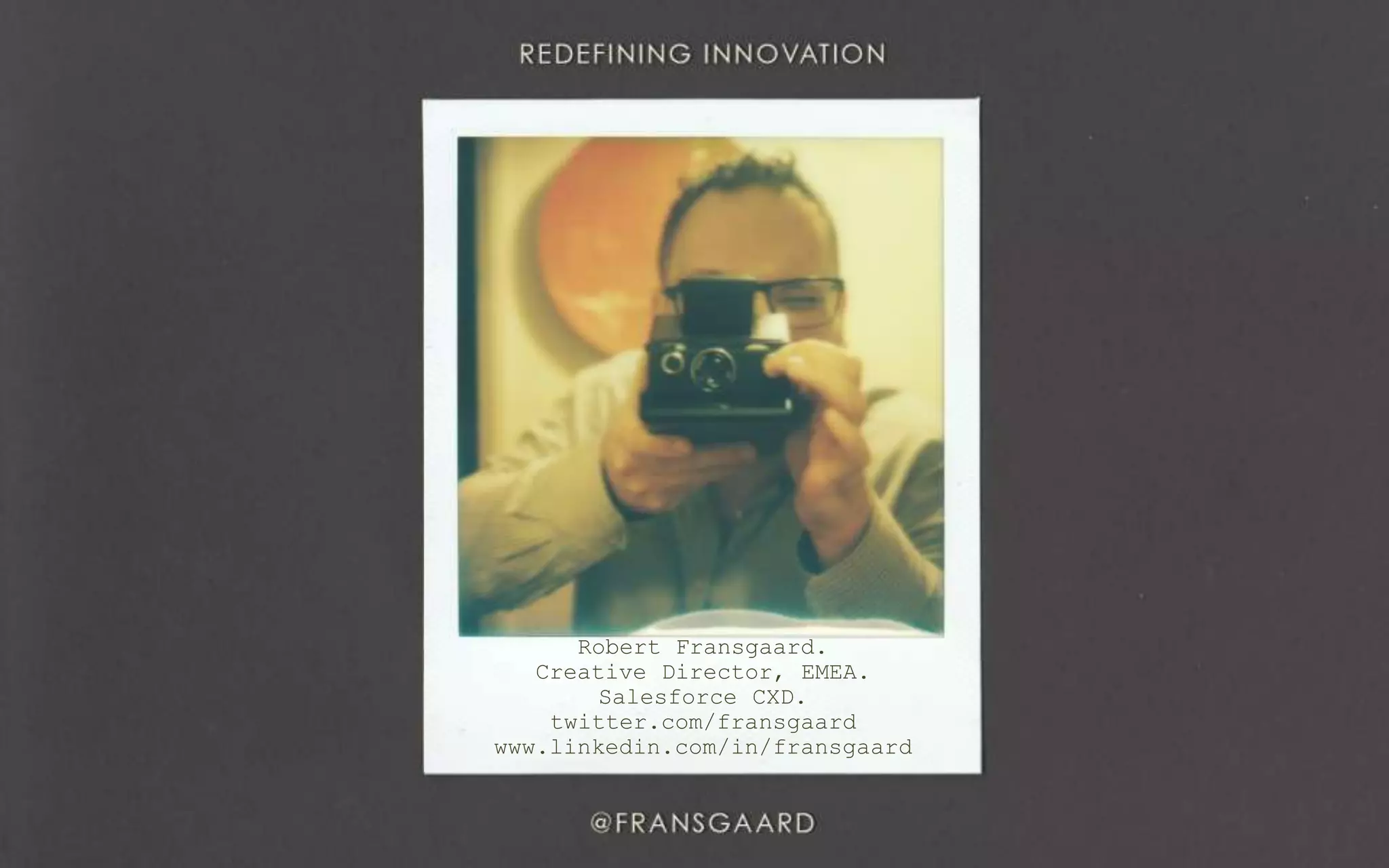
Robert Fransgaard.
Creative Director, EMEA.
Salesforce CXD.
twitter.com/fransgaard
www.linkedin.com/in/fransgaard
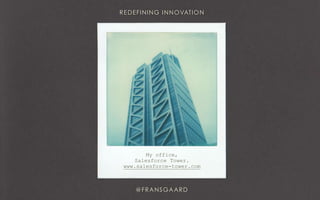
My office,
Salesforce Tower.
www.salesforce-tower.com
Salesforce, a founding driving
force of Cloud Computing.
www.salesforce.com/company
Salesforce Customer Experience Design 2015 Reel: https://vimeo.com/121897634
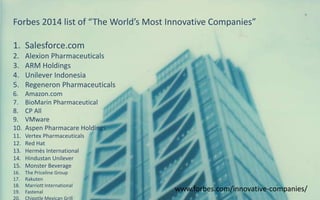
Forbes 2014 list of “The World’s Most Innovative Companies”
1. Salesforce.com
2. Alexion Pharmaceuticals
3. ARM Holdings
4. Unilever Indonesia
5. Regeneron Pharmaceuticals
6. Amazon.com
7. BioMarin Pharmaceutical
8. CP All
9. VMware
10. Aspen Pharmacare Holdings
11. Vertex Pharmaceuticals
12. Red Hat
13. Hermès International
14. Hindustan Unilever
15. Monster Beverage
16. The Priceline Group
17. Rakuten
18. Marriott International
19. Fastenal
20. Chipotle Mexican Grill
www.forbes.com/innovative-companies/
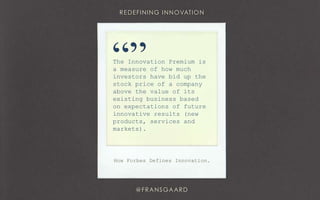
The Innovation Premium is
a measure of how much
investors have bid up the
stock price of a company
above the value of its
existing business based
on expectations of future
innovative results (new
products, services and
markets).
“”
How Forbes Defines Innovation.
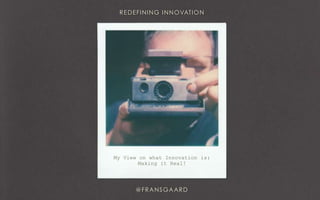
My View on what Innovation is:
Making it Real!
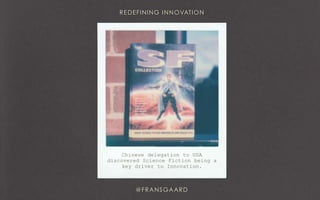
Chinese delegation to USA
discovered Science Fiction being a
key driver to Innovation.
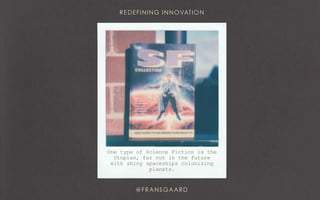
One type of Science Fiction is the
Utopian, far out in the future
with shiny spaceships colonizing
planets.
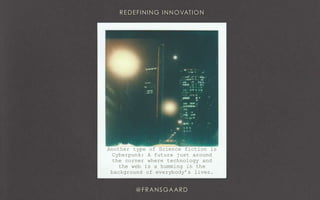
Another type of Science fiction is
Cyberpunk: A future just around
the corner where technology and
the web is a humming in the
background of everybody’s lives.
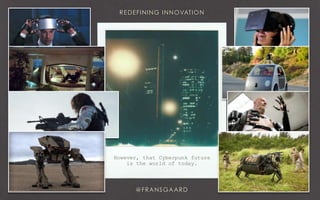
However, that Cyberpunk future
is the world of today.
Reality has surpassed the fiction:
A hacker army located in the
basement of a restaurant.
http://www.bbc.co.uk/newsbeat/article/32926248/bureau
-121-north-koreas-elite-hackers-and-a-tasteful-hotel-
in-china
The crowning jewel is the in-house North Korean
restaurant that can bring you delicious Korean
food right to your room.
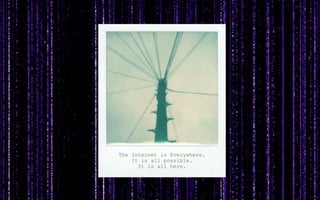
The Internet is Everywhere.
It is all possible.
It is all here.
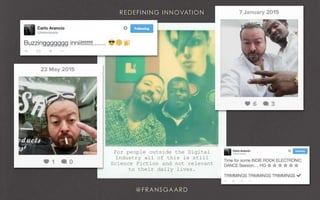
For people outside the Digital
Industry all of this is still
Science Fiction and not relevant
to their daily lives.
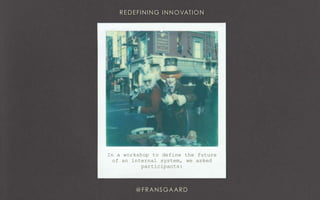
In a workshop to define the future

of an internal system, we asked
participants:
“If you had a magic wand, what but
be your one wish that would make
your job easier? You can wish for
anything.”
One participant said “I want to be
able upload photos as easy as on
Facebook”.
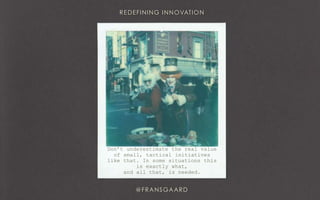
Don’t underestimate the real value
of small, tactical initiatives
like that. In some situations this
is exactly what,
and all that, is needed.
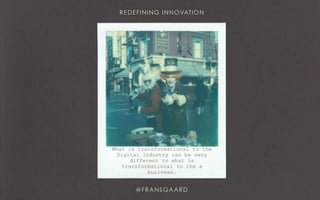
What is transformational to the
Digital Industry can be very
different to what is
transformational to the a
business.
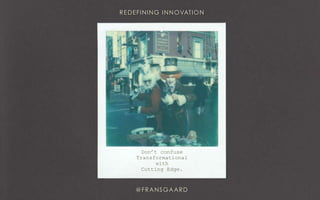
Don’t confuse
Transformational
with
Cutting Edge.
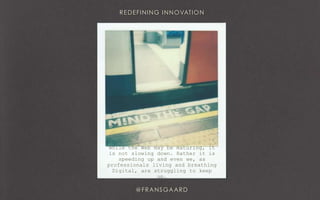
While the Web may be maturing, it
is not slowing down. Rather it is
speeding up and even we, as
professionals living and breathing
Digital, are struggling to keep
up.
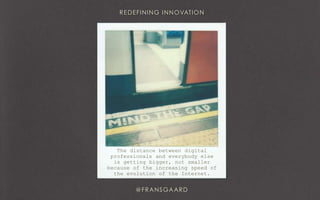
The distance between digital
professionals and everybody else
is getting bigger, not smaller
because of the increasing speed of
the evolution of the Internet.
Here are three things to address
in order to bring Customers on the
journey to Digital Innovation:
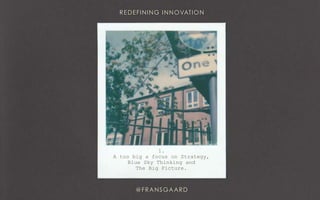
1.
A too big a focus on Strategy,
Blue Sky Thinking and
The Big Picture.
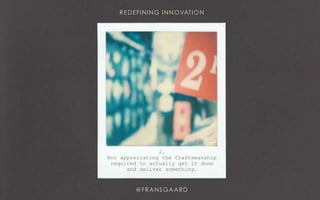
2.
Not appreciating the Craftsmanship
required to actually get it done
and deliver something.
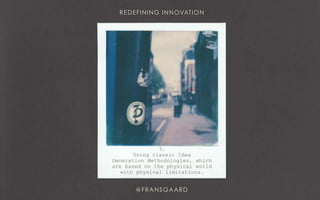
3.
Using classic Idea
Generation Methodologies, which
are based on the physical world
with physical limitations.
3. Classic Idea
Generation
Methodologies.
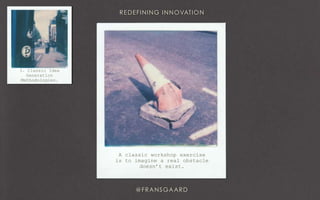
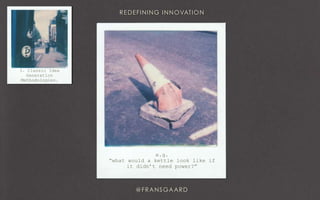
A classic workshop exercise
is to imagine a real obstacle
doesn’t exist.
3. Classic Idea
Generation
Methodologies.
e.g.
“what would a kettle look like if
it didn’t need power?”
3. Classic Idea
Generation
Methodologies.
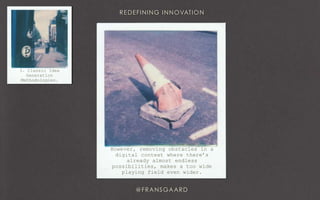
However, removing obstacles in a
digital context where there’s
already almost endless
possibilities, makes a too wide
playing field even wider.
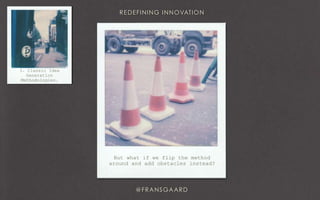
But what if we flip the method
around and add obstacles instead?
3. Classic Idea
Generation
Methodologies.
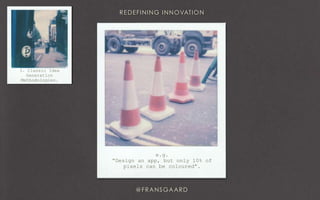
e.g.
“Design an app, but only 10% of
pixels can be coloured”.
3. Classic Idea
Generation
Methodologies.
Another classic workshop method is
“Cherry Splitting” where
participants divide a problem or
object into the individual
functional parts.
3. Classic Idea
Generation
Methodologies.
e.g
when redesigning a bicycle, you
would divide it into wheels, seat,
steer, chain etc.
3. Classic Idea
Generation
Methodologies.
But a digital product can divide
it into very very small, but still
functional chunks to the point
where the exercise becomes
useless.
3. Classic Idea
Generation
Methodologies.
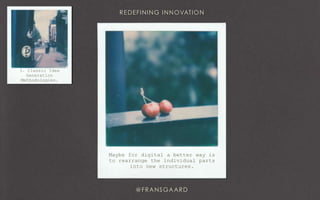
Maybe for digital a better way is
to rearrange the individual parts
into new structures.
3. Classic Idea
Generation
Methodologies.
e.g. take all components of a
contact form and rearrange them
into a new order.
Button first maybe?
3. Classic Idea
Generation
Methodologies.
2. Craftsmanship.
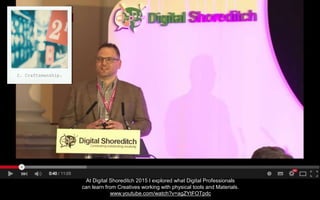
At Digital Shoreditch 2015 I explored what Digital Professionals
can learn from Creatives working with physical tools and Materials.
www.youtube.com/watch?v=agZYtFOTpdc
2. Craftsmanship.
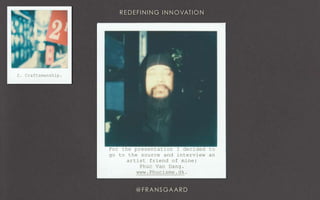
For the presentation I decided to
go to the source and interview an
artist friend of mine:
Phuc Van Dang.
www.Phucisme.dk.
2. Craftsmanship.
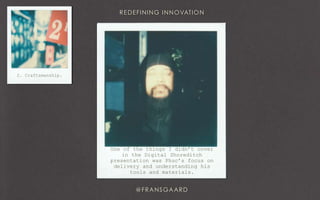
Phuc produces art on anything from
paintings and drawings to
porcelain and photography to
fullsize wall art and performa
art.
2. Craftsmanship.
One of the things I didn’t cover
in the Digital Shoreditch
presentation was Phuc’s focus on
delivery and understanding his
tools and materials.
2. Craftsmanship.
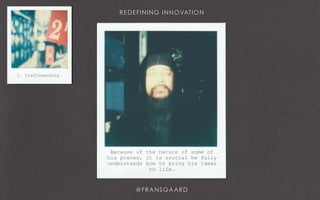
Because of the nature of some of
his pieces, it is crucial he fully
understands how to bring his ideas
to life.
2. Craftsmanship.
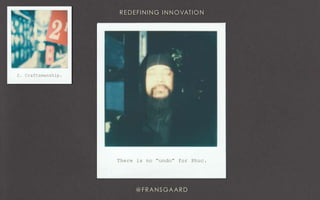
There is no “undo” for Phuc.
2. Craftsmanship.
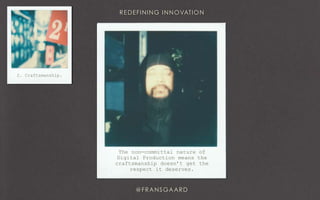
The non-committal nature of
Digital Production means the
craftsmanship doesn’t get the
respect it deserves.
2. Craftsmanship.
It can be updated later.
Fix it in phase 2.
etc.
2. Craftsmanship.
But we are forgetting once it is
live, it is committed and judged
by the users. Some may not
appreciate it. Some may never come
back.
2. Craftsmanship.
While we can fix the product, it
is much hard to fix the lost
relationship with a customer.
And finally back to point 1
on the heavy focus on
Big Picture thinking.
1. Strategy and
“The Big Picture”.
A customer has a simple request, a
simple thing that will mean a lot
for their company.
1. Strategy and
“The Big Picture”.
It may not be cutting edge and the
knowledgeable Digital
Professionals want to show a
display of their vast knowledge of
the Web.
1. Strategy and
“The Big Picture”.
Present all the many many
solutions to the customer ranging
far beyond the original problem.
1. Strategy and
“The Big Picture”.
Lift the thinking beyond the
immediate problem and look at the
Bigger Picture and present
Strategies to approach the problem
and all its new-found cousins.
1. Strategy and
“The Big Picture”.
Not only does this sometimes mean
the customer think they are being
oversold…
1. Strategy and
“The Big Picture”.
…it also leaves the customer
overwhelmed and questioning
whether what they wanted was right
in the first place.
1. Strategy and
“The Big Picture”.
The barrage of options and how far
it takes the conversation away
from the immediate problem leads
to indecisiveness.
1. Strategy and
“The Big Picture”.
And nothing gets done.
1. Strategy and
“The Big Picture”.
Customers are not stupid. But they
naturally focus on the problem
they have at hand. That’s where we
need to start the journey.
1. Strategy and
“The Big Picture”.
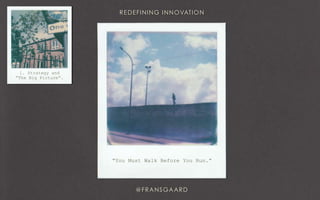
“You Must Walk Before You Run.”
1. Strategy and
“The Big Picture”.
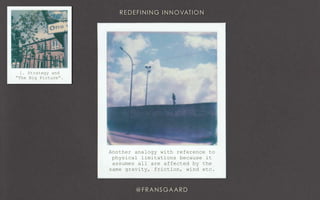
Another analogy with reference to
physical limitations because it
assumes all are affected by the
same gravity, friction, wind etc.
1. Strategy and
“The Big Picture”.
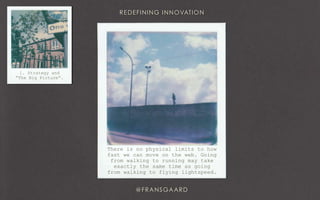
There is no physical limits to how
fast we can move on the web. Going
from walking to running may take
exactly the same time as going
from walking to flying lightspeed.
1. Strategy and
“The Big Picture”.
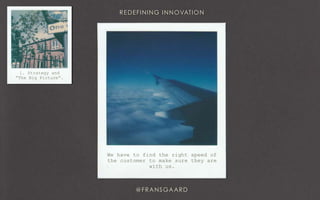
We have to find the right speed of
the customer to make sure they are
with us.
1. Strategy and
“The Big Picture”.
But as soon as we do, then the
real tangible transformational
stuff happens. Not only in our
thinking, but also what is being
delivered.
1. Strategy and
“The Big Picture”.
It is made Real.
1. Strategy and
“The Big Picture”.
Salesforce Services at Dreamforce 2014: https://vimeo.com/114378626
Final thought:
The only wrong decision
is not to make one.
Don’t make the vast possibilities
of the Web become an obstacle to
making decisions and prevent ideas
from becoming real.
Thanks!

Redefining Innovation

  • 1.
    Robert Fransgaard. Creative Director,EMEA. Salesforce CXD. twitter.com/fransgaard www.linkedin.com/in/fransgaard
  • 2.
  • 3.
    Salesforce, a foundingdriving force of Cloud Computing. www.salesforce.com/company
  • 4.
    Salesforce Customer ExperienceDesign 2015 Reel: https://vimeo.com/121897634
  • 5.
    Forbes 2014 listof “The World’s Most Innovative Companies” 1. Salesforce.com 2. Alexion Pharmaceuticals 3. ARM Holdings 4. Unilever Indonesia 5. Regeneron Pharmaceuticals 6. Amazon.com 7. BioMarin Pharmaceutical 8. CP All 9. VMware 10. Aspen Pharmacare Holdings 11. Vertex Pharmaceuticals 12. Red Hat 13. Hermès International 14. Hindustan Unilever 15. Monster Beverage 16. The Priceline Group 17. Rakuten 18. Marriott International 19. Fastenal 20. Chipotle Mexican Grill www.forbes.com/innovative-companies/
  • 6.
    The Innovation Premiumis a measure of how much investors have bid up the stock price of a company above the value of its existing business based on expectations of future innovative results (new products, services and markets). “” How Forbes Defines Innovation.
  • 7.
    My View onwhat Innovation is: Making it Real!
  • 8.
    Chinese delegation toUSA discovered Science Fiction being a key driver to Innovation.
  • 9.
    One type ofScience Fiction is the Utopian, far out in the future with shiny spaceships colonizing planets.
  • 10.
    Another type ofScience fiction is Cyberpunk: A future just around the corner where technology and the web is a humming in the background of everybody’s lives.
  • 11.
    However, that Cyberpunkfuture is the world of today.
  • 12.
    Reality has surpassedthe fiction: A hacker army located in the basement of a restaurant. http://www.bbc.co.uk/newsbeat/article/32926248/bureau -121-north-koreas-elite-hackers-and-a-tasteful-hotel- in-china The crowning jewel is the in-house North Korean restaurant that can bring you delicious Korean food right to your room.
  • 13.
    The Internet isEverywhere. It is all possible. It is all here.
  • 14.
    For people outsidethe Digital Industry all of this is still Science Fiction and not relevant to their daily lives.
  • 15.
    In a workshopto define the future of an internal system, we asked participants:
  • 16.
    “If you hada magic wand, what but be your one wish that would make your job easier? You can wish for anything.”
  • 17.
    One participant said“I want to be able upload photos as easy as on Facebook”.
  • 18.
    Don’t underestimate thereal value of small, tactical initiatives like that. In some situations this is exactly what, and all that, is needed.
  • 19.
    What is transformationalto the Digital Industry can be very different to what is transformational to the a business.
  • 20.
  • 21.
    While the Webmay be maturing, it is not slowing down. Rather it is speeding up and even we, as professionals living and breathing Digital, are struggling to keep up.
  • 22.
    The distance betweendigital professionals and everybody else is getting bigger, not smaller because of the increasing speed of the evolution of the Internet.
  • 23.
    Here are threethings to address in order to bring Customers on the journey to Digital Innovation:
  • 24.
    1. A too biga focus on Strategy, Blue Sky Thinking and The Big Picture.
  • 25.
    2. Not appreciating theCraftsmanship required to actually get it done and deliver something.
  • 26.
    3. Using classic Idea GenerationMethodologies, which are based on the physical world with physical limitations.
  • 27.
    3. Classic Idea Generation Methodologies. Aclassic workshop exercise is to imagine a real obstacle doesn’t exist.
  • 28.
    3. Classic Idea Generation Methodologies. e.g. “whatwould a kettle look like if it didn’t need power?”
  • 29.
    3. Classic Idea Generation Methodologies. However,removing obstacles in a digital context where there’s already almost endless possibilities, makes a too wide playing field even wider.
  • 30.
    But what ifwe flip the method around and add obstacles instead? 3. Classic Idea Generation Methodologies.
  • 31.
    e.g. “Design an app,but only 10% of pixels can be coloured”. 3. Classic Idea Generation Methodologies.
  • 32.
    Another classic workshopmethod is “Cherry Splitting” where participants divide a problem or object into the individual functional parts. 3. Classic Idea Generation Methodologies.
  • 33.
    e.g when redesigning abicycle, you would divide it into wheels, seat, steer, chain etc. 3. Classic Idea Generation Methodologies.
  • 34.
    But a digitalproduct can divide it into very very small, but still functional chunks to the point where the exercise becomes useless. 3. Classic Idea Generation Methodologies.
  • 35.
    Maybe for digitala better way is to rearrange the individual parts into new structures. 3. Classic Idea Generation Methodologies.
  • 36.
    e.g. take allcomponents of a contact form and rearrange them into a new order. Button first maybe? 3. Classic Idea Generation Methodologies.
  • 37.
    2. Craftsmanship. At DigitalShoreditch 2015 I explored what Digital Professionals can learn from Creatives working with physical tools and Materials. www.youtube.com/watch?v=agZYtFOTpdc
  • 38.
    2. Craftsmanship. For thepresentation I decided to go to the source and interview an artist friend of mine: Phuc Van Dang. www.Phucisme.dk.
  • 39.
    2. Craftsmanship. Phuc producesart on anything from paintings and drawings to porcelain and photography to fullsize wall art and performa art.
  • 40.
    2. Craftsmanship. One ofthe things I didn’t cover in the Digital Shoreditch presentation was Phuc’s focus on delivery and understanding his tools and materials.
  • 41.
    2. Craftsmanship. Because ofthe nature of some of his pieces, it is crucial he fully understands how to bring his ideas to life.
  • 42.
    2. Craftsmanship. There isno “undo” for Phuc.
  • 43.
    2. Craftsmanship. The non-committalnature of Digital Production means the craftsmanship doesn’t get the respect it deserves.
  • 44.
    2. Craftsmanship. It canbe updated later. Fix it in phase 2. etc.
  • 45.
    2. Craftsmanship. But weare forgetting once it is live, it is committed and judged by the users. Some may not appreciate it. Some may never come back.
  • 46.
    2. Craftsmanship. While wecan fix the product, it is much hard to fix the lost relationship with a customer.
  • 47.
    And finally backto point 1 on the heavy focus on Big Picture thinking. 1. Strategy and “The Big Picture”.
  • 48.
    A customer hasa simple request, a simple thing that will mean a lot for their company. 1. Strategy and “The Big Picture”.
  • 49.
    It may notbe cutting edge and the knowledgeable Digital Professionals want to show a display of their vast knowledge of the Web. 1. Strategy and “The Big Picture”.
  • 50.
    Present all themany many solutions to the customer ranging far beyond the original problem. 1. Strategy and “The Big Picture”.
  • 51.
    Lift the thinkingbeyond the immediate problem and look at the Bigger Picture and present Strategies to approach the problem and all its new-found cousins. 1. Strategy and “The Big Picture”.
  • 52.
    Not only doesthis sometimes mean the customer think they are being oversold… 1. Strategy and “The Big Picture”.
  • 53.
    …it also leavesthe customer overwhelmed and questioning whether what they wanted was right in the first place. 1. Strategy and “The Big Picture”.
  • 54.
    The barrage ofoptions and how far it takes the conversation away from the immediate problem leads to indecisiveness. 1. Strategy and “The Big Picture”.
  • 55.
    And nothing getsdone. 1. Strategy and “The Big Picture”.
  • 56.
    Customers are notstupid. But they naturally focus on the problem they have at hand. That’s where we need to start the journey. 1. Strategy and “The Big Picture”.
  • 57.
    “You Must WalkBefore You Run.” 1. Strategy and “The Big Picture”.
  • 58.
    Another analogy withreference to physical limitations because it assumes all are affected by the same gravity, friction, wind etc. 1. Strategy and “The Big Picture”.
  • 59.
    There is nophysical limits to how fast we can move on the web. Going from walking to running may take exactly the same time as going from walking to flying lightspeed. 1. Strategy and “The Big Picture”.
  • 60.
    We have tofind the right speed of the customer to make sure they are with us. 1. Strategy and “The Big Picture”.
  • 61.
    But as soonas we do, then the real tangible transformational stuff happens. Not only in our thinking, but also what is being delivered. 1. Strategy and “The Big Picture”.
  • 62.
    It is madeReal. 1. Strategy and “The Big Picture”.
  • 63.
    Salesforce Services atDreamforce 2014: https://vimeo.com/114378626
  • 64.
    Final thought: The onlywrong decision is not to make one.
  • 65.
    Don’t make thevast possibilities of the Web become an obstacle to making decisions and prevent ideas from becoming real.
  • 66.