Reading Strategies
Heather Schidecker
RED4348
CA1
Reading Strategies for Non-Fiction
Pre-Reading
Activities
• Prior Knowledge
• Making
Predictions
• NewVocabulary
• Preview
• Objective
During Reading Activities
• Think Aloud
• Self Questioning
• Visualize/Imagine
• Infer
• Make Connection
• Comprehension
monitoring
• Read Aloud
After Reading Activities
• QAR’s
• BookCircle/Fish Bowl
• Review
• KWL Chart
• Outline
Whole Reading Activity
• SQ3r
Pre-Reading Activities
These activities assit the reader Before they read.This helps the reader
gain deeper understanding of the text and adds to long and short term
memory
• Prior Knowledge
• Making Predictions
• NewVocabulary
• Preview
• Objective
Activate Prior Knowledge KWL
Read the title of the story
– Ask your self:
▪ What do I know about this topic?
– Write this information in the “K” Know section of KWL chart.
▪ What more do I want to know about this topic?
– Write this information under the “W” What I need to know section of KWL chart
– At least 5 questions teacher or student created
▪ Do I have experience with this topic?
– Relate this topic to your real life
Making Predictions/Inferences
This activity can be done as a writing activity,think aloud or group
activity.
Students will use prior knowledge to discuss what they think the story
will be about.
I think this story is about……
Because….
New Vocabulary
Teacher teaches difficult vocabulary before starting the reading so that
students have better comprehension of the story and increasing
readability of the story.
 Create aWord Journal (hand written/word processed)
 Use words teachers assigns and words you do not completely understand
 Use words you found while previewing the story
 Find the defintions and create defintions inYOUR OWNWORDS
 Refer back toWord journal as you read
Preview
 Scan the text
 Look for unusual words
 Read headings and Bolded words
 Write down questions you may have
 Look at pictures and subtitles or side bars
 Highloite things that may be important
 Decided what type of story you are reading: non fiction or fiction?
 Look at the text structure of the story
Previewing the text can help you plan how you will read and create a deeper
understanding of the reading
Objective
Find out the purpose of this story
o Why am I reading this?
o How will this help me?
o How does this relate to real life?
o What is this teaching me?
o Is this useful?
This activity can be done as a writing activity,group, or think aloud.
During reading Activites
▪ Read Aloud
▪ Comprehension Monitoring
▪ Think Aloud
▪ Self Questioning
▪ Visualize/Imagine
▪ Infer
▪ Connection
Think Aloud or Self Questioning
Reciprocal Teaching
▪ WhileYou are reading..
STOP and..
 Think does this make sense?
 Summarize what you’ve already read
 Find new vocabulary and read definition or use
context clues to make sense.
 Underline, Circle Important information
Ask
yourself:
✶ WHO?
✶ WHAT?
✶ WHERE?
✶ HOW?
Put yourself in the Story
▪ When reading a story pretend you are there.
VISUALIZE
– Where the story takes place
– The people, places and events that are in the story
IMAGINE
 Talking with the author while you were reading
 What would you ask him/her?
 What would the Author want you to know?
Connect and Infer Ideas
▪ Use a story map to connect events in the story
▪ Make inferences about the story
▪ Question and Predict
– Does that make sense?What will happen next?
▪ Look for the main Idea of the story
▪ What is this story mostly about?
▪ Find theTOPIC sentence
Read Aloud
1. Read the text Aloud to your self
2. Record your self reading and listen to it
3. Buddy Read
4. Echo Read
After the teacher or another student reads you read just as they did same expression
and intonation.
5. Choral Reading
Read along with other readers
Reading aloud assists with fluency which also assists vocabulary and comprehension.
Having Trouble?
Comprehension Monitoring
Fix up Strategy
▪ Identify the problem
– Where is the problem “ I don’t understand the third paragraph pg….”
– What is the difficulty? “I don’t understand what the author means when…”
▪ Restate
– Use your own words “The author means…”
– UseContext clues
▪ Look Back
– Look back in the text and see if you missed something
– Reread to clarify
▪ Look Forward
– Possibly something you need to know is ahead of where you are reading. “I don’t know much about that maybe if I
keep reading it will explain more”
▪ Get Help!
– UseWord Journal
– After using all the above strategies get help from someone else!
– Ask a partner
– Ask a teacher
Post-Reading Activities
▪ QAR’s
▪ Book Circle/Fish Bowl
▪ Review
▪ KWL Chart
▪ Outline
QAR’s
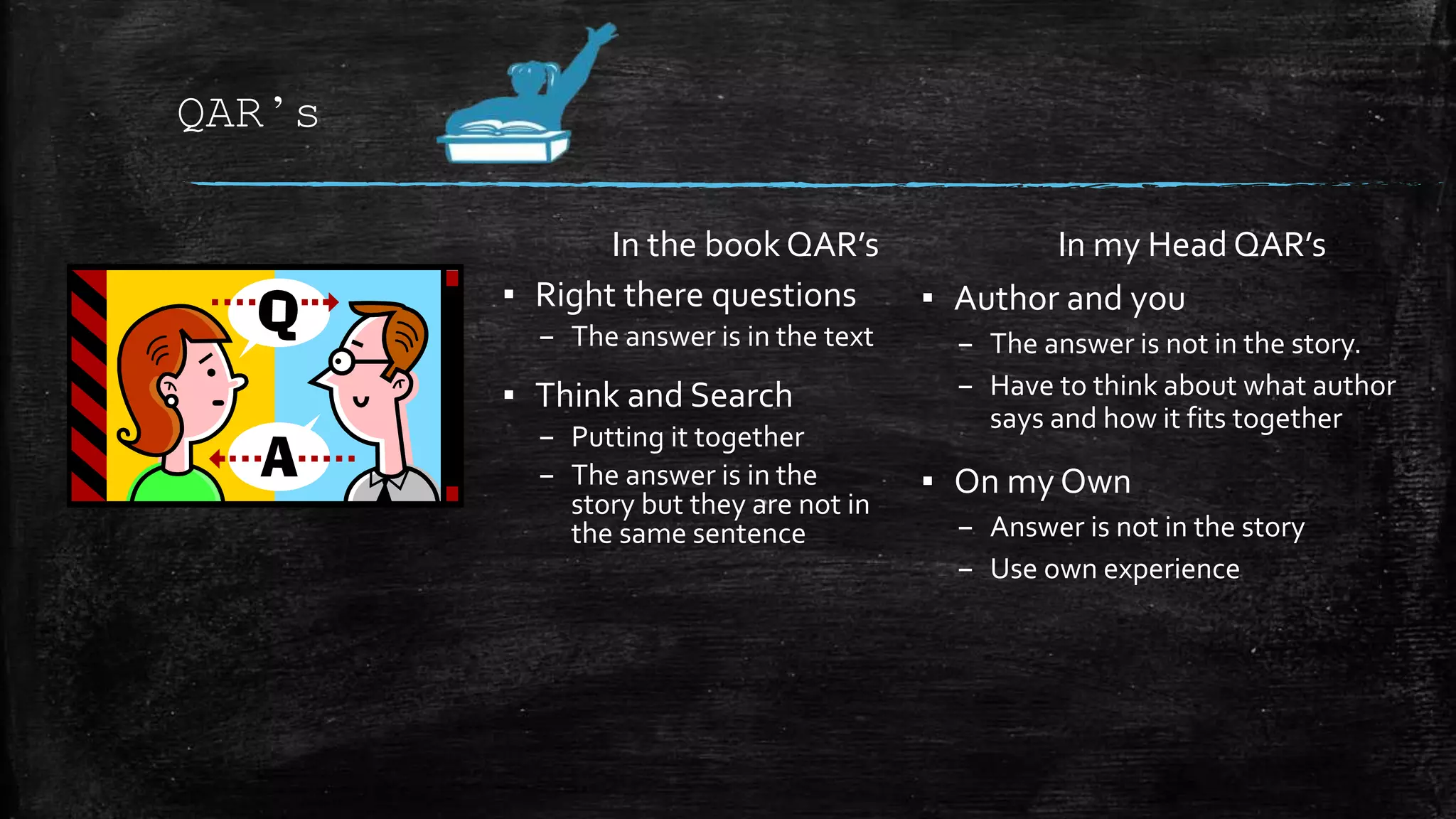
In the book QAR’s
▪ Right there questions
– The answer is in the text
▪ Think and Search
– Putting it together
– The answer is in the
story but they are not in
the same sentence
In my Head QAR’s
▪ Author and you
– The answer is not in the story.
– Have to think about what author
says and how it fits together
▪ On my Own
– Answer is not in the story
– Use own experience
Book Circle/Fish Bowl
 Students discuss text in depth.
 Each student has their own job
 Create questions
 Answer questions
 Discuss Authors purpose
 Discuss Personal expierience
Review
 Summarize the text
 Where your predictions correct?
 What was different or the same?
 Compare/Contrast was this information like anything you’ve read?
 What was the main idea? ( remember to back up with details)
Activities
KWL Chart
Answer your questions
in the “W” section of
your KWL Chart
▪ Create an a add for the text
▪ Create a Poster
▪ Create a timeline
▪ Write a postcard about the text to a
classmate
Use the information from the text to guide
you on one of these post-reading activities
Outline
▪ Create an outline on a provided template summarizing the text
▪ Story map
▪ Describe the beginning,middle, and end of the story
▪ Include the concreate important facts
▪ Supporting Details
▪ Explanation and casues and events
(S)urvey the assigned reading by first
skimming through it;
(Q)uestion, by turning all chapter headings
and subheaings into questions to answer as
you read;
(R)ead the assigned section and try to answer
those questions you formulated;
(R)ecite the information by turning away from
the text as soon as you've finished reading
the assigned section and reiterate it in your
own words
(R)eview what you read by going back to your
questions
SQ3R
References
BursuckW., Damer M. (2011). Teaching Reading to Students who are at risk or have
disabilities.Pearson
Reading activities.Retrieved from.http://www.readingrockets.org/article/82 .7/27/14

Reading Strategies

  • 1.
  • 2.
    Reading Strategies forNon-Fiction Pre-Reading Activities • Prior Knowledge • Making Predictions • NewVocabulary • Preview • Objective During Reading Activities • Think Aloud • Self Questioning • Visualize/Imagine • Infer • Make Connection • Comprehension monitoring • Read Aloud After Reading Activities • QAR’s • BookCircle/Fish Bowl • Review • KWL Chart • Outline Whole Reading Activity • SQ3r
  • 3.
    Pre-Reading Activities These activitiesassit the reader Before they read.This helps the reader gain deeper understanding of the text and adds to long and short term memory • Prior Knowledge • Making Predictions • NewVocabulary • Preview • Objective
  • 4.
    Activate Prior KnowledgeKWL Read the title of the story – Ask your self: ▪ What do I know about this topic? – Write this information in the “K” Know section of KWL chart. ▪ What more do I want to know about this topic? – Write this information under the “W” What I need to know section of KWL chart – At least 5 questions teacher or student created ▪ Do I have experience with this topic? – Relate this topic to your real life
  • 5.
    Making Predictions/Inferences This activitycan be done as a writing activity,think aloud or group activity. Students will use prior knowledge to discuss what they think the story will be about. I think this story is about…… Because….
  • 6.
    New Vocabulary Teacher teachesdifficult vocabulary before starting the reading so that students have better comprehension of the story and increasing readability of the story.  Create aWord Journal (hand written/word processed)  Use words teachers assigns and words you do not completely understand  Use words you found while previewing the story  Find the defintions and create defintions inYOUR OWNWORDS  Refer back toWord journal as you read
  • 7.
    Preview  Scan thetext  Look for unusual words  Read headings and Bolded words  Write down questions you may have  Look at pictures and subtitles or side bars  Highloite things that may be important  Decided what type of story you are reading: non fiction or fiction?  Look at the text structure of the story Previewing the text can help you plan how you will read and create a deeper understanding of the reading
  • 8.
    Objective Find out thepurpose of this story o Why am I reading this? o How will this help me? o How does this relate to real life? o What is this teaching me? o Is this useful? This activity can be done as a writing activity,group, or think aloud.
  • 9.
    During reading Activites ▪Read Aloud ▪ Comprehension Monitoring ▪ Think Aloud ▪ Self Questioning ▪ Visualize/Imagine ▪ Infer ▪ Connection
  • 10.
    Think Aloud orSelf Questioning Reciprocal Teaching ▪ WhileYou are reading.. STOP and..  Think does this make sense?  Summarize what you’ve already read  Find new vocabulary and read definition or use context clues to make sense.  Underline, Circle Important information Ask yourself: ✶ WHO? ✶ WHAT? ✶ WHERE? ✶ HOW?
  • 11.
    Put yourself inthe Story ▪ When reading a story pretend you are there. VISUALIZE – Where the story takes place – The people, places and events that are in the story IMAGINE  Talking with the author while you were reading  What would you ask him/her?  What would the Author want you to know?
  • 12.
    Connect and InferIdeas ▪ Use a story map to connect events in the story ▪ Make inferences about the story ▪ Question and Predict – Does that make sense?What will happen next? ▪ Look for the main Idea of the story ▪ What is this story mostly about? ▪ Find theTOPIC sentence
  • 13.
    Read Aloud 1. Readthe text Aloud to your self 2. Record your self reading and listen to it 3. Buddy Read 4. Echo Read After the teacher or another student reads you read just as they did same expression and intonation. 5. Choral Reading Read along with other readers Reading aloud assists with fluency which also assists vocabulary and comprehension.
  • 14.
    Having Trouble? Comprehension Monitoring Fixup Strategy ▪ Identify the problem – Where is the problem “ I don’t understand the third paragraph pg….” – What is the difficulty? “I don’t understand what the author means when…” ▪ Restate – Use your own words “The author means…” – UseContext clues ▪ Look Back – Look back in the text and see if you missed something – Reread to clarify ▪ Look Forward – Possibly something you need to know is ahead of where you are reading. “I don’t know much about that maybe if I keep reading it will explain more” ▪ Get Help! – UseWord Journal – After using all the above strategies get help from someone else! – Ask a partner – Ask a teacher
  • 15.
    Post-Reading Activities ▪ QAR’s ▪Book Circle/Fish Bowl ▪ Review ▪ KWL Chart ▪ Outline
  • 16.
    QAR’s In the bookQAR’s ▪ Right there questions – The answer is in the text ▪ Think and Search – Putting it together – The answer is in the story but they are not in the same sentence In my Head QAR’s ▪ Author and you – The answer is not in the story. – Have to think about what author says and how it fits together ▪ On my Own – Answer is not in the story – Use own experience
  • 17.
    Book Circle/Fish Bowl Students discuss text in depth.  Each student has their own job  Create questions  Answer questions  Discuss Authors purpose  Discuss Personal expierience Review  Summarize the text  Where your predictions correct?  What was different or the same?  Compare/Contrast was this information like anything you’ve read?  What was the main idea? ( remember to back up with details)
  • 18.
    Activities KWL Chart Answer yourquestions in the “W” section of your KWL Chart ▪ Create an a add for the text ▪ Create a Poster ▪ Create a timeline ▪ Write a postcard about the text to a classmate Use the information from the text to guide you on one of these post-reading activities
  • 19.
    Outline ▪ Create anoutline on a provided template summarizing the text ▪ Story map ▪ Describe the beginning,middle, and end of the story ▪ Include the concreate important facts ▪ Supporting Details ▪ Explanation and casues and events
  • 20.
    (S)urvey the assignedreading by first skimming through it; (Q)uestion, by turning all chapter headings and subheaings into questions to answer as you read; (R)ead the assigned section and try to answer those questions you formulated; (R)ecite the information by turning away from the text as soon as you've finished reading the assigned section and reiterate it in your own words (R)eview what you read by going back to your questions SQ3R
  • 21.
    References BursuckW., Damer M.(2011). Teaching Reading to Students who are at risk or have disabilities.Pearson Reading activities.Retrieved from.http://www.readingrockets.org/article/82 .7/27/14