




A LONGITUDINAL EXAMINATION OF 
SIGITE CONFERENCE SUBMISSION DATA 
2007‐2012 
Presentation for SIGITE 2014 1 by Randy Connolly, Janet Miller, and Rob Friedman
THE ABSTRACT 
This paper examines 
submission data for the 
SIGITE conference between 
the years 2007‐2012. 
It examines which external 
factors and which internal 
characteristics of the 
submissions are related to 
eventual reviewer ratings. 
Presentation for SIGITE 2014 2 by Randy Connolly, Janet Miller, and Rob Friedman 
Ramifications of the findings 
for future authors and 
conference organizers are 
also discussed.
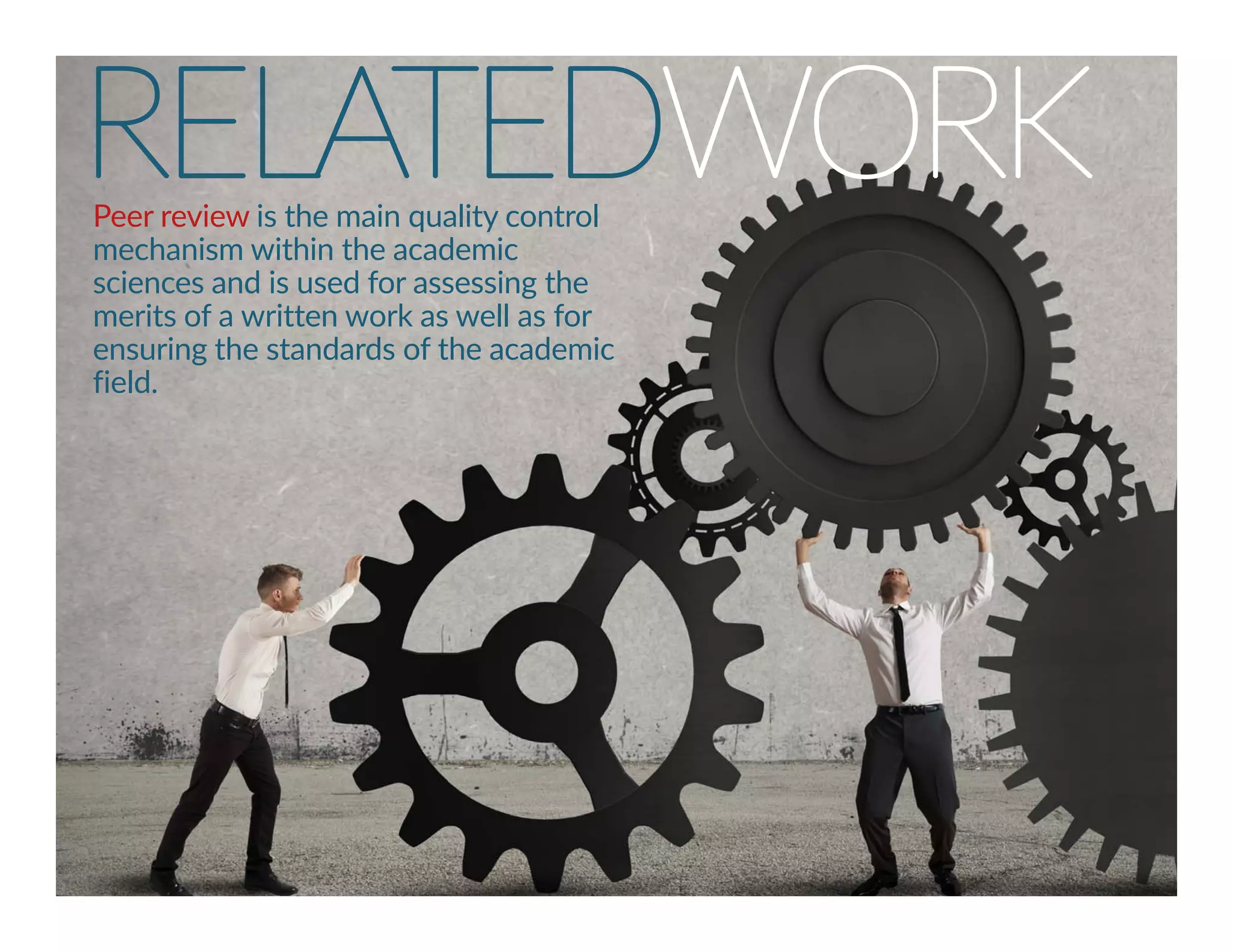
RELATEDWORK Peer review is the main quality control 
mechanism within the academic 
sciences and is used for assessing the 
merits of a written work as well as for 
ensuring the standards of the academic 
field. 
3
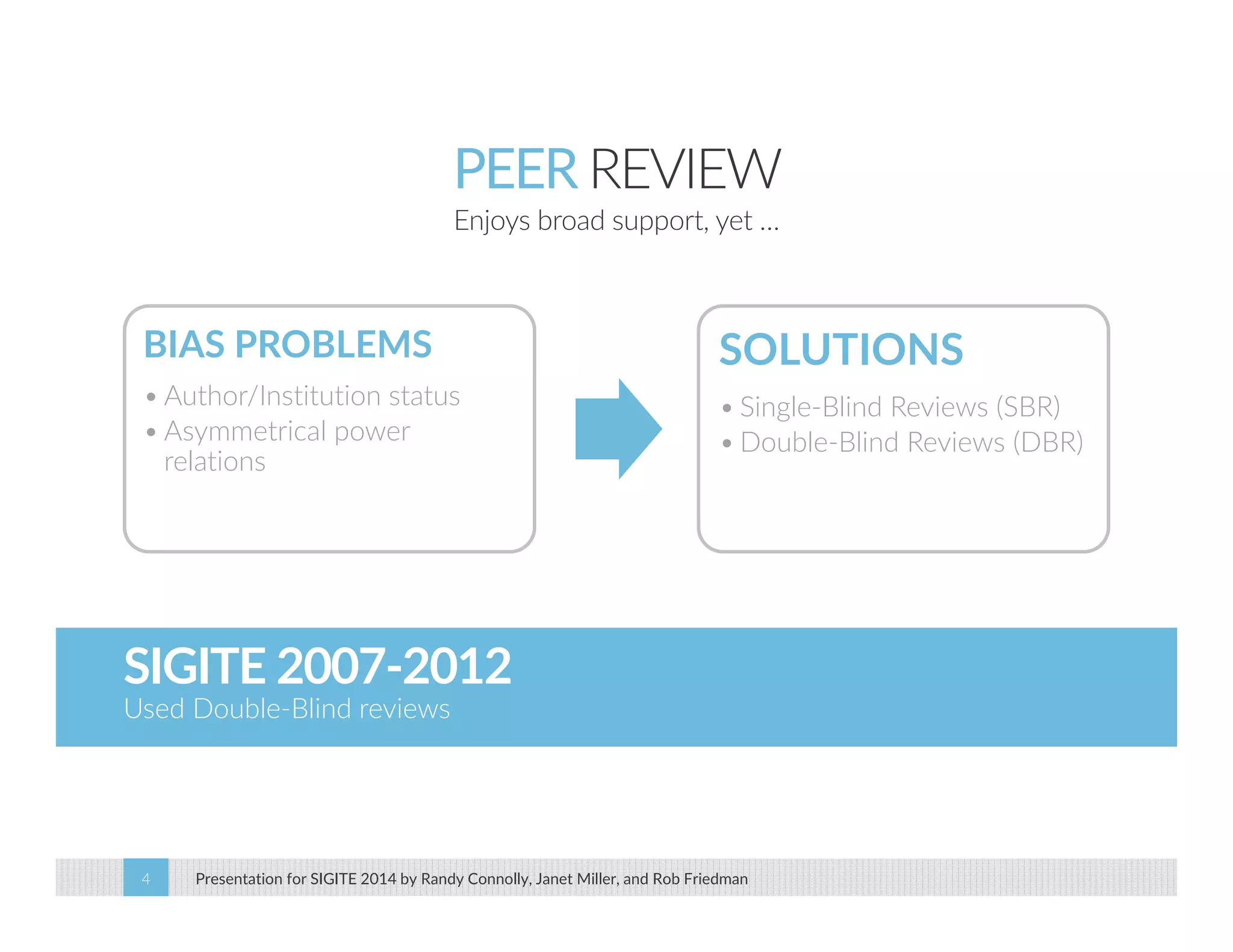
PEER REVIEW 
Enjoys broad support, yet … 
BIAS PROBLEMS 
• Author/Institution status 
• Asymmetrical power 
relations 
SOLUTIONS 
•Single‐Blind Reviews (SBR) 
•Double‐Blind Reviews (DBR) 
SIGITE 2007‐2012 
Used Double‐Blind reviews 
Presentation for SIGITE 2014 4 by Randy Connolly, Janet Miller, and Rob Friedman
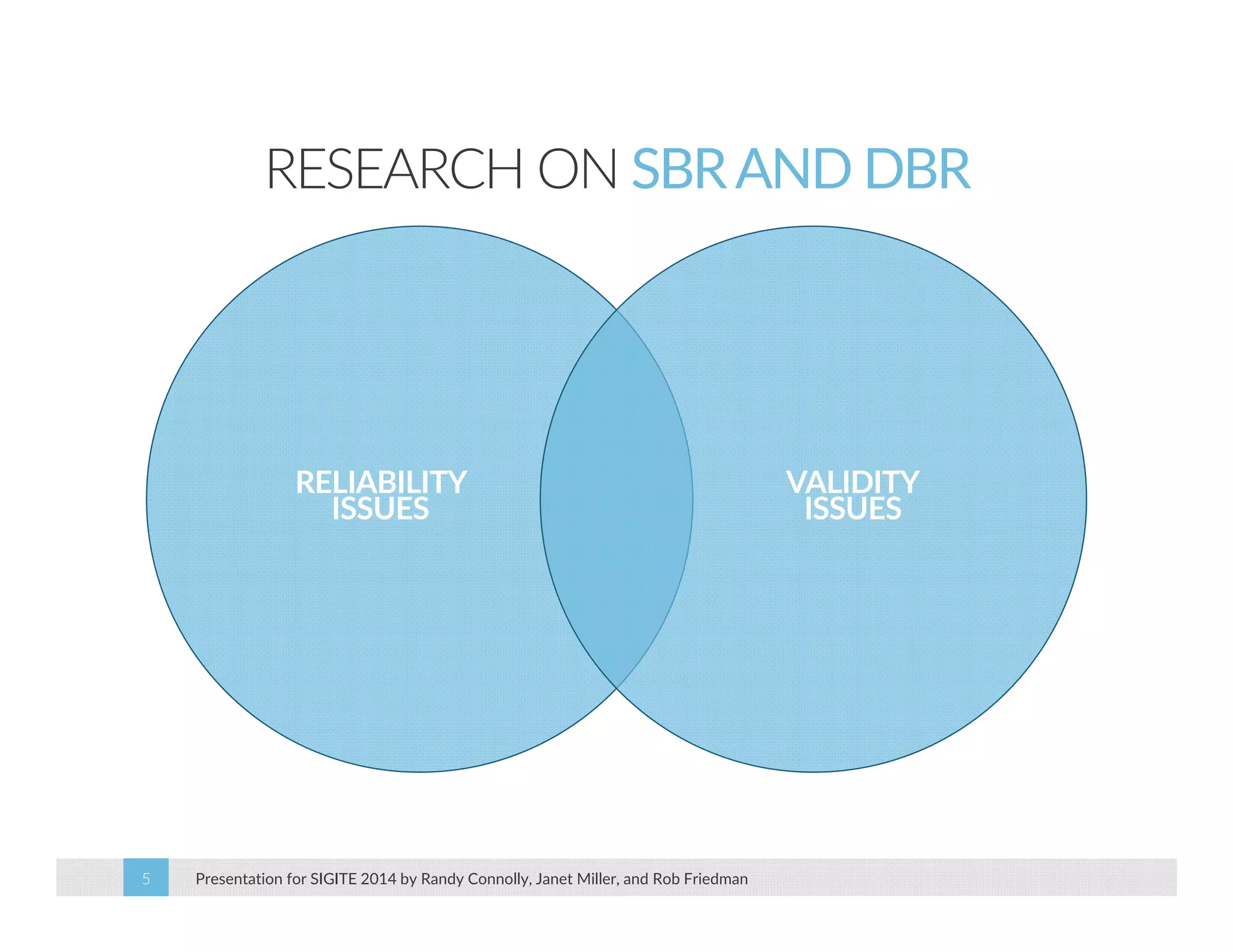
RESEARCH ON SBRAND DBR 
RELIABILITY 
ISSUES 
Presentation for SIGITE 2014 5 by Randy Connolly, Janet Miller, and Rob Friedman 
VALIDITY 
ISSUES
PEER REVIEW OFTEN LACKS RELIABILITY 
That is, reviewers often differ strongly about the merits of any given paper. 
6
PEER REVIEW OFTEN LACKS VALIDITY 
There is often little relationship between the judgments of 
reviewers and the subsequent judgments of the relevant 
larger scholarly community as defined by eventual citations. 
Presentation for SIGITE 2014 7 by Randy Connolly, Janet Miller, and Rob Friedman
SOME RESEARCH 
DISAGREES 
Others have found that there is indeed a 
“statistically significant association between 
selection decisions and the applicants' scientific 
achievements, if quantity and impact of research 
publications are used as a criterion for scientific 
achievement” 
Presentation for SIGITE 2014 8 by Randy Connolly, Janet Miller, and Rob Friedman
Our Study 
PROVIDES A UNIQUE ADDITION TO THIS 
LITERATURE 
Unlike earlier work, our study assesses reviews and submissions for a single 
international computing conference across an extended time period (2007‐2012). 
It assesses the reliability of the peer view process at SIGITE by examining both 
internal and external factors; the combination of these analyses is also unique. 
This paper also provides some innovation in the measures it uses to assess the 
validity of the peer review process. 
Presentation for SIGITE 2014 9 by Randy Connolly, Janet Miller, and Rob Friedman
10 
METHOD 
From 2007 to 2012, the ACM SIGITE 
conference used the same “Grinnell” 
submission system as the larger 
SIGCSE and ITiCSE education 
conferences. 
10 
This web‐based system was used by 
authors to submit their work, by 
reviewers to review submissions, and 
by program committees to evaluate 
reviews and to organize the eventual 
conference program.
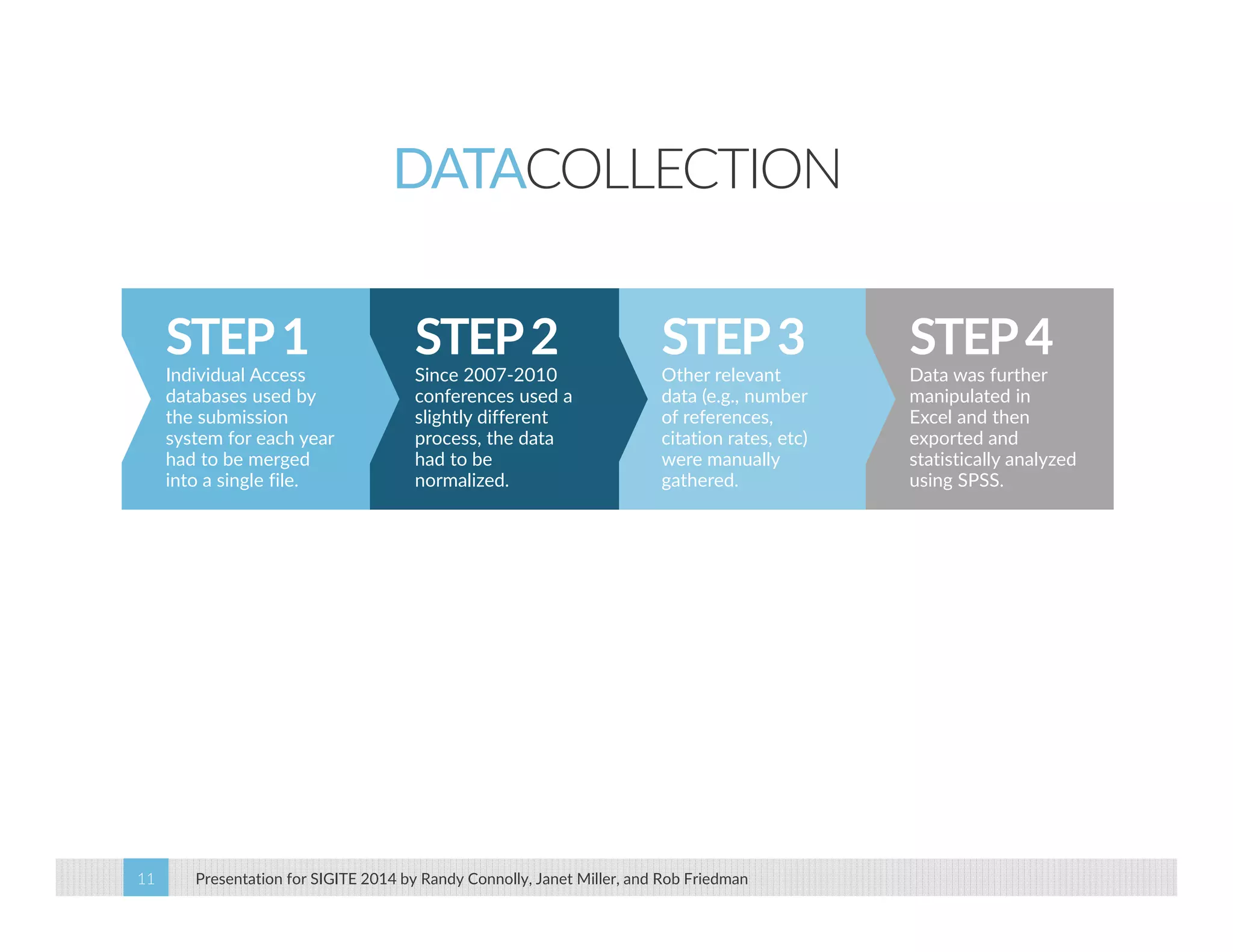
DATACOLLECTION 
Presentation for SIGITE 2014 11 by Randy Connolly, Janet Miller, and Rob Friedman 
STEP 4 
Data was further 
manipulated in 
Excel and then 
exported and 
statistically analyzed 
using SPSS. 
STEP 3 
Other relevant 
data (e.g., number 
of references, 
citation rates, etc) 
were manually 
gathered. 
STEP 2 
Since 2007‐2010 
conferences used a 
slightly different 
process, the data 
had to be 
normalized. 
STEP 1 
Individual Access 
databases used by 
the submission 
system for each year 
had to be merged 
into a single file.
12 
RESULTS 
Over the six years, there were 1026 
reviews from 192 different reviewers, 
and 508 authors were involved in 
submitting a total of 332 papers. 
12 
The 2010 version of the conference 
had the lowest number of paper 
submissions (n=37), while the 2012 
had the largest (n=87).
AUTHOR AND PAPER INFORMATION 
Who were our authors and how did they do on their papers? 
Presentation for SIGITE 2014 13 by Randy Connolly, Janet Miller, and Rob Friedman
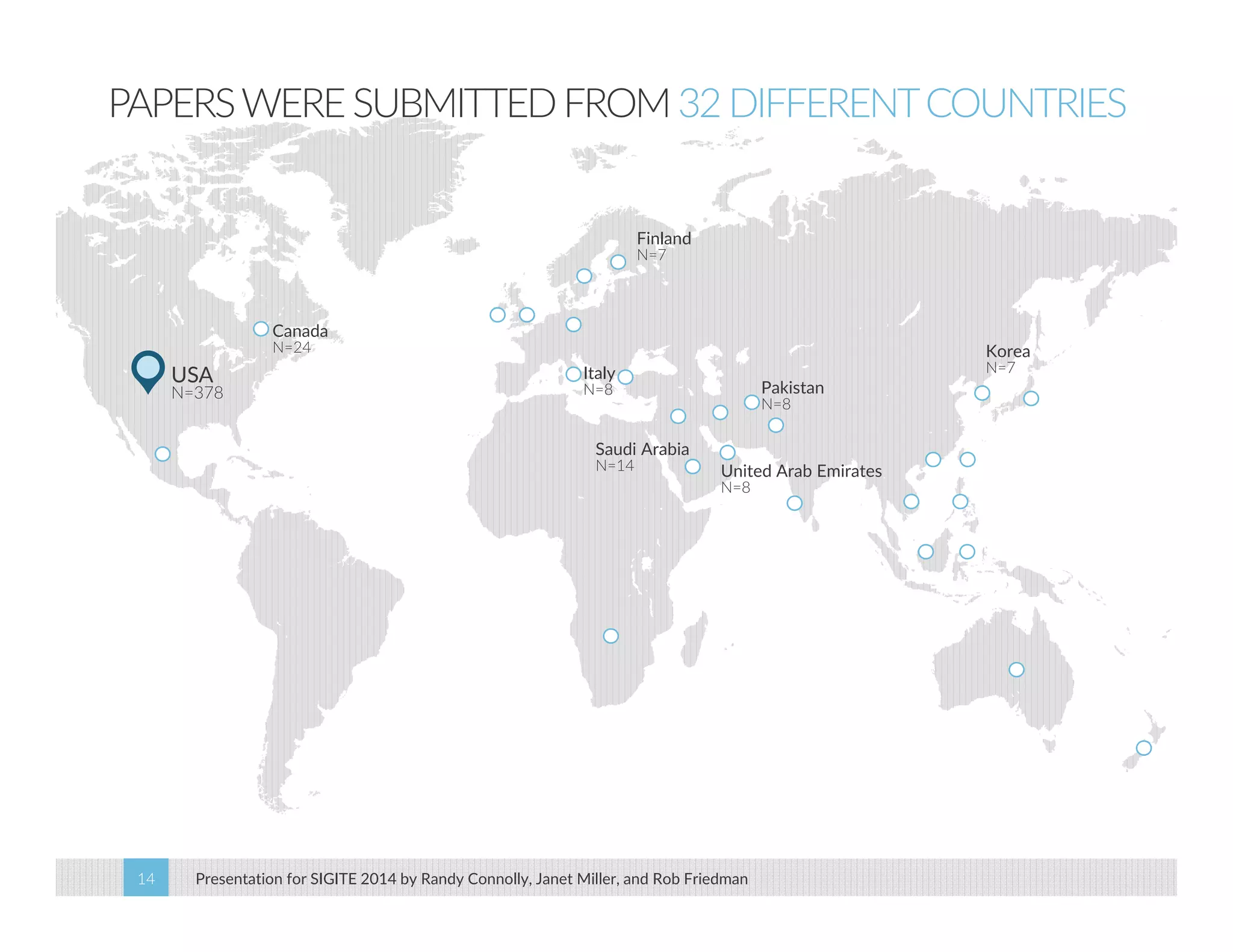
PAPERS WERE SUBMITTED FROM 32 DIFFERENT COUNTRIES 
USA 
N=378 
Canada 
N=24 
Saudi Arabia 
N=14 
Presentation for SIGITE 2014 14 by Randy Connolly, Janet Miller, and Rob Friedman 
Pakistan 
N=8 
Italy 
N=8 
United Arab Emirates 
N=8 
Finland 
N=7 
Korea 
N=7
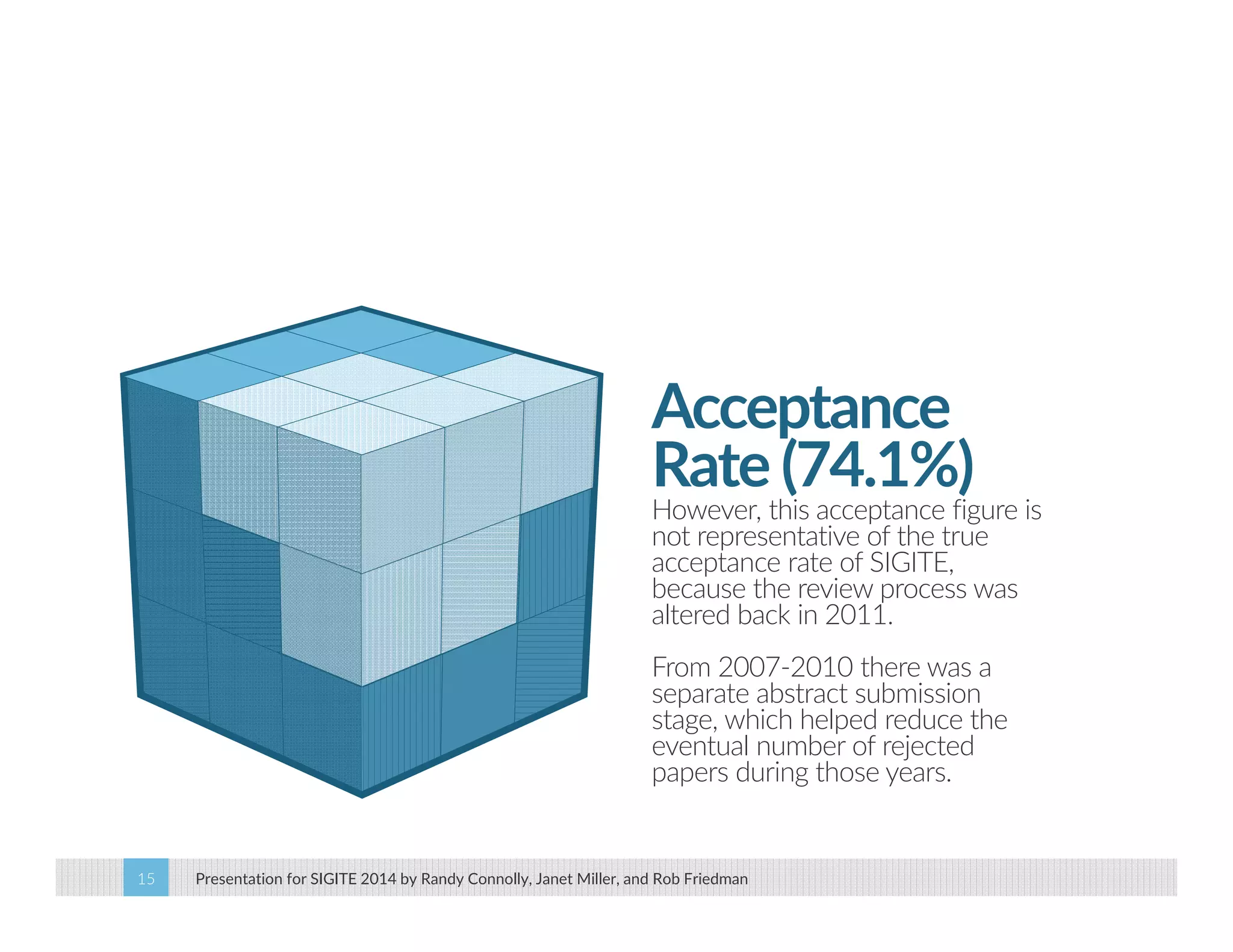
Acceptance 
Rate (74.1%) 
However, this acceptance figure is 
not representative of the true 
acceptance rate of SIGITE, 
because the review process was 
altered back in 2011. 
From 2007‐2010 there was a 
separate abstract submission 
stage, which helped reduce the 
eventual number of rejected 
papers during those years. 
Presentation for SIGITE 2014 15 by Randy Connolly, Janet Miller, and Rob Friedman
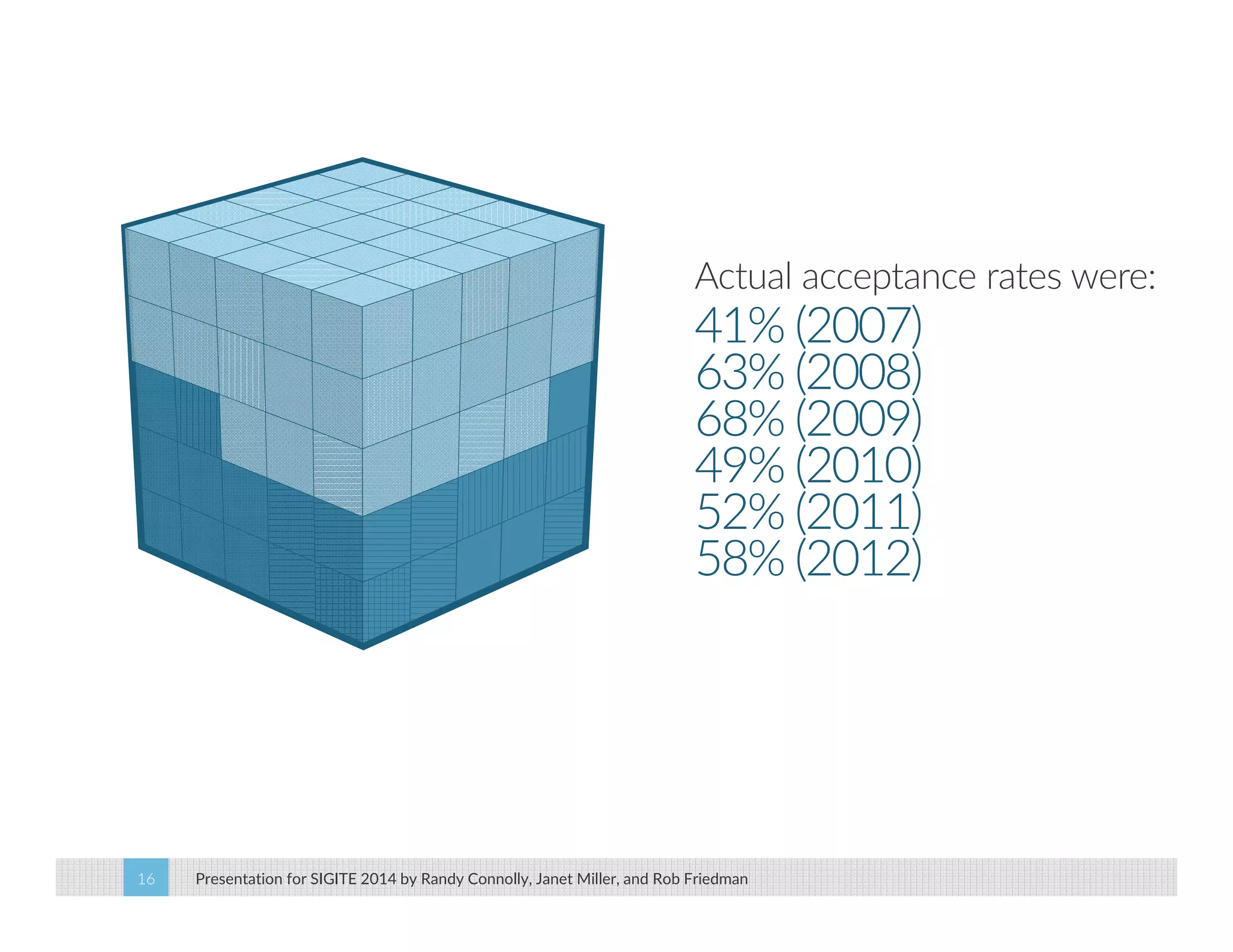
Actual acceptance rates were: 
41% (2007) 
63% (2008) 
68% (2009) 
49% (2010) 
52% (2011) 
58% (2012) 
Presentation for SIGITE 2014 16 by Randy Connolly, Janet Miller, and Rob Friedman
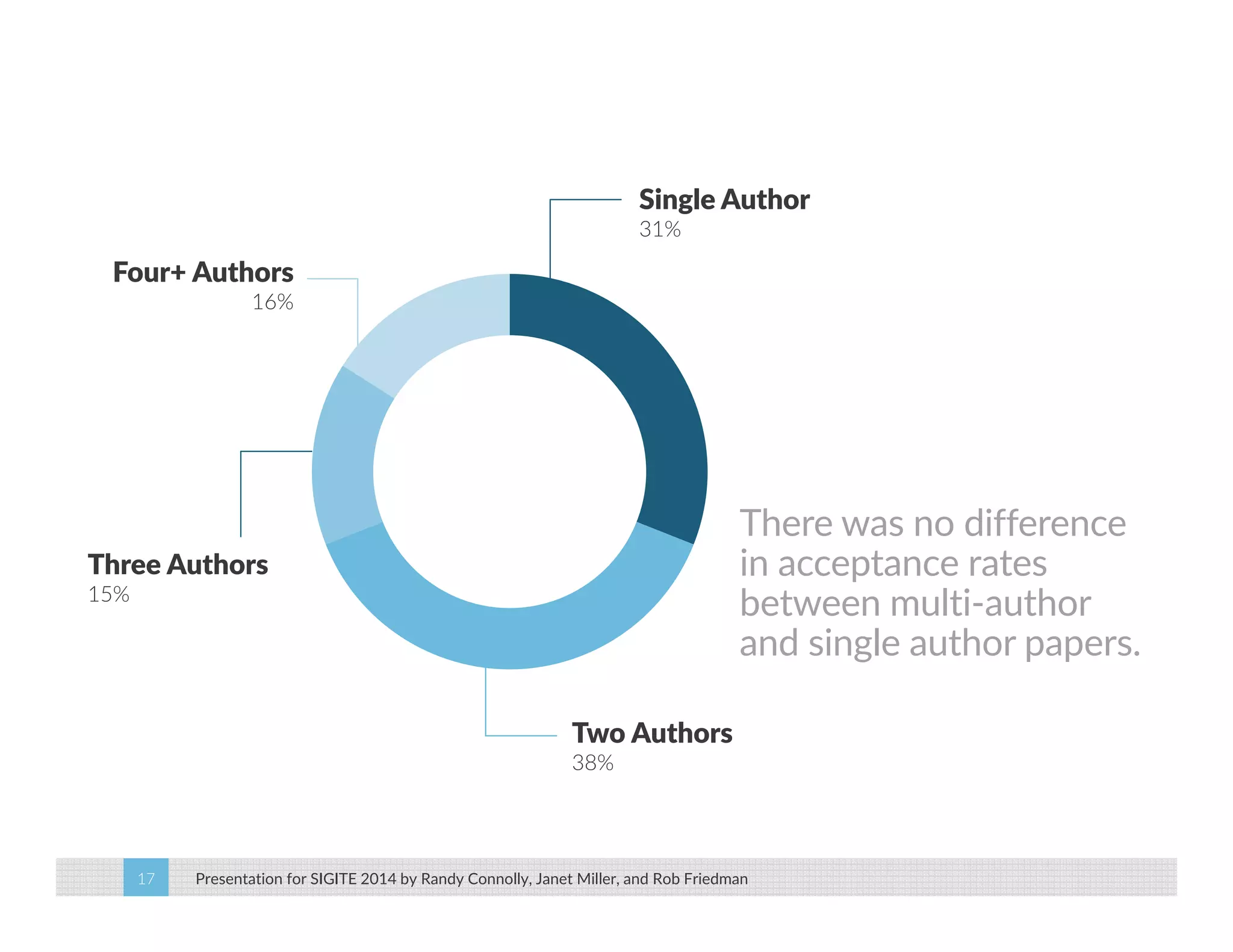
Single Author 
31% 
Two Authors 
38% 
Four+ Authors 
16% 
Three Authors 
15% 
There was no difference 
in acceptance rates 
between multi‐author 
and single author papers. 
Presentation for SIGITE 2014 17 by Randy Connolly, Janet Miller, and Rob Friedman
PAPER CATEGORIES 
What were our papers about? 
Presentation for SIGITE 2014 18 by Randy Connolly, Janet Miller, and Rob Friedman
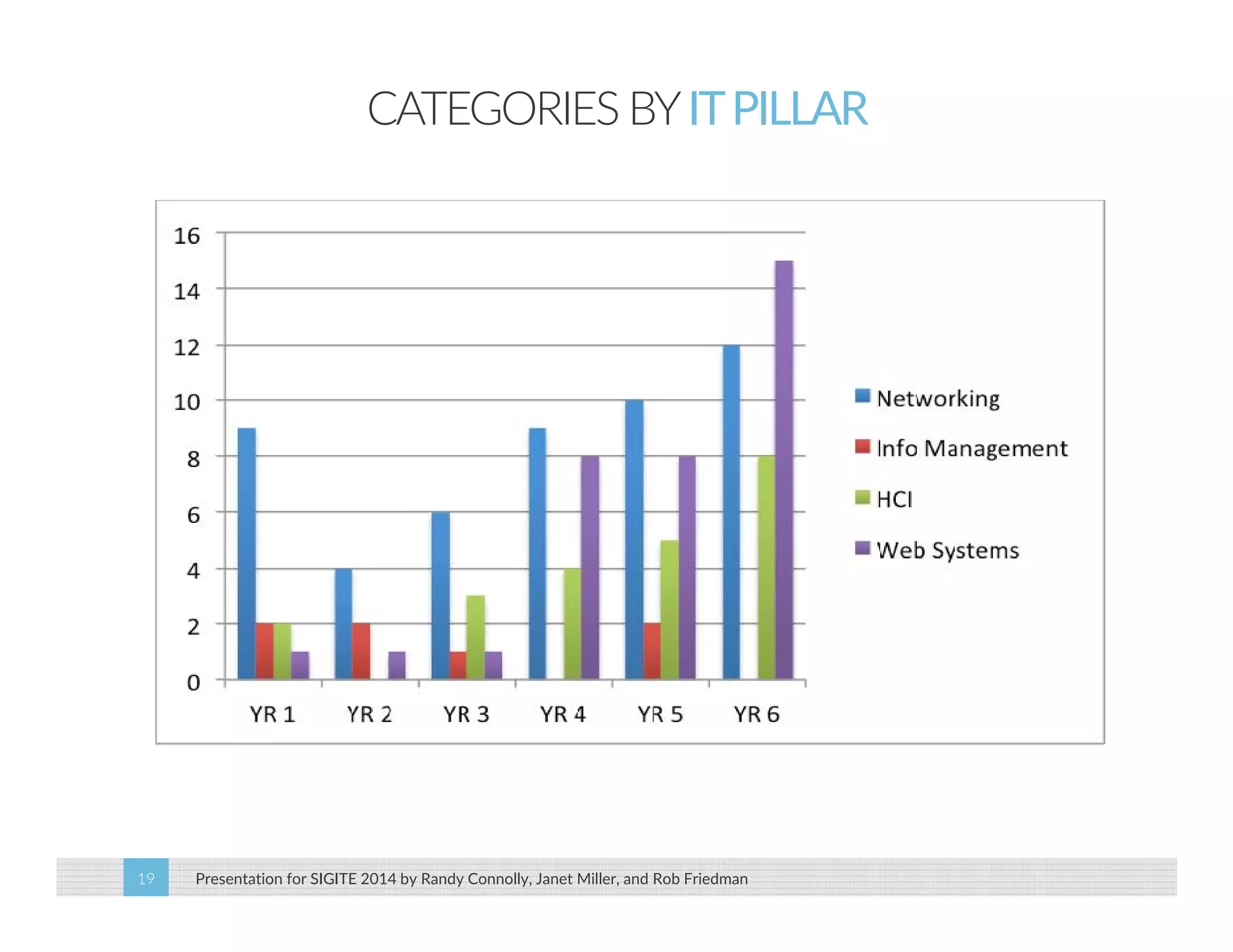
CATEGORIES BY IT PILLAR 
Presentation for SIGITE 2014 19 by Randy Connolly, Janet Miller, and Rob Friedman
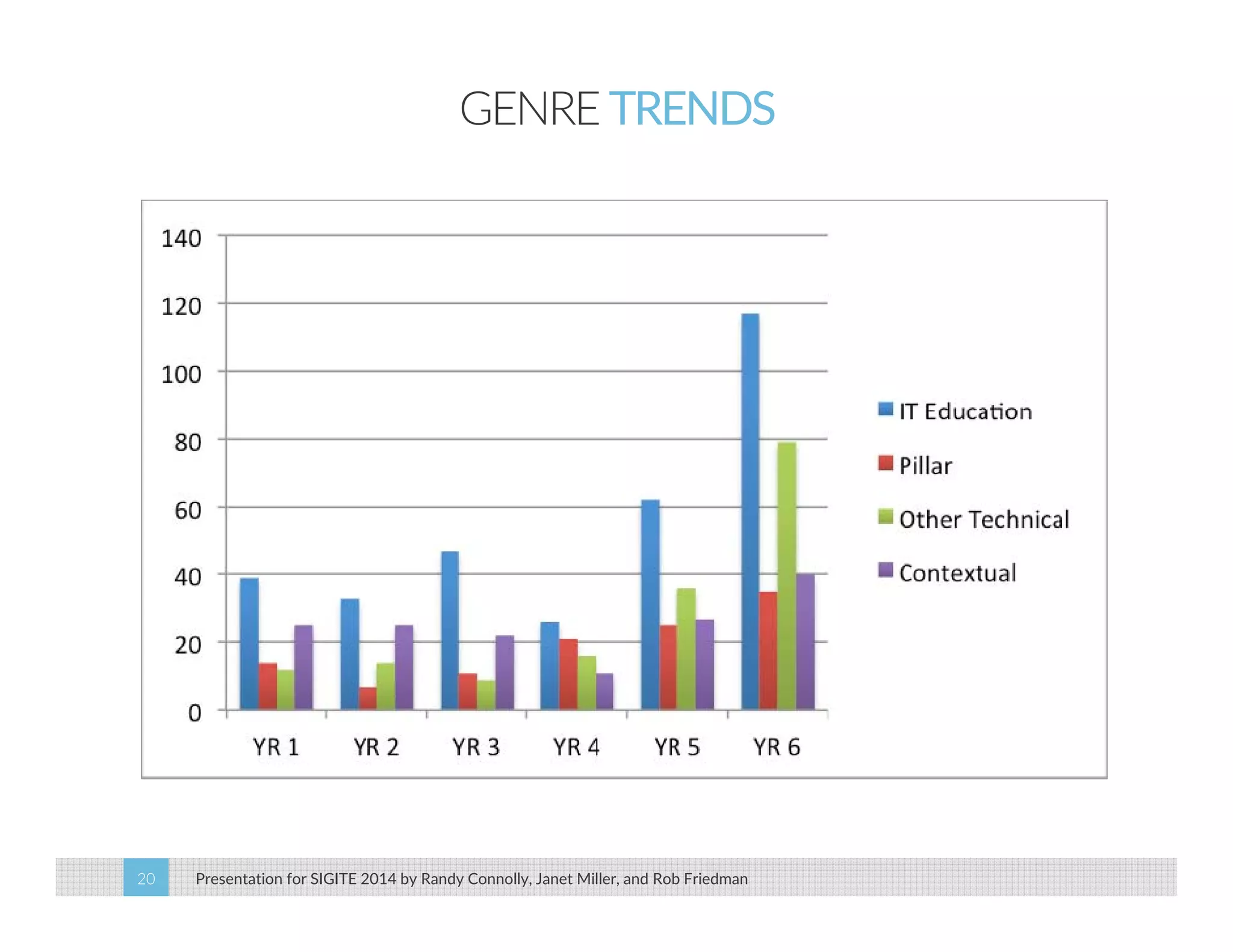
GENRE TRENDS 
Presentation for SIGITE 2014 20 by Randy Connolly, Janet Miller, and Rob Friedman
REVIEWER INFORMATION 
Who were our reviewers? 
Presentation for SIGITE 2014 21 by Randy Connolly, Janet Miller, and Rob Friedman
REVIEWER INFORMATION 
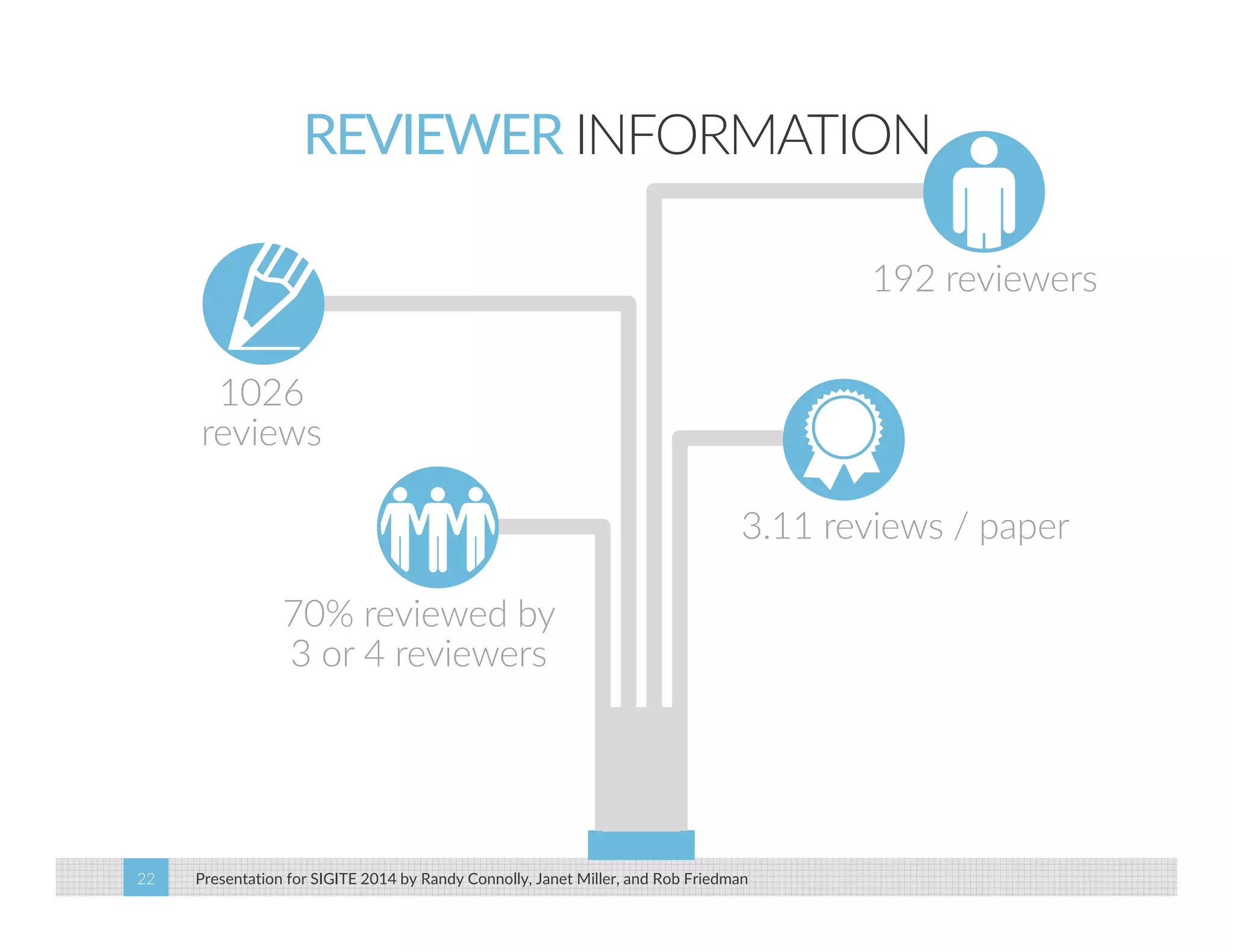
1026 
reviews 
Presentation for SIGITE 2014 22 by Randy Connolly, Janet Miller, and Rob Friedman 
192 reviewers 
70% reviewed by 
3 or 4 reviewers 
3.11 reviews / paper
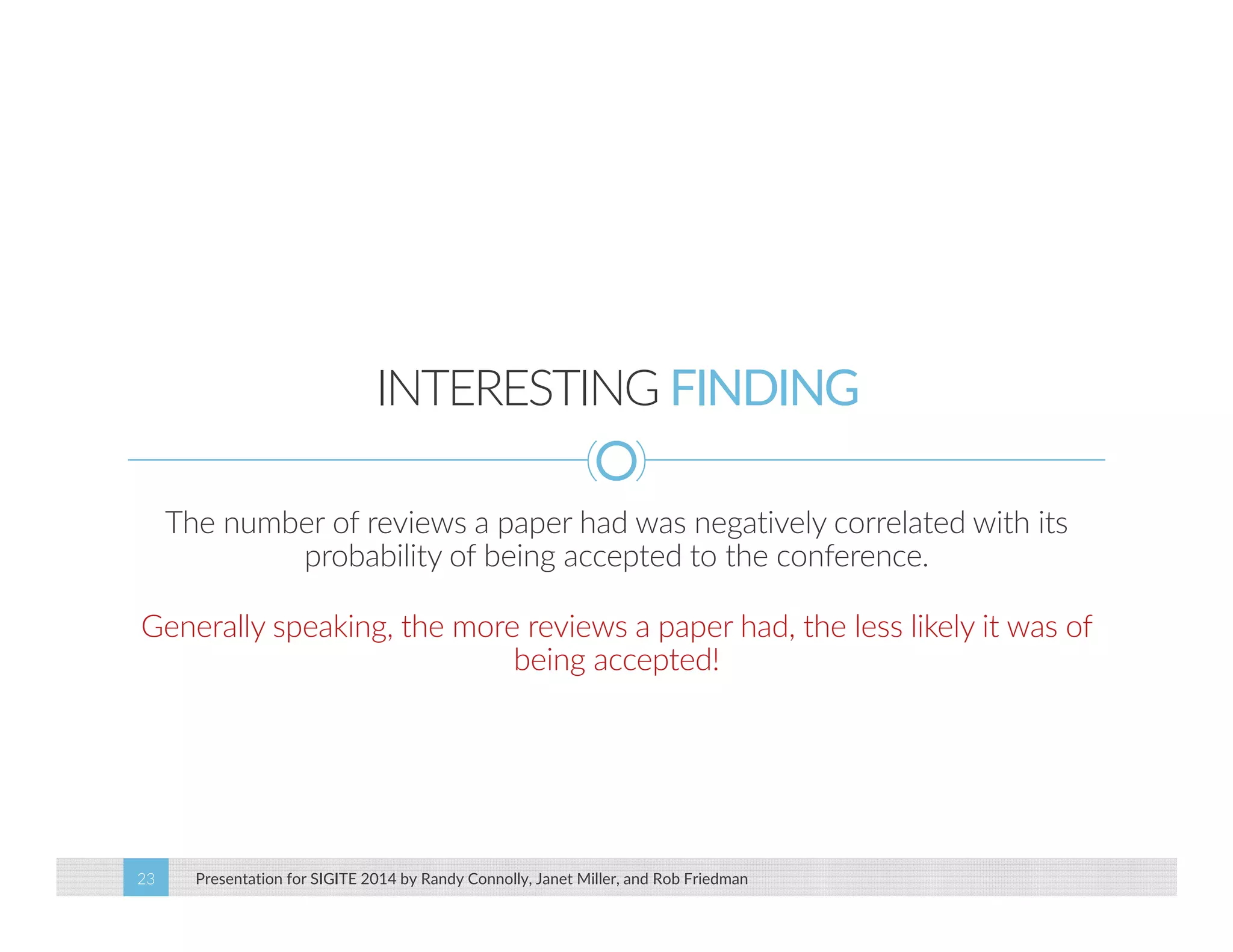
INTERESTING FINDING 
The number of reviews a paper had was negatively correlated with its 
probability of being accepted to the conference. 
Generally speaking, the more reviews a paper had, the less likely it was of 
being accepted! 
Presentation for SIGITE 2014 23 by Randy Connolly, Janet Miller, and Rob Friedman
RATING INFORMATION 
What did the ratings look like? 
Presentation for SIGITE 2014 24 by Randy Connolly, Janet Miller, and Rob Friedman
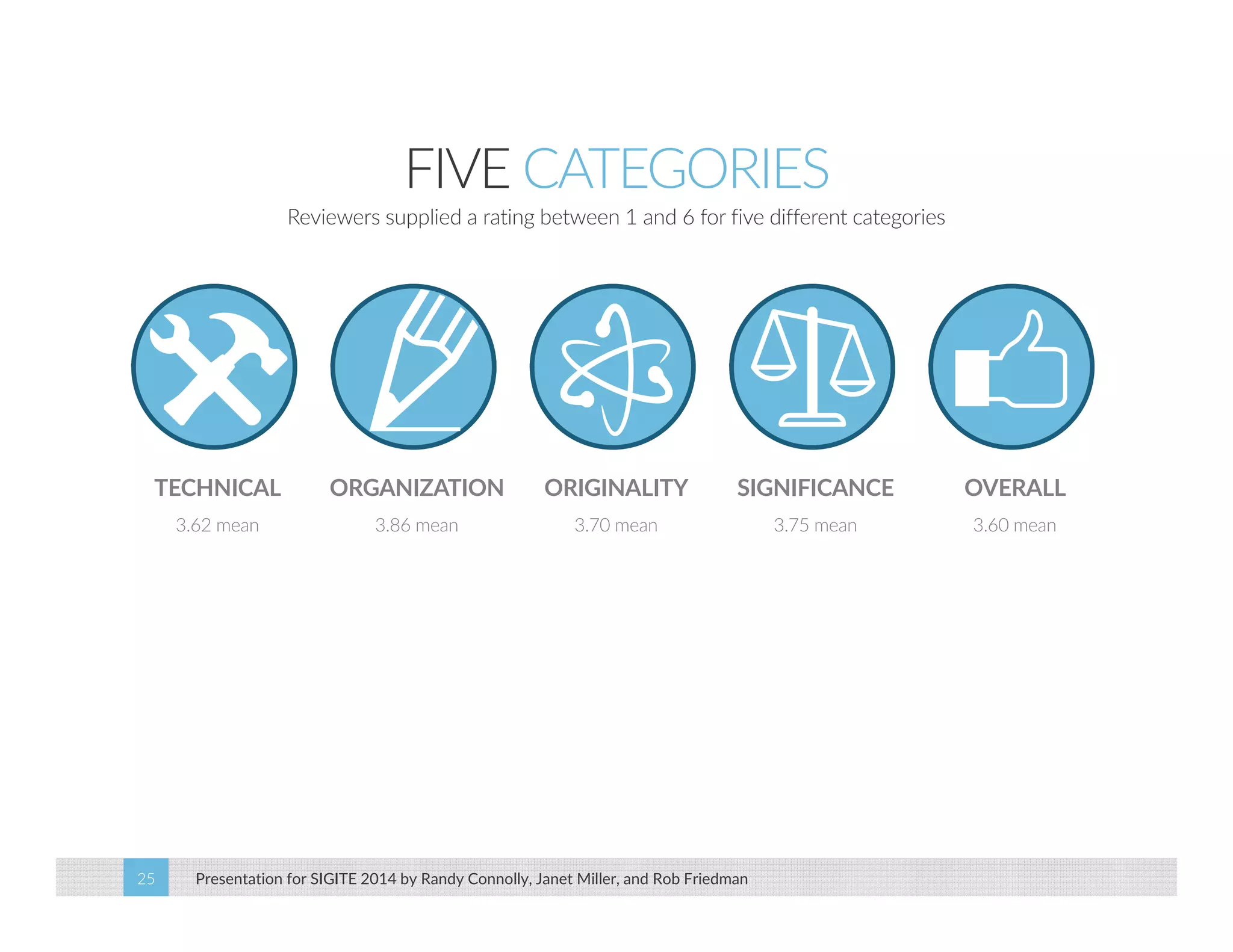
FIVE CATEGORIES 
Reviewers supplied a rating between 1 and 6 for five different categories 
TECHNICAL ORGANIZATION ORIGINALITY SIGNIFICANCE OVERALL 
3.62 mean 3.86 mean 3.70 mean 3.75 mean 3.60 mean 
Presentation for SIGITE 2014 25 by Randy Connolly, Janet Miller, and Rob Friedman
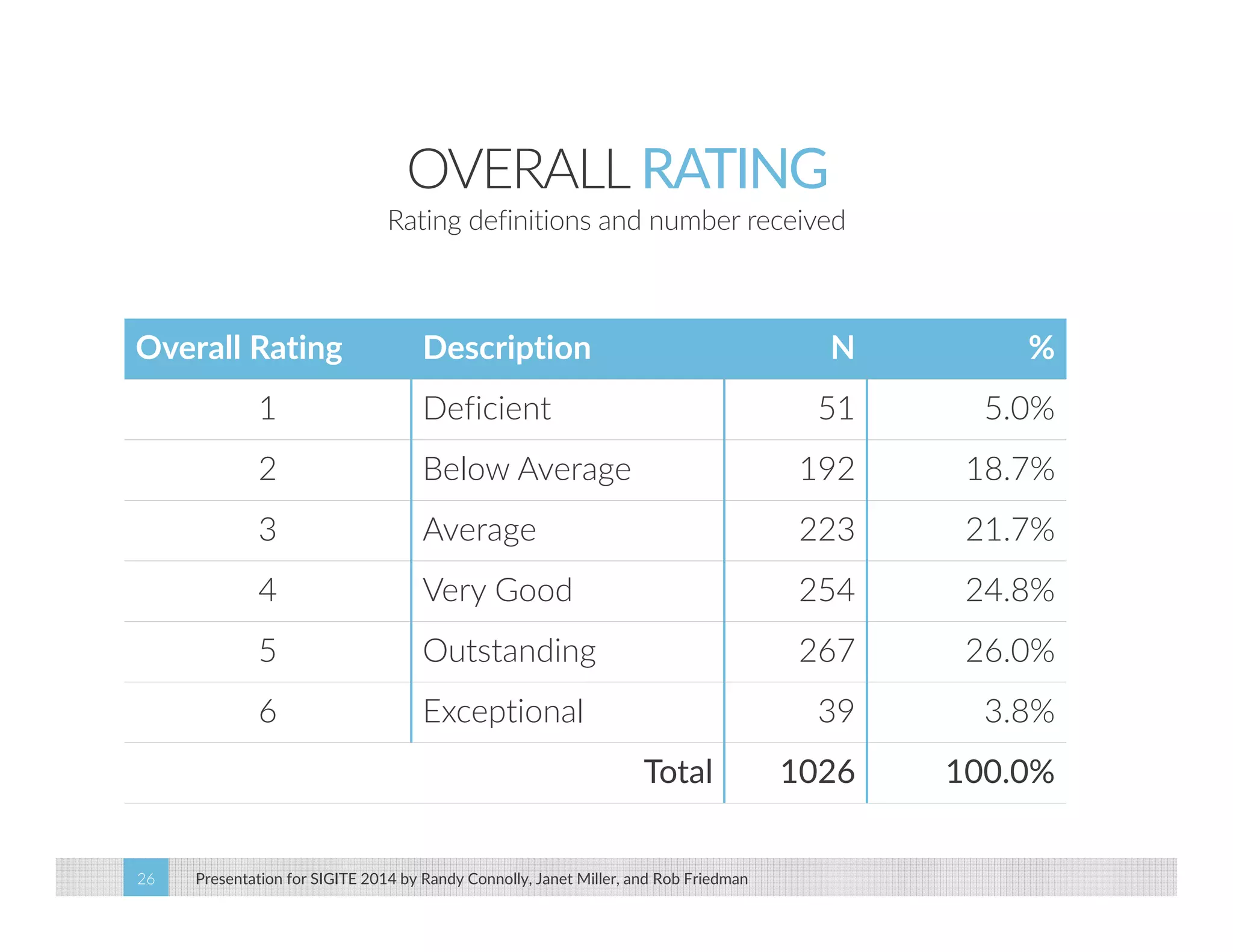
OVERALL RATING 
Rating definitions and number received 
Overall Rating Description N % 
1 Deficient 51 5.0% 
2 Below Average 192 18.7% 
3 Average 223 21.7% 
4 Very Good 254 24.8% 
5 Outstanding 267 26.0% 
6 Exceptional 39 3.8% 
Total 1026 100.0% 
Presentation for SIGITE 2014 26 by Randy Connolly, Janet Miller, and Rob Friedman
INTERESTING FINDING 
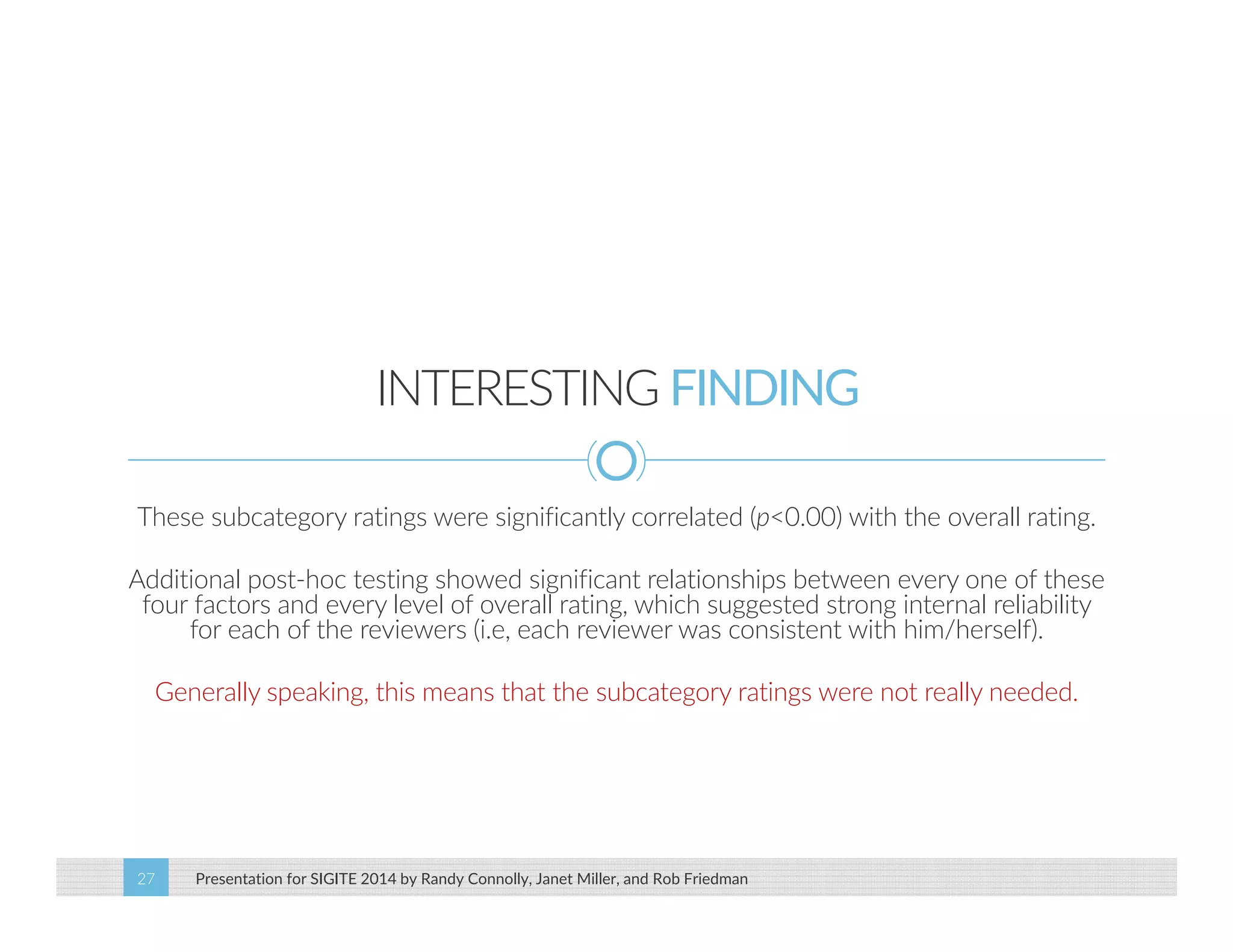
These subcategory ratings were significantly correlated (p<0.00) with the overall rating. 
Additional post‐hoc testing showed significant relationships between every one of these 
four factors and every level of overall rating, which suggested strong internal reliability 
for each of the reviewers (i.e, each reviewer was consistent with him/herself). 
Generally speaking, this means that the subcategory ratings were not really needed. 
Presentation for SIGITE 2014 27 by Randy Connolly, Janet Miller, and Rob Friedman
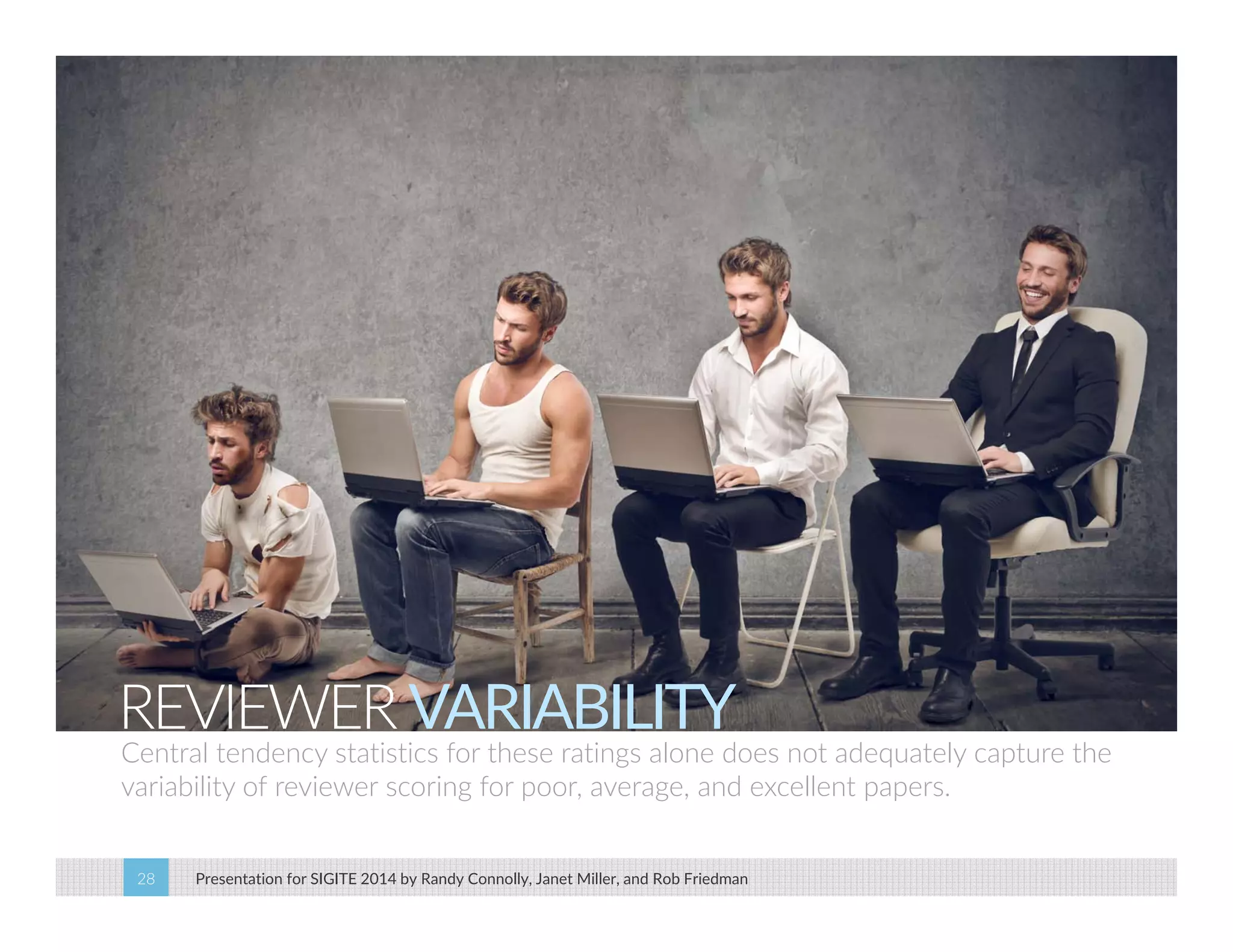
REVIEWER VARIABILITY 
Central tendency statistics for these ratings alone does not adequately capture the 
variability of reviewer scoring for poor, average, and excellent papers. 
Presentation for SIGITE 2014 28 by Randy Connolly, Janet Miller, and Rob Friedman
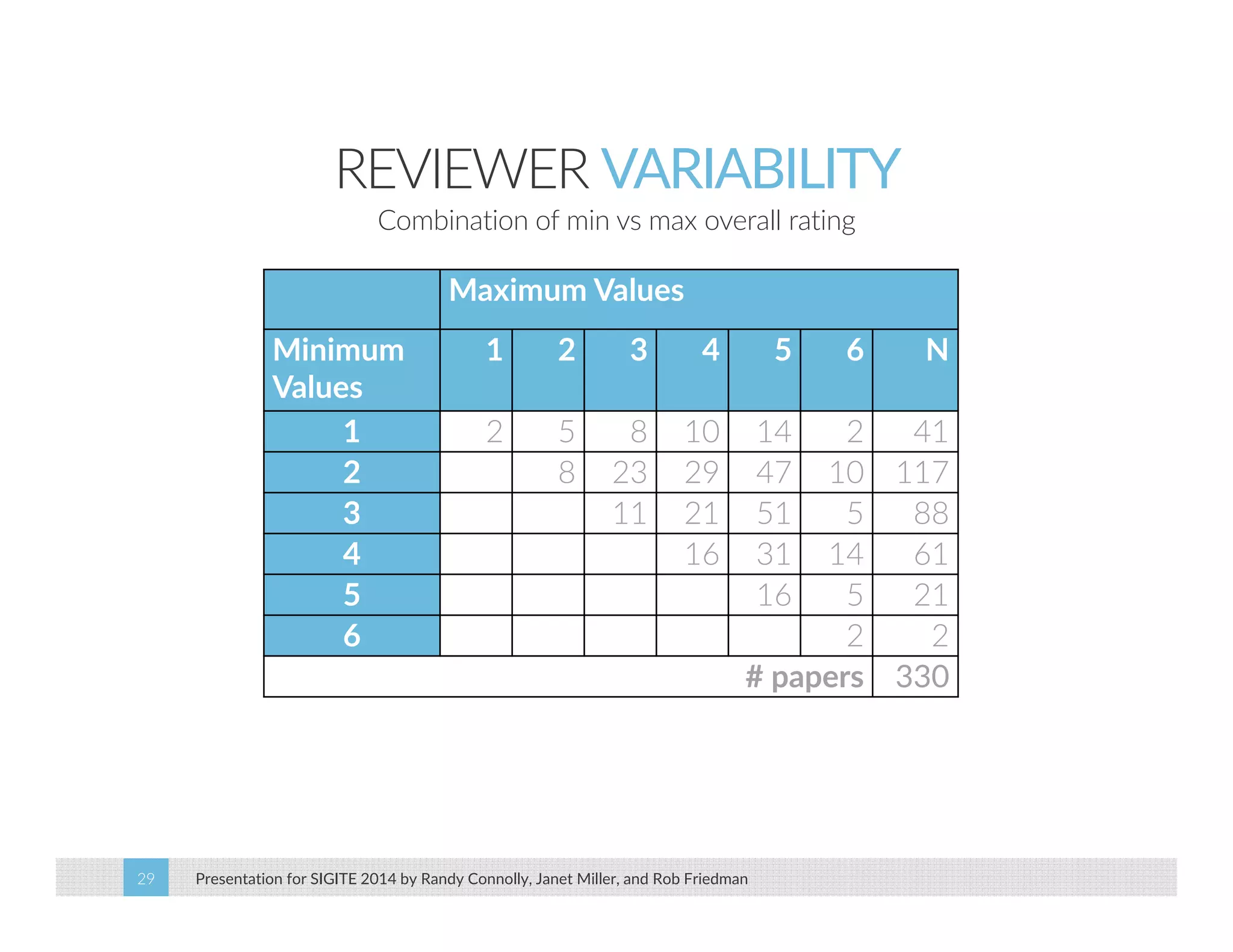
REVIEWER VARIABILITY 
Combination of min vs max overall rating 
Maximum Values 
Minimum 
Values 
1 2 3 4 5 6 N 
1 2 5 8 10 14 2 41 
2 8 23 29 47 10 117 
3 11 21 51 5 88 
4 16 31 14 61 
5 16 5 21 
6 2 2 
# papers 330 
Presentation for SIGITE 2014 29 by Randy Connolly, Janet Miller, and Rob Friedman
INTERESTING FINDING 
While the overall statistics exhibited a strong tendency towards the mean, 
paper ratings can vary considerably from reviewer to reviewer. 
Based on these findings, it is recommended that future program 
committees individually consider papers where rating scores deviate by 2 
or more rating points. 
Presentation for SIGITE 2014 30 by Randy Connolly, Janet Miller, and Rob Friedman
FACTORS AFFECTING RATING 
What things affect reviewer ratings? 
Presentation for SIGITE 2014 31 by Randy Connolly, Janet Miller, and Rob Friedman
Characteristics Reviewer 
Here we looked at two 
characteristics that may 
impact reviewer ratings: 
1. familiarity with the 
subject being reviewed 
2. regional location. 
Presentation for SIGITE 2014 32 by Randy Connolly, Janet Miller, and Rob Friedman
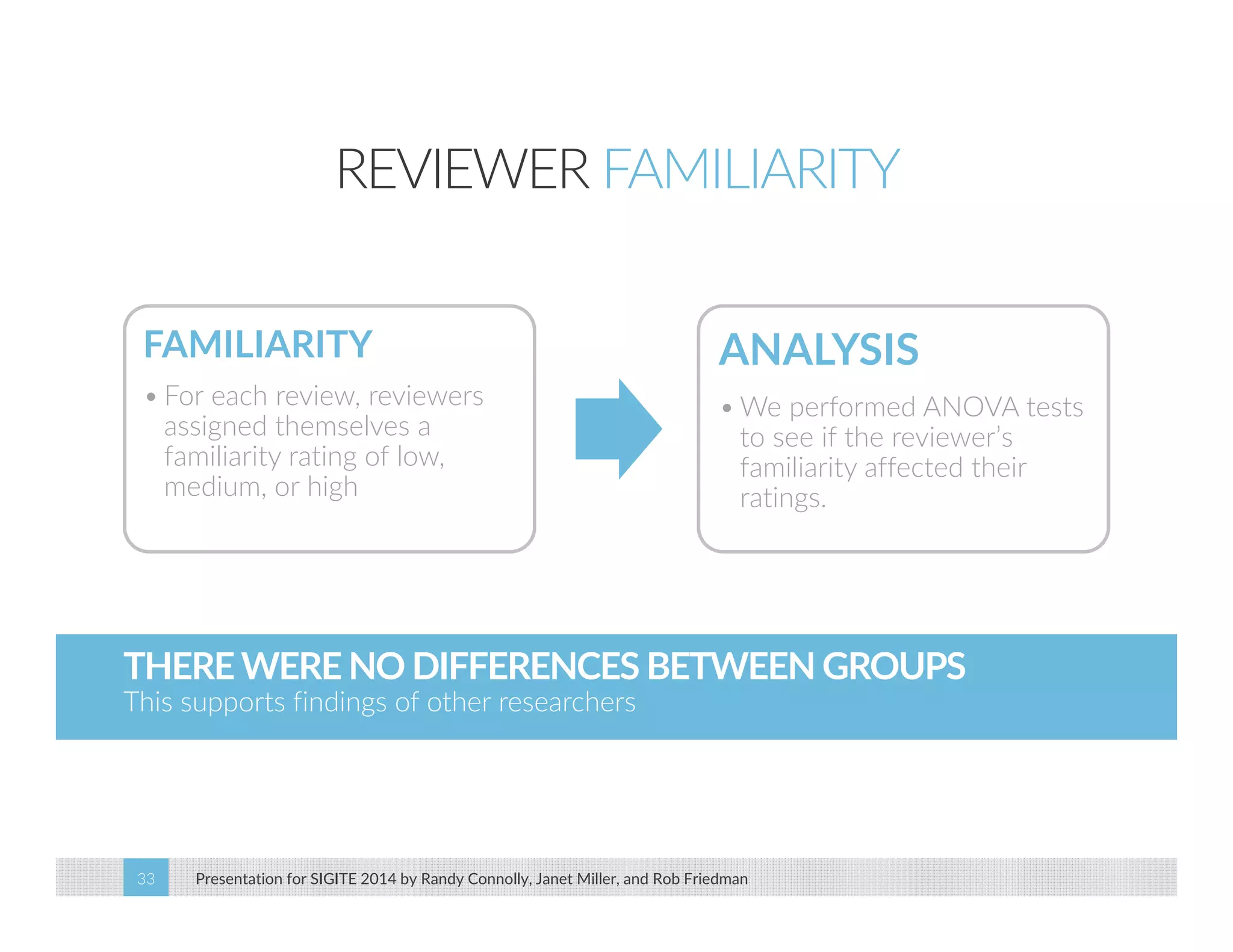
REVIEWER FAMILIARITY 
FAMILIARITY 
•For each review, reviewers 
assigned themselves a 
familiarity rating of low, 
medium, or high 
ANALYSIS 
•We performed ANOVA tests 
to see if the reviewer’s 
familiarity affected their 
ratings. 
THERE WERE NO DIFFERENCES BETWEEN GROUPS 
This supports findings of other researchers 
Presentation for SIGITE 2014 33 by Randy Connolly, Janet Miller, and Rob Friedman
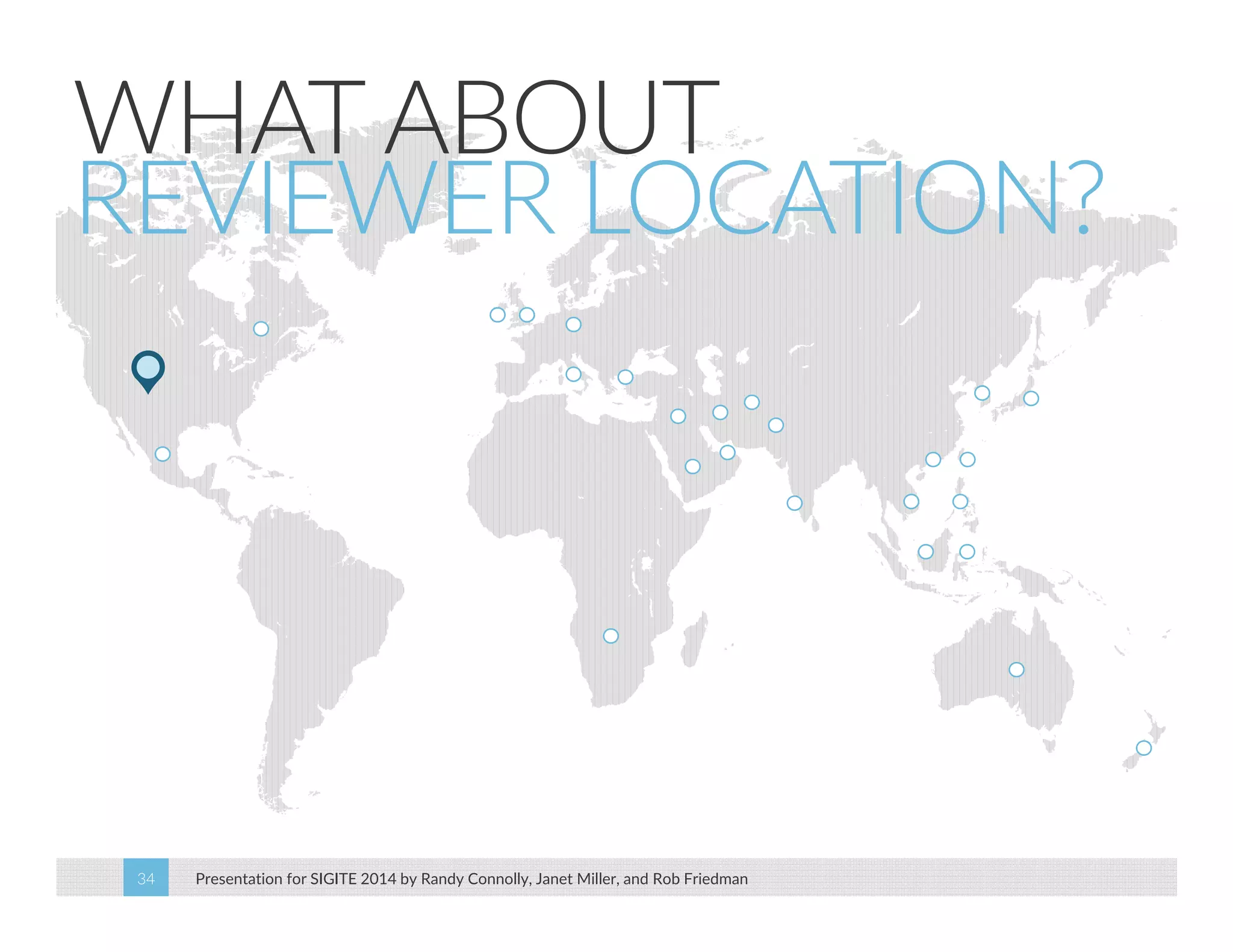
WHAT ABOUT 
REVIEWER LOCATION? 
Presentation for SIGITE 2014 34 by Randy Connolly, Janet Miller, and Rob Friedman
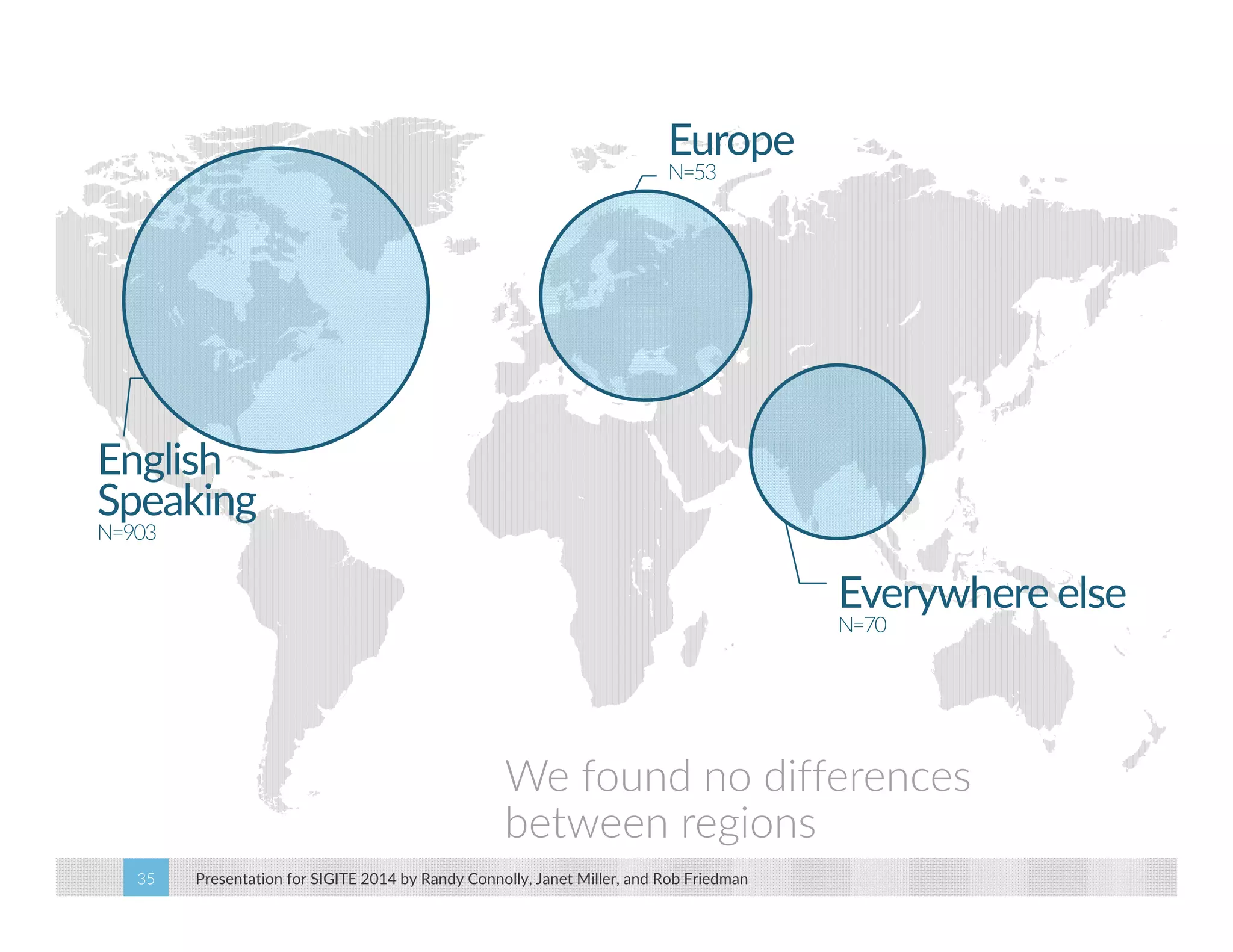
Europe 
N=53 
Presentation for SIGITE 2014 35 by Randy Connolly, Janet Miller, and Rob Friedman 
Everywhere else 
N=70 
English 
Speaking 
N=903 
We found no differences 
between regions
TEXTUAL 
CHARACTERISTICS 
36 
We compared several 
quantitative textual 
measures on a subset of our 
papers to see if any of them 
were related to reviewers’ 
overall ratings. 
The readability indices that 
we tested included the 
following: 
the percentage of complex 
words, the Flesh‐Kincaid 
Reading Ease Index, the 
Gunning Fog Score, the 
SMOG index, and the 
Coleman Liau Index. 
All of these indices are 
meant to measure the 
reading difficulty of a block 
of text.
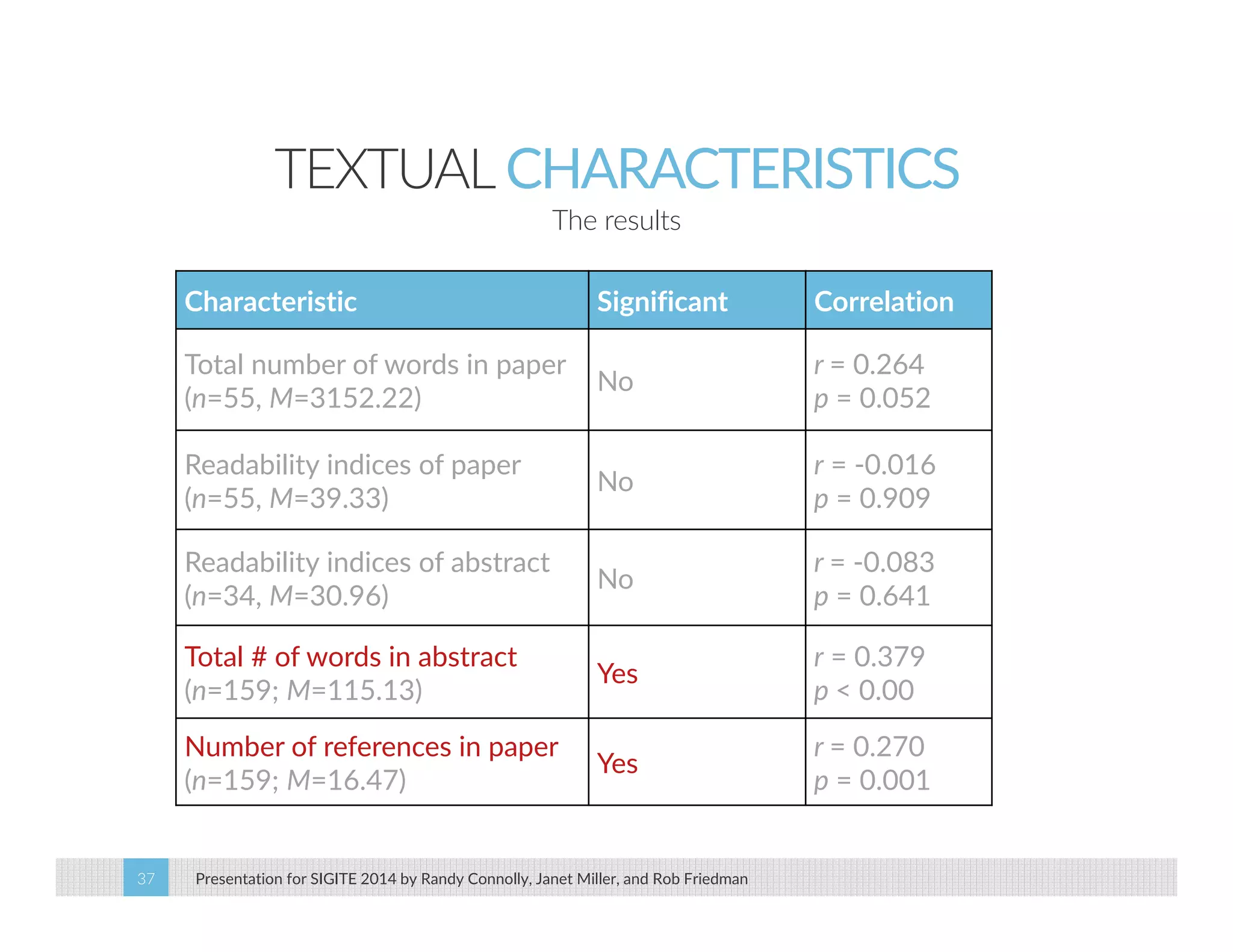
TEXTUAL CHARACTERISTICS 
The results 
Characteristic Significant Correlation 
Total number of words in paper 
(n=55, M=3152.22) No r = 0.264 
p = 0.052 
Readability indices of paper 
(n=55, M=39.33) No r = ‐0.016 
Presentation for SIGITE 2014 37 by Randy Connolly, Janet Miller, and Rob Friedman 
p = 0.909 
Readability indices of abstract 
(n=34, M=30.96) No r = ‐0.083 
p = 0.641 
Total # of words in abstract 
(n=159; M=115.13) Yes r = 0.379 
p < 0.00 
Number of references in paper 
(n=159; M=16.47) Yes r = 0.270 
p = 0.001
INTERESTING FINDING 
We were not surprised to find that the number of references in the paper 
would affect reviewer ratings. 
We were surprised to discover that the length of the abstract affects 
reviewer ratings! 
Presentation for SIGITE 2014 38 by Randy Connolly, Janet Miller, and Rob Friedman
PEER REVIEW VALIDITY 
How accurate were our reviewers? 
Presentation for SIGITE 2014 39 by Randy Connolly, Janet Miller, and Rob Friedman
40 
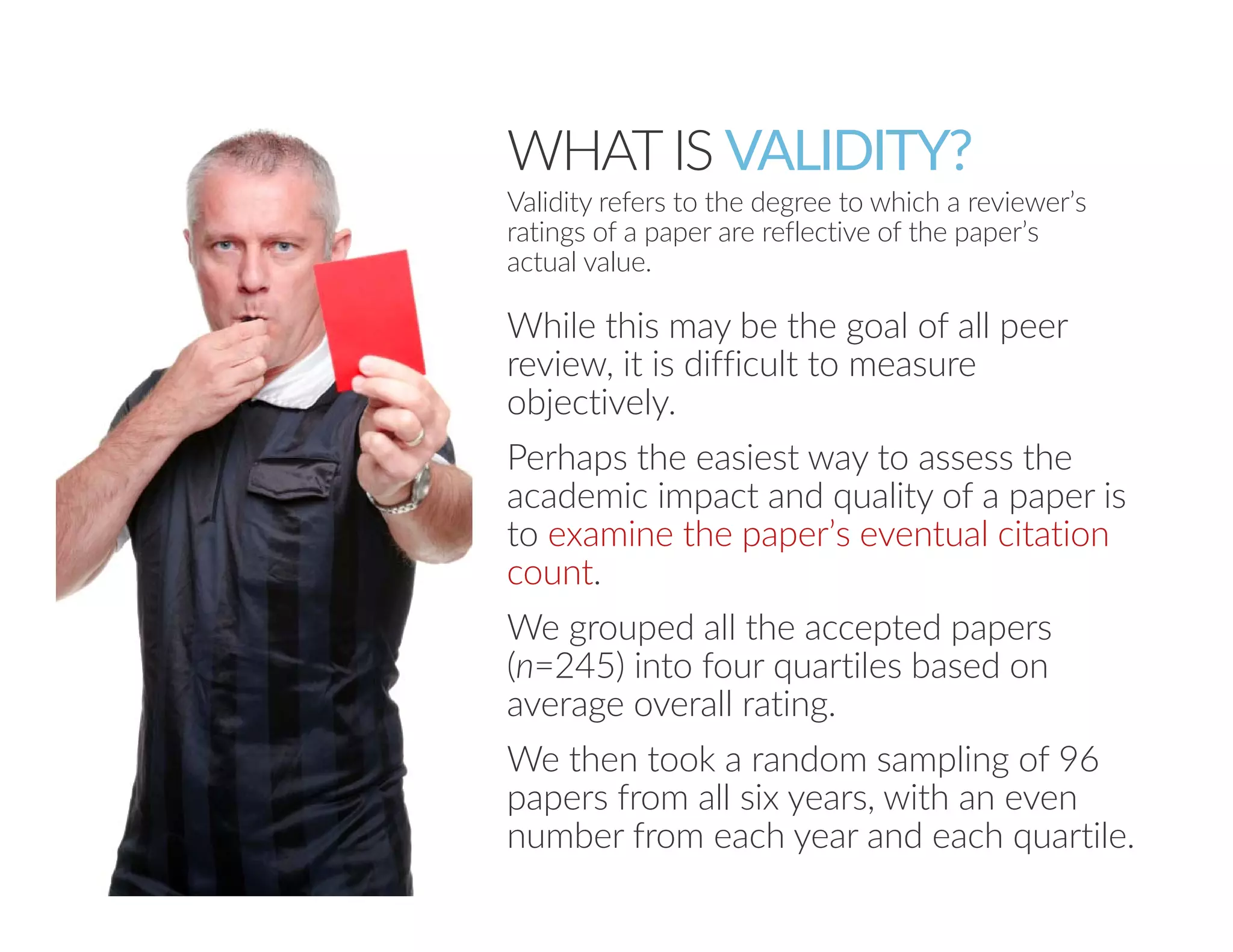
WHAT IS VALIDITY? 
Validity refers to the degree to which a reviewer’s 
ratings of a paper are reflective of the paper’s 
actual value. 
While this may be the goal of all peer 
review, it is difficult to measure 
objectively. 
Perhaps the easiest way to assess the 
academic impact and quality of a paper is 
to examine the paper’s eventual citation 
count. 
We grouped all the accepted papers 
(n=245) into four quartiles based on 
average overall rating. 
We then took a random sampling of 96 
papers from all six years, with an even 
number from each year and each quartile. 
Image description 
Lorem ipsum dolor sit amet
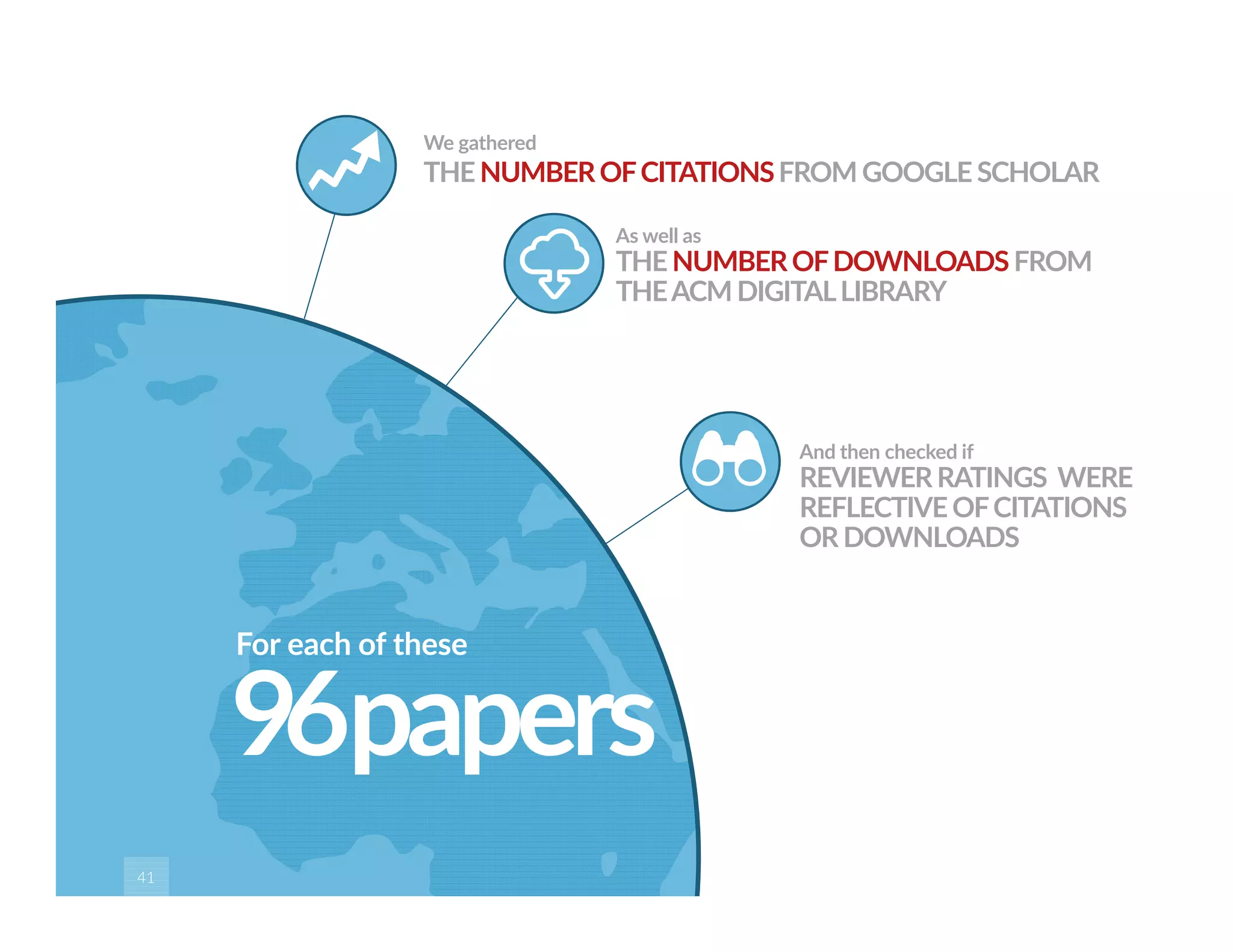
We gathered 
THE NUMBER OF CITATIONS FROM GOOGLE SCHOLAR 
As well as 
THE NUMBER OF DOWNLOADS FROM 
THE ACM DIGITAL LIBRARY 
96 papers 
Presentation for SIGITE 2014 41 
by Randy Connolly, Janet Miller, and Rob Friedman 
And then checked if 
REVIEWER RATINGS WERE 
REFLECTIVE OF CITATIONS 
OR DOWNLOADS 
For each of these
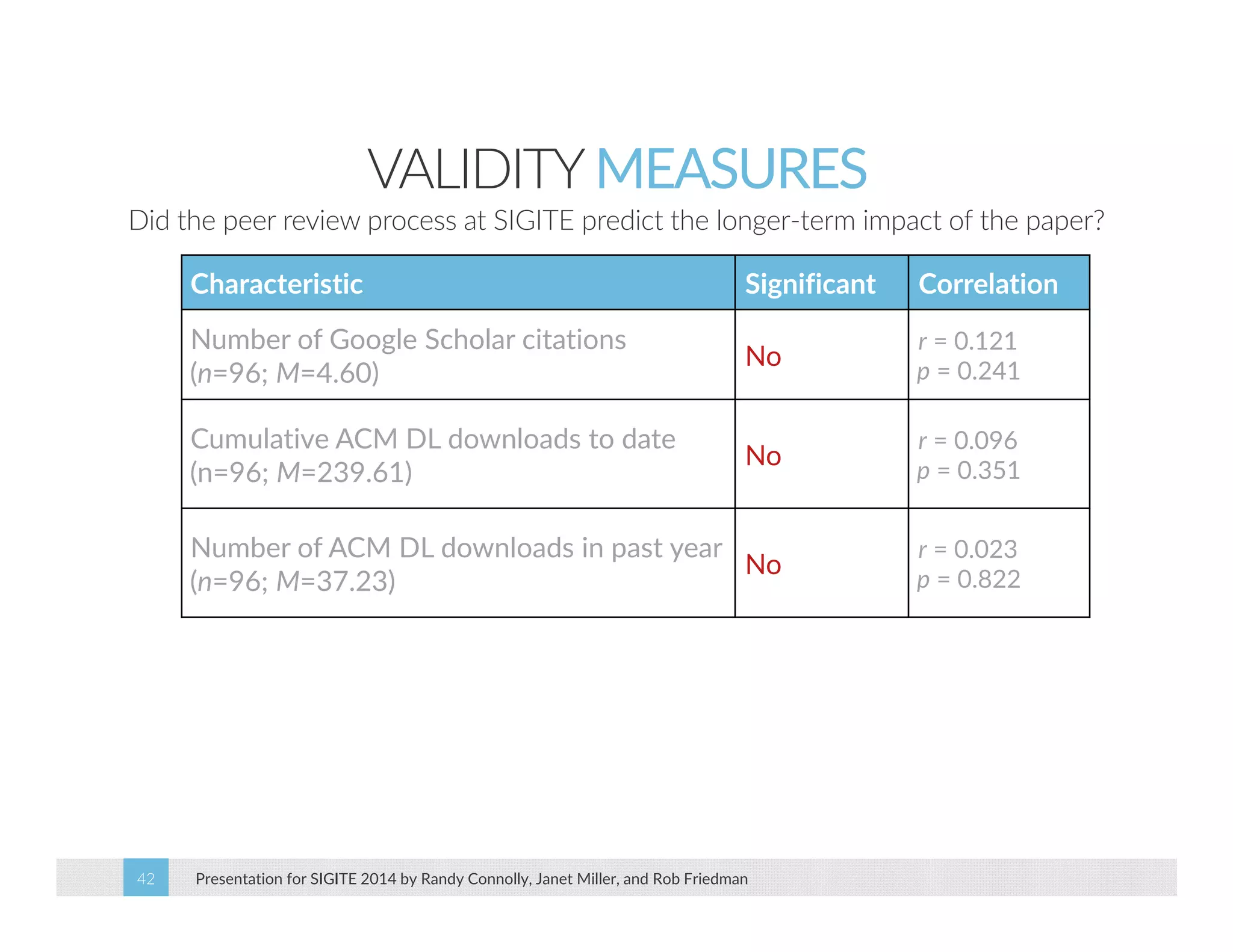
VALIDITY MEASURES 
Did the peer review process at SIGITE predict the longer‐term impact of the paper? 
Characteristic Significant Correlation 
Number of Google Scholar citations 
(n=96; M=4.60) No r = 0.121 
Presentation for SIGITE 2014 42 by Randy Connolly, Janet Miller, and Rob Friedman 
p = 0.241 
Cumulative ACM DL downloads to date 
(n=96; M=239.61) No r = 0.096 
p = 0.351 
Number of ACM DL downloads in past year 
(n=96; M=37.23) No r = 0.023 
p = 0.822
This study has several limitations. 
Our data set contained six years of data for a 
computing education conference: such 
conferences arguably have a unique set of 
reviewers and authors in comparison to 
“normal” computing conferences. 
As such, there may be limits to the 
generalizability of our results. 
It is also important to recognize that 
correlations are not the same as causation. 
43
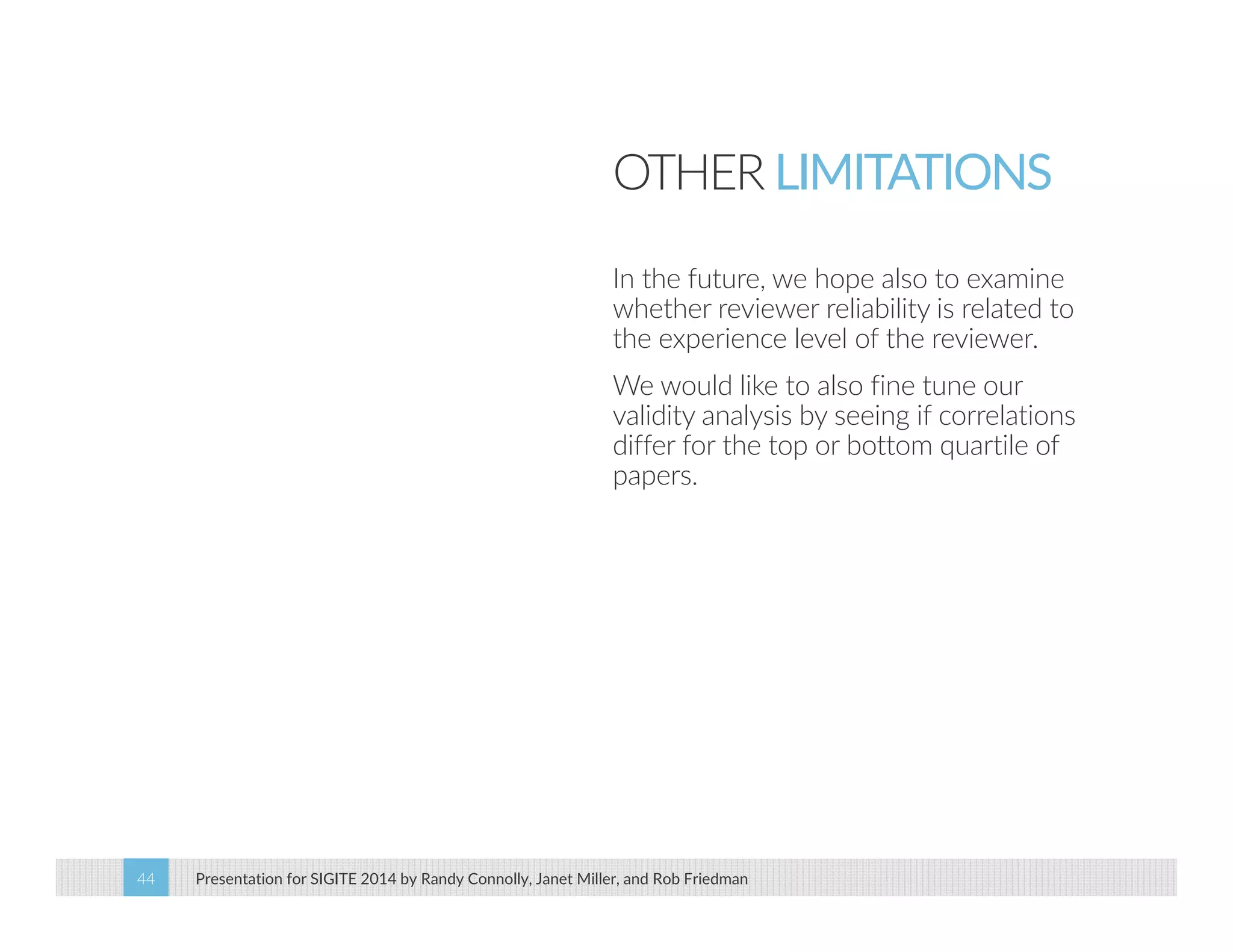
OTHER LIMITATIONS 
In the future, we hope also to examine 
whether reviewer reliability is related to 
the experience level of the reviewer. 
We would like to also fine tune our 
validity analysis by seeing if correlations 
differ for the top or bottom quartile of 
papers. 
Presentation for SIGITE 2014 44 by Randy Connolly, Janet Miller, and Rob Friedman
CONCLUSION 
45
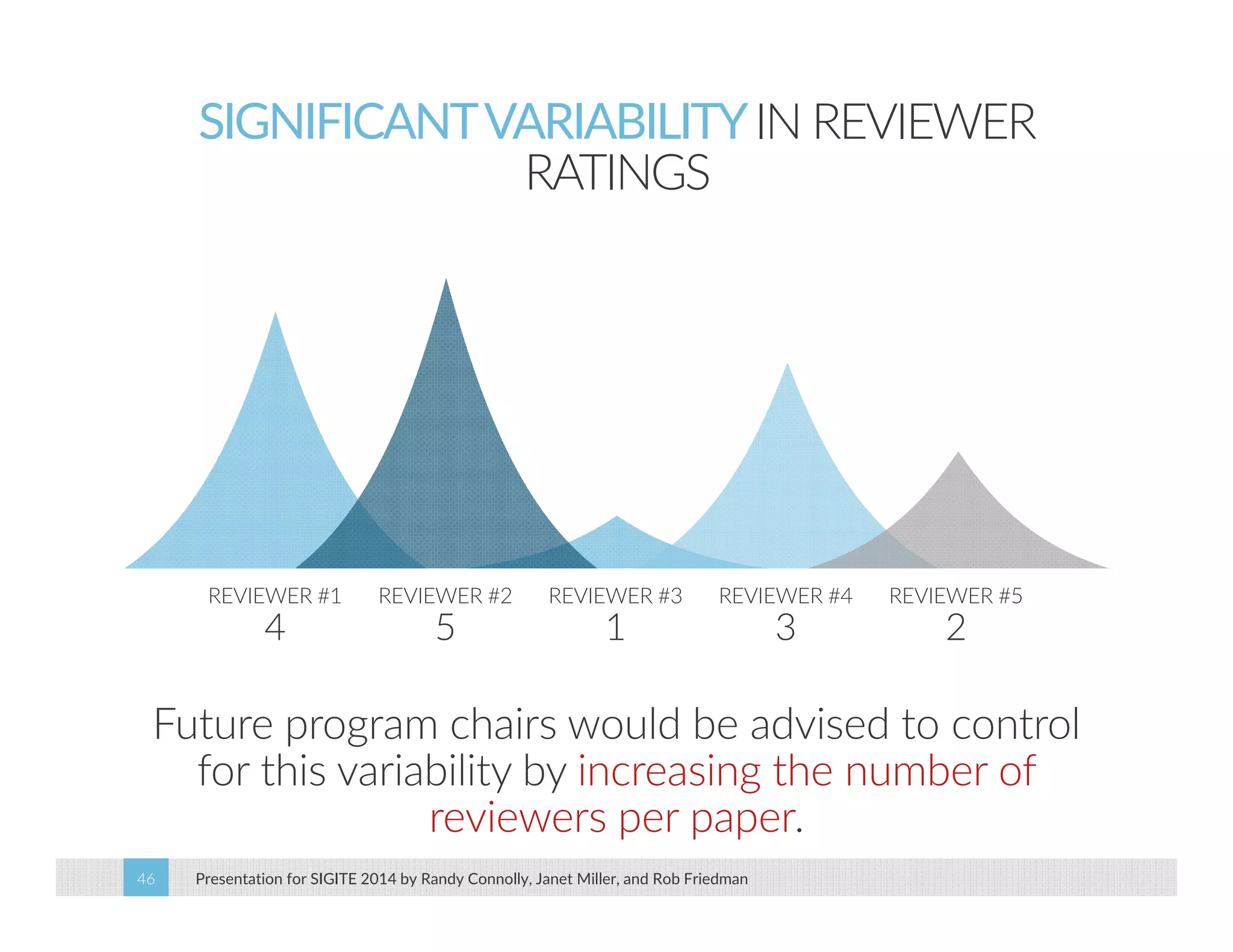
SIGNIFICANT VARIABILITY IN REVIEWER 
RATINGS 
REVIEWER #1 
4 
REVIEWER #2 
5 
REVIEWER #3 
1 
REVIEWER #4 
Presentation for SIGITE 2014 46 by Randy Connolly, Janet Miller, and Rob Friedman 
3 
REVIEWER #5 
2 
Future program chairs would be advised to control 
for this variability by increasing the number of 
reviewers per paper.
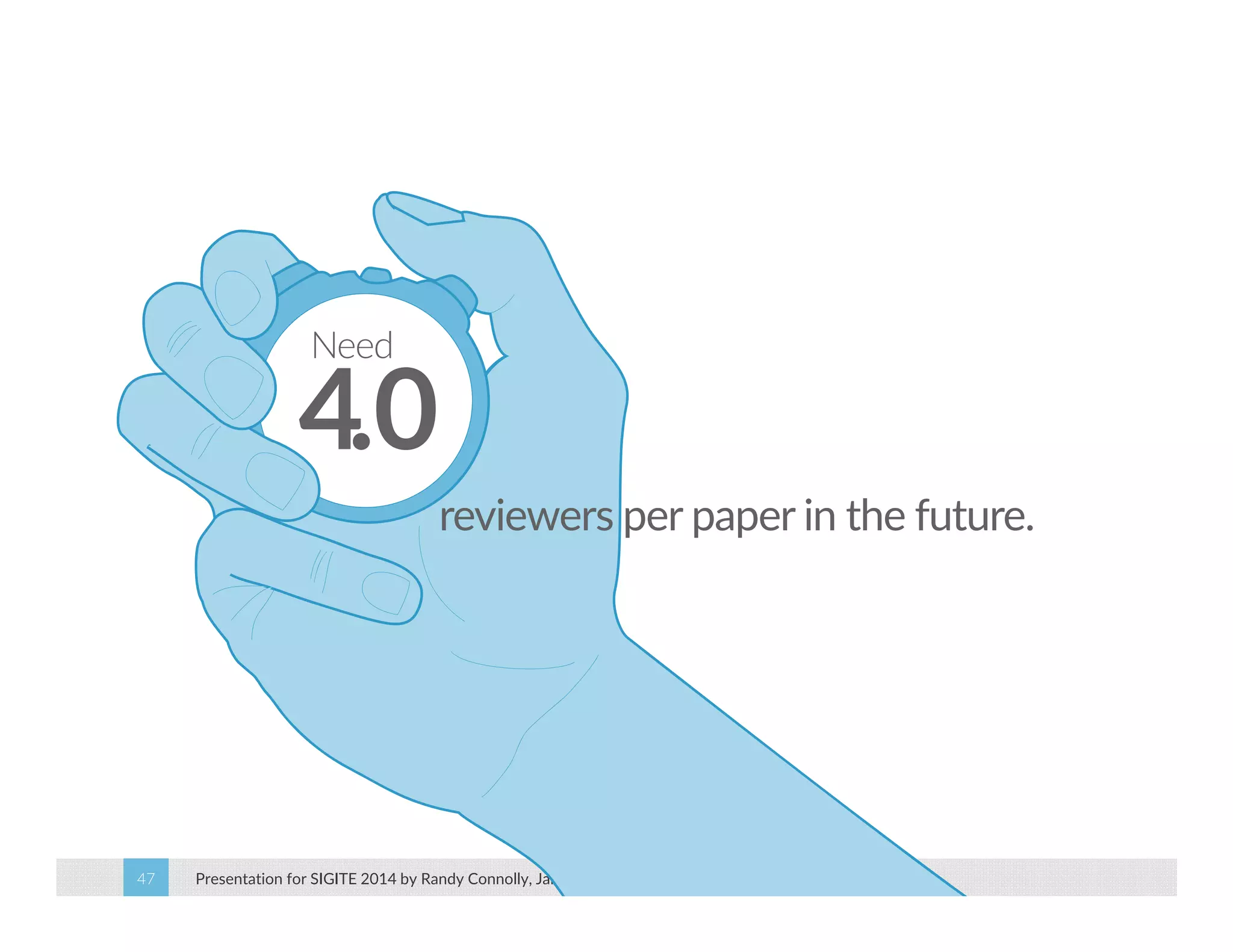
4.0 Need 
reviewers per paper in the future. 
Presentation for SIGITE 2014 47 by Randy Connolly, Janet Miller, and Rob Friedman
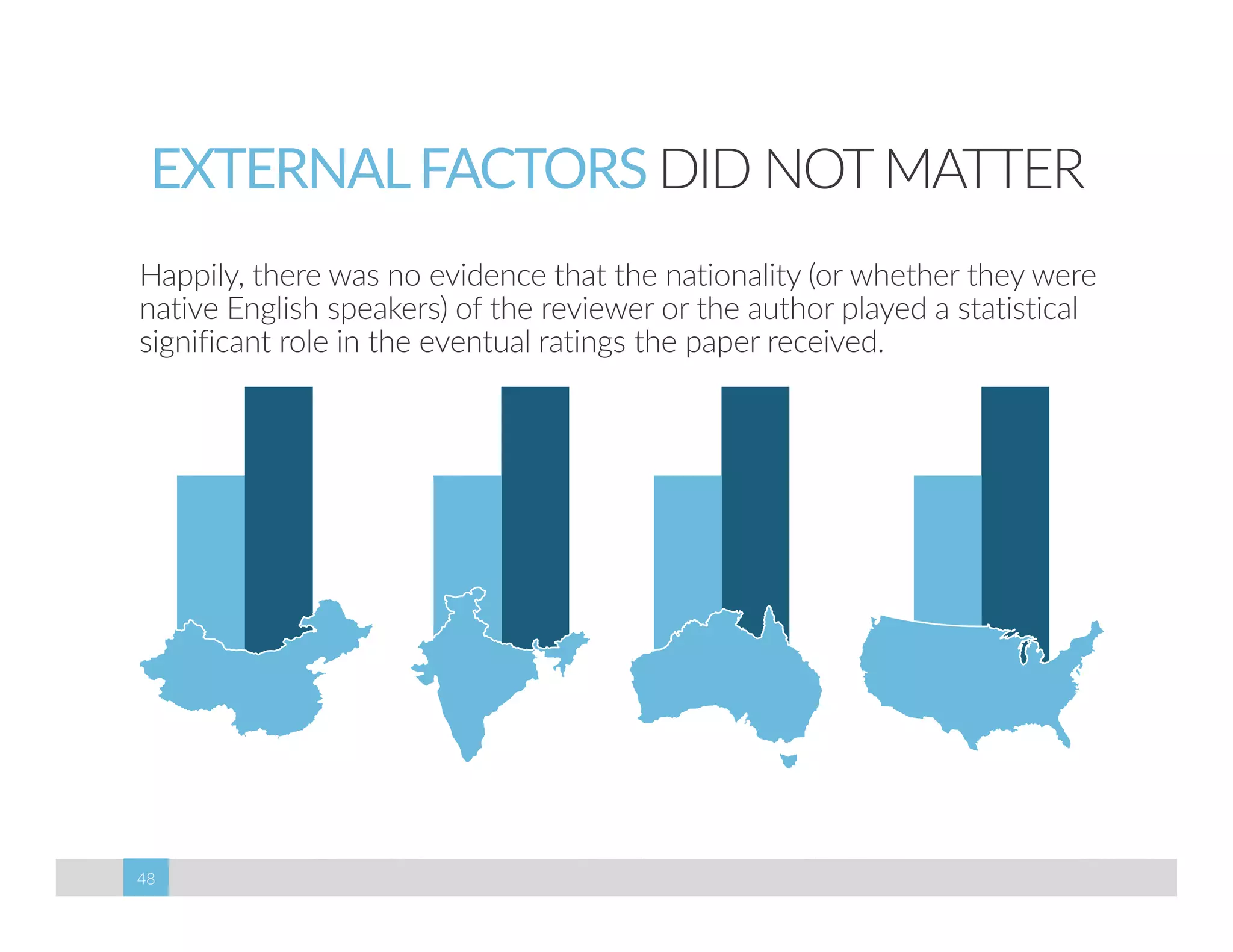
EXTERNAL FACTORS DID NOT MATTER 
Happily, there was no evidence that the nationality (or whether they were 
native English speakers) of the reviewer or the author played a statistical 
significant role in the eventual ratings the paper received. 
Presentation for SIGITE 2014 48 
by Randy Connolly, Janet Miller, and Rob Friedman
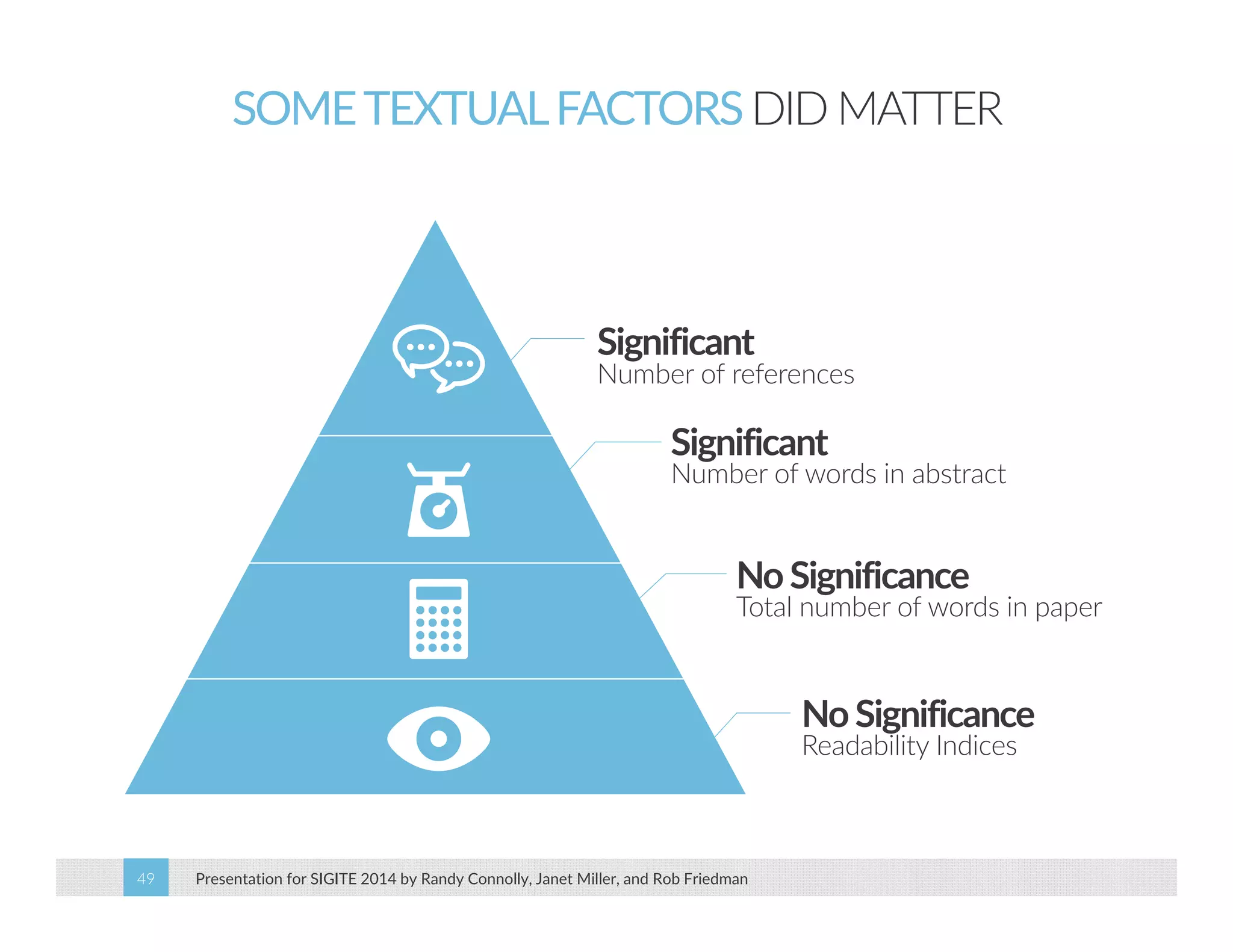
SOME TEXTUAL FACTORS DID MATTER 
Significant 
Number of references 
Significant 
Number of words in abstract 
No Significance 
Total number of words in paper 
Presentation for SIGITE 2014 49 by Randy Connolly, Janet Miller, and Rob Friedman 
No Significance 
Readability Indices
50 
WHY THE ABSTRACT? 
We were quite surprised to find that 
the number of words in the abstract 
was statistically significant. 
Presumably, reviewers read the 
abstract particularly carefully. 
As such, our results show that erring 
on the side of abstract brevity is 
usually a mistake. 
On the contrary, our evidence shows 
that it is important for authors to 
make sure the abstract contains 
sufficient information.
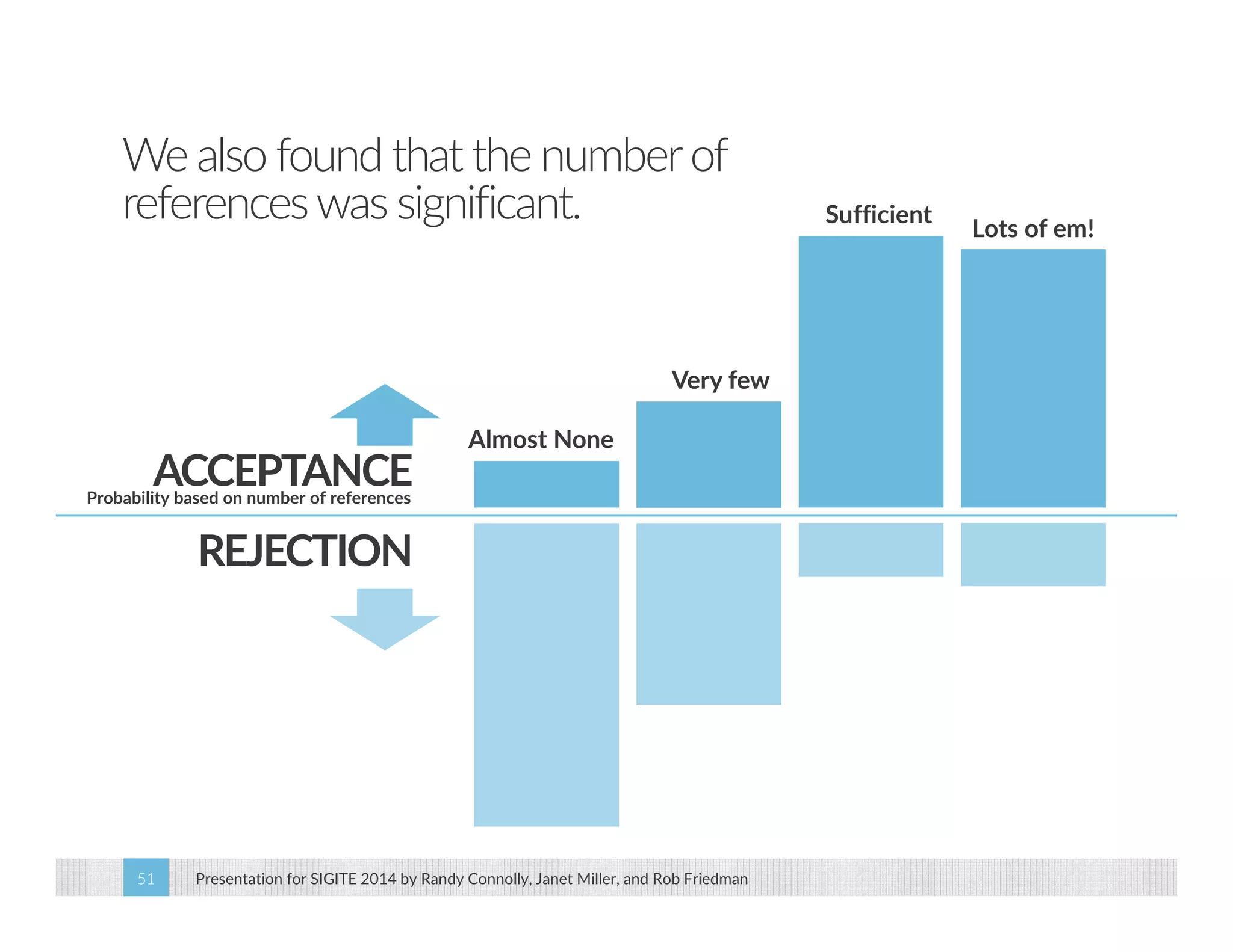
We also found that the number of 
references was significant. 
ACCEPTANCE Probability based on number of references 
REJECTION 
Almost None 
Very few 
Presentation for SIGITE 2014 51 by Randy Connolly, Janet Miller, and Rob Friedman 
Sufficient Lots of em!
Presentation for SIGITE 2014 52 by Randy Connolly, Janet Miller, and Rob Friedman 
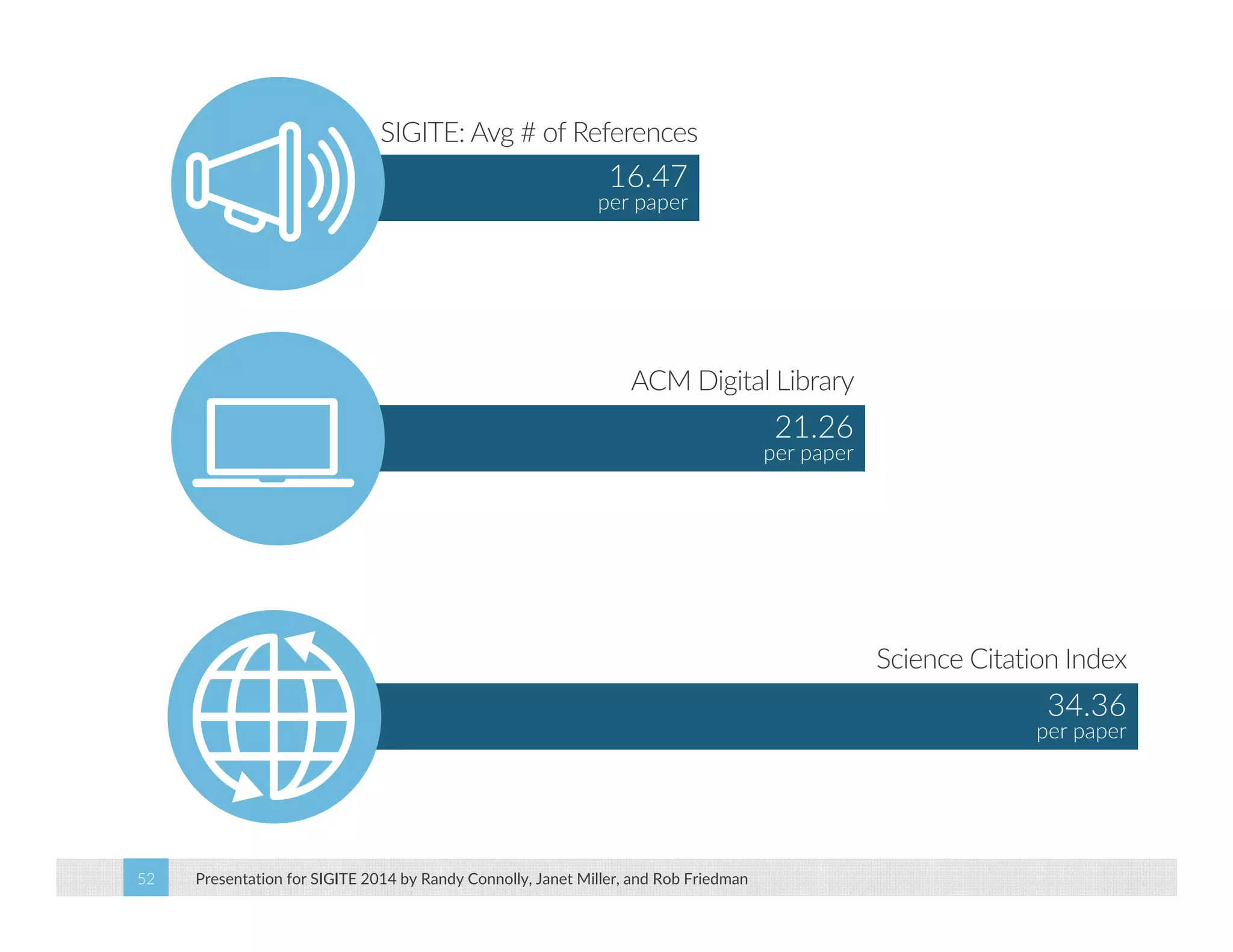
21.26 
per paper 
16.47 
per paper 
+103% 
SIGITE: Avg # of References 
ACM Digital Library 
+110% 
Science Citation Index 
34.36 
per paper 
+110%
OBVIOUS CONCLUSIONS 
Making a concerted effort at increasing citations is likely to improve a 
paper’s ratings with reviewers. 
It should be emphasized that the number of citations is not the cause of 
lower or better reviewer ratings. 
Rather, the number of citations is likely a proxy measure for determining if 
the paper under review is a properly researched paper that is connected to 
the broader scholarly community. 
Presentation for SIGITE 2014 53 by Randy Connolly, Janet Miller, and Rob Friedman
Final Conclusion 
VALIDITY 
We did not find any connection between reviewers’ ratings of a paper and its 
subsequent academic impact (measured by citations) or practical impact (measured by 
ACM Digital Library downloads). 
This might seem to be a disturbing result. 
However, other research in this area also found no correlation between reviewer ratings 
and subsequent academic impact. 
It is important to remember that, “the aim of the peer review process is not the selection 
of high impact papers, but is simply to filter junk papers and accept only the ones above 
a certain quality threshold”. 
Presentation for SIGITE 2014 54 by Randy Connolly, Janet Miller, and Rob Friedman
FUTUREWORK 
55 
We hope to extend our analysis to 
include not only more recent years, but 
also to include more fine‐grained 
examinations of the different factors 
affecting peer review at the SIGITE 
conference.
QUESTIONS? 
Presentation for SIGITE 2014 56 by Randy Connolly, Janet Miller, and Rob Friedman

A longitudinal examination of SIGITE conference submission data

  • 1.
    A LONGITUDINAL EXAMINATIONOF SIGITE CONFERENCE SUBMISSION DATA 2007‐2012 Presentation for SIGITE 2014 1 by Randy Connolly, Janet Miller, and Rob Friedman
  • 2.
    THE ABSTRACT Thispaper examines submission data for the SIGITE conference between the years 2007‐2012. It examines which external factors and which internal characteristics of the submissions are related to eventual reviewer ratings. Presentation for SIGITE 2014 2 by Randy Connolly, Janet Miller, and Rob Friedman Ramifications of the findings for future authors and conference organizers are also discussed.
  • 3.
    RELATEDWORK Peer reviewis the main quality control mechanism within the academic sciences and is used for assessing the merits of a written work as well as for ensuring the standards of the academic field. 3
  • 4.
    PEER REVIEW Enjoysbroad support, yet … BIAS PROBLEMS • Author/Institution status • Asymmetrical power relations SOLUTIONS •Single‐Blind Reviews (SBR) •Double‐Blind Reviews (DBR) SIGITE 2007‐2012 Used Double‐Blind reviews Presentation for SIGITE 2014 4 by Randy Connolly, Janet Miller, and Rob Friedman
  • 5.
    RESEARCH ON SBRANDDBR RELIABILITY ISSUES Presentation for SIGITE 2014 5 by Randy Connolly, Janet Miller, and Rob Friedman VALIDITY ISSUES
  • 6.
    PEER REVIEW OFTENLACKS RELIABILITY That is, reviewers often differ strongly about the merits of any given paper. 6
  • 7.
    PEER REVIEW OFTENLACKS VALIDITY There is often little relationship between the judgments of reviewers and the subsequent judgments of the relevant larger scholarly community as defined by eventual citations. Presentation for SIGITE 2014 7 by Randy Connolly, Janet Miller, and Rob Friedman
  • 8.
    SOME RESEARCH DISAGREES Others have found that there is indeed a “statistically significant association between selection decisions and the applicants' scientific achievements, if quantity and impact of research publications are used as a criterion for scientific achievement” Presentation for SIGITE 2014 8 by Randy Connolly, Janet Miller, and Rob Friedman
  • 9.
    Our Study PROVIDESA UNIQUE ADDITION TO THIS LITERATURE Unlike earlier work, our study assesses reviews and submissions for a single international computing conference across an extended time period (2007‐2012). It assesses the reliability of the peer view process at SIGITE by examining both internal and external factors; the combination of these analyses is also unique. This paper also provides some innovation in the measures it uses to assess the validity of the peer review process. Presentation for SIGITE 2014 9 by Randy Connolly, Janet Miller, and Rob Friedman
  • 10.
    10 METHOD From2007 to 2012, the ACM SIGITE conference used the same “Grinnell” submission system as the larger SIGCSE and ITiCSE education conferences. 10 This web‐based system was used by authors to submit their work, by reviewers to review submissions, and by program committees to evaluate reviews and to organize the eventual conference program.
  • 11.
    DATACOLLECTION Presentation forSIGITE 2014 11 by Randy Connolly, Janet Miller, and Rob Friedman STEP 4 Data was further manipulated in Excel and then exported and statistically analyzed using SPSS. STEP 3 Other relevant data (e.g., number of references, citation rates, etc) were manually gathered. STEP 2 Since 2007‐2010 conferences used a slightly different process, the data had to be normalized. STEP 1 Individual Access databases used by the submission system for each year had to be merged into a single file.
  • 12.
    12 RESULTS Overthe six years, there were 1026 reviews from 192 different reviewers, and 508 authors were involved in submitting a total of 332 papers. 12 The 2010 version of the conference had the lowest number of paper submissions (n=37), while the 2012 had the largest (n=87).
  • 13.
    AUTHOR AND PAPERINFORMATION Who were our authors and how did they do on their papers? Presentation for SIGITE 2014 13 by Randy Connolly, Janet Miller, and Rob Friedman
  • 14.
    PAPERS WERE SUBMITTEDFROM 32 DIFFERENT COUNTRIES USA N=378 Canada N=24 Saudi Arabia N=14 Presentation for SIGITE 2014 14 by Randy Connolly, Janet Miller, and Rob Friedman Pakistan N=8 Italy N=8 United Arab Emirates N=8 Finland N=7 Korea N=7
  • 15.
    Acceptance Rate (74.1%) However, this acceptance figure is not representative of the true acceptance rate of SIGITE, because the review process was altered back in 2011. From 2007‐2010 there was a separate abstract submission stage, which helped reduce the eventual number of rejected papers during those years. Presentation for SIGITE 2014 15 by Randy Connolly, Janet Miller, and Rob Friedman
  • 16.
    Actual acceptance rateswere: 41% (2007) 63% (2008) 68% (2009) 49% (2010) 52% (2011) 58% (2012) Presentation for SIGITE 2014 16 by Randy Connolly, Janet Miller, and Rob Friedman
  • 17.
    Single Author 31% Two Authors 38% Four+ Authors 16% Three Authors 15% There was no difference in acceptance rates between multi‐author and single author papers. Presentation for SIGITE 2014 17 by Randy Connolly, Janet Miller, and Rob Friedman
  • 18.
    PAPER CATEGORIES Whatwere our papers about? Presentation for SIGITE 2014 18 by Randy Connolly, Janet Miller, and Rob Friedman
  • 19.
    CATEGORIES BY ITPILLAR Presentation for SIGITE 2014 19 by Randy Connolly, Janet Miller, and Rob Friedman
  • 20.
    GENRE TRENDS Presentationfor SIGITE 2014 20 by Randy Connolly, Janet Miller, and Rob Friedman
  • 21.
    REVIEWER INFORMATION Whowere our reviewers? Presentation for SIGITE 2014 21 by Randy Connolly, Janet Miller, and Rob Friedman
  • 22.
    REVIEWER INFORMATION 1026 reviews Presentation for SIGITE 2014 22 by Randy Connolly, Janet Miller, and Rob Friedman 192 reviewers 70% reviewed by 3 or 4 reviewers 3.11 reviews / paper
  • 23.
    INTERESTING FINDING Thenumber of reviews a paper had was negatively correlated with its probability of being accepted to the conference. Generally speaking, the more reviews a paper had, the less likely it was of being accepted! Presentation for SIGITE 2014 23 by Randy Connolly, Janet Miller, and Rob Friedman
  • 24.
    RATING INFORMATION Whatdid the ratings look like? Presentation for SIGITE 2014 24 by Randy Connolly, Janet Miller, and Rob Friedman
  • 25.
    FIVE CATEGORIES Reviewerssupplied a rating between 1 and 6 for five different categories TECHNICAL ORGANIZATION ORIGINALITY SIGNIFICANCE OVERALL 3.62 mean 3.86 mean 3.70 mean 3.75 mean 3.60 mean Presentation for SIGITE 2014 25 by Randy Connolly, Janet Miller, and Rob Friedman
  • 26.
    OVERALL RATING Ratingdefinitions and number received Overall Rating Description N % 1 Deficient 51 5.0% 2 Below Average 192 18.7% 3 Average 223 21.7% 4 Very Good 254 24.8% 5 Outstanding 267 26.0% 6 Exceptional 39 3.8% Total 1026 100.0% Presentation for SIGITE 2014 26 by Randy Connolly, Janet Miller, and Rob Friedman
  • 27.
    INTERESTING FINDING Thesesubcategory ratings were significantly correlated (p<0.00) with the overall rating. Additional post‐hoc testing showed significant relationships between every one of these four factors and every level of overall rating, which suggested strong internal reliability for each of the reviewers (i.e, each reviewer was consistent with him/herself). Generally speaking, this means that the subcategory ratings were not really needed. Presentation for SIGITE 2014 27 by Randy Connolly, Janet Miller, and Rob Friedman
  • 28.
    REVIEWER VARIABILITY Centraltendency statistics for these ratings alone does not adequately capture the variability of reviewer scoring for poor, average, and excellent papers. Presentation for SIGITE 2014 28 by Randy Connolly, Janet Miller, and Rob Friedman
  • 29.
    REVIEWER VARIABILITY Combinationof min vs max overall rating Maximum Values Minimum Values 1 2 3 4 5 6 N 1 2 5 8 10 14 2 41 2 8 23 29 47 10 117 3 11 21 51 5 88 4 16 31 14 61 5 16 5 21 6 2 2 # papers 330 Presentation for SIGITE 2014 29 by Randy Connolly, Janet Miller, and Rob Friedman
  • 30.
    INTERESTING FINDING Whilethe overall statistics exhibited a strong tendency towards the mean, paper ratings can vary considerably from reviewer to reviewer. Based on these findings, it is recommended that future program committees individually consider papers where rating scores deviate by 2 or more rating points. Presentation for SIGITE 2014 30 by Randy Connolly, Janet Miller, and Rob Friedman
  • 31.
    FACTORS AFFECTING RATING What things affect reviewer ratings? Presentation for SIGITE 2014 31 by Randy Connolly, Janet Miller, and Rob Friedman
  • 32.
    Characteristics Reviewer Herewe looked at two characteristics that may impact reviewer ratings: 1. familiarity with the subject being reviewed 2. regional location. Presentation for SIGITE 2014 32 by Randy Connolly, Janet Miller, and Rob Friedman
  • 33.
    REVIEWER FAMILIARITY FAMILIARITY •For each review, reviewers assigned themselves a familiarity rating of low, medium, or high ANALYSIS •We performed ANOVA tests to see if the reviewer’s familiarity affected their ratings. THERE WERE NO DIFFERENCES BETWEEN GROUPS This supports findings of other researchers Presentation for SIGITE 2014 33 by Randy Connolly, Janet Miller, and Rob Friedman
  • 34.
    WHAT ABOUT REVIEWERLOCATION? Presentation for SIGITE 2014 34 by Randy Connolly, Janet Miller, and Rob Friedman
  • 35.
    Europe N=53 Presentationfor SIGITE 2014 35 by Randy Connolly, Janet Miller, and Rob Friedman Everywhere else N=70 English Speaking N=903 We found no differences between regions
  • 36.
    TEXTUAL CHARACTERISTICS 36 We compared several quantitative textual measures on a subset of our papers to see if any of them were related to reviewers’ overall ratings. The readability indices that we tested included the following: the percentage of complex words, the Flesh‐Kincaid Reading Ease Index, the Gunning Fog Score, the SMOG index, and the Coleman Liau Index. All of these indices are meant to measure the reading difficulty of a block of text.
  • 37.
    TEXTUAL CHARACTERISTICS Theresults Characteristic Significant Correlation Total number of words in paper (n=55, M=3152.22) No r = 0.264 p = 0.052 Readability indices of paper (n=55, M=39.33) No r = ‐0.016 Presentation for SIGITE 2014 37 by Randy Connolly, Janet Miller, and Rob Friedman p = 0.909 Readability indices of abstract (n=34, M=30.96) No r = ‐0.083 p = 0.641 Total # of words in abstract (n=159; M=115.13) Yes r = 0.379 p < 0.00 Number of references in paper (n=159; M=16.47) Yes r = 0.270 p = 0.001
  • 38.
    INTERESTING FINDING Wewere not surprised to find that the number of references in the paper would affect reviewer ratings. We were surprised to discover that the length of the abstract affects reviewer ratings! Presentation for SIGITE 2014 38 by Randy Connolly, Janet Miller, and Rob Friedman
  • 39.
    PEER REVIEW VALIDITY How accurate were our reviewers? Presentation for SIGITE 2014 39 by Randy Connolly, Janet Miller, and Rob Friedman
  • 40.
    40 WHAT ISVALIDITY? Validity refers to the degree to which a reviewer’s ratings of a paper are reflective of the paper’s actual value. While this may be the goal of all peer review, it is difficult to measure objectively. Perhaps the easiest way to assess the academic impact and quality of a paper is to examine the paper’s eventual citation count. We grouped all the accepted papers (n=245) into four quartiles based on average overall rating. We then took a random sampling of 96 papers from all six years, with an even number from each year and each quartile. Image description Lorem ipsum dolor sit amet
  • 41.
    We gathered THENUMBER OF CITATIONS FROM GOOGLE SCHOLAR As well as THE NUMBER OF DOWNLOADS FROM THE ACM DIGITAL LIBRARY 96 papers Presentation for SIGITE 2014 41 by Randy Connolly, Janet Miller, and Rob Friedman And then checked if REVIEWER RATINGS WERE REFLECTIVE OF CITATIONS OR DOWNLOADS For each of these
  • 42.
    VALIDITY MEASURES Didthe peer review process at SIGITE predict the longer‐term impact of the paper? Characteristic Significant Correlation Number of Google Scholar citations (n=96; M=4.60) No r = 0.121 Presentation for SIGITE 2014 42 by Randy Connolly, Janet Miller, and Rob Friedman p = 0.241 Cumulative ACM DL downloads to date (n=96; M=239.61) No r = 0.096 p = 0.351 Number of ACM DL downloads in past year (n=96; M=37.23) No r = 0.023 p = 0.822
  • 43.
    This study hasseveral limitations. Our data set contained six years of data for a computing education conference: such conferences arguably have a unique set of reviewers and authors in comparison to “normal” computing conferences. As such, there may be limits to the generalizability of our results. It is also important to recognize that correlations are not the same as causation. 43
  • 44.
    OTHER LIMITATIONS Inthe future, we hope also to examine whether reviewer reliability is related to the experience level of the reviewer. We would like to also fine tune our validity analysis by seeing if correlations differ for the top or bottom quartile of papers. Presentation for SIGITE 2014 44 by Randy Connolly, Janet Miller, and Rob Friedman
  • 45.
  • 46.
    SIGNIFICANT VARIABILITY INREVIEWER RATINGS REVIEWER #1 4 REVIEWER #2 5 REVIEWER #3 1 REVIEWER #4 Presentation for SIGITE 2014 46 by Randy Connolly, Janet Miller, and Rob Friedman 3 REVIEWER #5 2 Future program chairs would be advised to control for this variability by increasing the number of reviewers per paper.
  • 47.
    4.0 Need reviewersper paper in the future. Presentation for SIGITE 2014 47 by Randy Connolly, Janet Miller, and Rob Friedman
  • 48.
    EXTERNAL FACTORS DIDNOT MATTER Happily, there was no evidence that the nationality (or whether they were native English speakers) of the reviewer or the author played a statistical significant role in the eventual ratings the paper received. Presentation for SIGITE 2014 48 by Randy Connolly, Janet Miller, and Rob Friedman
  • 49.
    SOME TEXTUAL FACTORSDID MATTER Significant Number of references Significant Number of words in abstract No Significance Total number of words in paper Presentation for SIGITE 2014 49 by Randy Connolly, Janet Miller, and Rob Friedman No Significance Readability Indices
  • 50.
    50 WHY THEABSTRACT? We were quite surprised to find that the number of words in the abstract was statistically significant. Presumably, reviewers read the abstract particularly carefully. As such, our results show that erring on the side of abstract brevity is usually a mistake. On the contrary, our evidence shows that it is important for authors to make sure the abstract contains sufficient information.
  • 51.
    We also foundthat the number of references was significant. ACCEPTANCE Probability based on number of references REJECTION Almost None Very few Presentation for SIGITE 2014 51 by Randy Connolly, Janet Miller, and Rob Friedman Sufficient Lots of em!
  • 52.
    Presentation for SIGITE2014 52 by Randy Connolly, Janet Miller, and Rob Friedman 21.26 per paper 16.47 per paper +103% SIGITE: Avg # of References ACM Digital Library +110% Science Citation Index 34.36 per paper +110%
  • 53.
    OBVIOUS CONCLUSIONS Makinga concerted effort at increasing citations is likely to improve a paper’s ratings with reviewers. It should be emphasized that the number of citations is not the cause of lower or better reviewer ratings. Rather, the number of citations is likely a proxy measure for determining if the paper under review is a properly researched paper that is connected to the broader scholarly community. Presentation for SIGITE 2014 53 by Randy Connolly, Janet Miller, and Rob Friedman
  • 54.
    Final Conclusion VALIDITY We did not find any connection between reviewers’ ratings of a paper and its subsequent academic impact (measured by citations) or practical impact (measured by ACM Digital Library downloads). This might seem to be a disturbing result. However, other research in this area also found no correlation between reviewer ratings and subsequent academic impact. It is important to remember that, “the aim of the peer review process is not the selection of high impact papers, but is simply to filter junk papers and accept only the ones above a certain quality threshold”. Presentation for SIGITE 2014 54 by Randy Connolly, Janet Miller, and Rob Friedman
  • 55.
    FUTUREWORK 55 Wehope to extend our analysis to include not only more recent years, but also to include more fine‐grained examinations of the different factors affecting peer review at the SIGITE conference.
  • 56.
    QUESTIONS? Presentation forSIGITE 2014 56 by Randy Connolly, Janet Miller, and Rob Friedman