CROP:RED CABBAGE
COURSE NO: VSC 509
COURSE INSTRUCTOR: Dr. Aijaz Malik
PRESENTED BY: Naindeep,Suraya,Shahid
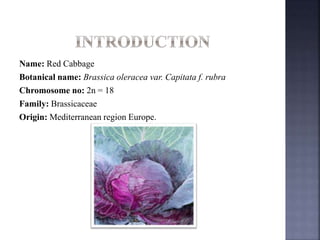
Name: Red Cabbage
Botanical name: Brassica oleracea var. Capitata f. rubra
Chromosome no: 2n = 18
Family: Brassicaceae
Origin: Mediterranean region Europe.
Red Cabbage in India (Red Cabbage) demand is growing very
fast. With time there has been a change in the eating habits.
Because of this, now new types of vegetables (Vegetables)
demand is increasing in the market. Health conscious people are
now starting to include nutritious fruits and vegetables in their
diet. After the COVID epidemic, it has taken the form of a new
trend and for farmers it has come as an opportunity. Farmers are
earning profit by doing farming according to the demand in the
market. Red cabbage is also a vegetable of the same category,
whose demand has increased a lot in recent times. Its cultivation
method is similar to that of green cabbage, but there is a difference
of many folds in terms of price.
 Demand for high value produce is growing both in domestic and
overseas market at the same time, competition is also increasing.
 Biotechnological tools must be used in conjunction with
conventional breeding to tag genes of interest. There is need to
develop varieties with durable resistance to multiple diseases and
pests; heat, drought and salt tolerant varieties.
 Eco-region specific technology generation based on maximum
productivity of available natural resources like climatic condition,
soil fertility and water.
 Improve the understanding of interactions between native
ecosystems and production systems and develop best practices to
conserve biodiversity
 Integrated management of emerging diseases and pests. Emphasis
should be on identification of new and effective bio-molecules for
management of biotic stresses being encouraged for ecofriendly
and sustainable management of diseases and pests.
 Develop production and post-harvest technologies to improve
product quality and minimize environmental impacts.
 Sustainable path for development to meet challenges in vegetable
production through proper technological innovations and
interventions.
 Inter institutional mechanisms to network and review the ongoing
programmes of biotechnology, cost effective production
technologies, postharvest technology, farm mechanization,
transfer of technology and organic farming
The popularity of red cabbage is for its rich content of
phytochemicals, antioxidants, vitamins (C,E,A,K) and minerals
(calcium, manganese, magnesium, iron, and potassium), and low
content of saturated fats and cholesterol. B vitamins e.g. thiamine
(B1), riboflavin (B2) and folate (B2) are also found in this crop.
Besides vitamins and minerals, cabbage also contain a small
amount of protein
It has multiple uses as salads, cole slaw, sauerkraut, soup, curries
and other cooking purposes. Red cabbage is known for possessing
different chemical compounds and medicinal properties (Podsędek
et al., 2014). It produces red or purple colored heads due to the
presence of anthocyanin pigment. Many of its organic compounds
are taken as dietary supplements.
It protects us from cancer, premature aging, diabetes, ulcer and
Alzheimer’s diseases. It helps in weight loss, boosting the immune
system, improving the skin and eye and detoxification of body.
Secondary plant metabolites like glucosinolates (GSs) present in
red cabbage are known for the health-promoting properties
(Verkerkand Dekker, 2004). These natural chemicals breakdown
into compounds like indole-3-carbinol, which has anticancer
property. Flavonoids of the crop have good therapeutic potential in
inflammation and pain.
Red cabbage, also called purple cabbage, is a leafy vegetable from
the cabbage family. It typically comes as a head of cabbage, which
is a ball of tight leaves. Red cabbage has broad reddish-purple
leaves with a thick white stem at the bottom of the head. The
leaves have a chewy texture when raw and a softer texture when
cooked. Fresh red cabbage should feel heavy with tight leaves
around the head.
Cultivation of red cabbage is done mainly on sandy to heavy
soils rich in organic matter. Early crops prefer light soil while
late crops thrive better on heavier soils due to retention of
moisture. On heavy soils, plants grow more slowly and the
keeping quality is improved. A pH range of 6.0-6.5 is
considered as optimum for growing cabbage. Plants growing in
saline soils are prone to diseases.
It thrives best in a relatively cool and moist climate. A temperature
range of 15-20˚C is considered as optimum for growth and head
formation of the crop. At temperature exceeding 25˚C, the growth
is checked. The minimum temperature for growth of cabbage is
just above 0℃. Red cabbage may withstand temperatures of 10-
40 ˚C for a few days only. The young plants can grow at higher
temperature followed by the their requirement for cool season for
heading.
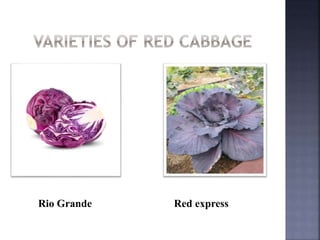
Rio Grande Red express
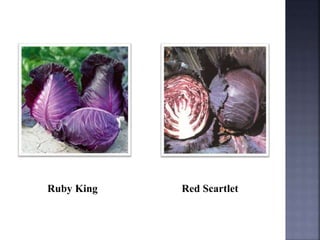
Ruby King Red Scartlet
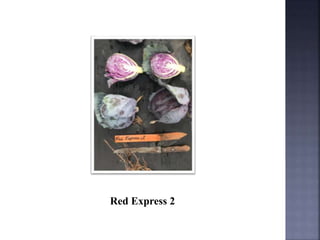
Red Express 2
The field is ploughed to fine tilth by giving four to five
ploughing with a sufficient interval between two ploughing.
Planking should be done for proper leveling. The transplanting
is done on the flat land, ridges or in furrows depending on
climate and soil conditions. For early planting, ridge method is
suitable especially in areas where the rains occur at the time of
planting. In saline soils, planting in furrows and in dry areas
transplanting on flat beds is recommended
The seeds are generally sown in a seed bed and 4-6 week old
seedlings are transplanted to the field. Red cabbage seeds are
sown on nursery beds to raise seedlings for transplanting in the
field. Raised beds of size 3 x 0.6 m and 10-15 cm in height are
prepared. About 70cm distance is kept between two beds to carry
out intercultural operations such as watering, weeding, etc. The
surface of beds should be smooth and well leveled. Well-
decomposed FYM @ 2-3 kg/m is added at the time of bed
preparation. Raised beds are necessary to avoid problem of water
logging in heavy soils. To avoid mortality of seedlings due to
damping off, drenching of the beds with Bavistin (15-20g/10 litres
of water) is effective.
 Generally, 4-6 weeks old seedlings are ready for transplanting but
older seedlings up to 8 weeks age can also be transplanted.
 Seedlings are transplanted at following distances. Early varieties:
45x45 cm, mid: 60x45 cm and late 60x60 cm.
 For early planting, ridge method is more suitable.
 In saline soils, planting should be done in furrows
 Red cabbage requires a continuous supply of moisture for uniform
growth and development of heads.
 The optimum growth of cabbage occurs at moisture content
varying from 60-100% of field capacity with an average of 80%.
Irrigation should be given when the moisture content of the soil
had dropped below 50% of field capacity
 During head initiation and development stages proper moisture
level in the soil should be maintained.
 Drip Irrigation increases yield by increasing water use efficiency.
 The use of drip irrigation in combination with mulch increases
yield over furrow irrigation in cabbage by 65%.
 Red cabbage is a heavy feeder and requires adequate manuring for
profitable yields
 Organic manuring can play a vital role in sustaining soil fertility
and crop production.
 Vermi composting is a potential source of readily available
nutrients, growth enhancing substances and a number of beneficial
microorganisms like N fixing, P solubilizing and cellulose
decomposing organisms (Suthar, 2012).
 Vermicompost contains more organic matter, nitrogen,
phosphorous, sulphur, calcium and magnesium (Zahid, 2001).
 It not only helps to improve and protect the soil fertility of top soil
but also helps to boost productivity by 40% with 20 to 60% lower
nutrient inputs
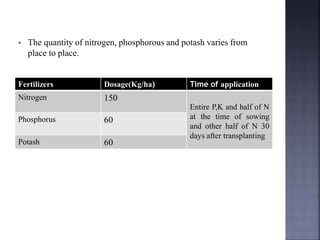
 The quantity of nitrogen, phosphorous and potash varies from
place to place.
Fertilizers Dosage(Kg/ha) Time of application
Nitrogen 150
Entire P,K and half of N
at the time of sowing
and other half of N 30
days after transplanting
Phosphorus 60
Potash 60
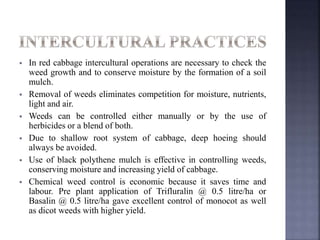
 In red cabbage intercultural operations are necessary to check the
weed growth and to conserve moisture by the formation of a soil
mulch.
 Removal of weeds eliminates competition for moisture, nutrients,
light and air.
 Weeds can be controlled either manually or by the use of
herbicides or a blend of both.
 Due to shallow root system of cabbage, deep hoeing should
always be avoided.
 Use of black polythene mulch is effective in controlling weeds,
conserving moisture and increasing yield of cabbage.
 Chemical weed control is economic because it saves time and
labour. Pre plant application of Trifluralin @ 0.5 litre/ha or
Basalin @ 0.5 litre/ha gave excellent control of monocot as well
as dicot weeds with higher yield.
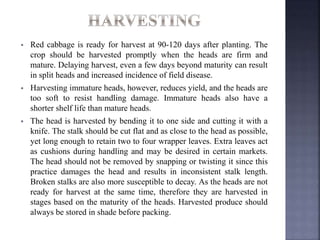
 Red cabbage is ready for harvest at 90-120 days after planting. The
crop should be harvested promptly when the heads are firm and
mature. Delaying harvest, even a few days beyond maturity can result
in split heads and increased incidence of field disease.
 Harvesting immature heads, however, reduces yield, and the heads are
too soft to resist handling damage. Immature heads also have a
shorter shelf life than mature heads.
 The head is harvested by bending it to one side and cutting it with a
knife. The stalk should be cut flat and as close to the head as possible,
yet long enough to retain two to four wrapper leaves. Extra leaves act
as cushions during handling and may be desired in certain markets.
The head should not be removed by snapping or twisting it since this
practice damages the head and results in inconsistent stalk length.
Broken stalks are also more susceptible to decay. As the heads are not
ready for harvest at the same time, therefore they are harvested in
stages based on the maturity of the heads. Harvested produce should
always be stored in shade before packing.
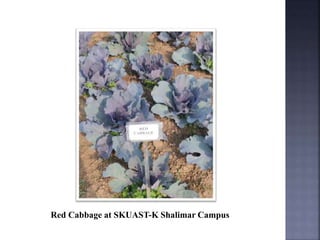
Red Cabbage at SKUAST-K Shalimar Campus
RED cabbage.pptx

RED cabbage.pptx

  • 1.
    CROP:RED CABBAGE COURSE NO:VSC 509 COURSE INSTRUCTOR: Dr. Aijaz Malik PRESENTED BY: Naindeep,Suraya,Shahid
  • 2.
    Name: Red Cabbage Botanicalname: Brassica oleracea var. Capitata f. rubra Chromosome no: 2n = 18 Family: Brassicaceae Origin: Mediterranean region Europe.
  • 3.
    Red Cabbage inIndia (Red Cabbage) demand is growing very fast. With time there has been a change in the eating habits. Because of this, now new types of vegetables (Vegetables) demand is increasing in the market. Health conscious people are now starting to include nutritious fruits and vegetables in their diet. After the COVID epidemic, it has taken the form of a new trend and for farmers it has come as an opportunity. Farmers are earning profit by doing farming according to the demand in the market. Red cabbage is also a vegetable of the same category, whose demand has increased a lot in recent times. Its cultivation method is similar to that of green cabbage, but there is a difference of many folds in terms of price.
  • 4.
     Demand forhigh value produce is growing both in domestic and overseas market at the same time, competition is also increasing.  Biotechnological tools must be used in conjunction with conventional breeding to tag genes of interest. There is need to develop varieties with durable resistance to multiple diseases and pests; heat, drought and salt tolerant varieties.  Eco-region specific technology generation based on maximum productivity of available natural resources like climatic condition, soil fertility and water.  Improve the understanding of interactions between native ecosystems and production systems and develop best practices to conserve biodiversity
  • 5.
     Integrated managementof emerging diseases and pests. Emphasis should be on identification of new and effective bio-molecules for management of biotic stresses being encouraged for ecofriendly and sustainable management of diseases and pests.  Develop production and post-harvest technologies to improve product quality and minimize environmental impacts.  Sustainable path for development to meet challenges in vegetable production through proper technological innovations and interventions.  Inter institutional mechanisms to network and review the ongoing programmes of biotechnology, cost effective production technologies, postharvest technology, farm mechanization, transfer of technology and organic farming
  • 6.
    The popularity ofred cabbage is for its rich content of phytochemicals, antioxidants, vitamins (C,E,A,K) and minerals (calcium, manganese, magnesium, iron, and potassium), and low content of saturated fats and cholesterol. B vitamins e.g. thiamine (B1), riboflavin (B2) and folate (B2) are also found in this crop. Besides vitamins and minerals, cabbage also contain a small amount of protein
  • 7.
    It has multipleuses as salads, cole slaw, sauerkraut, soup, curries and other cooking purposes. Red cabbage is known for possessing different chemical compounds and medicinal properties (Podsędek et al., 2014). It produces red or purple colored heads due to the presence of anthocyanin pigment. Many of its organic compounds are taken as dietary supplements.
  • 8.
    It protects usfrom cancer, premature aging, diabetes, ulcer and Alzheimer’s diseases. It helps in weight loss, boosting the immune system, improving the skin and eye and detoxification of body. Secondary plant metabolites like glucosinolates (GSs) present in red cabbage are known for the health-promoting properties (Verkerkand Dekker, 2004). These natural chemicals breakdown into compounds like indole-3-carbinol, which has anticancer property. Flavonoids of the crop have good therapeutic potential in inflammation and pain.
  • 9.
    Red cabbage, alsocalled purple cabbage, is a leafy vegetable from the cabbage family. It typically comes as a head of cabbage, which is a ball of tight leaves. Red cabbage has broad reddish-purple leaves with a thick white stem at the bottom of the head. The leaves have a chewy texture when raw and a softer texture when cooked. Fresh red cabbage should feel heavy with tight leaves around the head.
  • 10.
    Cultivation of redcabbage is done mainly on sandy to heavy soils rich in organic matter. Early crops prefer light soil while late crops thrive better on heavier soils due to retention of moisture. On heavy soils, plants grow more slowly and the keeping quality is improved. A pH range of 6.0-6.5 is considered as optimum for growing cabbage. Plants growing in saline soils are prone to diseases.
  • 11.
    It thrives bestin a relatively cool and moist climate. A temperature range of 15-20˚C is considered as optimum for growth and head formation of the crop. At temperature exceeding 25˚C, the growth is checked. The minimum temperature for growth of cabbage is just above 0℃. Red cabbage may withstand temperatures of 10- 40 ˚C for a few days only. The young plants can grow at higher temperature followed by the their requirement for cool season for heading.
  • 12.
  • 13.
    Ruby King RedScartlet
  • 14.
  • 15.
    The field isploughed to fine tilth by giving four to five ploughing with a sufficient interval between two ploughing. Planking should be done for proper leveling. The transplanting is done on the flat land, ridges or in furrows depending on climate and soil conditions. For early planting, ridge method is suitable especially in areas where the rains occur at the time of planting. In saline soils, planting in furrows and in dry areas transplanting on flat beds is recommended
  • 16.
    The seeds aregenerally sown in a seed bed and 4-6 week old seedlings are transplanted to the field. Red cabbage seeds are sown on nursery beds to raise seedlings for transplanting in the field. Raised beds of size 3 x 0.6 m and 10-15 cm in height are prepared. About 70cm distance is kept between two beds to carry out intercultural operations such as watering, weeding, etc. The surface of beds should be smooth and well leveled. Well- decomposed FYM @ 2-3 kg/m is added at the time of bed preparation. Raised beds are necessary to avoid problem of water logging in heavy soils. To avoid mortality of seedlings due to damping off, drenching of the beds with Bavistin (15-20g/10 litres of water) is effective.
  • 17.
     Generally, 4-6weeks old seedlings are ready for transplanting but older seedlings up to 8 weeks age can also be transplanted.  Seedlings are transplanted at following distances. Early varieties: 45x45 cm, mid: 60x45 cm and late 60x60 cm.  For early planting, ridge method is more suitable.  In saline soils, planting should be done in furrows
  • 18.
     Red cabbagerequires a continuous supply of moisture for uniform growth and development of heads.  The optimum growth of cabbage occurs at moisture content varying from 60-100% of field capacity with an average of 80%. Irrigation should be given when the moisture content of the soil had dropped below 50% of field capacity  During head initiation and development stages proper moisture level in the soil should be maintained.  Drip Irrigation increases yield by increasing water use efficiency.  The use of drip irrigation in combination with mulch increases yield over furrow irrigation in cabbage by 65%.
  • 19.
     Red cabbageis a heavy feeder and requires adequate manuring for profitable yields  Organic manuring can play a vital role in sustaining soil fertility and crop production.  Vermi composting is a potential source of readily available nutrients, growth enhancing substances and a number of beneficial microorganisms like N fixing, P solubilizing and cellulose decomposing organisms (Suthar, 2012).  Vermicompost contains more organic matter, nitrogen, phosphorous, sulphur, calcium and magnesium (Zahid, 2001).  It not only helps to improve and protect the soil fertility of top soil but also helps to boost productivity by 40% with 20 to 60% lower nutrient inputs
  • 20.
     The quantityof nitrogen, phosphorous and potash varies from place to place. Fertilizers Dosage(Kg/ha) Time of application Nitrogen 150 Entire P,K and half of N at the time of sowing and other half of N 30 days after transplanting Phosphorus 60 Potash 60
  • 21.
     In redcabbage intercultural operations are necessary to check the weed growth and to conserve moisture by the formation of a soil mulch.  Removal of weeds eliminates competition for moisture, nutrients, light and air.  Weeds can be controlled either manually or by the use of herbicides or a blend of both.  Due to shallow root system of cabbage, deep hoeing should always be avoided.  Use of black polythene mulch is effective in controlling weeds, conserving moisture and increasing yield of cabbage.  Chemical weed control is economic because it saves time and labour. Pre plant application of Trifluralin @ 0.5 litre/ha or Basalin @ 0.5 litre/ha gave excellent control of monocot as well as dicot weeds with higher yield.
  • 22.
     Red cabbageis ready for harvest at 90-120 days after planting. The crop should be harvested promptly when the heads are firm and mature. Delaying harvest, even a few days beyond maturity can result in split heads and increased incidence of field disease.  Harvesting immature heads, however, reduces yield, and the heads are too soft to resist handling damage. Immature heads also have a shorter shelf life than mature heads.  The head is harvested by bending it to one side and cutting it with a knife. The stalk should be cut flat and as close to the head as possible, yet long enough to retain two to four wrapper leaves. Extra leaves act as cushions during handling and may be desired in certain markets. The head should not be removed by snapping or twisting it since this practice damages the head and results in inconsistent stalk length. Broken stalks are also more susceptible to decay. As the heads are not ready for harvest at the same time, therefore they are harvested in stages based on the maturity of the heads. Harvested produce should always be stored in shade before packing.
  • 23.
    Red Cabbage atSKUAST-K Shalimar Campus