Recursion
You will learn the definition of
recursion as well as seeing how simple
recursive programs work
What Is Recursion?
“the determination of a succession of elements by
operation on one or more preceding elements according to
a rule or formula involving a finite number of steps”
(Merriam-Webster online)
What This Really Means
Breaking a problem down into a series of steps. The final
step is reached when some basic condition is satisfied.
The solution for each step is used to solve the
previous step. The solution for all the steps together form
the solution to the whole problem.
(The “Tam” translation)
Definition Of Philosophy
“…state of mind of the wise man; practical wisdom…” 1
See Metaphysics
1 The New Webster Encyclopedic Dictionary of the English Language
Metaphysics
“…know the ultimate grounds of being or what it is that
really exists, embracing both psychology and ontology.” 2
2 The New Webster Encyclopedic Dictionary of the English Language
Result Of Lookup , Possibility One: Success
• I know what Ontology means!
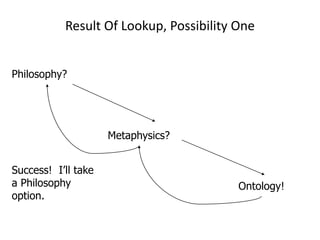
Result Of Lookup, Possibility One
Philosophy?
Metaphysics?
Ontology!
Success! I’ll take
a Philosophy
option.
Result Of Lookup, Possibility Two: Failure
• Lookup ‘loops’ back.
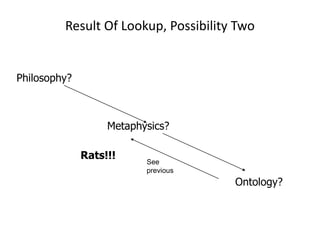
Result Of Lookup, Possibility Two
Philosophy?
Metaphysics?
Ontology?
Rats!!!
See
previous
Ontology
“…equivalent to metaphysics.”3
3 The New Webster Encyclopedic Dictionary of the English Language
Wav file from “The Simpsons”
Result Of Lookup, Possibility Three: Failure
• You’ve looked up everything and still don’t know the
definition!
Looking Up A Word
if (you completely understand a definition) then
return to previous definition (using the definition that’s
understood)
else
lookup (unknown word(s))
Recursion In Programming
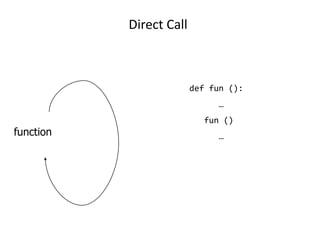
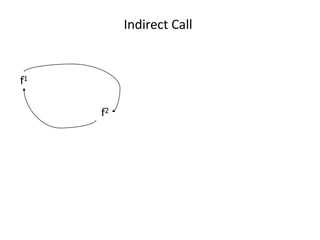
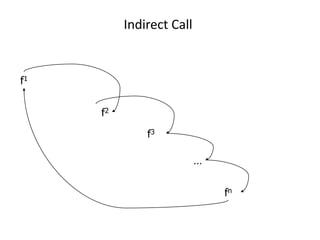
“A programming technique whereby a function calls itself
either directly or indirectly.”
Direct Call
function
def fun ():
…
fun ()
…
Indirect Call
f1
f2
Indirect Call
f1
f2
f3
…
fn
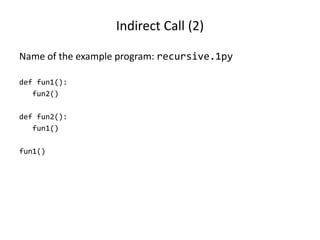
Indirect Call (2)
Name of the example program: recursive.1py
def fun1():
fun2()
def fun2():
fun1()
fun1()
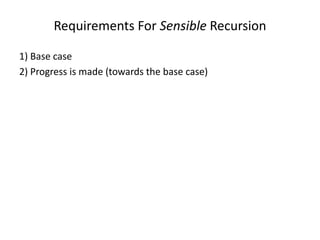
Requirements For Sensible Recursion
1) Base case
2) Progress is made (towards the base case)
sum (2)
if (2 == 1)
return 1
sum (3)
if (3 == 1)
return 1
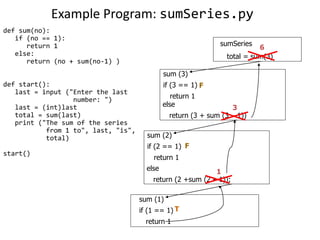
Example Program: sumSeries.py
def sum(no):
if (no == 1):
return 1
else:
return (no + sum(no-1) )
def start():
last = input ("Enter the last
number: ")
last = (int)last
total = sum(last)
print ("The sum of the series
from 1 to", last, "is",
total)
start()
sumSeries
total = sum(3)
F
else
return (3 + sum (3 – 1))
F
else
return (2 +sum (2 – 1));
sum (1)
if (1 == 1)
return 1
T
1
3
6
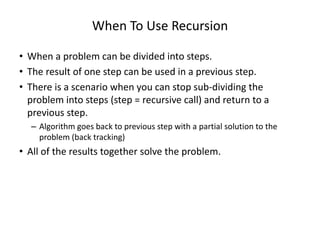
When To Use Recursion
• When a problem can be divided into steps.
• The result of one step can be used in a previous step.
• There is a scenario when you can stop sub-dividing the
problem into steps (step = recursive call) and return to a
previous step.
– Algorithm goes back to previous step with a partial solution to the
problem (back tracking)
• All of the results together solve the problem.
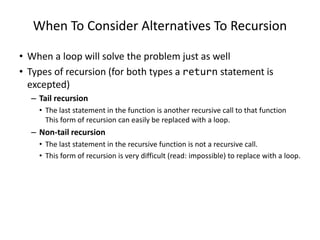
When To Consider Alternatives To Recursion
• When a loop will solve the problem just as well
• Types of recursion (for both types a return statement is
excepted)
– Tail recursion
• The last statement in the function is another recursive call to that function
This form of recursion can easily be replaced with a loop.
– Non-tail recursion
• The last statement in the recursive function is not a recursive call.
• This form of recursion is very difficult (read: impossible) to replace with a loop.
Example: Tail Recursion
• Tail recursion: A recursive call is the last statement in the
recursive function.
• Name of the example program: tail.py
def tail(no):
if (no <= 3):
print (no)
tail(no+1)
return()
tail(1)
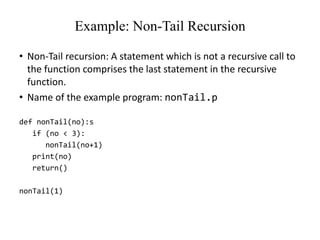
Example: Non-Tail Recursion
• Non-Tail recursion: A statement which is not a recursive call to
the function comprises the last statement in the recursive
function.
• Name of the example program: nonTail.p
def nonTail(no):s
if (no < 3):
nonTail(no+1)
print(no)
return()
nonTail(1)
Drawbacks Of Recursion
Function calls can be costly
– Uses up memory
– Uses up time
Benefits Of Using Recursion
• Simpler solution that’s more elegant (for some problems)
• Easier to visualize solutions (for some people and certain
classes of problems – typically require either: non-tail
recursion to be implemented or some form of “backtracking”)
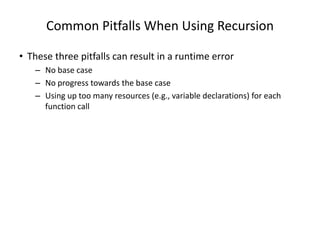
Common Pitfalls When Using Recursion
• These three pitfalls can result in a runtime error
– No base case
– No progress towards the base case
– Using up too many resources (e.g., variable declarations) for each
function call
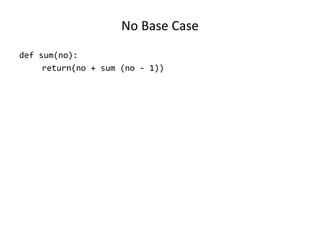
No Base Case
def sum(no):
return(no + sum (no - 1))
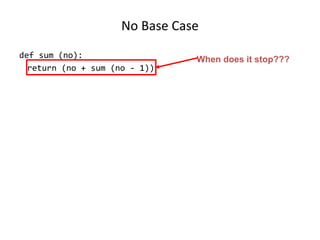
No Base Case
def sum (no):
return (no + sum (no - 1))
When does it stop???
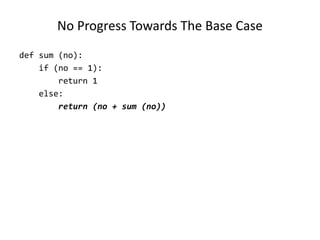
No Progress Towards The Base Case
def sum (no):
if (no == 1):
return 1
else:
return (no + sum (no))
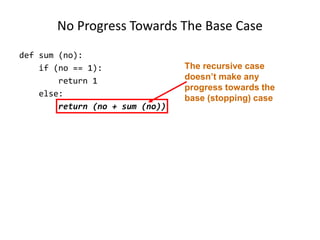
No Progress Towards The Base Case
def sum (no):
if (no == 1):
return 1
else:
return (no + sum (no))
The recursive case
doesn’t make any
progress towards the
base (stopping) case
Using Up Too Many Resources
• Name of the example program: recursiveBloat.py
def fun(no):
print(no)
aList = []
for i in range (0, 10000000, 1):
aList.append("*")
no = no + 1
fun(no)
fun(1)
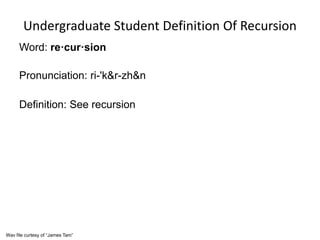
Undergraduate Student Definition Of Recursion
Word: re·cur·sion
Pronunciation: ri-'k&r-zh&n
Definition: See recursion
Wav file curtesy of “James Tam”
Recursion: Job Interview Question
• http://www.businessinsider.com/apple-interview-questions-2011-5#write-a-function-that-calculates-a-numbers-factorial-
using-recursion-9
You Should Now Know
• What is a recursive computer program
• How to write and trace simple recursive programs
• What are the requirements for recursion/What are the
common pitfalls of recursion

recursion.ppt

  • 1.
    Recursion You will learnthe definition of recursion as well as seeing how simple recursive programs work
  • 2.
    What Is Recursion? “thedetermination of a succession of elements by operation on one or more preceding elements according to a rule or formula involving a finite number of steps” (Merriam-Webster online)
  • 3.
    What This ReallyMeans Breaking a problem down into a series of steps. The final step is reached when some basic condition is satisfied. The solution for each step is used to solve the previous step. The solution for all the steps together form the solution to the whole problem. (The “Tam” translation)
  • 4.
    Definition Of Philosophy “…stateof mind of the wise man; practical wisdom…” 1 See Metaphysics 1 The New Webster Encyclopedic Dictionary of the English Language
  • 5.
    Metaphysics “…know the ultimategrounds of being or what it is that really exists, embracing both psychology and ontology.” 2 2 The New Webster Encyclopedic Dictionary of the English Language
  • 6.
    Result Of Lookup, Possibility One: Success • I know what Ontology means!
  • 7.
    Result Of Lookup,Possibility One Philosophy? Metaphysics? Ontology! Success! I’ll take a Philosophy option.
  • 8.
    Result Of Lookup,Possibility Two: Failure • Lookup ‘loops’ back.
  • 9.
    Result Of Lookup,Possibility Two Philosophy? Metaphysics? Ontology? Rats!!! See previous
  • 10.
    Ontology “…equivalent to metaphysics.”3 3The New Webster Encyclopedic Dictionary of the English Language Wav file from “The Simpsons”
  • 11.
    Result Of Lookup,Possibility Three: Failure • You’ve looked up everything and still don’t know the definition!
  • 12.
    Looking Up AWord if (you completely understand a definition) then return to previous definition (using the definition that’s understood) else lookup (unknown word(s))
  • 13.
    Recursion In Programming “Aprogramming technique whereby a function calls itself either directly or indirectly.”
  • 14.
    Direct Call function def fun(): … fun () …
  • 15.
  • 16.
  • 17.
    Indirect Call (2) Nameof the example program: recursive.1py def fun1(): fun2() def fun2(): fun1() fun1()
  • 18.
    Requirements For SensibleRecursion 1) Base case 2) Progress is made (towards the base case)
  • 19.
    sum (2) if (2== 1) return 1 sum (3) if (3 == 1) return 1 Example Program: sumSeries.py def sum(no): if (no == 1): return 1 else: return (no + sum(no-1) ) def start(): last = input ("Enter the last number: ") last = (int)last total = sum(last) print ("The sum of the series from 1 to", last, "is", total) start() sumSeries total = sum(3) F else return (3 + sum (3 – 1)) F else return (2 +sum (2 – 1)); sum (1) if (1 == 1) return 1 T 1 3 6
  • 20.
    When To UseRecursion • When a problem can be divided into steps. • The result of one step can be used in a previous step. • There is a scenario when you can stop sub-dividing the problem into steps (step = recursive call) and return to a previous step. – Algorithm goes back to previous step with a partial solution to the problem (back tracking) • All of the results together solve the problem.
  • 21.
    When To ConsiderAlternatives To Recursion • When a loop will solve the problem just as well • Types of recursion (for both types a return statement is excepted) – Tail recursion • The last statement in the function is another recursive call to that function This form of recursion can easily be replaced with a loop. – Non-tail recursion • The last statement in the recursive function is not a recursive call. • This form of recursion is very difficult (read: impossible) to replace with a loop.
  • 22.
    Example: Tail Recursion •Tail recursion: A recursive call is the last statement in the recursive function. • Name of the example program: tail.py def tail(no): if (no <= 3): print (no) tail(no+1) return() tail(1)
  • 23.
    Example: Non-Tail Recursion •Non-Tail recursion: A statement which is not a recursive call to the function comprises the last statement in the recursive function. • Name of the example program: nonTail.p def nonTail(no):s if (no < 3): nonTail(no+1) print(no) return() nonTail(1)
  • 24.
    Drawbacks Of Recursion Functioncalls can be costly – Uses up memory – Uses up time
  • 25.
    Benefits Of UsingRecursion • Simpler solution that’s more elegant (for some problems) • Easier to visualize solutions (for some people and certain classes of problems – typically require either: non-tail recursion to be implemented or some form of “backtracking”)
  • 26.
    Common Pitfalls WhenUsing Recursion • These three pitfalls can result in a runtime error – No base case – No progress towards the base case – Using up too many resources (e.g., variable declarations) for each function call
  • 27.
    No Base Case defsum(no): return(no + sum (no - 1))
  • 28.
    No Base Case defsum (no): return (no + sum (no - 1)) When does it stop???
  • 29.
    No Progress TowardsThe Base Case def sum (no): if (no == 1): return 1 else: return (no + sum (no))
  • 30.
    No Progress TowardsThe Base Case def sum (no): if (no == 1): return 1 else: return (no + sum (no)) The recursive case doesn’t make any progress towards the base (stopping) case
  • 31.
    Using Up TooMany Resources • Name of the example program: recursiveBloat.py def fun(no): print(no) aList = [] for i in range (0, 10000000, 1): aList.append("*") no = no + 1 fun(no) fun(1)
  • 32.
    Undergraduate Student DefinitionOf Recursion Word: re·cur·sion Pronunciation: ri-'k&r-zh&n Definition: See recursion Wav file curtesy of “James Tam”
  • 33.
    Recursion: Job InterviewQuestion • http://www.businessinsider.com/apple-interview-questions-2011-5#write-a-function-that-calculates-a-numbers-factorial- using-recursion-9
  • 34.
    You Should NowKnow • What is a recursive computer program • How to write and trace simple recursive programs • What are the requirements for recursion/What are the common pitfalls of recursion

Editor's Notes