GVK CHINMAYA VIDYALAYA
SENIOR SECONDARY SCHOOL
Kothuru, Indukurupet, SPS Nellore
Recursion
Class: 12 Subject: Python Teacher: C Vijaya
B.Tech, MBA
What is recursion?
Recursion is the process of defining something in terms of itself.
A physical world example would be to place two parallel mirrors facing each other. Any object in
between them would be reflected recursively.
Python Recursive Function
In Python, we know that a function can call other functions. It is even possible for the function to call
itself. These types of construct are termed as recursive functions.
The following image shows the working of a recursive function called recurse.
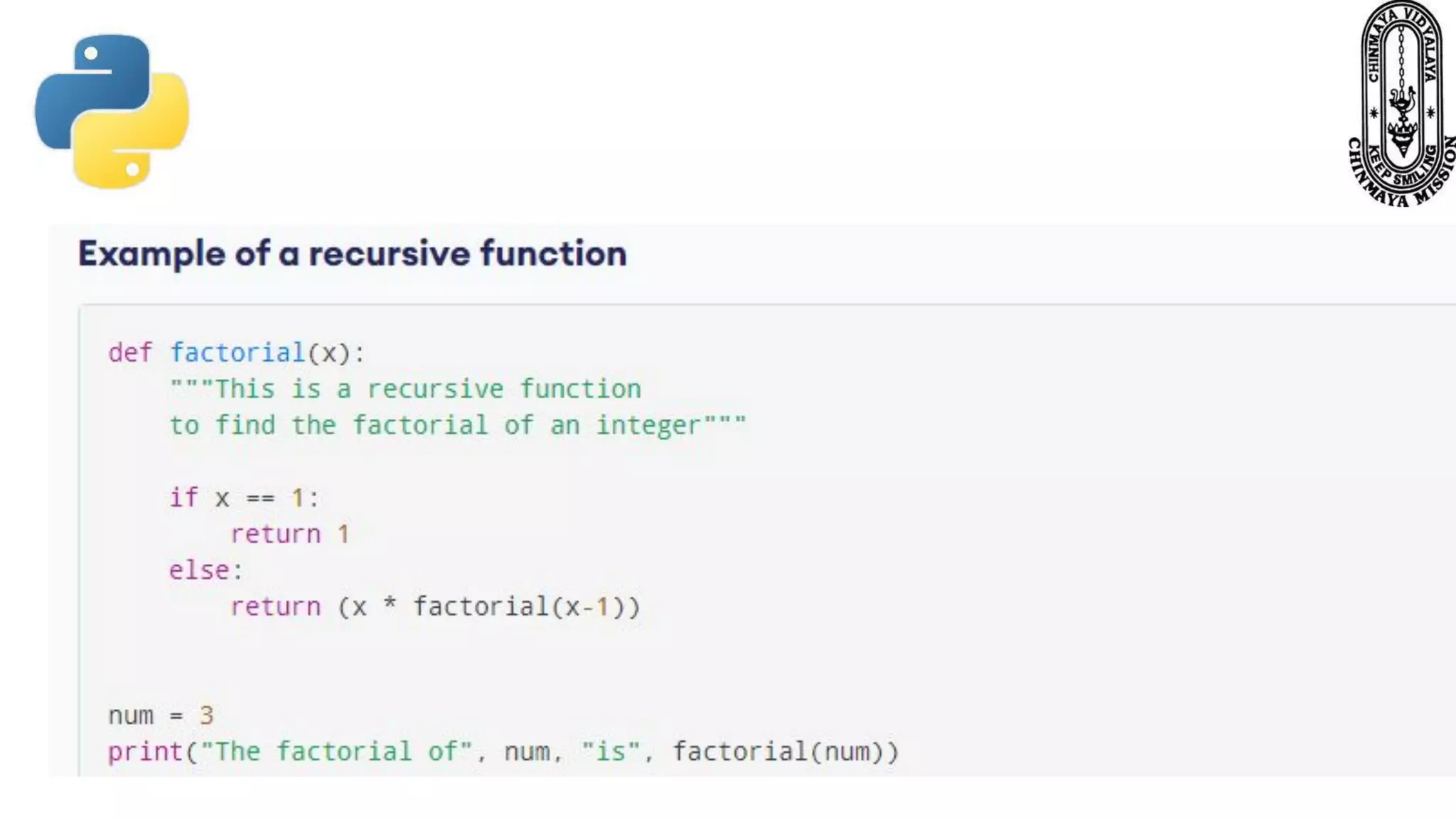
Following is an example of a recursive function to find the factorial of an integer.
Factorial of a number is the product of all the integers from 1 to that number. For example, the
factorial of 6 (denoted as 6!) is 1*2*3*4*5*6 = 720.
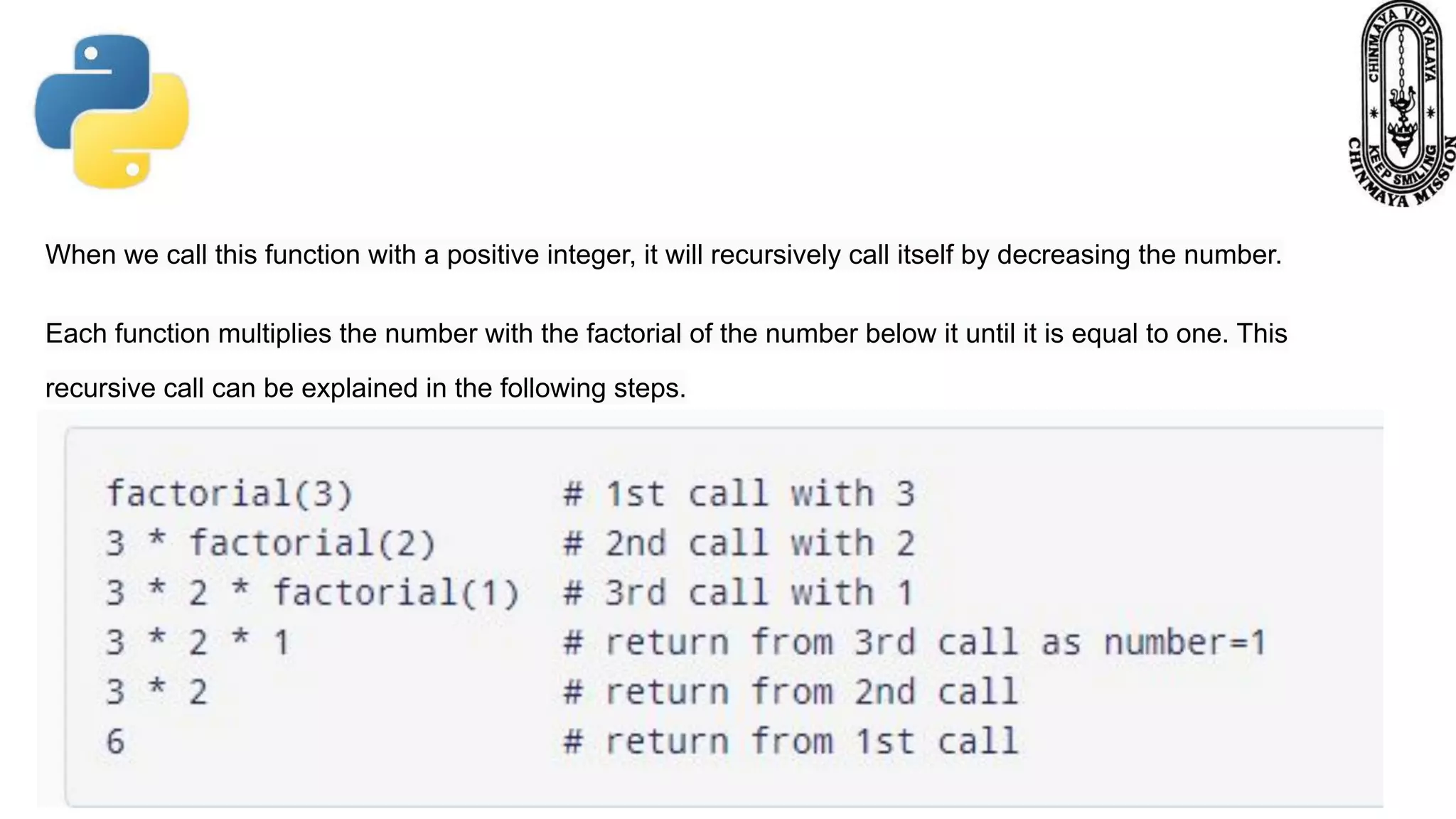
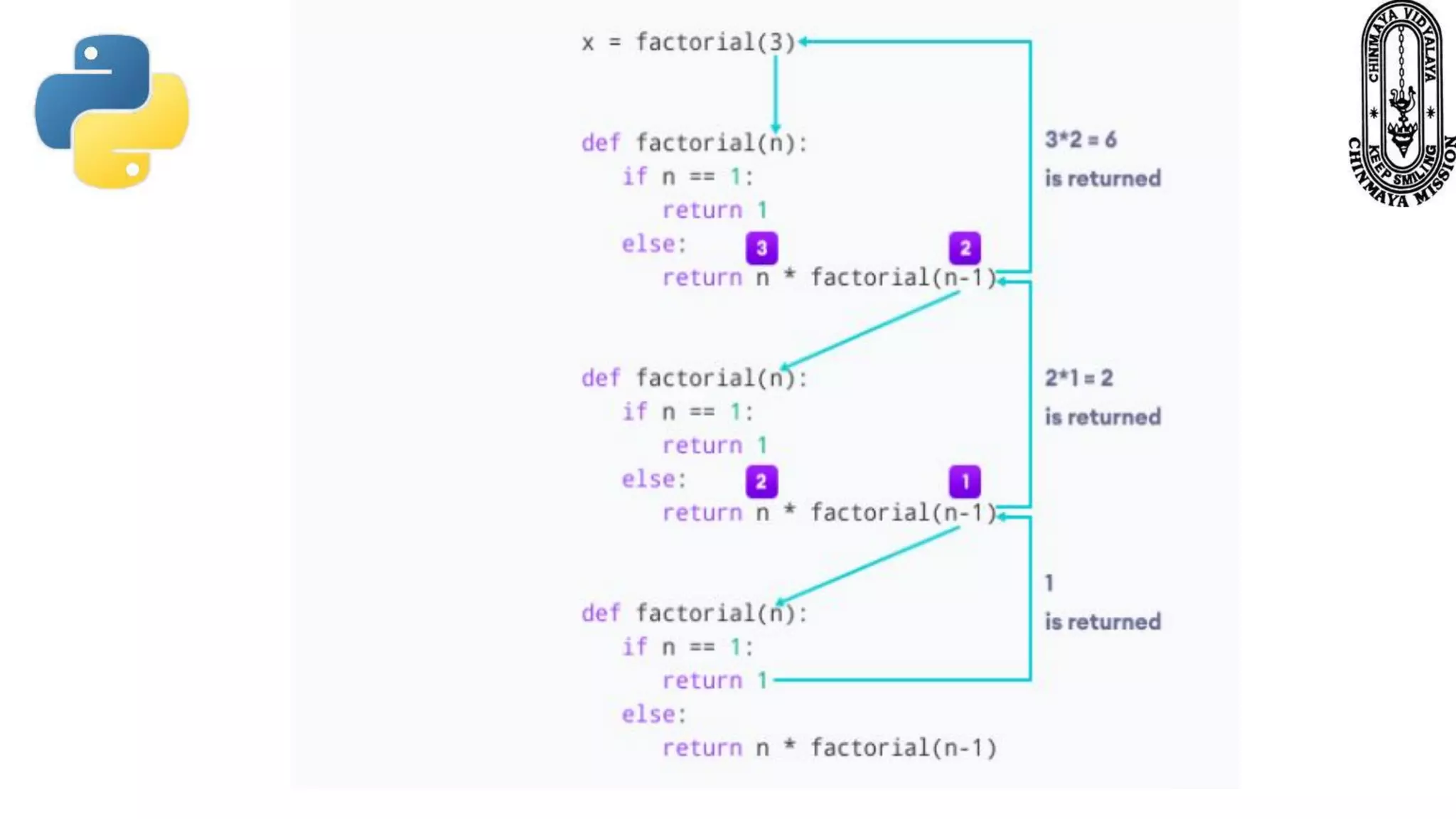
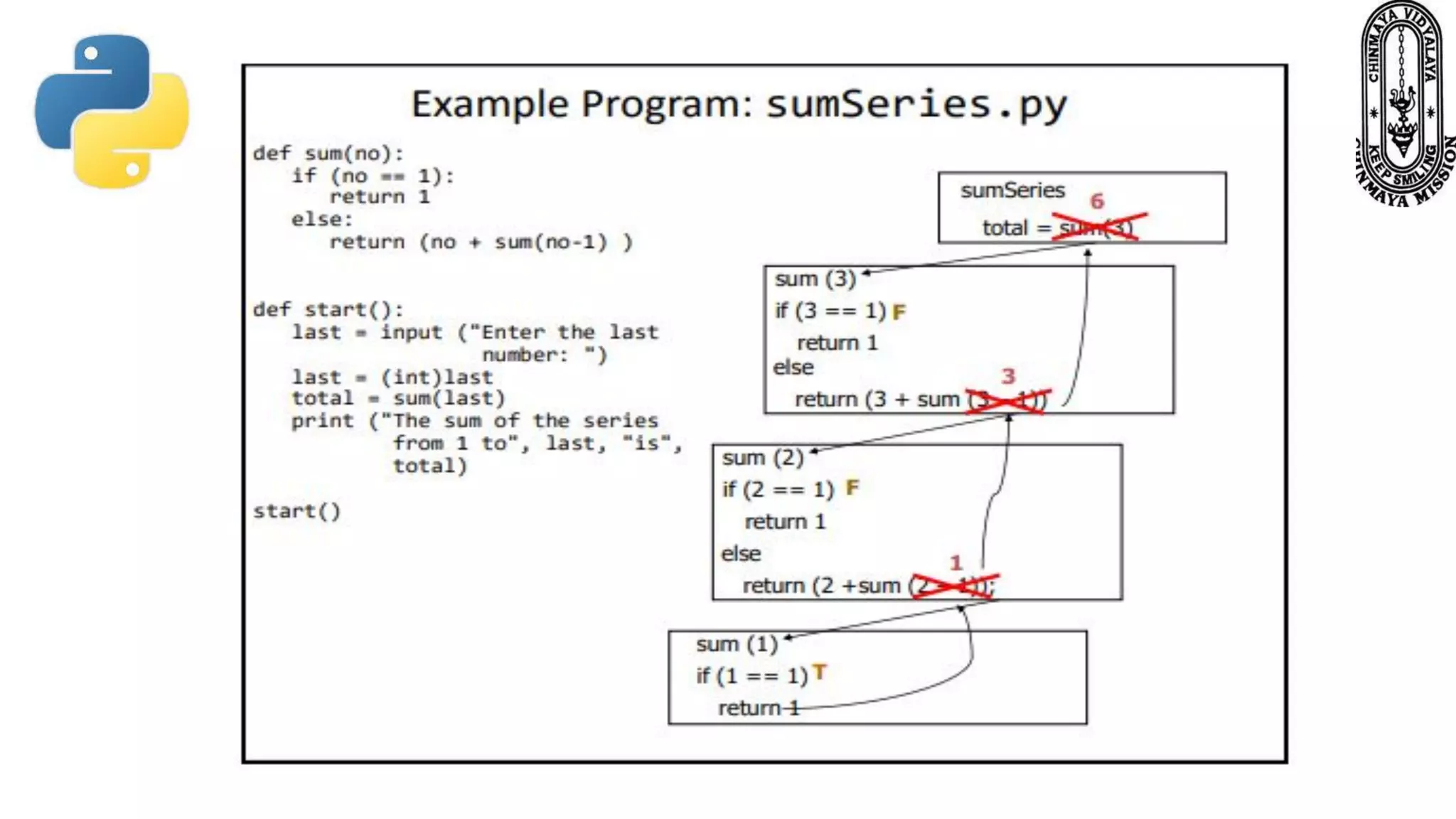
When we call this function with a positive integer, it will recursively call itself by decreasing the number.
Each function multiplies the number with the factorial of the number below it until it is equal to one. This
recursive call can be explained in the following steps.
Our recursion ends when the number reduces to 1. This is called the base condition.
Every recursive function must have a base condition that stops the recursion or else the function calls itself
infinitely.
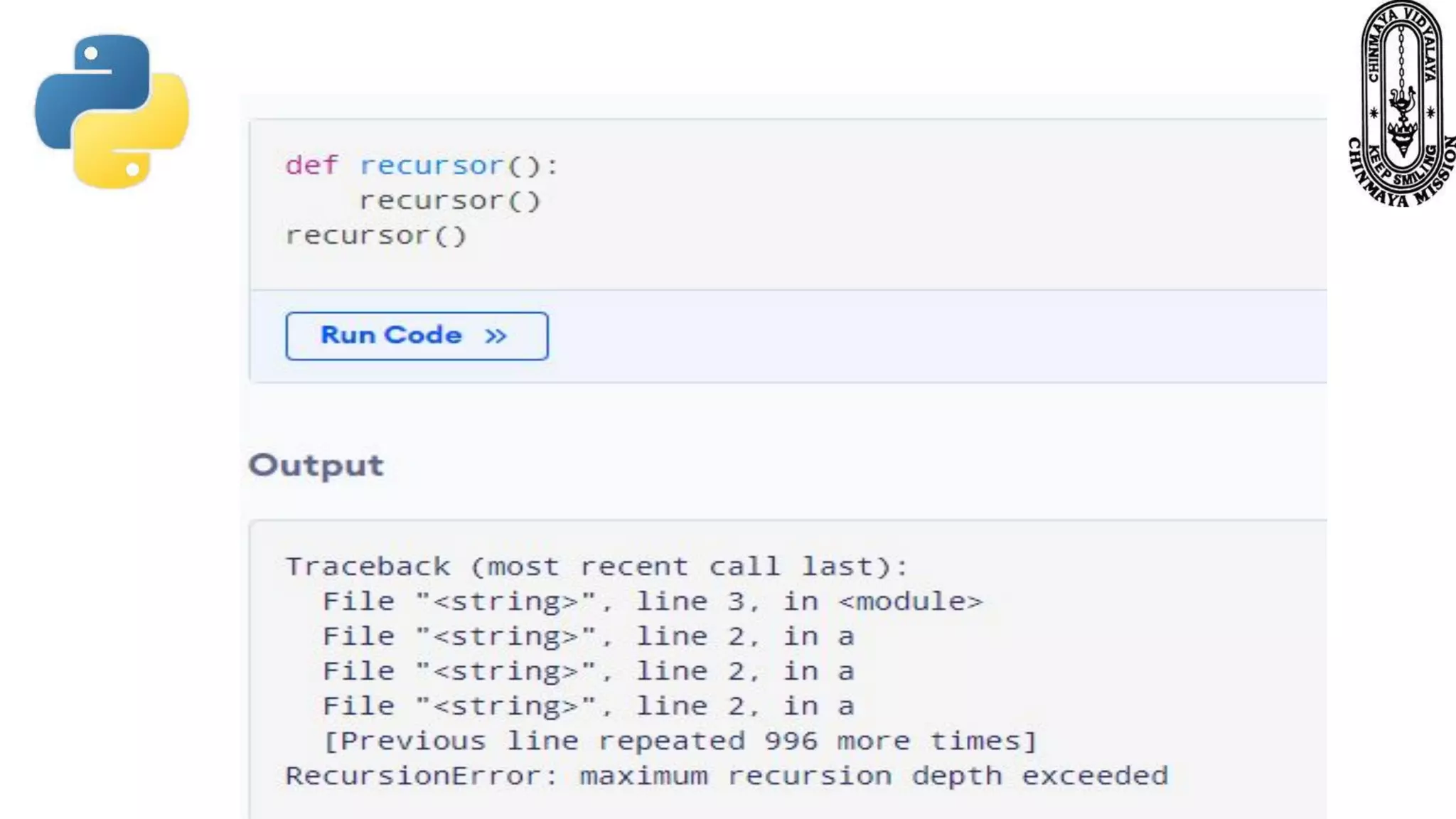
The Python interpreter limits the depths of recursion to help avoid infinite recursions, resulting in stack
overflows.
By default, the maximum depth of recursion is 1000. If the limit is crossed, it results in RecursionError. Let's
look at one such condition.
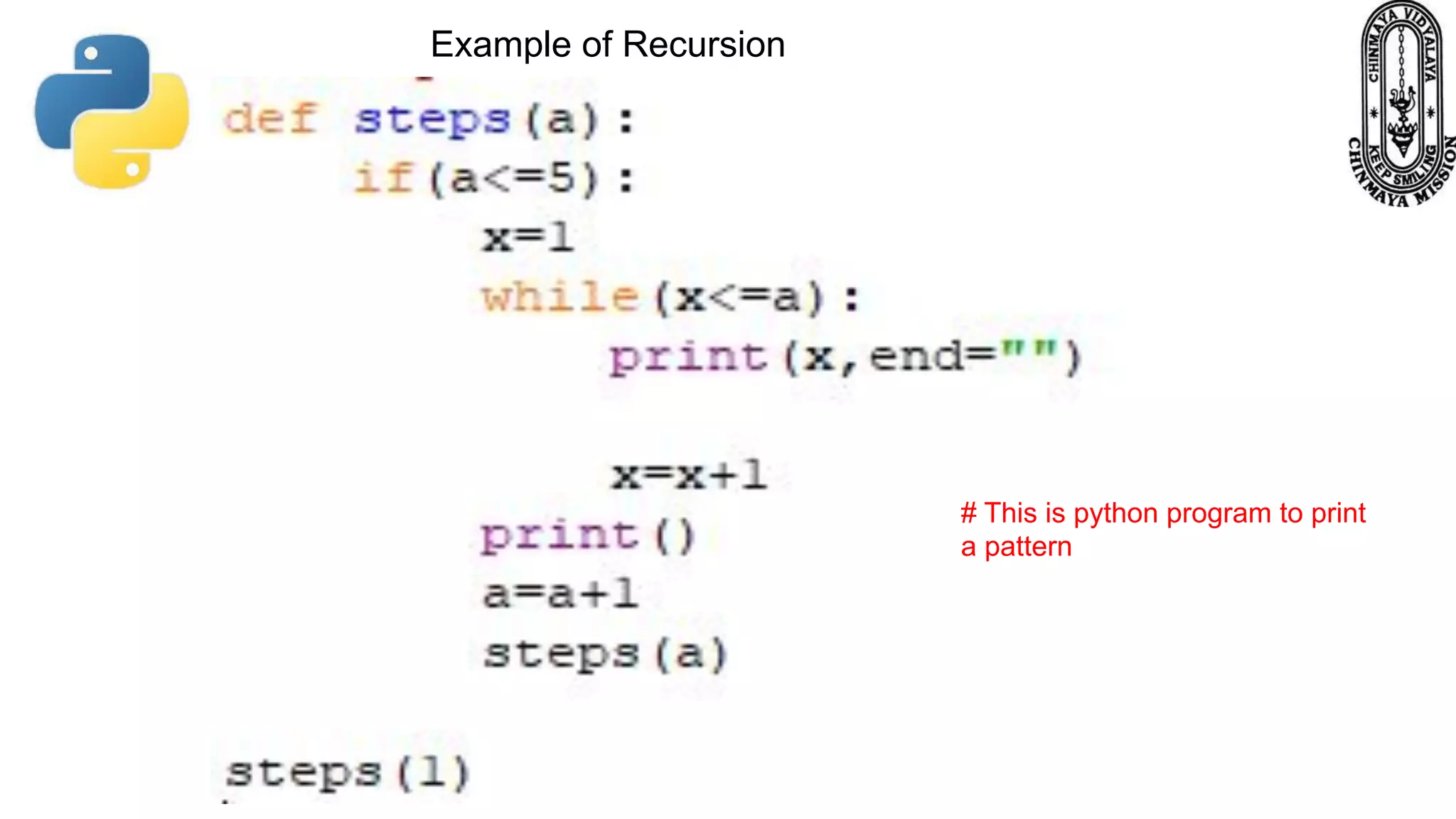
Example of Recursion
# This is python program to print
a pattern
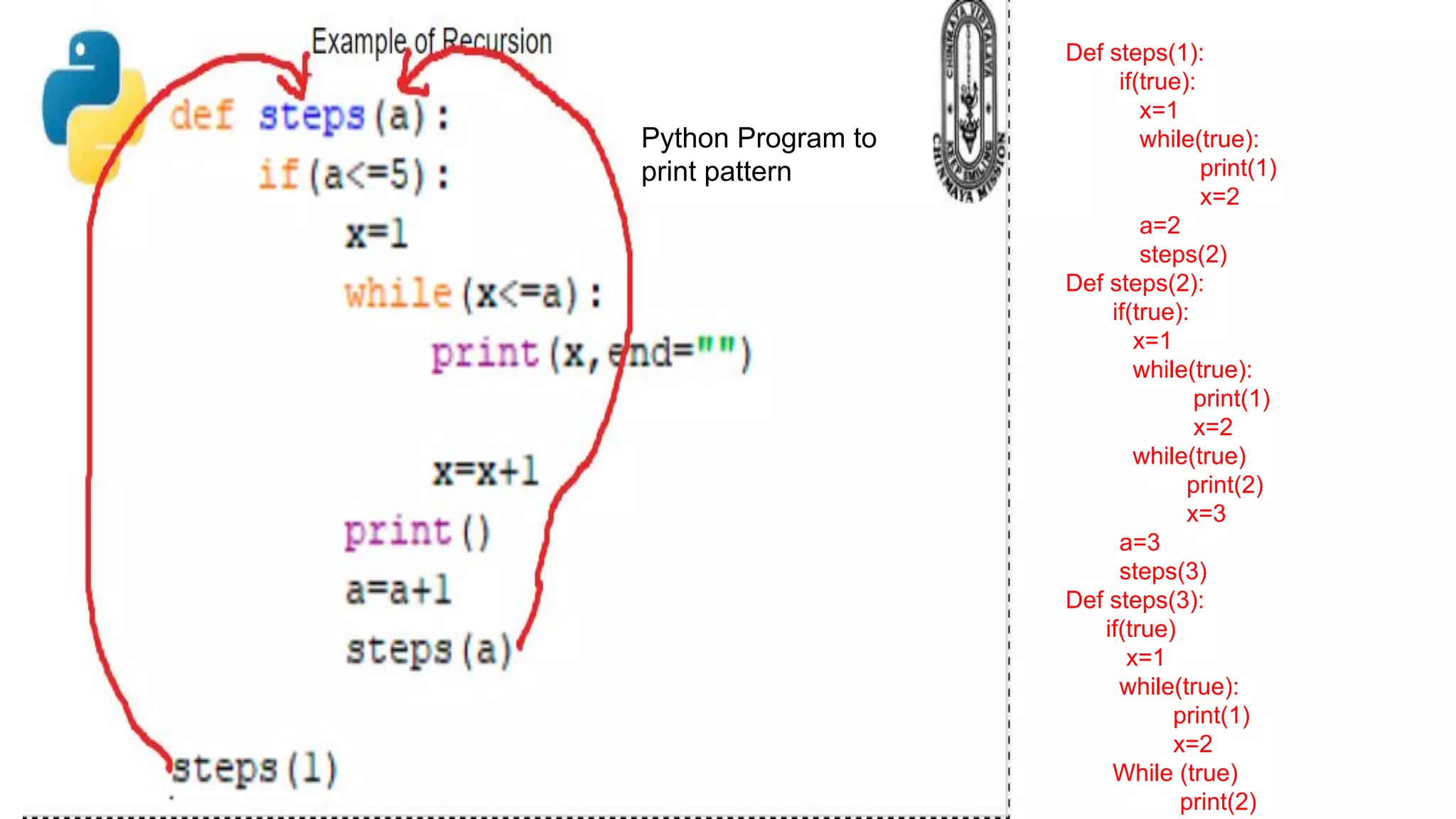
Example of Recursion Def steps(1):
if(true):
x=1
while(true):
print(1)
x=2
a=2
steps(2)
Def steps(2):
if(true):
x=1
while(true):
print(1)
x=2
while(true)
print(2)
x=3
a=3
steps(3)
Def steps(3):
if(true)
x=1
while(true):
print(1)
x=2
While (true)
print(2)
Python Program to
print pattern
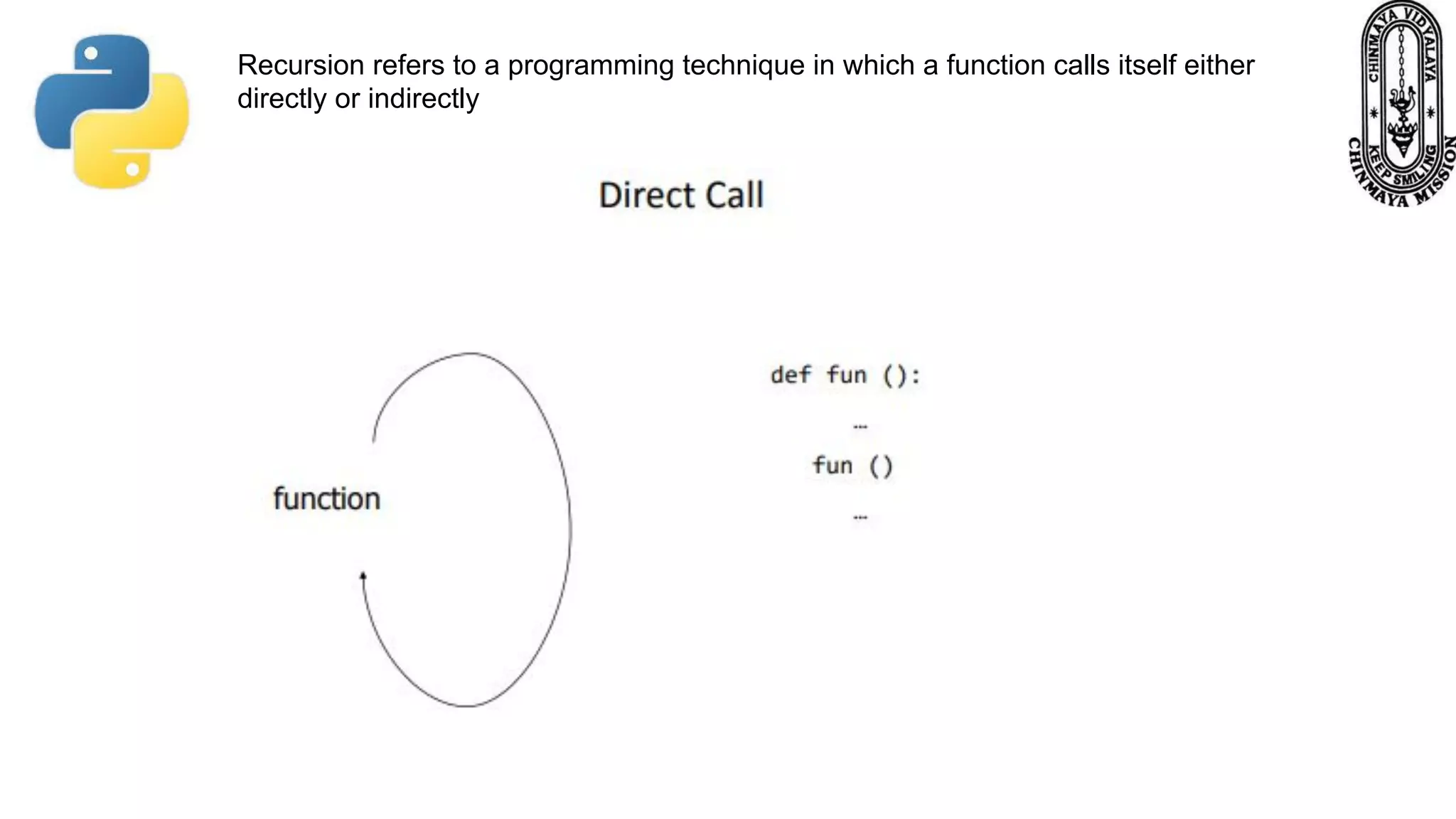
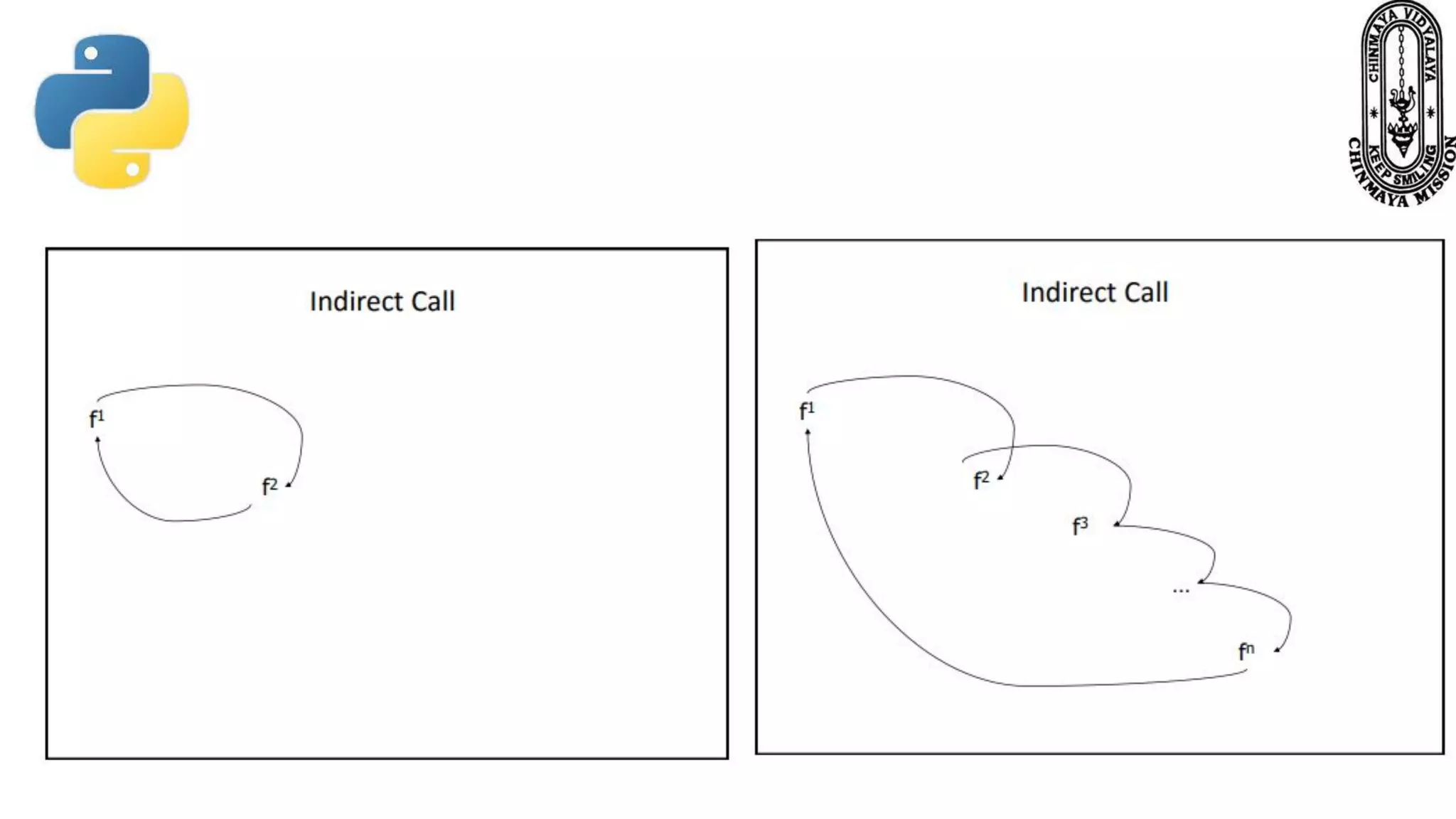
Recursion refers to a programming technique in which a function calls itself either
directly or indirectly
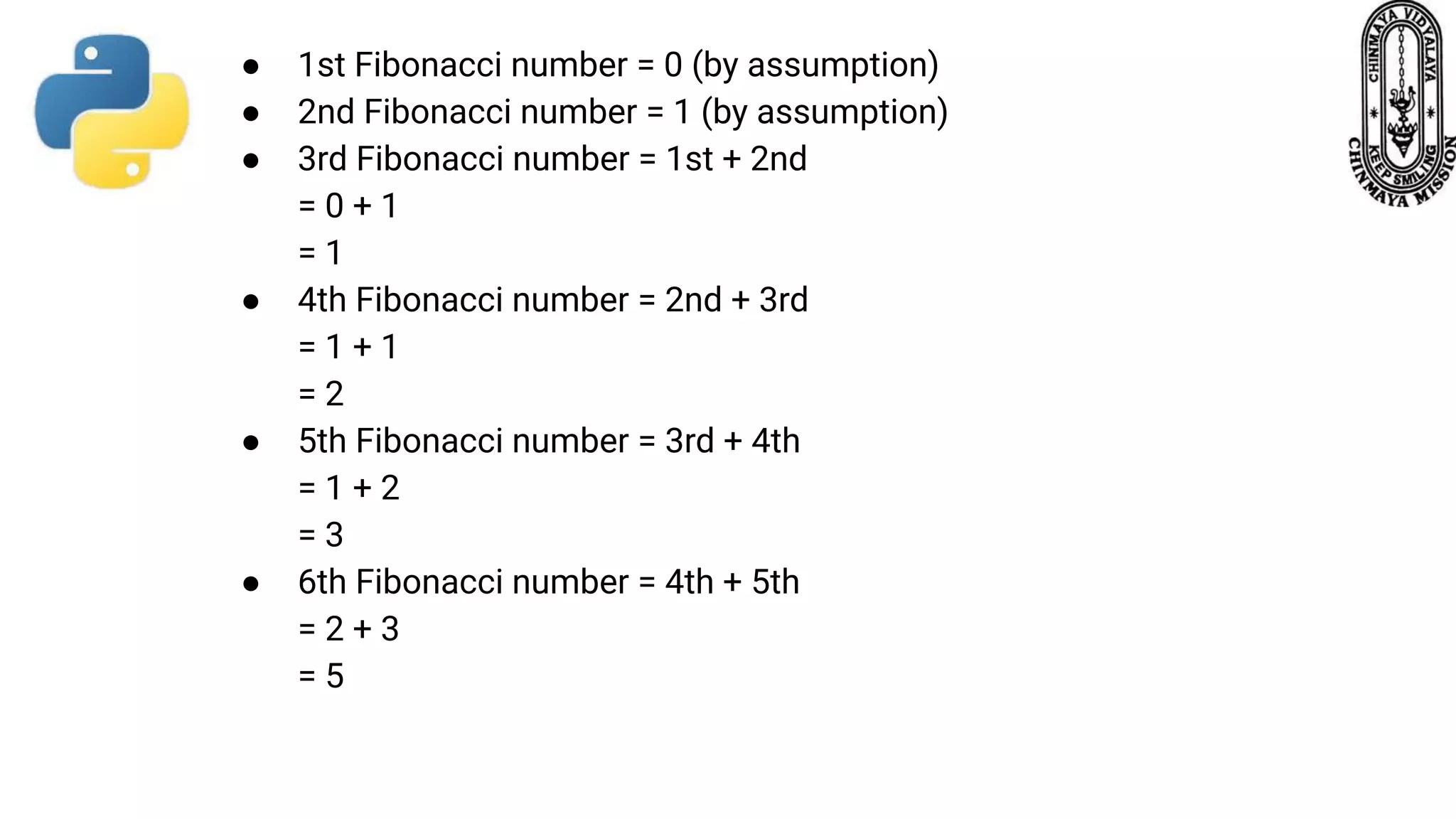
● 1st Fibonacci number = 0 (by assumption)
● 2nd Fibonacci number = 1 (by assumption)
● 3rd Fibonacci number = 1st + 2nd
= 0 + 1
= 1
● 4th Fibonacci number = 2nd + 3rd
= 1 + 1
= 2
● 5th Fibonacci number = 3rd + 4th
= 1 + 2
= 3
● 6th Fibonacci number = 4th + 5th
= 2 + 3
= 5
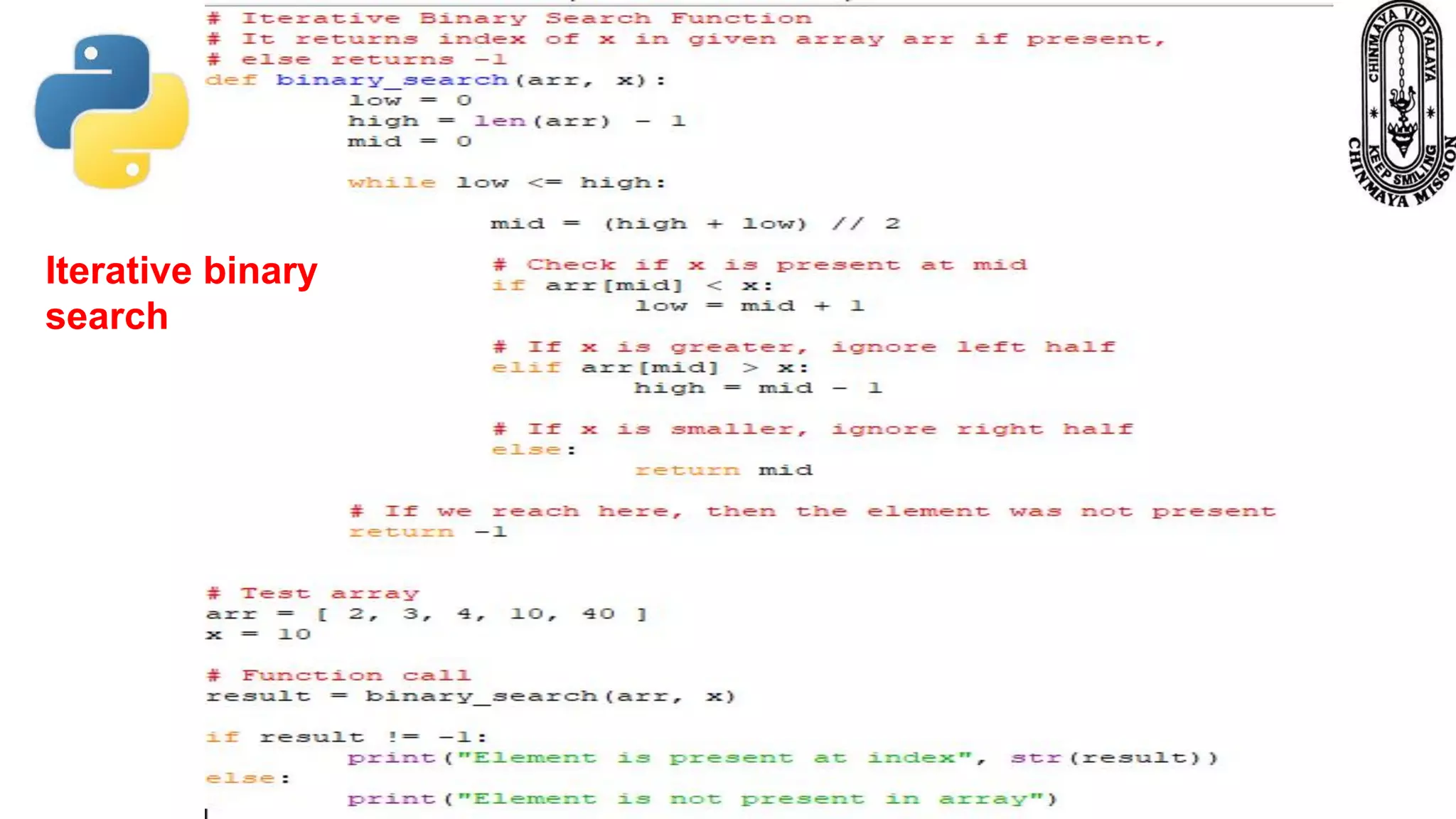
Iterative binary
search
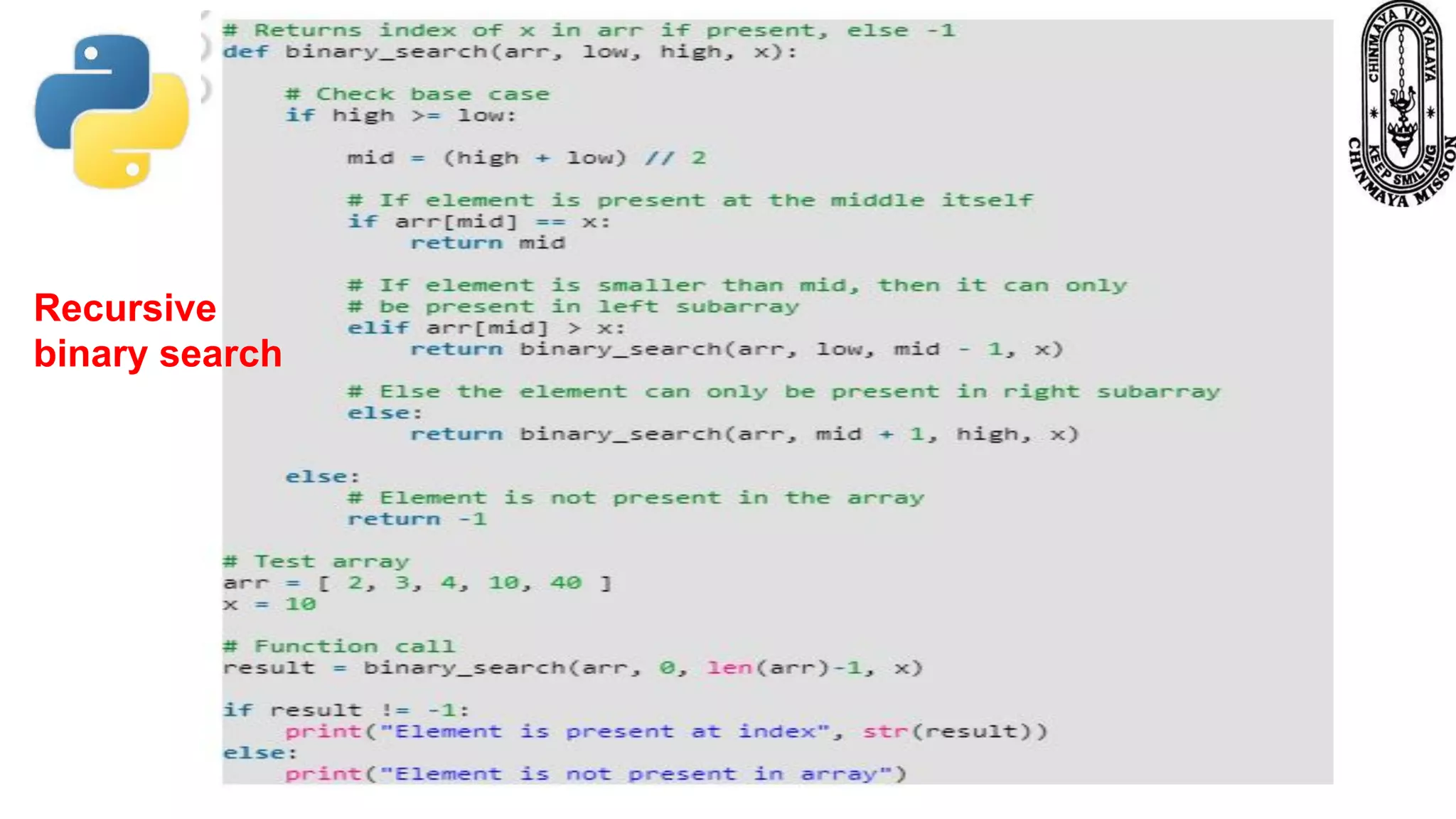
Recursive
binary search
Recursion CBSE Class 12

Recursion CBSE Class 12

  • 1.
    GVK CHINMAYA VIDYALAYA SENIORSECONDARY SCHOOL Kothuru, Indukurupet, SPS Nellore Recursion Class: 12 Subject: Python Teacher: C Vijaya B.Tech, MBA
  • 2.
    What is recursion? Recursionis the process of defining something in terms of itself. A physical world example would be to place two parallel mirrors facing each other. Any object in between them would be reflected recursively.
  • 3.
    Python Recursive Function InPython, we know that a function can call other functions. It is even possible for the function to call itself. These types of construct are termed as recursive functions. The following image shows the working of a recursive function called recurse.
  • 4.
    Following is anexample of a recursive function to find the factorial of an integer. Factorial of a number is the product of all the integers from 1 to that number. For example, the factorial of 6 (denoted as 6!) is 1*2*3*4*5*6 = 720.
  • 6.
    When we callthis function with a positive integer, it will recursively call itself by decreasing the number. Each function multiplies the number with the factorial of the number below it until it is equal to one. This recursive call can be explained in the following steps.
  • 8.
    Our recursion endswhen the number reduces to 1. This is called the base condition. Every recursive function must have a base condition that stops the recursion or else the function calls itself infinitely. The Python interpreter limits the depths of recursion to help avoid infinite recursions, resulting in stack overflows. By default, the maximum depth of recursion is 1000. If the limit is crossed, it results in RecursionError. Let's look at one such condition.
  • 10.
    Example of Recursion #This is python program to print a pattern
  • 11.
    Example of RecursionDef steps(1): if(true): x=1 while(true): print(1) x=2 a=2 steps(2) Def steps(2): if(true): x=1 while(true): print(1) x=2 while(true) print(2) x=3 a=3 steps(3) Def steps(3): if(true) x=1 while(true): print(1) x=2 While (true) print(2) Python Program to print pattern
  • 12.
    Recursion refers toa programming technique in which a function calls itself either directly or indirectly
  • 18.
    ● 1st Fibonaccinumber = 0 (by assumption) ● 2nd Fibonacci number = 1 (by assumption) ● 3rd Fibonacci number = 1st + 2nd = 0 + 1 = 1 ● 4th Fibonacci number = 2nd + 3rd = 1 + 1 = 2 ● 5th Fibonacci number = 3rd + 4th = 1 + 2 = 3 ● 6th Fibonacci number = 4th + 5th = 2 + 3 = 5
  • 19.
  • 20.