Recursion in Python
Enhanced Overview with Examples
and Insights
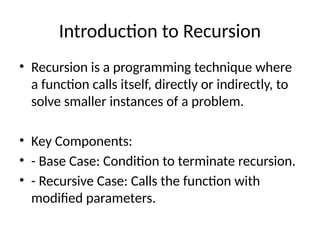
Introduction to Recursion
• Recursion is a programming technique where
a function calls itself, directly or indirectly, to
solve smaller instances of a problem.
• Key Components:
• - Base Case: Condition to terminate recursion.
• - Recursive Case: Calls the function with
modified parameters.
Recursive Function Syntax
• Python Syntax:
• def function_name(parameters):
• if base_case_condition:
• return result
• else:
• return recursive_call
• Example: Factorial Function
• def factorial_recursive(n):
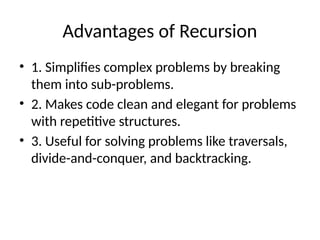
Advantages of Recursion
• 1. Simplifies complex problems by breaking
them into sub-problems.
• 2. Makes code clean and elegant for problems
with repetitive structures.
• 3. Useful for solving problems like traversals,
divide-and-conquer, and backtracking.
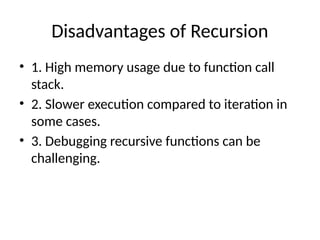
Disadvantages of Recursion
• 1. High memory usage due to function call
stack.
• 2. Slower execution compared to iteration in
some cases.
• 3. Debugging recursive functions can be
challenging.
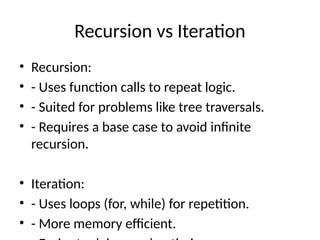
Recursion vs Iteration
• Recursion:
• - Uses function calls to repeat logic.
• - Suited for problems like tree traversals.
• - Requires a base case to avoid infinite
recursion.
• Iteration:
• - Uses loops (for, while) for repetition.
• - More memory efficient.

Enhanced_Recursion_Presennnnntation.pptx

  • 1.
    Recursion in Python EnhancedOverview with Examples and Insights
  • 2.
    Introduction to Recursion •Recursion is a programming technique where a function calls itself, directly or indirectly, to solve smaller instances of a problem. • Key Components: • - Base Case: Condition to terminate recursion. • - Recursive Case: Calls the function with modified parameters.
  • 3.
    Recursive Function Syntax •Python Syntax: • def function_name(parameters): • if base_case_condition: • return result • else: • return recursive_call • Example: Factorial Function • def factorial_recursive(n):
  • 4.
    Advantages of Recursion •1. Simplifies complex problems by breaking them into sub-problems. • 2. Makes code clean and elegant for problems with repetitive structures. • 3. Useful for solving problems like traversals, divide-and-conquer, and backtracking.
  • 5.
    Disadvantages of Recursion •1. High memory usage due to function call stack. • 2. Slower execution compared to iteration in some cases. • 3. Debugging recursive functions can be challenging.
  • 6.
    Recursion vs Iteration •Recursion: • - Uses function calls to repeat logic. • - Suited for problems like tree traversals. • - Requires a base case to avoid infinite recursion. • Iteration: • - Uses loops (for, while) for repetition. • - More memory efficient.