Objectives
• become familiarwith the idea of recursion
• learn to use recursion as a programming tool
• become familiar with the binary search
algorithm as an example of recursion
• become familiar with the merge sort algorithm
as an example of recursion
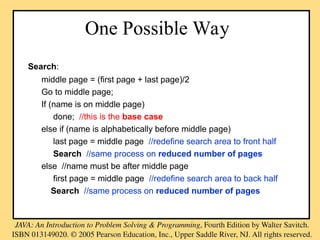
One Possible Way
Search:
middlepage = (first page + last page)/2
Go to middle page;
If (name is on middle page)
done; //this is the base case
else if (name is alphabetically before middle page)
last page = middle page //redefine search area to front half
Search //same process on reduced number of pages
else //name must be after middle page
first page = middle page //redefine search area to back half
Search //same process on reduced number of pages
5.
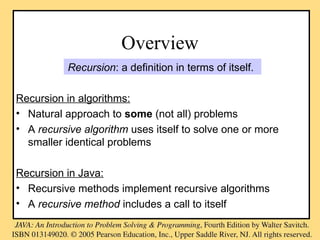
Recursion: a definitionin terms of itself.
Recursion in algorithms:
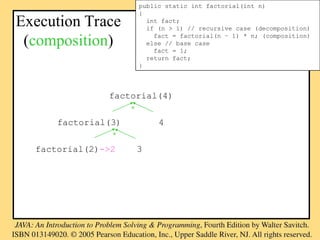
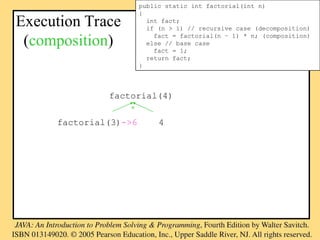
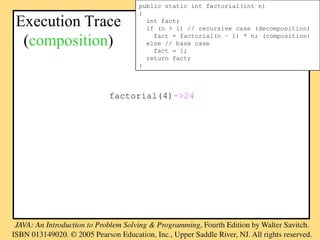
• Natural approach to some (not all) problems
• A recursive algorithm uses itself to solve one or more
smaller identical problems
Recursion in Java:
• Recursive methods implement recursive algorithms
• A recursive method includes a call to itself
Overview
6.
Recursive Methods
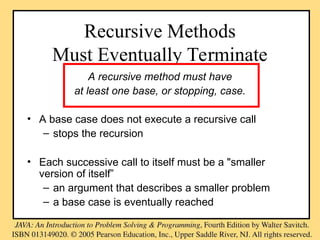
Must EventuallyTerminate
A recursive method must have
at least one base, or stopping, case.
• A base case does not execute a recursive call
– stops the recursion
• Each successive call to itself must be a "smaller
version of itself”
– an argument that describes a smaller problem
– a base case is eventually reached
7.
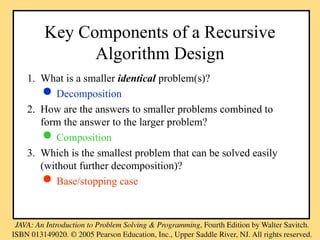
Key Components ofa Recursive
Algorithm Design
1. What is a smaller identical problem(s)?
Decomposition
2. How are the answers to smaller problems combined to
form the answer to the larger problem?
Composition
3. Which is the smallest problem that can be solved easily
(without further decomposition)?
Base/stopping case
8.
Examples in Recursion
•Usually quite confusing the first time
• Start with some simple examples
– recursive algorithms might not be best
• Later with inherently recursive algorithms
– harder to implement otherwise
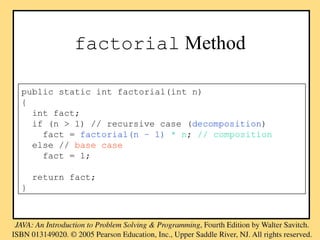
factorial Method
public staticint factorial(int n)
{
int fact;
if (n > 1) // recursive case (decomposition)
fact = factorial(n – 1) * n; // composition
else // base case
fact = 1;
return fact;
}
11.
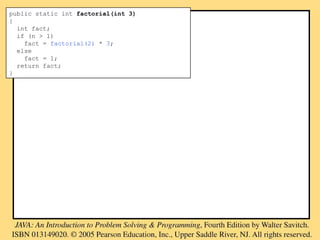
public static intfactorial(int 3)
{
int fact;
if (n > 1)
fact = factorial(2) * 3;
else
fact = 1;
return fact;
}
12.
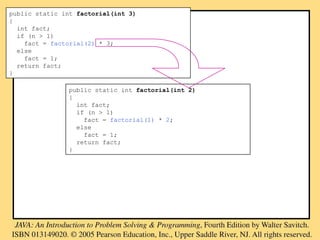
public static intfactorial(int 3)
{
int fact;
if (n > 1)
fact = factorial(2) * 3;
else
fact = 1;
return fact;
}
public static int factorial(int 2)
{
int fact;
if (n > 1)
fact = factorial(1) * 2;
else
fact = 1;
return fact;
}
13.
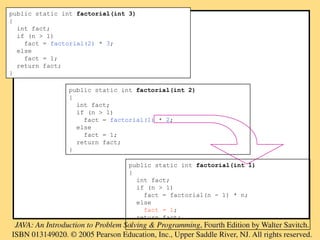
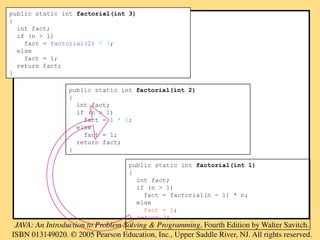
public static intfactorial(int 3)
{
int fact;
if (n > 1)
fact = factorial(2) * 3;
else
fact = 1;
return fact;
}
public static int factorial(int 2)
{
int fact;
if (n > 1)
fact = factorial(1) * 2;
else
fact = 1;
return fact;
}
public static int factorial(int 1)
{
int fact;
if (n > 1)
fact = factorial(n - 1) * n;
else
fact = 1;
return fact;
}
14.
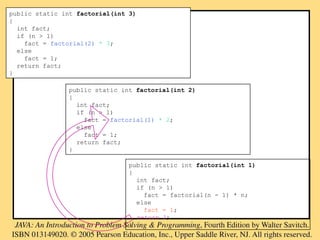
public static intfactorial(int 3)
{
int fact;
if (n > 1)
fact = factorial(2) * 3;
else
fact = 1;
return fact;
}
public static int factorial(int 2)
{
int fact;
if (n > 1)
fact = factorial(1) * 2;
else
fact = 1;
return fact;
}
public static int factorial(int 1)
{
int fact;
if (n > 1)
fact = factorial(n - 1) * n;
else
fact = 1;
return 1;
}
15.
public static intfactorial(int 3)
{
int fact;
if (n > 1)
fact = factorial(2) * 3;
else
fact = 1;
return fact;
}
public static int factorial(int 2)
{
int fact;
if (n > 1)
fact = 1 * 2;
else
fact = 1;
return fact;
}
public static int factorial(int 1)
{
int fact;
if (n > 1)
fact = factorial(n - 1) * n;
else
fact = 1;
return 1;
}
16.
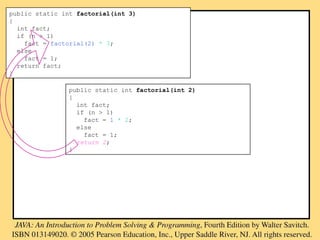
public static intfactorial(int 3)
{
int fact;
if (n > 1)
fact = factorial(2) * 3;
else
fact = 1;
return fact;
}
public static int factorial(int 2)
{
int fact;
if (n > 1)
fact = 1 * 2;
else
fact = 1;
return 2;
}
17.
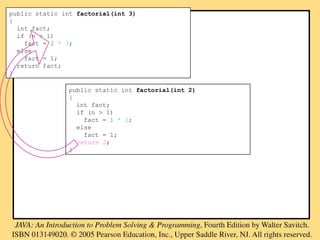
public static intfactorial(int 3)
{
int fact;
if (n > 1)
fact = 2 * 3;
else
fact = 1;
return fact;
}
public static int factorial(int 2)
{
int fact;
if (n > 1)
fact = 1 * 2;
else
fact = 1;
return 2;
}
18.
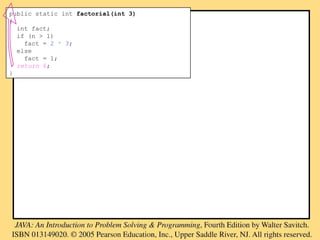
public static intfactorial(int 3)
{
int fact;
if (n > 1)
fact = 2 * 3;
else
fact = 1;
return 6;
}
19.
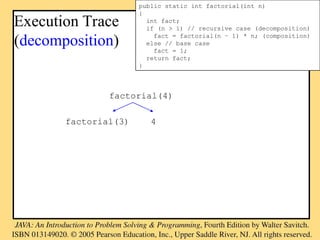
Execution Trace
(decomposition)
public staticint factorial(int n)
{
int fact;
if (n > 1) // recursive case (decomposition)
fact = factorial(n – 1) * n; (composition)
else // base case
fact = 1;
return fact;
}
factorial(4)
factorial(3) 4
20.
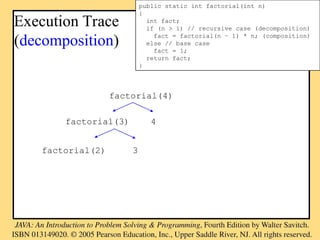
Execution Trace
(decomposition)
public staticint factorial(int n)
{
int fact;
if (n > 1) // recursive case (decomposition)
fact = factorial(n – 1) * n; (composition)
else // base case
fact = 1;
return fact;
}
factorial(4)
factorial(3) 4
factorial(2) 3
21.
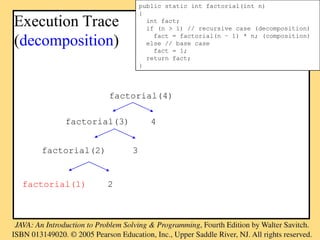
Execution Trace
(decomposition)
public staticint factorial(int n)
{
int fact;
if (n > 1) // recursive case (decomposition)
fact = factorial(n – 1) * n; (composition)
else // base case
fact = 1;
return fact;
}
factorial(4)
factorial(3) 4
factorial(2) 3
factorial(1) 2
22.
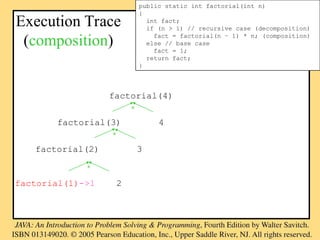
Execution Trace
(composition)
public staticint factorial(int n)
{
int fact;
if (n > 1) // recursive case (decomposition)
fact = factorial(n – 1) * n; (composition)
else // base case
fact = 1;
return fact;
}
factorial(4)
factorial(3) 4
factorial(2) 3
factorial(1)->1 2
*
*
*
23.
Execution Trace
(composition)
public staticint factorial(int n)
{
int fact;
if (n > 1) // recursive case (decomposition)
fact = factorial(n – 1) * n; (composition)
else // base case
fact = 1;
return fact;
}
factorial(4)
factorial(3) 4
factorial(2)->2 3
*
*
24.
Execution Trace
(composition)
public staticint factorial(int n)
{
int fact;
if (n > 1) // recursive case (decomposition)
fact = factorial(n – 1) * n; (composition)
else // base case
fact = 1;
return fact;
}
factorial(4)
factorial(3)->6 4
*
25.
Execution Trace
(composition)
public staticint factorial(int n)
{
int fact;
if (n > 1) // recursive case (decomposition)
fact = factorial(n – 1) * n; (composition)
else // base case
fact = 1;
return fact;
}
factorial(4)->24
26.
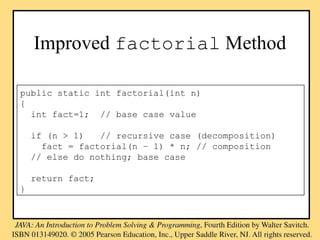
Improved factorial Method
publicstatic int factorial(int n)
{
int fact=1; // base case value
if (n > 1) // recursive case (decomposition)
fact = factorial(n – 1) * n; // composition
// else do nothing; base case
return fact;
}
27.
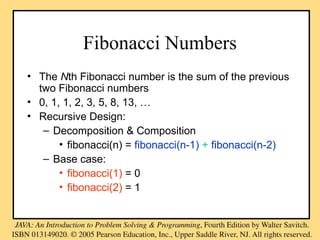
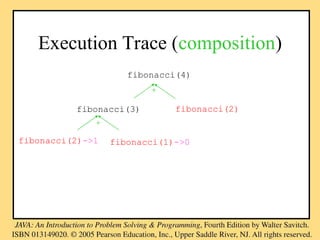
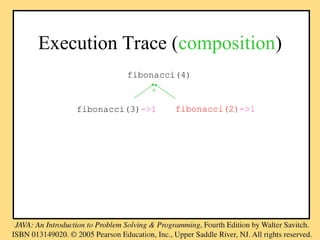
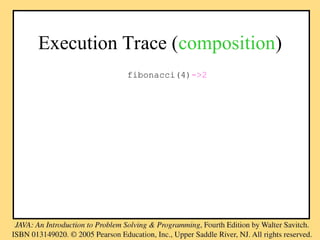
Fibonacci Numbers
• TheNth Fibonacci number is the sum of the previous
two Fibonacci numbers
• 0, 1, 1, 2, 3, 5, 8, 13, …
• Recursive Design:
– Decomposition & Composition
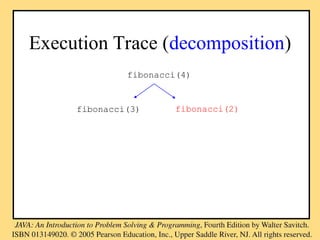
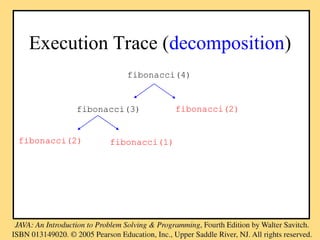
• fibonacci(n) = fibonacci(n-1) + fibonacci(n-2)
– Base case:
• fibonacci(1) = 0
• fibonacci(2) = 1
28.
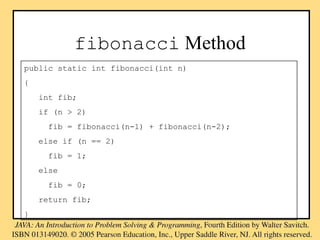
fibonacci Method
public staticint fibonacci(int n)
{
int fib;
if (n > 2)
fib = fibonacci(n-1) + fibonacci(n-2);
else if (n == 2)
fib = 1;
else
fib = 0;
return fib;
}
Remember:
Key to SuccessfulRecursion
• if-else statement (or some other branching
statement)
• Some branches: recursive call
– "smaller" arguments or solve "smaller"
versions of the same task (decomposition)
– Combine the results (composition) [if
necessary]
• Other branches: no recursive calls
– stopping cases or base cases
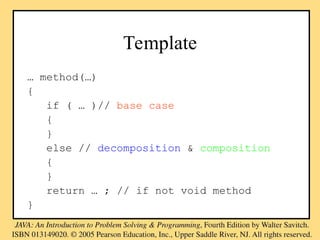
35.
Template
… method(…)
{
if (… )// base case
{
}
else // decomposition & composition
{
}
return … ; // if not void method
}
36.
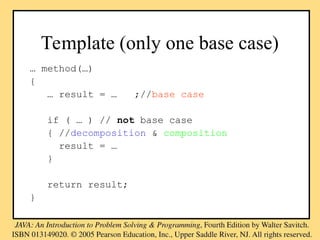
Template (only onebase case)
… method(…)
{
… result = … ;//base case
if ( … ) // not base case
{ //decomposition & composition
result = …
}
return result;
}
37.
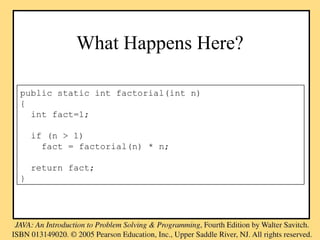
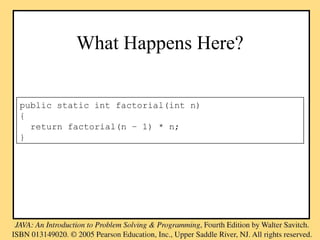
What Happens Here?
publicstatic int factorial(int n)
{
int fact=1;
if (n > 1)
fact = factorial(n) * n;
return fact;
}
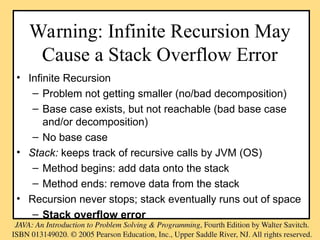
Warning: Infinite RecursionMay
Cause a Stack Overflow Error
• Infinite Recursion
– Problem not getting smaller (no/bad decomposition)
– Base case exists, but not reachable (bad base case
and/or decomposition)
– No base case
• Stack: keeps track of recursive calls by JVM (OS)
– Method begins: add data onto the stack
– Method ends: remove data from the stack
• Recursion never stops; stack eventually runs out of space
– Stack overflow error
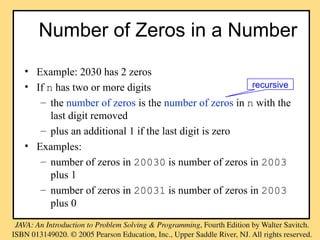
• Example: 2030has 2 zeros
• If n has two or more digits
– the number of zeros is the number of zeros in n with the
last digit removed
– plus an additional 1 if the last digit is zero
• Examples:
– number of zeros in 20030 is number of zeros in 2003
plus 1
– number of zeros in 20031 is number of zeros in 2003
plus 0
Number of Zeros in a Number
recursive
42.
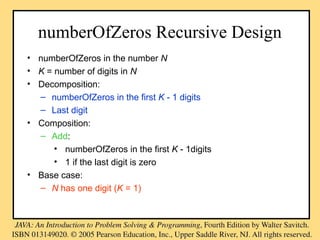
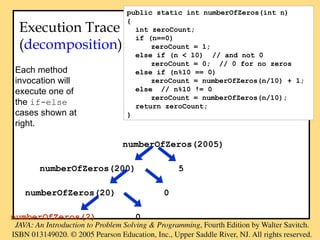
numberOfZeros Recursive Design
•numberOfZeros in the number N
• K = number of digits in N
• Decomposition:
– numberOfZeros in the first K - 1 digits
– Last digit
• Composition:
– Add:
• numberOfZeros in the first K - 1digits
• 1 if the last digit is zero
• Base case:
– N has one digit (K = 1)
43.
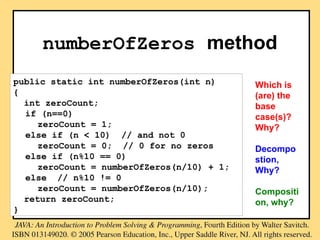
numberOfZeros method
public staticint numberOfZeros(int n)
{
int zeroCount;
if (n==0)
zeroCount = 1;
else if (n < 10) // and not 0
zeroCount = 0; // 0 for no zeros
else if (n%10 == 0)
zeroCount = numberOfZeros(n/10) + 1;
else // n%10 != 0
zeroCount = numberOfZeros(n/10);
return zeroCount;
}
Which is
(are) the
base
case(s)?
Why?
Decompo
stion,
Why?
Compositi
on, why?
44.
numberOfZeros(2005)
numberOfZeros(200) 5
numberOfZeros(20) 0
numberOfZeros(2)0
Execution Trace
(decomposition)
Each method
invocation will
execute one of
the if-else
cases shown at
right.
public static int numberOfZeros(int n)
{
int zeroCount;
if (n==0)
zeroCount = 1;
else if (n < 10) // and not 0
zeroCount = 0; // 0 for no zeros
else if (n%10 == 0)
zeroCount = numberOfZeros(n/10) + 1;
else // n%10 != 0
zeroCount = numberOfZeros(n/10);
return zeroCount;
}
45.
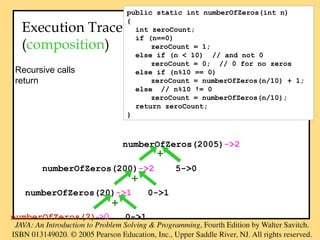
numberOfZeros(2005)->2
numberOfZeros(200)->2 5->0
numberOfZeros(20)->1 0->1
numberOfZeros(2)->00->1
Execution Trace
(composition)
Recursive calls
return
public static int numberOfZeros(int n)
{
int zeroCount;
if (n==0)
zeroCount = 1;
else if (n < 10) // and not 0
zeroCount = 0; // 0 for no zeros
else if (n%10 == 0)
zeroCount = numberOfZeros(n/10) + 1;
else // n%10 != 0
zeroCount = numberOfZeros(n/10);
return zeroCount;
}
+
+
+
46.
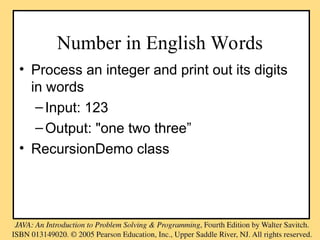
Number in EnglishWords
• Process an integer and print out its digits
in words
–Input: 123
–Output: "one two three”
• RecursionDemo class
47.
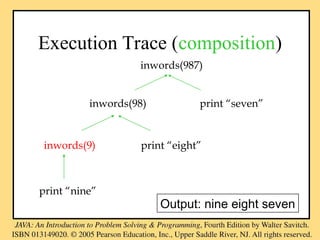
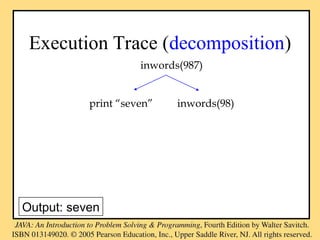
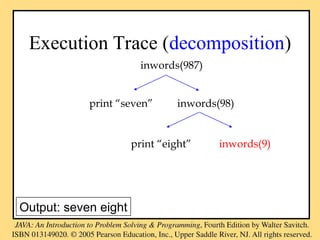
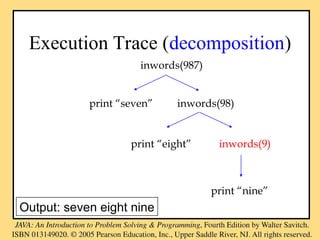
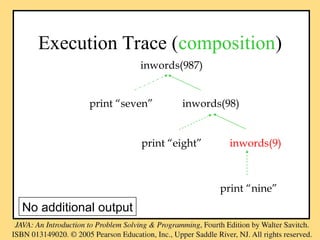
inWords Resursive Design
•inWords prints a number N in English words
• K = number of digits in N
• Decomposition:
– inWords for the first K – 1 digits
– Print the last digit
• Composition:
– Execution order of composed steps [more later]
• Base case:
– N has one digit (K = 1)
48.
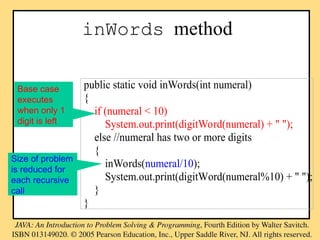
inWords method
public staticvoid inWords(int numeral)
{
if (numeral < 10)
System.out.print(digitWord(numeral) + " ");
else //numeral has two or more digits
{
inWords(numeral/10);
System.out.print(digitWord(numeral%10) + " ");
}
}
Base case
executes
when only 1
digit is left
Size of problem
is reduced for
each recursive
call
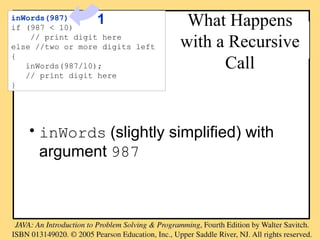
What Happens
with aRecursive
Call
• inWords (slightly simplified) with
argument 987
inWords(987)
if (987 < 10)
// print digit here
else //two or more digits left
{
inWords(987/10);
// print digit here
}
1
52.
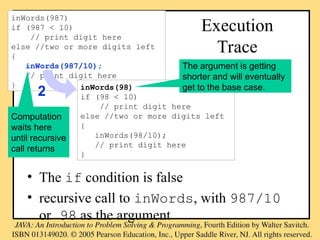
Execution
Trace
• The ifcondition is false
• recursive call to inWords, with 987/10
or 98 as the argument
inWords(987)
if (987 < 10)
// print digit here
else //two or more digits left
{
inWords(987/10);
// print digit here
} inWords(98)
if (98 < 10)
// print digit here
else //two or more digits left
{
inWords(98/10);
// print digit here
}
2
Computation
waits here
until recursive
call returns
The argument is getting
shorter and will eventually
get to the base case.
53.
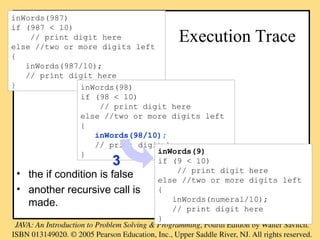
Execution Trace
• theif condition is false
• another recursive call is
made.
inWords(987)
if (987 < 10)
// print digit here
else //two or more digits left
{
inWords(987/10);
// print digit here
} inWords(98)
if (98 < 10)
// print digit here
else //two or more digits left
{
inWords(98/10);
// print digit here
} inWords(9)
if (9 < 10)
// print digit here
else //two or more digits left
{
inWords(numeral/10);
// print digit here
}
3
54.
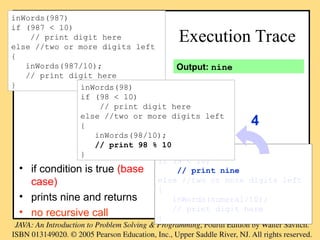
inWords(9)
if (9 <10)
// print nine
else //two or more digits left
{
inWords(numeral/10);
// print digit here
}
Execution Trace
• if condition is true (base
case)
• prints nine and returns
• no recursive call
inWords(987)
if (987 < 10)
// print digit here
else //two or more digits left
{
inWords(987/10);
// print digit here
} inWords(98)
if (98 < 10)
// print digit here
else //two or more digits left
{
inWords(98/10);
// print 98 % 10
}
4
Output: nine
55.
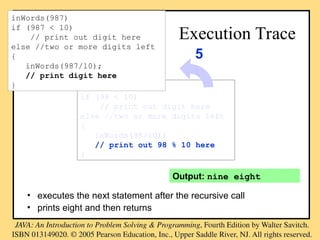
Output: nine eight
ExecutionTrace
• executes the next statement after the recursive call
• prints eight and then returns
inWords(98)
if (98 < 10)
// print out digit here
else //two or more digits left
{
inWords(98/10);
// print out 98 % 10 here
}
5
inWords(987)
if (987 < 10)
// print out digit here
else //two or more digits left
{
inWords(987/10);
// print digit here
}
56.
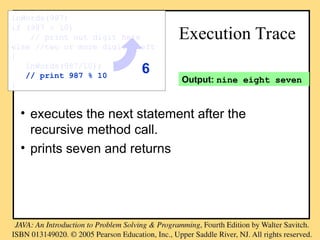
Output: nine eightseven
Execution Trace
• executes the next statement after the
recursive method call.
• prints seven and returns
6
inWords(987)
if (987 < 10)
// print out digit here
else //two or more digits left
{
inWords(987/10);
// print 987 % 10
}
6
57.
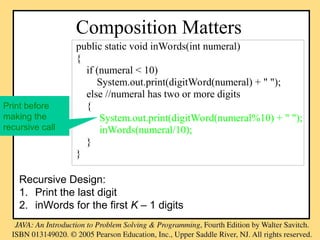
Composition Matters
public staticvoid inWords(int numeral)
{
if (numeral < 10)
System.out.print(digitWord(numeral) + " ");
else //numeral has two or more digits
{
System.out.print(digitWord(numeral%10) + " ");
inWords(numeral/10);
}
}
Print before
making the
recursive call
Recursive Design:
1. Print the last digit
2. inWords for the first K – 1 digits
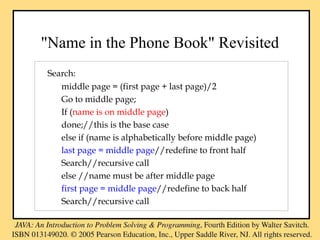
"Name in thePhone Book" Revisited
Search:
middle page = (first page + last page)/2
Go to middle page;
If (name is on middle page)
done;//this is the base case
else if (name is alphabetically before middle page)
last page = middle page//redefine to front half
Search//recursive call
else //name must be after middle page
first page = middle page//redefine to back half
Search//recursive call
63.
Binary Search Algorithm
•Searching a list for a particular value
– sequential and binary are two common
algorithms
• Sequential search (aka linear search):
– Not very efficient
– Easy to understand and program
• Binary search:
– more efficient than sequential
– but the list must be sorted first!
64.
Why Is ItCalled "Binary" Search?
Compare sequential and binary search algorithms:
How many elements are eliminated from the list each
time a value is read from the list and it is not the
"target" value?
Sequential search: only one item
Binary search: half the list!
That is why it is called binary -
each unsuccessful test for the target value
reduces the remaining search list by 1/2.
65.
Binary Search
Method
• public
find(target)calls
private
search(target,
first, last)
• returns the index of the
entry if the target value
is found or -1 if it is not
found
• Compare it to the
pseudocode for the
"name in the phone
book" problem
private int search(int target, int first, int last)
{
int location = -1; // not found
if (first <= last) // range is not empty
{
int mid = (first + last)/2;
if (target == a[mid])
location = mid;
else if (target < a[mid]) // first half
location = search(target, first, mid - 1);
else //(target > a[mid]) second half
location = search(target, mid + 1, last);
}
return location;
}
66.
Where is thecomposition?
• If no items
– not found (-1)
• Else if target is in the middle
– middle location
• Else
– location found by search(first half) or
search(second half)
67.
5 7 913 32 33 42 54 56 88
0 1 2 3 4 5 6 7 8 9
Indices
Contents
target is 33
The array a looks like this:
Binary Search Example
mid = (0 + 9) / 2 (which is 4)
33 > a[mid] (that is, 33 > a[4])
So, if 33 is in the array, then 33 is one of:
33 42 54 56 88
5 6 7 8 9
Eliminated half of the remaining elements from
consideration because array elements are sorted.
68.
5 7 913 32 33 42 54 56 88
0 1 2 3 4 5 6 7 8 9
Indexes
Contents
target is 33
The array a looks like this:
Binary Search Example
mid = (5 + 6) / 2 (which is 5)
33 == a[mid]
So we found 33 at index 5:
33
5
mid = (5 + 9) / 2 (which is 7)
33 < a[mid] (that is, 33 < a[7])
So, if 33 is in the array, then 33 is one of:
33 42
5 6
Eliminate
half of the
remaining
elements
69.
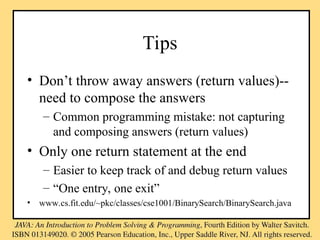
Tips
• Don’t throwaway answers (return values)--
need to compose the answers
– Common programming mistake: not capturing
and composing answers (return values)
• Only one return statement at the end
– Easier to keep track of and debug return values
– “One entry, one exit”
• www.cs.fit.edu/~pkc/classes/cse1001/BinarySearch/BinarySearch.java
70.
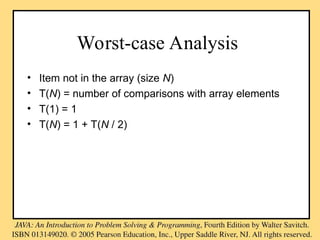
Worst-case Analysis
• Itemnot in the array (size N)
• T(N) = number of comparisons with array elements
• T(1) = 1
• T(N) = 1 + T(N / 2)
71.
Worst-case Analysis
• Itemnot in the array (size N)
• T(N) = number of comparisons with array elements
• T(1) = 1
• T(N) = 1 + T(N / 2)
= 1 + [1 + T(N / 4)]
72.
Worst-case Analysis
• Itemnot in the array (size N)
• T(N) = number of comparisons with array elements
• T(1) = 1
• T(N) = 1 + T(N / 2)
= 1 + [1 + T(N / 4)]
= 2 + T(N / 4)
= 2 + [1 + T(N / 8)]
Worst-case Analysis
• T(N)= k + T(N / 2k
) [1]
• T(N / 2k
) gets smaller until the base case: T(1)
– 2k
= N
– k = log2N
• Replace terms with k in [1]:
T(N) = log2N + T(N / N)
= log2N + T(1)
= log2N + 1
• “log2N” algorithm
• We used recurrence equations
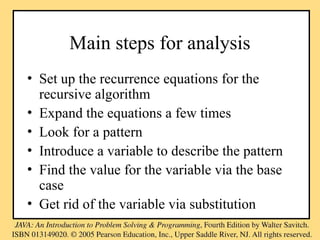
76.
Main steps foranalysis
• Set up the recurrence equations for the
recursive algorithm
• Expand the equations a few times
• Look for a pattern
• Introduce a variable to describe the pattern
• Find the value for the variable via the base
case
• Get rid of the variable via substitution
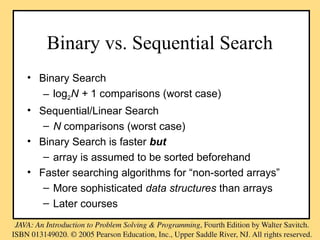
77.
Binary vs. SequentialSearch
• Binary Search
– log2N + 1 comparisons (worst case)
• Sequential/Linear Search
– N comparisons (worst case)
• Binary Search is faster but
– array is assumed to be sorted beforehand
• Faster searching algorithms for “non-sorted arrays”
– More sophisticated data structures than arrays
– Later courses
78.
Recursive Versus Iterative
Methods
Allrecursive algorithms/methods
can be rewritten without recursion.
• Iterative methods use loops instead of recursion
• Iterative methods generally run faster and use less
memory--less overhead in keeping track of method
calls
79.
So When ShouldYou Use
Recursion?
• Solutions/algorithms for some problems are
inherently recursive
– iterative implementation could be more
complicated
• When efficiency is less important
– it might make the code easier to understand
• Bottom line is about:
– Algorithm design
– Tradeoff between readability and efficiency
80.
Pages 807 NOTa good tip
[Programming Tip: Ask Until the User Gets It Right]
public void getCount()
{
System.out.println("Enter a positive number:");
count = SavitchIn.readLineInt();
if (count <= 0)
{
System.out.println("Input must be positive.
System.out.println("Try again.");
getCount(); //start over
}
}
read a number
Use a recursive
call to get
another number.
• Recursion continues until user enters valid input.
• No notion of a smaller problem for recursive design
• Easily implemented using iteration without loss
of readability
81.
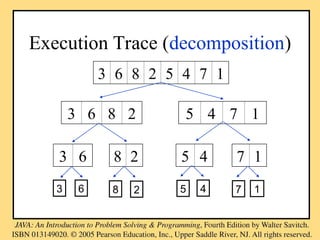
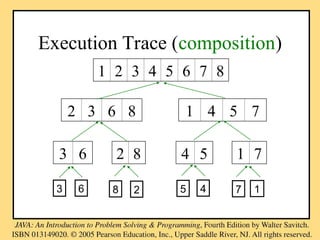
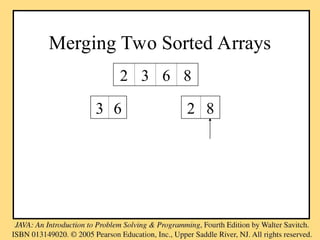
Merge Sort—
A RecursiveSorting Algorithm
• Example of divide and conquer algorithm
• Recursive design:
– Divides array in half and merge sorts the
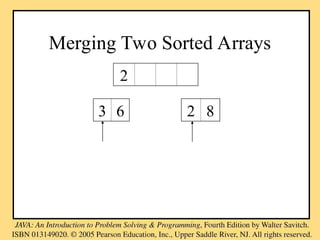
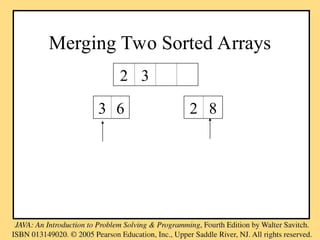
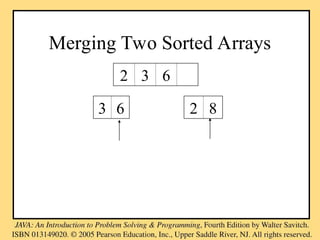
halves (decomposition)
– Combines two sorted halves (composition)
– Array has only one element (base case)
• Harder to implement iteratively
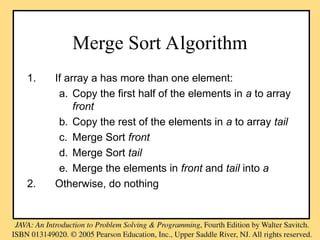
Merge Sort Algorithm
1.If array a has more than one element:
a. Copy the first half of the elements in a to array
front
b. Copy the rest of the elements in a to array tail
c. Merge Sort front
d. Merge Sort tail
e. Merge the elements in front and tail into a
2. Otherwise, do nothing
89.
Merge Sort
recursive
calls
make "smaller"
problemsby
dividing array
Combine the
two sorted
arrays
base case: a.length == 1 so
a is sorted and no recursive
call is necessary.
do recursive case if
true, base case if false
public static void sort(int[] a)
{
if (a.length >= 2)
{
int halfLength = a.length / 2;
int[] front = new int[halfLength];
int[] tail = new int[a.length – halfLength];
divide(a, front, tail);
sort(front);
sort(tail);
merge(a, front, tail);
}
// else do nothing.
}
90.
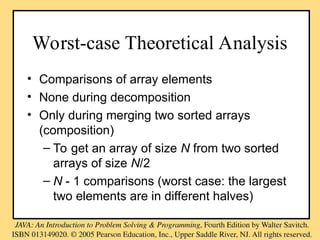
Worst-case Theoretical Analysis
•Comparisons of array elements
• None during decomposition
• Only during merging two sorted arrays
(composition)
– To get an array of size N from two sorted
arrays of size N/2
– N - 1 comparisons (worst case: the largest
two elements are in different halves)
91.
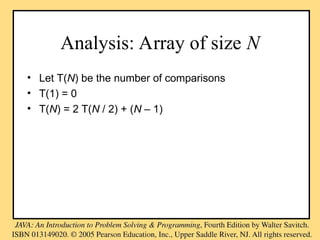
Analysis: Array ofsize N
• Let T(N) be the number of comparisons
• T(1) = 0
• T(N) = 2 T(N / 2) + (N – 1)
92.
Analysis: Array ofsize N
• Let T(N) be the number of comparisons
• T(1) = 0
• T(N) = 2 T(N / 2) + (N – 1)
= 2 [2 T(N / 4) + (N / 2 – 1)] + (N – 1)
Merge Sort Vs.
Selection/Insertion/BubbleSort
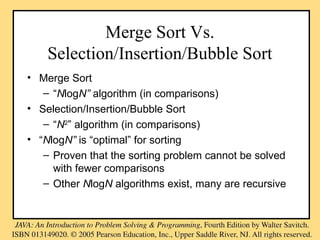
• Merge Sort
– “NlogN” algorithm (in comparisons)
• Selection/Insertion/Bubble Sort
– “N2
” algorithm (in comparisons)
• “NlogN” is “optimal” for sorting
– Proven that the sorting problem cannot be solved
with fewer comparisons
– Other NlogN algorithms exist, many are recursive
102.
Real Data Set:Web Server Log
• http://www.cs.fit.edu/~pkc/classes/writing/data/jan99.log
• 4.6 MB (44057 entries)
• Example entry in log:
ip195.dca.primenet.com - - [04/Jan/1999:09:16:51 -
0500] "GET / HTTP/1.0" 200 762
• Extracted features
– remote-host names (strings)
– file-size (integers)
• List size - 100 to 44000 entries
103.
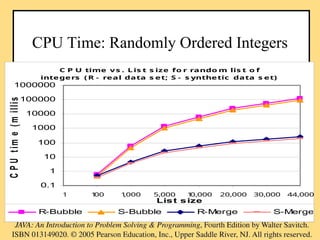
CPU Time: RandomlyOrdered Integers
C P U time v s . L is t s ize fo r rando m lis t o f
integers ( R - real data s et; S - s ynthetic data s et)
0.1
1
10
100
1000
10000
100000
1000000
1 1
00 1
,000 5,000 1
0,000 20,000 30,000 44,000
List size
C
P
U
t
i
m
e
(
m
ill
i
s
e
c
o
n
d
s
)
R-Bubble S-Bubble R-Merge S-Merge
104.
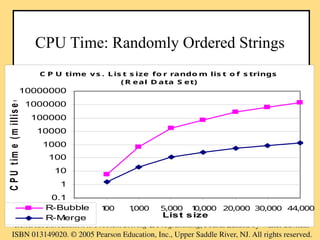
CPU Time: RandomlyOrdered Strings
C P U time vs . L is t s ize fo r rando m lis t o f s trings
( R eal D ata S et)
0.1
1
10
100
1000
10000
100000
1000000
10000000
1 1
00 1
,000 5,000 1
0,000 20,000 30,000 44,000
List size
C
P
U
t
im
e
(
m
illis
e
c
o
n
d
s
)
R-Bubble
R-Merge
105.
Google’s PageRank (1998)
•PageRank(x) depends on:
1. How many pages (y’s) linking to x
• how many incoming links (citations) from y’s to x
2. How important those pages (y’s) are:
• PageRank(y)’s
• How to determine PageRank(y)’s?
• What is the base case?
106.
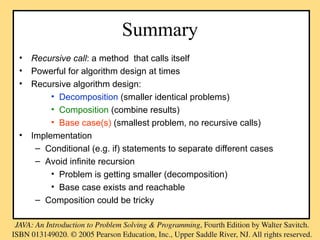
Summary
• Recursive call:a method that calls itself
• Powerful for algorithm design at times
• Recursive algorithm design:
• Decomposition (smaller identical problems)
• Composition (combine results)
• Base case(s) (smallest problem, no recursive calls)
• Implementation
– Conditional (e.g. if) statements to separate different cases
– Avoid infinite recursion
• Problem is getting smaller (decomposition)
• Base case exists and reachable
– Composition could be tricky
107.
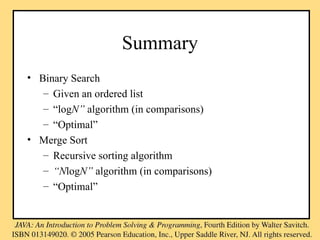
Summary
• Binary Search
–Given an ordered list
– “logN” algorithm (in comparisons)
– “Optimal”
• Merge Sort
– Recursive sorting algorithm
– “NlogN” algorithm (in comparisons)
– “Optimal”


![Factorial (N!)
• N! = (N-1)! * N [for N > 1]
• 1! = 1
• 3!
= 2! * 3
= (1! * 2) * 3
= 1 * 2 * 3
• Recursive design:
– Decomposition: (N-1)!
– Composition: * N
– Base case: 1!](https://image.slidesharecdn.com/ch11-250921053743-1d817c52/85/DSA-Recustion-one-shot-notes-for-exam-ppt-9-320.jpg)
![Remember:
Key to Successful Recursion
• if-else statement (or some other branching
statement)
• Some branches: recursive call
– "smaller" arguments or solve "smaller"
versions of the same task (decomposition)
– Combine the results (composition) [if
necessary]
• Other branches: no recursive calls
– stopping cases or base cases](https://image.slidesharecdn.com/ch11-250921053743-1d817c52/85/DSA-Recustion-one-shot-notes-for-exam-ppt-34-320.jpg)
![inWords Resursive Design
• inWords prints a number N in English words
• K = number of digits in N
• Decomposition:
– inWords for the first K – 1 digits
– Print the last digit
• Composition:
– Execution order of composed steps [more later]
• Base case:
– N has one digit (K = 1)](https://image.slidesharecdn.com/ch11-250921053743-1d817c52/85/DSA-Recustion-one-shot-notes-for-exam-ppt-47-320.jpg)
![Execution Trace (decomposition)
inwords(987)
inwords(9) [print “eight”]
inwords(98) [print “seven”]
[print “nine”]
No output yet, why?](https://image.slidesharecdn.com/ch11-250921053743-1d817c52/85/DSA-Recustion-one-shot-notes-for-exam-ppt-49-320.jpg)
![Binary Search
Method
• public
find(target) calls
private
search(target,
first, last)
• returns the index of the
entry if the target value
is found or -1 if it is not
found
• Compare it to the
pseudocode for the
"name in the phone
book" problem
private int search(int target, int first, int last)
{
int location = -1; // not found
if (first <= last) // range is not empty
{
int mid = (first + last)/2;
if (target == a[mid])
location = mid;
else if (target < a[mid]) // first half
location = search(target, first, mid - 1);
else //(target > a[mid]) second half
location = search(target, mid + 1, last);
}
return location;
}](https://image.slidesharecdn.com/ch11-250921053743-1d817c52/85/DSA-Recustion-one-shot-notes-for-exam-ppt-65-320.jpg)
![5 7 9 13 32 33 42 54 56 88
0 1 2 3 4 5 6 7 8 9
Indices
Contents
target is 33
The array a looks like this:
Binary Search Example
mid = (0 + 9) / 2 (which is 4)
33 > a[mid] (that is, 33 > a[4])
So, if 33 is in the array, then 33 is one of:
33 42 54 56 88
5 6 7 8 9
Eliminated half of the remaining elements from
consideration because array elements are sorted.](https://image.slidesharecdn.com/ch11-250921053743-1d817c52/85/DSA-Recustion-one-shot-notes-for-exam-ppt-67-320.jpg)
![5 7 9 13 32 33 42 54 56 88
0 1 2 3 4 5 6 7 8 9
Indexes
Contents
target is 33
The array a looks like this:
Binary Search Example
mid = (5 + 6) / 2 (which is 5)
33 == a[mid]
So we found 33 at index 5:
33
5
mid = (5 + 9) / 2 (which is 7)
33 < a[mid] (that is, 33 < a[7])
So, if 33 is in the array, then 33 is one of:
33 42
5 6
Eliminate
half of the
remaining
elements](https://image.slidesharecdn.com/ch11-250921053743-1d817c52/85/DSA-Recustion-one-shot-notes-for-exam-ppt-68-320.jpg)
![Worst-case Analysis
• Item not in the array (size N)
• T(N) = number of comparisons with array elements
• T(1) = 1
• T(N) = 1 + T(N / 2)
= 1 + [1 + T(N / 4)]](https://image.slidesharecdn.com/ch11-250921053743-1d817c52/85/DSA-Recustion-one-shot-notes-for-exam-ppt-71-320.jpg)
![Worst-case Analysis
• Item not in the array (size N)
• T(N) = number of comparisons with array elements
• T(1) = 1
• T(N) = 1 + T(N / 2)
= 1 + [1 + T(N / 4)]
= 2 + T(N / 4)
= 2 + [1 + T(N / 8)]](https://image.slidesharecdn.com/ch11-250921053743-1d817c52/85/DSA-Recustion-one-shot-notes-for-exam-ppt-72-320.jpg)
![Worst-case Analysis
• Item not in the array (size N)
• T(N) = number of comparisons with array elements
• T(1) = 1
• T(N) = 1 + T(N / 2)
= 1 + [1 + T(N / 4)]
= 2 + T(N / 4)
= 2 + [1 + T(N / 8)]
= 3 + T(N / 8)
= …](https://image.slidesharecdn.com/ch11-250921053743-1d817c52/85/DSA-Recustion-one-shot-notes-for-exam-ppt-73-320.jpg)
![Worst-case Analysis
• Item not in the array (size N)
• T(N) = number of comparisons with array elements
• T(1) = 1
• T(N) = 1 + T(N / 2)
= 1 + [1 + T(N / 4)]
= 2 + T(N / 4)
= 2 + [1 + T(N / 8)]
= 3 + T(N / 8)
= …
= k + T(N / 2k
) [1]](https://image.slidesharecdn.com/ch11-250921053743-1d817c52/85/DSA-Recustion-one-shot-notes-for-exam-ppt-74-320.jpg)
![Worst-case Analysis
• T(N) = k + T(N / 2k
) [1]
• T(N / 2k
) gets smaller until the base case: T(1)
– 2k
= N
– k = log2N
• Replace terms with k in [1]:
T(N) = log2N + T(N / N)
= log2N + T(1)
= log2N + 1
• “log2N” algorithm
• We used recurrence equations](https://image.slidesharecdn.com/ch11-250921053743-1d817c52/85/DSA-Recustion-one-shot-notes-for-exam-ppt-75-320.jpg)
![Pages 807 NOT a good tip
[Programming Tip: Ask Until the User Gets It Right]
public void getCount()
{
System.out.println("Enter a positive number:");
count = SavitchIn.readLineInt();
if (count <= 0)
{
System.out.println("Input must be positive.
System.out.println("Try again.");
getCount(); //start over
}
}
read a number
Use a recursive
call to get
another number.
• Recursion continues until user enters valid input.
• No notion of a smaller problem for recursive design
• Easily implemented using iteration without loss
of readability](https://image.slidesharecdn.com/ch11-250921053743-1d817c52/85/DSA-Recustion-one-shot-notes-for-exam-ppt-80-320.jpg)
![Merge Sort
recursive
calls
make "smaller"
problems by
dividing array
Combine the
two sorted
arrays
base case: a.length == 1 so
a is sorted and no recursive
call is necessary.
do recursive case if
true, base case if false
public static void sort(int[] a)
{
if (a.length >= 2)
{
int halfLength = a.length / 2;
int[] front = new int[halfLength];
int[] tail = new int[a.length – halfLength];
divide(a, front, tail);
sort(front);
sort(tail);
merge(a, front, tail);
}
// else do nothing.
}](https://image.slidesharecdn.com/ch11-250921053743-1d817c52/85/DSA-Recustion-one-shot-notes-for-exam-ppt-89-320.jpg)
![Analysis: Array of size N
• Let T(N) be the number of comparisons
• T(1) = 0
• T(N) = 2 T(N / 2) + (N – 1)
= 2 [2 T(N / 4) + (N / 2 – 1)] + (N – 1)](https://image.slidesharecdn.com/ch11-250921053743-1d817c52/85/DSA-Recustion-one-shot-notes-for-exam-ppt-92-320.jpg)
![Analysis: Array of size N
• Let T(N) be the number of comparisons
• T(1) = 0
• T(N) = 2 T(N / 2) + (N – 1)
= 2 [2 T(N / 4) + (N / 2 – 1)] + (N – 1)
= 4 T(N / 4) + (N – 2) + (N – 1)
= 4 [ 2 T(N / 8) + (N / 4 – 1) ] + (N – 2) + (N – 1)](https://image.slidesharecdn.com/ch11-250921053743-1d817c52/85/DSA-Recustion-one-shot-notes-for-exam-ppt-93-320.jpg)
![Analysis: Array of size N
• Let T(N) be the number of comparisons
• T(1) = 0
• T(N) = 2 T(N / 2) + (N – 1)
= 2 [2 T(N / 4) + (N / 2 – 1)] + (N – 1)
= 4 T(N / 4) + (N – 2) + (N – 1)
= 4 [ 2 T(N / 8) + (N / 4 – 1) ] + (N – 2) + (N – 1)
= 8 T(N / 8) + (N – 4) + (N – 2) + (N – 1) ](https://image.slidesharecdn.com/ch11-250921053743-1d817c52/85/DSA-Recustion-one-shot-notes-for-exam-ppt-94-320.jpg)
![Analysis: Array of size N
• Let T(N) be the number of comparisons
• T(1) = 0
• T(N) = 2 T(N / 2) + (N – 1)
= 2 [2 T(N / 4) + (N / 2 – 1)] + (N – 1)
= 4 T(N / 4) + (N – 2) + (N – 1)
= 4 [ 2 T(N / 8) + (N / 4 – 1) ] + (N – 2) + (N – 1)
= 8 T(N / 8) + (N – 4) + (N – 2) + (N – 1)
= 8 T(N / 8) + 3N – (1 + 2 + 4)](https://image.slidesharecdn.com/ch11-250921053743-1d817c52/85/DSA-Recustion-one-shot-notes-for-exam-ppt-95-320.jpg)
![Analysis: Array of size N
• Let T(N) be the number of comparisons
• T(1) = 0
• T(N) = 2 T(N / 2) + (N – 1)
= 2 [2 T(N / 4) + (N / 2 – 1)] + (N – 1)
= 4 T(N / 4) + (N – 2) + (N – 1)
= 4 [ 2 T(N / 8) + (N / 4 – 1) ] + (N – 2) + (N – 1)
= 8 T(N / 8) + (N – 4) + (N – 2) + (N – 1)
= 8 T(N / 8) + 3N – (1 + 2 + 4)
= …
= 2k
T(N / 2k
) + kN – (1 + 2 + … 2k-1
) [1]](https://image.slidesharecdn.com/ch11-250921053743-1d817c52/85/DSA-Recustion-one-shot-notes-for-exam-ppt-96-320.jpg)
![Analysis Continued
• T(N) = 2k
T(N / 2k
) + kN – (1 + 2 + … 2k-1
) [1]
= 2k
T(N / 2k
) + kN – (2k
- 1) [2]
• T(N / 2k
) gets smaller until the base case T(1):
– 2k
= N
– k = log2N
• Replace terms with k in [2]:
T(N) = N T(N / N) + log2N*N – (N – 1)
= N T(1) + Nlog2N – (N – 1)
= Nlog2N – N + 1
• “Nlog2N” algorithm](https://image.slidesharecdn.com/ch11-250921053743-1d817c52/85/DSA-Recustion-one-shot-notes-for-exam-ppt-97-320.jpg)
![Geometric Series and Sum
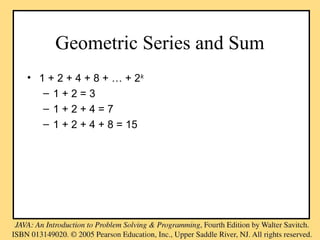
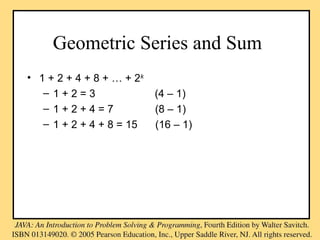
• 1 + 2 + 4 + 8 + … + 2k
– 1 + 2 = 3 (4 – 1)
– 1 + 2 + 4 = 7 (8 – 1)
– 1 + 2 + 4 + 8 = 15 (16 – 1)
• 1 + 2 + 4 + 8 + … + 2k
= 2k+1
- 1
• 1 + r + r2
+ r3
+ … + rk
= r0
+ r1
+ r2
+ r3
+ … + rk
= (rk+1
– 1) / (r – 1) [for r > 1]](https://image.slidesharecdn.com/ch11-250921053743-1d817c52/85/DSA-Recustion-one-shot-notes-for-exam-ppt-100-320.jpg)
![Real Data Set: Web Server Log
• http://www.cs.fit.edu/~pkc/classes/writing/data/jan99.log
• 4.6 MB (44057 entries)
• Example entry in log:
ip195.dca.primenet.com - - [04/Jan/1999:09:16:51 -
0500] "GET / HTTP/1.0" 200 762
• Extracted features
– remote-host names (strings)
– file-size (integers)
• List size - 100 to 44000 entries](https://image.slidesharecdn.com/ch11-250921053743-1d817c52/85/DSA-Recustion-one-shot-notes-for-exam-ppt-102-320.jpg)