SURGICAL TREATMENT OF RECTUSSURGICAL TREATMENT OF RECTUS
FEMORIS MUSCLE INJURIESFEMORIS MUSCLE INJURIES
William E Garrett, MD, PhDWilliam E Garrett, MD, PhD
Duke University Medical CenterDuke University Medical Center
INTRODUCTIONINTRODUCTION
• Most injuries treated non-operativelyMost injuries treated non-operatively
• Surgical treatment = indirect headSurgical treatment = indirect head
within muscle belly (only oneswithin muscle belly (only ones
operated)operated)
• Proximal injuries from direct head andProximal injuries from direct head and
distal injuries to the aponeurosis =distal injuries to the aponeurosis =
improve with time and RHB.improve with time and RHB.
CLINICAL PRESENTATIONCLINICAL PRESENTATION
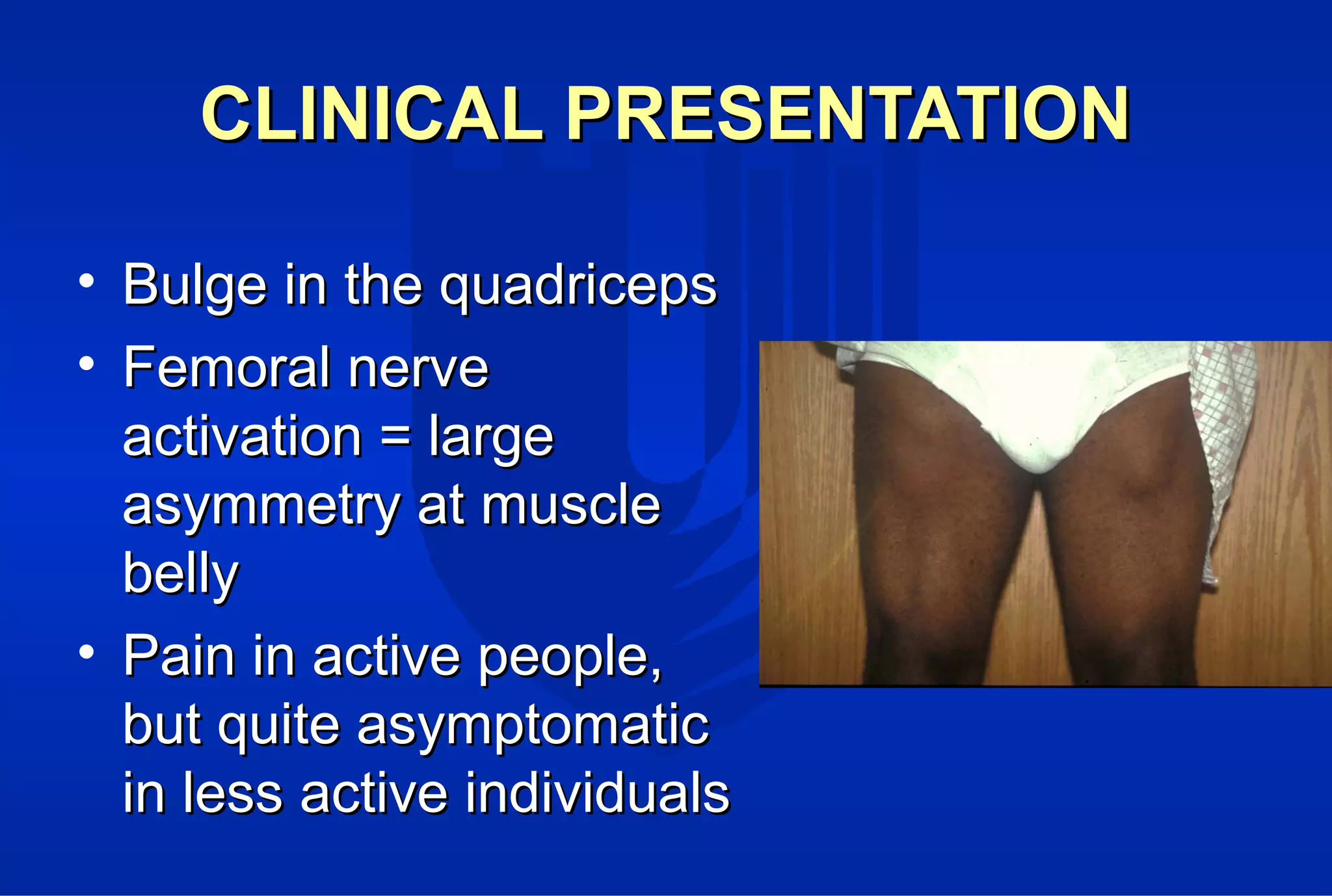
• Bulge in the quadricepsBulge in the quadriceps
• Femoral nerveFemoral nerve
activation = largeactivation = large
asymmetry at muscleasymmetry at muscle
bellybelly
• Pain in active people,Pain in active people,
but quite asymptomaticbut quite asymptomatic
in less active individualsin less active individuals
CLINICAL PRESENTATIONCLINICAL PRESENTATION
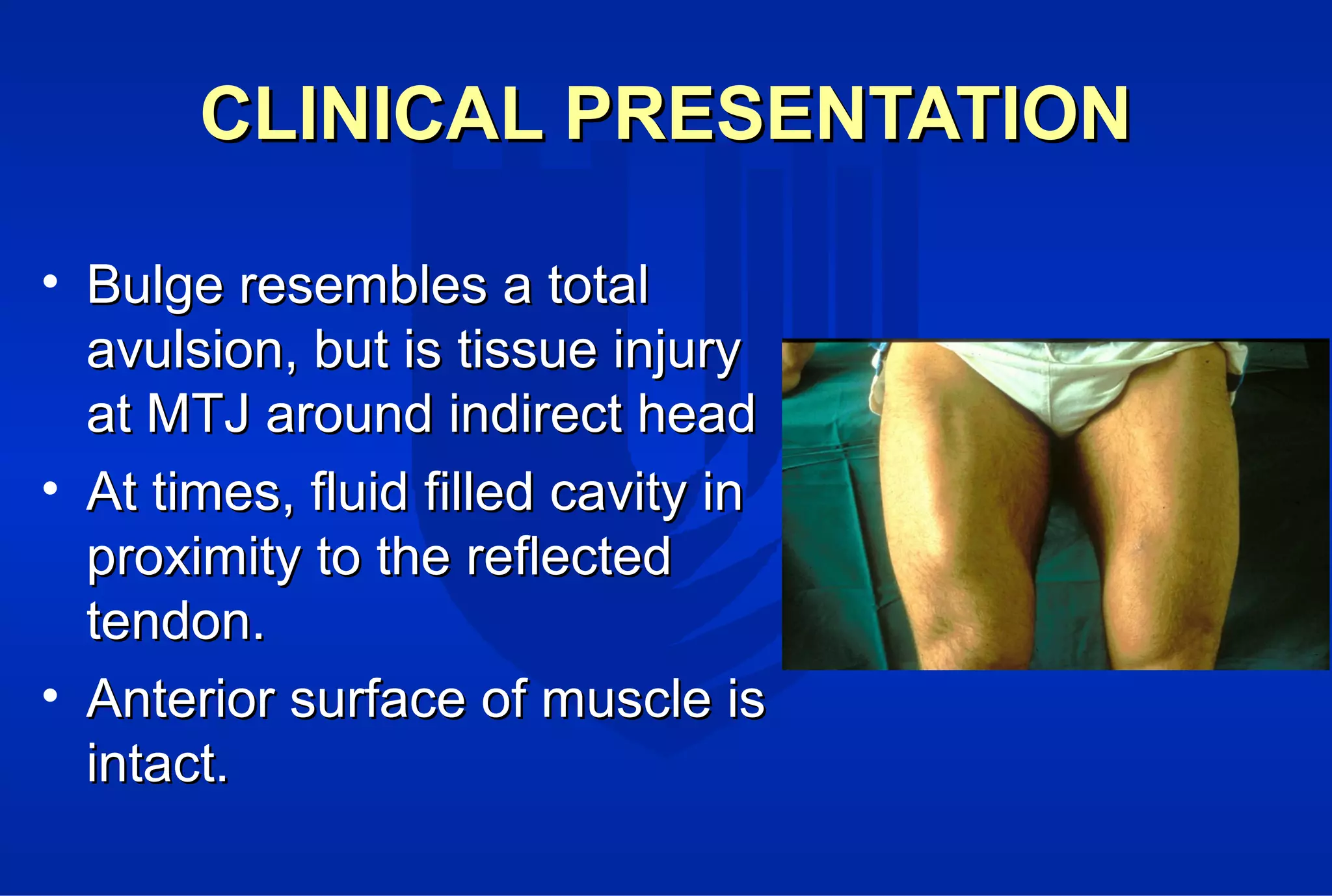
• Bulge resembles a totalBulge resembles a total
avulsion, but is tissue injuryavulsion, but is tissue injury
at MTJ around indirect headat MTJ around indirect head
• At times, fluid filled cavity inAt times, fluid filled cavity in
proximity to the reflectedproximity to the reflected
tendon.tendon.
• Anterior surface of muscle isAnterior surface of muscle is
intact.intact.
DIFFERENTIAL DIAGNOSISDIFFERENTIAL DIAGNOSIS
• Indirect head injuries = may presentIndirect head injuries = may present
as painless mass, sometimes bilateralas painless mass, sometimes bilateral
• Mass in muscle tissue = perhapsMass in muscle tissue = perhaps
malignant tumormalignant tumor  always MRIalways MRI
• Muscle hernia with few symptomsMuscle hernia with few symptoms
INDICATIONINDICATION
• Inability to perform maximallyInability to perform maximally
because of pain despite adequatebecause of pain despite adequate
conservative treatment.conservative treatment.
• Kickers, sprinters, and speed positionKickers, sprinters, and speed position
playersplayers  athletic disability with theseathletic disability with these
injuriesinjuries
CONSERVATIVE TREATMENTCONSERVATIVE TREATMENT
• Physical therapyPhysical therapy
• StretchingStretching
• ModalitiesModalities
• GrastonGraston
• Deep tissue mobilizationDeep tissue mobilization
• Steroid injection into cavity under USSteroid injection into cavity under US
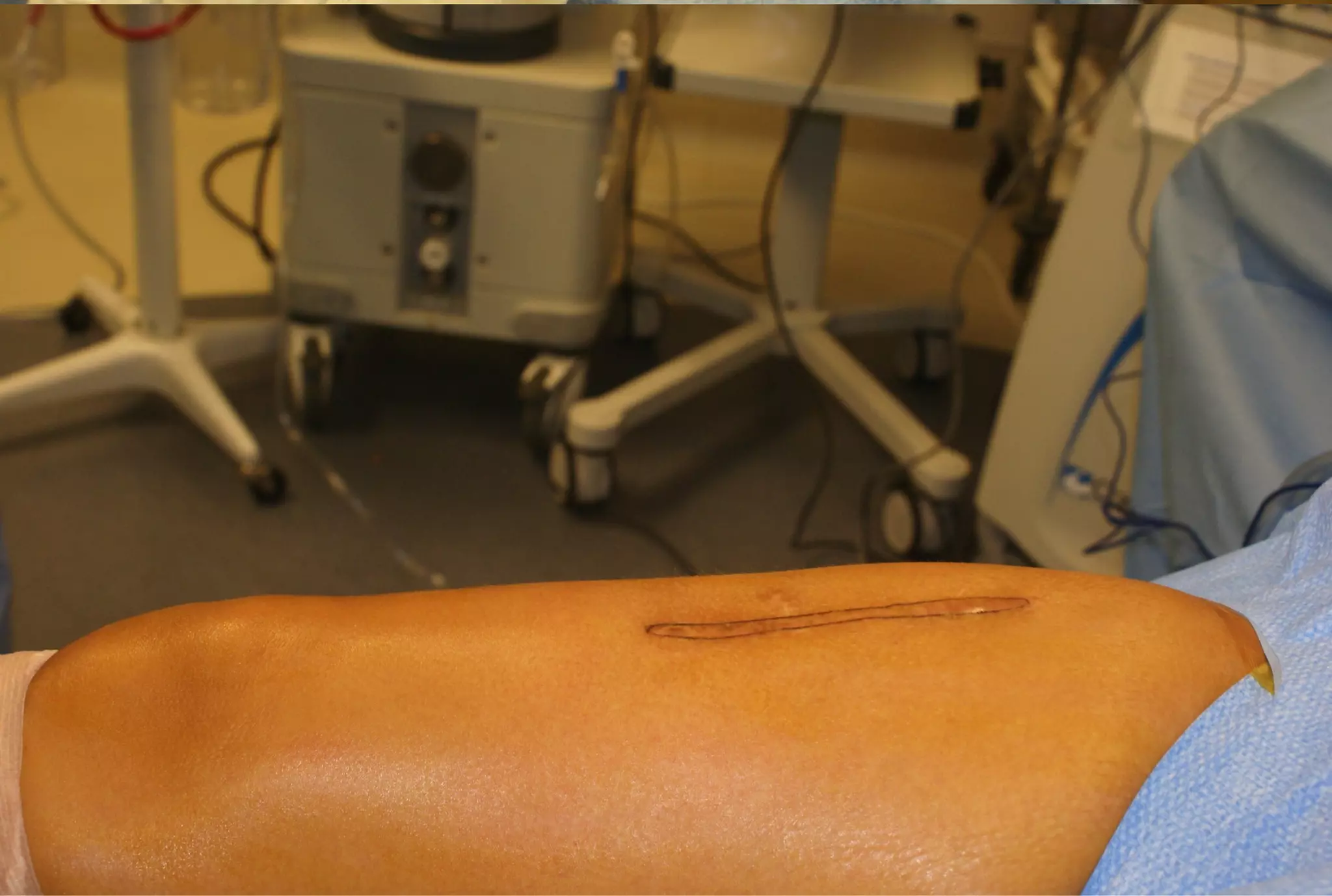
SURGICAL TECHNIQUESURGICAL TECHNIQUE
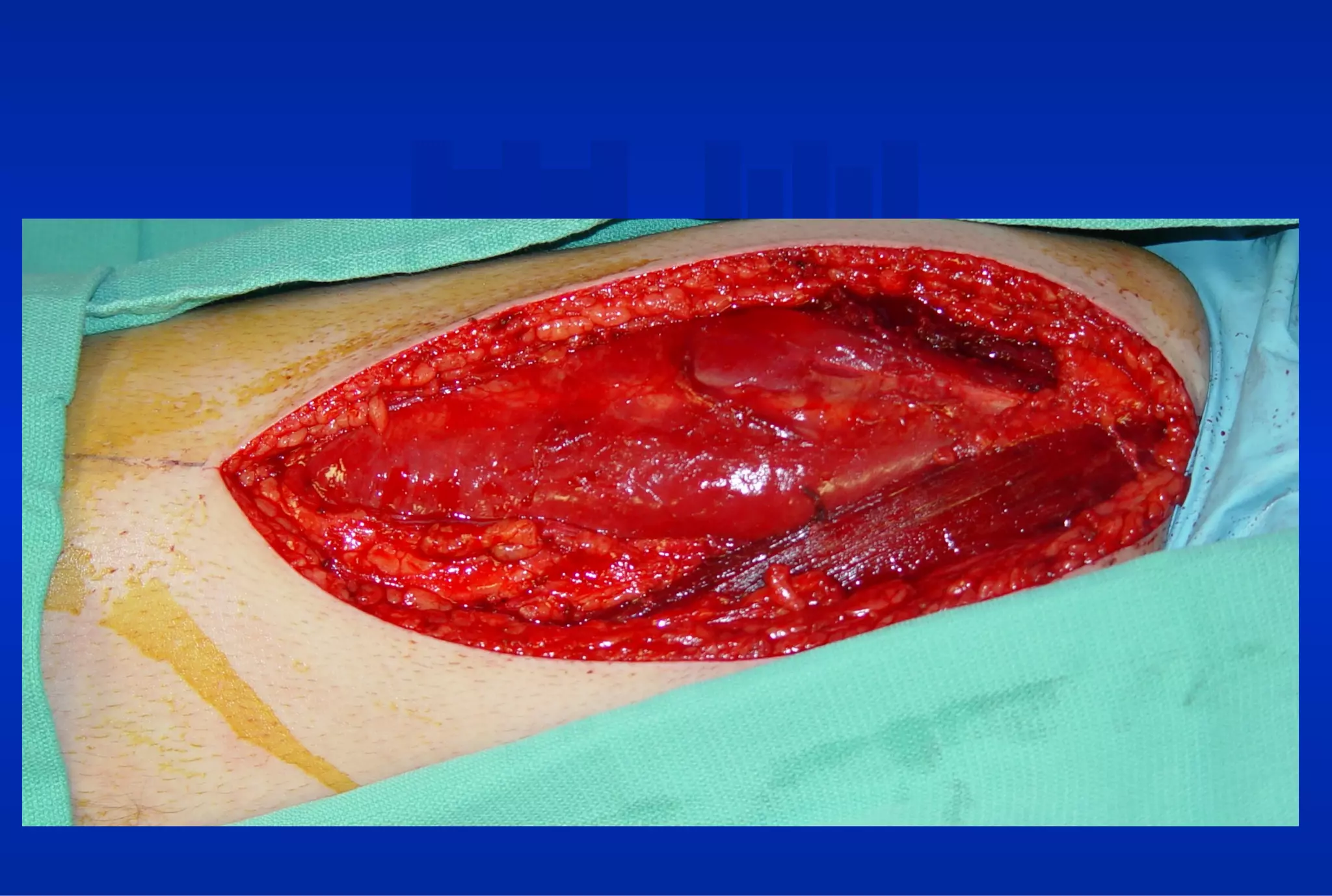
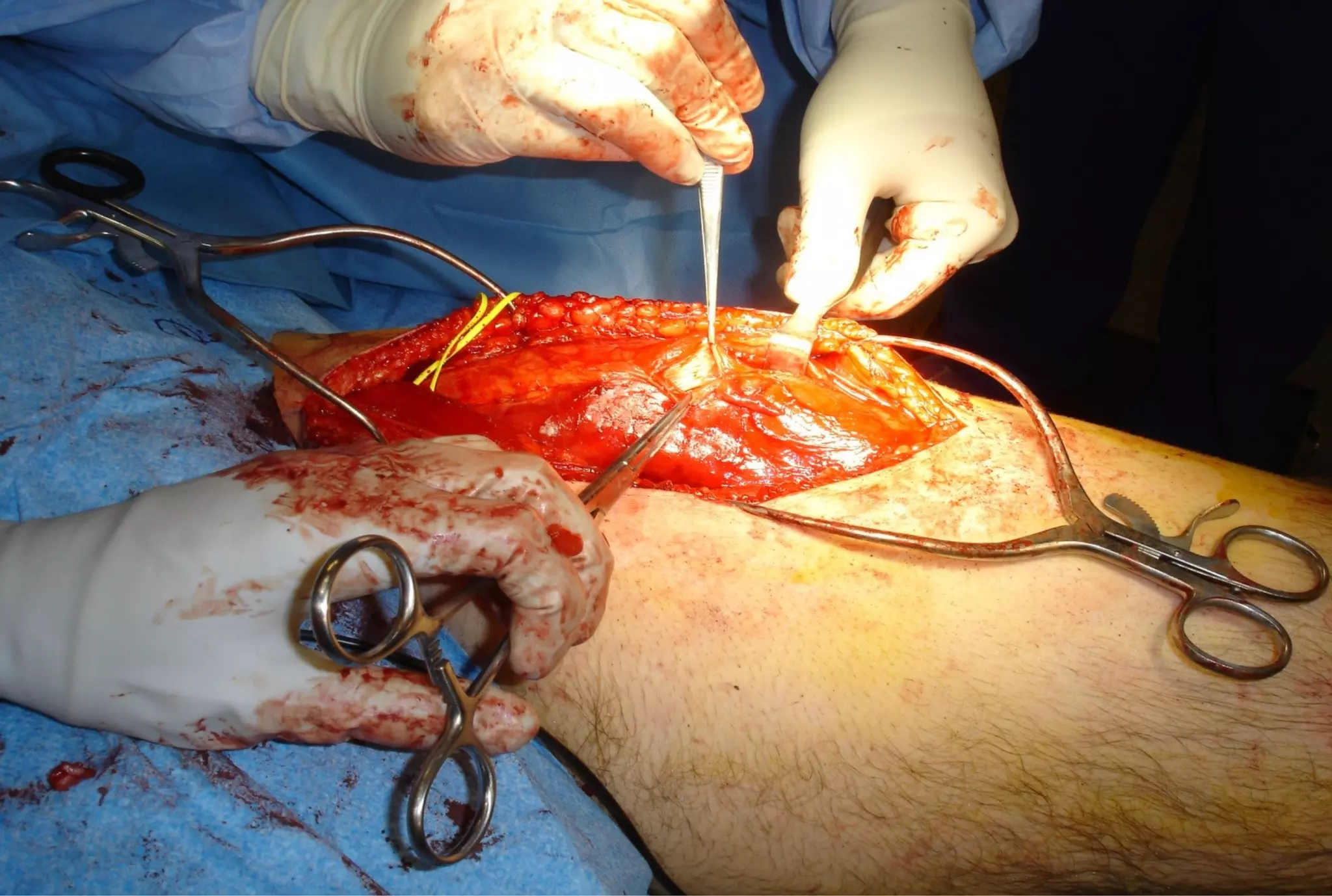
• Straight longitudinal anterior midlineStraight longitudinal anterior midline
skin incision over RFskin incision over RF
• Extended approach is sometimesExtended approach is sometimes
needed to see and stimulatedneeded to see and stimulated
branches of the femoral nervebranches of the femoral nerve
• Peripheral block needle stimulationPeripheral block needle stimulation
may be helpful (anesthesia).may be helpful (anesthesia).
SURGICAL TECHNIQUESURGICAL TECHNIQUE
• Usually, the muscle looks ok in theUsually, the muscle looks ok in the
anterior surface: problem is in theanterior surface: problem is in the
indirect headindirect head
• Nerve stimulation demonstrates theNerve stimulation demonstrates the
injury deep within the muscle: theinjury deep within the muscle: the
detached muscle shortensdetached muscle shortens
SURGICAL TECHNIQUESURGICAL TECHNIQUE
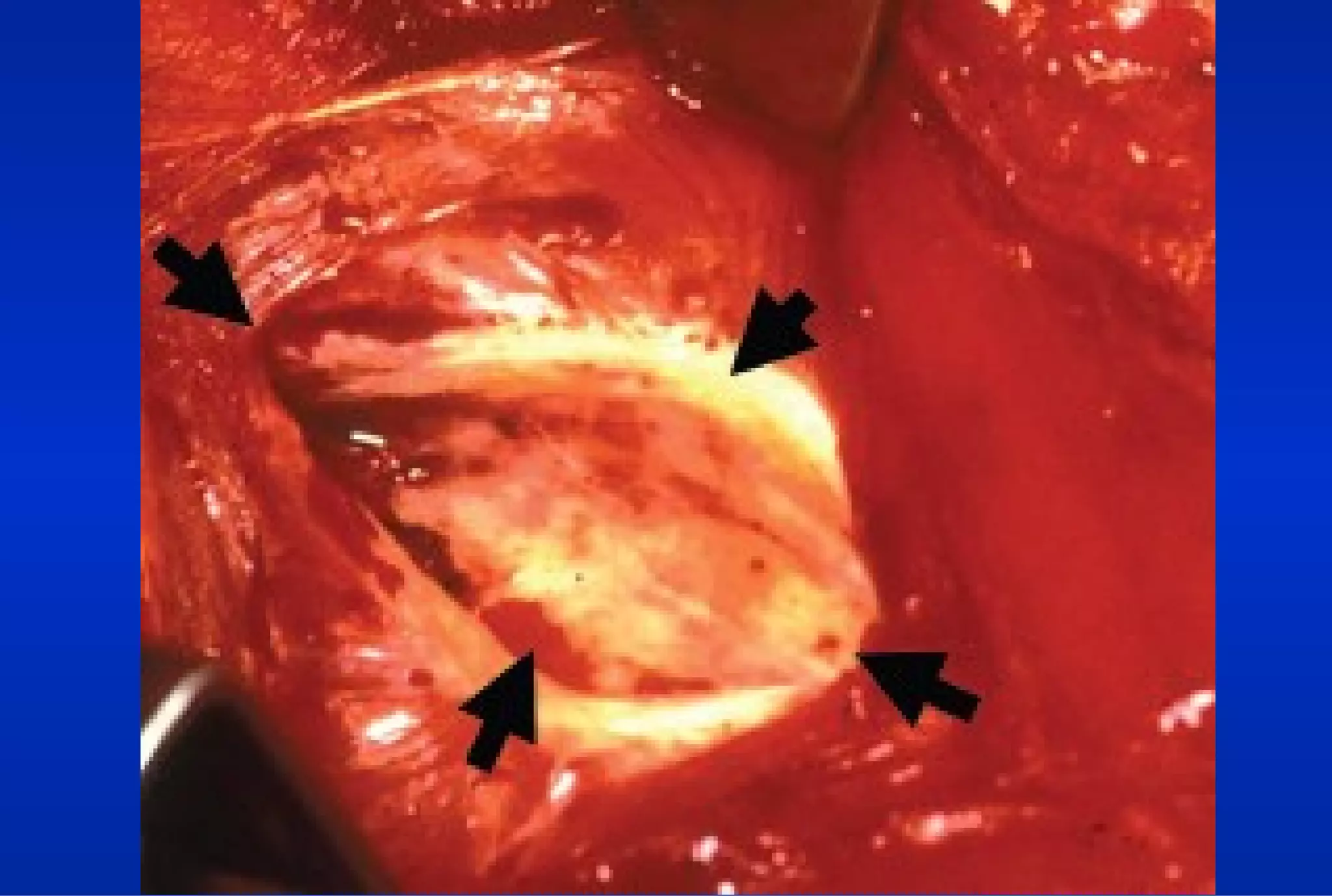
• Blunt dissection allows to identify theBlunt dissection allows to identify the
inside of the cavityinside of the cavity
• In all muscles:In all muscles:
– Extensive scarringExtensive scarring
– Cavity with fluidCavity with fluid
– Lining or capsule adjacent to retractedLining or capsule adjacent to retracted
muscle and scarmuscle and scar
SURGICAL TECHNIQUESURGICAL TECHNIQUE
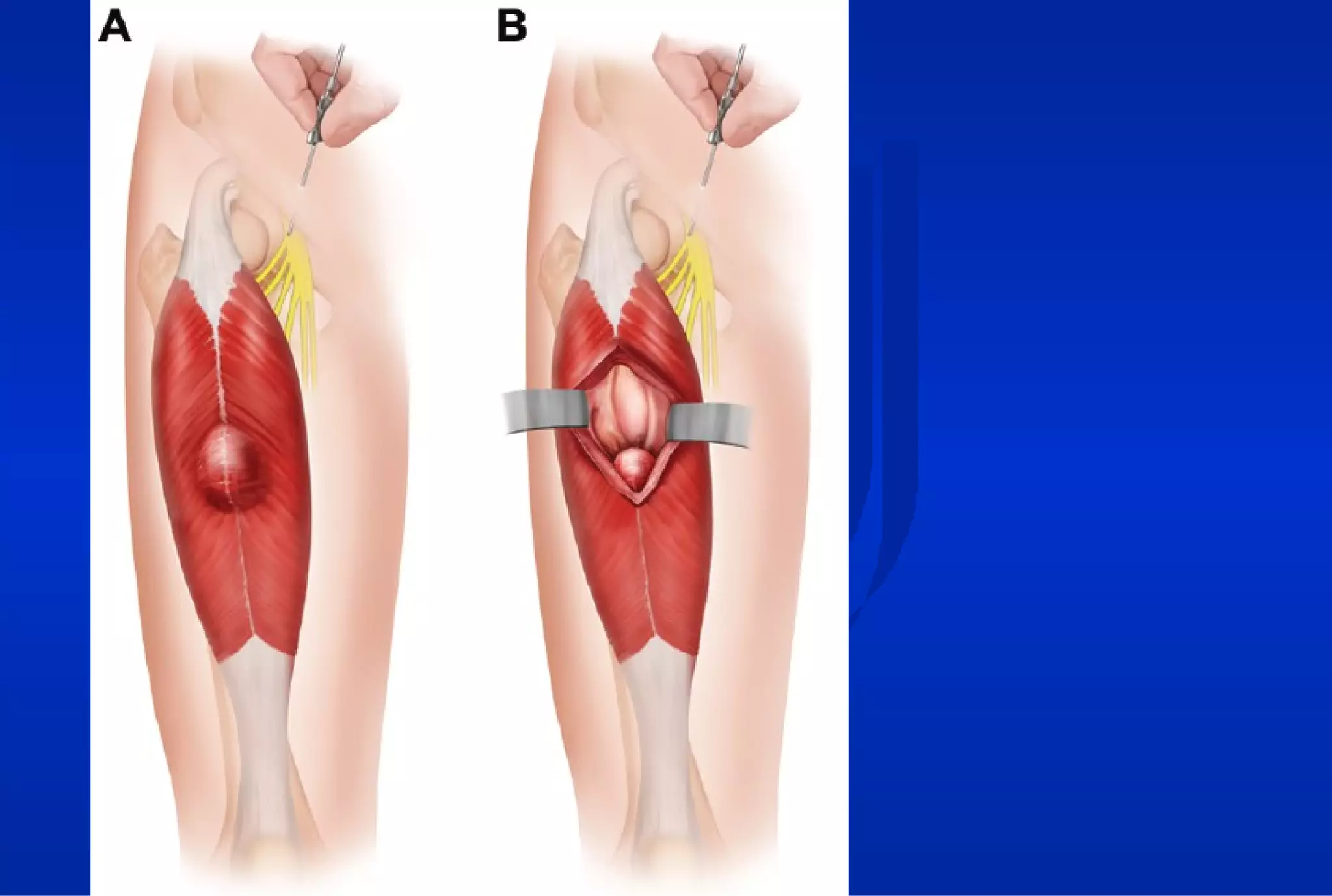
• Easiest to see cavity by lifting RF off theEasiest to see cavity by lifting RF off the
deep vastusdeep vastus
• Femoral nerve branch and artery can beFemoral nerve branch and artery can be
seen on the deep portion of the cavityseen on the deep portion of the cavity
• At times, extensive scar tissue betweenAt times, extensive scar tissue between
the vastus intermedius and the deepthe vastus intermedius and the deep
musclemuscle
SURGICAL TECHNIQUESURGICAL TECHNIQUE
• Injured tissues is freed from surroundingInjured tissues is freed from surrounding
scar tissuescar tissue
• The only other attachment of theThe only other attachment of the
indirect head was to distal tendon.indirect head was to distal tendon.
• Simply cutting the tendon + NV bundleSimply cutting the tendon + NV bundle
allowed complete resection of theallowed complete resection of the
scarred muscle (EXCISION)scarred muscle (EXCISION)
SURGICAL TECHNIQUESURGICAL TECHNIQUE
• On occasions, torn muscle fibers created aOn occasions, torn muscle fibers created a
space within the muscle, but not a completespace within the muscle, but not a complete
cavitycavity
• After the fibrotic mass is removed, femoralAfter the fibrotic mass is removed, femoral
nerve activation did not result in a largenerve activation did not result in a large
asymmetric bulge in the middle of theasymmetric bulge in the middle of the
muscle any longermuscle any longer
• Overlying fascia is closedOverlying fascia is closed
SURGICAL TECHNIQUESURGICAL TECHNIQUE
• RHB:RHB:
– Begins a few days after surgeryBegins a few days after surgery
– StretchingStretching
– Soft tissue massageSoft tissue massage
– Early active ROMEarly active ROM
– Progressed to RTP as toleratedProgressed to RTP as tolerated
SURGICAL TECHNIQUESURGICAL TECHNIQUE
• Delayed excision of indirectDelayed excision of indirect
headhead
• Two main questions:Two main questions:
–IS PAIN IMPROVED (MAINIS PAIN IMPROVED (MAIN
INDICATION FOR SURGERY)?INDICATION FOR SURGERY)?
–DO ATHLETES RETURN TO SPORTSDO ATHLETES RETURN TO SPORTS
WITHOUT RESTRICTIONS ORWITHOUT RESTRICTIONS OR
LIMITATIONS?LIMITATIONS?
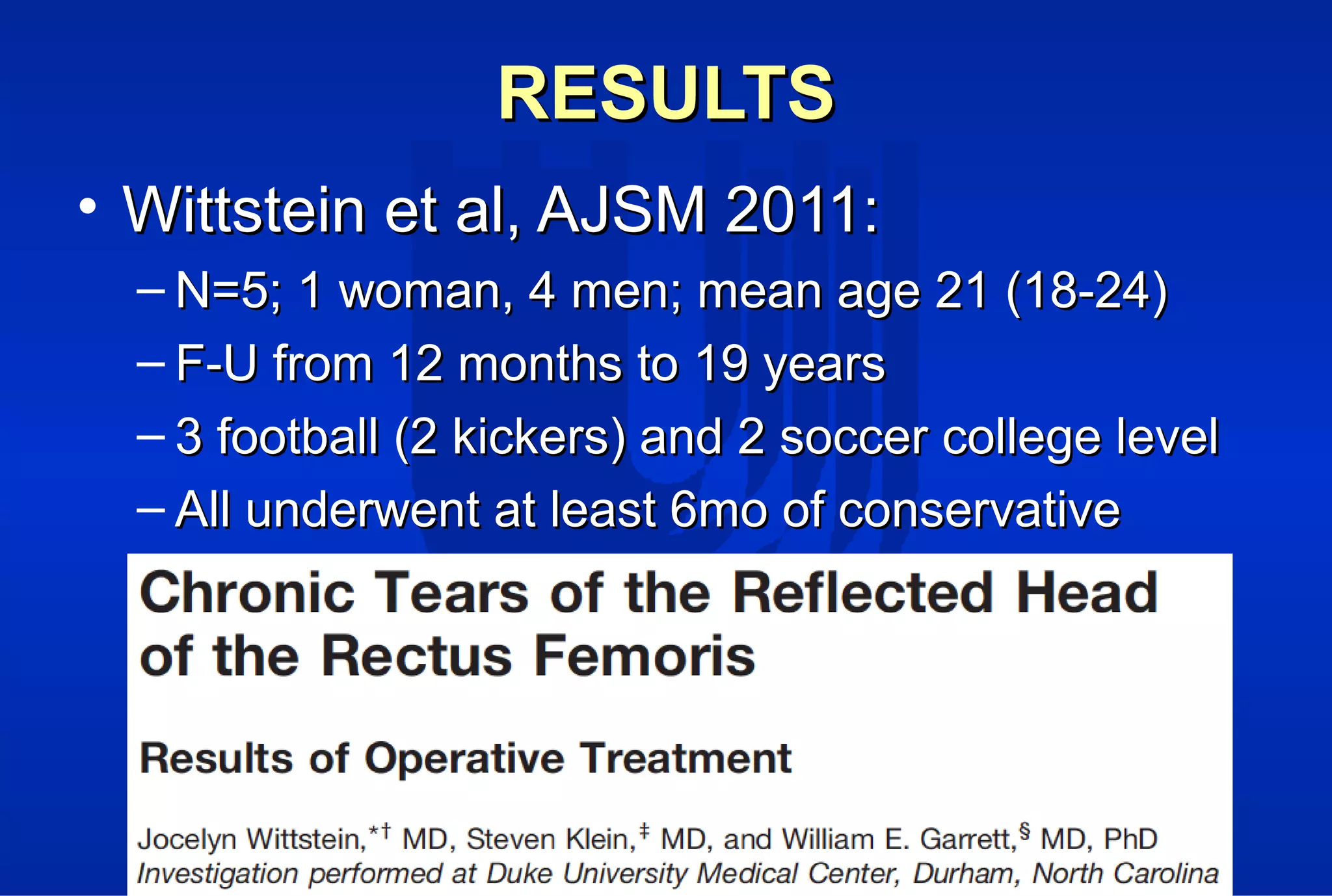
RESULTSRESULTS
• Wittstein et al, AJSM 2011:Wittstein et al, AJSM 2011:
– N=5; 1 woman, 4 men; mean age 21 (18-24)N=5; 1 woman, 4 men; mean age 21 (18-24)
– F-U from 12 months to 19 yearsF-U from 12 months to 19 years
– 3 football (2 kickers) and 2 soccer college level3 football (2 kickers) and 2 soccer college level
– All underwent at least 6mo of conservativeAll underwent at least 6mo of conservative
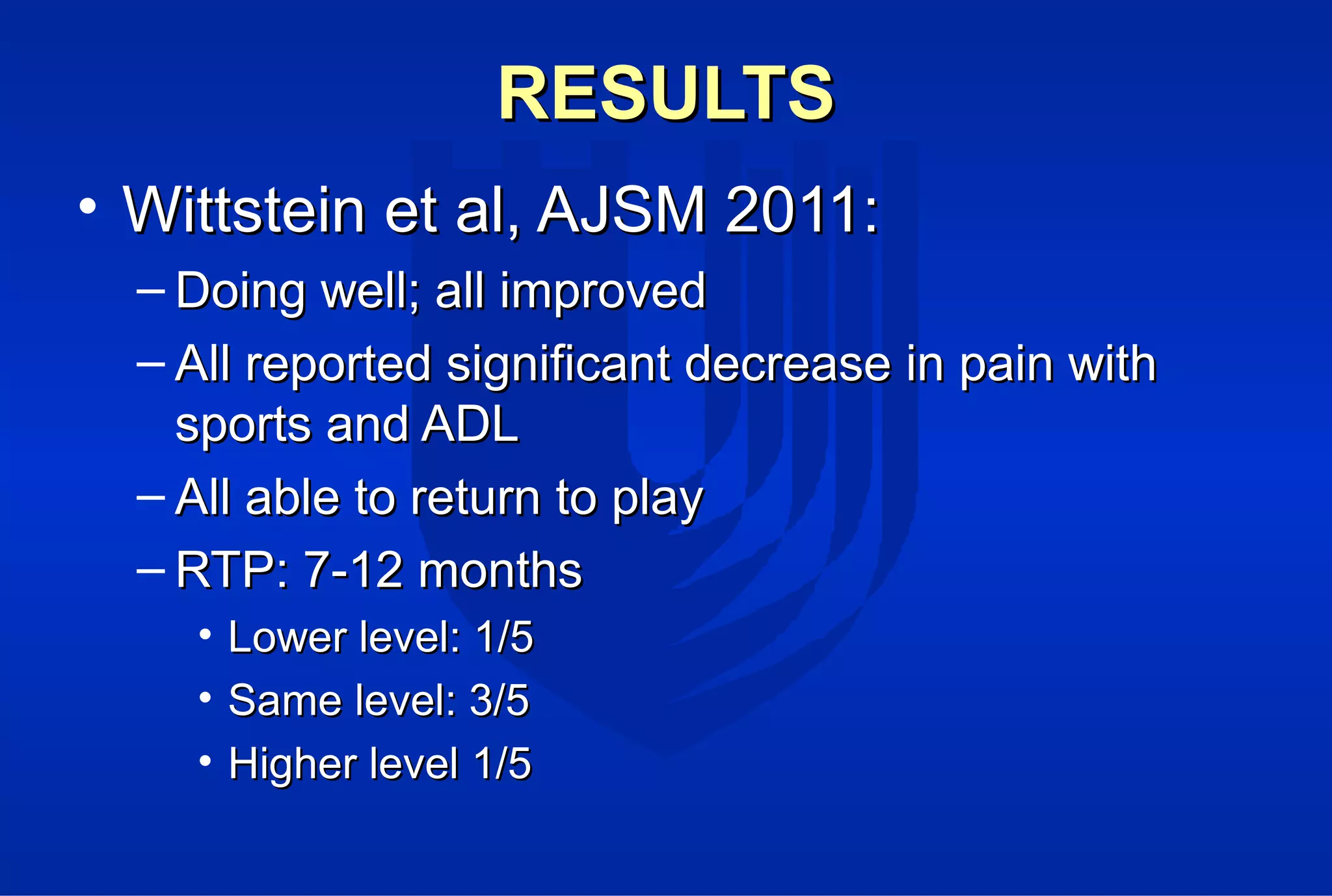
RESULTSRESULTS
• Wittstein et al, AJSM 2011:Wittstein et al, AJSM 2011:
– Doing well; all improvedDoing well; all improved
– All reported significant decrease in pain withAll reported significant decrease in pain with
sports and ADLsports and ADL
– All able to return to playAll able to return to play
– RTP: 7-12 monthsRTP: 7-12 months
• Lower level: 1/5Lower level: 1/5
• Same level: 3/5Same level: 3/5
• Higher level 1/5Higher level 1/5
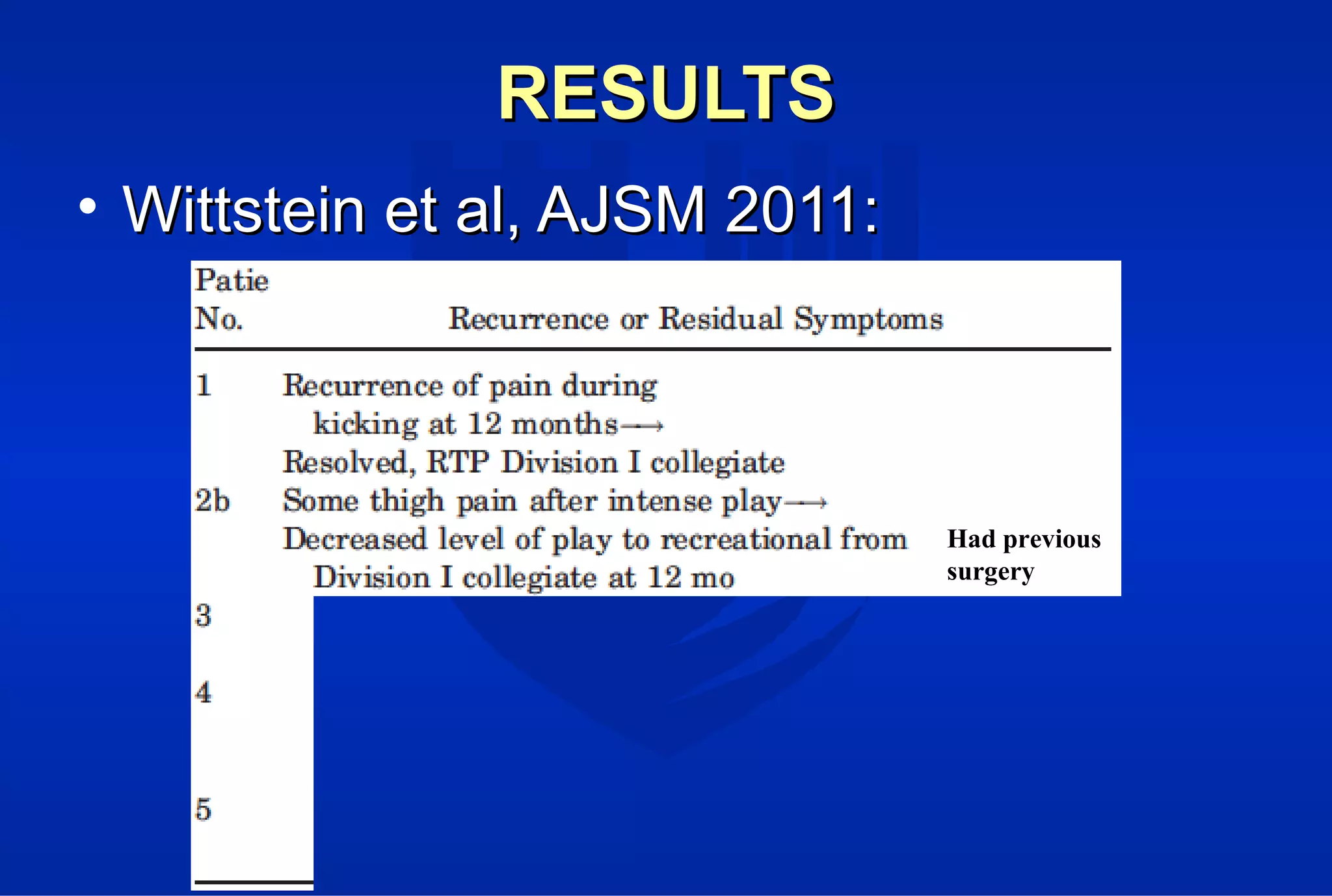
RESULTSRESULTS
• Wittstein et al, AJSM 2011:Wittstein et al, AJSM 2011:
RESULTSRESULTS
• Wittstein et al, AJSM 2011:Wittstein et al, AJSM 2011:
Had previous
surgery
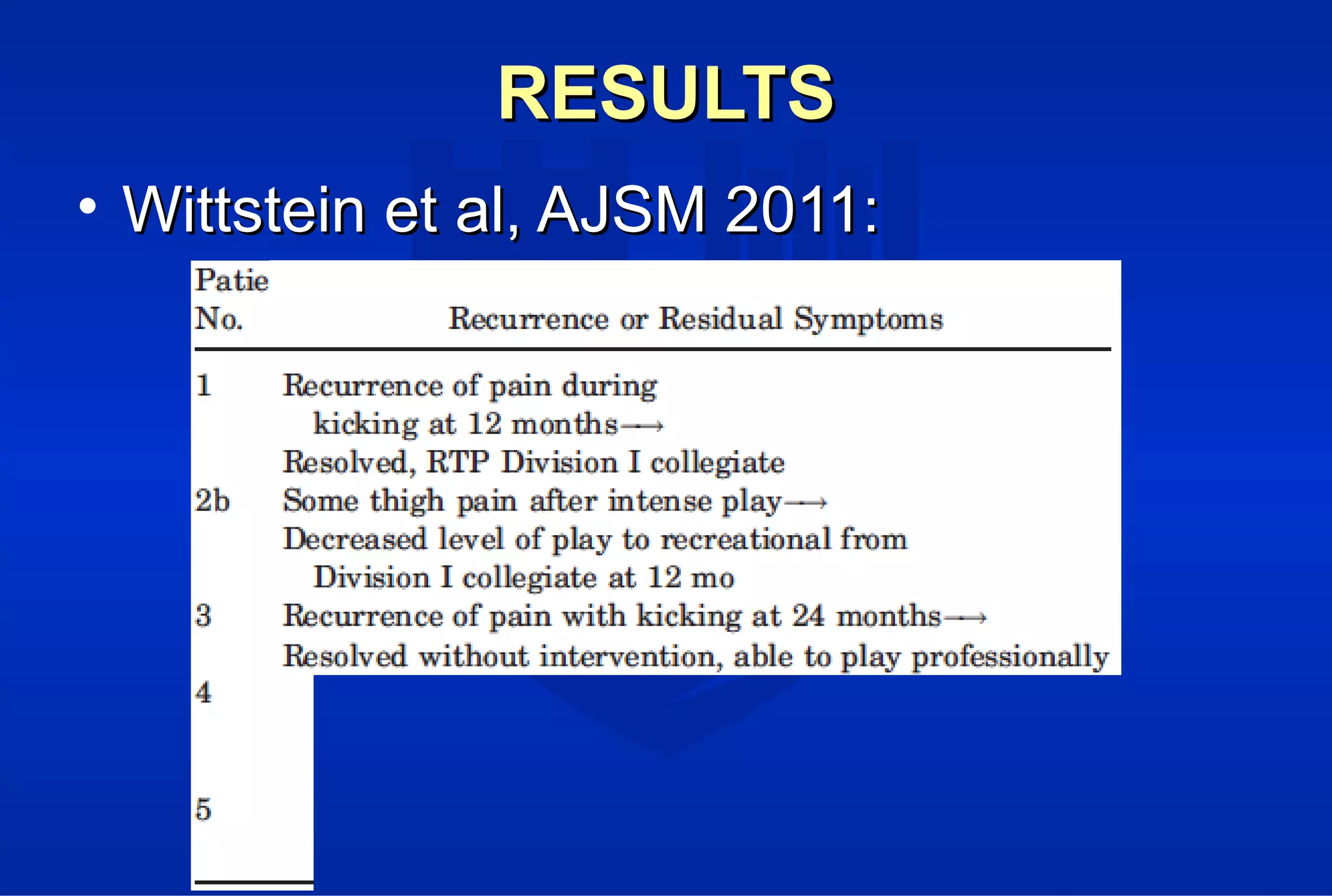
RESULTSRESULTS
• Wittstein et al, AJSM 2011:Wittstein et al, AJSM 2011:
RESULTSRESULTS
• Wittstein et al, AJSM 2011:Wittstein et al, AJSM 2011:
RESULTSRESULTS
• Wittstein et al, AJSM 2011:Wittstein et al, AJSM 2011:
RESULTSRESULTS
• Wittstein et al, AJSM 2011:Wittstein et al, AJSM 2011:
– Conclusions:Conclusions:
• High-level athletes are likely to experience significantHigh-level athletes are likely to experience significant
reduction in pain.reduction in pain.
• Recurrence of symptoms is not uncommon, but isRecurrence of symptoms is not uncommon, but is
self-limited and does not prevent RTP.self-limited and does not prevent RTP.
• RTP rate is highRTP rate is high
CONCLUSIONSCONCLUSIONS
–Out of many injuries, very fewOut of many injuries, very few
surgeriessurgeries
–Symptoms are usually tolerableSymptoms are usually tolerable
without surgerywithout surgery
–Significant incisionSignificant incision
CONCLUSIONSCONCLUSIONS
Make every effort to treat theseMake every effort to treat these
conservativelyconservatively
Surgery is not easy or intuitiveSurgery is not easy or intuitive

Rectus Femoris Injuries: what and when? William Garret

  • 1.
    SURGICAL TREATMENT OFRECTUSSURGICAL TREATMENT OF RECTUS FEMORIS MUSCLE INJURIESFEMORIS MUSCLE INJURIES William E Garrett, MD, PhDWilliam E Garrett, MD, PhD Duke University Medical CenterDuke University Medical Center
  • 2.
    INTRODUCTIONINTRODUCTION • Most injuriestreated non-operativelyMost injuries treated non-operatively • Surgical treatment = indirect headSurgical treatment = indirect head within muscle belly (only oneswithin muscle belly (only ones operated)operated) • Proximal injuries from direct head andProximal injuries from direct head and distal injuries to the aponeurosis =distal injuries to the aponeurosis = improve with time and RHB.improve with time and RHB.
  • 3.
    CLINICAL PRESENTATIONCLINICAL PRESENTATION •Bulge in the quadricepsBulge in the quadriceps • Femoral nerveFemoral nerve activation = largeactivation = large asymmetry at muscleasymmetry at muscle bellybelly • Pain in active people,Pain in active people, but quite asymptomaticbut quite asymptomatic in less active individualsin less active individuals
  • 4.
    CLINICAL PRESENTATIONCLINICAL PRESENTATION •Bulge resembles a totalBulge resembles a total avulsion, but is tissue injuryavulsion, but is tissue injury at MTJ around indirect headat MTJ around indirect head • At times, fluid filled cavity inAt times, fluid filled cavity in proximity to the reflectedproximity to the reflected tendon.tendon. • Anterior surface of muscle isAnterior surface of muscle is intact.intact.
  • 5.
    DIFFERENTIAL DIAGNOSISDIFFERENTIAL DIAGNOSIS •Indirect head injuries = may presentIndirect head injuries = may present as painless mass, sometimes bilateralas painless mass, sometimes bilateral • Mass in muscle tissue = perhapsMass in muscle tissue = perhaps malignant tumormalignant tumor  always MRIalways MRI • Muscle hernia with few symptomsMuscle hernia with few symptoms
  • 6.
    INDICATIONINDICATION • Inability toperform maximallyInability to perform maximally because of pain despite adequatebecause of pain despite adequate conservative treatment.conservative treatment. • Kickers, sprinters, and speed positionKickers, sprinters, and speed position playersplayers  athletic disability with theseathletic disability with these injuriesinjuries
  • 7.
    CONSERVATIVE TREATMENTCONSERVATIVE TREATMENT •Physical therapyPhysical therapy • StretchingStretching • ModalitiesModalities • GrastonGraston • Deep tissue mobilizationDeep tissue mobilization • Steroid injection into cavity under USSteroid injection into cavity under US
  • 8.
    SURGICAL TECHNIQUESURGICAL TECHNIQUE •Straight longitudinal anterior midlineStraight longitudinal anterior midline skin incision over RFskin incision over RF • Extended approach is sometimesExtended approach is sometimes needed to see and stimulatedneeded to see and stimulated branches of the femoral nervebranches of the femoral nerve • Peripheral block needle stimulationPeripheral block needle stimulation may be helpful (anesthesia).may be helpful (anesthesia).
  • 11.
    SURGICAL TECHNIQUESURGICAL TECHNIQUE •Usually, the muscle looks ok in theUsually, the muscle looks ok in the anterior surface: problem is in theanterior surface: problem is in the indirect headindirect head • Nerve stimulation demonstrates theNerve stimulation demonstrates the injury deep within the muscle: theinjury deep within the muscle: the detached muscle shortensdetached muscle shortens
  • 12.
    SURGICAL TECHNIQUESURGICAL TECHNIQUE •Blunt dissection allows to identify theBlunt dissection allows to identify the inside of the cavityinside of the cavity • In all muscles:In all muscles: – Extensive scarringExtensive scarring – Cavity with fluidCavity with fluid – Lining or capsule adjacent to retractedLining or capsule adjacent to retracted muscle and scarmuscle and scar
  • 17.
    SURGICAL TECHNIQUESURGICAL TECHNIQUE •Easiest to see cavity by lifting RF off theEasiest to see cavity by lifting RF off the deep vastusdeep vastus • Femoral nerve branch and artery can beFemoral nerve branch and artery can be seen on the deep portion of the cavityseen on the deep portion of the cavity • At times, extensive scar tissue betweenAt times, extensive scar tissue between the vastus intermedius and the deepthe vastus intermedius and the deep musclemuscle
  • 18.
    SURGICAL TECHNIQUESURGICAL TECHNIQUE •Injured tissues is freed from surroundingInjured tissues is freed from surrounding scar tissuescar tissue • The only other attachment of theThe only other attachment of the indirect head was to distal tendon.indirect head was to distal tendon. • Simply cutting the tendon + NV bundleSimply cutting the tendon + NV bundle allowed complete resection of theallowed complete resection of the scarred muscle (EXCISION)scarred muscle (EXCISION)
  • 20.
    SURGICAL TECHNIQUESURGICAL TECHNIQUE •On occasions, torn muscle fibers created aOn occasions, torn muscle fibers created a space within the muscle, but not a completespace within the muscle, but not a complete cavitycavity • After the fibrotic mass is removed, femoralAfter the fibrotic mass is removed, femoral nerve activation did not result in a largenerve activation did not result in a large asymmetric bulge in the middle of theasymmetric bulge in the middle of the muscle any longermuscle any longer • Overlying fascia is closedOverlying fascia is closed
  • 21.
    SURGICAL TECHNIQUESURGICAL TECHNIQUE •RHB:RHB: – Begins a few days after surgeryBegins a few days after surgery – StretchingStretching – Soft tissue massageSoft tissue massage – Early active ROMEarly active ROM – Progressed to RTP as toleratedProgressed to RTP as tolerated
  • 22.
    SURGICAL TECHNIQUESURGICAL TECHNIQUE •Delayed excision of indirectDelayed excision of indirect headhead • Two main questions:Two main questions: –IS PAIN IMPROVED (MAINIS PAIN IMPROVED (MAIN INDICATION FOR SURGERY)?INDICATION FOR SURGERY)? –DO ATHLETES RETURN TO SPORTSDO ATHLETES RETURN TO SPORTS WITHOUT RESTRICTIONS ORWITHOUT RESTRICTIONS OR LIMITATIONS?LIMITATIONS?
  • 23.
    RESULTSRESULTS • Wittstein etal, AJSM 2011:Wittstein et al, AJSM 2011: – N=5; 1 woman, 4 men; mean age 21 (18-24)N=5; 1 woman, 4 men; mean age 21 (18-24) – F-U from 12 months to 19 yearsF-U from 12 months to 19 years – 3 football (2 kickers) and 2 soccer college level3 football (2 kickers) and 2 soccer college level – All underwent at least 6mo of conservativeAll underwent at least 6mo of conservative
  • 24.
    RESULTSRESULTS • Wittstein etal, AJSM 2011:Wittstein et al, AJSM 2011: – Doing well; all improvedDoing well; all improved – All reported significant decrease in pain withAll reported significant decrease in pain with sports and ADLsports and ADL – All able to return to playAll able to return to play – RTP: 7-12 monthsRTP: 7-12 months • Lower level: 1/5Lower level: 1/5 • Same level: 3/5Same level: 3/5 • Higher level 1/5Higher level 1/5
  • 25.
    RESULTSRESULTS • Wittstein etal, AJSM 2011:Wittstein et al, AJSM 2011:
  • 26.
    RESULTSRESULTS • Wittstein etal, AJSM 2011:Wittstein et al, AJSM 2011: Had previous surgery
  • 27.
    RESULTSRESULTS • Wittstein etal, AJSM 2011:Wittstein et al, AJSM 2011:
  • 28.
    RESULTSRESULTS • Wittstein etal, AJSM 2011:Wittstein et al, AJSM 2011:
  • 29.
    RESULTSRESULTS • Wittstein etal, AJSM 2011:Wittstein et al, AJSM 2011:
  • 30.
    RESULTSRESULTS • Wittstein etal, AJSM 2011:Wittstein et al, AJSM 2011: – Conclusions:Conclusions: • High-level athletes are likely to experience significantHigh-level athletes are likely to experience significant reduction in pain.reduction in pain. • Recurrence of symptoms is not uncommon, but isRecurrence of symptoms is not uncommon, but is self-limited and does not prevent RTP.self-limited and does not prevent RTP. • RTP rate is highRTP rate is high
  • 31.
    CONCLUSIONSCONCLUSIONS –Out of manyinjuries, very fewOut of many injuries, very few surgeriessurgeries –Symptoms are usually tolerableSymptoms are usually tolerable without surgerywithout surgery –Significant incisionSignificant incision
  • 32.
    CONCLUSIONSCONCLUSIONS Make every effortto treat theseMake every effort to treat these conservativelyconservatively Surgery is not easy or intuitiveSurgery is not easy or intuitive