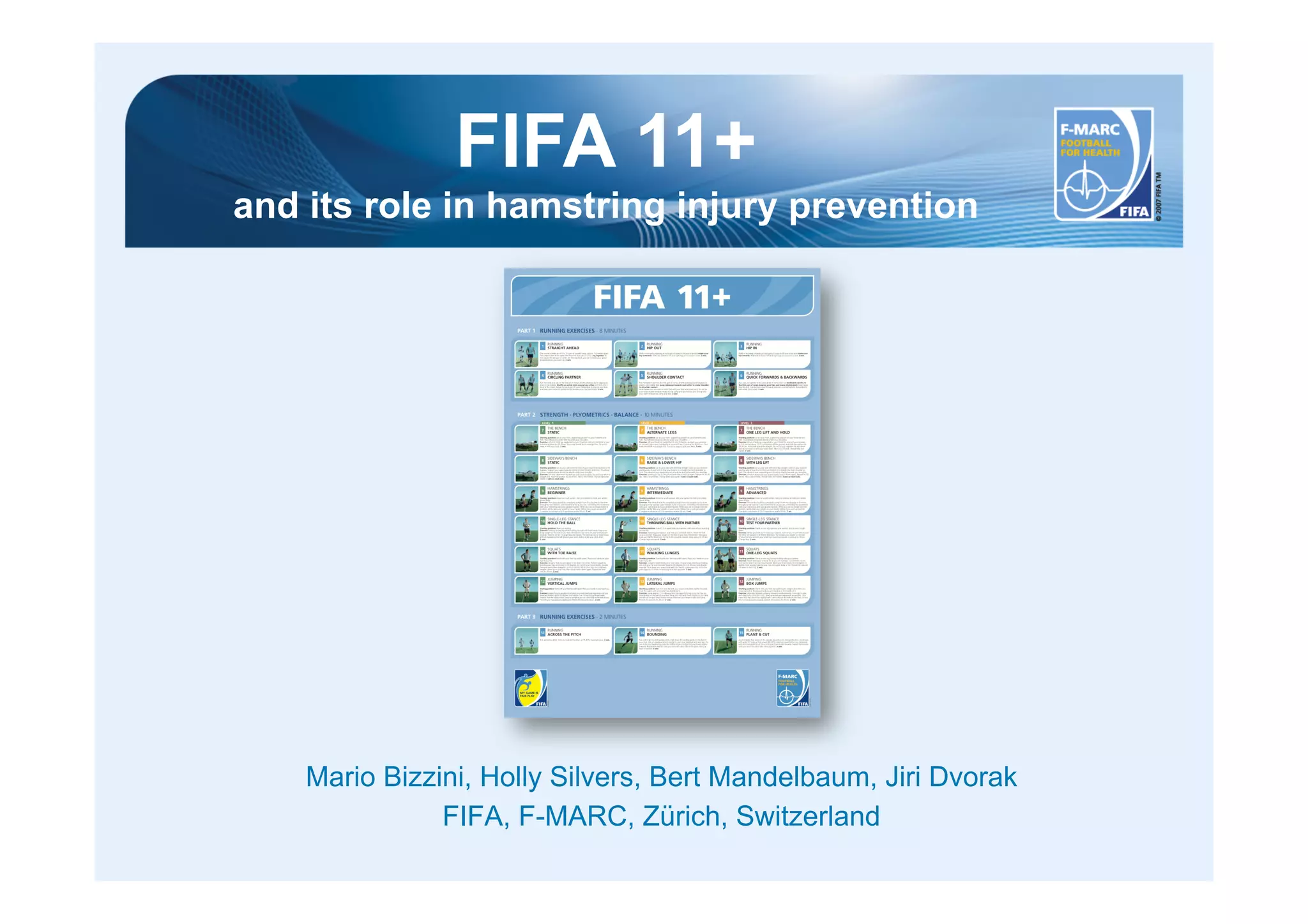


FIFA 11+ 
and its role in hamstring injury prevention 
Mario Bizzini, Holly Silvers, Bert Mandelbaum, Jiri Dvorak 
FIFA, F-MARC, Zürich, Switzerland
F-MARC 
FIFA-Medical Assessment & Research Centre (est. 1994) 
www.fifa.com/medical
Prevention of non-contact injuries 
Literature 
There is good evidence that prevention programs 
can prevent football injuries 
- Injuries in general > multimodal programs 
- Ankle sprains > orthosis, proprioceptive training 
- ACL, knee injuries > neuromuscular/plyometric tr. 
- Hamstring strains > eccentric training 
Ekstrand 1983, Heidt 2000, Junge 2002, Tropp 1985, Surve 1994, Södermann 2000, 
Caraffa 1996, Hewett 1999, Askling 2003, Mandelbaum 2005, Arnason 2007, 
Gilchrist 2008, Soligard 2008,Soligard 2009, Emery 2010, Petersen 2011, 
Junge 2011, Walden 2012, Bizzini 2013, Owoeye 2014, Silvers 2014
Injury prevention studies 
amateur-recreational football 
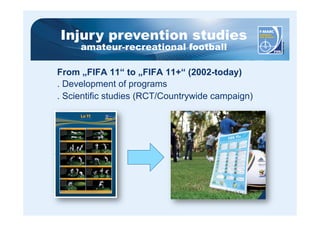
From „FIFA 11“ to „FIFA 11+“ (2002-today) 
. Development of programs 
. Scientific studies (RCT/Countrywide campaign)
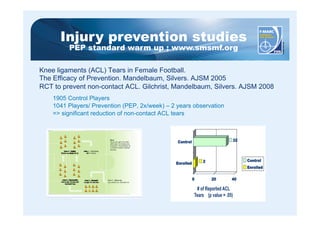
Knee ligaments (ACL) Tears in Female Football. 
The Efficacy of Prevention. Mandelbaum, Silvers. AJSM 2005 
RCT to prevent non-contact ACL. Gilchrist, Mandelbaum, Silvers. AJSM 2008 
1905 Control Players 
1041 Players/ Prevention (PEP, 2x/week) – 2 years observation 
=> significant reduction of non-contact ACL tears 
2 
32 
0 20 40 
# of Reported ACL 
Tears (p value = .05) 
Control 
Enrolled 
Control 
Enrolled 
Injury prevention studies 
PEP standard warm up ; www.smsmf.org
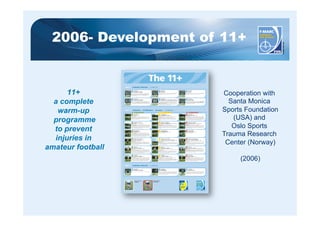
2006- Development of 11+ 
11+ 
a complete 
warm-up 
programme 
to prevent 
injuries in 
amateur football 
Cooperation with 
Santa Monica 
Sports Foundation 
(USA) and 
Oslo Sports 
Trauma Research 
Center (Norway) 
(2006) 
The 11+ 
PART 1 RUNNING EXERCISES · 8 MINUTES 
RUNNING 
STRAIGHT AHEAD 
RUNNING 
CIRCLING PARTNER 
PART 2 STRENGTH · PLYOMETRICS · BALANCE · 10 MINUTES 
RUNNING 
QUICK RUN 
LEVEL 1 LEVEL 2 LEVEL 3 
SQUATS 
WITH TOE RAISE – 2 sets 
PART 3 RUNNING EXERCISES · 2 MINUTES 
KNEE POSITION 
CORRECT 
KNEE POSITION 
INCORRECT 
15 
SIDEWAYS BENCH 
WITH LEG LIFT – 3 sets on each side 
RUNNING 
PLANT & CUT 
Jog 4-5 steps, then plant on the outside leg and cut to change direction. 
Accelerate and sprint 5-7 steps at high speed (80-90% maximum pace) before 
you decelerate and do a new plant & cut. Do not let your knee buckle inwards. 
vvRepeat the exercise until you reach the other side, then jog back. 
14 
RUNNING 
BOUNDING 
Run with high bounding steps with a high knee lift, landing gently on the ball 
of your foot. Use an exaggerated arm swing for each step (opposite arm and 
opposite leg). Try not to let your leading leg cross the midline of your body or 
let your knees buckle inwards. Repeat the exercise until you reach the other 
side of the pitch, then jog back to recover. 
13 RUNNING 
ACROSS THE PITCH 
Run across the pitch, from one side to the other, at 75-80% maximum pace. 
12 JUMPING 
BOX JUMPS – 2 sets 
Starting position: Stand with your feet at hip-width apart. Imagine that there 
is a cross marked on the ground and you are standing in the middle of it. 
Exercise: Alternate between jumping forwards and backwards, from side to 
side, and diagonally across the cross. Jump as quickly and explosively as 
possible. Your knees and hips should be slightly bent. Land softly on the ball 
of your foot. Do not let your knee buckle inwards. 
12 JUMPING 
LATERAL JUMPS – 2 sets 
Starting position: Stand on one leg with your upper body bent slightly 
forwards from the waist, with knees and hips slightly bent. 
Exercise: Jump approx. 1 m sideways from standing leg to free leg, like a 
skater. Land gently on the ball of your foot. Bend your hips and knees slightly 
as you land and do not let your knee buckle inward. Maintain your balance 
with each jump. Repeat the exercise for 30 sec. 
12 JUMPING 
VERTICAL JUMPS – 2 sets 
Starting position: Stand with your feet hip-width apart. Place your hands on 
your hips if you like. Exercise: Imagine that you are about to sit down on a 
chair. Bend your legs slowly until your knees are flexed to approx 90 degree, 
and hold for 2 sec. Do not let your knees buckle inwards. From the squat 
position, jump as high as you can, straight upwards. Land softly on the balls 
of your feet with your hips and knees slightly bent. Repeat for 30 sec. 
11 SQUATS 
ONE-LEG SQUATS – 2 sets on each leg 
Starting position: Stand on one leg, while holding on slightly to your partner. 
Exercise: Slowly bend your knee as far as you can manage. Concentrate on 
preventing the knee from buckling inwards. Bend your knee slowly, then 
straighten it slightly more quickly, keeping your hips and upper body in line. 
Repeat the exercise 10 times on each leg. 
11 SQUAT 
WALKING LUNGES – 2 sets 
Starting position: Stand with your feet at hip-width apart. Place your hands 
on your hips if you like. 
Exercise: Lunge forward slowly at an even pace. As you lunge, bend your 
leading leg until your hip and knee are flexed to 90 degrees. Do not let your 
knee buckle inwards. Try to keep your upper body and hips steady. Lunge 
your way across the pitch and then jog back. 
11 
Starting position: Stand with your feet hip-width apart. Place your hands on 
your hips if you like. Exercise: Imagine that you are about to sit down on a 
chair. Perform squats by bending your hips and knees to 90 degrees. Do not 
let your knees buckle inwards. Bend slowly down then straighten up more 
quickly. When your legs are completely straight, stand up on your toes, then 
slowly lower down again. Repeat the exercise for 30 sec 
10 SINGLE-LEG STANCE 
TEST YOUR PARTNER – 2 sets 
Starting position: Stand on one leg opposite your partner and at an arms’ 
length apart. 
Exercise: Whilst you both try to keep your balance, one of you tries to push 
the other off balance in different directions. Try to keep your weight on the 
ball of your foot and prevent your knee from buckling inwards. Continue for 
30 sec. Change legs and change roles. 
10 SINGLE-LEG STANCE 
THROWING BALL WITH PARTNER – 2 sets 
Starting position: Stand 2-3 m apart from your partner, with each of you 
standing on one leg. 
Exercise: Keeping your balance, and with your stomach held in, throw the ball 
to one another. Keep your weight on the ball of your foot. Remember: Keep 
your knee just slightly flexed and try not to let it buckle inwards. Keep going 
for 30 sec. Change sides and repeat. 
10 SINGLE-LEG STANCE 
HOLD THE BALL – 2 sets 
Starting position: Stand on one leg. 
Exercise: Balance on one leg whilst holding the ball with both your hands. 
Keep your body weight on the mid part of your foot. Remember: try not to 
let your knees buckle inwards. Hold for 30 sec. Change legs and repeat. The 
exercise can be made more difficult by passing the ball around your waist 
and/or under your other knee. 
9 HAMSTRINGS 
ADVANCED – 1 set 
Minimum of 12-15 repetitions. 
9 HAMSTRINGS 
INTERMEDIATE – 1 set 
Minimum 7-10 repetitions. 
9 HAMSTRINGS 
BEGINNER – 1 set 
Starting position: Kneel on a soft surface. Ask your partner to hold your 
ankles firmly. Exercise: Your body should be completely straight from the 
shoulder to the knee. Lean forward as far as you can controlling the movement 
with your hamstrings and your gluteal muscle. When you can no longer hold 
the position, gently take your weight on your hands, falling into a push-up 
position. Complete a minimum of 3-5 repetitions and/or 60 sec. 
8 
Starting position: Lie on your side with both legs straight. 
Exercise: Lean on your forearm and the side of your foot so that your body is 
in a straight line from shoulder to foot. The elbow of your supporting arm 
should be directly beneath your shoulder. Lift your uppermost leg to the side 
and slowly lower it down again. Repeat for 20-30 sec. Take a short break, 
change sides and repeat. 
8 SIDEWAYS BENCH 
RAISE & LOWER HIP – 3 sets on each side 
Starting position: Lie on your side with both legs straight. 
Exercise: Lean on your forearm and the side of your foot so that your body is 
in a straight line from shoulder to foot. The elbow of your supporting arm 
should be directly beneath your shoulder. Lower your hip to the ground and 
raise it back up again. Repeat for 20-30 sec. Take a short break, change sides 
and repeat. 
8 SIDEWAYS BENCH 
STATIC – 3 sets on each side 
Starting position: Lie on your side with the knee of your lowermost leg bent to 
90 degrees. Exercise: Support your upper body by resting on your forearm and 
knee. The elbow of your supporting arm should be directly under your shoulder 
and the supporting leg should be bent 90 degrees. Your uppermost shoulder, 
hip and knee should be in a straight line. Hold the position for 20-30 sec. 
Take a short break, change sides and repeat. 
7 THE BENCH 
ONE LEG LIFT – 3 sets 
Starting position: Lie on your front, supporting yourself on your forearms 
and feet. Your elbows should be directly under your shoulders. Exercise: Lift 
your body up, supported on your forearms, and pull your stomach in. Lift one 
leg about 10-15 centimetres off the ground, and hold the position for 20-30 sec. 
Your body should be straight. Do not let your opposite hip dip and do not sway 
or arch your lower back. Take a short break, change legs and repeat. 
7 THE BENCH 
ALTERNATE LEGS – 3 sets 
Starting position: Lie on your front, supporting yourself on your forearms 
and feet. Your elbows should be directly under your shoulders. 
Exercise: Lift your body up, supported on your forearms, and pull your 
stomach in. Lift each leg in turn, holding for a count of 2 sec. Continue for 
40-60 sec. Your body should be in a straight line. Try not to sway or arch 
your back. 
7 THE BENCH 
STATIC – 3 sets 
Starting position: Lie on your front, supporting yourself on your forearms 
and feet. Your elbows should be directly under your shoulders. 
Exercise: Lift your body up, supported on your forearms, pull your stomach in, 
and hold the position for 20-30 sec. Your body should be in a straight line. 
Try not to sway or arch your back. 
6 
As a pair, run quickly to the second set of cones then run backwards quickly 
to the first pair of cones keeping your hips and knees slightly bent. 
Keep repeating the drill, running two cones forwards and one cone backwards. 
Remember to take small, quick steps. 
5 RUNNING 
JUMPING W. SHOULDER CONTACT 
Run forwards in pairs to the first pair of cones. Shuffle sideways by 90 degrees 
to meet in the middle, then jump sideways towards each other to make 
shoulder to shoulder contact. 
Note: Make sure you land on both feet with your hips and knees bent. Do 
not let your knees buckle inwards. Make it a full jump and synchronize your 
timing with your team-mate as you jump and land. 
4 
Run forwards as a pair to the first set of cones. Shuffle sideways by 90 degrees 
to meet in the middle. Shuffle an entire circle around one other and then 
return back to the cones. Repeat for each pair of cones. Remember to stay on 
your toes and keep your centre of gravity low by bending your hips and knees. 
3 RUNNING 
HIP IN 
Walk or jog easily, stopping at each pair of cones to lift your knee and rotate your 
hip inwards. Alternate between left and right legs at successive cones. 
2 RUNNING 
HIP OUT 
Walk or jog easily, stopping at each pair of cones to lift your knee and rotate your 
hip outwards. Alternate between left and right legs at successive cones. 
1 
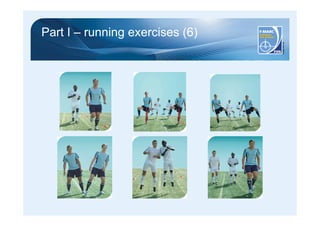
The course is made up of 6 to 10 pairs of parallel cones, approx. 5-6 metres 
apart. All running exercises are completed twice. Two players start at the 
same time from the first pair of cones. On the return leg, speed can be 
increased progressively as the players warm up. Jog in pairs all the way to 
the last pair of cones.
Part I – running exercises (6)
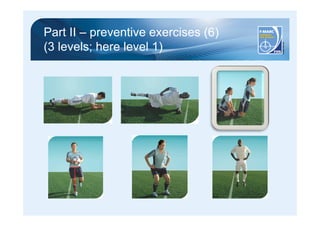
Part II – preventive exercises (6) 
(3 levels; here level 1)
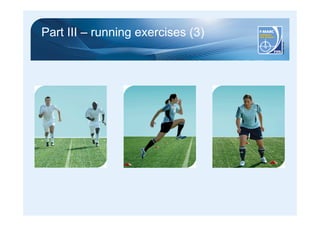
Part III – running exercises (3)
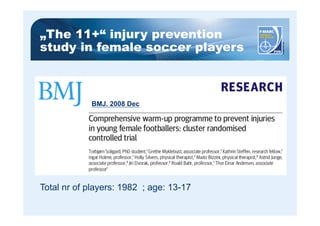
„The 11+“ injury prevention 
study in female soccer players 
BMJ. 2008 Dec 
Total nr of players: 1982 ; age: 13-17
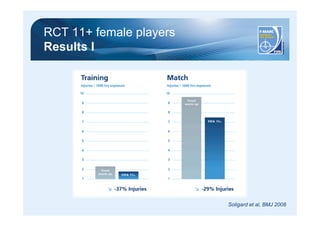
RCT 11+ female players 
Results I 
Soligard et al, BMJ 2008
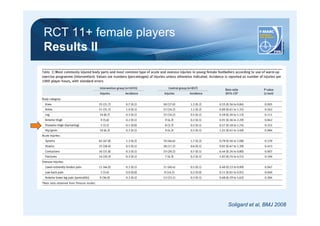
RCT 11+ female players 
Results II 
Soligard et al, BMJ 2008
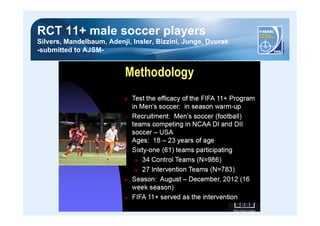
RCT 11+ male soccer players 
Silvers, Mandelbaum, Adenji, Insler, Bizzini, Junge, Dvorak 
-submitted to AJSM-
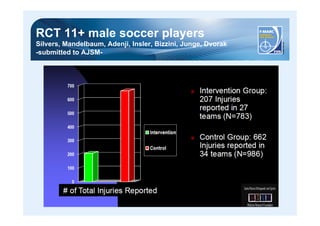
RCT 11+ male soccer players 
Silvers, Mandelbaum, Adenji, Insler, Bizzini, Junge, Dvorak 
-submitted to AJSM-
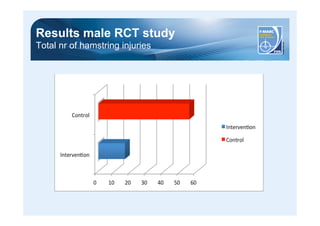
Results male RCT study 
Total nr of hamstring injuries
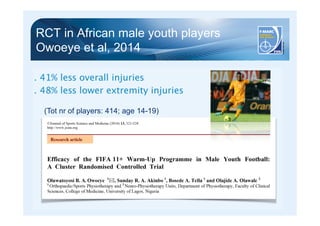
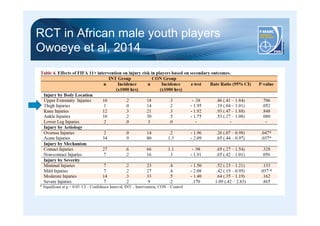
RCT in African male youth players 
Owoeye et al, 2014 
(Tot nr of players: 414; age 14-19)
RCT in African male youth players 
Owoeye et al, 2014
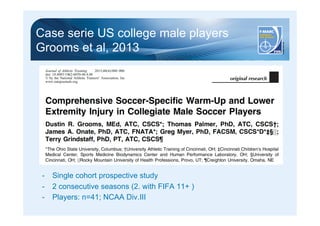
Case serie US college male players 
Grooms et al, 2013 
- Single cohort prospective study 
- 2 consecutive seasons (2. with FIFA 11+ ) 
- Players: n=41; NCAA Div.III
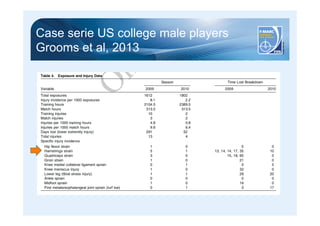
Case serie US college male players 
Grooms et al, 2013
Physiological and performance effects 
of FIFA 11+, male amateur players 
Impellizzeri et al. J Sport Sciences 2013 
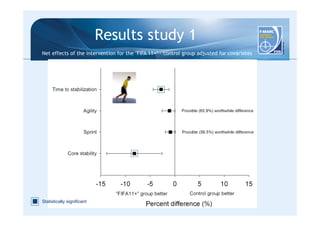
I. Performance effects of FIFA 11+? 
RCT study 
Improves neuromuscular control!
Statistically significant 
Results study 1 
Net effects of the intervention for the "FIFA 11+" – control group adjusted for covariates
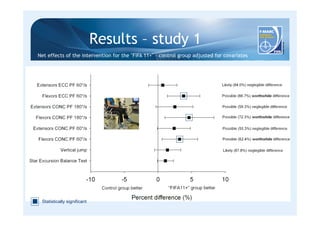
Statistically significant 
Results – study 1 
Net effects of the intervention for the "FIFA 11+" – control group adjusted for covariates
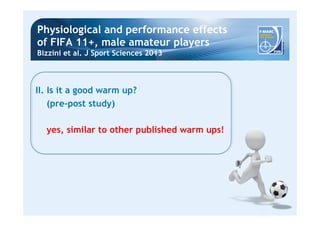
Physiological and performance effects 
of FIFA 11+, male amateur players 
Bizzini et al. J Sport Sciences 2013 
II. Is it a good warm up? 
(pre-post study) 
yes, similar to other published warm ups!
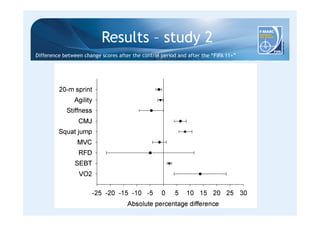
Results – study 2 
Difference between change scores after the control period and after the “FIFA 11+”
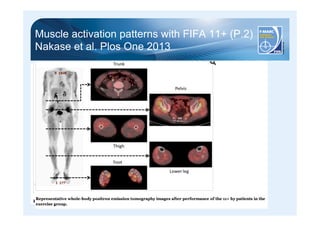
Muscle activation patterns with FIFA 11+ (P.2) 
Nakase et al. Plos One 2013
Summary 
FIFA 11+ & hamstring 
- FIFA 11+ can contribute to significantly 
reduce hamstring injuries in male players 
- Clearly less in female players 
- Program, not only ecc.hams 
- Possibly effects at neuromuscular level 
- Better readiness before training? 
- Relevant eccentric strength gains?
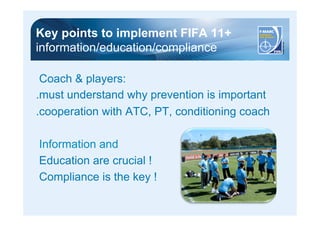
Key points to implement FIFA 11+ 
information/education/compliance 
Coach & players: 
.must understand why prevention is important 
.cooperation with ATC, PT, conditioning coach 
Information and 
Education are crucial ! 
Compliance is the key !
www.f-marc.com/11plus 
7 languages, free downloads

Mario Bizzini - Fifa 11+

  • 1.
    FIFA 11+ andits role in hamstring injury prevention Mario Bizzini, Holly Silvers, Bert Mandelbaum, Jiri Dvorak FIFA, F-MARC, Zürich, Switzerland
  • 2.
    F-MARC FIFA-Medical Assessment& Research Centre (est. 1994) www.fifa.com/medical
  • 3.
    Prevention of non-contactinjuries Literature There is good evidence that prevention programs can prevent football injuries - Injuries in general > multimodal programs - Ankle sprains > orthosis, proprioceptive training - ACL, knee injuries > neuromuscular/plyometric tr. - Hamstring strains > eccentric training Ekstrand 1983, Heidt 2000, Junge 2002, Tropp 1985, Surve 1994, Södermann 2000, Caraffa 1996, Hewett 1999, Askling 2003, Mandelbaum 2005, Arnason 2007, Gilchrist 2008, Soligard 2008,Soligard 2009, Emery 2010, Petersen 2011, Junge 2011, Walden 2012, Bizzini 2013, Owoeye 2014, Silvers 2014
  • 4.
    Injury prevention studies amateur-recreational football From „FIFA 11“ to „FIFA 11+“ (2002-today) . Development of programs . Scientific studies (RCT/Countrywide campaign)
  • 5.
    Knee ligaments (ACL)Tears in Female Football. The Efficacy of Prevention. Mandelbaum, Silvers. AJSM 2005 RCT to prevent non-contact ACL. Gilchrist, Mandelbaum, Silvers. AJSM 2008 1905 Control Players 1041 Players/ Prevention (PEP, 2x/week) – 2 years observation => significant reduction of non-contact ACL tears 2 32 0 20 40 # of Reported ACL Tears (p value = .05) Control Enrolled Control Enrolled Injury prevention studies PEP standard warm up ; www.smsmf.org
  • 6.
    2006- Development of11+ 11+ a complete warm-up programme to prevent injuries in amateur football Cooperation with Santa Monica Sports Foundation (USA) and Oslo Sports Trauma Research Center (Norway) (2006) The 11+ PART 1 RUNNING EXERCISES · 8 MINUTES RUNNING STRAIGHT AHEAD RUNNING CIRCLING PARTNER PART 2 STRENGTH · PLYOMETRICS · BALANCE · 10 MINUTES RUNNING QUICK RUN LEVEL 1 LEVEL 2 LEVEL 3 SQUATS WITH TOE RAISE – 2 sets PART 3 RUNNING EXERCISES · 2 MINUTES KNEE POSITION CORRECT KNEE POSITION INCORRECT 15 SIDEWAYS BENCH WITH LEG LIFT – 3 sets on each side RUNNING PLANT & CUT Jog 4-5 steps, then plant on the outside leg and cut to change direction. Accelerate and sprint 5-7 steps at high speed (80-90% maximum pace) before you decelerate and do a new plant & cut. Do not let your knee buckle inwards. vvRepeat the exercise until you reach the other side, then jog back. 14 RUNNING BOUNDING Run with high bounding steps with a high knee lift, landing gently on the ball of your foot. Use an exaggerated arm swing for each step (opposite arm and opposite leg). Try not to let your leading leg cross the midline of your body or let your knees buckle inwards. Repeat the exercise until you reach the other side of the pitch, then jog back to recover. 13 RUNNING ACROSS THE PITCH Run across the pitch, from one side to the other, at 75-80% maximum pace. 12 JUMPING BOX JUMPS – 2 sets Starting position: Stand with your feet at hip-width apart. Imagine that there is a cross marked on the ground and you are standing in the middle of it. Exercise: Alternate between jumping forwards and backwards, from side to side, and diagonally across the cross. Jump as quickly and explosively as possible. Your knees and hips should be slightly bent. Land softly on the ball of your foot. Do not let your knee buckle inwards. 12 JUMPING LATERAL JUMPS – 2 sets Starting position: Stand on one leg with your upper body bent slightly forwards from the waist, with knees and hips slightly bent. Exercise: Jump approx. 1 m sideways from standing leg to free leg, like a skater. Land gently on the ball of your foot. Bend your hips and knees slightly as you land and do not let your knee buckle inward. Maintain your balance with each jump. Repeat the exercise for 30 sec. 12 JUMPING VERTICAL JUMPS – 2 sets Starting position: Stand with your feet hip-width apart. Place your hands on your hips if you like. Exercise: Imagine that you are about to sit down on a chair. Bend your legs slowly until your knees are flexed to approx 90 degree, and hold for 2 sec. Do not let your knees buckle inwards. From the squat position, jump as high as you can, straight upwards. Land softly on the balls of your feet with your hips and knees slightly bent. Repeat for 30 sec. 11 SQUATS ONE-LEG SQUATS – 2 sets on each leg Starting position: Stand on one leg, while holding on slightly to your partner. Exercise: Slowly bend your knee as far as you can manage. Concentrate on preventing the knee from buckling inwards. Bend your knee slowly, then straighten it slightly more quickly, keeping your hips and upper body in line. Repeat the exercise 10 times on each leg. 11 SQUAT WALKING LUNGES – 2 sets Starting position: Stand with your feet at hip-width apart. Place your hands on your hips if you like. Exercise: Lunge forward slowly at an even pace. As you lunge, bend your leading leg until your hip and knee are flexed to 90 degrees. Do not let your knee buckle inwards. Try to keep your upper body and hips steady. Lunge your way across the pitch and then jog back. 11 Starting position: Stand with your feet hip-width apart. Place your hands on your hips if you like. Exercise: Imagine that you are about to sit down on a chair. Perform squats by bending your hips and knees to 90 degrees. Do not let your knees buckle inwards. Bend slowly down then straighten up more quickly. When your legs are completely straight, stand up on your toes, then slowly lower down again. Repeat the exercise for 30 sec 10 SINGLE-LEG STANCE TEST YOUR PARTNER – 2 sets Starting position: Stand on one leg opposite your partner and at an arms’ length apart. Exercise: Whilst you both try to keep your balance, one of you tries to push the other off balance in different directions. Try to keep your weight on the ball of your foot and prevent your knee from buckling inwards. Continue for 30 sec. Change legs and change roles. 10 SINGLE-LEG STANCE THROWING BALL WITH PARTNER – 2 sets Starting position: Stand 2-3 m apart from your partner, with each of you standing on one leg. Exercise: Keeping your balance, and with your stomach held in, throw the ball to one another. Keep your weight on the ball of your foot. Remember: Keep your knee just slightly flexed and try not to let it buckle inwards. Keep going for 30 sec. Change sides and repeat. 10 SINGLE-LEG STANCE HOLD THE BALL – 2 sets Starting position: Stand on one leg. Exercise: Balance on one leg whilst holding the ball with both your hands. Keep your body weight on the mid part of your foot. Remember: try not to let your knees buckle inwards. Hold for 30 sec. Change legs and repeat. The exercise can be made more difficult by passing the ball around your waist and/or under your other knee. 9 HAMSTRINGS ADVANCED – 1 set Minimum of 12-15 repetitions. 9 HAMSTRINGS INTERMEDIATE – 1 set Minimum 7-10 repetitions. 9 HAMSTRINGS BEGINNER – 1 set Starting position: Kneel on a soft surface. Ask your partner to hold your ankles firmly. Exercise: Your body should be completely straight from the shoulder to the knee. Lean forward as far as you can controlling the movement with your hamstrings and your gluteal muscle. When you can no longer hold the position, gently take your weight on your hands, falling into a push-up position. Complete a minimum of 3-5 repetitions and/or 60 sec. 8 Starting position: Lie on your side with both legs straight. Exercise: Lean on your forearm and the side of your foot so that your body is in a straight line from shoulder to foot. The elbow of your supporting arm should be directly beneath your shoulder. Lift your uppermost leg to the side and slowly lower it down again. Repeat for 20-30 sec. Take a short break, change sides and repeat. 8 SIDEWAYS BENCH RAISE & LOWER HIP – 3 sets on each side Starting position: Lie on your side with both legs straight. Exercise: Lean on your forearm and the side of your foot so that your body is in a straight line from shoulder to foot. The elbow of your supporting arm should be directly beneath your shoulder. Lower your hip to the ground and raise it back up again. Repeat for 20-30 sec. Take a short break, change sides and repeat. 8 SIDEWAYS BENCH STATIC – 3 sets on each side Starting position: Lie on your side with the knee of your lowermost leg bent to 90 degrees. Exercise: Support your upper body by resting on your forearm and knee. The elbow of your supporting arm should be directly under your shoulder and the supporting leg should be bent 90 degrees. Your uppermost shoulder, hip and knee should be in a straight line. Hold the position for 20-30 sec. Take a short break, change sides and repeat. 7 THE BENCH ONE LEG LIFT – 3 sets Starting position: Lie on your front, supporting yourself on your forearms and feet. Your elbows should be directly under your shoulders. Exercise: Lift your body up, supported on your forearms, and pull your stomach in. Lift one leg about 10-15 centimetres off the ground, and hold the position for 20-30 sec. Your body should be straight. Do not let your opposite hip dip and do not sway or arch your lower back. Take a short break, change legs and repeat. 7 THE BENCH ALTERNATE LEGS – 3 sets Starting position: Lie on your front, supporting yourself on your forearms and feet. Your elbows should be directly under your shoulders. Exercise: Lift your body up, supported on your forearms, and pull your stomach in. Lift each leg in turn, holding for a count of 2 sec. Continue for 40-60 sec. Your body should be in a straight line. Try not to sway or arch your back. 7 THE BENCH STATIC – 3 sets Starting position: Lie on your front, supporting yourself on your forearms and feet. Your elbows should be directly under your shoulders. Exercise: Lift your body up, supported on your forearms, pull your stomach in, and hold the position for 20-30 sec. Your body should be in a straight line. Try not to sway or arch your back. 6 As a pair, run quickly to the second set of cones then run backwards quickly to the first pair of cones keeping your hips and knees slightly bent. Keep repeating the drill, running two cones forwards and one cone backwards. Remember to take small, quick steps. 5 RUNNING JUMPING W. SHOULDER CONTACT Run forwards in pairs to the first pair of cones. Shuffle sideways by 90 degrees to meet in the middle, then jump sideways towards each other to make shoulder to shoulder contact. Note: Make sure you land on both feet with your hips and knees bent. Do not let your knees buckle inwards. Make it a full jump and synchronize your timing with your team-mate as you jump and land. 4 Run forwards as a pair to the first set of cones. Shuffle sideways by 90 degrees to meet in the middle. Shuffle an entire circle around one other and then return back to the cones. Repeat for each pair of cones. Remember to stay on your toes and keep your centre of gravity low by bending your hips and knees. 3 RUNNING HIP IN Walk or jog easily, stopping at each pair of cones to lift your knee and rotate your hip inwards. Alternate between left and right legs at successive cones. 2 RUNNING HIP OUT Walk or jog easily, stopping at each pair of cones to lift your knee and rotate your hip outwards. Alternate between left and right legs at successive cones. 1 The course is made up of 6 to 10 pairs of parallel cones, approx. 5-6 metres apart. All running exercises are completed twice. Two players start at the same time from the first pair of cones. On the return leg, speed can be increased progressively as the players warm up. Jog in pairs all the way to the last pair of cones.
  • 7.
    Part I –running exercises (6)
  • 8.
    Part II –preventive exercises (6) (3 levels; here level 1)
  • 9.
    Part III –running exercises (3)
  • 10.
    „The 11+“ injuryprevention study in female soccer players BMJ. 2008 Dec Total nr of players: 1982 ; age: 13-17
  • 11.
    RCT 11+ femaleplayers Results I Soligard et al, BMJ 2008
  • 12.
    RCT 11+ femaleplayers Results II Soligard et al, BMJ 2008
  • 13.
    RCT 11+ malesoccer players Silvers, Mandelbaum, Adenji, Insler, Bizzini, Junge, Dvorak -submitted to AJSM-
  • 14.
    RCT 11+ malesoccer players Silvers, Mandelbaum, Adenji, Insler, Bizzini, Junge, Dvorak -submitted to AJSM-
  • 15.
    Results male RCTstudy Total nr of hamstring injuries
  • 16.
    RCT in Africanmale youth players Owoeye et al, 2014 (Tot nr of players: 414; age 14-19)
  • 17.
    RCT in Africanmale youth players Owoeye et al, 2014
  • 18.
    Case serie UScollege male players Grooms et al, 2013 - Single cohort prospective study - 2 consecutive seasons (2. with FIFA 11+ ) - Players: n=41; NCAA Div.III
  • 19.
    Case serie UScollege male players Grooms et al, 2013
  • 20.
    Physiological and performanceeffects of FIFA 11+, male amateur players Impellizzeri et al. J Sport Sciences 2013 I. Performance effects of FIFA 11+? RCT study Improves neuromuscular control!
  • 21.
    Statistically significant Resultsstudy 1 Net effects of the intervention for the "FIFA 11+" – control group adjusted for covariates
  • 22.
    Statistically significant Results– study 1 Net effects of the intervention for the "FIFA 11+" – control group adjusted for covariates
  • 23.
    Physiological and performanceeffects of FIFA 11+, male amateur players Bizzini et al. J Sport Sciences 2013 II. Is it a good warm up? (pre-post study) yes, similar to other published warm ups!
  • 24.
    Results – study2 Difference between change scores after the control period and after the “FIFA 11+”
  • 25.
    Muscle activation patternswith FIFA 11+ (P.2) Nakase et al. Plos One 2013
  • 26.
    Summary FIFA 11+& hamstring - FIFA 11+ can contribute to significantly reduce hamstring injuries in male players - Clearly less in female players - Program, not only ecc.hams - Possibly effects at neuromuscular level - Better readiness before training? - Relevant eccentric strength gains?
  • 27.
    Key points toimplement FIFA 11+ information/education/compliance Coach & players: .must understand why prevention is important .cooperation with ATC, PT, conditioning coach Information and Education are crucial ! Compliance is the key !
  • 28.