Job Evaluation
Submitted to:
Sir Talha Asim Ghazi
Definition

An assessment of the relative worth of
 various jobs on the basis of a consistent set of
 job and personal factors, such
 as qualifications and skills required.
  According to Kimball and Kimball,
“Job evaluation represents an effort to
 determine the relative value of every job in a
 plant and to determine what the fair basic
 wage for such a job should be.”
Objective of Job
                 Evaluation
   The objective of job evaluation is to determine
    which jobs should get more pay than others.
    Gather information and data relating to job
    description, job specification and employee
    specifications of various jobs in the
    organizations.
     To determine the hierarchy/Rank based jobs
    in the organization.
   To determine duties, responsibilities and
    demands of the job with that of other jobs.
Goal of Job Evaluation
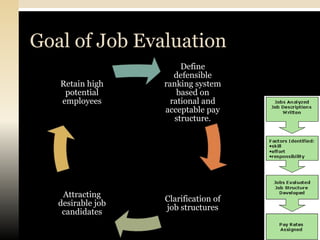
                        Define
                      defensible
   Retain high     ranking system
    potential          based on
   employees         rational and
                   acceptable pay
                      structure.


    Attracting
                   Clarification of
   desirable job
                   job structures
    candidates
FACTORS IN JOB EVALUATION
Job evaluators often assess jobs based on these
factors:
                 Training level or qualification requirements
                      Knowledge or skill requirement
                             Complexity of tasks
                    Interaction with various levels of org.
                 Problem solving and independent judgment
                      Accountability and responsibility
                         Decision making authority
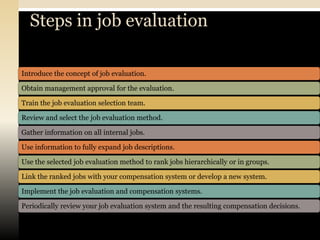
Steps in job evaluation

Introduce the concept of job evaluation.

Obtain management approval for the evaluation.

Train the job evaluation selection team.

Review and select the job evaluation method.

Gather information on all internal jobs.

Use information to fully expand job descriptions.

Use the selected job evaluation method to rank jobs hierarchically or in groups.

Link the ranked jobs with your compensation system or develop a new system.

Implement the job evaluation and compensation systems.

Periodically review your job evaluation system and the resulting compensation decisions.
Analyze job evaluation methods
 Five Job Evaluation are most commonly used.
 • Ranking
 • Classification
 • Point Evaluation
 • Factor Comparsion
 • Market Comparsion
RANKING
   Ranking jobs is the easiest, fastest, and least
    expensive approach to job evaluation.
   Jobs are arranged in order form from highest to
    lowest based on their relative value to your
    organization.
   Advantages Simplicity is the main advantage in
    using a ranking system. It is also easy to
    communicate the results to employees, and it is easy
    to understand.
   Disadvantages Ranking jobs is subjective. Jobs
    are evaluated, and their value and complexity are
    often assessed on the basis of opinion. Also, when
    creating a new job, existing jobs must be reranked to
    accommodate the new position.
CLASSIFICATION
   The general purpose of job classification is to create and
    maintain pay grades for comparable work across your
    organization.
   Universities, government employers and agencies, and other
    large organizations with limited resources typically use job
    classification systems.
   Advantage Job classification is simple once you establish
    your categories. You can assign new jobs and jobs with
    changing responsibilities within the existing system.
   Disadvantages Job classification is subjective, so jobs
    might fall into several categories. Decisions rely on the
    judgment of the job evaluator. Job evaluators must evaluate
    jobs carefully because similar titles might describe different
    jobs from different work sites.
POINT EVALUATION
   In a point evaluation system, you express the value of a particular
    job in monetary terms. You first identify compensable factors that
    a group of jobs possess. Based on these factors, you assign points
    that numerically represent the description and range of the job.
   Examples of compensable factors are skills required, level of
    decision-making authority, number of reporting staff
    members, and working conditions.
   Advantage This method is often viewed as less biased than
    other methods .
   Disadvantages Subjective decisions about compensable
    factors and the associated points assigned might be dominate. The
    job evaluator must be aware of biases and ensure that they are not
    represented in points assigned to jobs that are traditionally held by
    minority and female employees.
FACTOR COMPARISON
   Job evaluators rank jobs that have similar
    responsibilities and tasks according to points
    assigned to compensable factors.
    The evaluators then analyze jobs in the external
    labor market to establish the market rate for such
    factors.
    Jobs across the organization are then compared to
    the benchmark jobs according to the market rate of
    each job's compensable factors to determine job
    salaries.
   Advantage :This method results in customized job-
    ranking.
   Disadvantage: Compensable factor comparison
    is a time-consuming and subjective process.
MARKET COMPARISON
   Job evaluators compare compensation for
    your organization's jobs to the market rate for
    similar jobs. This method requires accurate
    market-pricing surveys.
Reasons for Job Evaluation

1.   To determine what positions and job responsibilities are similar
     for purposes of pay, promotions, lateral moves, transfers.
     assignments and assigned work, and other internal parity issues.
2.   To determine appropriate pay or salary grades and decide
     other compensation issues.
3.   To help with the development of job descriptions, job
     specifications, performance standards, competencies, and
     the performance appraisal system.
4.   To assist with employee career paths, career planning
     or pathing and succession planning.
5.   To assist the employee recruiting process by having in place job
     responsibilities that assist in the development of job postings, the
     assessment of applicant qualifications, suitable compensation
     and salary negotiation, and other factors related to recruiting
     employees
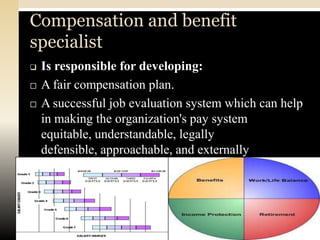
Compensation and benefit
specialist
   Is responsible for developing:
   A fair compensation plan.
   A successful job evaluation system which can help
    in making the organization's pay system
    equitable, understandable, legally
    defensible, approachable, and externally
    competitive.
Problems During Job Evaluation
   No centralized job catalog.
    For many organizations that may or may not have conducted
    formalized job evaluations their results are often stored in excel
    spreadsheets that are shared between HR professionals as
    needed. The task of managing and updating these files becomes
    unmanageable.
   No standard approach for evaluation of jobs.
     Many organizations conduct ranking that is based on salary or a
    somewhat subjective measure that is often not repeatable.
   Maintenance of catalog and expenses:
    If an organization elects to conduct formalized job evaluation the
    process usually requires a consultant to come in and use a
    specialized methodology that will allow the organization to get an
    accurate analysis of their job structure. .
  Corporate governance.
   This is a problem more and more companies are facing as
   they take their businesses into the global marketplace. How
   do you account for dramatic differences in job requirements
   based on geography, and who should be in charge of
   updating and managing those differences?
 Salary surveys

If your organization participates in salary surveys how do you
   gain the comfort level that the comparison you are making
   between your jobs and the industry is accurate?
 Workflow

Managing the workflow of a job evaluation. To conduct an
   accurate evaluation requires input from multiple
   sources, how do you keep track of where you are at in any
   given evaluation as information is delivered from different
   sources at different times
Group members
   Ambreena Basharat
   Haris Iqbal Qureshi 5038
   Laiqa Ahmed         5143
   Syed Umer Ali        5087

Compensation and benefits

  • 1.
  • 2.
    Definition An assessment ofthe relative worth of various jobs on the basis of a consistent set of job and personal factors, such as qualifications and skills required. According to Kimball and Kimball, “Job evaluation represents an effort to determine the relative value of every job in a plant and to determine what the fair basic wage for such a job should be.”
  • 3.
    Objective of Job Evaluation  The objective of job evaluation is to determine which jobs should get more pay than others.  Gather information and data relating to job description, job specification and employee specifications of various jobs in the organizations.  To determine the hierarchy/Rank based jobs in the organization.  To determine duties, responsibilities and demands of the job with that of other jobs.
  • 4.
    Goal of JobEvaluation Define defensible Retain high ranking system potential based on employees rational and acceptable pay structure. Attracting Clarification of desirable job job structures candidates
  • 5.
    FACTORS IN JOBEVALUATION Job evaluators often assess jobs based on these factors: Training level or qualification requirements Knowledge or skill requirement Complexity of tasks Interaction with various levels of org. Problem solving and independent judgment Accountability and responsibility Decision making authority
  • 6.
    Steps in jobevaluation Introduce the concept of job evaluation. Obtain management approval for the evaluation. Train the job evaluation selection team. Review and select the job evaluation method. Gather information on all internal jobs. Use information to fully expand job descriptions. Use the selected job evaluation method to rank jobs hierarchically or in groups. Link the ranked jobs with your compensation system or develop a new system. Implement the job evaluation and compensation systems. Periodically review your job evaluation system and the resulting compensation decisions.
  • 7.
    Analyze job evaluationmethods Five Job Evaluation are most commonly used. • Ranking • Classification • Point Evaluation • Factor Comparsion • Market Comparsion
  • 8.
    RANKING  Ranking jobs is the easiest, fastest, and least expensive approach to job evaluation.  Jobs are arranged in order form from highest to lowest based on their relative value to your organization.  Advantages Simplicity is the main advantage in using a ranking system. It is also easy to communicate the results to employees, and it is easy to understand.  Disadvantages Ranking jobs is subjective. Jobs are evaluated, and their value and complexity are often assessed on the basis of opinion. Also, when creating a new job, existing jobs must be reranked to accommodate the new position.
  • 9.
    CLASSIFICATION  The general purpose of job classification is to create and maintain pay grades for comparable work across your organization.  Universities, government employers and agencies, and other large organizations with limited resources typically use job classification systems.  Advantage Job classification is simple once you establish your categories. You can assign new jobs and jobs with changing responsibilities within the existing system.  Disadvantages Job classification is subjective, so jobs might fall into several categories. Decisions rely on the judgment of the job evaluator. Job evaluators must evaluate jobs carefully because similar titles might describe different jobs from different work sites.
  • 10.
    POINT EVALUATION  In a point evaluation system, you express the value of a particular job in monetary terms. You first identify compensable factors that a group of jobs possess. Based on these factors, you assign points that numerically represent the description and range of the job.  Examples of compensable factors are skills required, level of decision-making authority, number of reporting staff members, and working conditions.  Advantage This method is often viewed as less biased than other methods .  Disadvantages Subjective decisions about compensable factors and the associated points assigned might be dominate. The job evaluator must be aware of biases and ensure that they are not represented in points assigned to jobs that are traditionally held by minority and female employees.
  • 11.
    FACTOR COMPARISON  Job evaluators rank jobs that have similar responsibilities and tasks according to points assigned to compensable factors.  The evaluators then analyze jobs in the external labor market to establish the market rate for such factors.  Jobs across the organization are then compared to the benchmark jobs according to the market rate of each job's compensable factors to determine job salaries.  Advantage :This method results in customized job- ranking.  Disadvantage: Compensable factor comparison is a time-consuming and subjective process.
  • 12.
    MARKET COMPARISON  Job evaluators compare compensation for your organization's jobs to the market rate for similar jobs. This method requires accurate market-pricing surveys.
  • 13.
    Reasons for JobEvaluation 1. To determine what positions and job responsibilities are similar for purposes of pay, promotions, lateral moves, transfers. assignments and assigned work, and other internal parity issues. 2. To determine appropriate pay or salary grades and decide other compensation issues. 3. To help with the development of job descriptions, job specifications, performance standards, competencies, and the performance appraisal system. 4. To assist with employee career paths, career planning or pathing and succession planning. 5. To assist the employee recruiting process by having in place job responsibilities that assist in the development of job postings, the assessment of applicant qualifications, suitable compensation and salary negotiation, and other factors related to recruiting employees
  • 14.
    Compensation and benefit specialist  Is responsible for developing:  A fair compensation plan.  A successful job evaluation system which can help in making the organization's pay system equitable, understandable, legally defensible, approachable, and externally competitive.
  • 15.
    Problems During JobEvaluation  No centralized job catalog. For many organizations that may or may not have conducted formalized job evaluations their results are often stored in excel spreadsheets that are shared between HR professionals as needed. The task of managing and updating these files becomes unmanageable.  No standard approach for evaluation of jobs. Many organizations conduct ranking that is based on salary or a somewhat subjective measure that is often not repeatable.  Maintenance of catalog and expenses: If an organization elects to conduct formalized job evaluation the process usually requires a consultant to come in and use a specialized methodology that will allow the organization to get an accurate analysis of their job structure. .
  • 16.
     Corporategovernance. This is a problem more and more companies are facing as they take their businesses into the global marketplace. How do you account for dramatic differences in job requirements based on geography, and who should be in charge of updating and managing those differences?  Salary surveys If your organization participates in salary surveys how do you gain the comfort level that the comparison you are making between your jobs and the industry is accurate?  Workflow Managing the workflow of a job evaluation. To conduct an accurate evaluation requires input from multiple sources, how do you keep track of where you are at in any given evaluation as information is delivered from different sources at different times
  • 17.
    Group members  Ambreena Basharat  Haris Iqbal Qureshi 5038  Laiqa Ahmed 5143  Syed Umer Ali 5087