RECORDS AND
REPORT
S
Principles of documentation
• 1. DATE & TIME
 Document date and time of each recording.
 Record time in conventional manner (E.g. 9am, 6pm etc) or
according to the 24 hour clock (military clock)
 Avoid recording in advance.
• 2. Legibility
 Entries must be legible and easy to read.
 Writing must be clear.
• Very important in recording numbers and medical
terms
Principles of documentation
• 3. Correct Spelling
 Correct spelling is essential for accuracy.
• 4. Permanence
 Entries should be done in dark ink.
 It helps to identify changes and allows duplication
• 5.Accepted Terminology
 Use commonly accepted abbreviations, symbols and
terms that are specified by the agency
Principles of documentation
• 6. Factual
 Descriptive objective information about what nurse
sees, hears, feels and smells.
 Use of inference without supporting data is not
acceptable.
 Vague terms like appear, seem or apparently is not
accepted.
 Include objective signs of problems.
 Subjective data is documented in client’s exact words
within quotation marks.
Principles of documentation
• 7.Accurate
 Use of exact measurement establishes accuracy.eg. Intake
450ml of water than writing adequate amount of water.
 Clients name and identifying information is written on each
page.
 Before making any entry in the chart makes sure that it is
correct.
 Chart only your observations and actions to be accountable.
• If any mistakes occur while recording, draw a line
through it and write above or next to original entry
with your initials or name. Do not erase, blot or use
correction fluids.
Principles of documentation
8. Appropriateness
Record information's pertaining to the client
health problems& care only.
Principles of documentation
9. Completeness
Document all necessary information's.
It should give a clear picture of what took
place Complete pertinent assessment data such
as vital signs, wound drainage, client
complaints, which was notified and what
interventions are carried out are recorded.
Principles of documentation
• 10. Current
 Timely entries are must Keeping record at bed side
may facilitate immediate documentation
• 11. CONCISENESS
 (BRIEVITY)Recording need to be brief as well as
complete to save time in communication
 Client’s name and the word client can be omitted E g.
“perspiring profusely. Respiration shallow. 28/mt ”
Use accepted abbreviations18. 13
Principles of documentation
• 12. ORGANIZED
 Information should have logical manner. E g.
description of pain, nurses assessment and
interventions and the client response
 This helps in preventing any omission of information.
Easy to read.
• 13. SIGNATURE
 Each recording is signed by the nurse Signature
includes the name and the title in computerized
charting nurse will have his or her own code.
Principles of documentation
• 14. Confidentiality
All the client’s record are confidential files
The information in the chart is personal as well
as legal.
Record shouldn't be copied without the
permission of the client
.Nurse should not allow any outsiders to verify
the client record.
Types of documentation:
RECORD
 Record is a permanent written communication
that documents information relevant to a
client’s health care management, e.g. a client
chart is a continuing account of client’s health
care status and need.
Conduct training and research work
Assess health problems.
DEFINITION:
◾ Records the memory of the internal and external
transactions of an organization. Records contain a
written evidence of the activities of an organization in
the form of letters, circulars, reports, contracts,
invoices, vouchers, minutes of meeting, books of
account etc.
[S.L.Geol, 2001 ]
1
2
◾ It is a written communication that
permanently documents information relevant
to a client’s health care management. It is a
continuing account of the client’s health care
needs
[Sr. Mary lucita ]
1
3
PRINCIPLES OF MAINTAINING
RECORDS:
Specific purpose which should be clearly
understood
Items on forms and in registers should be
conveniently grouped so as to make their
completion as easy as possible.
The wording should be easily understood, and
where doubt is likely to arise, instructions to
facilitate interpretation should be included.
14
Principles of maintaining records
(contnd…)
Records should permit some freedom of
expression.
Records which are required by the teaching
staff should be easily accessible to them.
Person responsible for maintaining records
should be aware of their particular
responsibility and every effort should be made
to keep records up to date and accurate.
15
Principles of maintaining records
(contnd…)
Provision for periodic review of all records to
ensure that they keep pace with the changing
needs of the programme.
Adequate supply of stationery to permit records
to be maintained on the proper forms and in the
proper registers at all times.
Sufficient number of filing cabinets
appropriate equipments to operate a
and
filing
system which is simple and safe and requires the
minimum possible time.
Adequate, safe, fireproof storage arrangements
16
General rules of recording
Keep separate records or charts for each individual
It’s a legal document, write it in English, clearly
accurately
Name, age, ward, date and inpatient number
should be written on each page
All entries should be signed.
Chart nursing care and medications and other
treatments only after giving them
It should be reliable and accurate
Information should be factual
General rules of recording….
Correct spelling
Nurses should not allow others to record
Use only standard abbreviations.
Do not use ditto marks or chemical formula in
charting
Each patient should have daily note ,written by
nurses on all shifts.
The information within a record should be
complete
Concise data are easily understand
General rules of recording……..
Lengthy notes are difficult to read
Record immediately after performing nursing
activities
It should have correctness
It should be organized in a logical format order
Nurses should maintain confidentiality of patient
record
Do not use blank space in the record.
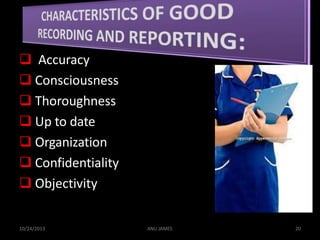
 Accuracy
 Consciousness
 Thoroughness
 Up to date
 Organization
 Confidentiality
 Objectivity
10/24/2013 ANU JAMES 20
• Communication
• Aids to diagnosis
• Education
• Documentation of continuity
• Research
• Legal documentation
• Individual case study
10/24/2013 ANU JAMES 21
PURPOSE OF KEEPING RECORDS:
USES OF RECORDS
Show the health conditions as it is and as the
patient and family accepts it.
goals towards which means are to be directed.
prevents duplication of services and helps follow
up services effectively.
Helps the nurses to evaluate the care and the
teaching
Organization of work
10/24/2013 ANU JAMES 22
USES OF RECORDS (contnd….)
Serves as a guide for diagnosis
treatment and evaluation of services
indicate progress
Used in research
The health assets and needs of the
village area
10/24/2013 ANU JAMES 23
1. Patients clinical record
2. Individual staff records
3. Ward records
4. Administrative records with educational
value.
TYPES OF RECORDS
24
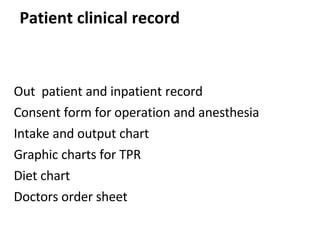
Patient clinical record
operation and anesthesia
Out patient and inpatient record
Consent form for operation and anesthesia
Intake and output chart
Graphic charts for TPR
Diet chart
Doctors order sheet
26
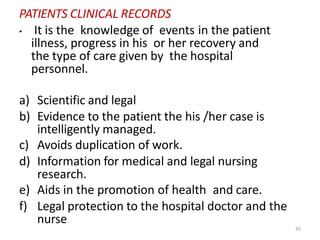
PATIENTS CLINICAL RECORDS
• It is the knowledge of events in the patient
illness, progress in his or her recovery and
the type of care given by the hospital
personnel.
a) Scientific and legal
b) Evidence to the patient the his /her case is
intelligently managed.
c) Avoids duplication of work.
d) Information for medical and legal nursing
research.
e) Aids in the promotion of health and care.
f) Legal protection to the hospital doctor and the
nurse
10/24/2013 ANU JAMES 27
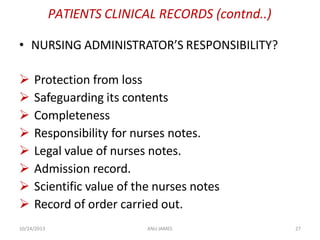
PATIENTS CLINICAL RECORDS (contnd..)
• NURSING ADMINISTRATOR’S RESPONSIBILITY?
 Protection from loss
 Safeguarding its contents
 Completeness
 Responsibility for nurses notes.
 Legal value of nurses notes.
 Admission record.
 Scientific value of the nurses notes
 Record of order carried out.
28
INDIVIDUAL STAFF RECORDS.
• A separate set of record is needed for staff,
giving details of their sickness and absences,
their carrier and development activities and a
personnel note
29
WARD RECORDS.
• Reducting or increase in beds.
• Change in medical staff and non nursing
personnel for the ward.
• The introduction and pattern of support.
10/24/2013 ANU JAMES 30
ADMINISTRATIVE RECORDS WITH
EDUCATIONAL VALUE.
• Treatments.
• Admissions.
• Equipments losses and replacements.
• Personnel performance.
• Other administrative records
TYPES OF RECORDS IN THE
DEPARTMENT OF PUBLIC HEALTH
31
• Cumulative or continuing records
• Family records
• Registers
• Reports
FILLING & ARRANGING OF RECORD
10/24/2013 ANU JAMES 32
• Alphabetically
• Numerically
• Geographically
• With index cards.
ALPHABETICALLY
• Dictionary order
• Encyclopaedic order
33
Advantages and disadvantages of
alphabetically arrangement system
• Most people are familiar
• Staff should be able to learn
and become comfortable with
the system in a timely manner
• The need to shift the records
after purging records is
reduced
• Cross reference may be
avoided
Advantages Disadvantages
• system does not work well
with very large filing systems
• Color coding is more difficult
since you need to have 26
colors or combination of
colors to designate all the
letters of the alphabet
• Confidentiality is an issue
• Some of the rules of alpha
filing can be very confusing.
34
NUMERICALLY
10/24/2013 35
• Serial number
• Digit filing
GEOGRAPHICALLY
Information is arranged alphabetically
by geographical of place name.
36
WITH INDEX CARDS
• An index card consists of heavy paper cut to a
standard size, used for recording and storing
small amounts of discrete data. It was
invented by Carl Linnaeus, around 1760.
Eg:- forms, case records and registers.
Diaries- diary of M & F
Return – monthly report of HW (M& F)
In addition each organization should maintain
• Cumulative records
• Family records
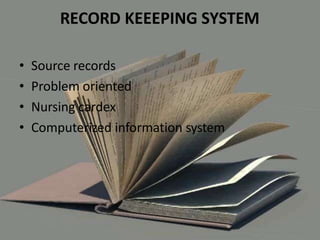
RECORD KEEEPING SYSTEM
10/24/2013 ANU JAMES 37
• Source records
• Problem oriented
• Nursing cardex
• Computerized information system
10/24/2013 ANU JAMES 38
Computerized information system
3 major categories
1) Clinical system
2) Management information system
3) Educational system
GUIDELINES FOR DOCUMENTATION
AND RECORD KEEPING
39
The Nursing and Midwifery Council (NMC 2002)
has said that patient and client records should:
• be based on fact, correct and consistent
• be written as soon as possible after an event has
happened
• be written clearly and in such a way that the text
cannot be erased
• be written in such a way that any alterations or
additions are dated, timed and signed, so that the
original entry is still clear
GUIDELINES FOR DOCUMENTATION AND
RECORD KEEPING (contnd..)
40
• be accurately dated, timed and signed, with
the signature printed alongside the first entry
• not include abbreviations, jargon meaningless
phrases, irrelevant speculation and offensive
subjective statements
• be readable on any photocopies
IMPORTENCE OF RECORDS IN
HOSPITAL OR HEALTH CENTERS.
41
• INDIVIDUAL AND FAMILY
• FOR THE DOCTOR
• FOR THE NURSE
• FOR AUTHORITIES
REPORTS
10/24/2013 ANU JAMES 42
DEFINITION
A report containing information
against in a narrative graphic or tabular
form, prepared on periodic, receiving,
regular or as a required basis. Reports may
refer to specific periods, events,
10/24/2013 ANU JAMES 43
occurrence, or subject and may be
oral or
communicated or presented in
written form
[ Basvanthappa bt.2009 ]
DEFINITION (contnd..)
10/24/2013 ANU JAMES 44
Reports are oral or written
exchanges of information shared between
care givers of workers in a number of ways.
A report summarises the service of the
personnel and of the agency
[ Jean b. 2002 ]
PURPOSES
10/24/2013 ANU JAMES 45
• Report is an essential tool to communication
• To show the kind and amount of services
rendered over a specific period.
• To illustrate progress in teaching goals.
• As an aid in studying health condition.
• As an aid in planning.
• To interpret the services to the public and to
the other interested agencies.
CRITERIA FOR A GOOD REPORT
10/24/2013 ANU JAMES 46
• made promptly.
• clear, concise, and complete.
• If it is written all pertinent, identifying data are
included-the date and time, the people
concerned, the situation, the signature of the
person making the report.
• It is clearly stated and well organized
• Important points are emphasized.
• In case of oral reports they are clearly expressed
and presented in an interesting manner.
REPORTS IN NURSING EDUCATION
47
• Factual data related to the students, staff,
clinical facilities, physical facilities,
administration and the curriculum
• Development made in the school programme
since the last report.
• Proposal and plans for future development.
• Problems encountered
• Recommendations
TYPES OF REPORTS
1. 24 hours reports
2. Census report
3. Anecdotal report
4. Birth and death report
5. Incidental report
10/24/2013 ANU JAMES 48
CLASIFICATION OF REPORTS BASED
ON TYPES
• Oral reports
• Written reports
10/24/2013 ANU JAMES 49
REPORTS USED IN HOSPITAL
SETTING:-
10/24/2013 ANU JAMES 50
• CHANGE – OF – SHIFT REPORTS
• TRANSFER REPORTS
• INCIDENT REPORTS
• LEGAL REPORTS
ADVANTAGES AND DISADVANTAGES
OF REPORTS
ADVANTAGES
• Monitoring operations
• Controlling
• Guide decision
• Employee motivation
• Performance evaluation
DISADVANTAGES
• It is time consuming.
• Expensive
• Reports can be biased
• Sometimes implementations
of the recommendations of a
report become unrealistic.
• Technical reports are not
easily understandable
10/24/2013 ANU JAMES 51
NURSES RESPONSIBILITY FOR RECORD
KEEPING AND REPORTING
10/24/2013 ANU JAMES 52
must be functional
Records and reports
accurate, complete, current organized and
confidential
• FACTS
• ACCURACY
• COMPLETENESS
• CURRENTNESS
• ORGANIZATION
• CONFIDENTIALITY
COMMON PROBLEMS THAT OCCUR
DURING REPORT WRITING.
10/24/2013 ANU JAMES 53
CONTENT AND ORGANIZATION
• Problem - No section headings
• Problem - missing items related to the
format
• Problem - lack of numbering
Common problems that occur during
report writing.(Contnd..)
10/24/2013 ANU JAMES 54
GRAMMAR, VOCABULARY, SENTENCE AND TONE.
OTHER PROBLEMS
• Incomplete sentences
• Confusing and unclear sentences.
• Miscommunication
• Too general
• Confidentiality.
• Missing information and facts.
• Wordiness.
10/24/2013 ANU JAMES 55
10/24/2013 ANU JAMES 56

records and reports.pptx

  • 1.
  • 2.
    Principles of documentation •1. DATE & TIME  Document date and time of each recording.  Record time in conventional manner (E.g. 9am, 6pm etc) or according to the 24 hour clock (military clock)  Avoid recording in advance. • 2. Legibility  Entries must be legible and easy to read.  Writing must be clear. • Very important in recording numbers and medical terms
  • 3.
    Principles of documentation •3. Correct Spelling  Correct spelling is essential for accuracy. • 4. Permanence  Entries should be done in dark ink.  It helps to identify changes and allows duplication • 5.Accepted Terminology  Use commonly accepted abbreviations, symbols and terms that are specified by the agency
  • 4.
    Principles of documentation •6. Factual  Descriptive objective information about what nurse sees, hears, feels and smells.  Use of inference without supporting data is not acceptable.  Vague terms like appear, seem or apparently is not accepted.  Include objective signs of problems.  Subjective data is documented in client’s exact words within quotation marks.
  • 5.
    Principles of documentation •7.Accurate  Use of exact measurement establishes accuracy.eg. Intake 450ml of water than writing adequate amount of water.  Clients name and identifying information is written on each page.  Before making any entry in the chart makes sure that it is correct.  Chart only your observations and actions to be accountable. • If any mistakes occur while recording, draw a line through it and write above or next to original entry with your initials or name. Do not erase, blot or use correction fluids.
  • 6.
    Principles of documentation 8.Appropriateness Record information's pertaining to the client health problems& care only.
  • 7.
    Principles of documentation 9.Completeness Document all necessary information's. It should give a clear picture of what took place Complete pertinent assessment data such as vital signs, wound drainage, client complaints, which was notified and what interventions are carried out are recorded.
  • 8.
    Principles of documentation •10. Current  Timely entries are must Keeping record at bed side may facilitate immediate documentation • 11. CONCISENESS  (BRIEVITY)Recording need to be brief as well as complete to save time in communication  Client’s name and the word client can be omitted E g. “perspiring profusely. Respiration shallow. 28/mt ” Use accepted abbreviations18. 13
  • 9.
    Principles of documentation •12. ORGANIZED  Information should have logical manner. E g. description of pain, nurses assessment and interventions and the client response  This helps in preventing any omission of information. Easy to read. • 13. SIGNATURE  Each recording is signed by the nurse Signature includes the name and the title in computerized charting nurse will have his or her own code.
  • 10.
    Principles of documentation •14. Confidentiality All the client’s record are confidential files The information in the chart is personal as well as legal. Record shouldn't be copied without the permission of the client .Nurse should not allow any outsiders to verify the client record.
  • 11.
    Types of documentation: RECORD Record is a permanent written communication that documents information relevant to a client’s health care management, e.g. a client chart is a continuing account of client’s health care status and need. Conduct training and research work Assess health problems.
  • 12.
    DEFINITION: ◾ Records thememory of the internal and external transactions of an organization. Records contain a written evidence of the activities of an organization in the form of letters, circulars, reports, contracts, invoices, vouchers, minutes of meeting, books of account etc. [S.L.Geol, 2001 ] 1 2
  • 13.
    ◾ It isa written communication that permanently documents information relevant to a client’s health care management. It is a continuing account of the client’s health care needs [Sr. Mary lucita ] 1 3
  • 14.
    PRINCIPLES OF MAINTAINING RECORDS: Specificpurpose which should be clearly understood Items on forms and in registers should be conveniently grouped so as to make their completion as easy as possible. The wording should be easily understood, and where doubt is likely to arise, instructions to facilitate interpretation should be included. 14
  • 15.
    Principles of maintainingrecords (contnd…) Records should permit some freedom of expression. Records which are required by the teaching staff should be easily accessible to them. Person responsible for maintaining records should be aware of their particular responsibility and every effort should be made to keep records up to date and accurate. 15
  • 16.
    Principles of maintainingrecords (contnd…) Provision for periodic review of all records to ensure that they keep pace with the changing needs of the programme. Adequate supply of stationery to permit records to be maintained on the proper forms and in the proper registers at all times. Sufficient number of filing cabinets appropriate equipments to operate a and filing system which is simple and safe and requires the minimum possible time. Adequate, safe, fireproof storage arrangements 16
  • 17.
    General rules ofrecording Keep separate records or charts for each individual It’s a legal document, write it in English, clearly accurately Name, age, ward, date and inpatient number should be written on each page All entries should be signed. Chart nursing care and medications and other treatments only after giving them It should be reliable and accurate Information should be factual
  • 18.
    General rules ofrecording…. Correct spelling Nurses should not allow others to record Use only standard abbreviations. Do not use ditto marks or chemical formula in charting Each patient should have daily note ,written by nurses on all shifts. The information within a record should be complete Concise data are easily understand
  • 19.
    General rules ofrecording…….. Lengthy notes are difficult to read Record immediately after performing nursing activities It should have correctness It should be organized in a logical format order Nurses should maintain confidentiality of patient record Do not use blank space in the record.
  • 20.
     Accuracy  Consciousness Thoroughness  Up to date  Organization  Confidentiality  Objectivity 10/24/2013 ANU JAMES 20
  • 21.
    • Communication • Aidsto diagnosis • Education • Documentation of continuity • Research • Legal documentation • Individual case study 10/24/2013 ANU JAMES 21 PURPOSE OF KEEPING RECORDS:
  • 22.
    USES OF RECORDS Showthe health conditions as it is and as the patient and family accepts it. goals towards which means are to be directed. prevents duplication of services and helps follow up services effectively. Helps the nurses to evaluate the care and the teaching Organization of work 10/24/2013 ANU JAMES 22
  • 23.
    USES OF RECORDS(contnd….) Serves as a guide for diagnosis treatment and evaluation of services indicate progress Used in research The health assets and needs of the village area 10/24/2013 ANU JAMES 23
  • 24.
    1. Patients clinicalrecord 2. Individual staff records 3. Ward records 4. Administrative records with educational value. TYPES OF RECORDS 24
  • 25.
    Patient clinical record operationand anesthesia Out patient and inpatient record Consent form for operation and anesthesia Intake and output chart Graphic charts for TPR Diet chart Doctors order sheet
  • 26.
    26 PATIENTS CLINICAL RECORDS •It is the knowledge of events in the patient illness, progress in his or her recovery and the type of care given by the hospital personnel. a) Scientific and legal b) Evidence to the patient the his /her case is intelligently managed. c) Avoids duplication of work. d) Information for medical and legal nursing research. e) Aids in the promotion of health and care. f) Legal protection to the hospital doctor and the nurse
  • 27.
    10/24/2013 ANU JAMES27 PATIENTS CLINICAL RECORDS (contnd..) • NURSING ADMINISTRATOR’S RESPONSIBILITY?  Protection from loss  Safeguarding its contents  Completeness  Responsibility for nurses notes.  Legal value of nurses notes.  Admission record.  Scientific value of the nurses notes  Record of order carried out.
  • 28.
    28 INDIVIDUAL STAFF RECORDS. •A separate set of record is needed for staff, giving details of their sickness and absences, their carrier and development activities and a personnel note
  • 29.
    29 WARD RECORDS. • Reductingor increase in beds. • Change in medical staff and non nursing personnel for the ward. • The introduction and pattern of support.
  • 30.
    10/24/2013 ANU JAMES30 ADMINISTRATIVE RECORDS WITH EDUCATIONAL VALUE. • Treatments. • Admissions. • Equipments losses and replacements. • Personnel performance. • Other administrative records
  • 31.
    TYPES OF RECORDSIN THE DEPARTMENT OF PUBLIC HEALTH 31 • Cumulative or continuing records • Family records • Registers • Reports
  • 32.
    FILLING & ARRANGINGOF RECORD 10/24/2013 ANU JAMES 32 • Alphabetically • Numerically • Geographically • With index cards.
  • 33.
  • 34.
    Advantages and disadvantagesof alphabetically arrangement system • Most people are familiar • Staff should be able to learn and become comfortable with the system in a timely manner • The need to shift the records after purging records is reduced • Cross reference may be avoided Advantages Disadvantages • system does not work well with very large filing systems • Color coding is more difficult since you need to have 26 colors or combination of colors to designate all the letters of the alphabet • Confidentiality is an issue • Some of the rules of alpha filing can be very confusing. 34
  • 35.
    NUMERICALLY 10/24/2013 35 • Serialnumber • Digit filing GEOGRAPHICALLY Information is arranged alphabetically by geographical of place name.
  • 36.
    36 WITH INDEX CARDS •An index card consists of heavy paper cut to a standard size, used for recording and storing small amounts of discrete data. It was invented by Carl Linnaeus, around 1760. Eg:- forms, case records and registers. Diaries- diary of M & F Return – monthly report of HW (M& F) In addition each organization should maintain • Cumulative records • Family records
  • 37.
    RECORD KEEEPING SYSTEM 10/24/2013ANU JAMES 37 • Source records • Problem oriented • Nursing cardex • Computerized information system
  • 38.
    10/24/2013 ANU JAMES38 Computerized information system 3 major categories 1) Clinical system 2) Management information system 3) Educational system
  • 39.
    GUIDELINES FOR DOCUMENTATION ANDRECORD KEEPING 39 The Nursing and Midwifery Council (NMC 2002) has said that patient and client records should: • be based on fact, correct and consistent • be written as soon as possible after an event has happened • be written clearly and in such a way that the text cannot be erased • be written in such a way that any alterations or additions are dated, timed and signed, so that the original entry is still clear
  • 40.
    GUIDELINES FOR DOCUMENTATIONAND RECORD KEEPING (contnd..) 40 • be accurately dated, timed and signed, with the signature printed alongside the first entry • not include abbreviations, jargon meaningless phrases, irrelevant speculation and offensive subjective statements • be readable on any photocopies
  • 41.
    IMPORTENCE OF RECORDSIN HOSPITAL OR HEALTH CENTERS. 41 • INDIVIDUAL AND FAMILY • FOR THE DOCTOR • FOR THE NURSE • FOR AUTHORITIES
  • 42.
  • 43.
    DEFINITION A report containinginformation against in a narrative graphic or tabular form, prepared on periodic, receiving, regular or as a required basis. Reports may refer to specific periods, events, 10/24/2013 ANU JAMES 43 occurrence, or subject and may be oral or communicated or presented in written form [ Basvanthappa bt.2009 ]
  • 44.
    DEFINITION (contnd..) 10/24/2013 ANUJAMES 44 Reports are oral or written exchanges of information shared between care givers of workers in a number of ways. A report summarises the service of the personnel and of the agency [ Jean b. 2002 ]
  • 45.
    PURPOSES 10/24/2013 ANU JAMES45 • Report is an essential tool to communication • To show the kind and amount of services rendered over a specific period. • To illustrate progress in teaching goals. • As an aid in studying health condition. • As an aid in planning. • To interpret the services to the public and to the other interested agencies.
  • 46.
    CRITERIA FOR AGOOD REPORT 10/24/2013 ANU JAMES 46 • made promptly. • clear, concise, and complete. • If it is written all pertinent, identifying data are included-the date and time, the people concerned, the situation, the signature of the person making the report. • It is clearly stated and well organized • Important points are emphasized. • In case of oral reports they are clearly expressed and presented in an interesting manner.
  • 47.
    REPORTS IN NURSINGEDUCATION 47 • Factual data related to the students, staff, clinical facilities, physical facilities, administration and the curriculum • Development made in the school programme since the last report. • Proposal and plans for future development. • Problems encountered • Recommendations
  • 48.
    TYPES OF REPORTS 1.24 hours reports 2. Census report 3. Anecdotal report 4. Birth and death report 5. Incidental report 10/24/2013 ANU JAMES 48
  • 49.
    CLASIFICATION OF REPORTSBASED ON TYPES • Oral reports • Written reports 10/24/2013 ANU JAMES 49
  • 50.
    REPORTS USED INHOSPITAL SETTING:- 10/24/2013 ANU JAMES 50 • CHANGE – OF – SHIFT REPORTS • TRANSFER REPORTS • INCIDENT REPORTS • LEGAL REPORTS
  • 51.
    ADVANTAGES AND DISADVANTAGES OFREPORTS ADVANTAGES • Monitoring operations • Controlling • Guide decision • Employee motivation • Performance evaluation DISADVANTAGES • It is time consuming. • Expensive • Reports can be biased • Sometimes implementations of the recommendations of a report become unrealistic. • Technical reports are not easily understandable 10/24/2013 ANU JAMES 51
  • 52.
    NURSES RESPONSIBILITY FORRECORD KEEPING AND REPORTING 10/24/2013 ANU JAMES 52 must be functional Records and reports accurate, complete, current organized and confidential • FACTS • ACCURACY • COMPLETENESS • CURRENTNESS • ORGANIZATION • CONFIDENTIALITY
  • 53.
    COMMON PROBLEMS THATOCCUR DURING REPORT WRITING. 10/24/2013 ANU JAMES 53 CONTENT AND ORGANIZATION • Problem - No section headings • Problem - missing items related to the format • Problem - lack of numbering
  • 54.
    Common problems thatoccur during report writing.(Contnd..) 10/24/2013 ANU JAMES 54 GRAMMAR, VOCABULARY, SENTENCE AND TONE. OTHER PROBLEMS • Incomplete sentences • Confusing and unclear sentences. • Miscommunication • Too general • Confidentiality. • Missing information and facts. • Wordiness.
  • 55.
  • 56.