1
Contents
No table of contents entries found.
Thank you
1. Introduction
1.1. Why is pig farming a profitable business?
1.2. Why then many pig projects in this country are not doing well?
2. Economic factors to prepare before starting breeding
2.1. Area/land
2.2. Structural methods
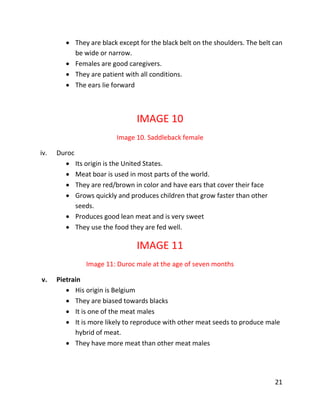
2.3. Equipment
2.4. Project starter food
2.5. Project operating costs
2.6. Pig feed requirements
3. 4 principles of success in pig farming
3.1. Design techniques
3.2. Protect yourself from diseases
3.3. The best feed for pigs
3.4. The best pig seeds
4. Production systems in pig farming
4.1. Fattening
4.2. Farrow to finisher (Breeding and fattening)
4.3. Producing seeds (Breeders)
The second part
1. Introduction
2. Care and education of different ages of pigs
2.1. How to breed a female and raise a pregnancy?
2.2. How to produce and raise piglets until weaning along with the care of
the lactating sow?
2.3. Feeding pigs according to age and weight requirements
2.4. How to choose and raise females that are prepared as parents?
2
2.5. How to choose and raise males
2.6. How to use males to mate females?
3. Operation and management of the pig project
3.1. Breeding education for pig project owner and staff
3.2. Responsibilities of the pig project owner
3.3. Record keeping
3.4. How to reduce pig feed costs?
3.5. How to reduce medical care costs in the project?
4. Some important diseases / problems that affect the economy in pig farming
4.1. Mortality of piglets from birth and just after weaning
4.2. Eczema (Mange) on the skin of pigs
4.3. Worms in Pigs
4.4. Reproductive diseases
4.5. Swine fever (African swine fever)
3
THANK YOU
I thank the almighty God for giving us many blessings in pig farming. Many thanks
go to my wife, Anna for encouraging me and giving me the time to write this
book.
Also, many thanks go to all the members of the Tanzania Pig Breeders Association
(TAPIFA) for giving me various opportunities to share our experience in pig
farming and also to be able to bring the best pig seeds to this country.
Finally, I would like to thank all breeders in various fields for encouraging me to
write this book.
God bless all in pig farming!
4
1. Introduction
Modern pig farming is a business like any other business and this farming has its
own principles that if followed correctly, good profits are obtained and if they are
not followed, the result is a loss. Unfortunately, many breeders in Tanzania breed
very locally and without following the rules, and therefore the breeding is not
productive. Pig breeding is a science. This little book tries to provide a guide to
the best and most productive breeding of pigs, based on the experience of
breeders who, by the power of God, have been able to breed modernly with
common Tanzanian resources.
1.1. Why is pig farming a profitable business??
 Pigs reproduce quickly. Pigs can give birth on average 2.5 times a year (two
consecutive years give birth 5 times) and can give birth to 12-15 children on
average although it happens to give birth to 20 children or more
 Pigs are fast. If you get good seeds, the pig can reach 90 kg or more within 5
months
 There are a lot of pork products and they are easily available. We have all types
of grain and grain products that are suitable for pig feed. Also all kinds of
proteins are available in the country
 Pork is a favorite meat of many. So the pork market is big in this country.
1.2. Why are many pig projects in this country not doing well?
The truth is that the farmer needs time to learn this entrepreneurship in practice
until he can afford it well and many projects die in the first 1-2 years. Due to many
years of breeding experience, including meeting and teaching many breeders, the
following are the reasons why many projects die within 1-2 years.
 It takes 1-2 years from the time you start farming until you start seeing the
fruits of your farming. Many breeders when they start breeding do not know this
fact. That's why we always advise that " start small with big goals" (Start small,
dream big) that is, start a small project with big goals: This will give you time to
learn from the various challenges that exist. Pig farming is like the steps of a small
child's growth and every step the breeder learns and becomes better. It is like a
5
child, when it is born he can't even sit, if he sits he needs to crawl, if he crawls he
needs to walk, if he walks he needs to run, etc. and every step he crosses
becomes a better human being.
 Lack of pig breeding education and the business that comes from that breeding.
Many breeders start breeding with the advice of relatives and close relatives, who
also do not have enough education about this entrepreneurship. They start
breeding with the wrong advice (They start on the wrong foot)
 Many breeders do not do what they are taught. Many breeders who get a
chance to be on platforms that provide education on entrepreneurship in pig
farming do not do what they are taught, either because they do not believe what
they are taught or do not allocate enough time to do what they are taught.
 Lack of patience. Many breeders lack the patience to learn and give up when they
encounter various challenges and make many projects die.
 Lack of reliable care from veterinarians. Many doctors do not have knowledge
and experience with pig farming and its diseases, so they fail to properly serve pig
farmers
 Lack of Capital: Pig farming requires capital to buy land, build infrastructure and
also the cost of feed to start the project.
2. Economic factors to prepare before starting pig farming.
When considering starting a pig breeding project, consider several economic
factors as follows:
2.1. Area/Land:
Pig farming requires a breeding area and the size of the area depends on the size
of the project and future plans. When looking for a breeding area, consider the
following:
 The breeding area should not be in the middle of people's residences
 The size of the area depends on the size of the future project.
 The area should be easily accessible by car or other fire engine
 Availability of construction materials at affordable prices
 A reliable source of water
 Availability of affordable food
6
 Transportation costs when delivering food and taking animals to market
 The distance to the market or the ease of getting your animals to the market
2.2. Structural methods
The pig project requires the following infrastructure:
 Pig sheds
 Houses for staff accommodation
 Store for animal feed and other foods
 Water system including pipes, tanks, drinking water (auto drinkers/drinking
nipples) and water source. If the water source is a well or pond, it means a
water pump will be needed.
 Scope around the sheds: It doesn't have to be expensive like fence wire, but
there are many plants like thorn that can be used to make a fence to prevent
unauthorized people from entering the project.
2.3. Equipment
In the field, various equipment will be needed such as buckets, brooms, mops,
trolleys, speeders, etc. for cleaning.
2.4. Project starter food
It is important to note that pig farming requires 1-2 years from starting the
project to having animals for sale (This depends on the breeding system). So the
breeder needs to have enough capital to buy food to feed the animals until he
starts making a profit.
2.5. Project operating costs
 Food is the biggest operating cost of a piggery project so it is very important.
 Using the right combination of food for each age of the pig
 Avoiding wastage of food during feeding
 Mixing the food, yourself at the farm to reduce costs
 Buy cheap mixed; food benefit during the harvest season
7
 Breeding the best pig seeds that grow fast, that use food well (feed efficiency)
and produce good meat
 Other Expenses, it is like salaries for workers, transportation, fuel for machines,
medicine, veterinary medicine, soap, clothing for farmers, equipment and
purchase of animals depending on the needs of the project.
2.6. Food needs of pigs
It is very important to know the food requirements for pigs because food is 60-
80% of the total cost of running a pig project.
On a farm that follows good animal husbandry practices using quality feed, the
following is a guide to pig feed requirements
2.6.1. Females
 If weaned (dry) and pregnant (gestating) - 2kg/day for 280 days. Feed 560kg
of food
 While breastfeeding (Lactating)-6kg/day for 56 days. Total 336kg of food
2.6.2. Male
 2kg/day for 365 days. Total 730 kg of food.
2.6.3. Children 14-35 days (Creep feeding)
 1kg for 21 days. Total 1kg of food
2.6.4. Weaned Children(weaners)
 0.81kg/day for 49 days. Total 40kg of food
2.6.5. Growing Piglets (growers)
 1.43kg/day for 35 days. Total 50kg of food
2.6.6. Seniors (Finisher)
 2.2-2.5/day for 50 days. Total 110-125 kg of food
8
Profit in pig farming is in growing and selling (marketable pigs) at least 20 children
per female per year. A male can serve (breed) 15 females and thus the food
requirements from producing and growing one pig until it is sold at 6 months and
weighing 100kg or more will be as follows.
 Female (896kg/20 children)-45kg
 Male (730/20 children/15 females) - 2.4kg
 Creep feeding 1kg
 Weaners 40kg
 Grower 50kg
 Finisher 125kg
 Total-264 kg of food for one pig
Those requirements are on the high side. So it is important to prepare to buy and
store food at a price when it is easy to keep food costs low without affecting the
quality of food.
The cost of food for a breeder who buys everything in the market is tshs. 500-
900/kg (2017 market). The costs of a breeder who cultivates grains such as
corn/sorghum and sunflower for pigs is less than tshs.400kg.
The cost of food for one pig is tshs. 132000-237600 for the breeder who buys
everything and less than tshs. 105,600 for the breeder who cultivates grain and
other crops that are pig food!
A 100kg pig provides at least 70kg of slaughter meat (excluding head, legs and
offal) and the price of meat in general is tshs. 5000-6000/kg. So the breeder
expects to get 350000-420000 tshs for one pig. Now the profit for the breeder will
depend on the cost of food as well as other operating costs as well as the cost of
transporting the animals to the market.Also, the breeder will get more profit if he
sells meat directly to the consumer where the price is higher and he will sell
everything including the head, legs and insides.
3. 4 principles of success in pig farming
9
Profit in pig farming is to produce and raise at least 20 piglets per female per year.
This is like 85% of all pigs born in a year because there are those who will breed
after birth and before weaning but there are those who will die after weaning for
various reasons!
In order to be able to produce and grow at least 20 piglets per female per year, it
is necessary to observe the following principles of success in pig breeding:
3.1. Structures and methods
In the previous lesson we learned that the pig project requires various structures
and methods. In this lesson we will learn the structures and techniques where the
pig will live, that is the sheds.
Structures are what sets the environment in which the animal will live. The right
environment enables the animal to reach its potential.
The environment can prevent the animal from reaching its potential for growth,
reproduction, consumption, etc.
The type of barns depends on the age of the pigs and the production system in pig
farming
So consider the following when building pig sheds
 Build sheds that allow good air circulation. This will help the health of the animals
and also prevent the environment for disease-carrying insects to reproduce easil.
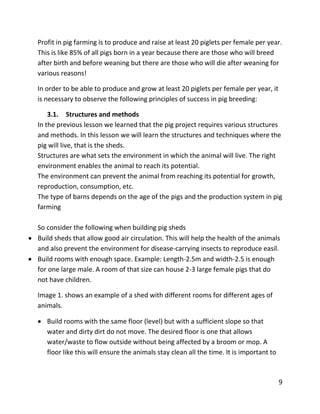
 Build rooms with enough space. Example: Length-2.5m and width-2.5 is enough
for one large male. A room of that size can house 2-3 large female pigs that do
not have children.
Image 1. shows an example of a shed with different rooms for different ages of
animals.
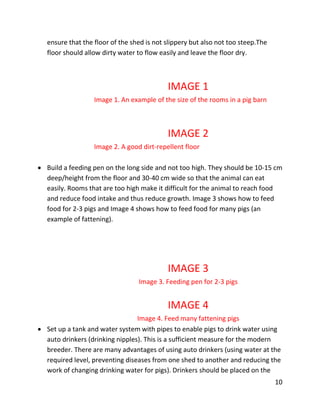
 Build rooms with the same floor (level) but with a sufficient slope so that
water and dirty dirt do not move. The desired floor is one that allows
water/waste to flow outside without being affected by a broom or mop. A
floor like this will ensure the animals stay clean all the time. It is important to
10
ensure that the floor of the shed is not slippery but also not too steep.The
floor should allow dirty water to flow easily and leave the floor dry.
IMAGE 1
Image 1. An example of the size of the rooms in a pig barn
IMAGE 2
Image 2. A good dirt-repellent floor
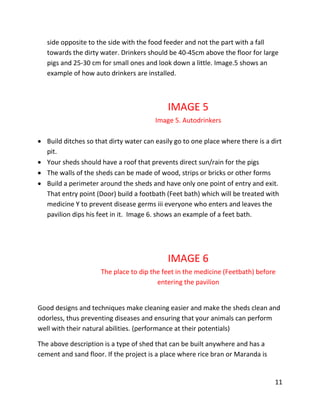
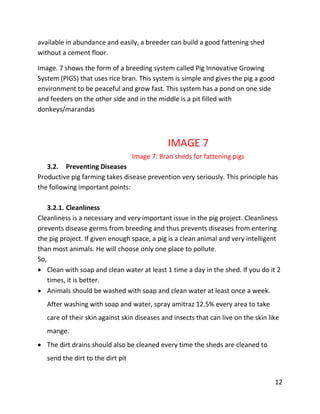
 Build a feeding pen on the long side and not too high. They should be 10-15 cm
deep/height from the floor and 30-40 cm wide so that the animal can eat
easily. Rooms that are too high make it difficult for the animal to reach food
and reduce food intake and thus reduce growth. Image 3 shows how to feed
food for 2-3 pigs and Image 4 shows how to feed food for many pigs (an
example of fattening).
IMAGE 3
Image 3. Feeding pen for 2-3 pigs
IMAGE 4
Image 4. Feed many fattening pigs
 Set up a tank and water system with pipes to enable pigs to drink water using
auto drinkers (drinking nipples). This is a sufficient measure for the modern
breeder. There are many advantages of using auto drinkers (using water at the
required level, preventing diseases from one shed to another and reducing the
work of changing drinking water for pigs). Drinkers should be placed on the
11
side opposite to the side with the food feeder and not the part with a fall
towards the dirty water. Drinkers should be 40-45cm above the floor for large
pigs and 25-30 cm for small ones and look down a little. Image.5 shows an
example of how auto drinkers are installed.
IMAGE 5
Image 5. Autodrinkers
 Build ditches so that dirty water can easily go to one place where there is a dirt
pit.
 Your sheds should have a roof that prevents direct sun/rain for the pigs
 The walls of the sheds can be made of wood, strips or bricks or other forms
 Build a perimeter around the sheds and have only one point of entry and exit.
That entry point (Door) build a footbath (Feet bath) which will be treated with
medicine Y to prevent disease germs iii everyone who enters and leaves the
pavilion dips his feet in it. Image 6. shows an example of a feet bath.
IMAGE 6
The place to dip the feet in the medicine (Feetbath) before
entering the pavilion
Good designs and techniques make cleaning easier and make the sheds clean and
odorless, thus preventing diseases and ensuring that your animals can perform
well with their natural abilities. (performance at their potentials)
The above description is a type of shed that can be built anywhere and has a
cement and sand floor. If the project is a place where rice bran or Maranda is
12
available in abundance and easily, a breeder can build a good fattening shed
without a cement floor.
Image. 7 shows the form of a breeding system called Pig Innovative Growing
System (PIGS) that uses rice bran. This system is simple and gives the pig a good
environment to be peaceful and grow fast. This system has a pond on one side
and feeders on the other side and in the middle is a pit filled with
donkeys/marandas
IMAGE 7
Image 7: Bran sheds for fattening pigs
3.2. Preventing Diseases
Productive pig farming takes disease prevention very seriously. This principle has
the following important points:
3.2.1. Cleanliness
Cleanliness is a necessary and very important issue in the pig project. Cleanliness
prevents disease germs from breeding and thus prevents diseases from entering
the pig project. If given enough space, a pig is a clean animal and very intelligent
than most animals. He will choose only one place to pollute.
So,
 Clean with soap and clean water at least 1 time a day in the shed. If you do it 2
times, it is better.
 Animals should be washed with soap and clean water at least once a week.
After washing with soap and water, spray amitraz 12.5% every area to take
care of their skin against skin diseases and insects that can live on the skin like
mange.
 The dirt drains should also be cleaned every time the sheds are cleaned to
send the dirt to the dirt pit
13
 All the environment surrounding the sheds should be cleaned by removing
grass, bushes and other debris.
3.2.2. Bio-security
Bio-security is the various measures and procedures taken to protect the pig
project from diseases.
 How humans, other animals/insects can bring diseases to your farm
Our world is full of invisible organisms (Micro-organism) everywhere: on the
ground, liquids, houses, means of transport, the clothes we wear, our bodies
and the air. Microbes are organisms that are not visible to the naked eye that
cause various diseases and are everywhere as I listed above, examples of
microbes are bacteria, viruses, etc. So every place a person passes by, he finds
microbes and when he leaves, he leaves with some of them on his body, on
clothing (clothes and shoes) etc. In the same way, when a vehicle goes from
one place to another, it carries microbes on any part of the vehicle, including
the tires. When a pig goes from one farm to another, it carries microbes from
that farm to another. The immune system of any animal is fighting all the time
with these microbes wherever the animal goes or when another animal or any
new entity arrives in its environment. When you see an animal suffering from
a certain disease, it means the following:
 microbes have become many in that part to exceed the immune system of
the animal
 the animal's immunity has decreased due to lack of good nutrition or due to
suffering from another disease.
On any pig project there are microbes. The immunity of animals in a farm is used
to the microbes of that environment and I was able to fight them. When you
14
develop filth in it and be able to fight it. When you introduce dirt into the project
and also host it on a large scale, they overwhelm your pig's immune system and
make them sick. Insects and animals like flies, wasps and mice bring foreign
microbes to your farm that can cause disease. This is true for any animal project
such as pigs, chickens, cows, rabbits, ducks etc.
When anyone (this includes the owner of the farm) comes to your farm, he comes
with other microbes in his body and on his clothes. Any transporter that comes to
your farm brings with it other microbes. When your workers leave the farm to
walk or the neighboring fields, they return with microbes to your farm! These
foreign microbes can bring diseases to your animals. And some diseases have no
prevention or cure.
That's why we say your pig breeding project is a restricted area.
Do not welcome strangers to the farm without necessary reasons. Visiting a
commercial farm with the intention of learning is not the most basic reason
because there are many other ways to teach someone without coming to your
farm. Many people like to visit farms as a form of tourism!! If you want people to
come to the farm to learn, organize a farm class, a commercial farm is not a place
for people to visit because of teaching it, otherwise you invite loss. This is true for
every animal project, not only pigs but also others like chickens, cows and so on.
You, the farmer and your workers, when you go from another place to your farm,
do the following:
 Shoes should be dipped in a foot bath containing a medicine that kills germs
that cause diseases (disinfectant)
15
 Strangers' clothes should be removed, and they should not enter the
pavilions
 It is advised to take a shower and wear the clothes in the field.
 Any means of transport, if there is a reason to come to the farm, should be
sprayed everywhere and it is good to have a place to load and unload
outside the scope of the farm.
Build a culture following
 Apply disinfectant regularly to the indoor and outdoor environment of your
sheds.
 Spray regularly inside and outside the sheds to kill and prevent the
breeding of flies, wasps, cockroaches and mice. These insects/animals bring
diseases to your project.
3.2.3. Vaccination and Treatment
Make sure your animals get the correct and timely prevention and treatment.
Immunity prevents animals from getting immune diseases and treatment cures
when the animal is bitten and thus avoids other infections.
3.2.4. Better Nutrition
Good nutrition includes enabling the animal to grow and reach the intended
weight and is also part of the principle of preventing pig diseases. An animal that
gets good nutrition, its body has strong immunity to fight against various diseases.
So the animal does not get sick easily and if it gets sick it recovers quickly.
3.3. Better nutrition for pigs
Good nutrition for pigs is very important for the breeder to be able to get a
reliable profit and this is where most of the operating costs are and it is also
16
where the success or failure of the project is shown. Food is 60-80% of the cost of
running a project. Pigs need good food with the right combination of the
following foods:
3.3.1. Energy
Energy comes from starchy foods and the best starch for pigs is found in corn.
Various grains (corn, rice, wheat, etc.) and roots (such as cassava) contain a
certain amount of starch, but not in the same quantity and quality as corn. Millet
that is not bird resistant can be used instead of corn.
What you need from carbohydrates is digestible energy (Digestible Energy-
DE).Energy-yielding foods are up to 70% in the optimal pig feed mix
3.3.2. Protein
The biggest challenge for many Tanzanian breeders is in protein sources because
protein sources are expensive. Protein is very important for the growth of pigs,
especially up to 4 months, because it is the time when the pig builds muscles
(meat) and bones, so the meat and structure (structure) of the pig is built here.
Most foods contain crude protein (crude protein-CP) in varying amounts as shown
in the following table:
Table 1: Protein levels
Food Protein level (%)
Maize 8
Corn barn 10
Rice bran 12
Wheat bran 13-15
Seafood 60
Sunflower seeds 30
Soya 24
Soyabean crops 44-46
Animal blood 90
17
I don't really like the use of animal blood because it can be a source of diseases.
There are very important proteins (amino acids) needed for pigs such as lysine,
methionine, threonine and not every food contains those proteins). Corn, for
example, has a small amount of lysine while seafood has a lot of lysine.
Protein is also found in some leaves such as quince, but it contains alpha-alpha
3.3.3. Oil and fat
These oils are also very important in the body because they are needed in the
construction of various organs such as muscles and cartilages. It also analyzes the
level of energy in the brain and comes from oil seeds (such as soy, sunflower,
cotton, etc.) and their seeds.
3.3.4. Minerals
It also analyzes the level of energy in the brain and comes from oil seeds (such as
soy, sunflower, cotton, etc.) and their seeds. These minerals are found in
limestone and bone or DCP. Also on various leaves that the pig eats to a very
small extent
3.3.5. Multi- Vitamin
Vitamins are also very important in pig nutrition. These are available as pre-mix
produced by various companies in this country. These pre-mixes also contain the
right amount of vitamins and minerals needed in pig nutrition. Some of the pre-
mix available in this country are like pigmix, pigmix, pigextra, pigboost etc.
An optimal pig feed must have the correct ratio of CP and DE for a given age of
pig. So there is a high level (feed maximum inclusion) in every food that is mixed
to make pig nutrition
18
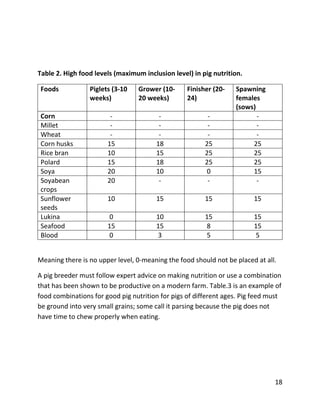
Table 2. High food levels (maximum inclusion level) in pig nutrition.
Foods Piglets (3-10
weeks)
Grower (10-
20 weeks)
Finisher (20-
24)
Spawning
females
(sows)
Corn - - - -
Millet - - - -
Wheat - - - -
Corn husks 15 18 25 25
Rice bran 10 15 25 25
Polard 15 18 25 25
Soya 20 10 0 15
Soyabean
crops
20 - - -
Sunflower
seeds
10 15 15 15
Lukina 0 10 15 15
Seafood 15 15 8 15
Blood 0 3 5 5
Meaning there is no upper level, 0-meaning the food should not be placed at all.
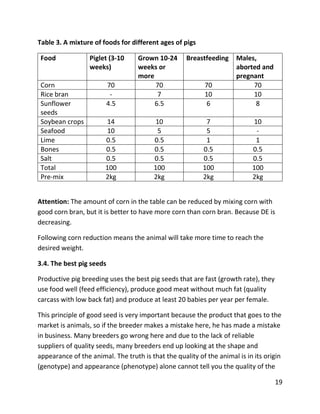
A pig breeder must follow expert advice on making nutrition or use a combination
that has been shown to be productive on a modern farm. Table.3 is an example of
food combinations for good pig nutrition for pigs of different ages. Pig feed must
be ground into very small grains; some call it parsing because the pig does not
have time to chew properly when eating.
19
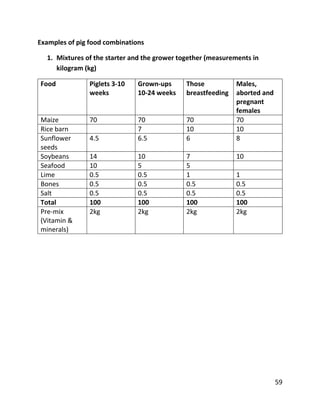
Table 3. A mixture of foods for different ages of pigs
Food Piglet (3-10
weeks)
Grown 10-24
weeks or
more
Breastfeeding Males,
aborted and
pregnant
Corn 70 70 70 70
Rice bran - 7 10 10
Sunflower
seeds
4.5 6.5 6 8
Soybean crops 14 10 7 10
Seafood 10 5 5 -
Lime 0.5 0.5 1 1
Bones 0.5 0.5 0.5 0.5
Salt 0.5 0.5 0.5 0.5
Total 100 100 100 100
Pre-mix 2kg 2kg 2kg 2kg
Attention: The amount of corn in the table can be reduced by mixing corn with
good corn bran, but it is better to have more corn than corn bran. Because DE is
decreasing.
Following corn reduction means the animal will take more time to reach the
desired weight.
3.4. The best pig seeds
Productive pig breeding uses the best pig seeds that are fast (growth rate), they
use food well (feed efficiency), produce good meat without much fat (quality
carcass with low back fat) and produce at least 20 babies per year per female.
This principle of good seed is very important because the product that goes to the
market is animals, so if the breeder makes a mistake here, he has made a mistake
in business. Many breeders go wrong here and due to the lack of reliable
suppliers of quality seeds, many breeders end up looking at the shape and
appearance of the animal. The truth is that the quality of the animal is in its origin
(genotype) and appearance (phenotype) alone cannot tell you the quality of the
20
seed. The history of the animal is what gives you its origin and quality. So it is very
important to buy pig seeds from a good and productive seed producer.
3.4.1. Type of pig seeds (Breeds)
When we say the type of Pig Seeds we mean those that were developed many
years ago and found seeds that are known to have the same origin (pure
lines/Pure breeds) and there are many. These seeds were brought to this country
by missionaries many years ago. Most of these seeds have lost their potency after
being produced without following production rules. Here we will look at the seeds
that are most used in the world in commercial pig breeding and that have been
able to reach this country.
i. Largewhite or Yorkshire
 His origin is England
 They are white and have a large body as the name implies
 Females have a lot of milk and are good babysitters
 Ears standing up is the meaning of shire there at the end.
IMAGE 8
Image 8. One year old large white male
ii. Landrace
 His origin is Denmark
 They are white, thin and tall
 Females have more milk and are better babysitters than others
 The ears lie forward to cover the face
IMAGE 9:
Image 9: Landrace female at six months old
iii. Saddleback
21
 They are black except for the black belt on the shoulders. The belt can
be wide or narrow.
 Females are good caregivers.
 They are patient with all conditions.
 The ears lie forward
IMAGE 10
Image 10. Saddleback female
iv. Duroc
 Its origin is the United States.
 Meat boar is used in most parts of the world.
 They are red/brown in color and have ears that cover their face
 Grows quickly and produces children that grow faster than other
seeds.
 Produces good lean meat and is very sweet
 They use the food they are fed well.
IMAGE 11
Image 11: Duroc male at the age of seven months
v. Pietrain
 His origin is Belgium
 They are biased towards blacks
 It is one of the meat males
 It is more likely to reproduce with other meat seeds to produce male
hybrid of meat.
 They have more meat than other meat males
22
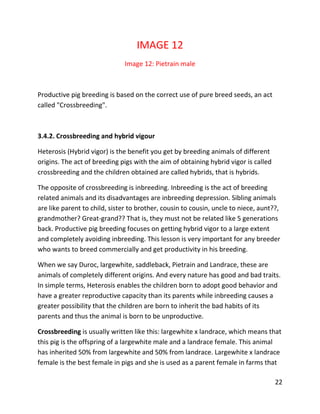
IMAGE 12
Image 12: Pietrain male
Productive pig breeding is based on the correct use of pure breed seeds, an act
called "Crossbreeding".
3.4.2. Crossbreeding and hybrid vigour
Heterosis (Hybrid vigor) is the benefit you get by breeding animals of different
origins. The act of breeding pigs with the aim of obtaining hybrid vigor is called
crossbreeding and the children obtained are called hybrids, that is hybrids.
The opposite of crossbreeding is inbreeding. Inbreeding is the act of breeding
related animals and its disadvantages are inbreeding depression. Sibling animals
are like parent to child, sister to brother, cousin to cousin, uncle to niece, aunt??,
grandmother? Great-grand?? That is, they must not be related like 5 generations
back. Productive pig breeding focuses on getting hybrid vigor to a large extent
and completely avoiding inbreeding. This lesson is very important for any breeder
who wants to breed commercially and get productivity in his breeding.
When we say Duroc, largewhite, saddleback, Pietrain and Landrace, these are
animals of completely different origins. And every nature has good and bad traits.
In simple terms, Heterosis enables the children born to adopt good behavior and
have a greater reproductive capacity than its parents while inbreeding causes a
greater possibility that the children are born to inherit the bad habits of its
parents and thus the animal is born to be unproductive.
Crossbreeding is usually written like this: largewhite x landrace, which means that
this pig is the offspring of a largewhite male and a landrace female. This animal
has inherited 50% from largewhite and 50% from landrace. Largewhite x landrace
female is the best female in pigs and she is used as a parent female in farms that
23
breed commercially and productively. Most pig breeding companies call this
female F1. This is the female known as camborough produces by an American
company called Pig Improvement Company (PIC)
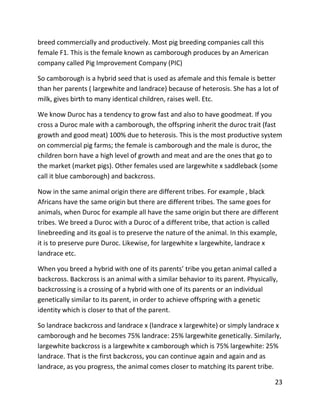
So camborough is a hybrid seed that is used as afemale and this female is better
than her parents ( largewhite and landrace) because of heterosis. She has a lot of
milk, gives birth to many identical children, raises well. Etc.
We know Duroc has a tendency to grow fast and also to have goodmeat. If you
cross a Duroc male with a camborough, the offspring inherit the duroc trait (fast
growth and good meat) 100% due to heterosis. This is the most productive system
on commercial pig farms; the female is camborough and the male is duroc, the
children born have a high level of growth and meat and are the ones that go to
the market (market pigs). Other females used are largewhite x saddleback (some
call it blue camborough) and backcross.
Now in the same animal origin there are different tribes. For example , black
Africans have the same origin but there are different tribes. The same goes for
animals, when Duroc for example all have the same origin but there are different
tribes. We breed a Duroc with a Duroc of a different tribe, that action is called
linebreeding and its goal is to preserve the nature of the animal. In this example,
it is to preserve pure Duroc. Likewise, for largewhite x largewhite, landrace x
landrace etc.
When you breed a hybrid with one of its parents’ tribe you getan animal called a
backcross. Backcross is an animal with a similar behavior to its parent. Physically,
backcrossing is a crossing of a hybrid with one of its parents or an individual
genetically similar to its parent, in order to achieve offspring with a genetic
identity which is closer to that of the parent.
So landrace backcross and landrace x (landrace x largewhite) or simply landrace x
camborough and he becomes 75% landrace: 25% largewhite genetically. Similarly,
largewhite backcross is a largewhite x camborough which is 75% largewhite: 25%
landrace. That is the first backcross, you can continue again and again and as
landrace, as you progress, the animal comes closer to matching its parent tribe.
24
These landraces or largewhite first backcross have a performance similar to
camborough in all aspects.
4. Systems in Pig Breeding
There are various breeding systems depending on the breeder’s goals. It is very
useful for a breeder to grow step by step in breeding to gain experience to be able
to do better in his breeding. Below are the production systems in pig farming
along with their challenges and benefits:
4.1. Fattening
Here the breeder buys weaners/ growers (8-12 weeks old) and raises them until
they are sold / slaughtered at 60 or 90 kg or more. This system is the simplest and
the investment in technical structures is cheaper than other systems. There is no
investment in seeds and there are no parents (Breeder). This is the system that is
suitable for a new farmer who wants to learn pig farming and get results quickly
because it is an easy system to run and manage.
The challenge of this system is the availability of weaners / growers to grow fast
and produce good meat.
4.2. Farrow to Finisher (breeding and fattening)
The breeder produces children and fattens them. All children born are fattened
and sold and this is called Terminal System. Therefore, the breeder needs
structures and techniques to breed (males and females) and also to fatten them.
 He needs a pair of meat boars (meat boars) and females
 Education and skills are needed to raise males, females, pregnant females,
lactating females and produce children and raise them well
The challenge of this system is
 More cost of technical structures and breeding stock (males and females)
 Cost and skills of raising breeding stock and children
25
 If the males and females get tired/old, it is necessary to buy others from a
reliable breeder
This system’s biggest advantage is the ability to produce meat with the same
quality all the time (consistent quality meat) and thus deliver it 25 of 55
acceptable crops in the market (consistently)
If you want to make it commercial, the male used in this system in many parts of
the world is Duroc because of its fast growth and good and sweet meat. In other
parts, the Hampshire type male is used and also the hybrid male derived from
Pietrain and Duroc.
The high level females used in this sytem are hybrids called F1 or camborough as
we have seen in the past. Also hybrids derived from largewhite and saddleback
(blue camborough) as the color is not a problem in the relevant market. In the
same way largewhite of landrace backcrosses are used for that purpose.
4.3. Breeders
These are producers of various seeds for systems and 4.1 and 4.2 above and sells
weaners/ growers. However, animals that are not bought older than 12weeks,
they are fattened and sold as finishers (market pigs).
This system has all the challenges as in 4.2 above and the additional ones are as
follows
 The breeder needs to invest in technical structures and different types of
pig seeds that are natural (pure breeds)
 The breeder needs more knowledge of seeds and seed production (cross
breeding). This is very important to avoid producing inbreeding.
 The breeder needs to keep reliable and honest records to be able to sell
real and good seeds to other breeders.
This is the most difficult system of all, and requires investment in seeds and
technical structures as well as sufficient knowledge in raising pigs and various pig
seeds!!
26
1. Introduction
This book is a continuation of our books on productive pig farming and is the
second part of our books called "Principles of Productive Pig Farming". The reader
of this book is expected to have read the first part of this book. If still, it is
recommended that the reader find and read the book "Principles of Productive
Pig Breeding Part One" because it contains many basic information that the
breeder needs to know in pig breeding before reading the second part of this
book.
2. Care and Education of Various Peers of Pigs
The care and rearing of pigs depends on the age of the pig, and is the main topic
in this section.
2.1. How to Breed a Female and Get Pregnant?
It is very important to learn the correct way to breed a female and how to raise a
pregnancy. let's start when breastfeeding.
When the female is lactating
The female should be given good nutrition during lactation. She should be given
nutrition for lactating pigs (Lactating meal) in the amount of 3 kg including 0.3 x
the number of children per day. (Please see the table at the end of the book
with examples of food formulas for different ages and groups of pigs. Also,
rearing food can be used to feed a lactating female) Example: this is about 6 kg
per day for a female with 10 piglets. The food should be divided into 3 times, eat
3 times a day. This will ensure that she does not lose more than 10% of the weight
she had while pregnant while breastfeeding. If a female loses a lot of weight while
nursing, it will take a long time to regain her health and thus delay her return to
heat.
27
Weaning day
On the day of ceasing to wean, the female should not be given any food. A little
water is not bad. This is called flushing and it is very important because it
prepares the female for the next birth by preventing milk production and
stimulating the production of hormones involved in reproduction. This is also the
right day to give the female protection from worms.
The followings days
On the 2nd to 4th day, she should be given 4 kg of adult food (finisher) per day or
more depending on her appetite. This food should be high in energy. For example,
she can be given the finisher or ground corn mixed with karma, 50-100 grams of
sugar, 1 kg of food.
This will cause the sugar to increase in the body (insulin spike) which will activate
the hormones that ripen the eggs (ovum) and cause more eggs to mature. This
increases the chances of having more mature eggs and increases the chances of
having more children. Day 5 onwards; reduce the feed slowly back to the normal
level {Now the normal feed rate depends on the age of the pig and its intake. The
breeder should know how much food the pig in question usually eats per day. It is
usually 2 to 3 kg per day.
If you follow the steps described, the female will come into heat within 3 to 7
days after weaning, depending on the type of seed. There are many signs of pigs
being in heat and not all of them will appear together and they depend on the
type of pig. The breeder should know well the behavior and nature of his pigs and
quickly recognize if he gets cold.
28
 Stops or slows down eating
 The vagina changes color and swells. The vagina also produces fluid or
white mucus. If it is a white pig, the vagina turns red.
 The female does not eat in the pavilion. He can be seen raising his ears as if
he is listening to something and walking. You may gag and foam at the
mouth.
 He can breed other females if he lives with other pigs.
 Being pressed on the back near the shoulders, he stands still and raises his
head and ears as if he is listening to something.
Mating day
Now the transition to the female to concentrate heat takes about three days. The
female and male should be well bathed and clean before breeding. When the
female is hot enough to stand, she should be taken to the male's shed and bred. If
the heat has not cooled down, she should be removed immediately from the
male's shed. Sometimes the male needs to be helped to ensure that the male is
aimed at the female's vagina. This should be done using clean and gloved hands.
After the female is bred, she should be removed from the male's shed
immediately. The female should be sent back to the male to be planted after 12
to 24 hours. This is because the female's reproductive eggs mature and travel to
the uterus 24 to 42 hours after standing heat and it is at this time that they can be
fertilized. Experts say that if a female is fertilized twice in that way, it is enough to
conceive. After being promoted; the female should eat food at a normal level and
not be disturbed. Pigs are pregnant for an average of 114 days (3 months, 3
weeks, 3 days)
29
3. So it takes 114 days after the first mating day to find the date of the female
giving birth. It is normal for a female to give birth 2 or 3 days late or to give birth
1 to 2 days.
18 to 21 days after planting
A female sow usually lays 18 to 21 eggs when she is in heat. Not all eggs are
fertilized when they meet the sperm of a male and it is also possible that all eggs
are not fertilized (fertilization) or those that are fertilized do not become children
(embryo), which means that the pregnancy is not conceived. If the sow does not
get pregnant, she will go into heat again between the 18th and 21st day after
insemination. So it is important to examine the female during those days so that
if she repeats the heat, she should be bred again.
Day 35 to 42 Since Planting
If a female pig is pregnant, some of the children will fail to grow due to various
reasons including lack of nutrition for the female and diseases. So usually those 18
to 21 eggs do not all grow into babies. Any cubs that die before the 35th day after
the female is implanted are sucked back into the female's body. And if there are
less than three adult children by the 35th day, the body absorbs them and the
female heats again on the 40th to the 42nd day. So it is very important for the
breeder to look at his female that was inseminated on day 40-42 to make sure
she has not returned to heat and to assure herself that the pregnancy is
developing.
Feeding of Pregnant Sows
30
It is very important that a pregnant pig is fed the right diet to ensure the growth
of the babies in the womb and also to ensure the health of the sow is good. Sows
should be fed Gestation feed. From the moment the female is planted until the
pregnancy reaches the age of 80 days, the children become small in shape and
during that time the important organs of the children are completed. Throughout
this period, the pregnant pig should be given food in a normal amount (eg 2 kg
per day).
From the 81st to the 105th day of pregnancy, the sow should be given more food
per day from normal (for example 2 kg) to more (for example 3-3.5 kg) per day.
This is because this is the period when the piglets grow rapidly and gain weight, so
the nutrition of the pregnant sow must be increased to meet the growth needs of
the children and the pregnant sow.
In the last week of pregnancy (106-114 days), the pregnant female should reduce
the amount of food and be given food with a large amount of fiber. It is good that
the sow started to be given Lactating Feed. Leaves and fruits, if available, are a
suitable supplement at this time. Foods with a lot of fiber will help the female to
get to the toilet easily and remove the feces from the stomach. This will help the
female to give birth without problems. This will help the female to give birth
without problems.
Important!!!
 When we say that the normal amount that a pig eats is not necessarily 2 kg
but depends on the normal consumption of the pig in question. Remember
that the consumption of pigs also depends on the quality of food, the
weight of the pig and the appetite of the pig in question.
31
 A pregnant pig needs a lot of water to drink. Therefore, it is important for a
pregnant pig to have clean, safe, cool and sufficient water all the time in its
cage.
2.1. How To Produce And Raise Piglets Until Weaning With The Care Of A
Lactating Sow
In the previous lesson, we looked at how to breed a female and raise a pregnancy.
And we said the last weeks; a pregnant female should be given food with more
fiber than usual. The goal of the food is to ensure that the pregnant female does
not miss the toilet, because if she misses the toilet, she will give birth with
difficulty and may fail to give birth. Also, if she misses the toilet after giving birth,
she will lose her appetite and thus lead to not producing enough milk for the
children and if the children lack milk they will die.
Symptoms of approaching childbirth
Pigs are pregnant for 114 days and usually give birth on time. But it is also normal
to give birth up to 2 days or late until day 118 depending on the number of
children in the womb. As the days get closer, the pig's stomach increases and its
vagina increases in size and becomes red in color (if it is a white pig). Pay close
attention to the cleanliness of the pregnant pig's shed, including spraying
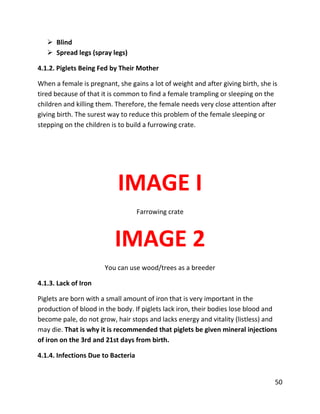
disinfectant. If you have a farrowing crate, the pregnant sow should be sent there
2 to 1 week before the farrowing date. This is important for the female to get
used to the environment in which she will give birth to her children. You can
deworm the female 2 to 1 week before giving birth. This will help newborns not
get worms and become weak and even die.
32
48 hours before giving birth, the udder drops further and the vagina becomes
larger. Pigs begin the distribution of sleeping (bedding): example; rice bran,
wooden pallets etc., if there are such as making a nest. If there is no place to
sleep, place it. At this time, if you try to milk your nipples, milk comes out. You eat
less and drink more water.
The day of birth
Urgent needs come out more often and in smaller amounts. Mucus can come out
of the vagina and fluid too. A pregnant pig does not eat but drinks a lot of water.
Important!
 The shed should be clean and dry, and the sleeping area should be clean.
 Prepare yourself with hand gloves and iodine- type medicine.
Time to give birth
 A pregnant pig should not be slaughtered.
 The birthing area should be heated or have a heated area for babies. Cold
kills most children in the first 14 days. It is important to know that the
female that gave birth does not like excessive heat, so the hot part of the
children should be on the side.
 Normally, the female starts giving birth by milking herself while lying on her
side.
 Put iodine in a small can
 Wear gloves and when the baby is born, wipe the face and nose to remove
the mucus so he can breathe easily. You can use a gloved hand or a cloth
clean too. Make sure you clean by washing with soap.
 Navel dipped in iodine medicine; this helps prevent infection enter piglets
body through navel. You can cut the umbilical cord and leave 10 to 15
centimeters. If your stalls are clean, it is not necessary to cut the umbilical
33
cord because the iodine is enough and the umbilical cord dries and breaks
within 1 to 2 days
 After birth so that he can get milk the beginning of the mother ( colostrum)
which gives the child protection against the new environment. The child
sucking increases the feeling for female to push and quickly give birth to
another child. babies usually come out quickly within every half hour a
baby is born.
 If the children are born late, you can give the mother an oxytocin drug. This
makes the uterus milk itself every now and then to make babies come out
and help the female give birth faster. Oxytocin also helps the female to
produce milk.
ATTENTION! Oxytocin should be used only if there is at least one child born, and
not otherwise. the use of oxytocin before even one child is born can cause
serious problems for the female giving birth, even leading to rupture of the
womb and the female death.
 If milk and children do not come out, she also shows restlessness: ask for
the help of the veterinarian or someone who knows how to help pigs give
birth.
 When the female gives birth, she produces two birth bags. Make sure this
has happened. if the placenta is delayed, you can inject oxytocin to help. if
it still doesn’t come out, contact a veterinarian to help you. Others inject
the female with an anti-biotic to prevent infection. It is not so important if
you pay attention to the cleanliness of your stalls.
After giving birth
 In the first 2 days, the female may not eat food and may drink just water.
 Usually on the 2nd or 3rd day the female starts eating.
 3-5 days make sure the female has access to the toilet. If the female misses
the toilet, she will lose her appetite and stop producing milk. Give her tasty
food also if there are leaves to give her, this will help her start using the
toilet earlier.
34
 The female should be given lactating feed grower is not bad all the time
while she is lactating.
Day 3 After Babies Are Born
 Children should be injected with iron.
 Children should have their teeth cut. Pigs are born with four (4) teeth in the
upper mouth and four (4) in the lower mouth to use them to win the teat
they want to suck (teat order). In order to overcome the suckling breast,
children fight and the teeth are the main weapon for this exercise. For
domesticated pigs, the teeth can hurt the udder and the breasts of the
lactating female, so they need to be cut.
Day 10 to 14 After Birth
Babies at the age of 10 to 14 days’ start drinking water and learning to eat food
 If there is a special area for children (creep area), then children should start
being given clean water and baby food (creep feed). Water and food should
be changed 3 times a day or once they are eating at least 300 to 400 grams
per day for one piglet.
 Continue to eat creep food until they are weaned on the day of 28 to 35.
 If there is no special area for children and there is no food for children, then
the children should be weaned at the age of 56 to 60days.
On the 21st day after birth
Piglets should be given an iron injection
Important: It is important to ensure high cleanliness in the stall of the lactating
female
Nutrition and Feeding for Lactating
Females, it is very important for lactating female to get good nutrition for her
health and also to produce milk with enough nutrients for children's health.
35
 A lactating female should be fed the food
She is lactating (lactating feed) all the time she is lactating and also enough
clean water all the time
 On average, the female eats 3kg plus 0.3 kg for each child she suckles.
For example, if a female has 10 children, she will need 6 kilos of food (3
kilos + 0.3 x 10). It is good that the food is divided and fed 3 times a day
(For example 2kg in the morning, afternoon and evening)
 It is good that children have a special area (creep areas) which they can
enter and exit to eat children's food. This will also help the lactating female
not to lose too much weight during breastfeeding and also be able to give
birth at a young age. As a result, the female will return to heat earlier and
produce more offspring per year. The advantage in pig breeding is that
each female gives birth to 20 to 32 children per year.
Weaning Day
Babies are usually weaned starting at 28 days old, depending on whether they
were eating baby food or not. Baby food prepares babies' stomachs to handle dry
food after weaning.
 On the day of weaning, the parent female should be removed from the
shed and leave the children there and not be removed.
 It is very important on the day the children are weaned that they stay with
what they know instead of going to a new environment because the new
environment together with being away from their mother will cause the
children to experience stress. Stress causes growth to decrease and also
make their body's immunity lower and they can easily be attacked by
diseases.
 On the day of weaning, the female should not be given food. This will
reduce production of milk and prepare the female to warm up quickly.
Problems When Babies Are Weaning and After Weaning
36
 Babies born with low weight (less than 1kg), usually die within the first 3
days. So it is very important that a pregnant female gets food nutrition so
that all her children are born with a good weight to withstand the
challenges of the first days after birth.
 Also the first 10 days after giving birth, it is very dangerous for small
children because the female 33 of 55 can sleep and kill the children, and
this often happens to females who are heavy and have given birth to many
children.
 Also if the shed of the mother with children is not cleaned enough, children
may have diarrhea. It is very important to consider cleanliness of the
lactating female shed.
 If the children did not eat baby food (creep) while nursing, they should be
given starter feed little by little in the early days. Do not give them a lot of
food in the early days because the stomach is not very used to dry food,
which can cause diarrhea (scour). If they start to have diarrhea, they should
be given a medicine containing sulfur or something else that can treat such
problems. After a while they will get used to dry food and forget their
mother. Diarrhea in children after weaning is a problem that occurs in
many breeding farms and can cause many children to die. So it is very
important to follow the procedure above or feed baby food while
breastfeeding.
2.2. Feeding Pigs According to Age and Weight
Requirements in this book " Part One" we explained that good pig nutrition must
have the right amount of energy, protein, oil and fat, minerals, vitamins and
water.
However, different ages of pigs require different levels of those foods. This will
enable age - appropriate growth as well as food costs. Piglets need more protein
than energy, but as they grow, the need for protein decreases and increase
energy requirements; this is why pigs are needed fed a different combination of
foods according to age and weight. There are four (4) groups of food
37
combinations from piglet when it starts eating until it is ready to be taken to the
(finisher stage) or be ready to be used as a parent (Breeding stock).
The breeder feeds food based on the ratio of protein and energy on food and
consider the food needs of different ages of pigs; he assures himself that his
animals weigh more than a kilo 100 at the age of 24 weeks (168days) only if he
uses quality seeds of pigs (hybrids) in his farm. Let's look at these groups of
combinations and age of pigs eating.
Creep Feed
Creep is food that is given to piglets when they are still young.
They absorb for the following purposes;
 Preparing the baby's stomach to digest dry food
 Giving the baby extra food and thus increasing growth during
breastfeeding.
 Enabling children to be weaned at young age (28 days old limit 35) and thus
enabling the female to return to production quickly. This will enable the
female to successfully produce 20 to 32 weaned children per year.
Children begin to be given baby food at the age of 10 to 14 days, to encourage
children to eat dry food at this young age.
 It should contain enough nutrients and especially easy-t-digest protein at a
level of 20% and a level of digestible energy (metabolized energy) of at
least 11 mega-joules. That is why the food usually contains foods of natural
origin milk.
 It should smell good. That is why it is recommended that if you make it
yourself and use soy, the soy should be fried (baked) instead of roasted by
machine, because fried soy has a good flavor.
 Tasty sugar but also fried soybeans to increase the sweetness of the food.
38
Piglets eat a very small amount of creep feed until the age of weaning and it is
necessary for each piglet to be eating an average of 300 to 400 grams the day
they are weaned. So while the cost of creep feed is high per kilogram, it is still a
small cost for one animal. If a piglet is properly fed creep feed, it is expected to
weigh 8 to 12 kilograms when it is weaned at the age of 28 to 35days. So the
piglet is weaned with good weight at a young age and he already eats dry food
well. This will enable him to reach a big weight when he is sold.
The correct use of creep food is as follows;
 You should have a place to keep creep food where the mother cannot
reach. This part being near their mother's head is better because at first
more peaceful when they are near their mother.
 Clean water water should be available all the time. Children start drinking
water before and eat after.
 Creep should be placed in places where the piglets can easily enter.
 Creep food should be put very little (half spoon at first) if dry and should be
changed 3times a day. Piglets eat more fresh food than that stayed for a
long time.
 The creep section should be as clean as their mother's shed.
 Creep feeding is a job that requires effort and attention, it requires
attentive and faithful young people to carry out the instructions. This is
very important since creep feed is expensive, you have to avoid food loss
shed1
Starter/Weaner Feed
This is a mixture of food that piglets eat immediately after weaning to enable
them to grow quickly and reach a weight of 26-30kg at the age of 77 to 84 days
having eaten 30 to 40 kg of the food per pig. This food has 18-19% protein and
digestible energy (metabolized energy) of at least 11 mega-joules.
Growing Feed (growers feed)
39
This is a mixture of food that piglets eat at the age of 85 days and weigh at least
26kgs to enable them to grow quickly and reach 50-80kg at the age of 4 months
(120 days) having eaten 50-80kg of that food for one. This food contains 16-17%
protein and digestible energy (metabolized energy) of at least 11 mega-joules.
Finisher Feed
Food that animals eat from day 120 until they are sold on day 160-180 or raised
on day 210 or when they are older. This food contains 14-15% protein and
digestible energy (metabolized energy) of at least 11 mega-joules.
Important:
 All animals from the time they start eating until four (4) months of age,
should be given food without limit (ad-libitum). If the sheds have lights,
they should be given food at night; every time they finish eating they
should be added. The period up to age of 4momths is when the pig is
building meat and fat and growth during this period will enable the quality
of the animal when it grows up; that is why animal must have good and
sufficient nutrition. It is only after the age of 4months that the animals
start to be given food on schedule of 2times a day; for example, a kilo 1 in
the morning at 4 o'clock and at 10 o'clock in the evening after cleaning
the stalls.
 When the animals reach the age of 4 month, they should be separated. The
males should stay in their shed and the females should stay in their shed to
avoid the males riding females at a young age and also disturbing females.
2.3. The best way to choose and raise gilts that are prepared as female parents
(Gilts care and selection)
Female (gilts) that will be used for reproduction must be carefully selected and
must come from parents with the qualities of giving birth to many children, with
enough milk and who nurse well until the time children are weaned. The selection
of the best females is done in two (2) phases;
40
Females at 3 months
Choose females based on the following characteristics:
 They are offspring known to have good breeding parents, many children
with a lot of milk and who breastfeed well.
 Come from a family with many children from 10 onwards
 They are the fastest growing females in the breed
 They are large and plump with strong legs and 12 more breasts.
 They should not have any disability.
Females at 5 to 6 months’ old
These females should be selected from the selected group when they are
3months old by checking the following additional features:
 They are the females that continued to grow faster.
 They are females that will show signs of heat earlier than others.
Visiting a male (Boar exposure)
It is very important that the females selected as parents are made boars
exposure. Boar exposure is the act of sending the females that are being prepared
to be parents (gilts) to a male matured equally for profit
 Enabling females to mature quickly (enhance sexual maturity)
 Increase the production of reproductive eggs (enhance ovum maturity and
production) and thus increase the possibility of carrying a pregnancy with
many children.
 Enable females to heat at the same time (estrus synchronization). This
exercise leads females to heat within 5-7 days and to spy on females of the
same age to conceive on days that do not overlap.
Boar exposure is done as follows:
41
 The male involved should be large and very mature from the age of 12
months or more.
 Females should start this exercise when they are 160 days old.
 The stalls of the male and the females should not be close to each other.
 Every morning the females should be opened and go to the pen of the
male. It is not necessary for them to enter the pen of the male, if the male's
room has a door that allows the pigs to see and smell each other, it is
enough. All that is needed is to touch and smell each other and it should be
done in just 10 minutes. After that the females should be returned to their
enclosure. If you can do 2times for a day, in the morning and in the
afternoon, then better.
 The exercise should continue until females start to get warm; which is
within 5 to 7 days. If the female gets hot, she should not be raised until she
gets hot right away three (3). Remember heat returns to the female
between 18 and 21 days after heat.
Throughout this period of preparing female for breeding, she should be given high
energy food and she should be given enough food. You can mix the following
food (Finisher) with sugar at the rate of 100grams of sugar per kilogram of food
and feed the mixture to the female. This will increase the production of
reproductive eggs and increase the possibility of the female carrying a pregnancy
with multiple children.
The age and weight required to breed a female is at least 7 months (210 days)
with weight of 120-135 kg
A female in heat should not be bred until she has met the following criteria:
 Be at least 7 months old (210 days)
 Be in heat at least 3 times
 Be between 120 to 135 kg or more
42
A hot female that met criteria should be sent to the male and bred immediately
one with standing temperature. After being planted, it should be returned to the
shed to him. The mating exercise should be repeated after 24hours.
Important:
 The shape of the male and female should not be different to avoid male
failing if the female is too big or the female being hurt if the male is too big.
 If the female does not want to bred, she should immediately be kept in the
male's shed to avoid the female being hurt.
2.4. The best way to choose and raise boars (Boar care and Selection)
Choosing the best male is a very important step in the success of the project of
pigs since one male affects the whole pen in the project.
The male should be selected based on the following characteristics:
 The male should have a large body and should not have any deformities.
 He should be born with a seed that has the ability to grow quickly. A good
male is the one that weighs 90kg before he reaches the age of 150 days.
 He should produce a seed with good meat without much fat
 He should produce a seed that uses food well, that is, less food for a
greater growth.
Important:
 In a group of males, males that mount their fellow males through the anus
should be separated and placed in a separate shed. Continuing this habit
this habit of climbing through the female toilet also when they are older.
They should be completely removed from the project (culling)
 Males that masturbate are not considered seed males and are removed
from the project. It is important to distinguish between ejaculation and
masturbation. When most males reach the age of 3.5 to 4months, they
43
start practicing ejaculation and this is normal. Masturbation is to ejaculate
and release sperm as if the male is already erect when he is not doing so.
2.5. The best way to use males to breed females.
Young males must be carefully monitored for their growth and timing they ride
the females so they don’t get hurt.
Important things to consider are as follows:
 The male should start to be used when he is at least 8months old. This
because the sperm starts to be produced especially when he is 5months old
and matures after 2.5 -3 months. Using a male to plant when he is young
has effects on his reproductive life.
 Male and female should match in shape. If it is the first time to mate, it is
better to find female that has given birth but in good shape to be used to
teach the young male to climb.
 The male should be used to climb while in the room he is used to.
 The floor of the room should not be slippery or have objects that can hurt
him.
 A young male should be well fed with good nutrition so that he is healthy
and has quality seeds. When he reaches 100kg, he should start being fed
little food and carefully so that he does not become too fat and fails to
plant or becomes too thin and does not have quality seeds.
Follow the following procedure when mating:
 The female should be taken to the room where the male is present and
should be a warm female of standing.
 Management should be done to prevent the female from hitting the male.
 Do not rush the male but lead him slowly behind the female so that he can
mount.
 If the female has standing heat, she does not walk much. The female guide
looks towards the corner with the male behind her.
44
 Using a gloved hand, help the male aim at the female's vagina by pushing
the tail to the side and also guiding the male to the vagina.
 If the female mounts well, she will stay for 3 to 5minutes and if she
descends, do not allow her to mount again and remove the female.
 If the male fails to mount, try again after 2 to 3 days
 When a young male starts breeding, it should not be used more than
2times a week.
 When a male is mature (12months or more) then he can be used more.
 On a farm with 20 females, it is appropriate to have two males: one big for
big females and another small for small females.
 Keep records of dates that females bred by a particular male in order to
later identify a male that does not produce or produces few children.
 A male can be used to climb at a high level for up to 2 years and if used a
lot, it is 4years.
 If the male is too big or old, he has to be replaced
3. Operation and Management of the pig project
Proper operation and management of piggery project is very important. Once you
have the best seeds and the best techniques; the difference between a project
doing well or not lies in the way the breeder runs and manages his project.
Therefore, the operation and management of the project must follow the
principles of productive pig farming and there are several things to consider,
including the following important ones:
3.1. Animal Husbandry Education for Pig Project Owners and Workers
It is very important that the owner of the pig project and workers in the project
get an education on the principles of productive pig breeding. It is appropriate for
these breeders to carefully study the following points which explained in detail in
our series of books on the Principles of Productive Pig Breeding:
 The needs of pigs for better structures
 The needs of pigs for better nutrition
45
 The right ways to produce pig seeds (crossbreeding)
 How to protect yourself from diseases in the pig project
 Correct ways to raise different ages of pigs.
3.2. Responsibilities of the pig project owner
Many pig projects in this country are managed by the project owner i.e. often the
project owner is also the manger and under him there are employees who do
various activities on the project. It is very important that the project owner fulfills
his duties all the time and on time so that the employees can also fulfill their
duties effectively. This will avoid as long as they do not perform well and bring
losses. The following are some of the important responsibilities for the project
owner:
 Building the right structures and techniques for pig farming, this will enable
the staff to serve the project efficiently and on time.
 To provide the necessary needs to its employees and again on time.
Workers need proper accommodation, food, medical care and working
equipment. Employees should be given wages taht are compatible with the
environment and the weight of the work and be paid on time.
 It is also important that the employees are given due respect as human
beings and also for the important work they do. A good relationship
between the project owner and the employee is very important for the
success of the project.
 The project owner should set appropriate criteria when looking for an
employee for his project based on honesty, attention, handwork and the
ability to learn quickly. Not every young man who comes fromthe village is
suitable for work on the pig project.
3.3. Memory Maintenance
Record keeping in the pig project is very important to enable to know what is
happening in the farm also the progress of the project. In order to preserve the
46
memories of animals, animals must have good brain numbers (ear tags) or
marks in the ears (ear notches)
Memories can be kept in a book or each animal must have its own card.
 It is important to keep records of food consumption; feed costs per kilo and
also the amount that the animals eat until they are sold.
Also include the necessary expenses such as medicine, water etc. This will
enable the breeder to know how much profit he depends on the project.
 On every animal, the following records should be kept;
 Date of birth
 Parents of respective pigs
 Average birthweight
 Various vaccinations
 Weight at the time of weaning
 Weight at the time of transition from one age to another
 Diseases and treatments given to her.
 The female should be kept the following additional records;
 Date of first warming
 The date of planting and the male used to plant
 His age and weight when he was planted for the first time
 Date of birth
 Number of children born
 The number of successfully weaned children
 Offspring e.g. first, second and so on
 The male should be kept the following additional records;
 Age when first bred
 The date when of confirming the first pregnancy from the male in
question
 The date of mating with the female
3.4. How to Reduce Pig Feed Costs?
47
Feed costs account for 60% to 80% or more of the total cost of running a pig
project. It is important to learn various methods to reduce these food costs
without affecting the quality of the food. The important methods are the
following:
3.4.1. The use of quality Pig Seeds
The use of high quality pig seeds that grow quickly and use feed efficiently is one
of the most important methods to reduce feed costs. For the same level and
quality of food, the best seeds can reach a weight of 90kg within 5 months while
the normal seeds reach a weight of 60-70 kg in 6-7 months. Also, when you take it
to the market, the best seeds will give you a high weight of the best meat while
the normal seeds will give you a low weight and high fat meat.
3.4.2. Use of Good Nutrition
The use of good nutrition enables the pig to get its body needs by eating less food
because the diet is loaded with all the necessary nutrients and reach the required
weight in time.
Inadequate nutrition will force the pig to try to eat a large amount of food to try
to get the necessary nutrients in its body and thus the animal will stagnate or
delay in reaching the required weight. By doing so, the animal will eat a large
amount of food for a long time and thus the cost of the food used will be high.
3.4.3. Buying Foods and Mixing Them Yourself
Pre-mixed foods are expensive because of production costs. Experience shows
that if a breeder buys food and mixes it himself, the cost of food per kilo becomes
less. However, it is very important that the mixture (formula) used is proven to
have proper nutrition or should be done with the advice of the veterinary
expert.
3.4.4. Buying Food in Bulk During the Harvest
48
Most of the pig food is energy derived from corn but also protein which is present
in a large amount of soybeans. These products are very cheap during the harvest
and become expensive towards the next season of preparing the fields, any
serious breeder buys these products during the harvest and take care of the cost
for its use until the next harvest season.
3.4.5 Cultivating of Food Crops for Pigs
The cultivation of crops such as corn, soybeans, sunflowers, pumpkins etc. that
are eaten by pigs is one of the most important ways to reduce the cost of pig
feed. This is because the cost of producing one kilo of these crops is much lower
than that of buying them in the market.
3.4.6. Use of Concentrate
Feed concentrate is a mixture of pig food mixed in factory with the right levels of
protein, vitamins and minerals. This is made to make it easier for the breeder to
mix animal feed accurately and cheaply because he mixes concentrate with corn
or corn bran only. The use of concentrate is an important method for the breeder
when it is easily available and also if the breeder grows corn or buys at a cheap
price during harvest.
3.5 How to Reduce Medical Care Costs On Pig Project
Many breeders breed in areas far from where the veterinarians live. The costs of
calling a veterinarian every time a problem occurs or animals need vaccinations
can be very high. Remember that every animal that is born will need to have its
teeth cut, injected with minerals, given protection against worms and also treated
where necessary. It is also possible that the animals will need to be castrated.
Without having someone in the field who can do those things or even some will
get the doctor come to your farm frequently, and thus the cost will be high. An
important strategy is to hire someone who knows veterinary medicine to work on
your farm. They can hire a young man who studied animal health and medicine
directly from college and find an experienced doctor who will teach the young
49
man do medical activities on the farm. Or you can hire an experienced doctor to
do medical activities in the field.
4. Some Important Diseases/Problems Affecting the Economy in Pig Breeding
Pigs, like any other animal, can be affected by various diseases and it will take a
whole book to talk about various diseases. It is very important to contact
veterinary experts as soon as your pet shows signs of being bitten. Here we will
talk about diseases that affect the economy of the project directly.
4.1. Piglet Mortality from Birth to Weaning
50% of all animals that die in a piggery project, die in the period from birth and
immediately after weaning (period up to 5weeks.)
The following are important factors that will help prevent or reduce deaths;
 High level of hygiene in the birthing and piglet's shed
 The right shed to give birth and feed for the female
 Close supervision when piglets are born
 Piglets must suckle milk 1-2 hours after birth to get the initial milk called
colostrum that provides immunity to children in the first 2 to 3 weeks
 Piglets should have a warm place to stay in the first days of their lives
otherwise they will die of the following:
4.1.1. Disability
Some piglets are born with disabilities either for the cause poor nutrition in the
female during pregnancy or inherited from the parents and these children die
after a few days due to failure to suckle and starve to death, so some of these
piglets are born with:
 Hernia of the stomach or testicles
 They do not have an anus
 And bisexual
50
 Blind
 Spread legs (spray legs)
4.1.2. Piglets Being Fed by Their Mother
When a female is pregnant, she gains a lot of weight and after giving birth, she is
tired because of that it is common to find a female trampling or sleeping on the
children and killing them. Therefore, the female needs very close attention after
giving birth. The surest way to reduce this problem of the female sleeping or
stepping on the children is to build a furrowing crate.
IMAGE I
Farrowing crate
IMAGE 2
You can use wood/trees as a breeder
4.1.3. Lack of Iron
Piglets are born with a small amount of iron that is very important in the
production of blood in the body. If piglets lack iron, their bodies lose blood and
become pale, do not grow, hair stops and lacks energy and vitality (listless) and
may die. That is why it is recommended that piglets be given mineral injections
of iron on the 3rd and 21st days from birth.
4.1.4. Infections Due to Bacteria
51
Attacks of bacteria type Escherichia coli (E.Coli) is one of the problems very large
for small piglets while breastfeeding and after to be terminated.
These bacteria live in the food system of animals, but certain conditions lead
them being born in abundance and attacking the small intestine, producing
toxins. This leads to severe diarrhea (scour) among piglets and other problems
and many of them die every day. These are medicines to treat this problem but
still many piglets will have lost their lives.
Some of the factors that cause E.Coli infection
 Piglets do not get enough colostrum and are in the time after birth
 Piglets are kept in the cold environment
 Lack of milk for the mother
 Dirty environment
 Stress that causes piglet's immune system to go down
 Piglets eat a lot of dry food before their stomachs get used to it, yes
because creep feeding is very important.
4.2. Eczema (pig mange)
Eczema brings out insects called mange mites that live in the pigs. A pig with
eczema scratches a lot on the walls and some skin whenever he can. This problem
has economic importance because it causes the growth of the pig to be small and
also the food is not used well in the body.
To prevent and treat this problem, it is better to do the following together:
 Pigs are bathed once a week with clean water and soap. After that they
should be sprayed on the skin with a medicine containing 12.5% amitraz.
This medicine should also be sprayed on the walls and floors of the pig
 Any medicine that contains ivermectin treats eczema
52
IMAGE 3
Skin damaged by mange
4.3. Worms in Pigs
This problem affects the economy of the project because it causes pigs to fail to
grow properly because worms live in the small intestine and eat the same food
that was supposed to be used in the animals' body. There are many types of
worms such as hook worms, tapeworms, soldiers (round worms) etc.
Round worms (Ascaris suum) are the most important worms and more common
than all worms in pig farming because they cause losses to the pig project. The
most affected animal can have up to 250 worms in the small intestine that will
cause it to lose appetite, vomit and eventually die. Small worm infections cause
decreased appetite, poor food intake and poor growth. Early symptoms of
hookworm infection can be dry cough, diarrhea and poor growth.
Worms live in small intestine and the female can lay 300000 eggs per day which
come out with the pig's feces (This is also true for humans with worms) The eggs
can live for many years and no medicine can kill the eggs of the worms
When a pig eats an environment with worm eggs, it swallows the eggs together.
The eggs travel with the food to the small intestine where they are released and
become young worms (larvae). The young worms enter the walls of the small
intestine and travel to the liver.
IMAGE 4
53
Giant worms
The liver is affected by milk spots. If this is the case, the animal that was
slaughtered is not allowed to be eaten as meat.
IMAGE 5
Milk spots on the liver
IMAGE 6
Pork affected by tapeworms
Those young worms from the liver enter the blood system and travel to the heart
and lungs where they can cause cough and pneumonia in pigs. When a pig
coughs, the worms enter the mouth and return to the digestive system and travel
to the small intestine where they live and grow into large worms. The cycle
repeats itself over and over.
Worms are treated and prevented with various drugs. The most common is
invermectin which treats worms and eczema 9mange). All worms are also
prevented by why it is treated in the same way as it is for the roundworms.
It is not easy to find a vacant land environment without worm eggs. (that is why
people are advised to drink worm medicine regularly). So every farm has the
possibility of having worm eggs., the difference is that some farms have bigger
problem than others. The basic and important thing is to prevent animals from
getting worms. So it is important to do the following on the pig project:
54
 Regularly cleaning the sheds by removing feces and scrubbing the floor and
walls with a brush and cleaning with soapy and clean water. It is good to do
this at least 1 time every day. This will remove a large amount of worm
eggs.
 Animals should be given worm protection as soon as they start eating food
and drink water. All animals under 4momnths should be vaccinated worms
every month and those older than 4 months should be given deworming
every 3 to 6 months depending on the problem of worms (worm load) in
the filed
 All foreign animals should be dewormed before being brought in the sheds.
 Try to set up as system in the farm where the animals enter the sheds, the
day they are sold, they are all sold (All in, All out).
After the animals are removed, the shed should be cleaned several times
and rested for at least one month before introducing other animals.
4.4. Reproductive Diseases
There are various germs that because reproductive diseases called SMEs. SMEDI
stands for:
S-Still births
M-Mummification (Children are rotten (mummies))
ED-Embryonic Deaths (Children die in early pregnancy)
I-Infertility (Animals do not conceive)
SMEDI causes all kinds of reproductive problems such as:
•Infertility
•Pregnancy from
•Children are stillborn
•Children are born rotten (mummies).
55
If you see many females experiencing such a problem, know that there is a
possibility of SMEDI and SMEDI does not have a definite cure. Often the solution
is to remove all the animals from the farm, clean the farm with a special drug
called Formalin and start the project with completely new animals. These diseases
cause great losses and include diseases such as resptospirosis, breucellosis,
porcine parvovirus (PPV) and porcine reproductive & respiratory syndrome
(PRRS). It is very difficult to know which disease has replicated in the field until
laboratory tests.
Reptospirosis is one of the diseases reported on some farms in Tanzania and is
caused by bacteria and usually abortions or pregnancies from before birth. Any
urine and hydraulics from the reproductive tract have those bacteria and may
burn other animals. If the male gets the disease, the disease slowly enters a few
stakes to show those symptoms and later spreads to other animals. Animals like
home and wild mice and they suffer from this disease, so they can infect animals
on your project. This disease can be confirmed for laboratory tests and is treated
with a Penicillin & streptomycin drug and the drug is also used as a vaccine.
Brucellosis is also one of the diseases reported on some farms in Tanzania and is
caused by bacteria type brucella suis. They usually do not conceive, mimples from
or bows produce mixed children of dead and rotten, mouth and nose have those
bacteria and can burn other animals. If the male gets the disease, he infects the
females when they breed. This disease exists in other animals as well and can
infect humans.
This disease does not have a special remedy for pigs and is very difficult to
remove it from the project. You can be certified for laboratory tests and Often its
solution is to remove all animals from the field, clean the field with a special
medicine called formalin and start a project with completely new animals.
Contact veterinary experts if you feel this disease has entered your body.
56
In order to prevent SMEDI diseases from entering your pig project, it is important
to consider the following:
 High hygiene by removing feces and urine daily and cleaning the stalls with
soap.
 Prevent mice and other animals from breeding in your project
 Give your animals vaccines such as reptospirosis and porcine Parvovirus to
the extent advised by the doctor.
 Buying new animals from farms without SMEDI
 Follow the instructions by Biosecurity
4.5 Swine Fever (African Swine Fever)
Swine flu is a very dangerous disease caused by a virus. It spreads very quickly and
has no cure or vaccine. If it enters the farm, many animals die within a short time.
This disease is present in all wild boar species and ticks (tampan) that live on the
bodies of these wild boars
The disease vaccine is transmitted to domesticated pigs or domesticated pigs
when they come into contact with a wild pig or part of the body of a dead wild
pig.
Any fluids from swine infected with swine flu are full of the virus and can spread
the disease to other adult pigs. This includes fluids from blood, meat, bones,
urine, feces, mouth and nose of the bitten animal. So a human or anybody that
touches that water can release the swine flu virus from one place to another.
Within 3 to 9 days after animals’ experience infection, they begin to show signs of
swine flu. The following are the usual symptoms if an animal gets swine flu:
 The animal’s body temperature greatly increases 4 days before any other
symptoms. So the animal gets fever.
57
•Pigs stop eating and pull themselves off / gather in one place without bright
light.
•Animals walk in a hurry; the behind legs seem powerless
•Discharge comes out from the eyes and nose
•Breathe in trouble and quickly
•Body skin changes to red, abdominal areas, ears and nose
•Animals die within a day after showing the symptoms although some may live up
to 3 days
Many of the animals die if this disease enters the pig project. There are those who
will be able to recover and these remain with the virus which they will infect
others
This disease has no cure or vaccine, the only way to prevent this disease is to
adopt strategies like the following
• Follow biosecurity instructions (the first part of this book explains in detail)
• Animals should be kept in stables and should not be allowed to walk
around carelessly
• Wild pigs and products derived from wild pigs should not be allowed to
come to the pig project
• Avoid feeding piglets with crumbs and meat products
What to do if you feel the swine flu has entered your project?
• Inform the veterinary medical experts, do the laboratory tests and confirm.
• Despite the fact that swine flu does not harm humans, do not sell the meat
of animals affected by swine flu. If you sell that meat, you are increasing
the possibility of the disease spreading to other people's farms. Dead pigs
suffering from swine flu should be burned or buried deep in the ground
58
• All animals that have not been affected by swine flu should be removed
from the sheds under the management of the relevant authorities
• The field and project should be cleaned with formalin or washing soda
What can be done to resume the pig project in an area which was affected by
swine flu!?
•The Field and project to be cleaned with formalin or washing soda. Sheds
cleaned with such drugs can be re-used after 3 to 6 months
•Strong suns can kill the swine flu virus. These viruses are not killed by any drug
but they become (inactive) and fail to reproduce and cause infection
•After cleaning, you can bring in a few animals and go on breeding while adding
more animals to the extent that you see that the disease is not back.
59
Examples of pig food combinations
1. Mixtures of the starter and the grower together (measurements in
kilogram (kg)
Food Piglets 3-10
weeks
Grown-ups
10-24 weeks
Those
breastfeeding
Males,
aborted and
pregnant
females
Maize 70 70 70 70
Rice barn 7 10 10
Sunflower
seeds
4.5 6.5 6 8
Soybeans 14 10 7 10
Seafood 10 5 5
Lime 0.5 0.5 1 1
Bones 0.5 0.5 0.5 0.5
Salt 0.5 0.5 0.5 0.5
Total 100 100 100 100
Pre-mix
(Vitamin &
minerals)
2kg 2kg 2kg 2kg
60
2. Mixtures according to Professor Lakule’s best breeding pig books
(measurements in kilograms)
Food Creep (3-8weeks) Pregnant, Dry,
Lactating and
males ( 9 weeks –
4 months)
Finisher ( from 4
months onwards)
Maize 30
Corn bran (or
wheat)
40 58 50
Rice bran 20 34
Sunflower 18 15 10
Seafood 10 5 3.5
Bone flour 0.75
Lime 125 1.25 1
Salt 0.5 0.5 0.5
Pre-mix (Vitamin
& minerals)
0.25 0.25 0.25
Total 100 100 100
61
3. Mixtures according to PUM (experts from Netherlands) (measurements in
kilograms (kg)
Food Creep ( 3-5
weeks)
Starter (6-12
weeks)
Grower (13-
19)
Finisher
(starting from
week 20)
Maize 56 55 60 57
Maize corn 5 5 6
Rice corn 5 4 6
Sunflower 5 7 8 11
Fried soybeans 6 11 5
Soybeans 11 16
Milk powder 10 5
Edible oil 5
Seafood 15 10 6
Sugar 2 1
Lime 0.5 0.5 0.5 0.5
Bones 0.5 0.5 0.5 0.5
Pre-mix
(vitamin &
minerals
2 2 2 2
4. Mixtures according to the experiments done by Ndungu. Timoth Msofe
Food Starter (after
weaning up to 12
weeks)
Grower (13-19
weeks)
Finisher ( 20
weeks onwards)
Corn 80 80 85
Soybeans 15 17 15
Seafood 5 3
Pre-mix (Vitamin
& minerals)
2 2 2

Pig farming.pdf

  • 1.
    1 Contents No table ofcontents entries found. Thank you 1. Introduction 1.1. Why is pig farming a profitable business? 1.2. Why then many pig projects in this country are not doing well? 2. Economic factors to prepare before starting breeding 2.1. Area/land 2.2. Structural methods 2.3. Equipment 2.4. Project starter food 2.5. Project operating costs 2.6. Pig feed requirements 3. 4 principles of success in pig farming 3.1. Design techniques 3.2. Protect yourself from diseases 3.3. The best feed for pigs 3.4. The best pig seeds 4. Production systems in pig farming 4.1. Fattening 4.2. Farrow to finisher (Breeding and fattening) 4.3. Producing seeds (Breeders) The second part 1. Introduction 2. Care and education of different ages of pigs 2.1. How to breed a female and raise a pregnancy? 2.2. How to produce and raise piglets until weaning along with the care of the lactating sow? 2.3. Feeding pigs according to age and weight requirements 2.4. How to choose and raise females that are prepared as parents?
  • 2.
    2 2.5. How tochoose and raise males 2.6. How to use males to mate females? 3. Operation and management of the pig project 3.1. Breeding education for pig project owner and staff 3.2. Responsibilities of the pig project owner 3.3. Record keeping 3.4. How to reduce pig feed costs? 3.5. How to reduce medical care costs in the project? 4. Some important diseases / problems that affect the economy in pig farming 4.1. Mortality of piglets from birth and just after weaning 4.2. Eczema (Mange) on the skin of pigs 4.3. Worms in Pigs 4.4. Reproductive diseases 4.5. Swine fever (African swine fever)
  • 3.
    3 THANK YOU I thankthe almighty God for giving us many blessings in pig farming. Many thanks go to my wife, Anna for encouraging me and giving me the time to write this book. Also, many thanks go to all the members of the Tanzania Pig Breeders Association (TAPIFA) for giving me various opportunities to share our experience in pig farming and also to be able to bring the best pig seeds to this country. Finally, I would like to thank all breeders in various fields for encouraging me to write this book. God bless all in pig farming!
  • 4.
    4 1. Introduction Modern pigfarming is a business like any other business and this farming has its own principles that if followed correctly, good profits are obtained and if they are not followed, the result is a loss. Unfortunately, many breeders in Tanzania breed very locally and without following the rules, and therefore the breeding is not productive. Pig breeding is a science. This little book tries to provide a guide to the best and most productive breeding of pigs, based on the experience of breeders who, by the power of God, have been able to breed modernly with common Tanzanian resources. 1.1. Why is pig farming a profitable business??  Pigs reproduce quickly. Pigs can give birth on average 2.5 times a year (two consecutive years give birth 5 times) and can give birth to 12-15 children on average although it happens to give birth to 20 children or more  Pigs are fast. If you get good seeds, the pig can reach 90 kg or more within 5 months  There are a lot of pork products and they are easily available. We have all types of grain and grain products that are suitable for pig feed. Also all kinds of proteins are available in the country  Pork is a favorite meat of many. So the pork market is big in this country. 1.2. Why are many pig projects in this country not doing well? The truth is that the farmer needs time to learn this entrepreneurship in practice until he can afford it well and many projects die in the first 1-2 years. Due to many years of breeding experience, including meeting and teaching many breeders, the following are the reasons why many projects die within 1-2 years.  It takes 1-2 years from the time you start farming until you start seeing the fruits of your farming. Many breeders when they start breeding do not know this fact. That's why we always advise that " start small with big goals" (Start small, dream big) that is, start a small project with big goals: This will give you time to learn from the various challenges that exist. Pig farming is like the steps of a small child's growth and every step the breeder learns and becomes better. It is like a
  • 5.
    5 child, when itis born he can't even sit, if he sits he needs to crawl, if he crawls he needs to walk, if he walks he needs to run, etc. and every step he crosses becomes a better human being.  Lack of pig breeding education and the business that comes from that breeding. Many breeders start breeding with the advice of relatives and close relatives, who also do not have enough education about this entrepreneurship. They start breeding with the wrong advice (They start on the wrong foot)  Many breeders do not do what they are taught. Many breeders who get a chance to be on platforms that provide education on entrepreneurship in pig farming do not do what they are taught, either because they do not believe what they are taught or do not allocate enough time to do what they are taught.  Lack of patience. Many breeders lack the patience to learn and give up when they encounter various challenges and make many projects die.  Lack of reliable care from veterinarians. Many doctors do not have knowledge and experience with pig farming and its diseases, so they fail to properly serve pig farmers  Lack of Capital: Pig farming requires capital to buy land, build infrastructure and also the cost of feed to start the project. 2. Economic factors to prepare before starting pig farming. When considering starting a pig breeding project, consider several economic factors as follows: 2.1. Area/Land: Pig farming requires a breeding area and the size of the area depends on the size of the project and future plans. When looking for a breeding area, consider the following:  The breeding area should not be in the middle of people's residences  The size of the area depends on the size of the future project.  The area should be easily accessible by car or other fire engine  Availability of construction materials at affordable prices  A reliable source of water  Availability of affordable food
  • 6.
    6  Transportation costswhen delivering food and taking animals to market  The distance to the market or the ease of getting your animals to the market 2.2. Structural methods The pig project requires the following infrastructure:  Pig sheds  Houses for staff accommodation  Store for animal feed and other foods  Water system including pipes, tanks, drinking water (auto drinkers/drinking nipples) and water source. If the water source is a well or pond, it means a water pump will be needed.  Scope around the sheds: It doesn't have to be expensive like fence wire, but there are many plants like thorn that can be used to make a fence to prevent unauthorized people from entering the project. 2.3. Equipment In the field, various equipment will be needed such as buckets, brooms, mops, trolleys, speeders, etc. for cleaning. 2.4. Project starter food It is important to note that pig farming requires 1-2 years from starting the project to having animals for sale (This depends on the breeding system). So the breeder needs to have enough capital to buy food to feed the animals until he starts making a profit. 2.5. Project operating costs  Food is the biggest operating cost of a piggery project so it is very important.  Using the right combination of food for each age of the pig  Avoiding wastage of food during feeding  Mixing the food, yourself at the farm to reduce costs  Buy cheap mixed; food benefit during the harvest season
  • 7.
    7  Breeding thebest pig seeds that grow fast, that use food well (feed efficiency) and produce good meat  Other Expenses, it is like salaries for workers, transportation, fuel for machines, medicine, veterinary medicine, soap, clothing for farmers, equipment and purchase of animals depending on the needs of the project. 2.6. Food needs of pigs It is very important to know the food requirements for pigs because food is 60- 80% of the total cost of running a pig project. On a farm that follows good animal husbandry practices using quality feed, the following is a guide to pig feed requirements 2.6.1. Females  If weaned (dry) and pregnant (gestating) - 2kg/day for 280 days. Feed 560kg of food  While breastfeeding (Lactating)-6kg/day for 56 days. Total 336kg of food 2.6.2. Male  2kg/day for 365 days. Total 730 kg of food. 2.6.3. Children 14-35 days (Creep feeding)  1kg for 21 days. Total 1kg of food 2.6.4. Weaned Children(weaners)  0.81kg/day for 49 days. Total 40kg of food 2.6.5. Growing Piglets (growers)  1.43kg/day for 35 days. Total 50kg of food 2.6.6. Seniors (Finisher)  2.2-2.5/day for 50 days. Total 110-125 kg of food
  • 8.
    8 Profit in pigfarming is in growing and selling (marketable pigs) at least 20 children per female per year. A male can serve (breed) 15 females and thus the food requirements from producing and growing one pig until it is sold at 6 months and weighing 100kg or more will be as follows.  Female (896kg/20 children)-45kg  Male (730/20 children/15 females) - 2.4kg  Creep feeding 1kg  Weaners 40kg  Grower 50kg  Finisher 125kg  Total-264 kg of food for one pig Those requirements are on the high side. So it is important to prepare to buy and store food at a price when it is easy to keep food costs low without affecting the quality of food. The cost of food for a breeder who buys everything in the market is tshs. 500- 900/kg (2017 market). The costs of a breeder who cultivates grains such as corn/sorghum and sunflower for pigs is less than tshs.400kg. The cost of food for one pig is tshs. 132000-237600 for the breeder who buys everything and less than tshs. 105,600 for the breeder who cultivates grain and other crops that are pig food! A 100kg pig provides at least 70kg of slaughter meat (excluding head, legs and offal) and the price of meat in general is tshs. 5000-6000/kg. So the breeder expects to get 350000-420000 tshs for one pig. Now the profit for the breeder will depend on the cost of food as well as other operating costs as well as the cost of transporting the animals to the market.Also, the breeder will get more profit if he sells meat directly to the consumer where the price is higher and he will sell everything including the head, legs and insides. 3. 4 principles of success in pig farming
  • 9.
    9 Profit in pigfarming is to produce and raise at least 20 piglets per female per year. This is like 85% of all pigs born in a year because there are those who will breed after birth and before weaning but there are those who will die after weaning for various reasons! In order to be able to produce and grow at least 20 piglets per female per year, it is necessary to observe the following principles of success in pig breeding: 3.1. Structures and methods In the previous lesson we learned that the pig project requires various structures and methods. In this lesson we will learn the structures and techniques where the pig will live, that is the sheds. Structures are what sets the environment in which the animal will live. The right environment enables the animal to reach its potential. The environment can prevent the animal from reaching its potential for growth, reproduction, consumption, etc. The type of barns depends on the age of the pigs and the production system in pig farming So consider the following when building pig sheds  Build sheds that allow good air circulation. This will help the health of the animals and also prevent the environment for disease-carrying insects to reproduce easil.  Build rooms with enough space. Example: Length-2.5m and width-2.5 is enough for one large male. A room of that size can house 2-3 large female pigs that do not have children. Image 1. shows an example of a shed with different rooms for different ages of animals.  Build rooms with the same floor (level) but with a sufficient slope so that water and dirty dirt do not move. The desired floor is one that allows water/waste to flow outside without being affected by a broom or mop. A floor like this will ensure the animals stay clean all the time. It is important to
  • 10.
    10 ensure that thefloor of the shed is not slippery but also not too steep.The floor should allow dirty water to flow easily and leave the floor dry. IMAGE 1 Image 1. An example of the size of the rooms in a pig barn IMAGE 2 Image 2. A good dirt-repellent floor  Build a feeding pen on the long side and not too high. They should be 10-15 cm deep/height from the floor and 30-40 cm wide so that the animal can eat easily. Rooms that are too high make it difficult for the animal to reach food and reduce food intake and thus reduce growth. Image 3 shows how to feed food for 2-3 pigs and Image 4 shows how to feed food for many pigs (an example of fattening). IMAGE 3 Image 3. Feeding pen for 2-3 pigs IMAGE 4 Image 4. Feed many fattening pigs  Set up a tank and water system with pipes to enable pigs to drink water using auto drinkers (drinking nipples). This is a sufficient measure for the modern breeder. There are many advantages of using auto drinkers (using water at the required level, preventing diseases from one shed to another and reducing the work of changing drinking water for pigs). Drinkers should be placed on the
  • 11.
    11 side opposite tothe side with the food feeder and not the part with a fall towards the dirty water. Drinkers should be 40-45cm above the floor for large pigs and 25-30 cm for small ones and look down a little. Image.5 shows an example of how auto drinkers are installed. IMAGE 5 Image 5. Autodrinkers  Build ditches so that dirty water can easily go to one place where there is a dirt pit.  Your sheds should have a roof that prevents direct sun/rain for the pigs  The walls of the sheds can be made of wood, strips or bricks or other forms  Build a perimeter around the sheds and have only one point of entry and exit. That entry point (Door) build a footbath (Feet bath) which will be treated with medicine Y to prevent disease germs iii everyone who enters and leaves the pavilion dips his feet in it. Image 6. shows an example of a feet bath. IMAGE 6 The place to dip the feet in the medicine (Feetbath) before entering the pavilion Good designs and techniques make cleaning easier and make the sheds clean and odorless, thus preventing diseases and ensuring that your animals can perform well with their natural abilities. (performance at their potentials) The above description is a type of shed that can be built anywhere and has a cement and sand floor. If the project is a place where rice bran or Maranda is
  • 12.
    12 available in abundanceand easily, a breeder can build a good fattening shed without a cement floor. Image. 7 shows the form of a breeding system called Pig Innovative Growing System (PIGS) that uses rice bran. This system is simple and gives the pig a good environment to be peaceful and grow fast. This system has a pond on one side and feeders on the other side and in the middle is a pit filled with donkeys/marandas IMAGE 7 Image 7: Bran sheds for fattening pigs 3.2. Preventing Diseases Productive pig farming takes disease prevention very seriously. This principle has the following important points: 3.2.1. Cleanliness Cleanliness is a necessary and very important issue in the pig project. Cleanliness prevents disease germs from breeding and thus prevents diseases from entering the pig project. If given enough space, a pig is a clean animal and very intelligent than most animals. He will choose only one place to pollute. So,  Clean with soap and clean water at least 1 time a day in the shed. If you do it 2 times, it is better.  Animals should be washed with soap and clean water at least once a week. After washing with soap and water, spray amitraz 12.5% every area to take care of their skin against skin diseases and insects that can live on the skin like mange.  The dirt drains should also be cleaned every time the sheds are cleaned to send the dirt to the dirt pit
  • 13.
    13  All theenvironment surrounding the sheds should be cleaned by removing grass, bushes and other debris. 3.2.2. Bio-security Bio-security is the various measures and procedures taken to protect the pig project from diseases.  How humans, other animals/insects can bring diseases to your farm Our world is full of invisible organisms (Micro-organism) everywhere: on the ground, liquids, houses, means of transport, the clothes we wear, our bodies and the air. Microbes are organisms that are not visible to the naked eye that cause various diseases and are everywhere as I listed above, examples of microbes are bacteria, viruses, etc. So every place a person passes by, he finds microbes and when he leaves, he leaves with some of them on his body, on clothing (clothes and shoes) etc. In the same way, when a vehicle goes from one place to another, it carries microbes on any part of the vehicle, including the tires. When a pig goes from one farm to another, it carries microbes from that farm to another. The immune system of any animal is fighting all the time with these microbes wherever the animal goes or when another animal or any new entity arrives in its environment. When you see an animal suffering from a certain disease, it means the following:  microbes have become many in that part to exceed the immune system of the animal  the animal's immunity has decreased due to lack of good nutrition or due to suffering from another disease. On any pig project there are microbes. The immunity of animals in a farm is used to the microbes of that environment and I was able to fight them. When you
  • 14.
    14 develop filth init and be able to fight it. When you introduce dirt into the project and also host it on a large scale, they overwhelm your pig's immune system and make them sick. Insects and animals like flies, wasps and mice bring foreign microbes to your farm that can cause disease. This is true for any animal project such as pigs, chickens, cows, rabbits, ducks etc. When anyone (this includes the owner of the farm) comes to your farm, he comes with other microbes in his body and on his clothes. Any transporter that comes to your farm brings with it other microbes. When your workers leave the farm to walk or the neighboring fields, they return with microbes to your farm! These foreign microbes can bring diseases to your animals. And some diseases have no prevention or cure. That's why we say your pig breeding project is a restricted area. Do not welcome strangers to the farm without necessary reasons. Visiting a commercial farm with the intention of learning is not the most basic reason because there are many other ways to teach someone without coming to your farm. Many people like to visit farms as a form of tourism!! If you want people to come to the farm to learn, organize a farm class, a commercial farm is not a place for people to visit because of teaching it, otherwise you invite loss. This is true for every animal project, not only pigs but also others like chickens, cows and so on. You, the farmer and your workers, when you go from another place to your farm, do the following:  Shoes should be dipped in a foot bath containing a medicine that kills germs that cause diseases (disinfectant)
  • 15.
    15  Strangers' clothesshould be removed, and they should not enter the pavilions  It is advised to take a shower and wear the clothes in the field.  Any means of transport, if there is a reason to come to the farm, should be sprayed everywhere and it is good to have a place to load and unload outside the scope of the farm. Build a culture following  Apply disinfectant regularly to the indoor and outdoor environment of your sheds.  Spray regularly inside and outside the sheds to kill and prevent the breeding of flies, wasps, cockroaches and mice. These insects/animals bring diseases to your project. 3.2.3. Vaccination and Treatment Make sure your animals get the correct and timely prevention and treatment. Immunity prevents animals from getting immune diseases and treatment cures when the animal is bitten and thus avoids other infections. 3.2.4. Better Nutrition Good nutrition includes enabling the animal to grow and reach the intended weight and is also part of the principle of preventing pig diseases. An animal that gets good nutrition, its body has strong immunity to fight against various diseases. So the animal does not get sick easily and if it gets sick it recovers quickly. 3.3. Better nutrition for pigs Good nutrition for pigs is very important for the breeder to be able to get a reliable profit and this is where most of the operating costs are and it is also
  • 16.
    16 where the successor failure of the project is shown. Food is 60-80% of the cost of running a project. Pigs need good food with the right combination of the following foods: 3.3.1. Energy Energy comes from starchy foods and the best starch for pigs is found in corn. Various grains (corn, rice, wheat, etc.) and roots (such as cassava) contain a certain amount of starch, but not in the same quantity and quality as corn. Millet that is not bird resistant can be used instead of corn. What you need from carbohydrates is digestible energy (Digestible Energy- DE).Energy-yielding foods are up to 70% in the optimal pig feed mix 3.3.2. Protein The biggest challenge for many Tanzanian breeders is in protein sources because protein sources are expensive. Protein is very important for the growth of pigs, especially up to 4 months, because it is the time when the pig builds muscles (meat) and bones, so the meat and structure (structure) of the pig is built here. Most foods contain crude protein (crude protein-CP) in varying amounts as shown in the following table: Table 1: Protein levels Food Protein level (%) Maize 8 Corn barn 10 Rice bran 12 Wheat bran 13-15 Seafood 60 Sunflower seeds 30 Soya 24 Soyabean crops 44-46 Animal blood 90
  • 17.
    17 I don't reallylike the use of animal blood because it can be a source of diseases. There are very important proteins (amino acids) needed for pigs such as lysine, methionine, threonine and not every food contains those proteins). Corn, for example, has a small amount of lysine while seafood has a lot of lysine. Protein is also found in some leaves such as quince, but it contains alpha-alpha 3.3.3. Oil and fat These oils are also very important in the body because they are needed in the construction of various organs such as muscles and cartilages. It also analyzes the level of energy in the brain and comes from oil seeds (such as soy, sunflower, cotton, etc.) and their seeds. 3.3.4. Minerals It also analyzes the level of energy in the brain and comes from oil seeds (such as soy, sunflower, cotton, etc.) and their seeds. These minerals are found in limestone and bone or DCP. Also on various leaves that the pig eats to a very small extent 3.3.5. Multi- Vitamin Vitamins are also very important in pig nutrition. These are available as pre-mix produced by various companies in this country. These pre-mixes also contain the right amount of vitamins and minerals needed in pig nutrition. Some of the pre- mix available in this country are like pigmix, pigmix, pigextra, pigboost etc. An optimal pig feed must have the correct ratio of CP and DE for a given age of pig. So there is a high level (feed maximum inclusion) in every food that is mixed to make pig nutrition
  • 18.
    18 Table 2. Highfood levels (maximum inclusion level) in pig nutrition. Foods Piglets (3-10 weeks) Grower (10- 20 weeks) Finisher (20- 24) Spawning females (sows) Corn - - - - Millet - - - - Wheat - - - - Corn husks 15 18 25 25 Rice bran 10 15 25 25 Polard 15 18 25 25 Soya 20 10 0 15 Soyabean crops 20 - - - Sunflower seeds 10 15 15 15 Lukina 0 10 15 15 Seafood 15 15 8 15 Blood 0 3 5 5 Meaning there is no upper level, 0-meaning the food should not be placed at all. A pig breeder must follow expert advice on making nutrition or use a combination that has been shown to be productive on a modern farm. Table.3 is an example of food combinations for good pig nutrition for pigs of different ages. Pig feed must be ground into very small grains; some call it parsing because the pig does not have time to chew properly when eating.
  • 19.
    19 Table 3. Amixture of foods for different ages of pigs Food Piglet (3-10 weeks) Grown 10-24 weeks or more Breastfeeding Males, aborted and pregnant Corn 70 70 70 70 Rice bran - 7 10 10 Sunflower seeds 4.5 6.5 6 8 Soybean crops 14 10 7 10 Seafood 10 5 5 - Lime 0.5 0.5 1 1 Bones 0.5 0.5 0.5 0.5 Salt 0.5 0.5 0.5 0.5 Total 100 100 100 100 Pre-mix 2kg 2kg 2kg 2kg Attention: The amount of corn in the table can be reduced by mixing corn with good corn bran, but it is better to have more corn than corn bran. Because DE is decreasing. Following corn reduction means the animal will take more time to reach the desired weight. 3.4. The best pig seeds Productive pig breeding uses the best pig seeds that are fast (growth rate), they use food well (feed efficiency), produce good meat without much fat (quality carcass with low back fat) and produce at least 20 babies per year per female. This principle of good seed is very important because the product that goes to the market is animals, so if the breeder makes a mistake here, he has made a mistake in business. Many breeders go wrong here and due to the lack of reliable suppliers of quality seeds, many breeders end up looking at the shape and appearance of the animal. The truth is that the quality of the animal is in its origin (genotype) and appearance (phenotype) alone cannot tell you the quality of the
  • 20.
    20 seed. The historyof the animal is what gives you its origin and quality. So it is very important to buy pig seeds from a good and productive seed producer. 3.4.1. Type of pig seeds (Breeds) When we say the type of Pig Seeds we mean those that were developed many years ago and found seeds that are known to have the same origin (pure lines/Pure breeds) and there are many. These seeds were brought to this country by missionaries many years ago. Most of these seeds have lost their potency after being produced without following production rules. Here we will look at the seeds that are most used in the world in commercial pig breeding and that have been able to reach this country. i. Largewhite or Yorkshire  His origin is England  They are white and have a large body as the name implies  Females have a lot of milk and are good babysitters  Ears standing up is the meaning of shire there at the end. IMAGE 8 Image 8. One year old large white male ii. Landrace  His origin is Denmark  They are white, thin and tall  Females have more milk and are better babysitters than others  The ears lie forward to cover the face IMAGE 9: Image 9: Landrace female at six months old iii. Saddleback
  • 21.
    21  They areblack except for the black belt on the shoulders. The belt can be wide or narrow.  Females are good caregivers.  They are patient with all conditions.  The ears lie forward IMAGE 10 Image 10. Saddleback female iv. Duroc  Its origin is the United States.  Meat boar is used in most parts of the world.  They are red/brown in color and have ears that cover their face  Grows quickly and produces children that grow faster than other seeds.  Produces good lean meat and is very sweet  They use the food they are fed well. IMAGE 11 Image 11: Duroc male at the age of seven months v. Pietrain  His origin is Belgium  They are biased towards blacks  It is one of the meat males  It is more likely to reproduce with other meat seeds to produce male hybrid of meat.  They have more meat than other meat males
  • 22.
    22 IMAGE 12 Image 12:Pietrain male Productive pig breeding is based on the correct use of pure breed seeds, an act called "Crossbreeding". 3.4.2. Crossbreeding and hybrid vigour Heterosis (Hybrid vigor) is the benefit you get by breeding animals of different origins. The act of breeding pigs with the aim of obtaining hybrid vigor is called crossbreeding and the children obtained are called hybrids, that is hybrids. The opposite of crossbreeding is inbreeding. Inbreeding is the act of breeding related animals and its disadvantages are inbreeding depression. Sibling animals are like parent to child, sister to brother, cousin to cousin, uncle to niece, aunt??, grandmother? Great-grand?? That is, they must not be related like 5 generations back. Productive pig breeding focuses on getting hybrid vigor to a large extent and completely avoiding inbreeding. This lesson is very important for any breeder who wants to breed commercially and get productivity in his breeding. When we say Duroc, largewhite, saddleback, Pietrain and Landrace, these are animals of completely different origins. And every nature has good and bad traits. In simple terms, Heterosis enables the children born to adopt good behavior and have a greater reproductive capacity than its parents while inbreeding causes a greater possibility that the children are born to inherit the bad habits of its parents and thus the animal is born to be unproductive. Crossbreeding is usually written like this: largewhite x landrace, which means that this pig is the offspring of a largewhite male and a landrace female. This animal has inherited 50% from largewhite and 50% from landrace. Largewhite x landrace female is the best female in pigs and she is used as a parent female in farms that
  • 23.
    23 breed commercially andproductively. Most pig breeding companies call this female F1. This is the female known as camborough produces by an American company called Pig Improvement Company (PIC) So camborough is a hybrid seed that is used as afemale and this female is better than her parents ( largewhite and landrace) because of heterosis. She has a lot of milk, gives birth to many identical children, raises well. Etc. We know Duroc has a tendency to grow fast and also to have goodmeat. If you cross a Duroc male with a camborough, the offspring inherit the duroc trait (fast growth and good meat) 100% due to heterosis. This is the most productive system on commercial pig farms; the female is camborough and the male is duroc, the children born have a high level of growth and meat and are the ones that go to the market (market pigs). Other females used are largewhite x saddleback (some call it blue camborough) and backcross. Now in the same animal origin there are different tribes. For example , black Africans have the same origin but there are different tribes. The same goes for animals, when Duroc for example all have the same origin but there are different tribes. We breed a Duroc with a Duroc of a different tribe, that action is called linebreeding and its goal is to preserve the nature of the animal. In this example, it is to preserve pure Duroc. Likewise, for largewhite x largewhite, landrace x landrace etc. When you breed a hybrid with one of its parents’ tribe you getan animal called a backcross. Backcross is an animal with a similar behavior to its parent. Physically, backcrossing is a crossing of a hybrid with one of its parents or an individual genetically similar to its parent, in order to achieve offspring with a genetic identity which is closer to that of the parent. So landrace backcross and landrace x (landrace x largewhite) or simply landrace x camborough and he becomes 75% landrace: 25% largewhite genetically. Similarly, largewhite backcross is a largewhite x camborough which is 75% largewhite: 25% landrace. That is the first backcross, you can continue again and again and as landrace, as you progress, the animal comes closer to matching its parent tribe.
  • 24.
    24 These landraces orlargewhite first backcross have a performance similar to camborough in all aspects. 4. Systems in Pig Breeding There are various breeding systems depending on the breeder’s goals. It is very useful for a breeder to grow step by step in breeding to gain experience to be able to do better in his breeding. Below are the production systems in pig farming along with their challenges and benefits: 4.1. Fattening Here the breeder buys weaners/ growers (8-12 weeks old) and raises them until they are sold / slaughtered at 60 or 90 kg or more. This system is the simplest and the investment in technical structures is cheaper than other systems. There is no investment in seeds and there are no parents (Breeder). This is the system that is suitable for a new farmer who wants to learn pig farming and get results quickly because it is an easy system to run and manage. The challenge of this system is the availability of weaners / growers to grow fast and produce good meat. 4.2. Farrow to Finisher (breeding and fattening) The breeder produces children and fattens them. All children born are fattened and sold and this is called Terminal System. Therefore, the breeder needs structures and techniques to breed (males and females) and also to fatten them.  He needs a pair of meat boars (meat boars) and females  Education and skills are needed to raise males, females, pregnant females, lactating females and produce children and raise them well The challenge of this system is  More cost of technical structures and breeding stock (males and females)  Cost and skills of raising breeding stock and children
  • 25.
    25  If themales and females get tired/old, it is necessary to buy others from a reliable breeder This system’s biggest advantage is the ability to produce meat with the same quality all the time (consistent quality meat) and thus deliver it 25 of 55 acceptable crops in the market (consistently) If you want to make it commercial, the male used in this system in many parts of the world is Duroc because of its fast growth and good and sweet meat. In other parts, the Hampshire type male is used and also the hybrid male derived from Pietrain and Duroc. The high level females used in this sytem are hybrids called F1 or camborough as we have seen in the past. Also hybrids derived from largewhite and saddleback (blue camborough) as the color is not a problem in the relevant market. In the same way largewhite of landrace backcrosses are used for that purpose. 4.3. Breeders These are producers of various seeds for systems and 4.1 and 4.2 above and sells weaners/ growers. However, animals that are not bought older than 12weeks, they are fattened and sold as finishers (market pigs). This system has all the challenges as in 4.2 above and the additional ones are as follows  The breeder needs to invest in technical structures and different types of pig seeds that are natural (pure breeds)  The breeder needs more knowledge of seeds and seed production (cross breeding). This is very important to avoid producing inbreeding.  The breeder needs to keep reliable and honest records to be able to sell real and good seeds to other breeders. This is the most difficult system of all, and requires investment in seeds and technical structures as well as sufficient knowledge in raising pigs and various pig seeds!!
  • 26.
    26 1. Introduction This bookis a continuation of our books on productive pig farming and is the second part of our books called "Principles of Productive Pig Farming". The reader of this book is expected to have read the first part of this book. If still, it is recommended that the reader find and read the book "Principles of Productive Pig Breeding Part One" because it contains many basic information that the breeder needs to know in pig breeding before reading the second part of this book. 2. Care and Education of Various Peers of Pigs The care and rearing of pigs depends on the age of the pig, and is the main topic in this section. 2.1. How to Breed a Female and Get Pregnant? It is very important to learn the correct way to breed a female and how to raise a pregnancy. let's start when breastfeeding. When the female is lactating The female should be given good nutrition during lactation. She should be given nutrition for lactating pigs (Lactating meal) in the amount of 3 kg including 0.3 x the number of children per day. (Please see the table at the end of the book with examples of food formulas for different ages and groups of pigs. Also, rearing food can be used to feed a lactating female) Example: this is about 6 kg per day for a female with 10 piglets. The food should be divided into 3 times, eat 3 times a day. This will ensure that she does not lose more than 10% of the weight she had while pregnant while breastfeeding. If a female loses a lot of weight while nursing, it will take a long time to regain her health and thus delay her return to heat.
  • 27.
    27 Weaning day On theday of ceasing to wean, the female should not be given any food. A little water is not bad. This is called flushing and it is very important because it prepares the female for the next birth by preventing milk production and stimulating the production of hormones involved in reproduction. This is also the right day to give the female protection from worms. The followings days On the 2nd to 4th day, she should be given 4 kg of adult food (finisher) per day or more depending on her appetite. This food should be high in energy. For example, she can be given the finisher or ground corn mixed with karma, 50-100 grams of sugar, 1 kg of food. This will cause the sugar to increase in the body (insulin spike) which will activate the hormones that ripen the eggs (ovum) and cause more eggs to mature. This increases the chances of having more mature eggs and increases the chances of having more children. Day 5 onwards; reduce the feed slowly back to the normal level {Now the normal feed rate depends on the age of the pig and its intake. The breeder should know how much food the pig in question usually eats per day. It is usually 2 to 3 kg per day. If you follow the steps described, the female will come into heat within 3 to 7 days after weaning, depending on the type of seed. There are many signs of pigs being in heat and not all of them will appear together and they depend on the type of pig. The breeder should know well the behavior and nature of his pigs and quickly recognize if he gets cold.
  • 28.
    28  Stops orslows down eating  The vagina changes color and swells. The vagina also produces fluid or white mucus. If it is a white pig, the vagina turns red.  The female does not eat in the pavilion. He can be seen raising his ears as if he is listening to something and walking. You may gag and foam at the mouth.  He can breed other females if he lives with other pigs.  Being pressed on the back near the shoulders, he stands still and raises his head and ears as if he is listening to something. Mating day Now the transition to the female to concentrate heat takes about three days. The female and male should be well bathed and clean before breeding. When the female is hot enough to stand, she should be taken to the male's shed and bred. If the heat has not cooled down, she should be removed immediately from the male's shed. Sometimes the male needs to be helped to ensure that the male is aimed at the female's vagina. This should be done using clean and gloved hands. After the female is bred, she should be removed from the male's shed immediately. The female should be sent back to the male to be planted after 12 to 24 hours. This is because the female's reproductive eggs mature and travel to the uterus 24 to 42 hours after standing heat and it is at this time that they can be fertilized. Experts say that if a female is fertilized twice in that way, it is enough to conceive. After being promoted; the female should eat food at a normal level and not be disturbed. Pigs are pregnant for an average of 114 days (3 months, 3 weeks, 3 days)
  • 29.
    29 3. So ittakes 114 days after the first mating day to find the date of the female giving birth. It is normal for a female to give birth 2 or 3 days late or to give birth 1 to 2 days. 18 to 21 days after planting A female sow usually lays 18 to 21 eggs when she is in heat. Not all eggs are fertilized when they meet the sperm of a male and it is also possible that all eggs are not fertilized (fertilization) or those that are fertilized do not become children (embryo), which means that the pregnancy is not conceived. If the sow does not get pregnant, she will go into heat again between the 18th and 21st day after insemination. So it is important to examine the female during those days so that if she repeats the heat, she should be bred again. Day 35 to 42 Since Planting If a female pig is pregnant, some of the children will fail to grow due to various reasons including lack of nutrition for the female and diseases. So usually those 18 to 21 eggs do not all grow into babies. Any cubs that die before the 35th day after the female is implanted are sucked back into the female's body. And if there are less than three adult children by the 35th day, the body absorbs them and the female heats again on the 40th to the 42nd day. So it is very important for the breeder to look at his female that was inseminated on day 40-42 to make sure she has not returned to heat and to assure herself that the pregnancy is developing. Feeding of Pregnant Sows
  • 30.
    30 It is veryimportant that a pregnant pig is fed the right diet to ensure the growth of the babies in the womb and also to ensure the health of the sow is good. Sows should be fed Gestation feed. From the moment the female is planted until the pregnancy reaches the age of 80 days, the children become small in shape and during that time the important organs of the children are completed. Throughout this period, the pregnant pig should be given food in a normal amount (eg 2 kg per day). From the 81st to the 105th day of pregnancy, the sow should be given more food per day from normal (for example 2 kg) to more (for example 3-3.5 kg) per day. This is because this is the period when the piglets grow rapidly and gain weight, so the nutrition of the pregnant sow must be increased to meet the growth needs of the children and the pregnant sow. In the last week of pregnancy (106-114 days), the pregnant female should reduce the amount of food and be given food with a large amount of fiber. It is good that the sow started to be given Lactating Feed. Leaves and fruits, if available, are a suitable supplement at this time. Foods with a lot of fiber will help the female to get to the toilet easily and remove the feces from the stomach. This will help the female to give birth without problems. This will help the female to give birth without problems. Important!!!  When we say that the normal amount that a pig eats is not necessarily 2 kg but depends on the normal consumption of the pig in question. Remember that the consumption of pigs also depends on the quality of food, the weight of the pig and the appetite of the pig in question.
  • 31.
    31  A pregnantpig needs a lot of water to drink. Therefore, it is important for a pregnant pig to have clean, safe, cool and sufficient water all the time in its cage. 2.1. How To Produce And Raise Piglets Until Weaning With The Care Of A Lactating Sow In the previous lesson, we looked at how to breed a female and raise a pregnancy. And we said the last weeks; a pregnant female should be given food with more fiber than usual. The goal of the food is to ensure that the pregnant female does not miss the toilet, because if she misses the toilet, she will give birth with difficulty and may fail to give birth. Also, if she misses the toilet after giving birth, she will lose her appetite and thus lead to not producing enough milk for the children and if the children lack milk they will die. Symptoms of approaching childbirth Pigs are pregnant for 114 days and usually give birth on time. But it is also normal to give birth up to 2 days or late until day 118 depending on the number of children in the womb. As the days get closer, the pig's stomach increases and its vagina increases in size and becomes red in color (if it is a white pig). Pay close attention to the cleanliness of the pregnant pig's shed, including spraying disinfectant. If you have a farrowing crate, the pregnant sow should be sent there 2 to 1 week before the farrowing date. This is important for the female to get used to the environment in which she will give birth to her children. You can deworm the female 2 to 1 week before giving birth. This will help newborns not get worms and become weak and even die.
  • 32.
    32 48 hours beforegiving birth, the udder drops further and the vagina becomes larger. Pigs begin the distribution of sleeping (bedding): example; rice bran, wooden pallets etc., if there are such as making a nest. If there is no place to sleep, place it. At this time, if you try to milk your nipples, milk comes out. You eat less and drink more water. The day of birth Urgent needs come out more often and in smaller amounts. Mucus can come out of the vagina and fluid too. A pregnant pig does not eat but drinks a lot of water. Important!  The shed should be clean and dry, and the sleeping area should be clean.  Prepare yourself with hand gloves and iodine- type medicine. Time to give birth  A pregnant pig should not be slaughtered.  The birthing area should be heated or have a heated area for babies. Cold kills most children in the first 14 days. It is important to know that the female that gave birth does not like excessive heat, so the hot part of the children should be on the side.  Normally, the female starts giving birth by milking herself while lying on her side.  Put iodine in a small can  Wear gloves and when the baby is born, wipe the face and nose to remove the mucus so he can breathe easily. You can use a gloved hand or a cloth clean too. Make sure you clean by washing with soap.  Navel dipped in iodine medicine; this helps prevent infection enter piglets body through navel. You can cut the umbilical cord and leave 10 to 15 centimeters. If your stalls are clean, it is not necessary to cut the umbilical
  • 33.
    33 cord because theiodine is enough and the umbilical cord dries and breaks within 1 to 2 days  After birth so that he can get milk the beginning of the mother ( colostrum) which gives the child protection against the new environment. The child sucking increases the feeling for female to push and quickly give birth to another child. babies usually come out quickly within every half hour a baby is born.  If the children are born late, you can give the mother an oxytocin drug. This makes the uterus milk itself every now and then to make babies come out and help the female give birth faster. Oxytocin also helps the female to produce milk. ATTENTION! Oxytocin should be used only if there is at least one child born, and not otherwise. the use of oxytocin before even one child is born can cause serious problems for the female giving birth, even leading to rupture of the womb and the female death.  If milk and children do not come out, she also shows restlessness: ask for the help of the veterinarian or someone who knows how to help pigs give birth.  When the female gives birth, she produces two birth bags. Make sure this has happened. if the placenta is delayed, you can inject oxytocin to help. if it still doesn’t come out, contact a veterinarian to help you. Others inject the female with an anti-biotic to prevent infection. It is not so important if you pay attention to the cleanliness of your stalls. After giving birth  In the first 2 days, the female may not eat food and may drink just water.  Usually on the 2nd or 3rd day the female starts eating.  3-5 days make sure the female has access to the toilet. If the female misses the toilet, she will lose her appetite and stop producing milk. Give her tasty food also if there are leaves to give her, this will help her start using the toilet earlier.
  • 34.
    34  The femaleshould be given lactating feed grower is not bad all the time while she is lactating. Day 3 After Babies Are Born  Children should be injected with iron.  Children should have their teeth cut. Pigs are born with four (4) teeth in the upper mouth and four (4) in the lower mouth to use them to win the teat they want to suck (teat order). In order to overcome the suckling breast, children fight and the teeth are the main weapon for this exercise. For domesticated pigs, the teeth can hurt the udder and the breasts of the lactating female, so they need to be cut. Day 10 to 14 After Birth Babies at the age of 10 to 14 days’ start drinking water and learning to eat food  If there is a special area for children (creep area), then children should start being given clean water and baby food (creep feed). Water and food should be changed 3 times a day or once they are eating at least 300 to 400 grams per day for one piglet.  Continue to eat creep food until they are weaned on the day of 28 to 35.  If there is no special area for children and there is no food for children, then the children should be weaned at the age of 56 to 60days. On the 21st day after birth Piglets should be given an iron injection Important: It is important to ensure high cleanliness in the stall of the lactating female Nutrition and Feeding for Lactating Females, it is very important for lactating female to get good nutrition for her health and also to produce milk with enough nutrients for children's health.
  • 35.
    35  A lactatingfemale should be fed the food She is lactating (lactating feed) all the time she is lactating and also enough clean water all the time  On average, the female eats 3kg plus 0.3 kg for each child she suckles. For example, if a female has 10 children, she will need 6 kilos of food (3 kilos + 0.3 x 10). It is good that the food is divided and fed 3 times a day (For example 2kg in the morning, afternoon and evening)  It is good that children have a special area (creep areas) which they can enter and exit to eat children's food. This will also help the lactating female not to lose too much weight during breastfeeding and also be able to give birth at a young age. As a result, the female will return to heat earlier and produce more offspring per year. The advantage in pig breeding is that each female gives birth to 20 to 32 children per year. Weaning Day Babies are usually weaned starting at 28 days old, depending on whether they were eating baby food or not. Baby food prepares babies' stomachs to handle dry food after weaning.  On the day of weaning, the parent female should be removed from the shed and leave the children there and not be removed.  It is very important on the day the children are weaned that they stay with what they know instead of going to a new environment because the new environment together with being away from their mother will cause the children to experience stress. Stress causes growth to decrease and also make their body's immunity lower and they can easily be attacked by diseases.  On the day of weaning, the female should not be given food. This will reduce production of milk and prepare the female to warm up quickly. Problems When Babies Are Weaning and After Weaning
  • 36.
    36  Babies bornwith low weight (less than 1kg), usually die within the first 3 days. So it is very important that a pregnant female gets food nutrition so that all her children are born with a good weight to withstand the challenges of the first days after birth.  Also the first 10 days after giving birth, it is very dangerous for small children because the female 33 of 55 can sleep and kill the children, and this often happens to females who are heavy and have given birth to many children.  Also if the shed of the mother with children is not cleaned enough, children may have diarrhea. It is very important to consider cleanliness of the lactating female shed.  If the children did not eat baby food (creep) while nursing, they should be given starter feed little by little in the early days. Do not give them a lot of food in the early days because the stomach is not very used to dry food, which can cause diarrhea (scour). If they start to have diarrhea, they should be given a medicine containing sulfur or something else that can treat such problems. After a while they will get used to dry food and forget their mother. Diarrhea in children after weaning is a problem that occurs in many breeding farms and can cause many children to die. So it is very important to follow the procedure above or feed baby food while breastfeeding. 2.2. Feeding Pigs According to Age and Weight Requirements in this book " Part One" we explained that good pig nutrition must have the right amount of energy, protein, oil and fat, minerals, vitamins and water. However, different ages of pigs require different levels of those foods. This will enable age - appropriate growth as well as food costs. Piglets need more protein than energy, but as they grow, the need for protein decreases and increase energy requirements; this is why pigs are needed fed a different combination of foods according to age and weight. There are four (4) groups of food
  • 37.
    37 combinations from pigletwhen it starts eating until it is ready to be taken to the (finisher stage) or be ready to be used as a parent (Breeding stock). The breeder feeds food based on the ratio of protein and energy on food and consider the food needs of different ages of pigs; he assures himself that his animals weigh more than a kilo 100 at the age of 24 weeks (168days) only if he uses quality seeds of pigs (hybrids) in his farm. Let's look at these groups of combinations and age of pigs eating. Creep Feed Creep is food that is given to piglets when they are still young. They absorb for the following purposes;  Preparing the baby's stomach to digest dry food  Giving the baby extra food and thus increasing growth during breastfeeding.  Enabling children to be weaned at young age (28 days old limit 35) and thus enabling the female to return to production quickly. This will enable the female to successfully produce 20 to 32 weaned children per year. Children begin to be given baby food at the age of 10 to 14 days, to encourage children to eat dry food at this young age.  It should contain enough nutrients and especially easy-t-digest protein at a level of 20% and a level of digestible energy (metabolized energy) of at least 11 mega-joules. That is why the food usually contains foods of natural origin milk.  It should smell good. That is why it is recommended that if you make it yourself and use soy, the soy should be fried (baked) instead of roasted by machine, because fried soy has a good flavor.  Tasty sugar but also fried soybeans to increase the sweetness of the food.
  • 38.
    38 Piglets eat avery small amount of creep feed until the age of weaning and it is necessary for each piglet to be eating an average of 300 to 400 grams the day they are weaned. So while the cost of creep feed is high per kilogram, it is still a small cost for one animal. If a piglet is properly fed creep feed, it is expected to weigh 8 to 12 kilograms when it is weaned at the age of 28 to 35days. So the piglet is weaned with good weight at a young age and he already eats dry food well. This will enable him to reach a big weight when he is sold. The correct use of creep food is as follows;  You should have a place to keep creep food where the mother cannot reach. This part being near their mother's head is better because at first more peaceful when they are near their mother.  Clean water water should be available all the time. Children start drinking water before and eat after.  Creep should be placed in places where the piglets can easily enter.  Creep food should be put very little (half spoon at first) if dry and should be changed 3times a day. Piglets eat more fresh food than that stayed for a long time.  The creep section should be as clean as their mother's shed.  Creep feeding is a job that requires effort and attention, it requires attentive and faithful young people to carry out the instructions. This is very important since creep feed is expensive, you have to avoid food loss shed1 Starter/Weaner Feed This is a mixture of food that piglets eat immediately after weaning to enable them to grow quickly and reach a weight of 26-30kg at the age of 77 to 84 days having eaten 30 to 40 kg of the food per pig. This food has 18-19% protein and digestible energy (metabolized energy) of at least 11 mega-joules. Growing Feed (growers feed)
  • 39.
    39 This is amixture of food that piglets eat at the age of 85 days and weigh at least 26kgs to enable them to grow quickly and reach 50-80kg at the age of 4 months (120 days) having eaten 50-80kg of that food for one. This food contains 16-17% protein and digestible energy (metabolized energy) of at least 11 mega-joules. Finisher Feed Food that animals eat from day 120 until they are sold on day 160-180 or raised on day 210 or when they are older. This food contains 14-15% protein and digestible energy (metabolized energy) of at least 11 mega-joules. Important:  All animals from the time they start eating until four (4) months of age, should be given food without limit (ad-libitum). If the sheds have lights, they should be given food at night; every time they finish eating they should be added. The period up to age of 4momths is when the pig is building meat and fat and growth during this period will enable the quality of the animal when it grows up; that is why animal must have good and sufficient nutrition. It is only after the age of 4months that the animals start to be given food on schedule of 2times a day; for example, a kilo 1 in the morning at 4 o'clock and at 10 o'clock in the evening after cleaning the stalls.  When the animals reach the age of 4 month, they should be separated. The males should stay in their shed and the females should stay in their shed to avoid the males riding females at a young age and also disturbing females. 2.3. The best way to choose and raise gilts that are prepared as female parents (Gilts care and selection) Female (gilts) that will be used for reproduction must be carefully selected and must come from parents with the qualities of giving birth to many children, with enough milk and who nurse well until the time children are weaned. The selection of the best females is done in two (2) phases;
  • 40.
    40 Females at 3months Choose females based on the following characteristics:  They are offspring known to have good breeding parents, many children with a lot of milk and who breastfeed well.  Come from a family with many children from 10 onwards  They are the fastest growing females in the breed  They are large and plump with strong legs and 12 more breasts.  They should not have any disability. Females at 5 to 6 months’ old These females should be selected from the selected group when they are 3months old by checking the following additional features:  They are the females that continued to grow faster.  They are females that will show signs of heat earlier than others. Visiting a male (Boar exposure) It is very important that the females selected as parents are made boars exposure. Boar exposure is the act of sending the females that are being prepared to be parents (gilts) to a male matured equally for profit  Enabling females to mature quickly (enhance sexual maturity)  Increase the production of reproductive eggs (enhance ovum maturity and production) and thus increase the possibility of carrying a pregnancy with many children.  Enable females to heat at the same time (estrus synchronization). This exercise leads females to heat within 5-7 days and to spy on females of the same age to conceive on days that do not overlap. Boar exposure is done as follows:
  • 41.
    41  The maleinvolved should be large and very mature from the age of 12 months or more.  Females should start this exercise when they are 160 days old.  The stalls of the male and the females should not be close to each other.  Every morning the females should be opened and go to the pen of the male. It is not necessary for them to enter the pen of the male, if the male's room has a door that allows the pigs to see and smell each other, it is enough. All that is needed is to touch and smell each other and it should be done in just 10 minutes. After that the females should be returned to their enclosure. If you can do 2times for a day, in the morning and in the afternoon, then better.  The exercise should continue until females start to get warm; which is within 5 to 7 days. If the female gets hot, she should not be raised until she gets hot right away three (3). Remember heat returns to the female between 18 and 21 days after heat. Throughout this period of preparing female for breeding, she should be given high energy food and she should be given enough food. You can mix the following food (Finisher) with sugar at the rate of 100grams of sugar per kilogram of food and feed the mixture to the female. This will increase the production of reproductive eggs and increase the possibility of the female carrying a pregnancy with multiple children. The age and weight required to breed a female is at least 7 months (210 days) with weight of 120-135 kg A female in heat should not be bred until she has met the following criteria:  Be at least 7 months old (210 days)  Be in heat at least 3 times  Be between 120 to 135 kg or more
  • 42.
    42 A hot femalethat met criteria should be sent to the male and bred immediately one with standing temperature. After being planted, it should be returned to the shed to him. The mating exercise should be repeated after 24hours. Important:  The shape of the male and female should not be different to avoid male failing if the female is too big or the female being hurt if the male is too big.  If the female does not want to bred, she should immediately be kept in the male's shed to avoid the female being hurt. 2.4. The best way to choose and raise boars (Boar care and Selection) Choosing the best male is a very important step in the success of the project of pigs since one male affects the whole pen in the project. The male should be selected based on the following characteristics:  The male should have a large body and should not have any deformities.  He should be born with a seed that has the ability to grow quickly. A good male is the one that weighs 90kg before he reaches the age of 150 days.  He should produce a seed with good meat without much fat  He should produce a seed that uses food well, that is, less food for a greater growth. Important:  In a group of males, males that mount their fellow males through the anus should be separated and placed in a separate shed. Continuing this habit this habit of climbing through the female toilet also when they are older. They should be completely removed from the project (culling)  Males that masturbate are not considered seed males and are removed from the project. It is important to distinguish between ejaculation and masturbation. When most males reach the age of 3.5 to 4months, they
  • 43.
    43 start practicing ejaculationand this is normal. Masturbation is to ejaculate and release sperm as if the male is already erect when he is not doing so. 2.5. The best way to use males to breed females. Young males must be carefully monitored for their growth and timing they ride the females so they don’t get hurt. Important things to consider are as follows:  The male should start to be used when he is at least 8months old. This because the sperm starts to be produced especially when he is 5months old and matures after 2.5 -3 months. Using a male to plant when he is young has effects on his reproductive life.  Male and female should match in shape. If it is the first time to mate, it is better to find female that has given birth but in good shape to be used to teach the young male to climb.  The male should be used to climb while in the room he is used to.  The floor of the room should not be slippery or have objects that can hurt him.  A young male should be well fed with good nutrition so that he is healthy and has quality seeds. When he reaches 100kg, he should start being fed little food and carefully so that he does not become too fat and fails to plant or becomes too thin and does not have quality seeds. Follow the following procedure when mating:  The female should be taken to the room where the male is present and should be a warm female of standing.  Management should be done to prevent the female from hitting the male.  Do not rush the male but lead him slowly behind the female so that he can mount.  If the female has standing heat, she does not walk much. The female guide looks towards the corner with the male behind her.
  • 44.
    44  Using agloved hand, help the male aim at the female's vagina by pushing the tail to the side and also guiding the male to the vagina.  If the female mounts well, she will stay for 3 to 5minutes and if she descends, do not allow her to mount again and remove the female.  If the male fails to mount, try again after 2 to 3 days  When a young male starts breeding, it should not be used more than 2times a week.  When a male is mature (12months or more) then he can be used more.  On a farm with 20 females, it is appropriate to have two males: one big for big females and another small for small females.  Keep records of dates that females bred by a particular male in order to later identify a male that does not produce or produces few children.  A male can be used to climb at a high level for up to 2 years and if used a lot, it is 4years.  If the male is too big or old, he has to be replaced 3. Operation and Management of the pig project Proper operation and management of piggery project is very important. Once you have the best seeds and the best techniques; the difference between a project doing well or not lies in the way the breeder runs and manages his project. Therefore, the operation and management of the project must follow the principles of productive pig farming and there are several things to consider, including the following important ones: 3.1. Animal Husbandry Education for Pig Project Owners and Workers It is very important that the owner of the pig project and workers in the project get an education on the principles of productive pig breeding. It is appropriate for these breeders to carefully study the following points which explained in detail in our series of books on the Principles of Productive Pig Breeding:  The needs of pigs for better structures  The needs of pigs for better nutrition
  • 45.
    45  The rightways to produce pig seeds (crossbreeding)  How to protect yourself from diseases in the pig project  Correct ways to raise different ages of pigs. 3.2. Responsibilities of the pig project owner Many pig projects in this country are managed by the project owner i.e. often the project owner is also the manger and under him there are employees who do various activities on the project. It is very important that the project owner fulfills his duties all the time and on time so that the employees can also fulfill their duties effectively. This will avoid as long as they do not perform well and bring losses. The following are some of the important responsibilities for the project owner:  Building the right structures and techniques for pig farming, this will enable the staff to serve the project efficiently and on time.  To provide the necessary needs to its employees and again on time. Workers need proper accommodation, food, medical care and working equipment. Employees should be given wages taht are compatible with the environment and the weight of the work and be paid on time.  It is also important that the employees are given due respect as human beings and also for the important work they do. A good relationship between the project owner and the employee is very important for the success of the project.  The project owner should set appropriate criteria when looking for an employee for his project based on honesty, attention, handwork and the ability to learn quickly. Not every young man who comes fromthe village is suitable for work on the pig project. 3.3. Memory Maintenance Record keeping in the pig project is very important to enable to know what is happening in the farm also the progress of the project. In order to preserve the
  • 46.
    46 memories of animals,animals must have good brain numbers (ear tags) or marks in the ears (ear notches) Memories can be kept in a book or each animal must have its own card.  It is important to keep records of food consumption; feed costs per kilo and also the amount that the animals eat until they are sold. Also include the necessary expenses such as medicine, water etc. This will enable the breeder to know how much profit he depends on the project.  On every animal, the following records should be kept;  Date of birth  Parents of respective pigs  Average birthweight  Various vaccinations  Weight at the time of weaning  Weight at the time of transition from one age to another  Diseases and treatments given to her.  The female should be kept the following additional records;  Date of first warming  The date of planting and the male used to plant  His age and weight when he was planted for the first time  Date of birth  Number of children born  The number of successfully weaned children  Offspring e.g. first, second and so on  The male should be kept the following additional records;  Age when first bred  The date when of confirming the first pregnancy from the male in question  The date of mating with the female 3.4. How to Reduce Pig Feed Costs?
  • 47.
    47 Feed costs accountfor 60% to 80% or more of the total cost of running a pig project. It is important to learn various methods to reduce these food costs without affecting the quality of the food. The important methods are the following: 3.4.1. The use of quality Pig Seeds The use of high quality pig seeds that grow quickly and use feed efficiently is one of the most important methods to reduce feed costs. For the same level and quality of food, the best seeds can reach a weight of 90kg within 5 months while the normal seeds reach a weight of 60-70 kg in 6-7 months. Also, when you take it to the market, the best seeds will give you a high weight of the best meat while the normal seeds will give you a low weight and high fat meat. 3.4.2. Use of Good Nutrition The use of good nutrition enables the pig to get its body needs by eating less food because the diet is loaded with all the necessary nutrients and reach the required weight in time. Inadequate nutrition will force the pig to try to eat a large amount of food to try to get the necessary nutrients in its body and thus the animal will stagnate or delay in reaching the required weight. By doing so, the animal will eat a large amount of food for a long time and thus the cost of the food used will be high. 3.4.3. Buying Foods and Mixing Them Yourself Pre-mixed foods are expensive because of production costs. Experience shows that if a breeder buys food and mixes it himself, the cost of food per kilo becomes less. However, it is very important that the mixture (formula) used is proven to have proper nutrition or should be done with the advice of the veterinary expert. 3.4.4. Buying Food in Bulk During the Harvest
  • 48.
    48 Most of thepig food is energy derived from corn but also protein which is present in a large amount of soybeans. These products are very cheap during the harvest and become expensive towards the next season of preparing the fields, any serious breeder buys these products during the harvest and take care of the cost for its use until the next harvest season. 3.4.5 Cultivating of Food Crops for Pigs The cultivation of crops such as corn, soybeans, sunflowers, pumpkins etc. that are eaten by pigs is one of the most important ways to reduce the cost of pig feed. This is because the cost of producing one kilo of these crops is much lower than that of buying them in the market. 3.4.6. Use of Concentrate Feed concentrate is a mixture of pig food mixed in factory with the right levels of protein, vitamins and minerals. This is made to make it easier for the breeder to mix animal feed accurately and cheaply because he mixes concentrate with corn or corn bran only. The use of concentrate is an important method for the breeder when it is easily available and also if the breeder grows corn or buys at a cheap price during harvest. 3.5 How to Reduce Medical Care Costs On Pig Project Many breeders breed in areas far from where the veterinarians live. The costs of calling a veterinarian every time a problem occurs or animals need vaccinations can be very high. Remember that every animal that is born will need to have its teeth cut, injected with minerals, given protection against worms and also treated where necessary. It is also possible that the animals will need to be castrated. Without having someone in the field who can do those things or even some will get the doctor come to your farm frequently, and thus the cost will be high. An important strategy is to hire someone who knows veterinary medicine to work on your farm. They can hire a young man who studied animal health and medicine directly from college and find an experienced doctor who will teach the young
  • 49.
    49 man do medicalactivities on the farm. Or you can hire an experienced doctor to do medical activities in the field. 4. Some Important Diseases/Problems Affecting the Economy in Pig Breeding Pigs, like any other animal, can be affected by various diseases and it will take a whole book to talk about various diseases. It is very important to contact veterinary experts as soon as your pet shows signs of being bitten. Here we will talk about diseases that affect the economy of the project directly. 4.1. Piglet Mortality from Birth to Weaning 50% of all animals that die in a piggery project, die in the period from birth and immediately after weaning (period up to 5weeks.) The following are important factors that will help prevent or reduce deaths;  High level of hygiene in the birthing and piglet's shed  The right shed to give birth and feed for the female  Close supervision when piglets are born  Piglets must suckle milk 1-2 hours after birth to get the initial milk called colostrum that provides immunity to children in the first 2 to 3 weeks  Piglets should have a warm place to stay in the first days of their lives otherwise they will die of the following: 4.1.1. Disability Some piglets are born with disabilities either for the cause poor nutrition in the female during pregnancy or inherited from the parents and these children die after a few days due to failure to suckle and starve to death, so some of these piglets are born with:  Hernia of the stomach or testicles  They do not have an anus  And bisexual
  • 50.
    50  Blind  Spreadlegs (spray legs) 4.1.2. Piglets Being Fed by Their Mother When a female is pregnant, she gains a lot of weight and after giving birth, she is tired because of that it is common to find a female trampling or sleeping on the children and killing them. Therefore, the female needs very close attention after giving birth. The surest way to reduce this problem of the female sleeping or stepping on the children is to build a furrowing crate. IMAGE I Farrowing crate IMAGE 2 You can use wood/trees as a breeder 4.1.3. Lack of Iron Piglets are born with a small amount of iron that is very important in the production of blood in the body. If piglets lack iron, their bodies lose blood and become pale, do not grow, hair stops and lacks energy and vitality (listless) and may die. That is why it is recommended that piglets be given mineral injections of iron on the 3rd and 21st days from birth. 4.1.4. Infections Due to Bacteria
  • 51.
    51 Attacks of bacteriatype Escherichia coli (E.Coli) is one of the problems very large for small piglets while breastfeeding and after to be terminated. These bacteria live in the food system of animals, but certain conditions lead them being born in abundance and attacking the small intestine, producing toxins. This leads to severe diarrhea (scour) among piglets and other problems and many of them die every day. These are medicines to treat this problem but still many piglets will have lost their lives. Some of the factors that cause E.Coli infection  Piglets do not get enough colostrum and are in the time after birth  Piglets are kept in the cold environment  Lack of milk for the mother  Dirty environment  Stress that causes piglet's immune system to go down  Piglets eat a lot of dry food before their stomachs get used to it, yes because creep feeding is very important. 4.2. Eczema (pig mange) Eczema brings out insects called mange mites that live in the pigs. A pig with eczema scratches a lot on the walls and some skin whenever he can. This problem has economic importance because it causes the growth of the pig to be small and also the food is not used well in the body. To prevent and treat this problem, it is better to do the following together:  Pigs are bathed once a week with clean water and soap. After that they should be sprayed on the skin with a medicine containing 12.5% amitraz. This medicine should also be sprayed on the walls and floors of the pig  Any medicine that contains ivermectin treats eczema
  • 52.
    52 IMAGE 3 Skin damagedby mange 4.3. Worms in Pigs This problem affects the economy of the project because it causes pigs to fail to grow properly because worms live in the small intestine and eat the same food that was supposed to be used in the animals' body. There are many types of worms such as hook worms, tapeworms, soldiers (round worms) etc. Round worms (Ascaris suum) are the most important worms and more common than all worms in pig farming because they cause losses to the pig project. The most affected animal can have up to 250 worms in the small intestine that will cause it to lose appetite, vomit and eventually die. Small worm infections cause decreased appetite, poor food intake and poor growth. Early symptoms of hookworm infection can be dry cough, diarrhea and poor growth. Worms live in small intestine and the female can lay 300000 eggs per day which come out with the pig's feces (This is also true for humans with worms) The eggs can live for many years and no medicine can kill the eggs of the worms When a pig eats an environment with worm eggs, it swallows the eggs together. The eggs travel with the food to the small intestine where they are released and become young worms (larvae). The young worms enter the walls of the small intestine and travel to the liver. IMAGE 4
  • 53.
    53 Giant worms The liveris affected by milk spots. If this is the case, the animal that was slaughtered is not allowed to be eaten as meat. IMAGE 5 Milk spots on the liver IMAGE 6 Pork affected by tapeworms Those young worms from the liver enter the blood system and travel to the heart and lungs where they can cause cough and pneumonia in pigs. When a pig coughs, the worms enter the mouth and return to the digestive system and travel to the small intestine where they live and grow into large worms. The cycle repeats itself over and over. Worms are treated and prevented with various drugs. The most common is invermectin which treats worms and eczema 9mange). All worms are also prevented by why it is treated in the same way as it is for the roundworms. It is not easy to find a vacant land environment without worm eggs. (that is why people are advised to drink worm medicine regularly). So every farm has the possibility of having worm eggs., the difference is that some farms have bigger problem than others. The basic and important thing is to prevent animals from getting worms. So it is important to do the following on the pig project:
  • 54.
    54  Regularly cleaningthe sheds by removing feces and scrubbing the floor and walls with a brush and cleaning with soapy and clean water. It is good to do this at least 1 time every day. This will remove a large amount of worm eggs.  Animals should be given worm protection as soon as they start eating food and drink water. All animals under 4momnths should be vaccinated worms every month and those older than 4 months should be given deworming every 3 to 6 months depending on the problem of worms (worm load) in the filed  All foreign animals should be dewormed before being brought in the sheds.  Try to set up as system in the farm where the animals enter the sheds, the day they are sold, they are all sold (All in, All out). After the animals are removed, the shed should be cleaned several times and rested for at least one month before introducing other animals. 4.4. Reproductive Diseases There are various germs that because reproductive diseases called SMEs. SMEDI stands for: S-Still births M-Mummification (Children are rotten (mummies)) ED-Embryonic Deaths (Children die in early pregnancy) I-Infertility (Animals do not conceive) SMEDI causes all kinds of reproductive problems such as: •Infertility •Pregnancy from •Children are stillborn •Children are born rotten (mummies).
  • 55.
    55 If you seemany females experiencing such a problem, know that there is a possibility of SMEDI and SMEDI does not have a definite cure. Often the solution is to remove all the animals from the farm, clean the farm with a special drug called Formalin and start the project with completely new animals. These diseases cause great losses and include diseases such as resptospirosis, breucellosis, porcine parvovirus (PPV) and porcine reproductive & respiratory syndrome (PRRS). It is very difficult to know which disease has replicated in the field until laboratory tests. Reptospirosis is one of the diseases reported on some farms in Tanzania and is caused by bacteria and usually abortions or pregnancies from before birth. Any urine and hydraulics from the reproductive tract have those bacteria and may burn other animals. If the male gets the disease, the disease slowly enters a few stakes to show those symptoms and later spreads to other animals. Animals like home and wild mice and they suffer from this disease, so they can infect animals on your project. This disease can be confirmed for laboratory tests and is treated with a Penicillin & streptomycin drug and the drug is also used as a vaccine. Brucellosis is also one of the diseases reported on some farms in Tanzania and is caused by bacteria type brucella suis. They usually do not conceive, mimples from or bows produce mixed children of dead and rotten, mouth and nose have those bacteria and can burn other animals. If the male gets the disease, he infects the females when they breed. This disease exists in other animals as well and can infect humans. This disease does not have a special remedy for pigs and is very difficult to remove it from the project. You can be certified for laboratory tests and Often its solution is to remove all animals from the field, clean the field with a special medicine called formalin and start a project with completely new animals. Contact veterinary experts if you feel this disease has entered your body.
  • 56.
    56 In order toprevent SMEDI diseases from entering your pig project, it is important to consider the following:  High hygiene by removing feces and urine daily and cleaning the stalls with soap.  Prevent mice and other animals from breeding in your project  Give your animals vaccines such as reptospirosis and porcine Parvovirus to the extent advised by the doctor.  Buying new animals from farms without SMEDI  Follow the instructions by Biosecurity 4.5 Swine Fever (African Swine Fever) Swine flu is a very dangerous disease caused by a virus. It spreads very quickly and has no cure or vaccine. If it enters the farm, many animals die within a short time. This disease is present in all wild boar species and ticks (tampan) that live on the bodies of these wild boars The disease vaccine is transmitted to domesticated pigs or domesticated pigs when they come into contact with a wild pig or part of the body of a dead wild pig. Any fluids from swine infected with swine flu are full of the virus and can spread the disease to other adult pigs. This includes fluids from blood, meat, bones, urine, feces, mouth and nose of the bitten animal. So a human or anybody that touches that water can release the swine flu virus from one place to another. Within 3 to 9 days after animals’ experience infection, they begin to show signs of swine flu. The following are the usual symptoms if an animal gets swine flu:  The animal’s body temperature greatly increases 4 days before any other symptoms. So the animal gets fever.
  • 57.
    57 •Pigs stop eatingand pull themselves off / gather in one place without bright light. •Animals walk in a hurry; the behind legs seem powerless •Discharge comes out from the eyes and nose •Breathe in trouble and quickly •Body skin changes to red, abdominal areas, ears and nose •Animals die within a day after showing the symptoms although some may live up to 3 days Many of the animals die if this disease enters the pig project. There are those who will be able to recover and these remain with the virus which they will infect others This disease has no cure or vaccine, the only way to prevent this disease is to adopt strategies like the following • Follow biosecurity instructions (the first part of this book explains in detail) • Animals should be kept in stables and should not be allowed to walk around carelessly • Wild pigs and products derived from wild pigs should not be allowed to come to the pig project • Avoid feeding piglets with crumbs and meat products What to do if you feel the swine flu has entered your project? • Inform the veterinary medical experts, do the laboratory tests and confirm. • Despite the fact that swine flu does not harm humans, do not sell the meat of animals affected by swine flu. If you sell that meat, you are increasing the possibility of the disease spreading to other people's farms. Dead pigs suffering from swine flu should be burned or buried deep in the ground
  • 58.
    58 • All animalsthat have not been affected by swine flu should be removed from the sheds under the management of the relevant authorities • The field and project should be cleaned with formalin or washing soda What can be done to resume the pig project in an area which was affected by swine flu!? •The Field and project to be cleaned with formalin or washing soda. Sheds cleaned with such drugs can be re-used after 3 to 6 months •Strong suns can kill the swine flu virus. These viruses are not killed by any drug but they become (inactive) and fail to reproduce and cause infection •After cleaning, you can bring in a few animals and go on breeding while adding more animals to the extent that you see that the disease is not back.
  • 59.
    59 Examples of pigfood combinations 1. Mixtures of the starter and the grower together (measurements in kilogram (kg) Food Piglets 3-10 weeks Grown-ups 10-24 weeks Those breastfeeding Males, aborted and pregnant females Maize 70 70 70 70 Rice barn 7 10 10 Sunflower seeds 4.5 6.5 6 8 Soybeans 14 10 7 10 Seafood 10 5 5 Lime 0.5 0.5 1 1 Bones 0.5 0.5 0.5 0.5 Salt 0.5 0.5 0.5 0.5 Total 100 100 100 100 Pre-mix (Vitamin & minerals) 2kg 2kg 2kg 2kg
  • 60.
    60 2. Mixtures accordingto Professor Lakule’s best breeding pig books (measurements in kilograms) Food Creep (3-8weeks) Pregnant, Dry, Lactating and males ( 9 weeks – 4 months) Finisher ( from 4 months onwards) Maize 30 Corn bran (or wheat) 40 58 50 Rice bran 20 34 Sunflower 18 15 10 Seafood 10 5 3.5 Bone flour 0.75 Lime 125 1.25 1 Salt 0.5 0.5 0.5 Pre-mix (Vitamin & minerals) 0.25 0.25 0.25 Total 100 100 100
  • 61.
    61 3. Mixtures accordingto PUM (experts from Netherlands) (measurements in kilograms (kg) Food Creep ( 3-5 weeks) Starter (6-12 weeks) Grower (13- 19) Finisher (starting from week 20) Maize 56 55 60 57 Maize corn 5 5 6 Rice corn 5 4 6 Sunflower 5 7 8 11 Fried soybeans 6 11 5 Soybeans 11 16 Milk powder 10 5 Edible oil 5 Seafood 15 10 6 Sugar 2 1 Lime 0.5 0.5 0.5 0.5 Bones 0.5 0.5 0.5 0.5 Pre-mix (vitamin & minerals 2 2 2 2 4. Mixtures according to the experiments done by Ndungu. Timoth Msofe Food Starter (after weaning up to 12 weeks) Grower (13-19 weeks) Finisher ( 20 weeks onwards) Corn 80 80 85 Soybeans 15 17 15 Seafood 5 3 Pre-mix (Vitamin & minerals) 2 2 2