Subject – (BT902) Advances in Microbial Biotechnology
PRESENTATION
On Topic
“Recombinant DNA technology in genetic improvement and
non-microbial origin products produced by genetically
engineered microorganisms.”
Submitted By:
Gyan Chand Saini
Ph.D. Biotechnology
Roll no. - 23001906001
Submitted To:
prof. Kiran Nehra
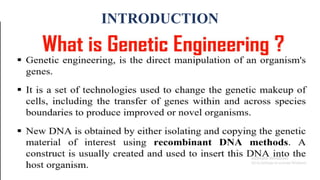
INTRODUCTION
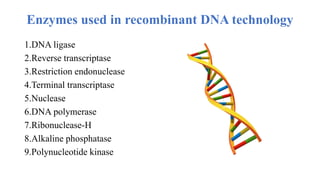
Enzymes used in recombinant DNA technology
1.DNA ligase
2.Reverse transcriptase
3.Restriction endonuclease
4.Terminal transcriptase
5.Nuclease
6.DNA polymerase
7.Ribonuclease-H
8.Alkaline phosphatase
9.Polynucleotide kinase
1. DNA ligase:
• DNA ligase is isolated from E.coli and Bacteriophage commercially and
used in recombinant DNA technology.
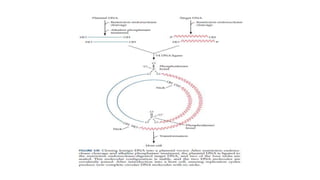
• The enzyme DNA ligase joins the DNA fragments with cloning vector.
2. Reverse transcriptase(RT):
• RT is used to synthesize complementary strand (cDNA) from mRNA
template.
• It is also known as RNA dependent DNA polymerase
• It is isolated from retrovirus
3. Restriction endonuclease:
• Restriction endonuclease enzyme recognize and cut DNA strand at specific sequence called
restriction site.
• These enzyme is isolated from wide variety of microorganisms. Endonuclease enzyme degrades
foreign genome when enter inside microbial cell but the host cell own DNA is protected from
its endonuclease by methylation of bases at restriction site.
There are 3 types of restriction endonuclease: Type II Restriction endonuclease:
• It does not require ATP to cut DNA
• It cuts DNA at restriction site itself
• eg. EcoRI, Hind III
Type III Restriction endonuclease:
• It requires ATP to cut DNA
• It cuts DNA about 25bp away from restriction site.
• eg. EcoPI
Type I Restriction endonuclease:
• It has both methylation and endonuclease
activity.
• It require ATP to cut the DNA
• It cuts DNA about 1000bp away from its
restriction site
• eg. EcoKI
4. Terminal transferase:
• It is the enzyme that converts blunt end of DNA fragments into sticky end.
• If the restriction enzyme cuts DNA forming blunt ends, then efficiency of ligation
is very low. So the enzyme terminal transferase converts bunt end into sticky end.
• Terminal transferase enzyme synthesize short sequence of complementary
nucleotide at free ends of DNA, so that blunt end is converted into sticky end.
5. Nuclease:
• The enzyme nucleases hydrolyses the phosphodiester bond on DNA strand
creating 3’-OH group and 5’-P group.
• It usually cut DNA on either side of distortion caused by thymine dimers or
intercalating agents
• The gap is filled by DNA polymerase and strand is joined by DNA ligase
• Nuclease are of two types; endonuclease and exonuclease
6. DNA polymerase:
• DNA polymerase is a complex enzyme which synthesize nucleotide
complementary to template strand.
• It adds nucleotide to free 3′ OH end and help in elongation of strand
• It also helps to fill gap in double stranded DNA.
• DNA polymerase-I isolated from E. coli is commonly used in gene cloning
• Taq polymerase isolated from Thermus aquaticus is used in PCR
7. Ribonuclease-H (RNase H):
• RNase-H removes mRNA from DNA-RNA heteroduplex and that mRNA is
used to synthesize cDNA
• It is isolated from retrovirus
8. Alkaline phosphatase:
• The enzyme Alkaline phosphatase helps in removal of terminal
phosphate group from 5′ end
• It prevents self annealing of vector DNA soon after cut open by
restriction endonuclease
9. Polynucleotide kinase:
• It adds phosphate group from ATP molecule to terminal 5’end after
dephosphorylation by alkaline phosphatase.
G. M. Bhopale* and R. K. Nanda Recombinant DNA expression
products for human therapeutic use (CURRENT SCIENCE,
VOL. 89, NO. 4, 25 AUGUST 2005)
Golden rice
FLAVR SAVR TOMATO
G. M. Bhopale* and R. K. Nanda Recombinant DNA expression products for human therapeutic use (CURRENT SCIENCE, VOL. 89, NO. 4, 25 AUGUST 2005)
Production of non- microbial
origin products
Haemopoietic growth factors
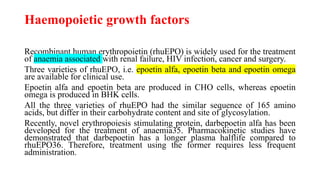
Recombinant human erythropoietin (rhuEPO) is widely used for the treatment
of anaemia associated with renal failure, HIV infection, cancer and surgery.
Three varieties of rhuEPO, i.e. epoetin alfa, epoetin beta and epoetin omega
are available for clinical use.
Epoetin alfa and epoetin beta are produced in CHO cells, whereas epoetin
omega is produced in BHK cells.
All the three varieties of rhuEPO had the similar sequence of 165 amino
acids, but differ in their carbohydrate content and site of glycosylation.
Recently, novel erythropoiesis stimulating protein, darbepoetin alfa has been
developed for the treatment of anaemia35. Pharmacokinetic studies have
demonstrated that darbepoetin has a longer plasma halflife compared to
rhuEPO36. Therefore, treatment using the former requires less frequent
administration.
Therapeutic enzymes
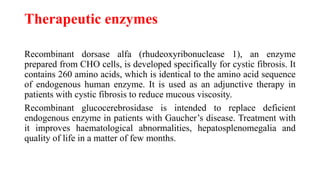
Recombinant dorsase alfa (rhudeoxyribonuclease 1), an enzyme
prepared from CHO cells, is developed specifically for cystic fibrosis. It
contains 260 amino acids, which is identical to the amino acid sequence
of endogenous human enzyme. It is used as an adjunctive therapy in
patients with cystic fibrosis to reduce mucous viscosity.
Recombinant glucocerebrosidase is intended to replace deficient
endogenous enzyme in patients with Gaucher’s disease. Treatment with
it improves haematological abnormalities, hepatosplenomegalia and
quality of life in a matter of few months.
THANK YOU

recombinant Dna technology.pptx

  • 1.
    Subject – (BT902)Advances in Microbial Biotechnology PRESENTATION On Topic “Recombinant DNA technology in genetic improvement and non-microbial origin products produced by genetically engineered microorganisms.” Submitted By: Gyan Chand Saini Ph.D. Biotechnology Roll no. - 23001906001 Submitted To: prof. Kiran Nehra
  • 2.
  • 4.
    Enzymes used inrecombinant DNA technology 1.DNA ligase 2.Reverse transcriptase 3.Restriction endonuclease 4.Terminal transcriptase 5.Nuclease 6.DNA polymerase 7.Ribonuclease-H 8.Alkaline phosphatase 9.Polynucleotide kinase
  • 6.
    1. DNA ligase: •DNA ligase is isolated from E.coli and Bacteriophage commercially and used in recombinant DNA technology. • The enzyme DNA ligase joins the DNA fragments with cloning vector. 2. Reverse transcriptase(RT): • RT is used to synthesize complementary strand (cDNA) from mRNA template. • It is also known as RNA dependent DNA polymerase • It is isolated from retrovirus
  • 7.
    3. Restriction endonuclease: •Restriction endonuclease enzyme recognize and cut DNA strand at specific sequence called restriction site. • These enzyme is isolated from wide variety of microorganisms. Endonuclease enzyme degrades foreign genome when enter inside microbial cell but the host cell own DNA is protected from its endonuclease by methylation of bases at restriction site. There are 3 types of restriction endonuclease: Type II Restriction endonuclease: • It does not require ATP to cut DNA • It cuts DNA at restriction site itself • eg. EcoRI, Hind III Type III Restriction endonuclease: • It requires ATP to cut DNA • It cuts DNA about 25bp away from restriction site. • eg. EcoPI Type I Restriction endonuclease: • It has both methylation and endonuclease activity. • It require ATP to cut the DNA • It cuts DNA about 1000bp away from its restriction site • eg. EcoKI
  • 9.
    4. Terminal transferase: •It is the enzyme that converts blunt end of DNA fragments into sticky end. • If the restriction enzyme cuts DNA forming blunt ends, then efficiency of ligation is very low. So the enzyme terminal transferase converts bunt end into sticky end. • Terminal transferase enzyme synthesize short sequence of complementary nucleotide at free ends of DNA, so that blunt end is converted into sticky end. 5. Nuclease: • The enzyme nucleases hydrolyses the phosphodiester bond on DNA strand creating 3’-OH group and 5’-P group. • It usually cut DNA on either side of distortion caused by thymine dimers or intercalating agents • The gap is filled by DNA polymerase and strand is joined by DNA ligase • Nuclease are of two types; endonuclease and exonuclease
  • 10.
    6. DNA polymerase: •DNA polymerase is a complex enzyme which synthesize nucleotide complementary to template strand. • It adds nucleotide to free 3′ OH end and help in elongation of strand • It also helps to fill gap in double stranded DNA. • DNA polymerase-I isolated from E. coli is commonly used in gene cloning • Taq polymerase isolated from Thermus aquaticus is used in PCR 7. Ribonuclease-H (RNase H): • RNase-H removes mRNA from DNA-RNA heteroduplex and that mRNA is used to synthesize cDNA • It is isolated from retrovirus
  • 11.
    8. Alkaline phosphatase: •The enzyme Alkaline phosphatase helps in removal of terminal phosphate group from 5′ end • It prevents self annealing of vector DNA soon after cut open by restriction endonuclease 9. Polynucleotide kinase: • It adds phosphate group from ATP molecule to terminal 5’end after dephosphorylation by alkaline phosphatase.
  • 20.
    G. M. Bhopale*and R. K. Nanda Recombinant DNA expression products for human therapeutic use (CURRENT SCIENCE, VOL. 89, NO. 4, 25 AUGUST 2005)
  • 21.
  • 22.
  • 23.
    G. M. Bhopale*and R. K. Nanda Recombinant DNA expression products for human therapeutic use (CURRENT SCIENCE, VOL. 89, NO. 4, 25 AUGUST 2005)
  • 24.
    Production of non-microbial origin products
  • 38.
    Haemopoietic growth factors Recombinanthuman erythropoietin (rhuEPO) is widely used for the treatment of anaemia associated with renal failure, HIV infection, cancer and surgery. Three varieties of rhuEPO, i.e. epoetin alfa, epoetin beta and epoetin omega are available for clinical use. Epoetin alfa and epoetin beta are produced in CHO cells, whereas epoetin omega is produced in BHK cells. All the three varieties of rhuEPO had the similar sequence of 165 amino acids, but differ in their carbohydrate content and site of glycosylation. Recently, novel erythropoiesis stimulating protein, darbepoetin alfa has been developed for the treatment of anaemia35. Pharmacokinetic studies have demonstrated that darbepoetin has a longer plasma halflife compared to rhuEPO36. Therefore, treatment using the former requires less frequent administration.
  • 39.
    Therapeutic enzymes Recombinant dorsasealfa (rhudeoxyribonuclease 1), an enzyme prepared from CHO cells, is developed specifically for cystic fibrosis. It contains 260 amino acids, which is identical to the amino acid sequence of endogenous human enzyme. It is used as an adjunctive therapy in patients with cystic fibrosis to reduce mucous viscosity. Recombinant glucocerebrosidase is intended to replace deficient endogenous enzyme in patients with Gaucher’s disease. Treatment with it improves haematological abnormalities, hepatosplenomegalia and quality of life in a matter of few months.
  • 40.