Recombinant DNA
technology
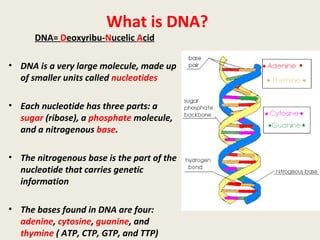
What is DNA?
DNA= Deoxyribu-Nucelic Acid
• DNA is a very large molecule, made up
of smaller units called nucleotides
• Each nucleotide has three parts: a
sugar (ribose), a phosphate molecule,
and a nitrogenous base.
• The nitrogenous base is the part of the
nucleotide that carries genetic
information
• The bases found in DNA are four:
adenine, cytosine, guanine, and
thymine ( ATP, CTP, GTP, and TTP)
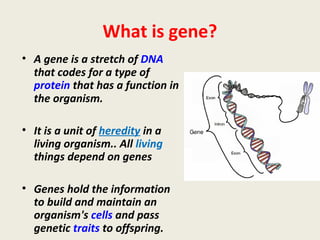
What is gene?
• A gene is a stretch of DNA
that codes for a type of
protein that has a function in
the organism.
• It is a unit of heredity in a
living organism.. All living
things depend on genes
• Genes hold the information
to build and maintain an
organism's cells and pass
genetic traits to offspring.
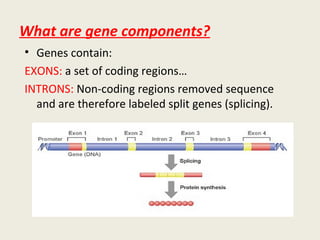
What are gene components?
• Genes contain:
EXONS: a set of coding regions…
INTRONS: Non-coding regions removed sequence
and are therefore labeled split genes (splicing).
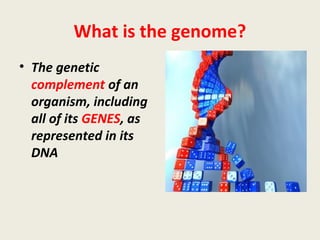
What is the genome?
• The genetic
complement of an
organism, including
all of its GENES, as
represented in its
DNA
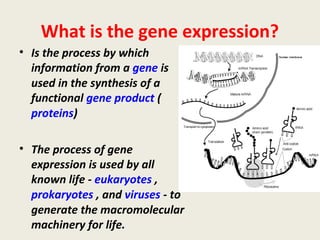
What is the gene expression?
• Is the process by which
information from a gene is
used in the synthesis of a
functional gene product (
proteins)
• The process of gene
expression is used by all
known life - eukaryotes ,
prokaryotes , and viruses - to
generate the macromolecular
machinery for life.
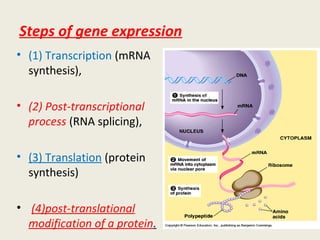
Steps of gene expression
• (1) Transcription (mRNA
synthesis),
• (2) Post-transcriptional
process (RNA splicing),
• (3) Translation (protein
synthesis)
• (4)post-translational
modification of a protein.
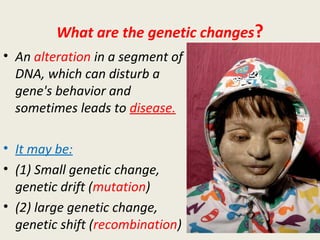
What are the genetic changes?
• An alteration in a segment of
DNA, which can disturb a
gene's behavior and
sometimes leads to disease.
• It may be:
• (1) Small genetic change,
genetic drift (mutation)
• (2) large genetic change,
genetic shift (recombination)
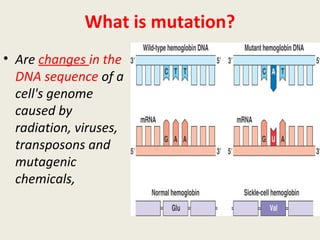
What is mutation?
• Are changes in the
DNA sequence of a
cell's genome
caused by
radiation, viruses,
transposons and
mutagenic
chemicals,
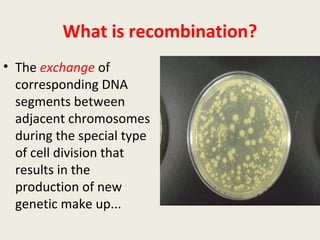
What is recombination?
• The exchange of
corresponding DNA
segments between
adjacent chromosomes
during the special type
of cell division that
results in the
production of new
genetic make up...
Recombinant DNA
technology
In vitro recombination
Genetic engineering
Genetic surgery
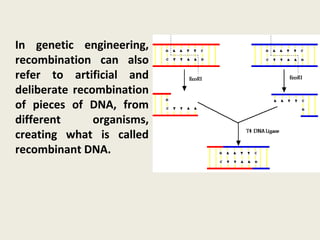
In genetic engineering,
recombination can also
refer to artificial and
deliberate recombination
of pieces of DNA, from
different organisms,
creating what is called
recombinant DNA.
Application of genetic
engineering in Medicine
(1) Treatment of
genetic diseases
(gene therapy)
• e.g. SCID girl
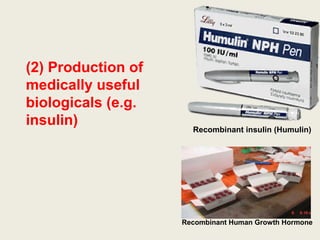
(2) Production of
medically useful
biologicals (e.g.
insulin)
Recombinant Human Growth Hormone
Recombinant insulin (Humulin)
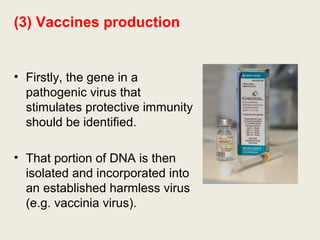
(3) Vaccines production
• Firstly, the gene in a
pathogenic virus that
stimulates protective immunity
should be identified.
• That portion of DNA is then
isolated and incorporated into
an established harmless virus
(e.g. vaccinia virus).
• This new recombinant virus is
used as a vaccine.
• These vaccines are much safer
since they do not expose the
patients to the actual virus and
do not risk to infection.
• This method may be useful in
vaccines against malaria and
schistosomiasis and many
viruses (e.g. HBV)
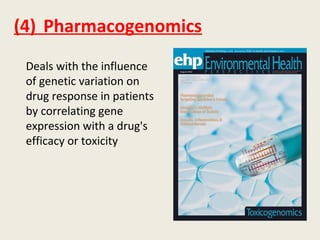
(4) Pharmacogenomics
Deals with the influence
of genetic variation on
drug response in patients
by correlating gene
expression with a drug's
efficacy or toxicity
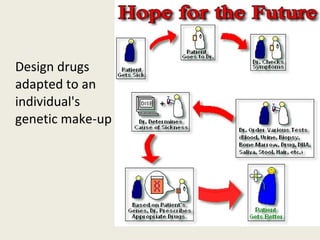
Design drugs
adapted to an
individual's
genetic make-up
• Write in details about the medical
applications of recombinant DNA
technology
Recombinant DNA technology ppt
alhefzi.com/G34/Molecular/Recombinant
%20DNA.ppt
นายรักษิต สุขโต เลขที่ 38 ม.6/3

Recombinant dna

  • 1.
  • 2.
    What is DNA? DNA=Deoxyribu-Nucelic Acid • DNA is a very large molecule, made up of smaller units called nucleotides • Each nucleotide has three parts: a sugar (ribose), a phosphate molecule, and a nitrogenous base. • The nitrogenous base is the part of the nucleotide that carries genetic information • The bases found in DNA are four: adenine, cytosine, guanine, and thymine ( ATP, CTP, GTP, and TTP)
  • 3.
    What is gene? •A gene is a stretch of DNA that codes for a type of protein that has a function in the organism. • It is a unit of heredity in a living organism.. All living things depend on genes • Genes hold the information to build and maintain an organism's cells and pass genetic traits to offspring.
  • 4.
    What are genecomponents? • Genes contain: EXONS: a set of coding regions… INTRONS: Non-coding regions removed sequence and are therefore labeled split genes (splicing).
  • 5.
    What is thegenome? • The genetic complement of an organism, including all of its GENES, as represented in its DNA
  • 6.
    What is thegene expression? • Is the process by which information from a gene is used in the synthesis of a functional gene product ( proteins) • The process of gene expression is used by all known life - eukaryotes , prokaryotes , and viruses - to generate the macromolecular machinery for life.
  • 7.
    Steps of geneexpression • (1) Transcription (mRNA synthesis), • (2) Post-transcriptional process (RNA splicing), • (3) Translation (protein synthesis) • (4)post-translational modification of a protein.
  • 8.
    What are thegenetic changes? • An alteration in a segment of DNA, which can disturb a gene's behavior and sometimes leads to disease. • It may be: • (1) Small genetic change, genetic drift (mutation) • (2) large genetic change, genetic shift (recombination)
  • 9.
    What is mutation? •Are changes in the DNA sequence of a cell's genome caused by radiation, viruses, transposons and mutagenic chemicals,
  • 10.
    What is recombination? •The exchange of corresponding DNA segments between adjacent chromosomes during the special type of cell division that results in the production of new genetic make up...
  • 11.
    Recombinant DNA technology In vitrorecombination Genetic engineering Genetic surgery
  • 12.
    In genetic engineering, recombinationcan also refer to artificial and deliberate recombination of pieces of DNA, from different organisms, creating what is called recombinant DNA.
  • 13.
    Application of genetic engineeringin Medicine (1) Treatment of genetic diseases (gene therapy) • e.g. SCID girl
  • 14.
    (2) Production of medicallyuseful biologicals (e.g. insulin) Recombinant Human Growth Hormone Recombinant insulin (Humulin)
  • 15.
    (3) Vaccines production •Firstly, the gene in a pathogenic virus that stimulates protective immunity should be identified. • That portion of DNA is then isolated and incorporated into an established harmless virus (e.g. vaccinia virus).
  • 16.
    • This newrecombinant virus is used as a vaccine. • These vaccines are much safer since they do not expose the patients to the actual virus and do not risk to infection. • This method may be useful in vaccines against malaria and schistosomiasis and many viruses (e.g. HBV)
  • 17.
    (4) Pharmacogenomics Deals withthe influence of genetic variation on drug response in patients by correlating gene expression with a drug's efficacy or toxicity
  • 18.
    Design drugs adapted toan individual's genetic make-up
  • 19.
    • Write indetails about the medical applications of recombinant DNA technology
  • 20.
    Recombinant DNA technologyppt alhefzi.com/G34/Molecular/Recombinant %20DNA.ppt นายรักษิต สุขโต เลขที่ 38 ม.6/3