RECENT ADVANCEMENTS IN
SOLAR COOKERS
ANAM MUKTHAR
SHAIVYA MANHAS
SYED RABIA
M. Tech. (Renewable Energy)
Department of Energy Management
SHRI MATA VAISHNO DEVI UNIVERSITY , KAKRYAL, KATRA , J&K
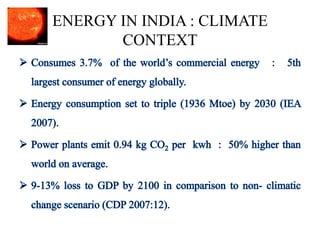
ENERGY IN INDIA : CLIMATE
CONTEXT
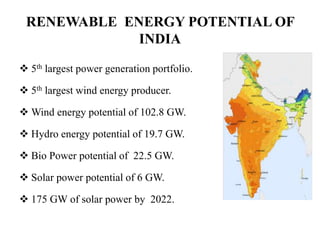
RENEWABLE ENERGY POTENTIAL OF
INDIA
 5th largest power generation portfolio.
 5th largest wind energy producer.
 Wind energy potential of 102.8 GW.
 Hydro energy potential of 19.7 GW.
 Bio Power potential of 22.5 GW.
 Solar power potential of 6 GW.
 175 GW of solar power by 2022.
INSTALLED SOLAR POWER
CAPACITY IN INDIA
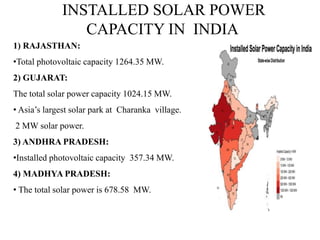
1) RAJASTHAN:
•Total photovoltaic capacity 1264.35 MW.
2) GUJARAT:
The total solar power capacity 1024.15 MW.
• Asia’s largest solar park at Charanka village.
2 MW solar power.
3) ANDHRA PRADESH:
•Installed photovoltaic capacity 357.34 MW.
4) MADHYA PRADESH:
• The total solar power is 678.58 MW.
SOLAR COOKING &
ITS HISTORY
• An important domestic thermal application is cooking.
• Solar Cooking actually has starting with the documented efforts of French-
Swiss Physicist Horace de Saussure in 1767.
• 1200s -Roman Empire people have sun-dried fruits, vegetables, fish and meats
to preserve them.
• 1600s- A German physicist, E.W. von made large lenses to boil water in a clay
pot.
• 1930s- India began to investigate solar energy as a substitute for dwindling
wood and depletion of soil from burning crop residues and dung .
• 1945- Indian pioneer Sri M. K. Ghosh designed the first solar box cooker to be
commercially produced .
WHAT IS A SOLAR COOKER ?
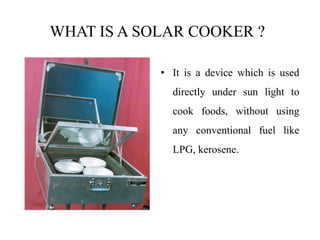
• It is a device which is used
directly under sun light to
cook foods, without using
any conventional fuel like
LPG, kerosene.
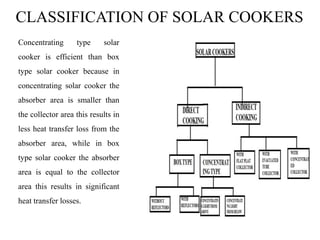
Concentrating type solar
cooker is efficient than box
type solar cooker because in
concentrating solar cooker the
absorber area is smaller than
the collector area this results in
less heat transfer loss from the
absorber area, while in box
type solar cooker the absorber
area is equal to the collector
area this results in significant
heat transfer losses.
CLASSIFICATION OF SOLAR COOKERS
BOX TYPE SOLAR COOKER
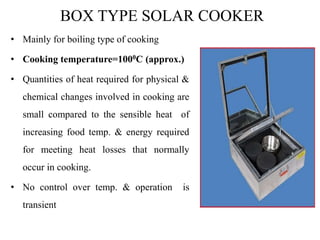
• Mainly for boiling type of cooking
• Cooking temperature=1000C (approx.)
• Quantities of heat required for physical &
chemical changes involved in cooking are
small compared to the sensible heat of
increasing food temp. & energy required
for meeting heat losses that normally
occur in cooking.
• No control over temp. & operation is
transient
COMPONENTS OF BOX TYPE SOLAR
COOKER
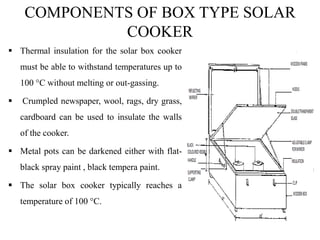
 Thermal insulation for the solar box cooker
must be able to withstand temperatures up to
100 °C without melting or out-gassing.
 Crumpled newspaper, wool, rags, dry grass,
cardboard can be used to insulate the walls
of the cooker.
 Metal pots can be darkened either with flat-
black spray paint , black tempera paint.
 The solar box cooker typically reaches a
temperature of 100 °C.
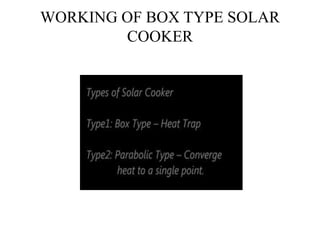
WORKING OF BOX TYPE SOLAR
COOKER
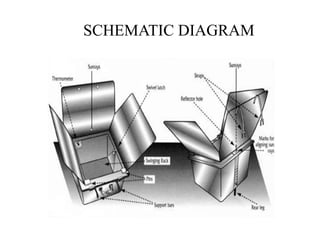
SCHEMATIC DIAGRAM
MULTI REFLECTOR SOLAR COOKER
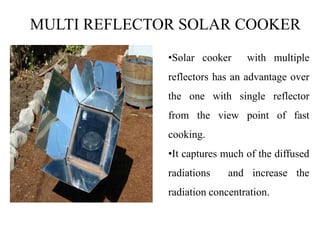
•Solar cooker with multiple
reflectors has an advantage over
the one with single reflector
from the view point of fast
cooking.
•It captures much of the diffused
radiations and increase the
radiation concentration.
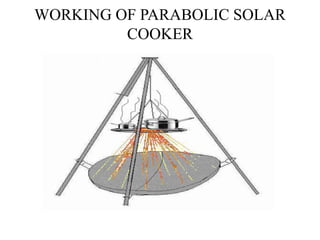
PARABOLIC TYPE SOLAR COOKER
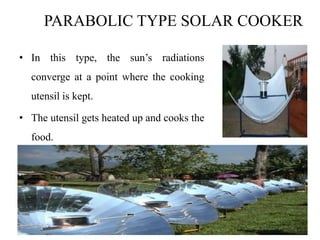
• In this type, the sun’s radiations
converge at a point where the cooking
utensil is kept.
• The utensil gets heated up and cooks the
food.
HISTORY OF PARABOLIC SOLAR
COOKERS
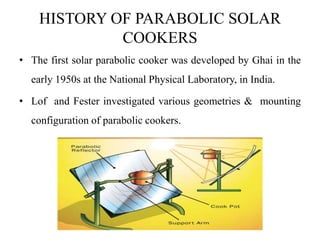
• The first solar parabolic cooker was developed by Ghai in the
early 1950s at the National Physical Laboratory, in India.
• Lof and Fester investigated various geometries & mounting
configuration of parabolic cookers.
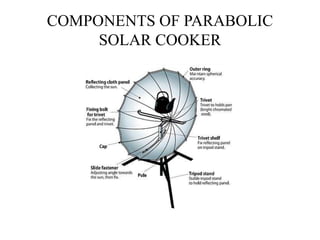
COMPONENTS OF PARABOLIC
SOLAR COOKER
WORKING OF PARABOLIC SOLAR
COOKER
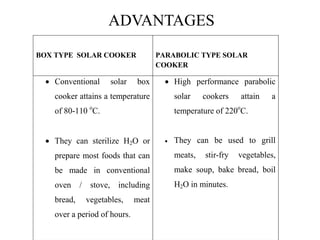
ADVANTAGES
BOX TYPE SOLAR COOKER PARABOLIC TYPE SOLAR
COOKER
 Conventional solar box
cooker attains a temperature
of 80-110 o
C.
 They can sterilize H2O or
prepare most foods that can
be made in conventional
oven / stove, including
bread, vegetables, meat
over a period of hours.
 High performance parabolic
solar cookers attain a
temperature of 220o
C.
 They can be used to grill
meats, stir-fry vegetables,
make soup, bake bread, boil
H2O in minutes.
DISADVANTAGES
• Solar cookers are less useful in cloudy weather and near the poles
(where the sun is low in the sky or below the horizon).
• Some solar cookers, especially solar ovens, take longer to cook
food than a conventional stove or oven.
• Cooks may need to learn special cooking techniques to fry
common foods, such as flatbreads like chapatis and tortillas.
• Some solar cooker designs are affected by strong winds, which can
slow the cooking process, cool the food due to convective losses,
and disturb the reflector.
CONCLUSION
• Solar cookers use no fuel. This saves cost as well as reducing environmental
damage caused by fuel use. Since 2.5 billion people cook on open fires using
biomass fuels, solar cookers could have large economic and environmental benefits
by reducing deforestation.
• When solar cookers are used outside, they do not contribute inside heat, potentially
saving fuel costs for cooling as well.
• Solar cookers are less useful in cloudy weather and near the poles (where the sun is
low in the sky or below the horizon). Solar cooking has three devices for an
integrated cooking solution:
a) Solar cooker.
b) Fuel-efficient cook-stove.
c) Insulated storage container such as a basket filled with straw to store heated food.
Very hot food may continue to cook for hours in a well-insulated container.
REFERENCES
• Cuce E, Cuce PM. A comprehensive review on solar cookers. Appl Energy 2013; 102:1399-1421.
• Escobar EM. Low budget solar cookers: an alternative to diminish the use of wood as a source of fuel. Renew Energy
1996; 9:754–7.
• Funk PA. Evaluating the international standard procedure for testing solar cookers and reporting performance. Solar
Energy 2000;68(1):1–7.
• Halacy B, Halacy C. Cooking with the sun. Lafayette, CA: Jack Howell; 1992.
• Hoda MM. Solar cookers. Lucknow, India: Appropriate Technology Development Association; 1979.
• Hosein Z, Mohammad M, Ali K. Optimization of the parabolic mirror position in a solar cooker using the response
surface method (RSM). Renew Energy 2015; 81:753-759.
• Knudson B. State of the art of solar cooking: a global survey of practices and promotion programs. Sacramento: SCI;
2004.
• Mahavar S, Sengar N, Rajawat P, Verma M, Dashora P. Design development and performance studies of a novel Single
Family Solar Cooke., Renew Energy 2012; 47: 67-76.
• Mullick SC, Kandpal TC, Saxena AK. Thermal test procedure for box-type solar cookers. Solar Energy 1987; 39:353-
60.
• Nandwani SS. Solar cookers – cheap technology with high ecological benefits. Ecol Econ 1996; 17:73–81.
• Saxena A, Varun, Pandey SP, Srivastav G. A thermodynamic review on solar box type cookers. Renew Sust Energy Rev
2011; 15:3301–18.
ANY
QUERIES
THANK
YOU

Recent advancements in solar cookers2

  • 1.
    RECENT ADVANCEMENTS IN SOLARCOOKERS ANAM MUKTHAR SHAIVYA MANHAS SYED RABIA M. Tech. (Renewable Energy) Department of Energy Management SHRI MATA VAISHNO DEVI UNIVERSITY , KAKRYAL, KATRA , J&K
  • 2.
    ENERGY IN INDIA: CLIMATE CONTEXT
  • 3.
    RENEWABLE ENERGY POTENTIALOF INDIA  5th largest power generation portfolio.  5th largest wind energy producer.  Wind energy potential of 102.8 GW.  Hydro energy potential of 19.7 GW.  Bio Power potential of 22.5 GW.  Solar power potential of 6 GW.  175 GW of solar power by 2022.
  • 4.
    INSTALLED SOLAR POWER CAPACITYIN INDIA 1) RAJASTHAN: •Total photovoltaic capacity 1264.35 MW. 2) GUJARAT: The total solar power capacity 1024.15 MW. • Asia’s largest solar park at Charanka village. 2 MW solar power. 3) ANDHRA PRADESH: •Installed photovoltaic capacity 357.34 MW. 4) MADHYA PRADESH: • The total solar power is 678.58 MW.
  • 5.
    SOLAR COOKING & ITSHISTORY • An important domestic thermal application is cooking. • Solar Cooking actually has starting with the documented efforts of French- Swiss Physicist Horace de Saussure in 1767. • 1200s -Roman Empire people have sun-dried fruits, vegetables, fish and meats to preserve them. • 1600s- A German physicist, E.W. von made large lenses to boil water in a clay pot. • 1930s- India began to investigate solar energy as a substitute for dwindling wood and depletion of soil from burning crop residues and dung . • 1945- Indian pioneer Sri M. K. Ghosh designed the first solar box cooker to be commercially produced .
  • 6.
    WHAT IS ASOLAR COOKER ? • It is a device which is used directly under sun light to cook foods, without using any conventional fuel like LPG, kerosene.
  • 7.
    Concentrating type solar cookeris efficient than box type solar cooker because in concentrating solar cooker the absorber area is smaller than the collector area this results in less heat transfer loss from the absorber area, while in box type solar cooker the absorber area is equal to the collector area this results in significant heat transfer losses. CLASSIFICATION OF SOLAR COOKERS
  • 8.
    BOX TYPE SOLARCOOKER • Mainly for boiling type of cooking • Cooking temperature=1000C (approx.) • Quantities of heat required for physical & chemical changes involved in cooking are small compared to the sensible heat of increasing food temp. & energy required for meeting heat losses that normally occur in cooking. • No control over temp. & operation is transient
  • 9.
    COMPONENTS OF BOXTYPE SOLAR COOKER  Thermal insulation for the solar box cooker must be able to withstand temperatures up to 100 °C without melting or out-gassing.  Crumpled newspaper, wool, rags, dry grass, cardboard can be used to insulate the walls of the cooker.  Metal pots can be darkened either with flat- black spray paint , black tempera paint.  The solar box cooker typically reaches a temperature of 100 °C.
  • 10.
    WORKING OF BOXTYPE SOLAR COOKER
  • 11.
  • 12.
    MULTI REFLECTOR SOLARCOOKER •Solar cooker with multiple reflectors has an advantage over the one with single reflector from the view point of fast cooking. •It captures much of the diffused radiations and increase the radiation concentration.
  • 13.
    PARABOLIC TYPE SOLARCOOKER • In this type, the sun’s radiations converge at a point where the cooking utensil is kept. • The utensil gets heated up and cooks the food.
  • 14.
    HISTORY OF PARABOLICSOLAR COOKERS • The first solar parabolic cooker was developed by Ghai in the early 1950s at the National Physical Laboratory, in India. • Lof and Fester investigated various geometries & mounting configuration of parabolic cookers.
  • 15.
  • 16.
  • 17.
    ADVANTAGES BOX TYPE SOLARCOOKER PARABOLIC TYPE SOLAR COOKER  Conventional solar box cooker attains a temperature of 80-110 o C.  They can sterilize H2O or prepare most foods that can be made in conventional oven / stove, including bread, vegetables, meat over a period of hours.  High performance parabolic solar cookers attain a temperature of 220o C.  They can be used to grill meats, stir-fry vegetables, make soup, bake bread, boil H2O in minutes.
  • 18.
    DISADVANTAGES • Solar cookersare less useful in cloudy weather and near the poles (where the sun is low in the sky or below the horizon). • Some solar cookers, especially solar ovens, take longer to cook food than a conventional stove or oven. • Cooks may need to learn special cooking techniques to fry common foods, such as flatbreads like chapatis and tortillas. • Some solar cooker designs are affected by strong winds, which can slow the cooking process, cool the food due to convective losses, and disturb the reflector.
  • 19.
    CONCLUSION • Solar cookersuse no fuel. This saves cost as well as reducing environmental damage caused by fuel use. Since 2.5 billion people cook on open fires using biomass fuels, solar cookers could have large economic and environmental benefits by reducing deforestation. • When solar cookers are used outside, they do not contribute inside heat, potentially saving fuel costs for cooling as well. • Solar cookers are less useful in cloudy weather and near the poles (where the sun is low in the sky or below the horizon). Solar cooking has three devices for an integrated cooking solution: a) Solar cooker. b) Fuel-efficient cook-stove. c) Insulated storage container such as a basket filled with straw to store heated food. Very hot food may continue to cook for hours in a well-insulated container.
  • 20.
    REFERENCES • Cuce E,Cuce PM. A comprehensive review on solar cookers. Appl Energy 2013; 102:1399-1421. • Escobar EM. Low budget solar cookers: an alternative to diminish the use of wood as a source of fuel. Renew Energy 1996; 9:754–7. • Funk PA. Evaluating the international standard procedure for testing solar cookers and reporting performance. Solar Energy 2000;68(1):1–7. • Halacy B, Halacy C. Cooking with the sun. Lafayette, CA: Jack Howell; 1992. • Hoda MM. Solar cookers. Lucknow, India: Appropriate Technology Development Association; 1979. • Hosein Z, Mohammad M, Ali K. Optimization of the parabolic mirror position in a solar cooker using the response surface method (RSM). Renew Energy 2015; 81:753-759. • Knudson B. State of the art of solar cooking: a global survey of practices and promotion programs. Sacramento: SCI; 2004. • Mahavar S, Sengar N, Rajawat P, Verma M, Dashora P. Design development and performance studies of a novel Single Family Solar Cooke., Renew Energy 2012; 47: 67-76. • Mullick SC, Kandpal TC, Saxena AK. Thermal test procedure for box-type solar cookers. Solar Energy 1987; 39:353- 60. • Nandwani SS. Solar cookers – cheap technology with high ecological benefits. Ecol Econ 1996; 17:73–81. • Saxena A, Varun, Pandey SP, Srivastav G. A thermodynamic review on solar box type cookers. Renew Sust Energy Rev 2011; 15:3301–18.
  • 21.
  • 22.