A Trust-based Social Recommender
for Teachers
Soude Fazeli, PhD candidate
Dr. Hendrik Drachsler
Dr. Francis Brouns
Prof. Dr. Peter Sloep


 page 1
The doctoral study is funded by

• NELLL
(Netherlands Laboratory for Lifelong Learning at the OUNL)


• Open Discovery Space (ODS)
 A socially-powered, multilingual
 open learning infrastructure
 to boost the adaptation of
 eLearning Resources in Europe


Run-time: 2011-2015

 page 2
A social space for teachers


                      Learning Networks?

page 3
page 4
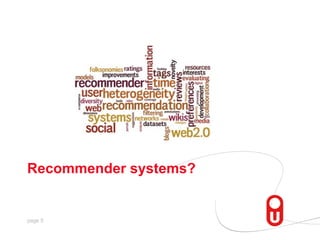
Recommender systems?


page 5
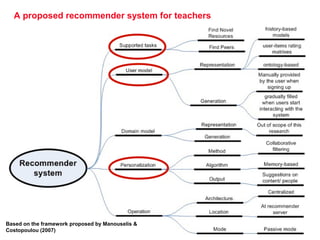
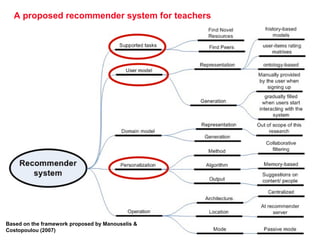
A proposed recommender system for teachers


       page 6
Based on the framework proposed by Manouselis &
Costopoulou (2007)
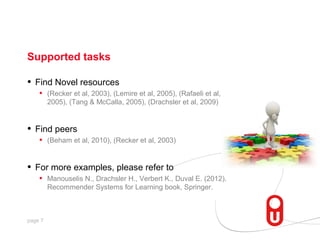
Supported tasks

•   Find Novel resources
     • (Recker et al, 2003), (Lemire et al, 2005), (Rafaeli et al,
         2005), (Tang & McCalla, 2005), (Drachsler et al, 2009)


•   Find peers
     • (Beham et al, 2010), (Recker et al, 2003)


•   For more examples, please refer to
     • Manouselis N., Drachsler H., Verbert K., Duval E. (2012).
         Recommender Systems for Learning book, Springer.


page 7
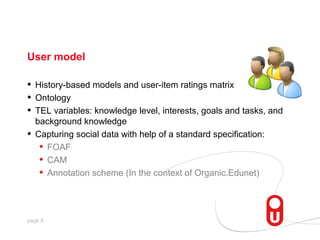
User model

•   History-based models and user-item ratings matrix
•   Ontology
•   TEL variables: knowledge level, interests, goals and tasks, and
    background knowledge
•   Capturing social data with help of a standard specification:
     • FOAF
     • CAM
     • Annotation scheme (In the context of Organic.Edunet)


page 8
A proposed recommender system for teachers


       page 9
Based on the framework proposed by Manouselis &
Costopoulou (2007)
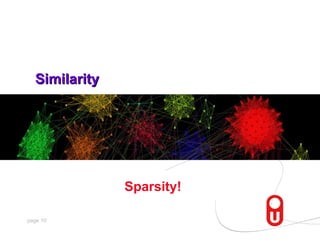
Similarity


               Sparsity!

page 10
(Golbeck, 2009; Kamvar et al., 2003; Ziegler & Golbeck, 2007;
 Massa & Avesani, 2004; Lathia et al., 2008; Fazeli et al., 2010)
page 11
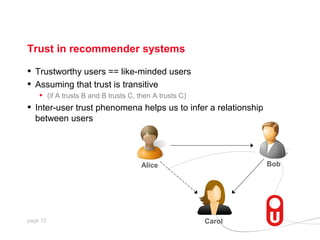
Trust in recommender systems

•   Trustworthy users == like-minded users
•   Assuming that trust is transitive
     • (if A trusts B and B trusts C, then A trusts C)
•   Inter-user trust phenomena helps us to infer a relationship
    between users


                               Alice                              Bob


page 12                                        Carol
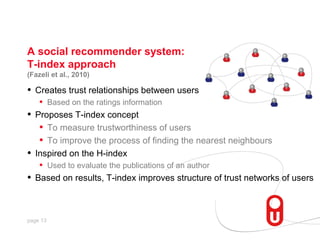
A social recommender system:
T-index approach
(Fazeli et al., 2010)

•   Creates trust relationships between users
     •    Based on the ratings information
•   Proposes T-index concept
     • To measure trustworthiness of users
     • To improve the process of finding the nearest neighbours
•   Inspired on the H-index
     •    Used to evaluate the publications of an author
•   Based on results, T-index improves structure of trust networks of users


page 13
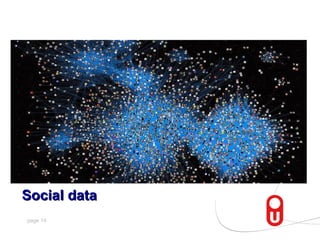
Social data
page 14
•   RQ1: How can the sparsity problem within
    educational datasets be solved by using inter-user
    trust relationships which originally come from the
    social data of users?

•   RQ2: How can teachers’ networks be made to
    evolve by the use of social data?

    page 15
Proposed research


1.   Requirement analysis
           •   Literature review
           •   Interview study
2.   Dataset-driven study
3.   User evaluation study
4.   Pilot study


 page 16
1. Requirement analysis

  •   Goal
       • Investigating the teachers’ main needs and requirements
  •   Method
       • Nominal group technique (NGT)
       • 18 teachers (novices, experts, mentors and supervising teachers) from the
         Limburg area, the Netherlands
       • Inviting teachers to cluster the generated ideas by WebSort
       • Survey on use of social media by teachers
  •   Description
       • “What kind of support do you need to provide innovative teaching at your
         school?"
       • Writing down the ideas, discussion, clustering, ranking the ideas
  •   Expected outcomes
       • An inventory list of teachers’ needs and requirements
       • A framework to identify suitable recommender systems’ strategies for our
  page 17 target   users
Proposed research


1.   Requirement analysis
           •   Literature review
           •   Interview study
2.   Dataset-driven study
3.   User evaluation study
4.   Pilot study


 page 18
2. Dataset study

  •   Goal
       • To find out the most suitable recommender system algorithm for teachers
  •   Method
       • An offline empirical study of candidate algorithms (T-index, Pearson, Slope-
            one, Tanimoto)
       •    TravelWell, Organic.Edunet, eTwinning (TELeurope, Mace, Openscout)
  •   Variables to be measured
       • Prediction accuracy, coverage, and F1
  •   Expected outcomes
       • If the T-index approach can help to deal with the sparse data in the used
            datasets
        •   Which of the recommender system algorithms suits teachers best


      (Verbert et al., 2011)

  page 19
Proposed research


1.   Requirement analysis
           •   Literature review
           •   Interview study
2.   Dataset-driven study
3.   User evaluation study
4.   Pilot study


 page 20
3. User evaluation study

  •   Goal
       • To study users’ satisfaction
  •   Method
       • Questionnaire
       • Pre and post test of knowledge gain
  •   Variables to be measured
       • Interestingness and value-addedness (Tang & McCalla, 2009)
       • Prediction accuracy, coverage, and F1 measures
  •   Expected outcomes
       • Initial feedback by end-users on users’ satisfaction as an input for pilot study


  page 21
Proposed research


1.   Requirement analysis
           •   Literature review
           •   Interview study
2.   Dataset-driven study
3.   User evaluation study
4.   Pilot study


 page 22
4. Pilot study
  •   Goal
       • To deploy the final release
       • To test it under realistic operational conditions with the end-users
  •   Method
       • Evaluating performance of the designed recommender system algorithm
       • Study the structure of the teachers’ networks
  •   Variables to be measured
       • Prediction accuracy and coverage
       • Effectiveness in terms of total number of visited, bookmarked, or rated
            learning objects for two groups of users
       •    Indegree distribution to study how the structure of teachers’ networks changes
  •   Expected outcomes
       • Empirical data on prediction accuracy and coverage
       • The visualization of teachers’ networks


  page 23
Conclusion

• The aim is to support teachers to find the most
    suitable content or people
•   Recommender systems as a solution
•   How to overcome the sparsity problem by use of
    social data


    page 24
Ongoing and Further work

 •   Requirement analysis
      • Data collection (done)
            • Teachers from the Netherlands
            • European teachers in an Open Discovery Space Summer School, Greece
      •    Publishing the results as an extensive requirement analysis for teachers all
           over the Europe (in progress)


 •   Data set study
      • Testing data sets with users’ ratings (successfully done)
      • Testing data sets based on implicit users’ feedback (tags, bookmarks,
           comments, blogs, etc) (in progress)


 page 25
Soude Fazeli
PhD candidate
Open University of the Netherlands
Centre for Learning Sciences and Technologies
(CELSTEC) PO-Box 2960
6401 DL Heerlen, The Netherlands
email: soude.fazeli@ou.nl


  page 26

RecSysTEL2012 slides

  • 1.
    A Trust-based SocialRecommender for Teachers Soude Fazeli, PhD candidate Dr. Hendrik Drachsler Dr. Francis Brouns Prof. Dr. Peter Sloep page 1
  • 2.
    The doctoral studyis funded by • NELLL (Netherlands Laboratory for Lifelong Learning at the OUNL) • Open Discovery Space (ODS) A socially-powered, multilingual open learning infrastructure to boost the adaptation of eLearning Resources in Europe Run-time: 2011-2015 page 2
  • 3.
    A social spacefor teachers Learning Networks? page 3
  • 4.
  • 5.
  • 6.
    A proposed recommendersystem for teachers page 6 Based on the framework proposed by Manouselis & Costopoulou (2007)
  • 7.
    Supported tasks • Find Novel resources • (Recker et al, 2003), (Lemire et al, 2005), (Rafaeli et al, 2005), (Tang & McCalla, 2005), (Drachsler et al, 2009) • Find peers • (Beham et al, 2010), (Recker et al, 2003) • For more examples, please refer to • Manouselis N., Drachsler H., Verbert K., Duval E. (2012). Recommender Systems for Learning book, Springer. page 7
  • 8.
    User model • History-based models and user-item ratings matrix • Ontology • TEL variables: knowledge level, interests, goals and tasks, and background knowledge • Capturing social data with help of a standard specification: • FOAF • CAM • Annotation scheme (In the context of Organic.Edunet) page 8
  • 9.
    A proposed recommendersystem for teachers page 9 Based on the framework proposed by Manouselis & Costopoulou (2007)
  • 10.
    Similarity Sparsity! page 10
  • 11.
    (Golbeck, 2009; Kamvaret al., 2003; Ziegler & Golbeck, 2007; Massa & Avesani, 2004; Lathia et al., 2008; Fazeli et al., 2010) page 11
  • 12.
    Trust in recommendersystems • Trustworthy users == like-minded users • Assuming that trust is transitive • (if A trusts B and B trusts C, then A trusts C) • Inter-user trust phenomena helps us to infer a relationship between users Alice Bob page 12 Carol
  • 13.
    A social recommendersystem: T-index approach (Fazeli et al., 2010) • Creates trust relationships between users • Based on the ratings information • Proposes T-index concept • To measure trustworthiness of users • To improve the process of finding the nearest neighbours • Inspired on the H-index • Used to evaluate the publications of an author • Based on results, T-index improves structure of trust networks of users page 13
  • 14.
  • 15.
    RQ1: How can the sparsity problem within educational datasets be solved by using inter-user trust relationships which originally come from the social data of users? • RQ2: How can teachers’ networks be made to evolve by the use of social data? page 15
  • 16.
    Proposed research 1. Requirement analysis • Literature review • Interview study 2. Dataset-driven study 3. User evaluation study 4. Pilot study page 16
  • 17.
    1. Requirement analysis • Goal • Investigating the teachers’ main needs and requirements • Method • Nominal group technique (NGT) • 18 teachers (novices, experts, mentors and supervising teachers) from the Limburg area, the Netherlands • Inviting teachers to cluster the generated ideas by WebSort • Survey on use of social media by teachers • Description • “What kind of support do you need to provide innovative teaching at your school?" • Writing down the ideas, discussion, clustering, ranking the ideas • Expected outcomes • An inventory list of teachers’ needs and requirements • A framework to identify suitable recommender systems’ strategies for our page 17 target users
  • 18.
    Proposed research 1. Requirement analysis • Literature review • Interview study 2. Dataset-driven study 3. User evaluation study 4. Pilot study page 18
  • 19.
    2. Dataset study • Goal • To find out the most suitable recommender system algorithm for teachers • Method • An offline empirical study of candidate algorithms (T-index, Pearson, Slope- one, Tanimoto) • TravelWell, Organic.Edunet, eTwinning (TELeurope, Mace, Openscout) • Variables to be measured • Prediction accuracy, coverage, and F1 • Expected outcomes • If the T-index approach can help to deal with the sparse data in the used datasets • Which of the recommender system algorithms suits teachers best (Verbert et al., 2011) page 19
  • 20.
    Proposed research 1. Requirement analysis • Literature review • Interview study 2. Dataset-driven study 3. User evaluation study 4. Pilot study page 20
  • 21.
    3. User evaluationstudy • Goal • To study users’ satisfaction • Method • Questionnaire • Pre and post test of knowledge gain • Variables to be measured • Interestingness and value-addedness (Tang & McCalla, 2009) • Prediction accuracy, coverage, and F1 measures • Expected outcomes • Initial feedback by end-users on users’ satisfaction as an input for pilot study page 21
  • 22.
    Proposed research 1. Requirement analysis • Literature review • Interview study 2. Dataset-driven study 3. User evaluation study 4. Pilot study page 22
  • 23.
    4. Pilot study • Goal • To deploy the final release • To test it under realistic operational conditions with the end-users • Method • Evaluating performance of the designed recommender system algorithm • Study the structure of the teachers’ networks • Variables to be measured • Prediction accuracy and coverage • Effectiveness in terms of total number of visited, bookmarked, or rated learning objects for two groups of users • Indegree distribution to study how the structure of teachers’ networks changes • Expected outcomes • Empirical data on prediction accuracy and coverage • The visualization of teachers’ networks page 23
  • 24.
    Conclusion • The aimis to support teachers to find the most suitable content or people • Recommender systems as a solution • How to overcome the sparsity problem by use of social data page 24
  • 25.
    Ongoing and Furtherwork • Requirement analysis • Data collection (done) • Teachers from the Netherlands • European teachers in an Open Discovery Space Summer School, Greece • Publishing the results as an extensive requirement analysis for teachers all over the Europe (in progress) • Data set study • Testing data sets with users’ ratings (successfully done) • Testing data sets based on implicit users’ feedback (tags, bookmarks, comments, blogs, etc) (in progress) page 25
  • 26.
    Soude Fazeli PhD candidate OpenUniversity of the Netherlands Centre for Learning Sciences and Technologies (CELSTEC) PO-Box 2960 6401 DL Heerlen, The Netherlands email: soude.fazeli@ou.nl page 26