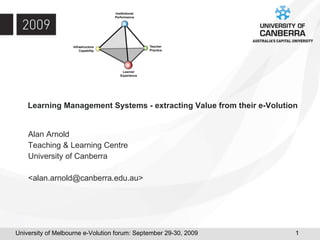
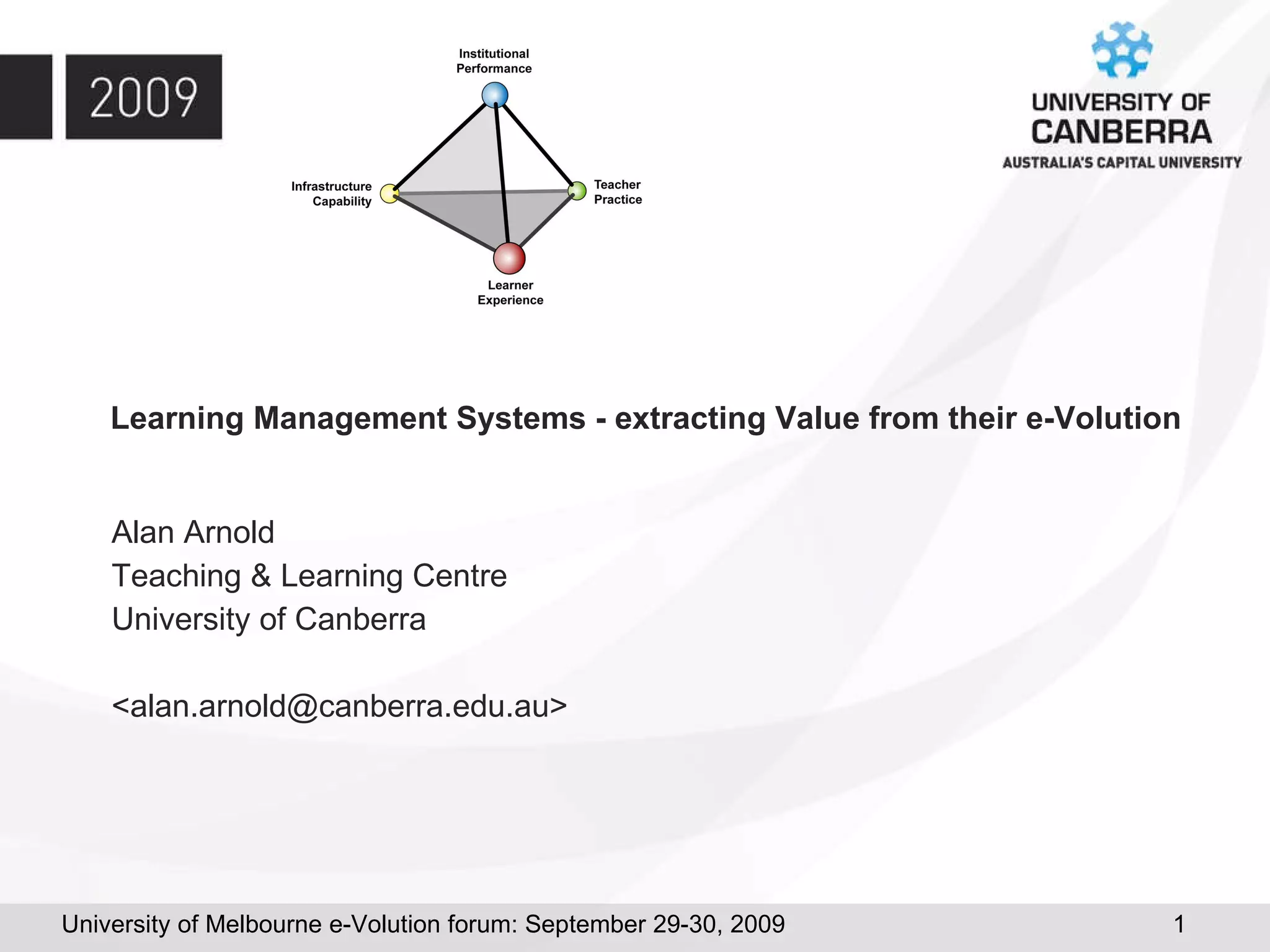
Learning Management Systems - extracting Value from their e-Volution Alan Arnold  Teaching & Learning Centre University of Canberra <alan.arnold@canberra.edu.au>
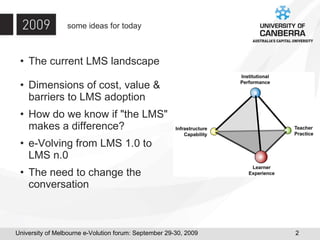
some ideas for today The current LMS landscape Dimensions of cost, value & barriers to LMS adoption How do we know if &quot;the LMS&quot; makes a difference? e-Volving from LMS 1.0 to LMS n.0 The need to change the conversation
hands up … If your day-to-day interactions are primarily with students  8 If your day-to-day interactions are primarily with staff  15 If your main discussions with staff are about learning & teaching  12 If your main discussions with staff are about research  6 If your main discussions with staff are about knowledge transfer  3 If you use an LMS more than once a day  10   …  once a week?  10 If you have/had intentions to Tweet this meeting  1 (PL)
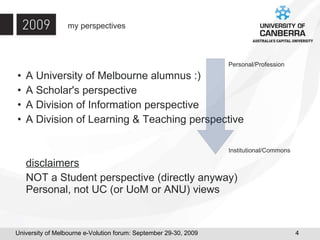
my perspectives A University of Melbourne alumnus :) A Scholar's perspective A Division of Information perspective A Division of Learning & Teaching perspective disclaimers   NOT a Student perspective (directly anyway) Personal, not UC (or UoM or ANU) views Personal/Profession Institutional/Commons
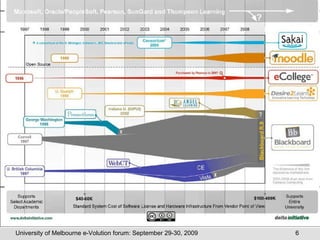
the state of learning management in higher education systems The Delta Initiative consultancy group webinar in cooperation with the Cal State system on the state of the LMS. August 11, 2009 www.deltainitiative.com/picts/pdf/deltainitiativelmswebinar09-2.pdf The State of the LMS: An Institutional Perspective  Michael Feldstein August 26, 2009 mfeldstein.com
 
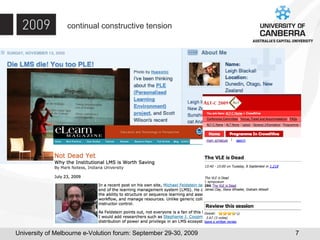
continual constructive tension
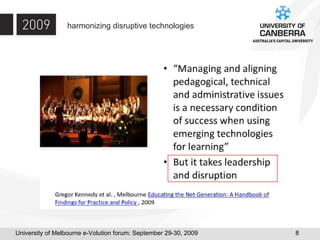
harmonizing disruptive technologies
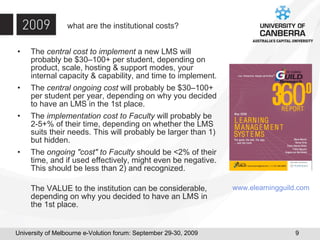
what are the institutional costs? The  central cost to implement  a new LMS will probably be $30–100+ per student, depending on product, scale, hosting & support modes, your internal capacity & capability, and time to implement. The  central ongoing cost  will probably be $30–100+ per student per year, depending on why you decided to have an LMS in the 1st place. The  implementation cost to Faculty  will probably be 2-5+% of their time, depending on whether the LMS suits their needs. This will probably be larger than 1) but hidden. The  ongoing &quot;cost&quot; to Faculty  should be <2% of their time, and if used effectively, might even be negative. This should be less than 2) and recognized. The VALUE to the institution can be considerable, depending on why you decided to have an LMS in the 1st place.  www. elearningguild .com
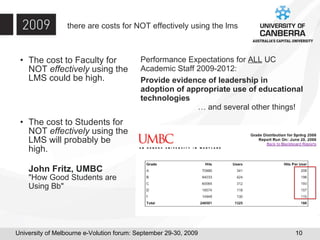
there are costs for NOT effectively using the lms The cost to Faculty for NOT  effectively  using the LMS could be high. The cost to Students for NOT  effectively  using the LMS will probably be high. John Fritz, UMBC &quot;How Good Students are Using Bb&quot;   Performance Expectations for  ALL  UC Academic Staff 2009-2012:  Provide evidence of leadership in adoption of appropriate use of educational technologies … and several other things!
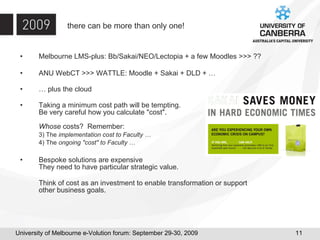
there can be more than only one! Melbourne LMS-plus: Bb/Sakai/NEO/Lectopia + a few Moodles >>> ?? ANU WebCT >>> WATTLE: Moodle + Sakai + DLD + … …  plus the cloud Taking a minimum cost path will be tempting.  Be very careful how you calculate &quot;cost&quot;.  Whose  costs?  Remember: 3) The  implementation cost to Faculty  … 4) The  ongoing &quot;cost&quot; to Faculty  … Bespoke solutions are expensive  They need to have particular strategic value. Think of cost as an investment to enable transformation or support other business goals.
the current Moodle v Sakai myth &quot;One of my biggest criticisms of Sakai in the past has been its lack of a teaching and learning focus, even though I have readily conceded that it would be my choice for a pure research and collaboration space … Sakai isn’t trying to be (for example) a java-based Moodle.  Its primary focus is as a learning and collaboration space, rather than a tool designed primarily to to deliver online/blended learning  courses a-la Moodle.&quot; AuSakai wrap up, September 20th, 2009 www.markdrechsler.com/?p=80 Moodle & Bb can also provide collaboration spaces
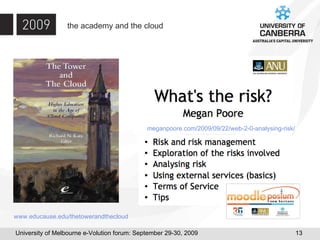
the academy and the cloud www. educause . edu/thetowerandthecloud meganpoore.com/2009/09/22/web-2-0-analysing-risk/
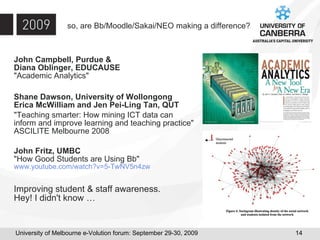
so, are Bb/Moodle/Sakai/NEO making a difference? John Campbell, Purdue &  Diana Oblinger, EDUCAUSE &quot;Academic Analytics&quot; Shane Dawson, University of Wollongong Erica McWilliam and Jen Pei-Ling Tan, QUT &quot;Teaching smarter: How mining ICT data can  inform and improve learning and teaching practice&quot;  ASCILITE Melbourne 2008 John Fritz, UMBC &quot;How Good Students are Using Bb&quot;  www.youtube.com/watch?v=5-TwNV5n4zw Improving student & staff awareness.  Hey! I didn't know …
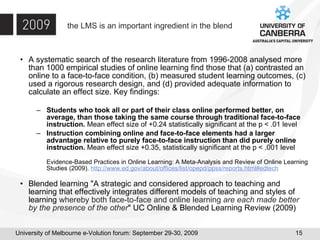
the LMS is an important ingredient in the blend A systematic search of the research literature from 1996-2008 analysed more than 1000 empirical studies of online learning find those that (a) contrasted an online to a face-to-face condition, (b) measured student learning outcomes, (c) used a rigorous research design, and (d) provided adequate information to calculate an effect size. Key findings: Students who took all or part of their class online performed better, on average, than those taking the same course through traditional face-to-face instruction.  Mean effect size of +0.24 statistically significant at the p < .01 level Instruction combining online and face-to-face elements had a larger advantage relative to purely face-to-face instruction than did purely online instruction.  Mean effect size +0.35, statistically significant at the p < .001 level Evidence-Based Practices in Online Learning: A Meta-Analysis and Review of Online Learning Studies (2009).  http://www.ed.gov/about/offices/list/opepd/ppss/reports.html#edtech Blended learning &quot;A strategic and considered approach to teaching and learning that effectively integrates different models of teaching and styles of learning  whereby both face-to-face and online learning  are each made better by the presence of the other &quot; UC Online & Blended Learning Review (2009)
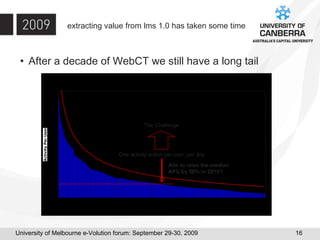
extracting value from lms 1.0 has taken some time After a decade of WebCT we still have a long tail One activity action per user, per day The Challenge Aim to raise the median APU by 50% in 2010?
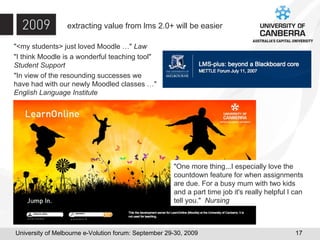
extracting value from lms 2.0+ will be easier &quot;<my students> just loved Moodle …&quot;  Law &quot;I think Moodle is a wonderful teaching tool&quot;  Student Support &quot;In view of the resounding successes we  have had with our newly Moodled classes …&quot;  English Language Institute &quot;One more thing...I especially love the countdown feature for when assignments are due. For a busy mum with two kids and a part time job it's really helpful I can tell you.&quot;  Nursing
but not without its challenges! Welcome to Wattle! [email_address]
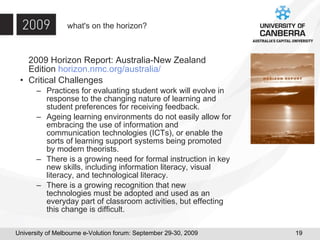
what's on the horizon? 2009 Horizon Report: Australia-New Zealand Edition  horizon.nmc.org/australia/ Critical Challenges Practices for evaluating student work will evolve in response to the changing nature of learning and student preferences for receiving feedback. Ageing learning environments do not easily allow for embracing the use of information and communication technologies (ICTs), or enable the sorts of learning support systems being promoted by modern theorists. There is a growing need for formal instruction in key new skills, including information literacy, visual literacy, and technological literacy. There is a growing recognition that new technologies must be adopted and used as an everyday part of classroom activities, but effecting this change is difficult.
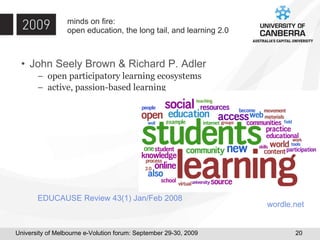
minds on fire:  open education, the long tail, and learning 2.0 John Seely Brown & Richard P. Adler open participatory learning ecosystems active, passion-based learning EDUCAUSE Review 43(1) Jan/Feb 2008 wordle .net
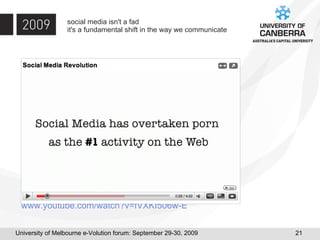
social media isn't a fad it's a fundamental shift in the way we communicate www.youtube.com/watch?v=fVXKI506w-E
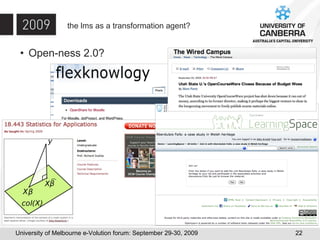
the lms as a transformation agent? Open-ness 2.0?
btw, why are we still having  separate  e-Learning and e-Research conversations? Let's talk more about [scholarly cyberinfrastructure] to help our students engage with &quot; the pleasure of the rigour of the work &quot; (McWilliam) US National Science Foundation  Office of Cyberinfrastructure , American Council of Learned Societies  Our Cultural Commonwealth National Collaborative Research Infrastructure Strategy (NCRIS)  Platforms for Collaboration  - ARCS,  ANDS, AREN … etc These don't seem to have much influenced teaching practice yet. In the meantime … re-use & re-purpose - don't re-invent the wheel.  use existing tools in smarter ways. &quot;Inspiration can happen at any time.  Capture it!&quot; (Echo360).  EVO?? still keep an eye on the e-framework  www.e-framework.org  - very similar to early Sakai framework before it was sidetracked by &quot;LMS&quot; build & use smarter glue to stick services together eg LMS plus Microsoft Live@edu, Google Apps, resource discovery + collaborative &quot;reading list&quot; creation tools, (Zotero?), digitize more of our cultural heritage, visualizations, mine the web of data …
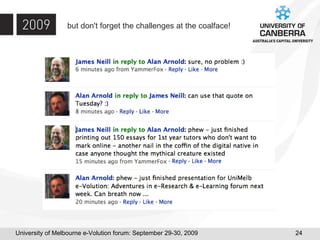
but don't forget the challenges at the coalface!
Thank you And continue to DreamLarge!
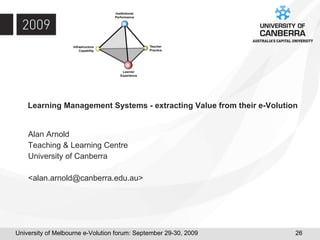
Learning Management Systems - extracting Value from their e-Volution Alan Arnold  Teaching & Learning Centre University of Canberra <alan.arnold@canberra.edu.au>

Learning Management Systems - extracting Value from their e-Volution

  • 1.
    Learning Management Systems- extracting Value from their e-Volution Alan Arnold Teaching & Learning Centre University of Canberra <alan.arnold@canberra.edu.au>
  • 2.
    some ideas fortoday The current LMS landscape Dimensions of cost, value & barriers to LMS adoption How do we know if &quot;the LMS&quot; makes a difference? e-Volving from LMS 1.0 to LMS n.0 The need to change the conversation
  • 3.
    hands up …If your day-to-day interactions are primarily with students 8 If your day-to-day interactions are primarily with staff 15 If your main discussions with staff are about learning & teaching 12 If your main discussions with staff are about research 6 If your main discussions with staff are about knowledge transfer 3 If you use an LMS more than once a day 10 … once a week? 10 If you have/had intentions to Tweet this meeting 1 (PL)
  • 4.
    my perspectives AUniversity of Melbourne alumnus :) A Scholar's perspective A Division of Information perspective A Division of Learning & Teaching perspective disclaimers NOT a Student perspective (directly anyway) Personal, not UC (or UoM or ANU) views Personal/Profession Institutional/Commons
  • 5.
    the state oflearning management in higher education systems The Delta Initiative consultancy group webinar in cooperation with the Cal State system on the state of the LMS. August 11, 2009 www.deltainitiative.com/picts/pdf/deltainitiativelmswebinar09-2.pdf The State of the LMS: An Institutional Perspective Michael Feldstein August 26, 2009 mfeldstein.com
  • 6.
  • 7.
  • 8.
  • 9.
    what are theinstitutional costs? The central cost to implement a new LMS will probably be $30–100+ per student, depending on product, scale, hosting & support modes, your internal capacity & capability, and time to implement. The central ongoing cost will probably be $30–100+ per student per year, depending on why you decided to have an LMS in the 1st place. The implementation cost to Faculty will probably be 2-5+% of their time, depending on whether the LMS suits their needs. This will probably be larger than 1) but hidden. The ongoing &quot;cost&quot; to Faculty should be <2% of their time, and if used effectively, might even be negative. This should be less than 2) and recognized. The VALUE to the institution can be considerable, depending on why you decided to have an LMS in the 1st place. www. elearningguild .com
  • 10.
    there are costsfor NOT effectively using the lms The cost to Faculty for NOT effectively using the LMS could be high. The cost to Students for NOT effectively using the LMS will probably be high. John Fritz, UMBC &quot;How Good Students are Using Bb&quot; Performance Expectations for ALL UC Academic Staff 2009-2012: Provide evidence of leadership in adoption of appropriate use of educational technologies … and several other things!
  • 11.
    there can bemore than only one! Melbourne LMS-plus: Bb/Sakai/NEO/Lectopia + a few Moodles >>> ?? ANU WebCT >>> WATTLE: Moodle + Sakai + DLD + … … plus the cloud Taking a minimum cost path will be tempting. Be very careful how you calculate &quot;cost&quot;. Whose costs? Remember: 3) The implementation cost to Faculty … 4) The ongoing &quot;cost&quot; to Faculty … Bespoke solutions are expensive They need to have particular strategic value. Think of cost as an investment to enable transformation or support other business goals.
  • 12.
    the current Moodlev Sakai myth &quot;One of my biggest criticisms of Sakai in the past has been its lack of a teaching and learning focus, even though I have readily conceded that it would be my choice for a pure research and collaboration space … Sakai isn’t trying to be (for example) a java-based Moodle. Its primary focus is as a learning and collaboration space, rather than a tool designed primarily to to deliver online/blended learning courses a-la Moodle.&quot; AuSakai wrap up, September 20th, 2009 www.markdrechsler.com/?p=80 Moodle & Bb can also provide collaboration spaces
  • 13.
    the academy andthe cloud www. educause . edu/thetowerandthecloud meganpoore.com/2009/09/22/web-2-0-analysing-risk/
  • 14.
    so, are Bb/Moodle/Sakai/NEOmaking a difference? John Campbell, Purdue & Diana Oblinger, EDUCAUSE &quot;Academic Analytics&quot; Shane Dawson, University of Wollongong Erica McWilliam and Jen Pei-Ling Tan, QUT &quot;Teaching smarter: How mining ICT data can inform and improve learning and teaching practice&quot; ASCILITE Melbourne 2008 John Fritz, UMBC &quot;How Good Students are Using Bb&quot; www.youtube.com/watch?v=5-TwNV5n4zw Improving student & staff awareness. Hey! I didn't know …
  • 15.
    the LMS isan important ingredient in the blend A systematic search of the research literature from 1996-2008 analysed more than 1000 empirical studies of online learning find those that (a) contrasted an online to a face-to-face condition, (b) measured student learning outcomes, (c) used a rigorous research design, and (d) provided adequate information to calculate an effect size. Key findings: Students who took all or part of their class online performed better, on average, than those taking the same course through traditional face-to-face instruction. Mean effect size of +0.24 statistically significant at the p < .01 level Instruction combining online and face-to-face elements had a larger advantage relative to purely face-to-face instruction than did purely online instruction. Mean effect size +0.35, statistically significant at the p < .001 level Evidence-Based Practices in Online Learning: A Meta-Analysis and Review of Online Learning Studies (2009). http://www.ed.gov/about/offices/list/opepd/ppss/reports.html#edtech Blended learning &quot;A strategic and considered approach to teaching and learning that effectively integrates different models of teaching and styles of learning whereby both face-to-face and online learning are each made better by the presence of the other &quot; UC Online & Blended Learning Review (2009)
  • 16.
    extracting value fromlms 1.0 has taken some time After a decade of WebCT we still have a long tail One activity action per user, per day The Challenge Aim to raise the median APU by 50% in 2010?
  • 17.
    extracting value fromlms 2.0+ will be easier &quot;<my students> just loved Moodle …&quot; Law &quot;I think Moodle is a wonderful teaching tool&quot; Student Support &quot;In view of the resounding successes we have had with our newly Moodled classes …&quot; English Language Institute &quot;One more thing...I especially love the countdown feature for when assignments are due. For a busy mum with two kids and a part time job it's really helpful I can tell you.&quot; Nursing
  • 18.
    but not withoutits challenges! Welcome to Wattle! [email_address]
  • 19.
    what's on thehorizon? 2009 Horizon Report: Australia-New Zealand Edition horizon.nmc.org/australia/ Critical Challenges Practices for evaluating student work will evolve in response to the changing nature of learning and student preferences for receiving feedback. Ageing learning environments do not easily allow for embracing the use of information and communication technologies (ICTs), or enable the sorts of learning support systems being promoted by modern theorists. There is a growing need for formal instruction in key new skills, including information literacy, visual literacy, and technological literacy. There is a growing recognition that new technologies must be adopted and used as an everyday part of classroom activities, but effecting this change is difficult.
  • 20.
    minds on fire: open education, the long tail, and learning 2.0 John Seely Brown & Richard P. Adler open participatory learning ecosystems active, passion-based learning EDUCAUSE Review 43(1) Jan/Feb 2008 wordle .net
  • 21.
    social media isn'ta fad it's a fundamental shift in the way we communicate www.youtube.com/watch?v=fVXKI506w-E
  • 22.
    the lms asa transformation agent? Open-ness 2.0?
  • 23.
    btw, why arewe still having separate e-Learning and e-Research conversations? Let's talk more about [scholarly cyberinfrastructure] to help our students engage with &quot; the pleasure of the rigour of the work &quot; (McWilliam) US National Science Foundation Office of Cyberinfrastructure , American Council of Learned Societies Our Cultural Commonwealth National Collaborative Research Infrastructure Strategy (NCRIS) Platforms for Collaboration - ARCS, ANDS, AREN … etc These don't seem to have much influenced teaching practice yet. In the meantime … re-use & re-purpose - don't re-invent the wheel. use existing tools in smarter ways. &quot;Inspiration can happen at any time. Capture it!&quot; (Echo360). EVO?? still keep an eye on the e-framework www.e-framework.org - very similar to early Sakai framework before it was sidetracked by &quot;LMS&quot; build & use smarter glue to stick services together eg LMS plus Microsoft Live@edu, Google Apps, resource discovery + collaborative &quot;reading list&quot; creation tools, (Zotero?), digitize more of our cultural heritage, visualizations, mine the web of data …
  • 24.
    but don't forgetthe challenges at the coalface!
  • 25.
    Thank you Andcontinue to DreamLarge!
  • 26.
    Learning Management Systems- extracting Value from their e-Volution Alan Arnold Teaching & Learning Centre University of Canberra <alan.arnold@canberra.edu.au>