• Cognizant 20-20 Insights


Reality Checking Agile’s Architectural
Inner Workings
By demystifying Agile constructs, and how architects fit into the
development process, organizations can find and follow best practices
and deliver benefits that advance accelerated coding objectives and
meet strategic business needs.

      Executive Summary                                      team members. Ultimately, it is up to the team
                                                             to figure out how much to architect up front —
      Although Agile has been around since 2001,
                                                             by applying their collective wisdom. However,
      some organizations still find the concept of “Agile
                                                             in general, the idea is to not spend much time
      architecture” confusing. On one hand, they hear
                                                             designing and implementing various moving
      “don’t do up-front design” — but this is often
                                                             parts — hinged-to layers and tiers, with interde-
      counteracted by the fact that if an organization
                                                             pendencies or responsibilities and cross-cutting
      does not design early, it will face major challenges
                                                             concerns. Rather, it makes more sense to simply
      in proceeding with software visioning and/or
                                                             build the minimal amount of code needed to
      framework development.
                                                             connect all of the basic pieces (some of which may
      Agile philosophy warns organizations to not            still be in the conceptual state) and start building
      attempt “big design up front” because doing so         the actual functionality on top — thus providing an
      may result in teams scrapping a major chunk of         early end-to-end experience of the results.
      hard work if the business decides to change its
                                                             So the focus is more on the API level of the infra-
      approach. Such a change can arise from any one
                                                             structure and not the actual implementation
      of numerous reasons: changed market require-
                                                             — which is usually mocked up for the first few
      ments, staying ahead of the competition, etc. And
                                                             Sprints. And as iterations progress, the actual
      this dilemma forces Agile advocates to ponder,
                                                             implementation is incrementally completed, as
      how much architecture is just right in Agile?
                                                             guided by the need of the other functional parts
      Although there may be no absolute answer to this
                                                             of the application.
      quandary, this paper will explore how an Agile
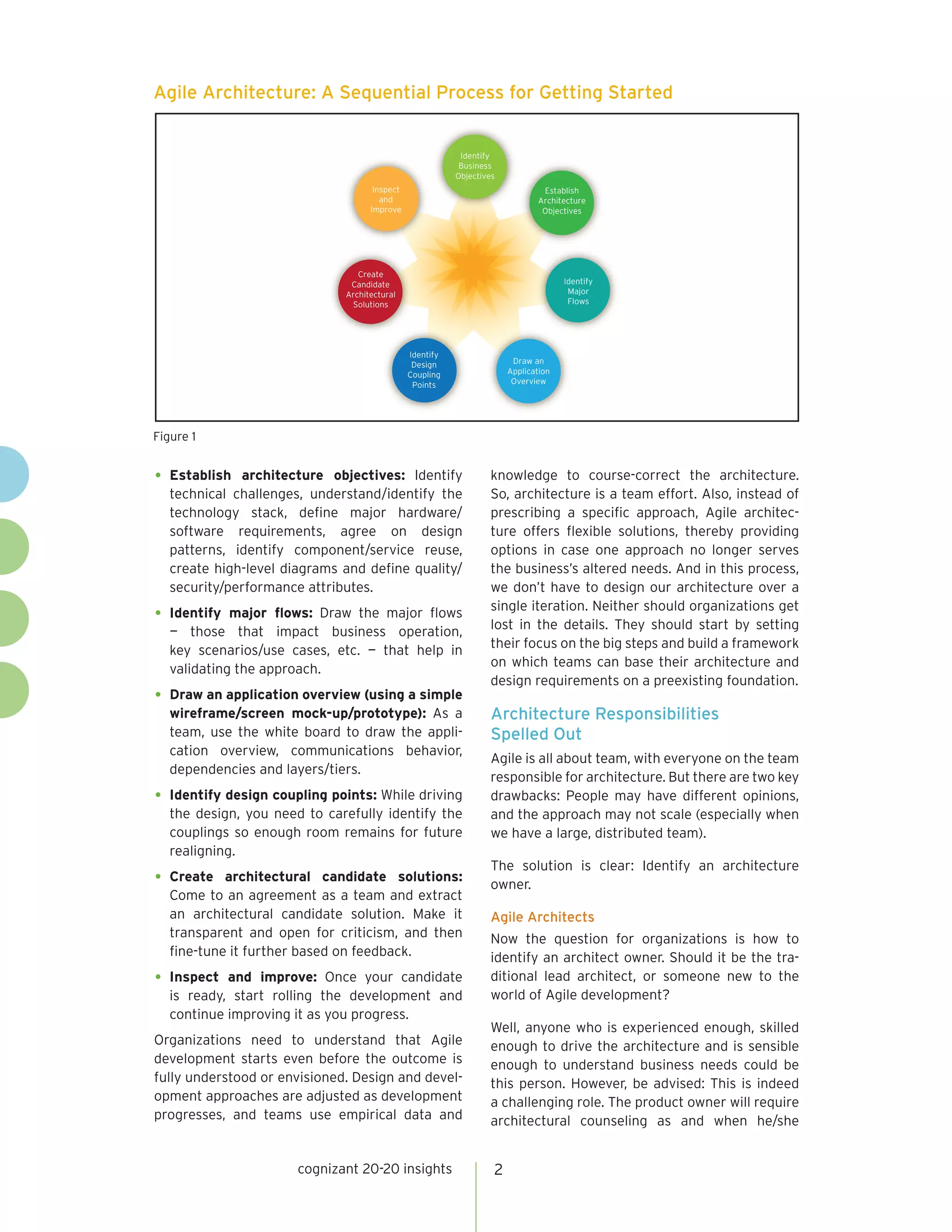
      team can find the best balance of up-front archi-      Here is a guideline on getting started with an
      tecture work.                                          Agile architecture, distilled to seven simple steps:
      Assessing Architecture Requirements                    •	 Identify business objectives: Focus on under-
      Honestly, there is no single, fixed answer to the        standing “why” the business wants to build this,
      question of how much architecture is just enough.        rather than “what” the business is planning.
      The answer depends on the project’s context and


      cognizant 20-20 insights | february 2013
Agile Architecture: A Sequential Process for Getting Started


                                                           Identify
                                                           Business
                                                          Objectives
                                     Inspect                                   Establish
                                       and                                    Architecture
                                    Improve                                    Objectives


                                 Create
                               Candidate                                             Identify
                              Architectural                                           Major
                               Solutions                                              Flows


                                               Identify
                                                Design                  Draw an
                                               Coupling                Application
                                                Points                  Overview


Figure 1


•	 Establish  architecture objectives: Identify                   knowledge to course-correct the architecture.
   technical challenges, understand/identify the                  So, architecture is a team effort. Also, instead of
   technology stack, define major hardware/                       prescribing a specific approach, Agile architec-
   software requirements, agree on design                         ture offers flexible solutions, thereby providing
   patterns, identify component/service reuse,                    options in case one approach no longer serves
   create high-level diagrams and define quality/                 the business’s altered needs. And in this process,
   security/performance attributes.                               we don’t have to design our architecture over a
                                                                  single iteration. Neither should organizations get
•	 Identify  major flows: Draw the major flows
                                                                  lost in the details. They should start by setting
   — those that impact business operation,
                                                                  their focus on the big steps and build a framework
   key scenarios/use cases, etc. — that help in
                                                                  on which teams can base their architecture and
   validating the approach.
                                                                  design requirements on a preexisting foundation.
•	 Draw an application overview (using a simple
   wireframe/screen mock-up/prototype): As a                      Architecture Responsibilities
   team, use the white board to draw the appli-                   Spelled Out
   cation overview, communications behavior,
                                                                  Agile is all about team, with everyone on the team
   dependencies and layers/tiers.
                                                                  responsible for architecture. But there are two key
•	 Identify design coupling points: While driving                 drawbacks: People may have different opinions,
   the design, you need to carefully identify the                 and the approach may not scale (especially when
   couplings so enough room remains for future                    we have a large, distributed team).
   realigning.
                                                                  The solution is clear: Identify an architecture
•	 Create   architectural candidate solutions:
                                                                  owner.
   Come to an agreement as a team and extract
   an architectural candidate solution. Make it                   Agile Architects
   transparent and open for criticism, and then                   Now the question for organizations is how to
   fine-tune it further based on feedback.                        identify an architect owner. Should it be the tra-
•	 Inspect  and improve: Once your candidate                      ditional lead architect, or someone new to the
   is ready, start rolling the development and                    world of Agile development?
   continue improving it as you progress.
                                                                  Well, anyone who is experienced enough, skilled
Organizations need to understand that Agile                       enough to drive the architecture and is sensible
development starts even before the outcome is                     enough to understand business needs could be
fully understood or envisioned. Design and devel-                 this person. However, be advised: This is indeed
opment approaches are adjusted as development                     a challenging role. The product owner will require
progresses, and teams use empirical data and                      architectural counseling as and when he/she


                       cognizant 20-20 insights                    2
creates a new vision. Developers are usually on        •	 Part of the up-front effort are initial require-
their toes and may even glance at the architect            ments and architecture envisioning so that
with a heinous look. During Sprint planning,               teams are able to answer critical questions
the team will need its architects to define the            about the scope, cost, schedule and technical
technology boundary of the work-items. The                 strategy of their projects.
organization will expect architects not only to
provide system architecture, but also to consider      The question then becomes whether to engage in
the big picture of enterprise architecture.            up-front design or not.

Ironically, if the organization looks at traditional   Big Up-Front Designing vs. None
architects moving into the Agile sphere, there         Big up-front designing (BUFD) is on one extreme,
is a palpable sense of resistance in the air. This     whereas no up-front designing (NUFD) is the
resistance is attributed to the widespread myths       other pole. Agile architecture, however, is about
of Agile architecture and its associated roles.        some short small up-front design (SSSUFD). Keep
These include:                                         in mind:

•	 Sprint 0 is the time for a detailed architectural   •	 Agile architecture is not a blueprint.
  spec.
                                                       •	 Agile architecture is about what changes you
•	 Agilemethods are architecturally weak, dis-             can ignore.
  connected from the realities of delivering large
  systems in complex enterprise environments.          •	 Agile architecture is about impactful choices
                                                           up front that will make later choices easy.
•	 Agile discourages “up-front” designing.             •	 Agile architecture is subject to change.
However, the facts suggest:                            •	 Agile architecture is about stable ground, but
                                                           not frozen (static) ground.
•	 During “Sprint 0,” teams need to get their
  project organized and moving in the right            So, how much rough up-front design (RUFD) is
  direction. But they don’t need a detailed spec       enough?
  per se.
                                                       •	 It depends.
•	 Agile encourages waste reduction, as devel-
  opment is based on a moving target. But that         •	 Let it give  you enough confidence to move
                                                           forward, but don’t rush.
  doesn’t mean Agile is architecturally weak.
  Rather, it helps us to be more aligned to            •	 It can take as long as two Sprints and be as
  realities and helps drive success by delivering          short as ’’about a week.’’
  complex enterprise projects.


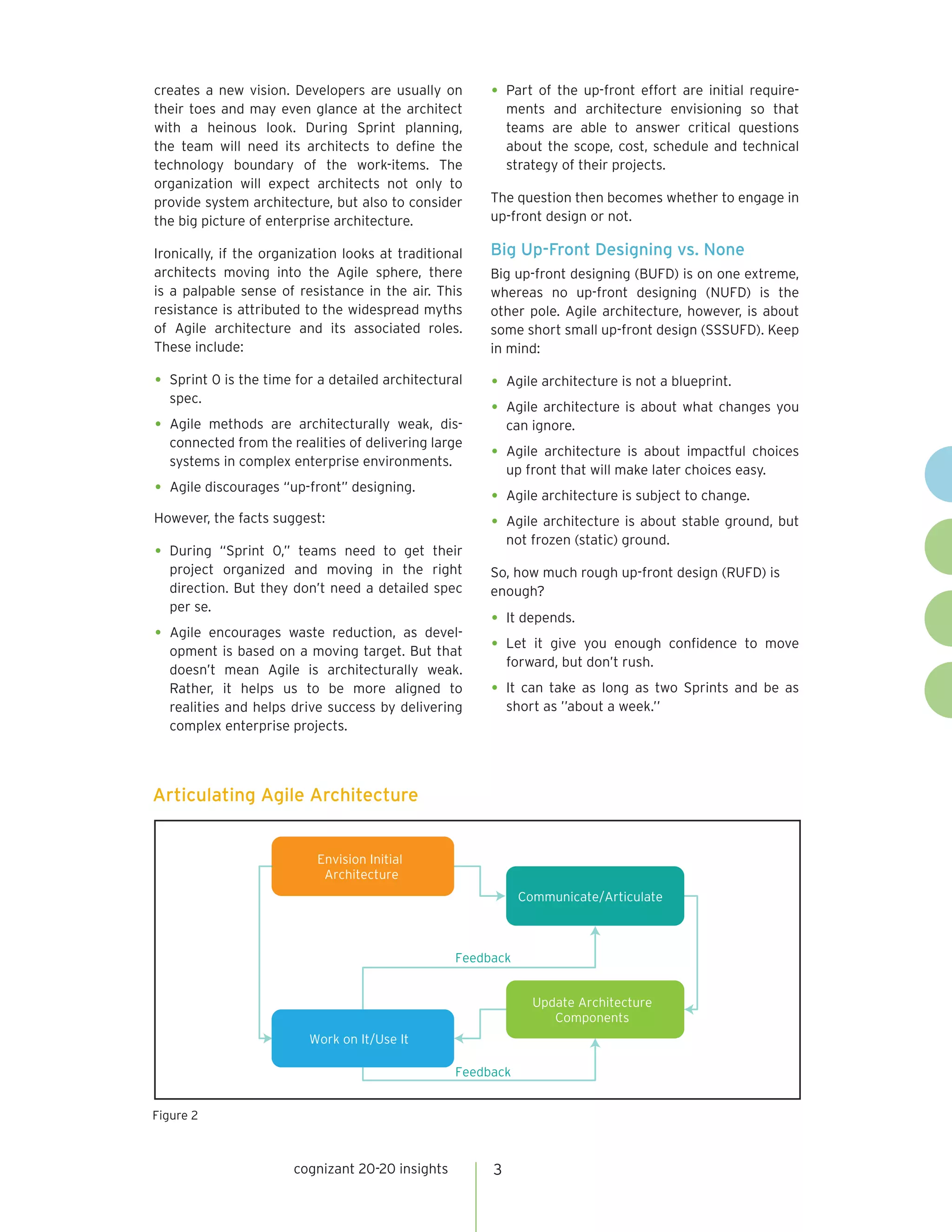
Articulating Agile Architecture


                           Envision Initial
                            Architecture
                                                             Communicate/Articulate


                                                  Feedback


                                                               Update Architecture
                                                                  Components
                          Work on It/Use It

                                                  Feedback


Figure 2


                       cognizant 20-20 insights        3
•	 Deliver your architecture as code, as abstract                                  •	 However, the work evolves to reflect greater
    base classes and some ’’base-lined’’ documents.                                    understanding and knowledge of the develop-
                                                                                       ment team.
•	 It  grounds you in reality and gives you the
    platform to take off and implement the user                                    In addition, the following best practices should
    stories as you go forward.                                                     be followed once the foundational thinking is in
•	 Spike it (i.e., create a technical debt item and                                place:
    drive it).
                                                                                   •	 Think about the future, but don’t overbuild the
Agile is, and has always been, driven by moving                                        architecture.
targets (i.e., changing/evolving needs). Its archi-
tecture, however, has never wavered.
                                                                                   •	 Be open about your architecture — encourage
                                                                                       criticism, and allow your architecture to evolve.
Evolving Architecture                                                              •	 Use spikes; validate your model through imple-
Some thoughts to consider as your organization                                         mentation.
ponders Agile architecture:                                                        •	 Travel light — do not create a five-page
                                                                                       document when a diagram will do.
•	 Architecture emerges over time, incrementally.
•	 Organizations need to work faster at first, due                                 •	 Allow requirements to drive your architecture
                                                                                       updates.
    to the greater need to set the foundation of a
    project.


About the Author
Arijit Sarbagna is a Senior Manager of Projects within Cognizant’s Advanced Solutions Group. He spe-
cializes in helping companies realize efficiency gains by adopting Agile principles and practices such as
Scrum (and Extreme Programming). Arijit started his technology career in 1998 as a software developer,
a development lead/manager, a business development manager and a variety of other jobs before
settling on his true calling, project and program management in Agile space. Arijit is also the local
Chapter Engagement Representative (CER) from PMI Agile Community of Practice (CoP) and represents
the West Bengal, India chapter. He can be reached at Arijit.Sarbagna@cognizant.com.


About Cognizant
Cognizant (NASDAQ: CTSH) is a leading provider of information technology, consulting, and business process out-
sourcing services, dedicated to helping the world’s leading companies build stronger businesses. Headquartered in
Teaneck, New Jersey (U.S.), Cognizant combines a passion for client satisfaction, technology innovation, deep industry
and business process expertise, and a global, collaborative workforce that embodies the future of work. With over 50
delivery centers worldwide and approximately 156,700 employees as of December 31, 2012, Cognizant is a member of
the NASDAQ-100, the S&P 500, the Forbes Global 2000, and the Fortune 500 and is ranked among the top performing
and fastest growing companies in the world. Visit us online at www.cognizant.com or follow us on Twitter: Cognizant.


                                         World Headquarters                  European Headquarters                 India Operations Headquarters
                                         500 Frank W. Burr Blvd.             1 Kingdom Street                      #5/535, Old Mahabalipuram Road
                                         Teaneck, NJ 07666 USA               Paddington Central                    Okkiyam Pettai, Thoraipakkam
                                         Phone: +1 201 801 0233              London W2 6BD                         Chennai, 600 096 India
                                         Fax: +1 201 801 0243                Phone: +44 (0) 20 7297 7600           Phone: +91 (0) 44 4209 6000
                                         Toll Free: +1 888 937 3277          Fax: +44 (0) 20 7121 0102             Fax: +91 (0) 44 4209 6060
                                         Email: inquiry@cognizant.com        Email: infouk@cognizant.com           Email: inquiryindia@cognizant.com


©
­­ Copyright 2013, Cognizant. All rights reserved. No part of this document may be reproduced, stored in a retrieval system, transmitted in any form or by any
means, electronic, mechanical, photocopying, recording, or otherwise, without the express written permission from Cognizant. The information contained herein is
subject to change without notice. All other trademarks mentioned herein are the property of their respective owners.

Reality checking agile's architectural inner workings

  • 1.
    • Cognizant 20-20Insights Reality Checking Agile’s Architectural Inner Workings By demystifying Agile constructs, and how architects fit into the development process, organizations can find and follow best practices and deliver benefits that advance accelerated coding objectives and meet strategic business needs. Executive Summary team members. Ultimately, it is up to the team to figure out how much to architect up front — Although Agile has been around since 2001, by applying their collective wisdom. However, some organizations still find the concept of “Agile in general, the idea is to not spend much time architecture” confusing. On one hand, they hear designing and implementing various moving “don’t do up-front design” — but this is often parts — hinged-to layers and tiers, with interde- counteracted by the fact that if an organization pendencies or responsibilities and cross-cutting does not design early, it will face major challenges concerns. Rather, it makes more sense to simply in proceeding with software visioning and/or build the minimal amount of code needed to framework development. connect all of the basic pieces (some of which may Agile philosophy warns organizations to not still be in the conceptual state) and start building attempt “big design up front” because doing so the actual functionality on top — thus providing an may result in teams scrapping a major chunk of early end-to-end experience of the results. hard work if the business decides to change its So the focus is more on the API level of the infra- approach. Such a change can arise from any one structure and not the actual implementation of numerous reasons: changed market require- — which is usually mocked up for the first few ments, staying ahead of the competition, etc. And Sprints. And as iterations progress, the actual this dilemma forces Agile advocates to ponder, implementation is incrementally completed, as how much architecture is just right in Agile? guided by the need of the other functional parts Although there may be no absolute answer to this of the application. quandary, this paper will explore how an Agile team can find the best balance of up-front archi- Here is a guideline on getting started with an tecture work. Agile architecture, distilled to seven simple steps: Assessing Architecture Requirements • Identify business objectives: Focus on under- Honestly, there is no single, fixed answer to the standing “why” the business wants to build this, question of how much architecture is just enough. rather than “what” the business is planning. The answer depends on the project’s context and cognizant 20-20 insights | february 2013
  • 2.
    Agile Architecture: ASequential Process for Getting Started Identify Business Objectives Inspect Establish and Architecture Improve Objectives Create Candidate Identify Architectural Major Solutions Flows Identify Design Draw an Coupling Application Points Overview Figure 1 • Establish architecture objectives: Identify knowledge to course-correct the architecture. technical challenges, understand/identify the So, architecture is a team effort. Also, instead of technology stack, define major hardware/ prescribing a specific approach, Agile architec- software requirements, agree on design ture offers flexible solutions, thereby providing patterns, identify component/service reuse, options in case one approach no longer serves create high-level diagrams and define quality/ the business’s altered needs. And in this process, security/performance attributes. we don’t have to design our architecture over a single iteration. Neither should organizations get • Identify major flows: Draw the major flows lost in the details. They should start by setting — those that impact business operation, their focus on the big steps and build a framework key scenarios/use cases, etc. — that help in on which teams can base their architecture and validating the approach. design requirements on a preexisting foundation. • Draw an application overview (using a simple wireframe/screen mock-up/prototype): As a Architecture Responsibilities team, use the white board to draw the appli- Spelled Out cation overview, communications behavior, Agile is all about team, with everyone on the team dependencies and layers/tiers. responsible for architecture. But there are two key • Identify design coupling points: While driving drawbacks: People may have different opinions, the design, you need to carefully identify the and the approach may not scale (especially when couplings so enough room remains for future we have a large, distributed team). realigning. The solution is clear: Identify an architecture • Create architectural candidate solutions: owner. Come to an agreement as a team and extract an architectural candidate solution. Make it Agile Architects transparent and open for criticism, and then Now the question for organizations is how to fine-tune it further based on feedback. identify an architect owner. Should it be the tra- • Inspect and improve: Once your candidate ditional lead architect, or someone new to the is ready, start rolling the development and world of Agile development? continue improving it as you progress. Well, anyone who is experienced enough, skilled Organizations need to understand that Agile enough to drive the architecture and is sensible development starts even before the outcome is enough to understand business needs could be fully understood or envisioned. Design and devel- this person. However, be advised: This is indeed opment approaches are adjusted as development a challenging role. The product owner will require progresses, and teams use empirical data and architectural counseling as and when he/she cognizant 20-20 insights 2
  • 3.
    creates a newvision. Developers are usually on • Part of the up-front effort are initial require- their toes and may even glance at the architect ments and architecture envisioning so that with a heinous look. During Sprint planning, teams are able to answer critical questions the team will need its architects to define the about the scope, cost, schedule and technical technology boundary of the work-items. The strategy of their projects. organization will expect architects not only to provide system architecture, but also to consider The question then becomes whether to engage in the big picture of enterprise architecture. up-front design or not. Ironically, if the organization looks at traditional Big Up-Front Designing vs. None architects moving into the Agile sphere, there Big up-front designing (BUFD) is on one extreme, is a palpable sense of resistance in the air. This whereas no up-front designing (NUFD) is the resistance is attributed to the widespread myths other pole. Agile architecture, however, is about of Agile architecture and its associated roles. some short small up-front design (SSSUFD). Keep These include: in mind: • Sprint 0 is the time for a detailed architectural • Agile architecture is not a blueprint. spec. • Agile architecture is about what changes you • Agilemethods are architecturally weak, dis- can ignore. connected from the realities of delivering large systems in complex enterprise environments. • Agile architecture is about impactful choices up front that will make later choices easy. • Agile discourages “up-front” designing. • Agile architecture is subject to change. However, the facts suggest: • Agile architecture is about stable ground, but not frozen (static) ground. • During “Sprint 0,” teams need to get their project organized and moving in the right So, how much rough up-front design (RUFD) is direction. But they don’t need a detailed spec enough? per se. • It depends. • Agile encourages waste reduction, as devel- opment is based on a moving target. But that • Let it give you enough confidence to move forward, but don’t rush. doesn’t mean Agile is architecturally weak. Rather, it helps us to be more aligned to • It can take as long as two Sprints and be as realities and helps drive success by delivering short as ’’about a week.’’ complex enterprise projects. Articulating Agile Architecture Envision Initial Architecture Communicate/Articulate Feedback Update Architecture Components Work on It/Use It Feedback Figure 2 cognizant 20-20 insights 3
  • 4.
    • Deliver yourarchitecture as code, as abstract • However, the work evolves to reflect greater base classes and some ’’base-lined’’ documents. understanding and knowledge of the develop- ment team. • It grounds you in reality and gives you the platform to take off and implement the user In addition, the following best practices should stories as you go forward. be followed once the foundational thinking is in • Spike it (i.e., create a technical debt item and place: drive it). • Think about the future, but don’t overbuild the Agile is, and has always been, driven by moving architecture. targets (i.e., changing/evolving needs). Its archi- tecture, however, has never wavered. • Be open about your architecture — encourage criticism, and allow your architecture to evolve. Evolving Architecture • Use spikes; validate your model through imple- Some thoughts to consider as your organization mentation. ponders Agile architecture: • Travel light — do not create a five-page document when a diagram will do. • Architecture emerges over time, incrementally. • Organizations need to work faster at first, due • Allow requirements to drive your architecture updates. to the greater need to set the foundation of a project. About the Author Arijit Sarbagna is a Senior Manager of Projects within Cognizant’s Advanced Solutions Group. He spe- cializes in helping companies realize efficiency gains by adopting Agile principles and practices such as Scrum (and Extreme Programming). Arijit started his technology career in 1998 as a software developer, a development lead/manager, a business development manager and a variety of other jobs before settling on his true calling, project and program management in Agile space. Arijit is also the local Chapter Engagement Representative (CER) from PMI Agile Community of Practice (CoP) and represents the West Bengal, India chapter. He can be reached at Arijit.Sarbagna@cognizant.com. About Cognizant Cognizant (NASDAQ: CTSH) is a leading provider of information technology, consulting, and business process out- sourcing services, dedicated to helping the world’s leading companies build stronger businesses. Headquartered in Teaneck, New Jersey (U.S.), Cognizant combines a passion for client satisfaction, technology innovation, deep industry and business process expertise, and a global, collaborative workforce that embodies the future of work. With over 50 delivery centers worldwide and approximately 156,700 employees as of December 31, 2012, Cognizant is a member of the NASDAQ-100, the S&P 500, the Forbes Global 2000, and the Fortune 500 and is ranked among the top performing and fastest growing companies in the world. Visit us online at www.cognizant.com or follow us on Twitter: Cognizant. World Headquarters European Headquarters India Operations Headquarters 500 Frank W. Burr Blvd. 1 Kingdom Street #5/535, Old Mahabalipuram Road Teaneck, NJ 07666 USA Paddington Central Okkiyam Pettai, Thoraipakkam Phone: +1 201 801 0233 London W2 6BD Chennai, 600 096 India Fax: +1 201 801 0243 Phone: +44 (0) 20 7297 7600 Phone: +91 (0) 44 4209 6000 Toll Free: +1 888 937 3277 Fax: +44 (0) 20 7121 0102 Fax: +91 (0) 44 4209 6060 Email: inquiry@cognizant.com Email: infouk@cognizant.com Email: inquiryindia@cognizant.com © ­­ Copyright 2013, Cognizant. All rights reserved. No part of this document may be reproduced, stored in a retrieval system, transmitted in any form or by any means, electronic, mechanical, photocopying, recording, or otherwise, without the express written permission from Cognizant. The information contained herein is subject to change without notice. All other trademarks mentioned herein are the property of their respective owners.