Real-time Text Communication:
Making It Real
(Jon Azpiroz, Karel Van Isacker)


Presented by Karel Van Isacker (EPR)
The background

●   Voice communication
    ●   Not possible for everyone
    ●   Alternative manners (BSL over MSN, in
        the past ICQ, now AOL IM)
    ●   But what about mobiles?
●   Quest for alternatives to traditional
    voice telephony that could be accessible
    across desktop and mobile
    communications devices.
The vehicle

●   FP7 AEGIS project
    ●   Project title:
        –   Open Accessibility Everywhere:
            Groundwork, Infrastructure, Standards
    ●   Starting date: 1 September 2008
    ●   Duration: 48 Months
    ●   Integrated Project (IP) within the ICT
        programme of FP7
The directions

●   FP7 AEGIS project
    ●   Desktop accessibility
        –   odt2Braille, odt2Daisy, Symbol support, …
    ●   Web applications accessibility
        –   ARIA, …
    ●   Mobile accessibility
        –   Tecla (mobile switch), …, and RTT
●   Available on iPhone/Android market,
    SourceForge, …
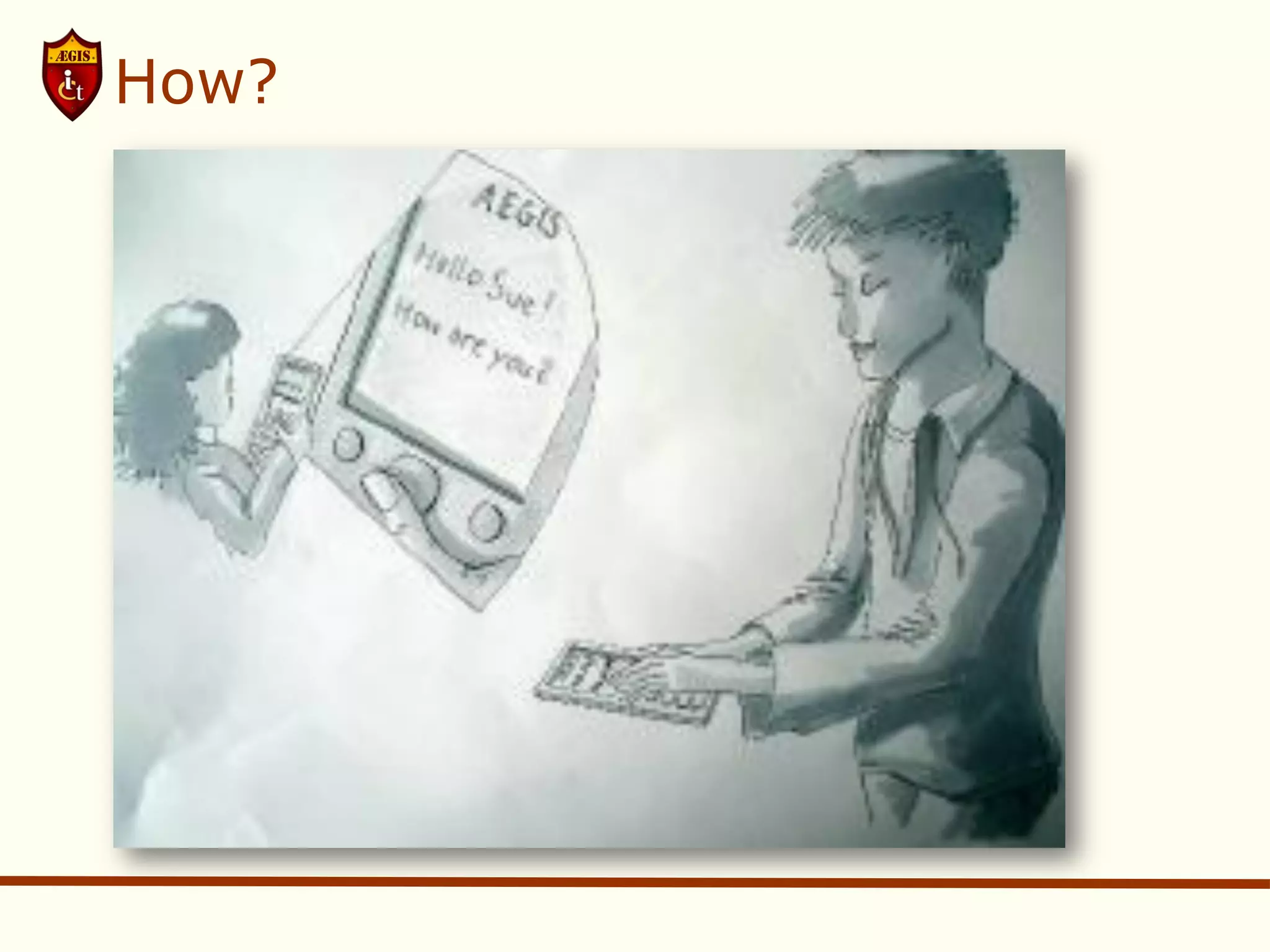
How?
Background Of Text Communications
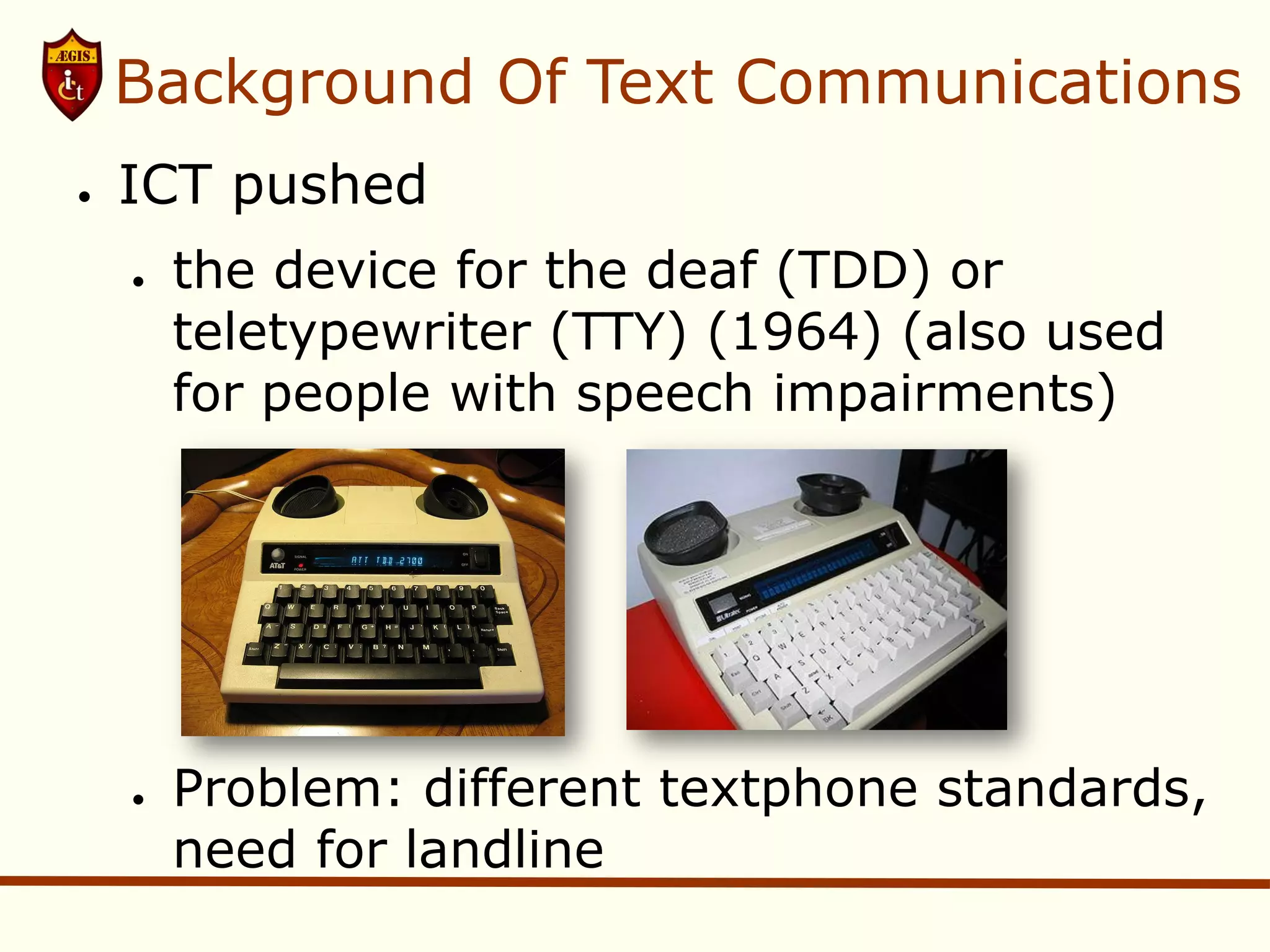
●   ICT pushed
    ●   the device for the deaf (TDD) or
        teletypewriter (TTY) (1964) (also used
        for people with speech impairments)


    ●   Problem: different textphone standards,
        need for landline
Background Of Text Communications
●   ICT pushed
    ●   Short Message Service (SMS) (1984)
    ●   First SMS message sent over the
        Vodafone GSM network (UK) on 3
        December 1992, from a personal
        computer to an Orbitel 901 handset.
        Text was "Merry Christmas".
    ●   Commercialised in 1993 (Nokia only
        handset manufacturer whose total GSM
        phone line supported user-sending of
        SMS text messages).
Background Of Text Communications
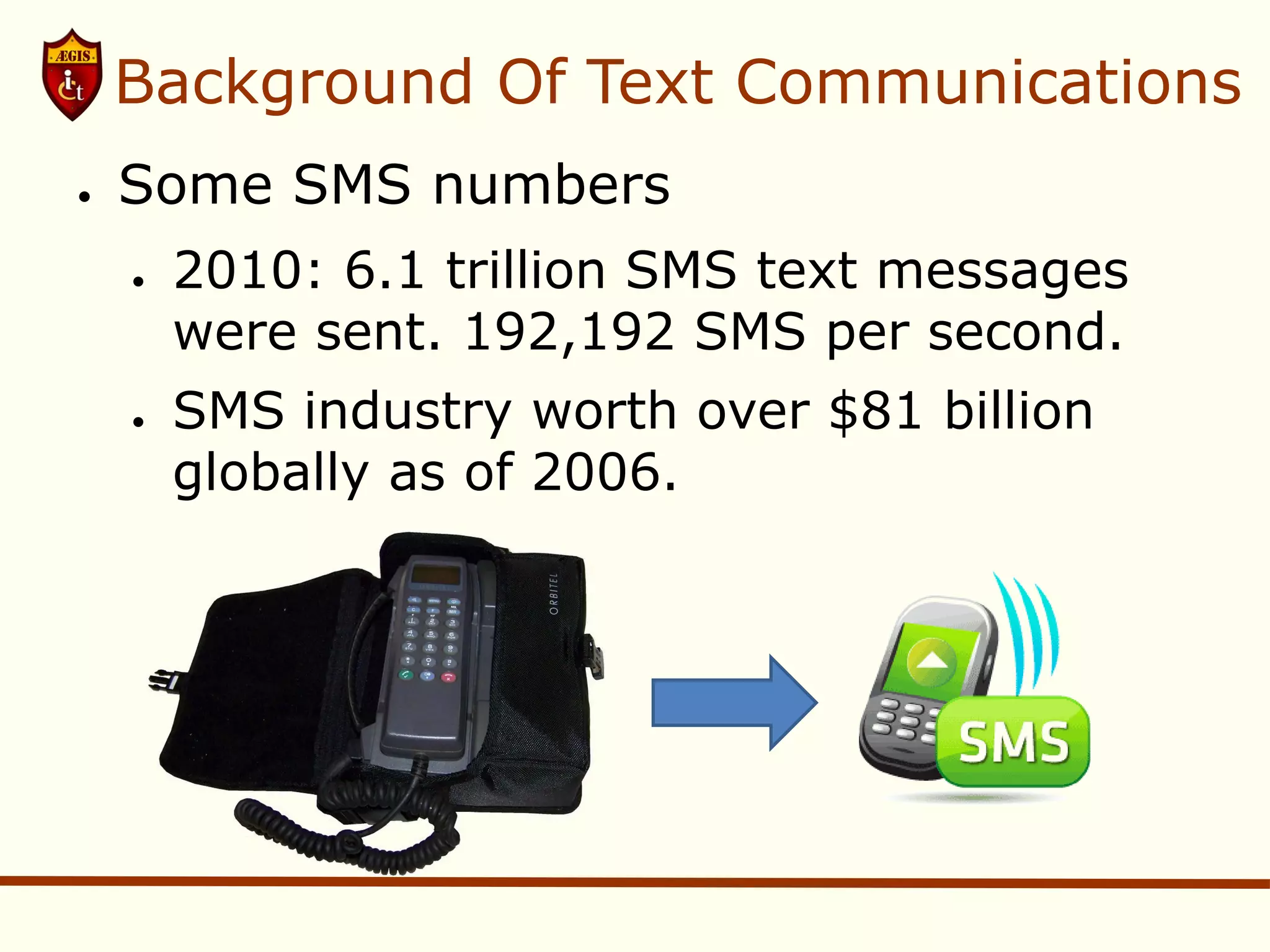
●   Some SMS numbers
    ●   2010: 6.1 trillion SMS text messages
        were sent. 192,192 SMS per second.
    ●   SMS industry worth over $81 billion
        globally as of 2006.
Background Of Text Communications
●   Advantages of SMS
    ●   Used by the hearing impaired
        community.
    ●   Text-based, easy to use, affordable and
        mobile.
    ●   Vibrating function of the handset alerts
        the user about a message.
Background Of Text Communications
●   Disadvantages of SMS
    ●   Unreliable system
    ●   No guarantee that an SMS message will
        get to its destination or will get to its
        destination quickly
        –   Delay messages for minutes, days or even
            lose them completely.
        –   Most common cause of delivery failure is
            due to destination busy, memory full or
            destination out of service.
        –   Limited interactivity
Increase interactivity
●   Instant Messaging (IM) for mobile
    devices
    ●   More interactivity as users can exchange
        messages faster and more efficiently.
    ●   IM Messages are cheaper than SMS.
    ●   Problem: lack of standardisation
        (BlackBerry, MSN, Google, AOL, Yahoo,
        ICQ, FaceBook, WhatsApp,…)
        –   Few IM clients work with different networks
            (Pidgin for Win, InstantBird for Linux)
Increase interactivity
●   Instant Messaging (IM) for mobile
    devices
    ●   Deaf users like IM for its interactivity,
        the possibility for both parties to type at
        the same time and the ability to display
        emotions through the use of emoticons.
    ●   However, IM is not as interactive as
        voice communications.
        –   delays in the conversations
        –   they cannot interrupt each other
Real-time Text
●   Real-time text (RTT) is conversational
    text that is sent and received on a
    character by character basis.
●   A more natural, bi-directional flow of
    conversation takes place.
●   Pioneered by ICQ in 1996.
●   Based on standards (SIP +
    RFC4103) for interoperability
Real-time Text brought to the mobile
●   Based on J2ME
    ●   Wide availability of the application is
        one of the most important
        requirements.
    ●   Roughly 78% of the mobile phones sold
        in 2010 were inexpensive feature
        phones that run the Java Micro Edition
        (Java ME) environment.
    ●   Application will be compatible in mobile
        devices with different OS such as
        Symbian or BlackBerry.
Real-time Text brought to the mobile
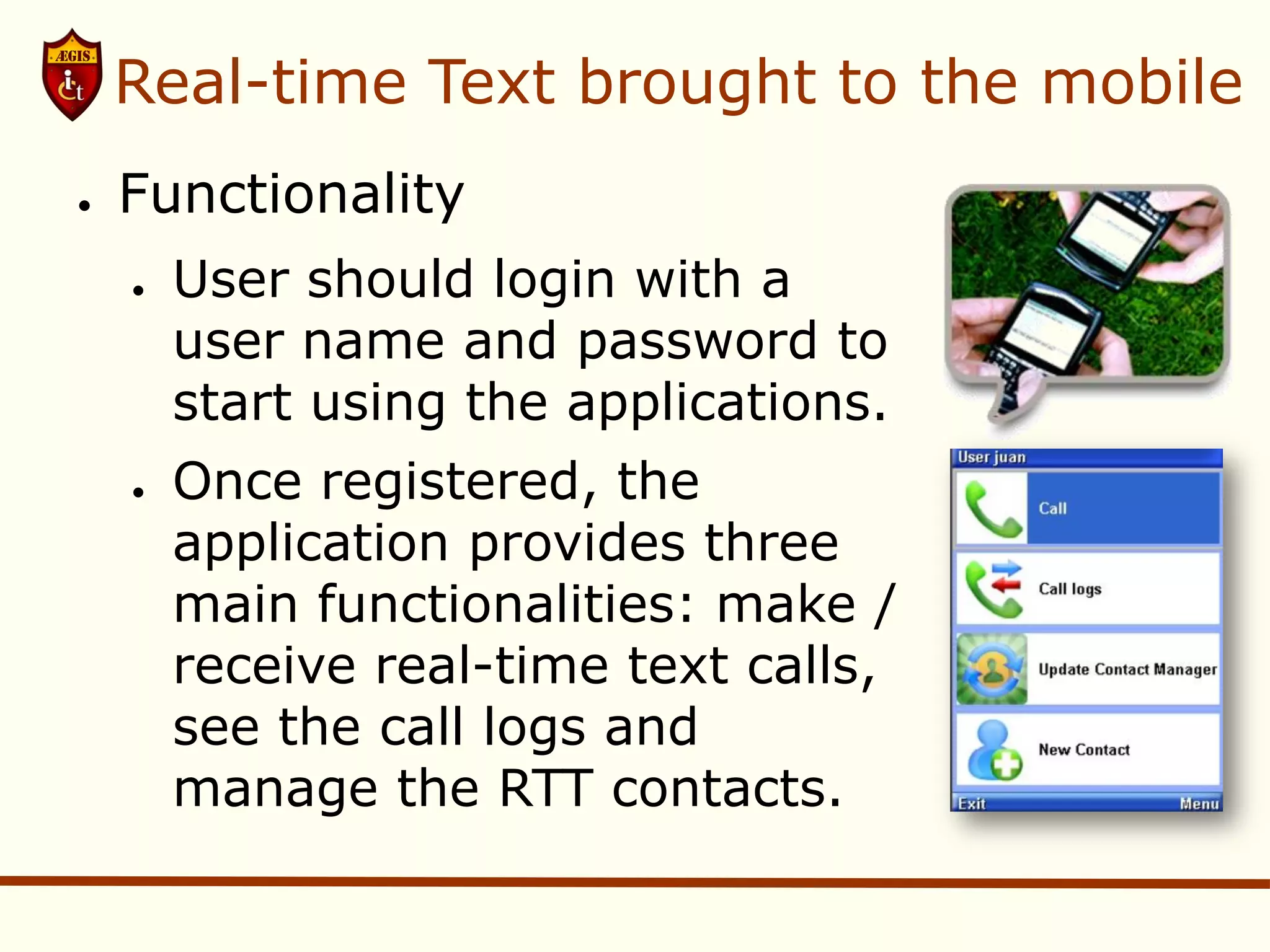
●   Functionality
    ●   User should login with a
        user name and password to
        start using the applications.
    ●   Once registered, the
        application provides three
        main functionalities: make /
        receive real-time text calls,
        see the call logs and
        manage the RTT contacts.
Real-time Text brought to the mobile
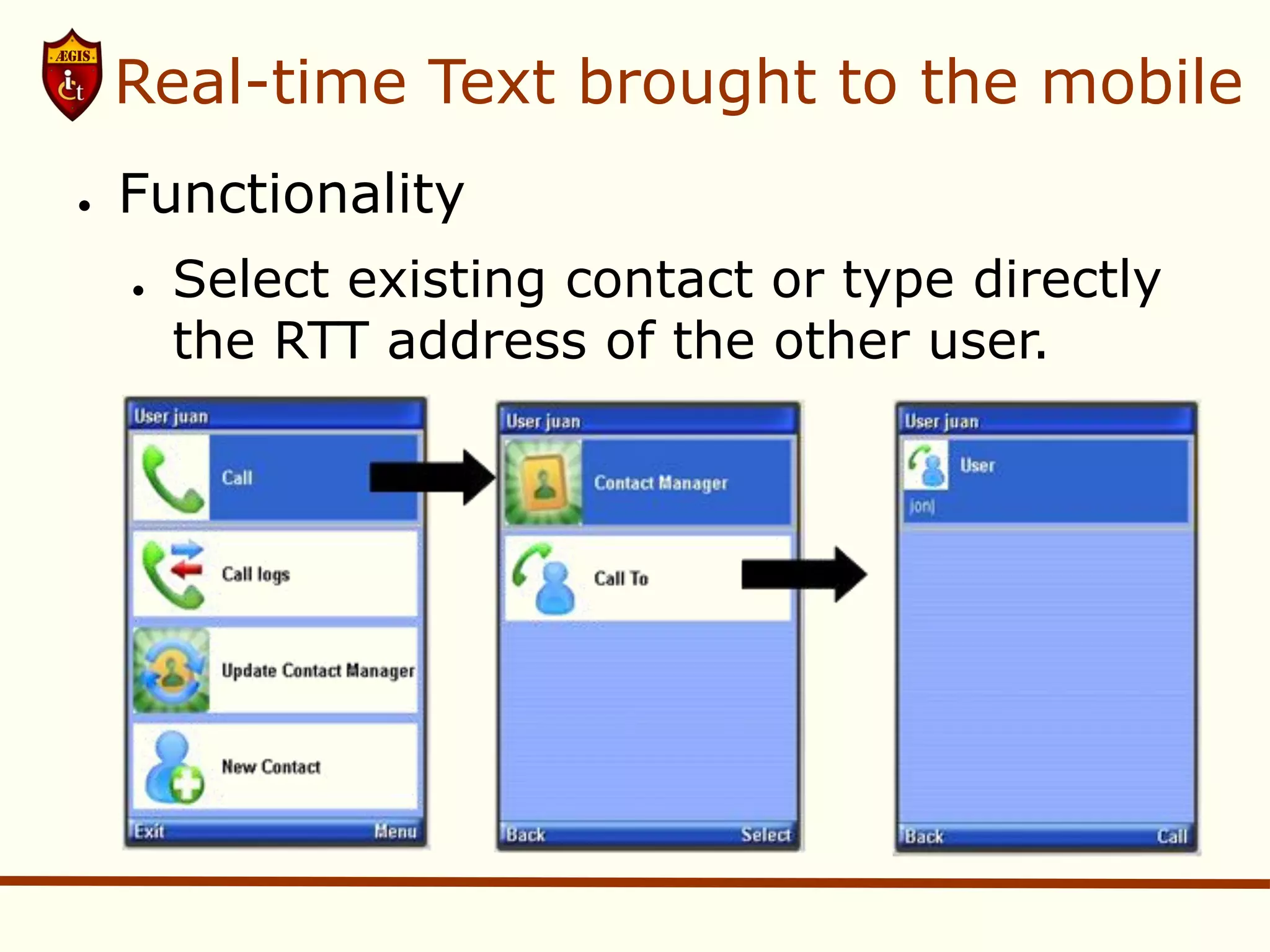
●   Functionality
    ●   Select existing contact or type directly
        the RTT address of the other user.
Real-time Text brought to the mobile
●   Functionality
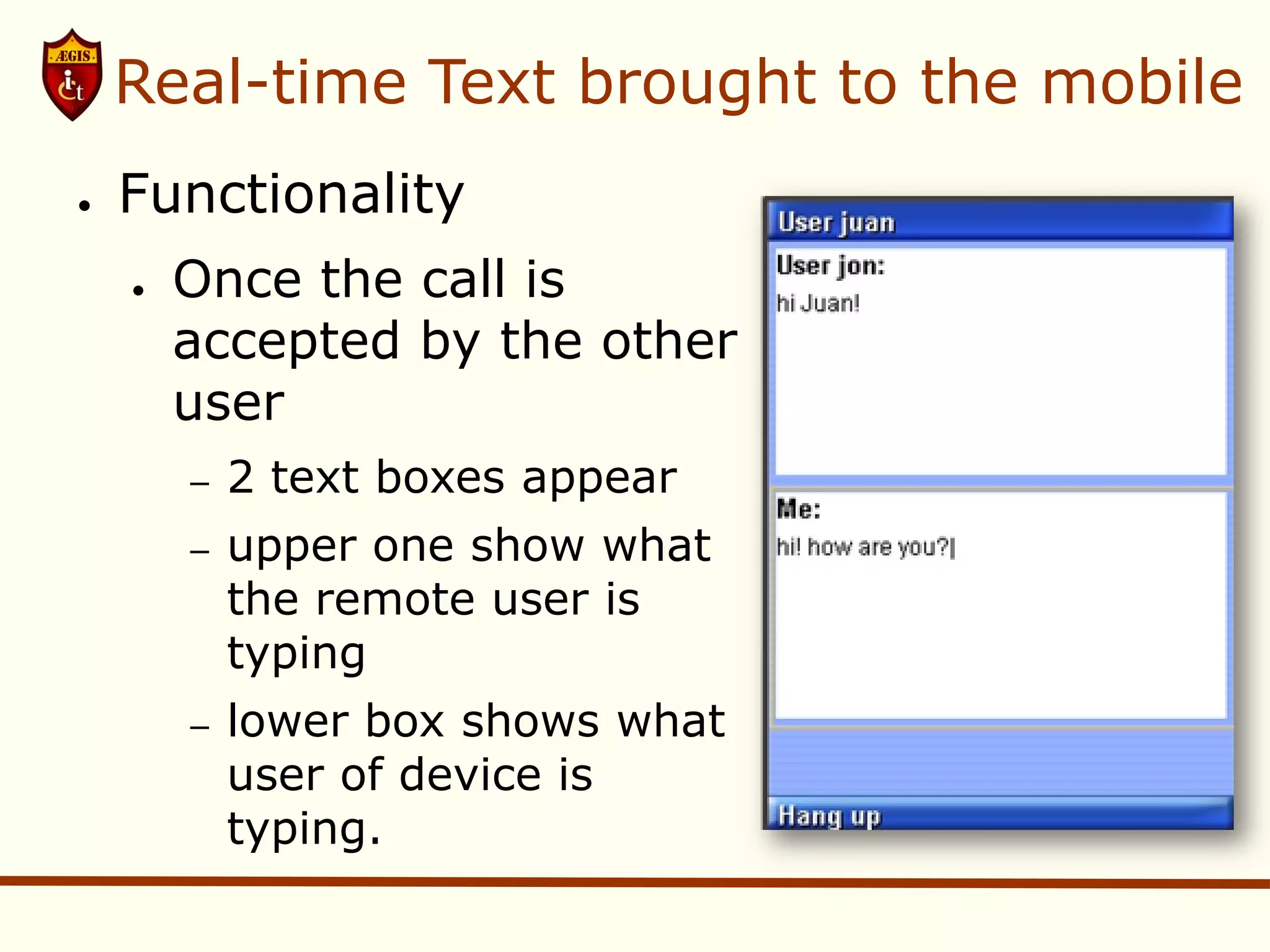
    ●   Once the call is
        accepted by the other
        user
        –   2 text boxes appear
        –   upper one show what
            the remote user is
            typing
        –   lower box shows what
            user of device is
            typing.
Real-time Text brought to the mobile
●   User testing
    ●   Spain, Belgium, Sweden, and the United
        Kingdom
    ●   26 users with hearing impairments
    ●   11 experts and 11 tutors
●   Feedback overall positive, and desire to
    have this functionality directly
    embedded in IM they use now
●   But: 2 window conversation is new
Real-time Text brought to the mobile
●   Next version (by August 2012)
    ●   Chat based user interface (both
        conversations shown in same screen).
    ●   New modalities of communication.
    ●   Character-by-character, versus word-by-
        word.
    ●   New client will be developed for LWUIT
        Java devices. This will make RTT
        compatible with touch screen devices.
Any questions?
●   Jon Azpiroz
    ●   Fundación Vodafone España
    ●   Spain
    ●   jon.azpiroz@vodafone.com
●   Karel Van Isacker
    ●   European Platform of Rehabilitation
    ●   Belgium
    ●   karel@phoenixkm.eu

Real time text communication - making it real ITAG 2011

  • 1.
    Real-time Text Communication: MakingIt Real (Jon Azpiroz, Karel Van Isacker) Presented by Karel Van Isacker (EPR)
  • 2.
    The background ● Voice communication ● Not possible for everyone ● Alternative manners (BSL over MSN, in the past ICQ, now AOL IM) ● But what about mobiles? ● Quest for alternatives to traditional voice telephony that could be accessible across desktop and mobile communications devices.
  • 3.
    The vehicle ● FP7 AEGIS project ● Project title: – Open Accessibility Everywhere: Groundwork, Infrastructure, Standards ● Starting date: 1 September 2008 ● Duration: 48 Months ● Integrated Project (IP) within the ICT programme of FP7
  • 4.
    The directions ● FP7 AEGIS project ● Desktop accessibility – odt2Braille, odt2Daisy, Symbol support, … ● Web applications accessibility – ARIA, … ● Mobile accessibility – Tecla (mobile switch), …, and RTT ● Available on iPhone/Android market, SourceForge, …
  • 5.
  • 6.
    Background Of TextCommunications ● ICT pushed ● the device for the deaf (TDD) or teletypewriter (TTY) (1964) (also used for people with speech impairments) ● Problem: different textphone standards, need for landline
  • 7.
    Background Of TextCommunications ● ICT pushed ● Short Message Service (SMS) (1984) ● First SMS message sent over the Vodafone GSM network (UK) on 3 December 1992, from a personal computer to an Orbitel 901 handset. Text was "Merry Christmas". ● Commercialised in 1993 (Nokia only handset manufacturer whose total GSM phone line supported user-sending of SMS text messages).
  • 8.
    Background Of TextCommunications ● Some SMS numbers ● 2010: 6.1 trillion SMS text messages were sent. 192,192 SMS per second. ● SMS industry worth over $81 billion globally as of 2006.
  • 9.
    Background Of TextCommunications ● Advantages of SMS ● Used by the hearing impaired community. ● Text-based, easy to use, affordable and mobile. ● Vibrating function of the handset alerts the user about a message.
  • 10.
    Background Of TextCommunications ● Disadvantages of SMS ● Unreliable system ● No guarantee that an SMS message will get to its destination or will get to its destination quickly – Delay messages for minutes, days or even lose them completely. – Most common cause of delivery failure is due to destination busy, memory full or destination out of service. – Limited interactivity
  • 11.
    Increase interactivity ● Instant Messaging (IM) for mobile devices ● More interactivity as users can exchange messages faster and more efficiently. ● IM Messages are cheaper than SMS. ● Problem: lack of standardisation (BlackBerry, MSN, Google, AOL, Yahoo, ICQ, FaceBook, WhatsApp,…) – Few IM clients work with different networks (Pidgin for Win, InstantBird for Linux)
  • 12.
    Increase interactivity ● Instant Messaging (IM) for mobile devices ● Deaf users like IM for its interactivity, the possibility for both parties to type at the same time and the ability to display emotions through the use of emoticons. ● However, IM is not as interactive as voice communications. – delays in the conversations – they cannot interrupt each other
  • 13.
    Real-time Text ● Real-time text (RTT) is conversational text that is sent and received on a character by character basis. ● A more natural, bi-directional flow of conversation takes place. ● Pioneered by ICQ in 1996. ● Based on standards (SIP + RFC4103) for interoperability
  • 14.
    Real-time Text broughtto the mobile ● Based on J2ME ● Wide availability of the application is one of the most important requirements. ● Roughly 78% of the mobile phones sold in 2010 were inexpensive feature phones that run the Java Micro Edition (Java ME) environment. ● Application will be compatible in mobile devices with different OS such as Symbian or BlackBerry.
  • 15.
    Real-time Text broughtto the mobile ● Functionality ● User should login with a user name and password to start using the applications. ● Once registered, the application provides three main functionalities: make / receive real-time text calls, see the call logs and manage the RTT contacts.
  • 16.
    Real-time Text broughtto the mobile ● Functionality ● Select existing contact or type directly the RTT address of the other user.
  • 17.
    Real-time Text broughtto the mobile ● Functionality ● Once the call is accepted by the other user – 2 text boxes appear – upper one show what the remote user is typing – lower box shows what user of device is typing.
  • 18.
    Real-time Text broughtto the mobile ● User testing ● Spain, Belgium, Sweden, and the United Kingdom ● 26 users with hearing impairments ● 11 experts and 11 tutors ● Feedback overall positive, and desire to have this functionality directly embedded in IM they use now ● But: 2 window conversation is new
  • 19.
    Real-time Text broughtto the mobile ● Next version (by August 2012) ● Chat based user interface (both conversations shown in same screen). ● New modalities of communication. ● Character-by-character, versus word-by- word. ● New client will be developed for LWUIT Java devices. This will make RTT compatible with touch screen devices.
  • 20.
    Any questions? ● Jon Azpiroz ● Fundación Vodafone España ● Spain ● jon.azpiroz@vodafone.com ● Karel Van Isacker ● European Platform of Rehabilitation ● Belgium ● karel@phoenixkm.eu