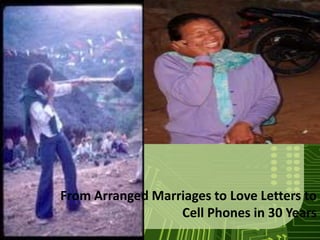


From Arranged Marriages to Love Letters to
                  Cell Phones in 30 Years
Cellphones

Charmaine D. Diaz
    II - BACA
Outline
• Definition
• Timeline
   – Evolution of Cellphones
• Features
   – Uses
• Impact to society
   – ADVANTAGES AND DISADVANTAGES
      •   Market and economy
      •   Media
      •   People
      •   Health
• Present news
Definitions
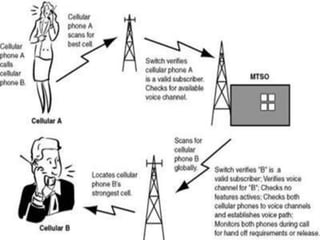
• A mobile phone, cell phone or hand phone- is an
  electronic device used to make mobile telephone
  calls across a wide geographic area, served by many
  public cells, allowing the user to be mobile. These
  communication devices connect to a wireless
  communications network through radio waves or
  satellite transmissions.

  -A portable telephone that connects with the
  telephone network using radio waves
• GSM-Global System for Mobile, an international standard for
  mobile phones

• IP- Internet Protocol address; a sequence of numbers used to identify a
  particular computer or domain name on the Internet

• Wi-Fi- Wireless Fidelity, A local area network that uses high frequency
  radio signals to transmit and receive data over distances of a few hundred
  feet; uses ethernet protocol

• GPS- Global Positioning System. A navigational system involving satellites
  and computers that can determine the latitude and longitude of a receiver
  on Earth by computing the time difference for signals from different
  satellites to reach the receiver

• SIM Card-Subscriber Identity Module a small microchip.
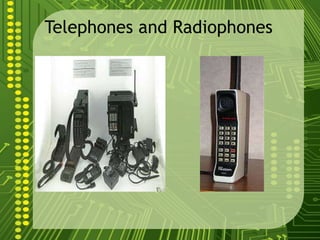
Telephones and Radiophones
HISTORY
• 1950- Radiophones have a long and varied history going back to
  Reginald Fessenden’s invention and shore-to-ship demonstration of
  radio telephony, through the World war II with military use of radio
  telephony links and civil services.

• On June 17, 1946- The first mobile telephone call made from a car
  occurred St. Louis, Missouri USA using the Bell System’s Mobile
  Telephone Services.
        Disadvantages: the system was impractical from what is
  considered a portable handset today. The equipment weighed 80
  pounds (36 kg), and the AT&T service, basically a massive party
  line, it is expensive too.
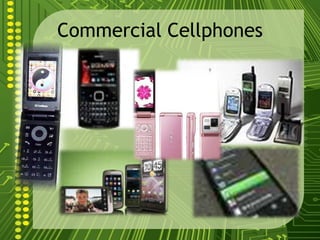
Commercial Cellphones
Commercial Phones
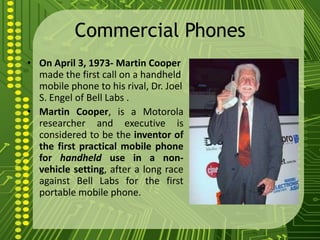
• On April 3, 1973- Martin Cooper
  made the first call on a handheld
  mobile phone to his rival, Dr. Joel
  S. Engel of Bell Labs .
• Martin Cooper, is a Motorola
  researcher and executive is
  considered to be the inventor of
  the first practical mobile phone
  for handheld use in a non-
  vehicle setting, after a long race
  against Bell Labs for the first
  portable mobile phone.
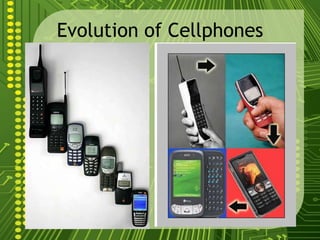
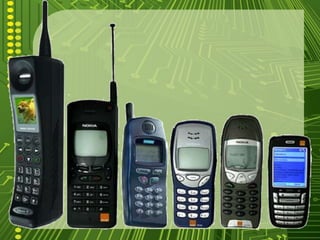
Evolution of Cellphones
First Generation: Analog Cellular Networks
                   (1G)
• The technology in these early networks was pushed
  to the limit to accommodate increasing usage. The
  base stations and the mobile phones utilized variable
  transmission power, which allowed range and cell
  size to vary. As the system expanded and neared
  capacity, the ability to reduce transmission power
  allowed new cells to be added, resulting in
  more, smaller cells and thus more capacity.
• In 1979- The first commercially automated cellular network
  (the 1G) was launched in Japan by NTT initially in the
  metropolitan area of Tokyo.
       Japan became the first nationwide 1G network.
• In 1981- this was followed by the simultaneous launch of the
  Nordic Mobile Telephone (NMT) system in
  Denmark, Finland, Norway and Sweden.
       NMT was the first mobile phone network featuring
  international roaming.
• In 1983- The first 1G network launched in the USA was
  Chicago-based Ameritech using the Motorola DynaTAC
  mobile phone.
Second Generation: Digital Mobile
           Communication (2G)


• These differed from the previous generation by using
  digital instead of analog transmission, and also fast
  out-of-band phone-to-network signaling. The rise in
  mobile phone usage as a result of 2G was explosive
  and this era also saw the advent of prepaid mobile
  phones.
• In the 1990s- the 'second generation' (2G) mobile phone systems
  emerged, primarily using the GSM standard.

• In 1991- The first "modern" network technology on digital 2G
  (second generation) cellular technology was launched by Radiolinja
  in Finland on the GSM standard, which also marked the
  introduction of competition in mobile telecoms .

• The second generation introduced a new variant of
  communication called SMS or text messaging.
• 3 December 1992- The first machine-generated SMS message was
  sent in the UK

• in 1993 - the first person-to-person SMS sent in Finland.

• In the late 1990s- The advent of prepaid services soon made SMS
  the communication method of choice amongst the young, a trend
  which spread across all ages.

• 2G introduced the ability to access media content on mobile
  phones.
• In 1998- the first downloadable content sold to mobile phones was
  the ring tone, launched by Finland's Radiolinja (now Elisa).

• In 1999- The first commercial payment system to mimic banks and
  credit cards was launched in the Philippines and simultaneously by
  mobile operators Globe and Smart.

• In 1999- The first full internet service on mobile phones was
  introduced by NTT DoCoMo in Japan.

• In 2000- Advertising on the mobile phone first appeared in Finland
  when a free daily SMS news headline service.
Third generation: High speed IP data networks
                       and
         Wideband mobile communication


• The main technological difference that distinguishes
  3G technology from 2G technology is the use of
  packet switching rather than circuit switching for
  data transmission.
• May 2001- The first pre-commercial trial network with 3G was
  launched by NTT DoCoMo in Japan in the Tokyo region.

• October 1, 2001- NTT DoCoMo launched the first commercial 3G
  network

• In 2002 -the first 3G networks on the rival CDMA2000 1xEV-DO
  technology were launched by SK Telecom and KTF in South
  Korea, and Monet in the USA.

• In the mid 2000s -an evolution of 3G technology begun to be
  implemented, namely High-Speed Downlink packet Access(HSDPA).
Fourth generation: All-IP networks

• By 2009-it had become clear that, at some point, 3G networks
  would be overwhelmed by the growth of bandwidth-intensive
  applications like streaming media. The first two commercially
  available technologies billed as 4G were the WiMAX standard
  offered in the U.S. by Sprint and the LTE standard, first offered in
  Scandinavia by TealiaSonera.

• One of the main ways in which 4G differed technologically from 3G
  was in its elimination of circuit switching, instead employing an
  all-IP network. Thus, 4G ushered in a treatment of voice calls just
  like any other type of streaming audio media, utilizing packet
  switching over internet, LAN or WAN networks.
The mobile phone is often called the

• Fourth Screen: if counting cinema, TV and PC
  screens as the first three

• Third Screen: counting only TV and PC screens.

• It is also called the Seventh of the Mass Media: with
  Print, Recordings, Cinema, Radio, TV and Internet the
  first six.
Features
Common components found on all phones are:

• A battery, typically rechargeable, providing the power source for
  the phone functions
• An input mechanism to allow the user to interact with the phone.
  Like the keypad, but touch screens are also found in some high-end
  smart phones.
• Basic mobile phone services to allow users to make calls and send
  text messages.
• All GSM phones use a SIM card to allow an account to be swapped
  among devices.
Other Features That May Be Found On Mobile
                   Phones
• GPS Navigation                • video download
• music (MP3) and video (MP4)   • video calling
  playback                      • Built-in cameras and
• RDS radio receiver              camcorders with autofocus and
• alarms                          flash
• memo recording                • ringtones
• Personal digital assistant    • games,
  functions                     • PTT
• ability to watch streaming    • memory card reader(SD),
  videos                        • USB (2.0)
• dual line support,            • Internet e-mail and browsing
• infrared                        and serving as a wireless
• Bluetooth                       modem.
• Wi-Fi connectivity,           • mobile payments
• instant messaging
IMPACT TO SOCIETY and ITS USES
Market and Economy

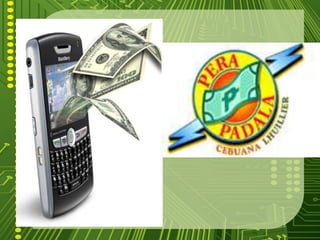
  Cell phone money transfers going international

  Sending money by cell phone
People

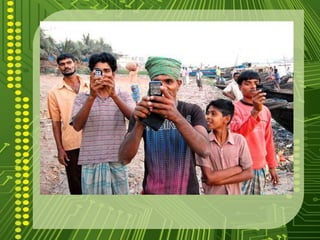
• Mobile phones help lift poor out of poverty. The United
  Nations has reported that mobile phones—spreading faster
  than any other information technology—can improve the
  livelihood of the poorest people in developing countries.

• Mobile phones have spawned a wealth of micro-
  enterprises, offering work to people with little education and
  few resources, such as selling airtime on the streets and
  repairing or refurbishing handsets.
LOVE
Media
• In 1998- one of the first examples of selling media content
  through the mobile phone was the sale of ringtones by
  Radiolinja in Finland. Soon afterwards, other media content
  appeared such as news, videogames, jokes, horoscopes, TV
  content and advertising.

• In 2006- the total value of mobile-phone-paid media content
  exceeded Internet-paid media content and was worth 31
  billion dollars.

• In 2007- The value of music on phones was worth 9.3 billion
  dollars and gaming was worth over 5 billion dollars.
Restrictions and Dangers

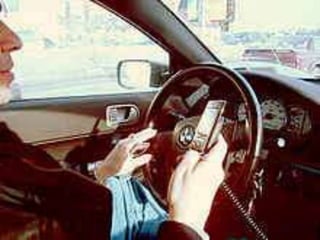
•   While Driving
•   In school
•   In work
•   While walking
•   Privacy
--A study by Motorola found that one in ten
  cell phone subscribers have a second phone
  that often is kept secret from other family
  members. These phones may be used to
  engage in activities including extramarital
  affairs or clandestine business dealings.
HEALTH EFFECTS
• On 31st May 2011, the World Health Organization confirmed
  that mobile phone radiation has a "carcinogenic hazard" and
  "possibly carcinogenic to humans" after a team of scientists
  reviewed peer-review studies on cell phone safety.
• gliomas brain cancer in the highest category of heavy users
  reported average: 30 minutes per day over a 10‐year period.
• Mobile phones use electromagnetic radiation in the
  microwave range, which some believe may be harmful to
  human health.
• A mobile phone can spread infectious diseases by its frequent
  contact with hands.
   – One study came to the result that pathogenic bacteria are present on
     approximately 40% of mobile phones belonging to patients in a hospital, and
     on approximately 20% of mobile phones belonging to hospital staff.
Trending topics
• There was an article stating that: most of the cellphone manufacturing will
  declare bankrupt in 2012.. Like- Nokia, Sony Ericson

• Nokia declared bankcruptcy because theyt don’t have a model which has a
  windows based OS.

• Samsung and Apple company is now the top star, according in the article

•  A buyout of Nokia would launch Samsung into the position as the world's
  handset leader.
THUS:
       Should buyer would maintain the Microsoft relationship or change to
  the popular Android OS to power Nokia phones
Resources
•   http://www.smartmotorist.com/traffic-and-safety-guideline/cell-phones-and-
    driving-a-prescription-for-disaster.html
•   http://searchdisasterrecovery.techtarget.com/tip/Disaster-recovery-planning-for-
    mobile-phone-users
•   http://www.clicker.com/tv/cnn-money/getting-cell-phones-to-work-in-a-disaster-
    1928595/
•   http://news.cnet.com/8301-1023_3-20061435-93.html
•   http://arstechnica.com/gadgets/news/2008/12/cell-phone-money-transfers-going-
    international.ars
•   http://lifehacker.com/175883/geek-to-live--send-and-receive-money-with-your-
    cell-phone
•   http://www.bankrate.com/finance/savings/make-payments-by-cell-phone-1.aspx
•   http://www.waccglobal.org/component/content/article/2239:cell-phones-tools-
    for-social-justice.html
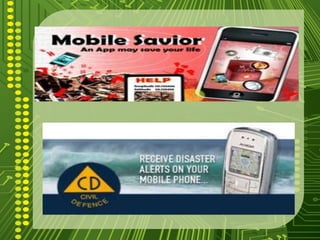
•   http://www.thebesthandphone.com/mobile-savior-application-useful-for-natural-
    disaster-alerts.html/mobile-savior-application-useful-for-natural-disaster-alerts-2
•   Finding Love by Cell Phone | PCWorld

cellphones

  • 2.
    From Arranged Marriagesto Love Letters to Cell Phones in 30 Years
  • 3.
  • 4.
    Outline • Definition • Timeline – Evolution of Cellphones • Features – Uses • Impact to society – ADVANTAGES AND DISADVANTAGES • Market and economy • Media • People • Health • Present news
  • 5.
    Definitions • A mobilephone, cell phone or hand phone- is an electronic device used to make mobile telephone calls across a wide geographic area, served by many public cells, allowing the user to be mobile. These communication devices connect to a wireless communications network through radio waves or satellite transmissions. -A portable telephone that connects with the telephone network using radio waves
  • 6.
    • GSM-Global Systemfor Mobile, an international standard for mobile phones • IP- Internet Protocol address; a sequence of numbers used to identify a particular computer or domain name on the Internet • Wi-Fi- Wireless Fidelity, A local area network that uses high frequency radio signals to transmit and receive data over distances of a few hundred feet; uses ethernet protocol • GPS- Global Positioning System. A navigational system involving satellites and computers that can determine the latitude and longitude of a receiver on Earth by computing the time difference for signals from different satellites to reach the receiver • SIM Card-Subscriber Identity Module a small microchip.
  • 7.
  • 8.
    HISTORY • 1950- Radiophoneshave a long and varied history going back to Reginald Fessenden’s invention and shore-to-ship demonstration of radio telephony, through the World war II with military use of radio telephony links and civil services. • On June 17, 1946- The first mobile telephone call made from a car occurred St. Louis, Missouri USA using the Bell System’s Mobile Telephone Services. Disadvantages: the system was impractical from what is considered a portable handset today. The equipment weighed 80 pounds (36 kg), and the AT&T service, basically a massive party line, it is expensive too.
  • 9.
  • 10.
    Commercial Phones • OnApril 3, 1973- Martin Cooper made the first call on a handheld mobile phone to his rival, Dr. Joel S. Engel of Bell Labs . • Martin Cooper, is a Motorola researcher and executive is considered to be the inventor of the first practical mobile phone for handheld use in a non- vehicle setting, after a long race against Bell Labs for the first portable mobile phone.
  • 11.
  • 12.
    First Generation: AnalogCellular Networks (1G) • The technology in these early networks was pushed to the limit to accommodate increasing usage. The base stations and the mobile phones utilized variable transmission power, which allowed range and cell size to vary. As the system expanded and neared capacity, the ability to reduce transmission power allowed new cells to be added, resulting in more, smaller cells and thus more capacity.
  • 13.
    • In 1979-The first commercially automated cellular network (the 1G) was launched in Japan by NTT initially in the metropolitan area of Tokyo. Japan became the first nationwide 1G network. • In 1981- this was followed by the simultaneous launch of the Nordic Mobile Telephone (NMT) system in Denmark, Finland, Norway and Sweden. NMT was the first mobile phone network featuring international roaming. • In 1983- The first 1G network launched in the USA was Chicago-based Ameritech using the Motorola DynaTAC mobile phone.
  • 15.
    Second Generation: DigitalMobile Communication (2G) • These differed from the previous generation by using digital instead of analog transmission, and also fast out-of-band phone-to-network signaling. The rise in mobile phone usage as a result of 2G was explosive and this era also saw the advent of prepaid mobile phones.
  • 16.
    • In the1990s- the 'second generation' (2G) mobile phone systems emerged, primarily using the GSM standard. • In 1991- The first "modern" network technology on digital 2G (second generation) cellular technology was launched by Radiolinja in Finland on the GSM standard, which also marked the introduction of competition in mobile telecoms . • The second generation introduced a new variant of communication called SMS or text messaging.
  • 17.
    • 3 December1992- The first machine-generated SMS message was sent in the UK • in 1993 - the first person-to-person SMS sent in Finland. • In the late 1990s- The advent of prepaid services soon made SMS the communication method of choice amongst the young, a trend which spread across all ages. • 2G introduced the ability to access media content on mobile phones.
  • 18.
    • In 1998-the first downloadable content sold to mobile phones was the ring tone, launched by Finland's Radiolinja (now Elisa). • In 1999- The first commercial payment system to mimic banks and credit cards was launched in the Philippines and simultaneously by mobile operators Globe and Smart. • In 1999- The first full internet service on mobile phones was introduced by NTT DoCoMo in Japan. • In 2000- Advertising on the mobile phone first appeared in Finland when a free daily SMS news headline service.
  • 20.
    Third generation: Highspeed IP data networks and Wideband mobile communication • The main technological difference that distinguishes 3G technology from 2G technology is the use of packet switching rather than circuit switching for data transmission.
  • 21.
    • May 2001-The first pre-commercial trial network with 3G was launched by NTT DoCoMo in Japan in the Tokyo region. • October 1, 2001- NTT DoCoMo launched the first commercial 3G network • In 2002 -the first 3G networks on the rival CDMA2000 1xEV-DO technology were launched by SK Telecom and KTF in South Korea, and Monet in the USA. • In the mid 2000s -an evolution of 3G technology begun to be implemented, namely High-Speed Downlink packet Access(HSDPA).
  • 23.
    Fourth generation: All-IPnetworks • By 2009-it had become clear that, at some point, 3G networks would be overwhelmed by the growth of bandwidth-intensive applications like streaming media. The first two commercially available technologies billed as 4G were the WiMAX standard offered in the U.S. by Sprint and the LTE standard, first offered in Scandinavia by TealiaSonera. • One of the main ways in which 4G differed technologically from 3G was in its elimination of circuit switching, instead employing an all-IP network. Thus, 4G ushered in a treatment of voice calls just like any other type of streaming audio media, utilizing packet switching over internet, LAN or WAN networks.
  • 25.
    The mobile phoneis often called the • Fourth Screen: if counting cinema, TV and PC screens as the first three • Third Screen: counting only TV and PC screens. • It is also called the Seventh of the Mass Media: with Print, Recordings, Cinema, Radio, TV and Internet the first six.
  • 27.
    Features Common components foundon all phones are: • A battery, typically rechargeable, providing the power source for the phone functions • An input mechanism to allow the user to interact with the phone. Like the keypad, but touch screens are also found in some high-end smart phones. • Basic mobile phone services to allow users to make calls and send text messages. • All GSM phones use a SIM card to allow an account to be swapped among devices.
  • 28.
    Other Features ThatMay Be Found On Mobile Phones • GPS Navigation • video download • music (MP3) and video (MP4) • video calling playback • Built-in cameras and • RDS radio receiver camcorders with autofocus and • alarms flash • memo recording • ringtones • Personal digital assistant • games, functions • PTT • ability to watch streaming • memory card reader(SD), videos • USB (2.0) • dual line support, • Internet e-mail and browsing • infrared and serving as a wireless • Bluetooth modem. • Wi-Fi connectivity, • mobile payments • instant messaging
  • 29.
    IMPACT TO SOCIETYand ITS USES
  • 30.
    Market and Economy Cell phone money transfers going international Sending money by cell phone
  • 32.
    People • Mobile phoneshelp lift poor out of poverty. The United Nations has reported that mobile phones—spreading faster than any other information technology—can improve the livelihood of the poorest people in developing countries. • Mobile phones have spawned a wealth of micro- enterprises, offering work to people with little education and few resources, such as selling airtime on the streets and repairing or refurbishing handsets.
  • 34.
  • 35.
    Media • In 1998-one of the first examples of selling media content through the mobile phone was the sale of ringtones by Radiolinja in Finland. Soon afterwards, other media content appeared such as news, videogames, jokes, horoscopes, TV content and advertising. • In 2006- the total value of mobile-phone-paid media content exceeded Internet-paid media content and was worth 31 billion dollars. • In 2007- The value of music on phones was worth 9.3 billion dollars and gaming was worth over 5 billion dollars.
  • 38.
    Restrictions and Dangers • While Driving • In school • In work • While walking • Privacy
  • 40.
    --A study byMotorola found that one in ten cell phone subscribers have a second phone that often is kept secret from other family members. These phones may be used to engage in activities including extramarital affairs or clandestine business dealings.
  • 41.
    HEALTH EFFECTS • On31st May 2011, the World Health Organization confirmed that mobile phone radiation has a "carcinogenic hazard" and "possibly carcinogenic to humans" after a team of scientists reviewed peer-review studies on cell phone safety. • gliomas brain cancer in the highest category of heavy users reported average: 30 minutes per day over a 10‐year period. • Mobile phones use electromagnetic radiation in the microwave range, which some believe may be harmful to human health. • A mobile phone can spread infectious diseases by its frequent contact with hands. – One study came to the result that pathogenic bacteria are present on approximately 40% of mobile phones belonging to patients in a hospital, and on approximately 20% of mobile phones belonging to hospital staff.
  • 42.
    Trending topics • Therewas an article stating that: most of the cellphone manufacturing will declare bankrupt in 2012.. Like- Nokia, Sony Ericson • Nokia declared bankcruptcy because theyt don’t have a model which has a windows based OS. • Samsung and Apple company is now the top star, according in the article • A buyout of Nokia would launch Samsung into the position as the world's handset leader. THUS: Should buyer would maintain the Microsoft relationship or change to the popular Android OS to power Nokia phones
  • 43.
    Resources • http://www.smartmotorist.com/traffic-and-safety-guideline/cell-phones-and- driving-a-prescription-for-disaster.html • http://searchdisasterrecovery.techtarget.com/tip/Disaster-recovery-planning-for- mobile-phone-users • http://www.clicker.com/tv/cnn-money/getting-cell-phones-to-work-in-a-disaster- 1928595/ • http://news.cnet.com/8301-1023_3-20061435-93.html • http://arstechnica.com/gadgets/news/2008/12/cell-phone-money-transfers-going- international.ars • http://lifehacker.com/175883/geek-to-live--send-and-receive-money-with-your- cell-phone • http://www.bankrate.com/finance/savings/make-payments-by-cell-phone-1.aspx • http://www.waccglobal.org/component/content/article/2239:cell-phones-tools- for-social-justice.html • http://www.thebesthandphone.com/mobile-savior-application-useful-for-natural- disaster-alerts.html/mobile-savior-application-useful-for-natural-disaster-alerts-2 • Finding Love by Cell Phone | PCWorld