WELCOME
Y.SINDHURA DEEPIKA
M.SANDEEP
K.S.R.M ENGINEERING COLLEGE
KADAPA.
Are R.B.I Policies
Suitable For Growth
Of Indian Economy?
Reserve Bank Of India
   The Central Bank Of India -RBI.

   Established In 1935 With a Share Capital Of Rs. 5 crores on the basis
    of the Hilton Young Commission.

    The Share Capital was Divided into Rs. 100 each
    fully paid up which was entirely owned by private shareholders in the
     beginning.

   RBI was nationalised in 1949.

   The govt. held shares of normal value of Rs. 2,20000.
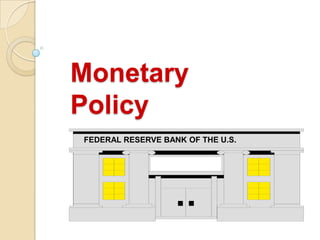
Monetary
Policy
FEDERAL RESERVE BANK OF THE U.S.
What is Monetary Policy?

   Shaw defines monetary policy as “any conscious
    action undertaken by the monetary authorities to
    change the quantity, availability or cost.., of money.

    Monetary policy is essentially a programme of
    action undertaken by the monetary authorities
    generally the central bank, to control and regulate
    the supply of money with the public and the flow of
    credit with a view to achieving the objectives of
    general economic policy
Objectives Of Monetary Policy
   Maintain price Stability.

   Flow of credit to the productive sectors of the economy.

   Stability for the national currency.

   Growth in employment and income.

   To promote and encourage economic growth in the country.
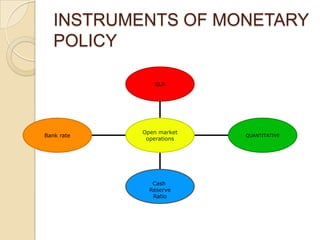
INSTRUMENTS OF MONETARY
   POLICY

               SLR


            Open market
Bank rate                 QUANTITATIVE
             operations


               Cash
              Reserve
               Ratio
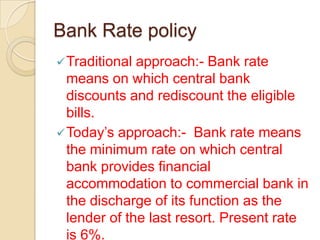
Bank Rate policy
 Traditional approach:- Bank rate
  means on which central bank
  discounts and rediscount the eligible
  bills.
 Today’s approach:- Bank rate means
  the minimum rate on which central
  bank provides financial
  accommodation to commercial bank in
  the discharge of its function as the
  lender of the last resort. Present rate
  is 6%.
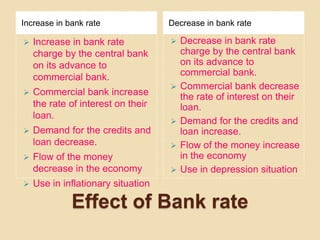
Increase in bank rate               Decrease in bank rate

   Increase in bank rate              Decrease in bank rate
    charge by the central bank          charge by the central bank
    on its advance to                   on its advance to
    commercial bank.                    commercial bank.
                                       Commercial bank decrease
   Commercial bank increase            the rate of interest on their
    the rate of interest on their       loan.
    loan.
                                       Demand for the credits and
   Demand for the credits and          loan increase.
    loan decrease.                     Flow of the money increase
   Flow of the money                   in the economy
    decrease in the economy            Use in depression situation
   Use in inflationary situation

             Effect of Bank rate
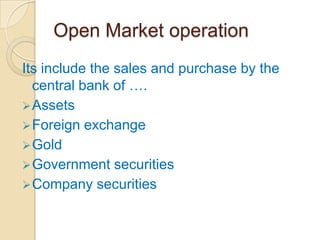
Open Market operation
Its include the sales and purchase by the
  central bank of ….
 Assets
 Foreign exchange
 Gold
 Government securities
 Company securities
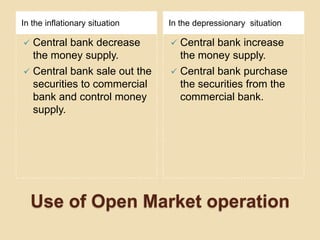
In the inflationary situation   In the depressionary situation

 Central bank decrease          Central bank increase
  the money supply.               the money supply.
 Central bank sale out the      Central bank purchase
  securities to commercial        the securities from the
  bank and control money          commercial bank.
  supply.


    Use of Open Market operation
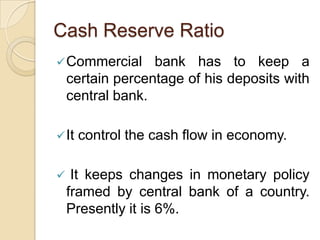
Cash Reserve Ratio
 Commercial      bank has to keep a
    certain percentage of his deposits with
    central bank.

 It   control the cash flow in economy.

    It keeps changes in monetary policy
    framed by central bank of a country.
    Presently it is 6%.
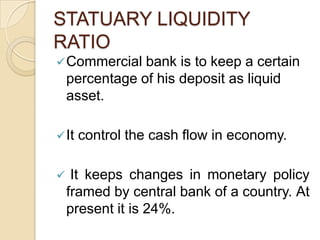
STATUARY LIQUIDITY
RATIO
 Commercial    bank is to keep a certain
    percentage of his deposit as liquid
    asset.

 It   control the cash flow in economy.

    It keeps changes in monetary policy
    framed by central bank of a country. At
    present it is 24%.
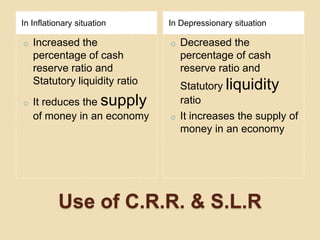
In Inflationary situation       In Depressionary situation

o   Increased the               o   Decreased the
    percentage of cash              percentage of cash
    reserve ratio and               reserve ratio and
    Statutory liquidity ratio       Statutory liquidity
o   It reduces the supply           ratio
    of money in an economy      o   It increases the supply of
                                    money in an economy


          Use of C.R.R. & S.L.R
Qualitative Instruments
   Credit Rationing:
    Under this two measures are adopted:
•    Imposition of upper limits on the credit available to large
    industries and      firms.
•   Charging a higher interest rate on bank loans beyond a certain
    limit.


   Change In Lending Margins:
   The banks provide loans only upto a certain percentage of the
    value of the mortgaged property.
   The gap between the value of the mortgaged property and
    amount advanced is called ‘lending margin’.
 Moral Suasion:
•    The moral suasion is a method of persuading and
    convincing the commercial banks to advance credit in
    accordance with the directive of the central bank in the
    economic interest of the country.


    Direct controls:
•   Where all other methods prove ineffective, the
    monetary, authorities resort to direct control measures
    with clear directive to the banks carry out their lending
    activity in a specified manner.
Highlights of Monetary Policy
2011-2012
   The Reserve Bank announces the following policy
    measures:

   The Bank Rate has been retained at 6.0 percent.
 It has been decided to increase the repo rate from
  8.25 per cent to 8.50 per cent
 The reverse repo rate is increased from 7.25 per
  cent to 7.50 per cent.
 It has been decided to increase the cash reserve
  ratio (CRR) of scheduled banks by 25 basis points
  from 5.75 per cent to 6.0 per cent.
 The SLR is announced 24%.
Limitations Of Monetary Policy

 The      time lag :
•     The first and the most important limitation in the
    effective working of monetary policy is the time lag.
    i.e. time taken in chalking out the policy action, its
    implementation and working time.

 Problem    in forecasting :
•   The formulation of an appropriate monetary policy
    requires a reliable assessment of the magnitude of
    the problem-recession or inflation- as it helps in
    determining the appropriate policy measures.
 Non-banking    Financial Intermediaries:
•   The structural change in the financial market has also
    reduced the scope of effectiveness of monetary policy.

 Under    Development of money and capital markets :
•   The effectiveness of monetary policy in less developed
    countries is reduced considerably because of the
    underdeveloped character of their capital and money
    markets.
Real one (1)

Real one (1)

  • 1.
  • 2.
    Are R.B.I Policies SuitableFor Growth Of Indian Economy?
  • 3.
    Reserve Bank OfIndia  The Central Bank Of India -RBI.  Established In 1935 With a Share Capital Of Rs. 5 crores on the basis of the Hilton Young Commission.  The Share Capital was Divided into Rs. 100 each fully paid up which was entirely owned by private shareholders in the beginning.  RBI was nationalised in 1949.  The govt. held shares of normal value of Rs. 2,20000.
  • 4.
  • 5.
    What is MonetaryPolicy?  Shaw defines monetary policy as “any conscious action undertaken by the monetary authorities to change the quantity, availability or cost.., of money.  Monetary policy is essentially a programme of action undertaken by the monetary authorities generally the central bank, to control and regulate the supply of money with the public and the flow of credit with a view to achieving the objectives of general economic policy
  • 6.
    Objectives Of MonetaryPolicy  Maintain price Stability.  Flow of credit to the productive sectors of the economy.  Stability for the national currency.  Growth in employment and income.  To promote and encourage economic growth in the country.
  • 7.
    INSTRUMENTS OF MONETARY POLICY SLR Open market Bank rate QUANTITATIVE operations Cash Reserve Ratio
  • 8.
    Bank Rate policy Traditional approach:- Bank rate means on which central bank discounts and rediscount the eligible bills.  Today’s approach:- Bank rate means the minimum rate on which central bank provides financial accommodation to commercial bank in the discharge of its function as the lender of the last resort. Present rate is 6%.
  • 9.
    Increase in bankrate Decrease in bank rate  Increase in bank rate  Decrease in bank rate charge by the central bank charge by the central bank on its advance to on its advance to commercial bank. commercial bank.  Commercial bank decrease  Commercial bank increase the rate of interest on their the rate of interest on their loan. loan.  Demand for the credits and  Demand for the credits and loan increase. loan decrease.  Flow of the money increase  Flow of the money in the economy decrease in the economy  Use in depression situation  Use in inflationary situation Effect of Bank rate
  • 10.
    Open Market operation Itsinclude the sales and purchase by the central bank of ….  Assets  Foreign exchange  Gold  Government securities  Company securities
  • 11.
    In the inflationarysituation In the depressionary situation  Central bank decrease  Central bank increase the money supply. the money supply.  Central bank sale out the  Central bank purchase securities to commercial the securities from the bank and control money commercial bank. supply. Use of Open Market operation
  • 12.
    Cash Reserve Ratio Commercial bank has to keep a certain percentage of his deposits with central bank.  It control the cash flow in economy.  It keeps changes in monetary policy framed by central bank of a country. Presently it is 6%.
  • 13.
    STATUARY LIQUIDITY RATIO  Commercial bank is to keep a certain percentage of his deposit as liquid asset.  It control the cash flow in economy.  It keeps changes in monetary policy framed by central bank of a country. At present it is 24%.
  • 14.
    In Inflationary situation In Depressionary situation o Increased the o Decreased the percentage of cash percentage of cash reserve ratio and reserve ratio and Statutory liquidity ratio Statutory liquidity o It reduces the supply ratio of money in an economy o It increases the supply of money in an economy Use of C.R.R. & S.L.R
  • 16.
    Qualitative Instruments  Credit Rationing: Under this two measures are adopted: • Imposition of upper limits on the credit available to large industries and firms. • Charging a higher interest rate on bank loans beyond a certain limit.  Change In Lending Margins:  The banks provide loans only upto a certain percentage of the value of the mortgaged property.  The gap between the value of the mortgaged property and amount advanced is called ‘lending margin’.
  • 17.
     Moral Suasion: • The moral suasion is a method of persuading and convincing the commercial banks to advance credit in accordance with the directive of the central bank in the economic interest of the country.  Direct controls: • Where all other methods prove ineffective, the monetary, authorities resort to direct control measures with clear directive to the banks carry out their lending activity in a specified manner.
  • 19.
    Highlights of MonetaryPolicy 2011-2012  The Reserve Bank announces the following policy measures:  The Bank Rate has been retained at 6.0 percent.  It has been decided to increase the repo rate from 8.25 per cent to 8.50 per cent  The reverse repo rate is increased from 7.25 per cent to 7.50 per cent.  It has been decided to increase the cash reserve ratio (CRR) of scheduled banks by 25 basis points from 5.75 per cent to 6.0 per cent.  The SLR is announced 24%.
  • 20.
    Limitations Of MonetaryPolicy  The time lag : • The first and the most important limitation in the effective working of monetary policy is the time lag. i.e. time taken in chalking out the policy action, its implementation and working time.  Problem in forecasting : • The formulation of an appropriate monetary policy requires a reliable assessment of the magnitude of the problem-recession or inflation- as it helps in determining the appropriate policy measures.
  • 21.
     Non-banking Financial Intermediaries: • The structural change in the financial market has also reduced the scope of effectiveness of monetary policy.  Under Development of money and capital markets : • The effectiveness of monetary policy in less developed countries is reduced considerably because of the underdeveloped character of their capital and money markets.