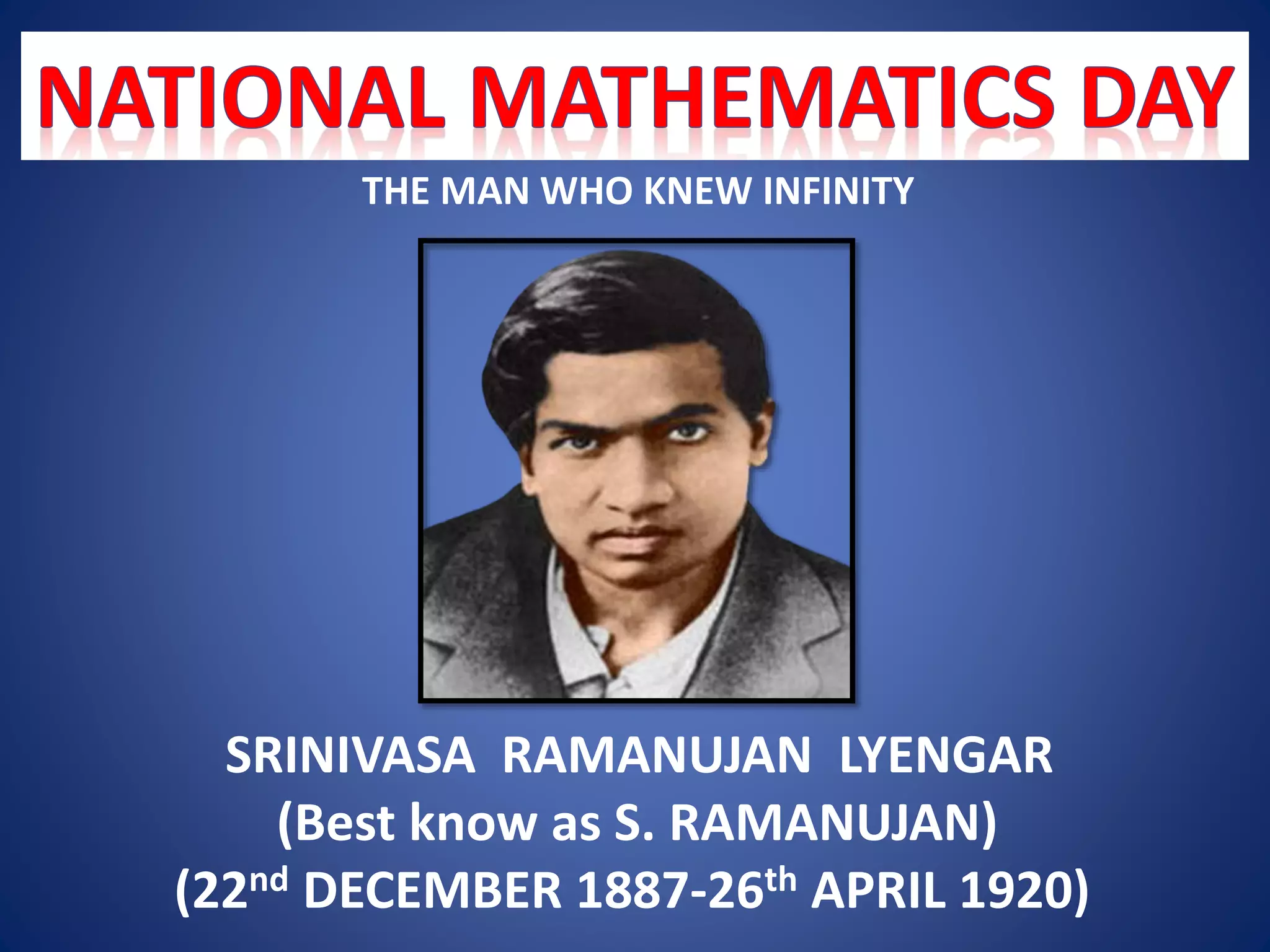
THE MAN WHO KNEW INFINITY
SRINIVASA RAMANUJAN LYENGAR
(Best know as S. RAMANUJAN)
(22nd DECEMBER 1887-26th APRIL 1920)
BY
SONU KUMAR
M.Sc.(Mathematics):-4th SEMESTER
Department of Mathematics
R.N. College, Hajipur (Vaishali)
( B.R.A. Bihar University, Muzaffarpur ).
TABLE OF CONTANT
BASI CONCEPT OF SET THEORY :SYMBOLS
& TERMINOLOGY
DEFINING SETS
SET MEMBERSHIP
SOME IMPORTANT SETS
NOTES
MORE NENBERSHIP QUESTION
BASIC CONCEPT OF SET THEORY :SYMBOLS &
TERMINOLOGY
:- A set is a collection of objects.
A well-defined set has no ambiguity as to what
objects are in the set or not.
For example:-
 the collection of all red cars
 the collection of positive numbers
 the collection of people born before 1980
 the collection of greatest baseball players
:- All of these collection are sets. However , the
collection of greatest baseball players is not well-defined.
Normally we restrict our attention to just well-defined
sets.
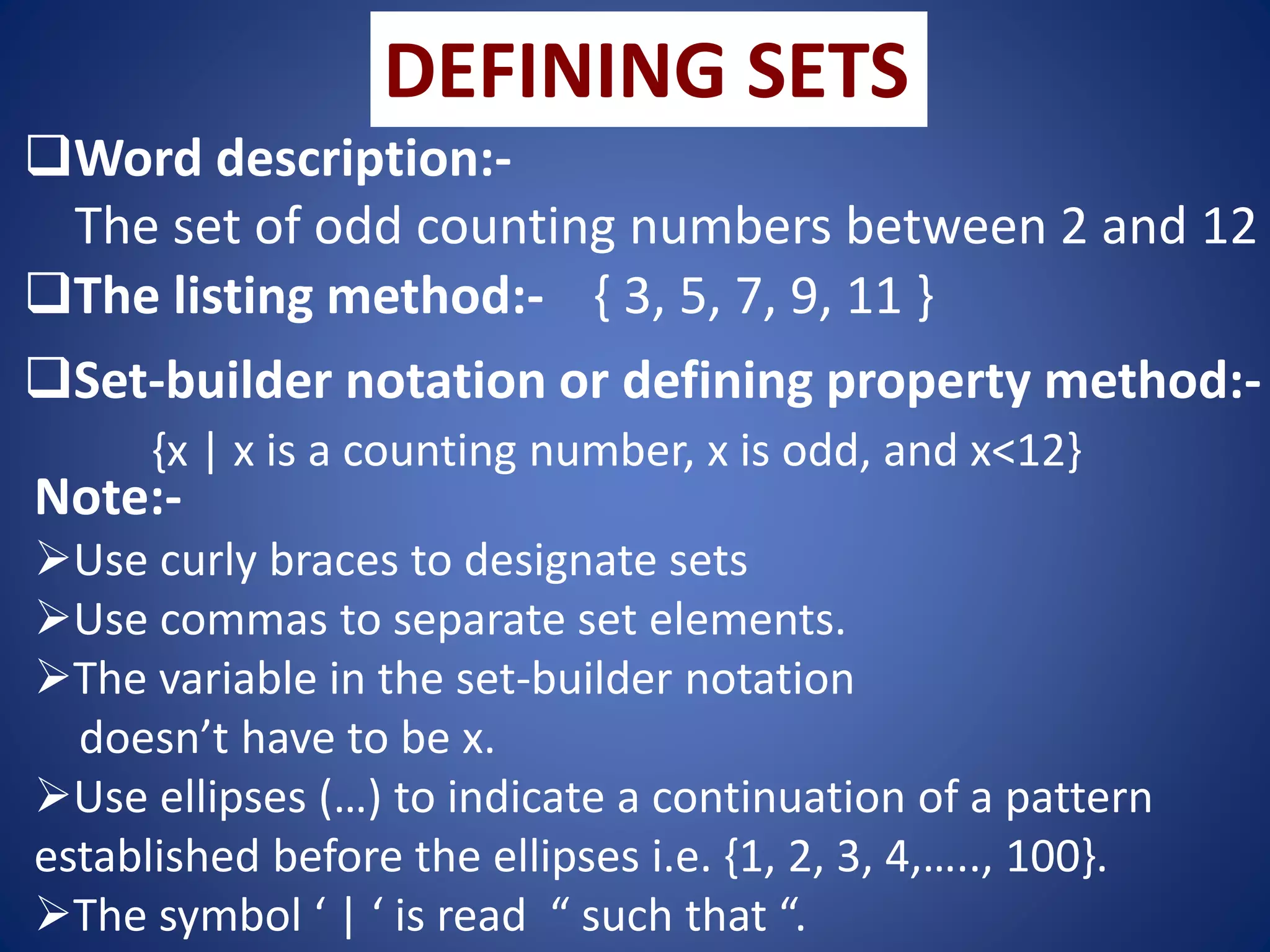
DEFINING SETS
Word description:-
The set of odd counting numbers between 2 and 12
The listing method:- { 3, 5, 7, 9, 11 }
Set-builder notation or defining property method:-
{x | x is a counting number, x is odd, and x<12}
Note:-
Use curly braces to designate sets
Use commas to separate set elements.
The variable in the set-builder notation
doesn’t have to be x.
Use ellipses (…) to indicate a continuation of a pattern
established before the ellipses i.e. {1, 2, 3, 4,….., 100}.
The symbol ‘ | ‘ is read “ such that “.
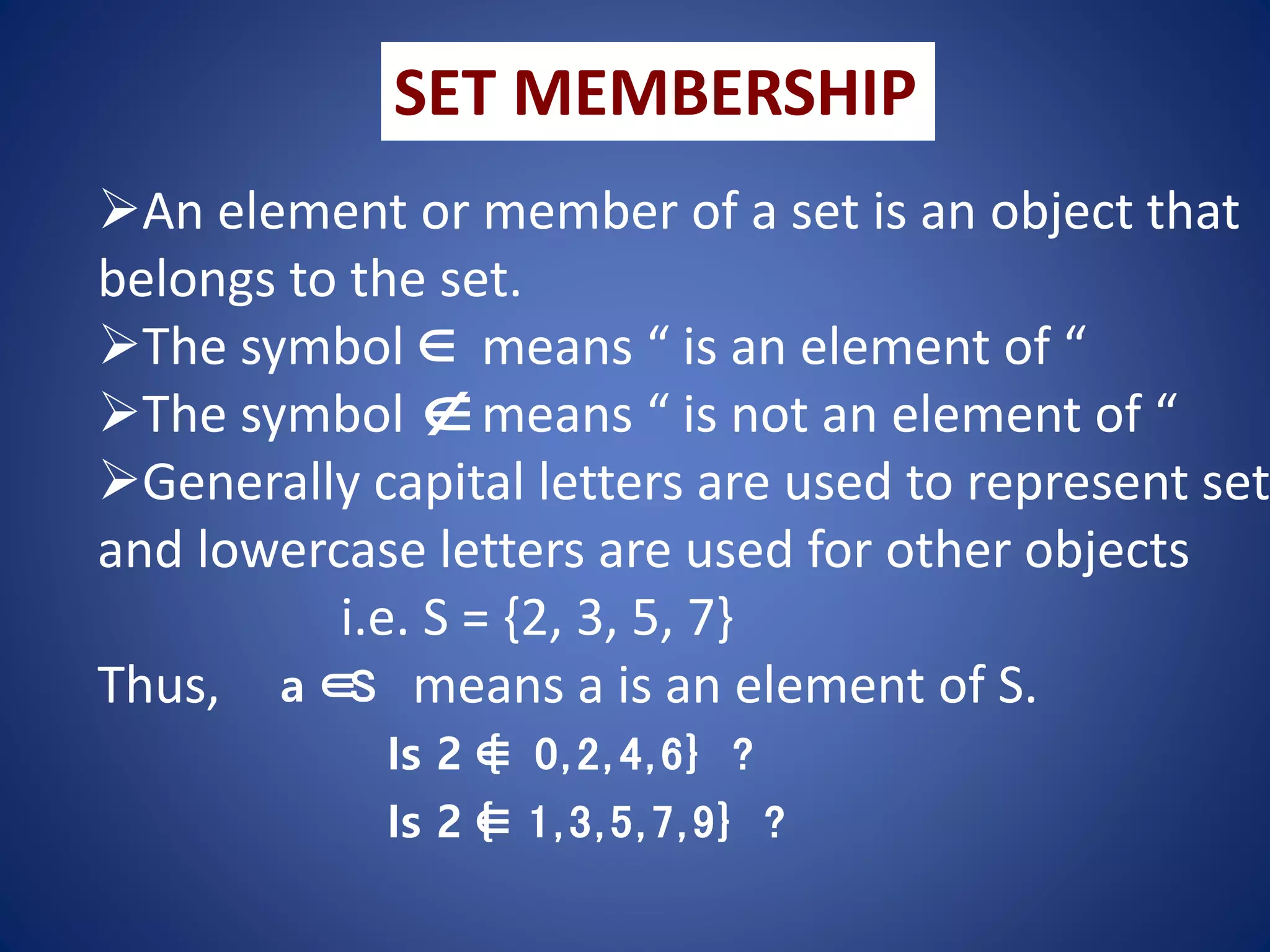
SET MEMBERSHIP
An element or member of a set is an object that
belongs to the set.
The symbol means “ is an element of “
The symbol means “ is not an element of “
Generally capital letters are used to represent set
and lowercase letters are used for other objects
i.e. S = {2, 3, 5, 7}
Thus, means a is an element of S.


a ∈
S
Is 2 ∈
{ 0,2, 4,6} ?
Is 2 ∈
{ 1,3,5,7,9} ?
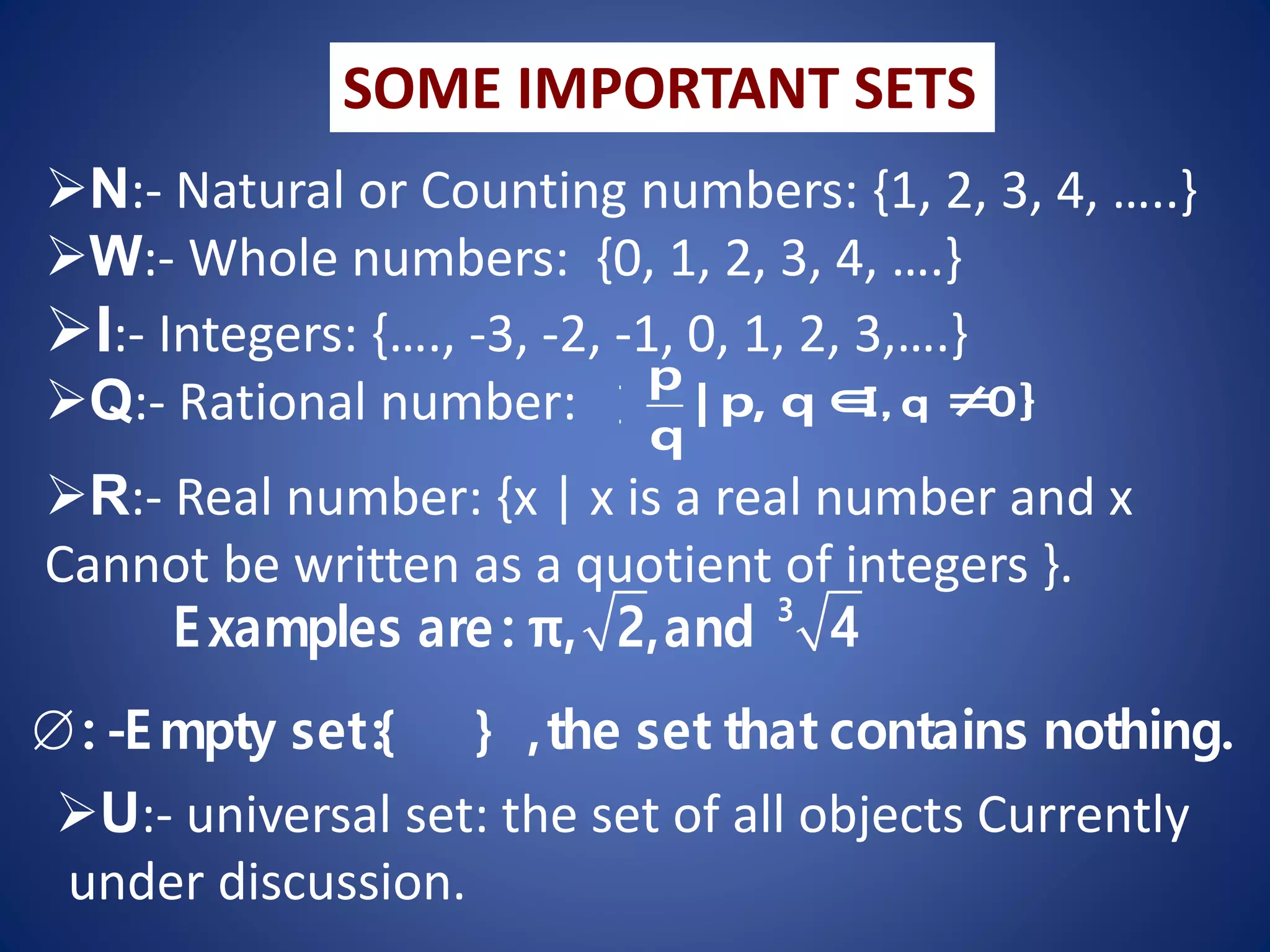
SOME IMPORTANT SETS
N:- Natural or Counting numbers: {1, 2, 3, 4, …..}
W:- Whole numbers: {0, 1, 2, 3, 4, ….}
I:- Integers: {…., -3, -2, -1, 0, 1, 2, 3,….}
Q:- Rational number:
p
{ | p, q∈
I, q ≠
0}
q
R:- Real number: {x | x is a real number and x
Cannot be written as a quotient of integers }.
3
Examples are : π, 2,and 4
: -Empty set:{ } ,the set that contains nothing.
U:- universal set: the set of all objects Currently
under discussion.
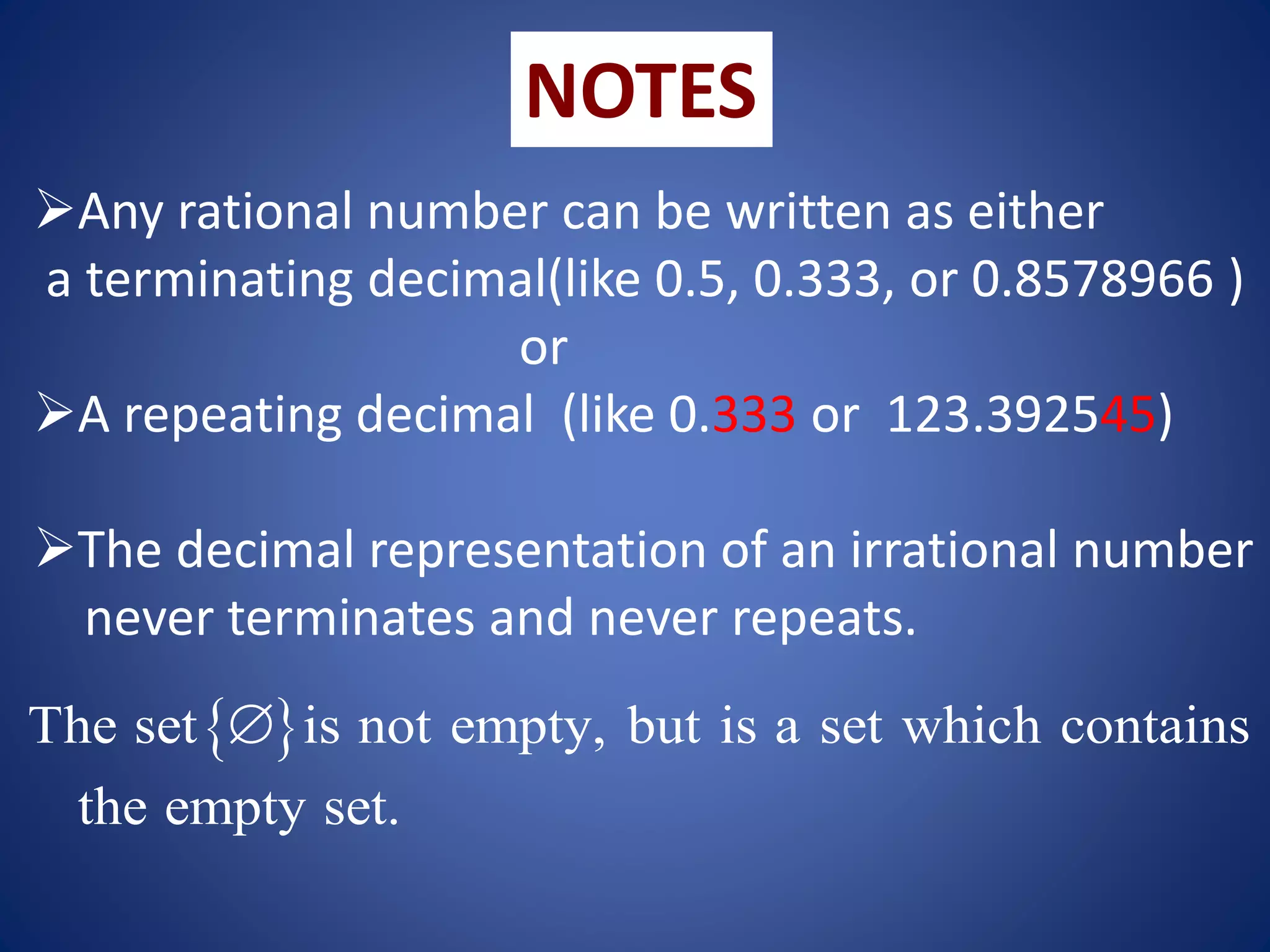
NOTES
Any rational number can be written as either
a terminating decimal(like 0.5, 0.333, or 0.8578966 )
or
A repeating decimal (like 0.333 or 123.392545)
The decimal representation of an irrational number
never terminates and never repeats.
 
The set is not empty, but is a set which contains
the empty set.

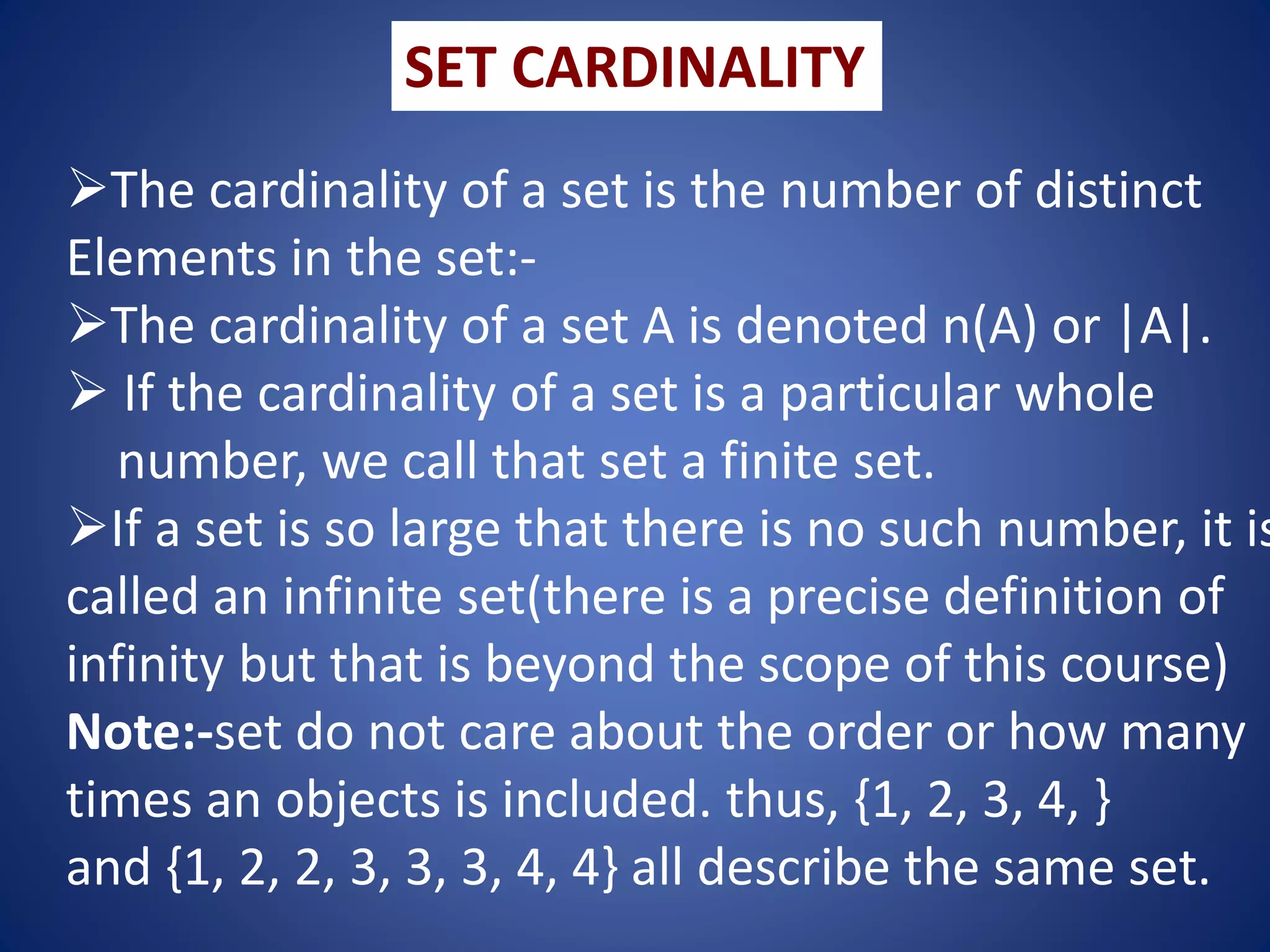
SET CARDINALITY
The cardinality of a set is the number of distinct
Elements in the set:-
The cardinality of a set A is denoted n(A) or |A|.
 If the cardinality of a set is a particular whole
number, we call that set a finite set.
If a set is so large that there is no such number, it is
called an infinite set(there is a precise definition of
infinity but that is beyond the scope of this course)
Note:-set do not care about the order or how many
times an objects is included. thus, {1, 2, 3, 4, }
and {1, 2, 2, 3, 3, 3, 4, 4} all describe the same set.

SET THEORY AND THEIR APLICATION

  • 1.
    THE MAN WHOKNEW INFINITY SRINIVASA RAMANUJAN LYENGAR (Best know as S. RAMANUJAN) (22nd DECEMBER 1887-26th APRIL 1920)
  • 2.
    BY SONU KUMAR M.Sc.(Mathematics):-4th SEMESTER Departmentof Mathematics R.N. College, Hajipur (Vaishali) ( B.R.A. Bihar University, Muzaffarpur ).
  • 3.
    TABLE OF CONTANT BASICONCEPT OF SET THEORY :SYMBOLS & TERMINOLOGY DEFINING SETS SET MEMBERSHIP SOME IMPORTANT SETS NOTES MORE NENBERSHIP QUESTION
  • 4.
    BASIC CONCEPT OFSET THEORY :SYMBOLS & TERMINOLOGY :- A set is a collection of objects. A well-defined set has no ambiguity as to what objects are in the set or not. For example:-  the collection of all red cars  the collection of positive numbers  the collection of people born before 1980  the collection of greatest baseball players :- All of these collection are sets. However , the collection of greatest baseball players is not well-defined. Normally we restrict our attention to just well-defined sets.
  • 5.
    DEFINING SETS Word description:- Theset of odd counting numbers between 2 and 12 The listing method:- { 3, 5, 7, 9, 11 } Set-builder notation or defining property method:- {x | x is a counting number, x is odd, and x<12} Note:- Use curly braces to designate sets Use commas to separate set elements. The variable in the set-builder notation doesn’t have to be x. Use ellipses (…) to indicate a continuation of a pattern established before the ellipses i.e. {1, 2, 3, 4,….., 100}. The symbol ‘ | ‘ is read “ such that “.
  • 6.
    SET MEMBERSHIP An elementor member of a set is an object that belongs to the set. The symbol means “ is an element of “ The symbol means “ is not an element of “ Generally capital letters are used to represent set and lowercase letters are used for other objects i.e. S = {2, 3, 5, 7} Thus, means a is an element of S.   a ∈ S Is 2 ∈ { 0,2, 4,6} ? Is 2 ∈ { 1,3,5,7,9} ?
  • 7.
    SOME IMPORTANT SETS N:-Natural or Counting numbers: {1, 2, 3, 4, …..} W:- Whole numbers: {0, 1, 2, 3, 4, ….} I:- Integers: {…., -3, -2, -1, 0, 1, 2, 3,….} Q:- Rational number: p { | p, q∈ I, q ≠ 0} q R:- Real number: {x | x is a real number and x Cannot be written as a quotient of integers }. 3 Examples are : π, 2,and 4 : -Empty set:{ } ,the set that contains nothing. U:- universal set: the set of all objects Currently under discussion.
  • 8.
    NOTES Any rational numbercan be written as either a terminating decimal(like 0.5, 0.333, or 0.8578966 ) or A repeating decimal (like 0.333 or 123.392545) The decimal representation of an irrational number never terminates and never repeats.   The set is not empty, but is a set which contains the empty set. 
  • 9.
    SET CARDINALITY The cardinalityof a set is the number of distinct Elements in the set:- The cardinality of a set A is denoted n(A) or |A|.  If the cardinality of a set is a particular whole number, we call that set a finite set. If a set is so large that there is no such number, it is called an infinite set(there is a precise definition of infinity but that is beyond the scope of this course) Note:-set do not care about the order or how many times an objects is included. thus, {1, 2, 3, 4, } and {1, 2, 2, 3, 3, 3, 4, 4} all describe the same set.