Reading Incentive
   Programs
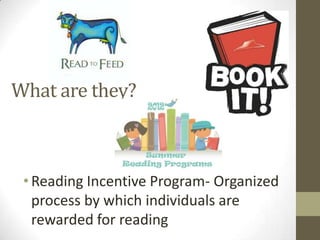
What are they?


 • Reading Incentive Program- Organized
   process by which individuals are
   rewarded for reading
Divisive Issue
What’s your motivation?
• Create a love of
  reading
• Entice reluctant
  readers
• Promote the library
• Increase circulation
• Increase literacy
  scores through
  reading practice
• Technically not a reading incentive program
• Reading Management System
• Stephen D. Krashen:
  • Access to reading material
  • Time to read
  • Testing on content
  • Prizes in exchange for points (not necessary to
    AR)
Reading Selection
• Reading programs         • AR quizzes only cover a
  allow for self-            limited range of
  selected, interest-        material
  based reading, outside   • Reading level
  of established             requirements further
  curriculum                 limit available books
• Mandatory reading          (and may pose privacy
  programs can justify       issues!)
  library purchases        • Selection for books
  outside of curriculum      that are hard to quiz
                             can be limited: how-
                             tos, poetry, etc.
Reading Time
• Mandatory reading      • Mandatory
  programs = more          incentivized reading
  reading time than        could lead to less
  SSR programs             voluntary reading
• Possible increase in   • Reading time takes
  literacy with AR at      from instruction time
  the K-3 level          • Silent reading isn’t as
                           productive as reading
                           group discussions
Testing / Assessment
• Turns reading into    • Could lead to higher
  another homework        standardized test
  assignment              scores
• AR tests              • Accountability for
  recall/surface          SSR
  reading, not deeper   • Statistics and
  understanding or        quantitative results
  connection              for analysis
• Reading = Stress      • Immediate feedback
                          for students
Rewards
• Extrinsic rewards       • Verbal praise, social
  stop development of       recognition,
  intrinsic motivations     certificates, food,
                            parties, books,
                            charity donations
                          • Engage reluctant
                            readers
                          • Verbal
                            rewards/recognition
                            increase task interest
Ask Yourself:
 • Do I focus on individual achievement and
   goals, so all students are recognized?
 • Can groups or classes collaborate? Is
   collaborative work or discussion encouraged?
 • Are students still reading for other reasons than
   this program? Do I still promote materials that
   might not “count” for the incentive?
 • Are my incentives appropriate and related (public
   recognition, certificates, books)?

*Adapted from Doug Johnson’s “Creating Fat Students Who Don’t Like to Read.”
“Book Bucks”- Diva Steiner
• Voluntary Program       • Bucks can be spent
• Does not replace          on books at fairs
  curriculum time           several times a year
• No book criteria,       • Bonus Bucks earned
  open selection            from creative
                            engagement-
• Students give their
                            posters, dioramas, b
  review of book and
                            ook covers, etc.
  summarize the story
 • Aligns with schools’
   “Early Literacy
   Profiles.”

Reading Incentive Programs

  • 1.
  • 2.
    What are they? • Reading Incentive Program- Organized process by which individuals are rewarded for reading
  • 3.
  • 4.
    What’s your motivation? •Create a love of reading • Entice reluctant readers • Promote the library • Increase circulation • Increase literacy scores through reading practice
  • 5.
    • Technically nota reading incentive program • Reading Management System • Stephen D. Krashen: • Access to reading material • Time to read • Testing on content • Prizes in exchange for points (not necessary to AR)
  • 6.
    Reading Selection • Readingprograms • AR quizzes only cover a allow for self- limited range of selected, interest- material based reading, outside • Reading level of established requirements further curriculum limit available books • Mandatory reading (and may pose privacy programs can justify issues!) library purchases • Selection for books outside of curriculum that are hard to quiz can be limited: how- tos, poetry, etc.
  • 7.
    Reading Time • Mandatoryreading • Mandatory programs = more incentivized reading reading time than could lead to less SSR programs voluntary reading • Possible increase in • Reading time takes literacy with AR at from instruction time the K-3 level • Silent reading isn’t as productive as reading group discussions
  • 8.
    Testing / Assessment •Turns reading into • Could lead to higher another homework standardized test assignment scores • AR tests • Accountability for recall/surface SSR reading, not deeper • Statistics and understanding or quantitative results connection for analysis • Reading = Stress • Immediate feedback for students
  • 9.
    Rewards • Extrinsic rewards • Verbal praise, social stop development of recognition, intrinsic motivations certificates, food, parties, books, charity donations • Engage reluctant readers • Verbal rewards/recognition increase task interest
  • 10.
    Ask Yourself: •Do I focus on individual achievement and goals, so all students are recognized? • Can groups or classes collaborate? Is collaborative work or discussion encouraged? • Are students still reading for other reasons than this program? Do I still promote materials that might not “count” for the incentive? • Are my incentives appropriate and related (public recognition, certificates, books)? *Adapted from Doug Johnson’s “Creating Fat Students Who Don’t Like to Read.”
  • 11.
    “Book Bucks”- DivaSteiner • Voluntary Program • Bucks can be spent • Does not replace on books at fairs curriculum time several times a year • No book criteria, • Bonus Bucks earned open selection from creative engagement- • Students give their posters, dioramas, b review of book and ook covers, etc. summarize the story • Aligns with schools’ “Early Literacy Profiles.”

Editor's Notes

  • #3 Book It! Read to Feed! Summer Reading Programs! Charity Donations (Read to Feed)! Books! Verbal recognition & Praise!
  • #4 As with politics, it’s complicated, but many people use results to support what they already think. Xkcd- Wikipedian protester. Difficult to research because most articles/research are done on the biggest program: Accelerated Reader
  • #5 Not everyone is starting on the same page… reading programs (of any kind) can be more or less successful at these). Different members of a learning institution might have different motivations.
  • #6 AR is the most well-known RIP, because it’s management system makes for easy adoption. It is also the most controversial. Krashen breaks down AR into 4 componetsStudies unclear on the outcomes of AR (nothing to compare to), but possibly more harmful than good.
  • #7 Librarians or teachers can create quizzes for additional works, but many require students to chose only AR texts.Is selection based on reading level? Problem: reading level does not always correlate with emotional or maturity levels.Problem- If books are labeled by reading level- it’s been suggested this could compromise student’s rights to privacy.
  • #8 - Some studies show Students K-3rd do show some improvement in literacy over non AR, possibly because of extra practice, but no comparison to non-AR SSR programs, etc.
  • #9 Some students appreciate the immediate feedback, and enjoy working to improve their scores.
  • #10 Research varies on whether rewards damage development of love of reading. Some studies show that other factors, like choice of materials, setting own goals, effect far more.
  • #12 Book Bucks is a RIP developed by Diva Steiner, an elementary librarian from NY. 3-5th graders receive $1 Buck for every 30 pages read, K-2 receive $1 for every book readThe Book forms were changed to match Early Literacy profiles, to help teachers gauge comprehension & reading improvement.