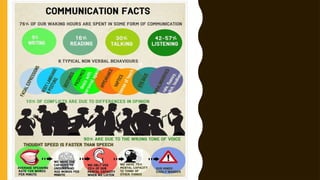
L E S S O N 1
NATURE AND
PROCESS OF
COMMUNICATION
SPECIFIC OBJECTIVES
At the end of this lesson, the learner should be able to:
● define what communication is;
● explain the nature of communication; and
● describe the process of communication.
ESSENTIAL QUESTION
“Why is communication an
essential human need?”
WARM UP!
1. Kindly get one tangible thing you have in
your house that you consider important to
you.
2. For a couple of minutes, think of the reason/s
why it is important. Be ready to share it in
class.
3. Be sure to introduce yourself in a creative
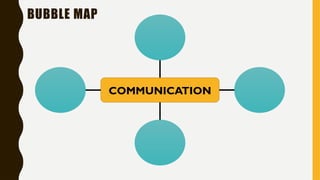
BUBBLE MAP
COMMUNICATION
ETYMOLOGY
communis (commonness)
communicare (to share)
NATURE OF
COMMUNICATION
Communication is a process.
Communication occurs between two or more
people.
Communication could be expressed as verbal
or non-verbal.
COMMUNICATION
•Transmission of ideas, thoughts, and
emotions…
•Uses verbal and non-verbal cues
STIMULUS
•the start of communication process
•an idea or concept the sender
would like to convey
ENCODING
•Putting idea into words
DECODING
•Accepting and interpreting
of the message
FEEDBACK
•The response of the
receiver
THINK ABOUT IT?
Communication is
not always successful.
COMMUNICATION
BREAKDOWN
A communication breakdown is
defined as a failure to exchange
information, resulting in a lack
of communication.
NOISE
•Any barrier or hindrance
obstructing the
understanding of the message
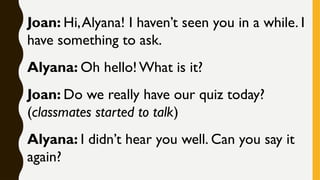
Joan: Hi,Alyana! I haven’t seen you in a while. I
have something to ask.
Alyana: Oh hello!What is it?
Joan: Do we really have our quiz today?
(classmates started to talk)
Alyana: I didn’t hear you well. Can you say it
again?
•Communication is a process; it starts
with a stimulus, which is an idea or concept
that the sender has and would like to convey.
•The sender encodes the message by putting
it into words and then expresses the ideas in
proper sequence.
•This message is then accepted and
interpreted or decoded by the receiver.
•The receiver may or may not respond to
the sender. If the receiver chooses to
respond, then he or she will provide
feedback.
•When providing feedback, the receiver
then becomes the sender, and the first
sender then becomes the receiver of the
message.
ESSENTIAL QUESTION
“Why is communication
an essential human need?”
Communication is an essential human need
because it allows us to convey our ideas and
feelings.
It is essential for humans to communicate
because doing so allows us to exchange ideas
with others and understand others’ viewpoints.
LET’S WRAP IT UP!
•Define communication in your own
words.
(minimum of 2 sentences)
•Write at least 5 important elements of
communication.
•How do you achieve effective or good
Thank you for listening!
PERFORMANCE TASK #1
Present a short skit (5 mins)
which shows the nature and
process of communication.
L E S S O N 2 :
MODELS OF
COMMUNICATION
S E P T E M B E R 1 2 , 2 0 2 0
SPECIFIC OBJECTIVES
At the end of this lesson, the learner should be able to:
•differentiate between the various models of
communication; and
•explain each model of communication.
L E S S O N 3
FUNCTIONS OF
COMMUNICATION
LESSON 2: MODELS OF COMMUNICATION
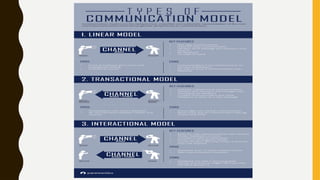
A model is a representation of an object
or process through diagrams and
graphics.Therefore, a model of
communication is a representation of how
communication transpires.
MODELS OF COMMUNICATION
The three most well-known models for
communication are Linear, Interactive, and
Transactional.
Each model offers a different perspective
on the communication process.
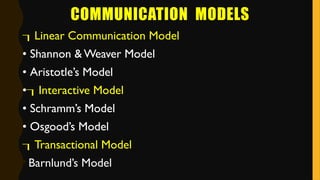
COMMUNICATION MODELS
Linear Communication Model
• Shannon & Weaver Model
• Aristotle’s Model
•Interactive Model
• Schramm’s Model
• Osgood’s Model
Transactional Model
•Barnlund’s Model
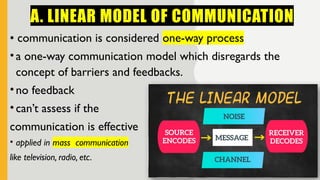
A. LINEAR MODEL OF COMMUNICATION
• communication is considered one-way process
•a one-way communication model which disregards the
concept of barriers and feedbacks.
•no feedback
•can’t assess if the
communication is effective
• applied in mass communication
like television, radio, etc.
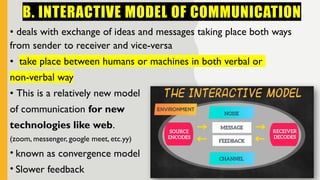
B. INTERACTIVE MODEL OF COMMUNICATION
• deals with exchange of ideas and messages taking place both ways
from sender to receiver and vice-versa
• take place between humans or machines in both verbal or
non-verbal way
• This is a relatively new model
of communication for new
technologies like web.
(zoom, messenger, google meet, etc.yy)
• known as convergence model
• Slower feedback
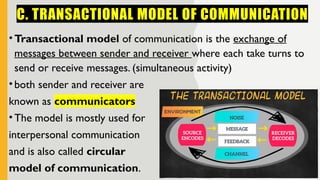
C. TRANSACTIONAL MODEL OF COMMUNICATION
•Transactional model of communication is the exchange of
messages between sender and receiver where each take turns to
send or receive messages. (simultaneous activity)
•both sender and receiver are
known as communicators
•The model is mostly used for
interpersonal communication
and is also called circular
model of communication.
COMPLETE EACH OF THE FOLLOWING SENTENCES BY
SUPPLYING THE MISSING WORD.
1. A ______________ of communication is a conceptual
representation used to explain the communication process.
2. The three general types of communication models are
__________________
5.The element of communication that is not taken into account in the
linear communication model is ______________.
6.A type communication model which uses modern technologies is
_______________
• 7. In transactional model, both sender and receiver are
known as ___________________
LINEAR, TRANSACTIONAL OR INTERACTIVE?
8. Listening to your favorite podcast in
Spotify.
9. Reading your favorite anime story
from the magazine.
10. Having chitchat with your best
friend.
CHOOSE THE LETTER OF THE CORRECT
ANSWER.
1. Which functions of communication was
described in this situation:
Class Rule : Always conduct yourself politely
and respectfully.
A.control
B.social interaction
C.motivation
D.emotional expression
E. information dissemination
CHOOSE THE LETTER OF THE CORRECT
ANSWER.
2. Which functions of communication was
described in this situation:
“I’m so glad that you came into my life.”
A.control
B.social interaction
C.motivation
D.emotional expression
E. information dissemination
CHOOSE THE LETTER OF THE CORRECT
ANSWER.
3. It refers to the function of communication that
is used when the speaker wants to make other
aware of certain data, concepts, and processes.
A. control
B. social interaction
C. motivation
D.emotional expression
E. information dissemination
CHOOSE THE LETTER OF THE CORRECT
ANSWER.
4. Which functions of communication was
described in this situation:
“Would you like some coffee, tea, or me?”
A. control
B. social interaction
C. motivation
D.emotional expression
E. information dissemination
CHOOSE THE LETTER OF THE CORRECT
ANSWER.
5. Which functions of communication was described in
this situation:
“For now, overcome your weaknesses and be
the best version of yourself.”
A. control
B. social interaction
C. motivation
D.emotional expression
E. information dissemination
6. Which is an example of regulation and
control?
A.“It’s nice to meet you.”
B.“Clean your room, then you can play
basketball.”
C.“Where can I find the library?”
D.“Seychelles is one of the world’s smallest
countries.”
7. Which of the situations shows social
interaction?
A. Sir X tells his students to finish answering the
quiz.
B. Earl invites Margie for a coffee.
C. Joan tells her friend not to lose hope.
D.The teacher introduced Conditional Probability
to her class.
8. Which one has different function?
A.“We pray for those who mourn.”
B.“Thank you for coming into my life.”
C.“Keep quiet.”
D.“I’m so sorry for your loss.”
9.The city Mayor is sharing the data to the public,
“There are 50 families in our vicinity that are affected
by the typhoon Carina.” What function of
communication is shown in
the situation?
A. control
B. motivation
C. social interaction
D. information
10.Your friend is asking you to hang out
on he 21st
of August because it is a
holiday.
A. control
B. motivation
C. social interaction
D. information
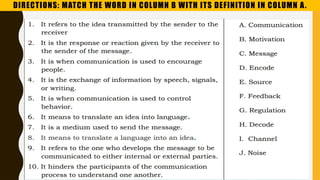
DIRECTIONS: MATCH THE WORD IN COLUMN B WITH ITS DEFINITION IN COLUMN A.
CHOOSE THE LETTER OF THE CORRECT ANSWER.
1.What is verbal communication?
•A) Using body language to express ideas
•B) Expressing ideas through spoken or written
words
•C) Communicating through facial expressions
•D) Using gestures to convey messages
CHOOSE THE LETTER OF THE CORRECT ANSWER.
2.What is verbal communication?
•A) Using body language to express ideas
•B) Expressing ideas through spoken or written
words
•C) Communicating through facial expressions
•D) Using gestures to convey messages
CHOOSE THE LETTER OF THE CORRECT ANSWER.
3.Which type of non-verbal communication
involves using gestures to convey meaning?
•A) Paralanguage
•B) Haptics
•C) Kinesics
•D) Proxemics
CHOOSE THE LETTER OF THE CORRECT ANSWER.
4.Which of the following is an example of
proxemics in communication?
•A)The distance you maintain from someone during a
conversation
•B)The way you use your hands while speaking
•C) The tone of your voice
•D)The expressions on your face
CHOOSE THE LETTER OF THE CORRECT ANSWER.
5. Which of the following non-verbal cues is
often used to show agreement or interest?
•A) Crossing arms
•B) Nodding head
•C) Avoiding eye contact
•D) Shifting gaze frequently
CHOOSE THE LETTER OF THE CORRECT ANSWER.
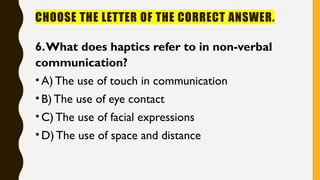
6.What does haptics refer to in non-verbal
communication?
•A) The use of touch in communication
•B) The use of eye contact
•C) The use of facial expressions
•D) The use of space and distance
CHOOSE THE LETTER OF THE CORRECT ANSWER.
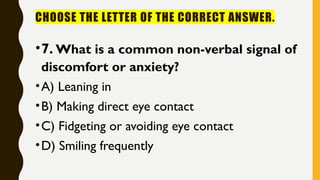
•7. What is a common non-verbal signal of
discomfort or anxiety?
•A) Leaning in
•B) Making direct eye contact
•C) Fidgeting or avoiding eye contact
•D) Smiling frequently
CHOOSE THE LETTER OF THE CORRECT ANSWER.
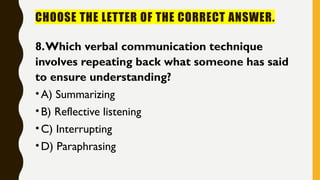
8.Which verbal communication technique
involves repeating back what someone has said
to ensure understanding?
•A) Summarizing
•B) Reflective listening
•C) Interrupting
•D) Paraphrasing
CHOOSE THE LETTER OF THE CORRECT ANSWER.
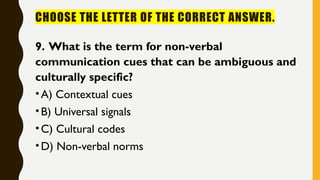
9. What is the term for non-verbal
communication cues that can be ambiguous and
culturally specific?
•A) Contextual cues
•B) Universal signals
•C) Cultural codes
•D) Non-verbal norms
CHOOSE THE LETTER OF THE CORRECT ANSWER.
10. In what way can posture affect verbal
communication?
•A) It can reinforce the message being conveyed
•B) It has no effect on verbal communication
•C) It contradicts the spoken message
•D) It is irrelevant to the message
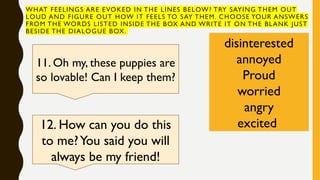
WHAT FEELINGS ARE EVOKED IN THE LINES BELOW? TRY SAYING THEM OUT
LOUD AND FIGURE OUT HOW IT FEELS TO SAY THEM. CHOOSE YOUR ANSWERS
FROM THE WORDS LISTED INSIDE THE BOX AND WRITE IT ON THE BLANK JUST
BESIDE THE DIALOGUE BOX.
disinterested
annoyed
Proud
worried
angry
excited
11. Oh my, these puppies are
so lovable! Can I keep them?
12. How can you do this
to me?You said you will
always be my friend!
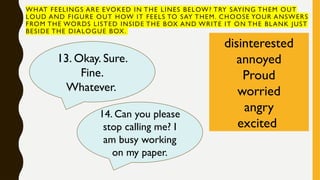
WHAT FEELINGS ARE EVOKED IN THE LINES BELOW? TRY SAYING THEM OUT
LOUD AND FIGURE OUT HOW IT FEELS TO SAY THEM. CHOOSE YOUR ANSWERS
FROM THE WORDS LISTED INSIDE THE BOX AND WRITE IT ON THE BLANK JUST
BESIDE THE DIALOGUE BOX.
13. Okay. Sure.
Fine.
Whatever.
14. Can you please
stop calling me? I
am busy working
on my paper.
disinterested
annoyed
Proud
worried
angry
excited
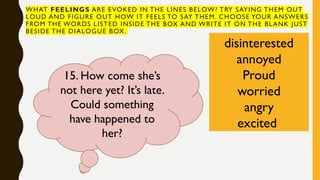
WHAT FEELINGS ARE EVOKED IN THE LINES BELOW? TRY SAYING THEM OUT
LOUD AND FIGURE OUT HOW IT FEELS TO SAY THEM. CHOOSE YOUR ANSWERS
FROM THE WORDS LISTED INSIDE THE BOX AND WRITE IT ON THE BLANK JUST
BESIDE THE DIALOGUE BOX.
disinterested
annoyed
Proud
worried
angry
excited
15. How come she’s
not here yet? It’s late.
Could something
have happened to
her?
COMMON TYPES OF COMMUNICATION BARRIERS
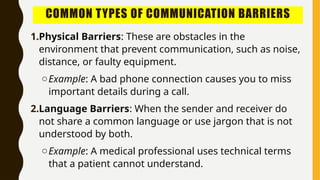
1.Physical Barriers: These are obstacles in the
environment that prevent communication, such as noise,
distance, or faulty equipment.
oExample: A bad phone connection causes you to miss
important details during a call.
2.Language Barriers: When the sender and receiver do
not share a common language or use jargon that is not
understood by both.
oExample: A medical professional uses technical terms
that a patient cannot understand.
COMMON TYPES OF COMMUNICATION BARRIERS
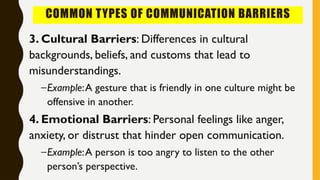
3. Cultural Barriers: Differences in cultural
backgrounds, beliefs, and customs that lead to
misunderstandings.
–Example:A gesture that is friendly in one culture might be
offensive in another.
4. Emotional Barriers: Personal feelings like anger,
anxiety, or distrust that hinder open communication.
–Example:A person is too angry to listen to the other
person’s perspective.
COMMON TYPES OF COMMUNICATION BARRIERS
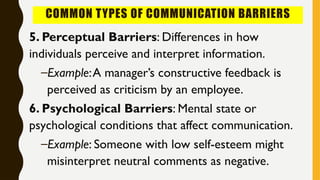
5. Perceptual Barriers: Differences in how
individuals perceive and interpret information.
–Example:A manager’s constructive feedback is
perceived as criticism by an employee.
6. Psychological Barriers: Mental state or
psychological conditions that affect communication.
–Example: Someone with low self-esteem might
misinterpret neutral comments as negative.
COMMON TYPES OF COMMUNICATION BARRIERS
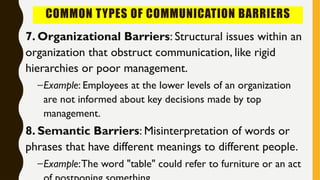
7. Organizational Barriers: Structural issues within an
organization that obstruct communication, like rigid
hierarchies or poor management.
–Example: Employees at the lower levels of an organization
are not informed about key decisions made by top
management.
8. Semantic Barriers: Misinterpretation of words or
phrases that have different meanings to different people.
–Example:The word "table" could refer to furniture or an act
Situation: Maria is a project manager who works with
a team spread across different countries. During a
recent virtual meeting, she noticed that one of her
team members,Ahmed, seemed disengaged and
provided minimal input.After the meeting, Maria
realized that Ahmed may have misunderstood some of
the key points discussed because English is not his first
language.Additionally, the time zone difference made
Ahmed attend the meeting late at night, which might
have contributed to his lack of participation.
CHOOSE THE LETTER OF THE CORRECT ANSWER.
1.What type of barrier occurs when noise
interferes with the communication process?
•a) Emotional Barrier
•b) Physical Barrier
•c) Psychological Barrier
•d) Cultural Barrier
CHOOSE THE LETTER OF THE CORRECT ANSWER.
2.Which barrier is caused by the use of jargon or
technical language that the receiver cannot
understand?
• a) Language Barrier
• b) Organizational Barrier
• c) Perceptual Barrier
• d) Psychological Barrier
CHOOSE THE LETTER OF THE CORRECT ANSWER.
3.When a person’s feelings, such as anger or
anxiety, prevent effective communication, this
is known as a:
•a) Physical Barrier
•b) Emotional Barrier
•c) Cultural Barrier
•d) Semantic Barrier
CHOOSE THE LETTER OF THE CORRECT ANSWER.
4.A manager from the U.S. uses a thumbs-up
gesture, which is misinterpreted as offensive in
another culture.What type of barrier is this?
•a) Language Barrier
•b) Perceptual Barrier
•c) Cultural Barrier
•d) Organizational Barrier
CHOOSE THE LETTER OF THE CORRECT ANSWER.
5.Which barrier is characterized by structural
issues within an organization that hinder the
flow of information?
•a) Perceptual Barrier
•b) Emotional Barrier
•c) Organizational Barrier
•d) Physical Barrier
CHOOSE THE LETTER OF THE CORRECT ANSWER.
6.When a person interprets neutral feedback
as negative due to their own insecurities, what
kind of barrier is present?
•a) Psychological Barrier
•b) Semantic Barrier
•c) Cultural Barrier
•d) Physical Barrier
CHOOSE THE LETTER OF THE CORRECT ANSWER.
7. Differences in how people interpret the
same information can be attributed to which
barrier?
•a) Emotional Barrier
•b) Perceptual Barrier
•c) Physical Barrier
•d) Organizational Barrier
CHOOSE THE LETTER OF THE CORRECT ANSWER.
8.What type of barrier might occur when
employees are not informed about decisions
made by top management?
•a) Cultural Barrier
•b) Physical Barrier
•c) Organizational Barrier
•d) Psychological Barrier
CHOOSE THE LETTER OF THE CORRECT ANSWER.
9.When words or phrases are misinterpreted
due to having multiple meanings, this is known
as a:
•a) Physical Barrier
•b) Semantic Barrier
•c) Emotional Barrier
•d) Psychological Barrier
CHOOSE THE LETTER OF THE CORRECT ANSWER.
10.A doctor uses medical terms that the
patient does not understand.This is an
example of a:
•a) Perceptual Barrier
•b) Language Barrier
•c) Organizational Barrier
•d) Cultural Barrier
very demure…
very mindful…
very cutesy…
EVALUATION:
https://forms.gle/Xqt2HmdAHSgT5AY5A
A. DIRECTIONS: WRITE TRUE IF THE STATEMENT IS
CORRECT AND FALSE IF IT IS NOT.
1. Communication breakdown can lead to a total cessation
of communication.
2. Nonverbal dimension encompasses the use of a language.
3. Misunderstanding occurs when oral and written are not in
agreement.
4. A gesture may have multiple meanings. __________
5. One’s experience is a factor in comprehending a message.
IDENTIFY THE FOLLOWING. ANSWERS ONLY.
1.The use of ____________ means using over-complicated, unfamiliar
and/or technical terms.
2. Some people may find it difficult to express their ___________ and
some topics may be completely 'off-limits’ or 3. ___________.
4. Lack of __________, interest, distractions, or irrelevance to the
receiver is also a barrier.
5. ______________ in perception and viewpoint may lead to
breakdown.
6-7 Give 2 examples of physical disabilities.
8.A _____________ communicator must be aware of these barriers and
try to reduce their impact by continually checking understanding and by
offering appropriate feedback.
Intercultural communication fosters
understanding and respect among people from
different cultural backgrounds, promoting
harmony in diverse environments. It helps
individuals navigate cultural differences, reduce
stereotypes, and build stronger relationships. In
everyday life, it enhances global competency and
encourages empathy, making interactions more
inclusive and meaningful.
The sociocultural dimension of
communication refers to how various social
and cultural factors influence communication
processes and outcomes. Sensitivity to these
dimensions is essential for effective
communication, as different cultures, genders,
ages, social statuses, and religions shape how
individuals perceive and engage in conversation.
1. Culture
Culture profoundly impacts communication
styles, language use, non-verbal cues, and the
interpretation of messages. Cultural
differences can create barriers or
opportunities for understanding, making it
essential to be aware of norms, values, and
beliefs in intercultural interactions.
2. Gender
Gender influences communication in
terms of roles, expectations, and
behaviors. Societal norms around gender
may affect how individuals express
themselves, the topics they discuss, and the
power dynamics present in conversations.
3.Age
Age can create generational
communication gaps, where language,
technology use, or cultural references
differ. Sensitivity to age-related differences
ensures respect and clarity in interactions
with younger or older individuals.
4. Social Status
Social status affects communication patterns,
particularly in hierarchical or formal settings.
People of different social standings may
employ different levels of formality, tone, and
even non-verbal communication.
Understanding social status dynamics fosters
respectful and effective communication.
5. Religion
Religious beliefs can shape perspectives on
life, ethics, and communication. Being
mindful of religious customs, practices, and
values is crucial to avoid misunderstandings
and to engage respectfully with individuals
of different faiths.
SELECT THE CORRESPONDING LETTER FOR THE CORRECT OPTION.
1.What is intercultural communication?
A. Communication between people of the same culture
B. Communication between people from different
cultural backgrounds
C. Communication that only involves nonverbal cues
D. Communication that focuses on formal language
SELECT THE CORRESPONDING LETTER FOR THE CORRECT OPTION.
2.Which of the following factors can most
impact intercultural communication?
A.Age
B. Gender
C. Social status
D.All of the above
SELECT THE CORRESPONDING LETTER FOR THE CORRECT OPTION.
3. How does culture affect communication?
A. It determines the language people speak
B. It influences the values, behaviors, and
interpretations of messages
C. It makes communication more complex
D. It has no effect on communication
SELECT THE CORRESPONDING LETTER FOR THE CORRECT OPTION.
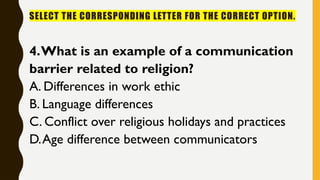
4.What is an example of a communication
barrier related to religion?
A. Differences in work ethic
B. Language differences
C. Conflict over religious holidays and practices
D.Age difference between communicators
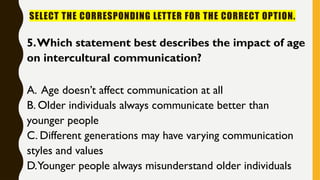
SELECT THE CORRESPONDING LETTER FOR THE CORRECT OPTION.
5.Which statement best describes the impact of age
on intercultural communication?
A. Age doesn’t affect communication at all
B. Older individuals always communicate better than
younger people
C. Different generations may have varying communication
styles and values
D.Younger people always misunderstand older individuals
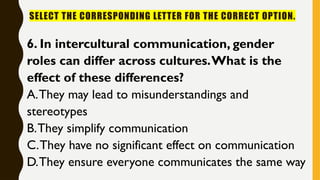
SELECT THE CORRESPONDING LETTER FOR THE CORRECT OPTION.
6. In intercultural communication, gender
roles can differ across cultures.What is the
effect of these differences?
A.They may lead to misunderstandings and
stereotypes
B.They simplify communication
C.They have no significant effect on communication
D.They ensure everyone communicates the same way
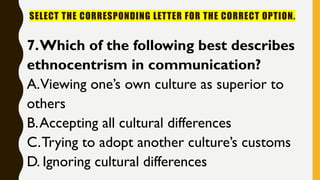
SELECT THE CORRESPONDING LETTER FOR THE CORRECT OPTION.
7.Which of the following best describes
ethnocentrism in communication?
A.Viewing one’s own culture as superior to
others
B.Accepting all cultural differences
C.Trying to adopt another culture’s customs
D. Ignoring cultural differences
SELECT THE CORRESPONDING LETTER FOR THE CORRECT OPTION.
8.What is the role of social status in intercultural
communication?
A. It creates equal power dynamics between
communicators
B. It can create power imbalances and affect the flow of
communication
C. It ensures respect in all interactions
D. It has no impact on communication
SELECT THE CORRESPONDING LETTER FOR THE CORRECT OPTION.
9. How can sexual orientation influence
intercultural communication?
A. It never affects communication
B. It can lead to discrimination or exclusion in
certain cultures
C. It improves communication in all settings
D. It only affects romantic relationships
SELECT THE CORRESPONDING LETTER FOR THE CORRECT OPTION.
10.What does “high-context” communication
refer to?
A. Communication that relies heavily on explicit verbal
messages
B. Communication that depends more on non-verbal
cues, context, and shared understanding
C. Communication that uses complex words and phrases
D. Communication in formal settings
SELECT THE CORRESPONDING LETTER FOR THE CORRECT OPTION.
11.Which of the following best describes
cultural relativism?
A. Believing your culture is superior
B. Understanding that cultures have their own
values and behaviors
C. Rejecting all cultural traditions
D.Adopting another culture completely
SELECT THE CORRESPONDING LETTER FOR THE CORRECT OPTION.
12.When discussing ethnicity, how can
stereotypes create barriers in
communication?
A.They promote more accurate communication
B.They create generalizations that may lead to
misinterpretation
C.They help people better understand each other
D.They eliminate communication difficulties
SELECT THE CORRESPONDING LETTER FOR THE CORRECT OPTION.
13. How does language diversity affect
intercultural communication?
A. It simplifies communication
B. It often requires interpreters and translators to
avoid misunderstandings
C. It eliminates communication barriers completely
D. It has no effect on communication
SELECT THE CORRESPONDING LETTER FOR THE CORRECT OPTION.
14.What is an example of a gender
communication difference?
A. Men always speak more than women
B.Women prefer emotional communication while
men prefer factual communication
C.Women and men have the same communication
styles
D. Gender differences are not seen in any culture
SELECT THE CORRESPONDING LETTER FOR THE CORRECT OPTION.
15.Which of the following is a potential
cultural barrier in communication?
A. Shared cultural values
B. Different nonverbal cues
C. Mutual understanding
D. Common language
SELECT THE CORRESPONDING LETTER FOR THE CORRECT OPTION.
16.What is one way to improve intercultural
communication in a diverse environment?
A.Avoid discussing cultural differences
B.Assume everyone understands your point of
view
C. Develop cultural awareness and sensitivity
D. Focus only on verbal communication
SELECT THE CORRESPONDING LETTER FOR THE CORRECT OPTION.
17. In some cultures, maintaining direct eye
contact is considered disrespectful.This is an
example of how ____ affects communication.
A. Religion
B. Gender
C. Nonverbal communication and culture
D. Social status
SELECT THE CORRESPONDING LETTER FOR THE CORRECT OPTION.
18.Which of the following is a true statement
about communication across social statuses?
A. People from higher social statuses never face
communication barriers
B. Social status can create power dynamics that affect how
freely someone communicates
C. Social status doesn’t affect communication in any setting
D. Only people of low social status have communication
challenges
SELECT THE CORRESPONDING LETTER FOR THE CORRECT OPTION.
19.Which factor can complicate
intercultural communication in professional
settings?
A. Ethnocentrism and cultural stereotypes
B. Speaking the same language
C. Sharing similar work ethics
D.All of the above
SELECT THE CORRESPONDING LETTER FOR THE CORRECT OPTION.
20.What is the most effective way to
overcome barriers in intercultural
communication?
A.Assume that everyone will adapt to your culture
B.Avoid interaction with different cultures
C. Develop empathy, open-mindedness, and effective
listening
D. Use only written communication
SELECT THE CORRESPONDING LETTER FOR THE CORRECT OPTION.
1.Which speech style is often used
between close friends and family
members?
a) Formal
b) Casual
c) Consultative
d) Intimate
SELECT THE CORRESPONDING LETTER FOR THE CORRECT OPTION.
2. In which speech style would you typically
hear an exchange between a doctor and a
patient?
a) Intimate
b) Frozen
c) Consultative
d) Casual
SELECT THE CORRESPONDING LETTER FOR THE CORRECT OPTION.
3.Which speech style is used in scripted or
ceremonial situations, like in a wedding or a
legal proceeding?
a) Frozen
b) Casual
c) Consultative
d) Intimate
SELECT THE CORRESPONDING LETTER FOR THE CORRECT OPTION.
4.What speech style is used when
delivering a formal speech or
presentation?
a) Consultative
b) Formal
c) Casual
d) Intimate
SELECT THE CORRESPONDING LETTER FOR THE CORRECT OPTION.
5.When friends are casually talking
about their weekend plans, what speech
style is being used?
a) Frozen
b) Formal
c) Casual
d) Consultative
SELECT THE CORRESPONDING LETTER FOR THE CORRECT OPTION.
6.Which of the following speech styles
involves a two-way communication where
information is shared but not rehearsed?
a) Frozen
b) Consultative
c) Intimate
d) Casual
SELECT THE CORRESPONDING LETTER FOR THE CORRECT OPTION.
7.The use of personal language, inside
jokes, and incomplete sentences is most
common in which speech style?
a) Consultative
b) Intimate
c) Casual
d) Formal
SELECT THE CORRESPONDING LETTER FOR THE CORRECT OPTION.
8.A job interview typically uses which
speech style?
a) Frozen
b) Casual
c) Consultative
d) Formal
SELECT THE CORRESPONDING LETTER FOR THE CORRECT OPTION.
9.Which speech style is often seen in
academic lectures and professional
meetings?
a) Frozen
b) Consultative
c) Casual
d) Intimate
SELECT THE CORRESPONDING LETTER FOR THE CORRECT OPTION.
10.What are speech styles in oral
communication?
a) The level of formality in spoken language based
on the situation and relationship between speakers
b) The use of different accents in a conversation
c) The methods used to project the voice during
public speaking
d) The physical gestures used while communicating
SELECT THE CORRESPONDING LETTER FOR THE CORRECT OPTION.
11.Which speech style is rarely altered
and follows a set pattern or structure,
such as in a religious ceremony?
a) Formal
b) Casual
c) Frozen
d) Intimate
SELECT THE CORRESPONDING LETTER FOR THE CORRECT OPTION.
12.A speech delivered by a president
during an inauguration is an example of
what speech style?
a) Formal
b) Frozen
c) Consultative
d) Casual
SELECT THE CORRESPONDING LETTER FOR THE CORRECT OPTION.
13.Which speech style typically uses
structured, polished, and carefully chosen
words, such as in a business presentation?
a) Consultative
b) Casual
c) Formal
d) Intimate
SELECT THE CORRESPONDING LETTER FOR THE CORRECT OPTION.
14. In which speech style are the speakers
not too familiar with each other, yet they
still interact politely, such as in a classroom
discussion?
a) Casual
b) Frozen
c) Consultative
d) Intimate
SELECT THE CORRESPONDING LETTER FOR THE CORRECT OPTION.
15.Talking to someone you just met at a
social event would likely fall under which
speech style?
a) Formal
b) Frozen
c) Casual
d) Intimate
An Introduction To
Public Speaking
Quarter 2
Public Speaking
In this session we will be looking at…
 The importance of Planning & Preparation for
effective Public Speaking
 Define public speaking
 Identify some tips for more effective
presentations
Public Speaking
Public Speaking is a ‘formal’ face-
to-face communication method
where a person(s) uses the medium
of speech to Inform and/or
Influence a group of listeners (an
audience).
What is Public Speaking?
“If You Fail to Plan, You Are
Planning to Fail”
— Benjamin Franklin
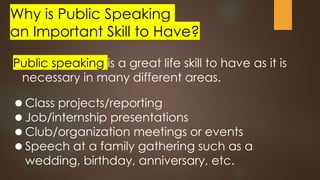
Why is Public Speaking
an Important Skill to Have?
Public speaking is a great life skill to have as it is
necessary in many different areas.
●Class projects/reporting
●Job/internship presentations
●Club/organization meetings or events
●Speech at a family gathering such as a
wedding, birthday, anniversary, etc.
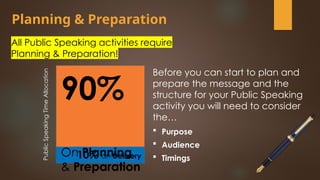
Planning & Preparation
All Public Speaking activities require
Planning & Preparation!
10% on Delivery
90%
On Planning
& Preparation
Before you can start to plan and
prepare the message and the
structure for your Public Speaking
activity you will need to consider
the…
 Purpose
 Audience
 Timings
Public
Speaking
Time
Allocation
Types of Speeches
According to Purpose
INFORMATIVE SPEECH
An informative speech is given for the purpose of
providing information about a topic to the
audience.To write an informative speech, you first
choose a topic- either one that you already know
about or one that you are willing to research and learn
about.Then, you outline and draft your informative
speech based on the topic, key points, and details and
information you want to give about your topic.
INFORMATIVE SPEECH
Make sure you catch your audience's
attention and that you summarize
key points and "take-aways" as you
go. The main types of informative
speeches include definition, descriptive,
explanatory, and demonstrative.
INFORMATIVE SPEECH
Examples:
1. College professor lecturing on a specific topic
during a class
2. Guest speaker presenting information to a group
of students about how to apply for college
3. Company president presenting information about
last quarter's sales to a group of board members
PERSUASIVE SPEECH
A persuasive speech is given for the purpose of
persuading the audience to feel a certain way, to take
a certain action, or to support a specific view or
cause.To write a persuasive speech, you choose a topic
about which people disagree or can have differing opinions.
Your persuasive argument will be made stronger if you can
demonstrate that you are passionate about the topic and
have a strong opinion one way or the other.Then, you outline
and draft your persuasive speech by taking a position on the
topic and outlining your support for your position.
PERSUASIVE SPEECH
Examples:
1.A teenager attempting to convince her parents that she
needs to be able to stay out until 11pm instead of 10pm
2.A student council president trying to convince school
administrators to allow the students to have a dance after
the final football game of the season
3.A lawyer giving a closing argument in court, arguing about
whether the defendant is innocent or guilty of the crime
PERSUASIVE SPEECH
“I said earlier that it would be far off from reality that poverty would be solved,
why? Because first, we should identify the cause of poverty and from there it
would be solved. So what do you think the cause ladies and gentlemen? Is it
overpopulation? Unemployment? Pollution? Lack of education? Poor governance?
Or is it corruption? Ladies and gentlemen all of these are the causes and who
should we blame? Who do you think we should blame? The government?Yes,
certainly it is. But who’s more to blame are the citizens.Yes, it is us. Every Filipino,
every people are to blame and why it is us? Just imagine if all people have proper
discipline, what would our country be? A nice, clean, peaceful country.
Who wouldn't want to see a Philippines like that? No pollution, less crime, no
corruption. For only if its people are disciplined, the politicians, the workers,
professionals, students, the old ones and even kids, this country could be
developed and fight for poverty.”
SOURCE: 2016 WORLD CHAMPION OF PUBLIC SPEAKING,
DARREN TAY WEN JIE
INSPIRATIONAL SPEECH
Inspirational Speech is a kind of speech
that convinces people they can succeed
in life.This speech includes uplifting stories
that the speaker thinks the people listening to
it will be moved and inspired to do greater
and better things in their life.
INSPIRATIONAL SPEECH
"When I was 17, I read a quote that went something like: 'If
you live each day as if it was your last, someday you’ll most
certainly be right.' It made an impression on me, and since
then, for the past 33 years, I have looked in the mirror
every morning and asked myself: 'If today were the last day
of my life, would I want to do what I am about to do
today?' And whenever the answer has been 'No' for too
many days in a row, I know I need to change something.“
Source: 13 Inspiring Graduation Speeches and How toWrite One | Fairygodboss
ENTERTAINMENT SPEECH
The primary purpose of the speech is to
entertain, to have the audience relax, smile
and enjoy the occasion.The speech should have a
central theme or a focus.The sole purpose is to
have the audience enjoy the presentation.There are
many ways to entertain the audience. You can tell
jokes, tell funny stories, dramatize an anecdote tell a
scary story.
•(a) I will turn my paper in on Friday. (said by
student to instructor)
•i. commisive
•ii. to promise
DIRECTIONS. WRITE THE TYPE OF SPEECH THAT
IS APPROPRIATE FOR THE FOLLOWING.
1.To teach the audience the importance of exercise.
2.To have the audience be amused by a dance
performance.
3.To have the audience understand cultural diversities
4.To have the audience support the school project
5.To have the audience participate in an anti-pollution.
DIRECTIONS. WRITE THE TYPE OF SPEECH THAT
IS APPROPRIATE FOR THE FOLLOWING.
6.To have the audience start a small business.
7.To encourage the audience attend a concert.
8.To explain the importance of family bonding.
9.To teach the audience the importance of
exercise.
10.To have the audience be amused by a dance
1. Communication is derived as a process by
which ideas, thoughts, feelings, emotion,
information passes through
a) symbols
b) behavior
c) signs
d) all of the above
2. One of the most basic functions of communication
provides data and information for effective completion
of tasks, solution of problems, and elimination of
uncertainty.
a) social interaction
b) emotional expression
c) information dissemination
d) control
3. What 7 Cs refers to ensuring what you’re saying
is communicated clearly and with no room for
misunderstanding.
•a) concise
•b) clarity
•c) concreteness
•d) None of the above
4. The __________is the one who receives
the message.
•a) channel
•b) sender
•c) receiver
•d) barrier
5. A model of communication which
considered one-way process and disregards
the concept of barriers and feedbacks.
•a) linear
•b) transactional
•c) interactive
6. This is a relatively new model of
communication for new technologies like
web
•a) linear
•b) transactional
•c) interactive
7. It happens when someone talks to you using his
own lingo which makes the conversation
ineffective.
•a. Physical barrier
•b. Language barrier
•c. Physiological barrier
•d. psychological barrier
8. This function of communication facilitates
people’s expression of their emotions.
•a. social interaction
•b) information dissemination
•c) Motivation
•d) emotional expression
9. It is the medium that transmits the signal from
the transmitter to the receiver.
•a) channel
•b) receiver
•c) messenger
•d) television
10. Communication is a process.
•a. true
•b. false
•c. none of the above
11. In communication, it is a process of putting
idea into words.
•a. encoding
•b. decoding
•c. stimulus
•d. message
12. The use of ____________ means using
over-complicated, unfamiliar and/or technical
terms.
•a. jargon
•b. technology
•c. notes
•d. distractions
13.A _________ speech is given for the
purpose of persuading the audience to feel a
certain way, to take a certain action, or to
support a specific view or cause.
a. Inspirational
b. Persuasive
c. informative
14-15. Enumerate at least 2
speech context.
16. Any barrier or hindrance
obstructing the understanding
of the message is called
n_______
17. Which of the following statements show a
commissive speech act?
A. “I want to eat some cake.”
B. “She went out!”
C. “I’ll be here tomorrow at 6pm.”
D. “I’m sorry I was so angry at you yesterday.”
18. A communication that takes place through
television, radio, newspapers, magazines, books,
billboards, internet, and other types of media is called
_________________.
A. Intercommunication
B. Dyadic
C. Mass communication
D. public
19. Which of the following communicative
strategies refer to any limitation you may have
as a speaker?
A. nomination C. termination
B. restriction D. topic-control
18. A communication that takes place through
television, radio, newspapers, magazines, books,
billboards, internet, and other types of media is called
_________________.
A. Intercommunication
B. Dyadic
C. Mass communication
D. public
19. The third level of communication it’s a style
characterized by a semi-formal vocabulary, often
unplanned and reliant on the listener’s responses and
overall participation.
A. Intimate
B. Casual
C. Consultative
D. frozen
20. The concept of Speech Acts was first developed
by __________ (How To Do Things With Words, 1962) and
elaborated by John Searle (Speech Acts, 1969).
a. Martin Joos
b. J.L. Austin
c. John Meyer
d. Robert Frost
INSTRUCTIONS:
Read the following statements carefully
and identify what communicative
strategy each sentence suggests.
Choose from the choices given.
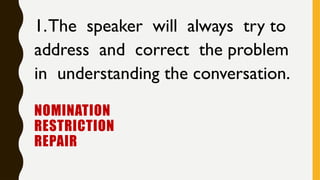
NOMINATION
RESTRICTION
REPAIR
1.The speaker will always try to
address and correct the problem
in understanding the conversation.
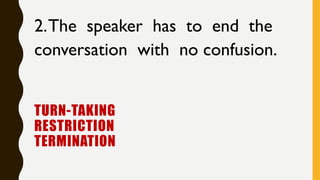
TURN-TAKING
RESTRICTION
TERMINATION
2.The speaker has to end the
conversation with no confusion.
NOMINATION
RESTRICTION
REPAIR
3. Each member in a group must
share their idea.
TURN-TAKING
TOPIC SHIFTING
TOPIC CONTROL
4.A sudden change of topic
which has no connection from the
previous conversation.
NOMINATION
RESTRICTION
REPAIR
5.The speaker leads the start
of conversation.
TRUE OR FALSE
6. Nomination is a communicative
strategy wherein the speaker freely
opens a topic to start the conversation.
TRUE OR FALSE
7.To repair a problem in
communication wherein everyone in the
group is speaking at same time, someone
must take initiative to get the
conversation back to its subject matter.
TRUE OR FALSE
8. Proper closing of
conversation is to walk away
from the circle since it is done.
TRUE OR FALSE
9. Good communication
strengthens relationship.
TRUE OR FALSE
10. Communication is complex
which somehow leads to
misunderstanding.
Identify what strategy is
used in each of the
following statements.
11. "That's it for today's
topic, I'll see you next
week."
12. "I'm sorry, could you
repeat your question
please? I didn't hear it
quite clearly. Thanks"
13. “What can you say
about our upcoming
examination?”
14. "Please hear me
out, I need to tell you
something"
15. “The correct
pronunciation of Nike is
not “nayk” but “nayki”.
PRINCIPLES OF
SPEECH WRITING
Uses principles of effective speech writing focusing
on:
• Audience profile
• Logical organization
• Duration
Most of the speakers avoid using a written
speech because they believe that reading
makes them feel uncomfortable and stiff. In
contrast, others can’t deliver a speech until
they have a well-written script in their hand.
The success of a speech depends on both
careful preparation and effective
presentation. Hence, speech writing is very
important.
HOW?
•Writing a speech should not be a nail-biting
or anxiety-provoking experience. If you
learn the basic speech format, you can easily
write an incredible speech.
•This step-by-step guide on speech format can
make this nerve-racking task simple and
straightforward.
The basic speech format is
very simple. It only consists
of three parts: an
introduction, a body, and
a conclusion. In order to
deliver an effective and
influential speech, you need
to do both; careful
preparation and a careful
presentation.
SPEECH WRITING PROCESS
Conducting an audience analysis
Determining the purpose of the
speech
Selecting a topic
Narrowing down a topic
Gathering data
AUDIENCE ANALYSIS
Demography
• age range
• male-female ratio
• educational background
• nationality
• economic status
• academic or corporate designation
AUDIENCE ANALYSIS
Situation
• time
• venue
• occasion
• size
AUDIENCE ANALYSIS
•Psychology
• values
• beliefs
• attitude
• preferences
• cultural and racial ideologies
• needs
PURPOSE
Informative Speech
Entertainment Speech
Persuasive Speech
Motivational Speech
INFORMATIVE SPEECH
Provides the audience with a clear
understanding of the concept or
idea presented by the speaker.
ENTERTAINMENT SPEECH
provides the audience with
amusement
PERSUASIVE SPEECH
Provides the audience with well-
argued ideas that can influence their
own beliefs and decisions.
MOTIVATIONAL SPEECH
is a public speech intended to inspire
an audience to make a change in their
lives. It usually has a clear purpose, a
personal story written for a specific
audience and a conclusion that includes a
call to action.
SELECTING A TOPIC
Choose a topic which you’re interested to.
 Narrowing down a topic
-Making your main idea more specific
 Data gathering
-Collecting ideas, information, sources, and
references relevant and related to the topic.
TOPIC:
"THE ROLE OF YOUTH
IN NATION-BUILDING
THROUGH CIVIC
ENGAGEMENT"
I. Narrowing Down:
•Focus on how students can contribute to
nation-building.
•Highlight specific civic engagements such
as volunteerism, voting, or activism.
•Discuss the impact of youth voices in
social, environmental, or political
movements.
II. Making the Main Idea More
Specific:
•The speech could focus on one specific
area, like "EncouragingYouth
Participation in Environmental
Advocacy" or "How Social Media
Amplifies theYouth's Role in
Political Movements."
III. Data Gathering:
•Research statistics on youth involvement in
civic activities.
•Look for real-life examples of young leaders
or movements.
•Gather quotes or ideas from youth activists
or government policies promoting youth
engagement.
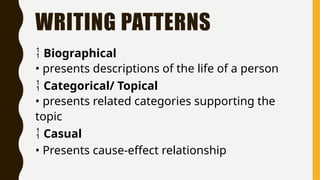
WRITING PATTERNS
 Biographical
• presents descriptions of the life of a person
 Categorical/ Topical
• presents related categories supporting the
topic
 Casual
• Presents cause-effect relationship
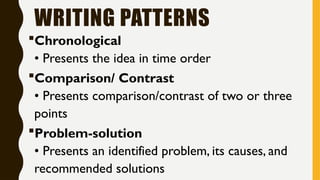
WRITING PATTERNS
Chronological
• Presents the idea in time order
Comparison/ Contrast
• Presents comparison/contrast of two or three
points
Problem-solution
• Presents an identified problem, its causes, and
recommended solutions
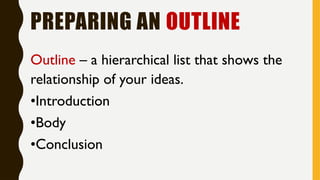
PREPARING AN OUTLINE
Outline – a hierarchical list that shows the
relationship of your ideas.
•Introduction
•Body
•Conclusion
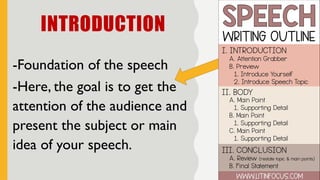
INTRODUCTION
-Foundation of the speech
-Here, the goal is to get the
attention of the audience and
present the subject or main
idea of your speech.
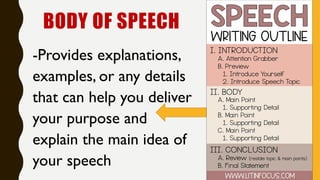
BODY OF SPEECH
-Provides explanations,
examples, or any details
that can help you deliver
your purpose and
explain the main idea of
your speech
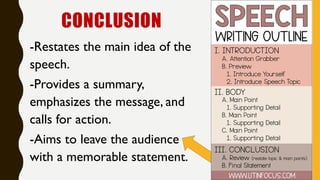
CONCLUSION
-Restates the main idea of the
speech.
-Provides a summary,
emphasizes the message, and
calls for action.
-Aims to leave the audience
with a memorable statement.
EDITING/REVISING
Involves correcting errors in
mechanics, such as grammar,
punctuation, capitalization, unity,
coherence, and others
•My favorite color is black. I
love to swim every Sunday.
You know what, there’s a
typhoon coming. Oh my! I
had a new phone.
SIX POWER PRINCIPLES FOR
SPEECH EDITING
According to Andrew Dlugan (2013)
o Edit for Focus
o Edit for Clarity
o Edit for Conclusion
o Edit for Continuity
o Edit forVariety
o Edit for Impact and Beauty
•The Importance of Education in Nation-Building
•Youth Empowerment: Shaping the Future of
the Philippines
•The Role of Technology in Modern Education
•Mental Health Awareness Among Filipino Youth
•The Effects of Social Media on Relationships
and Communication
•Sustainable Development Goals: What Can
We Do?
•The Value of Volunteering and Community Service
•Gender Equality: Progress and Challenges in the
Philippines
•The Importance of Financial Literacy for Young
Adults
•Navigating Career Choices: Dreams vs. Reality
•The Impact of Sports on Youth Development
•Environmental Conservation: Our Responsibility as
Citizens
•Leadership Skills: Developing Future Leaders of the
Philippines
They say smoking is dangerous to
your health. I am Juan dela Cruz from
11-Sharp and today I will talk about the
effect of smoking.
“Hey!You are ugly!” You can not make it!”
These are the words that I always hear
whenever I enter the classroom.This Juan dela
Cruz from 11-Sharp and today I will talk about
bullying.
1.What is the first step in writing a
speech?
A. Editing the content
B.Writing the conclusion
C.Analyzing the audience
D. Delivering the speech
2.Which of the following is a type of speech
that aims to apprise the audience?
•A. Informative
•B. Persuasive
•C. Entertainment
•D. Special occasion
3.What is the main goal of a persuasive
speech?
•A.To entertain the audience
•B.To convince the audience
•C.To provide information
•D.To tell a story
4.Which part of the speech introduces the main
idea and captures the audience's attention?
•A. Body
•B. Conclusion
•C. Introduction
•D.Thesis statement
5.What is the purpose of an informative
speech?
•A.To convince the audience of an idea
•B.To entertain the audience
•C.To share knowledge and facts
•D.To evoke emotions
6.Which type of speech is commonly used
during wedding toasts or eulogies?
•A. Persuasive
•B. Informative
•C. Special occasion
•D. Demonstrative
7.What is the final part of a speech that
reinforces the message and leaves a lasting
impact?
•A. Introduction
•B. Conclusion
•C. Body
•D.Thesis statement
8. In which type of speech does the speaker try to
influence the opinions, beliefs, or actions of the
audience?
•A. Informative
•B. Persuasive
•C. Demonstrative
•D. Entertainment
9.What is the purpose of the body of a
speech?
•A.To introduce the topic
•B.To provide supporting points and evidence
•C.To summarize the main points
•D.To make the audience laugh
10.Which type of speech is designed to amuse
or provide enjoyment to the audience?
•A. Persuasive
•B. Informative
•C. Entertainment
•D. Demonstrative
11.What technique can be used to capture the
audience's attention at the start of a speech?
•A. Presenting data
•B.Telling a personal story
•C. Repeating the topic
•D. Listing the main points
12.Why is it important to include transitions
in your speech?
•A.To make it longer
•B.To create a smooth flow between ideas
•C.To introduce new arguments
•D.To conclude sections
13.Why is using an outline important in
speech writing?
•A. It helps with memorization
•B. It ensures the speech is delivered with
enthusiasm
•C. It provides a clear structure and organizes ideas
logically
•D. It makes the speech shorter
14.Which of the following is the most
common method of organizing an outline in
speech writing?
•A. Chronological order
•B.Alphabetical order
•C. Random order
•D.Word count order
15. In a speech outline, what part
typically contains the supporting details
for the main points?
•A. Conclusion
•B. Body
•C. Introduction
•D.Thesis statement
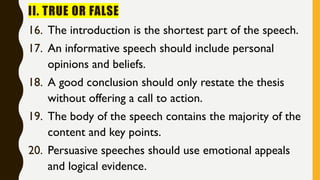
II. TRUE OR FALSE
16. The introduction is the shortest part of the speech.
17. An informative speech should include personal
opinions and beliefs.
18. A good conclusion should only restate the thesis
without offering a call to action.
19. The body of the speech contains the majority of the
content and key points.
20. Persuasive speeches should use emotional appeals
and logical evidence.
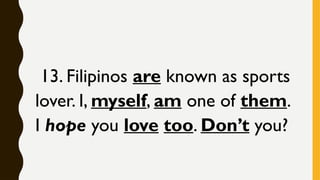
13. Filipinos are known as sports
lover. I, myself, am one of them.
I hope you love too. Don’t you?
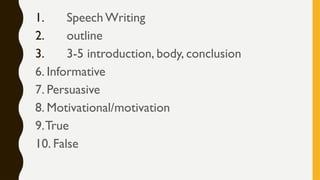
1. Speech Writing
2. outline
3. 3-5 introduction, body, conclusion
6. Informative
7. Persuasive
8. Motivational/motivation
9.True
10. False
1.Volume refers to the
loudness and softness
in speech delivery.
2. Articulation refers to
the words that should be
forceful and be given
ephasis.
Allocation
Alliteration
Articulation
Association
3. Body gestures refers to
the movements that
should be done in
delivering speech.
4. Eye contact is
important to establish
relationship with the
audience.
5.What do call the script
that you will read in
speech delivery?
Manuscript
6. Practice is
important before
delivering your speech.
7. Focusing on your
outline is important.
True or False?
8. Reading from a
manuscript is not
engaging. True or False?
9.Your speech must be
substantial and
informative regardless its
length. True or false?
10. Correcting grammars
will help you deliver a
good speech. True or
false?
•1. A speaker who appears in extremely conservative
dress and uses an emotionally charged style of
delivery to give a speech about abortion may be
perceived by the audience as lacking:
• a. Credibility
• b. Competence
• c. Objectivity
• d. Status
•2. All of the following are suggestions for delivering a
speech using a manuscript except:
• a. Concentrate on ideas, not individual words.
• b. As you finish each page, put it under the podium.
• c. Practice in advance so you know the speech well.
• d. Be sure that last-minute additions do not clutter
the manuscript.
•3. Changes in pitch while speaking is called:
• a. Inflection
• b. Rhythm
• c. Articulation
• d. Enunciation
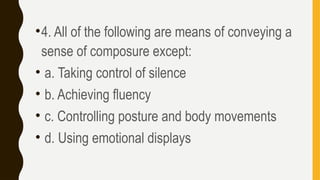
•4. All of the following are means of conveying a
sense of composure except:
• a. Taking control of silence
• b. Achieving fluency
• c. Controlling posture and body movements
• d. Using emotional displays
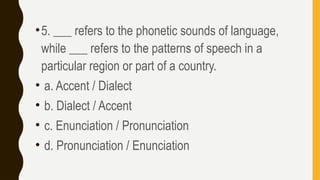
•5. ___ refers to the phonetic sounds of language,
while ___ refers to the patterns of speech in a
particular region or part of a country.
• a. Accent / Dialect
• b. Dialect / Accent
• c. Enunciation / Pronunciation
• d. Pronunciation / Enunciation
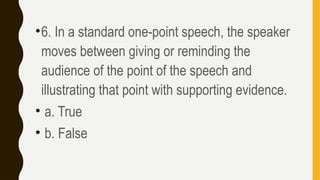
•6. In a standard one-point speech, the speaker
moves between giving or reminding the
audience of the point of the speech and
illustrating that point with supporting evidence.
• a. True
• b. False
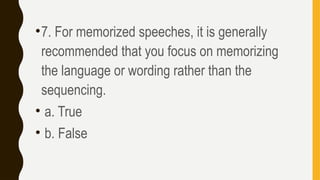
•7. For memorized speeches, it is generally
recommended that you focus on memorizing
the language or wording rather than the
sequencing.
• a. True
• b. False
•8. Vocal fillers, such as uh and um,
are indicators of a lack of fluency.
• a. True
• b. False
•9. Increased status, which could be
conveyed through more formal dress, may
come at the expense of decreased
immediacy.
• a. True
• b. False
•10. Silence and pauses in a
speech are indicators of a lack of
credibility.
• a. True
• b. False
The __________ speech format is often used for formal
occasions, such as ceremonies, where every word is pre-
written. Effective speakers often vary their __________
to emphasize key points and maintain audience
engagement. An __________ speech requires quick
thinking and the ability to organize thoughts on the spot.
Proper use of __________ can enhance the message
being delivered and provide visual reinforcement.The
__________ rate of speech can influence how well the
audience understands the content.

Communication Process Powerpoint for Oral Communication

  • 1.
    L E SS O N 1 NATURE AND PROCESS OF COMMUNICATION
  • 2.
    SPECIFIC OBJECTIVES At theend of this lesson, the learner should be able to: ● define what communication is; ● explain the nature of communication; and ● describe the process of communication.
  • 3.
    ESSENTIAL QUESTION “Why iscommunication an essential human need?”
  • 4.
    WARM UP! 1. Kindlyget one tangible thing you have in your house that you consider important to you. 2. For a couple of minutes, think of the reason/s why it is important. Be ready to share it in class. 3. Be sure to introduce yourself in a creative
  • 5.
  • 6.
  • 7.
    NATURE OF COMMUNICATION Communication isa process. Communication occurs between two or more people. Communication could be expressed as verbal or non-verbal.
  • 8.
    COMMUNICATION •Transmission of ideas,thoughts, and emotions… •Uses verbal and non-verbal cues
  • 9.
    STIMULUS •the start ofcommunication process •an idea or concept the sender would like to convey
  • 10.
  • 11.
  • 12.
  • 13.
    THINK ABOUT IT? Communicationis not always successful.
  • 14.
    COMMUNICATION BREAKDOWN A communication breakdownis defined as a failure to exchange information, resulting in a lack of communication.
  • 15.
    NOISE •Any barrier orhindrance obstructing the understanding of the message
  • 16.
    Joan: Hi,Alyana! Ihaven’t seen you in a while. I have something to ask. Alyana: Oh hello!What is it? Joan: Do we really have our quiz today? (classmates started to talk) Alyana: I didn’t hear you well. Can you say it again?
  • 17.
    •Communication is aprocess; it starts with a stimulus, which is an idea or concept that the sender has and would like to convey. •The sender encodes the message by putting it into words and then expresses the ideas in proper sequence. •This message is then accepted and interpreted or decoded by the receiver.
  • 18.
    •The receiver mayor may not respond to the sender. If the receiver chooses to respond, then he or she will provide feedback. •When providing feedback, the receiver then becomes the sender, and the first sender then becomes the receiver of the message.
  • 19.
    ESSENTIAL QUESTION “Why iscommunication an essential human need?”
  • 20.
    Communication is anessential human need because it allows us to convey our ideas and feelings. It is essential for humans to communicate because doing so allows us to exchange ideas with others and understand others’ viewpoints.
  • 22.
    LET’S WRAP ITUP! •Define communication in your own words. (minimum of 2 sentences) •Write at least 5 important elements of communication. •How do you achieve effective or good
  • 23.
    Thank you forlistening!
  • 24.
    PERFORMANCE TASK #1 Presenta short skit (5 mins) which shows the nature and process of communication.
  • 25.
    L E SS O N 2 : MODELS OF COMMUNICATION S E P T E M B E R 1 2 , 2 0 2 0
  • 26.
    SPECIFIC OBJECTIVES At theend of this lesson, the learner should be able to: •differentiate between the various models of communication; and •explain each model of communication.
  • 28.
    L E SS O N 3 FUNCTIONS OF COMMUNICATION
  • 29.
    LESSON 2: MODELSOF COMMUNICATION A model is a representation of an object or process through diagrams and graphics.Therefore, a model of communication is a representation of how communication transpires.
  • 30.
    MODELS OF COMMUNICATION Thethree most well-known models for communication are Linear, Interactive, and Transactional. Each model offers a different perspective on the communication process.
  • 31.
    COMMUNICATION MODELS Linear CommunicationModel • Shannon & Weaver Model • Aristotle’s Model •Interactive Model • Schramm’s Model • Osgood’s Model Transactional Model •Barnlund’s Model
  • 32.
    A. LINEAR MODELOF COMMUNICATION • communication is considered one-way process •a one-way communication model which disregards the concept of barriers and feedbacks. •no feedback •can’t assess if the communication is effective • applied in mass communication like television, radio, etc.
  • 33.
    B. INTERACTIVE MODELOF COMMUNICATION • deals with exchange of ideas and messages taking place both ways from sender to receiver and vice-versa • take place between humans or machines in both verbal or non-verbal way • This is a relatively new model of communication for new technologies like web. (zoom, messenger, google meet, etc.yy) • known as convergence model • Slower feedback
  • 34.
    C. TRANSACTIONAL MODELOF COMMUNICATION •Transactional model of communication is the exchange of messages between sender and receiver where each take turns to send or receive messages. (simultaneous activity) •both sender and receiver are known as communicators •The model is mostly used for interpersonal communication and is also called circular model of communication.
  • 36.
    COMPLETE EACH OFTHE FOLLOWING SENTENCES BY SUPPLYING THE MISSING WORD. 1. A ______________ of communication is a conceptual representation used to explain the communication process. 2. The three general types of communication models are __________________ 5.The element of communication that is not taken into account in the linear communication model is ______________. 6.A type communication model which uses modern technologies is _______________ • 7. In transactional model, both sender and receiver are known as ___________________
  • 37.
    LINEAR, TRANSACTIONAL ORINTERACTIVE? 8. Listening to your favorite podcast in Spotify. 9. Reading your favorite anime story from the magazine. 10. Having chitchat with your best friend.
  • 38.
    CHOOSE THE LETTEROF THE CORRECT ANSWER. 1. Which functions of communication was described in this situation: Class Rule : Always conduct yourself politely and respectfully. A.control B.social interaction C.motivation D.emotional expression E. information dissemination
  • 39.
    CHOOSE THE LETTEROF THE CORRECT ANSWER. 2. Which functions of communication was described in this situation: “I’m so glad that you came into my life.” A.control B.social interaction C.motivation D.emotional expression E. information dissemination
  • 40.
    CHOOSE THE LETTEROF THE CORRECT ANSWER. 3. It refers to the function of communication that is used when the speaker wants to make other aware of certain data, concepts, and processes. A. control B. social interaction C. motivation D.emotional expression E. information dissemination
  • 41.
    CHOOSE THE LETTEROF THE CORRECT ANSWER. 4. Which functions of communication was described in this situation: “Would you like some coffee, tea, or me?” A. control B. social interaction C. motivation D.emotional expression E. information dissemination
  • 42.
    CHOOSE THE LETTEROF THE CORRECT ANSWER. 5. Which functions of communication was described in this situation: “For now, overcome your weaknesses and be the best version of yourself.” A. control B. social interaction C. motivation D.emotional expression E. information dissemination
  • 43.
    6. Which isan example of regulation and control? A.“It’s nice to meet you.” B.“Clean your room, then you can play basketball.” C.“Where can I find the library?” D.“Seychelles is one of the world’s smallest countries.”
  • 44.
    7. Which ofthe situations shows social interaction? A. Sir X tells his students to finish answering the quiz. B. Earl invites Margie for a coffee. C. Joan tells her friend not to lose hope. D.The teacher introduced Conditional Probability to her class.
  • 45.
    8. Which onehas different function? A.“We pray for those who mourn.” B.“Thank you for coming into my life.” C.“Keep quiet.” D.“I’m so sorry for your loss.”
  • 46.
    9.The city Mayoris sharing the data to the public, “There are 50 families in our vicinity that are affected by the typhoon Carina.” What function of communication is shown in the situation? A. control B. motivation C. social interaction D. information
  • 47.
    10.Your friend isasking you to hang out on he 21st of August because it is a holiday. A. control B. motivation C. social interaction D. information
  • 48.
    DIRECTIONS: MATCH THEWORD IN COLUMN B WITH ITS DEFINITION IN COLUMN A.
  • 49.
    CHOOSE THE LETTEROF THE CORRECT ANSWER. 1.What is verbal communication? •A) Using body language to express ideas •B) Expressing ideas through spoken or written words •C) Communicating through facial expressions •D) Using gestures to convey messages
  • 50.
    CHOOSE THE LETTEROF THE CORRECT ANSWER. 2.What is verbal communication? •A) Using body language to express ideas •B) Expressing ideas through spoken or written words •C) Communicating through facial expressions •D) Using gestures to convey messages
  • 51.
    CHOOSE THE LETTEROF THE CORRECT ANSWER. 3.Which type of non-verbal communication involves using gestures to convey meaning? •A) Paralanguage •B) Haptics •C) Kinesics •D) Proxemics
  • 52.
    CHOOSE THE LETTEROF THE CORRECT ANSWER. 4.Which of the following is an example of proxemics in communication? •A)The distance you maintain from someone during a conversation •B)The way you use your hands while speaking •C) The tone of your voice •D)The expressions on your face
  • 53.
    CHOOSE THE LETTEROF THE CORRECT ANSWER. 5. Which of the following non-verbal cues is often used to show agreement or interest? •A) Crossing arms •B) Nodding head •C) Avoiding eye contact •D) Shifting gaze frequently
  • 54.
    CHOOSE THE LETTEROF THE CORRECT ANSWER. 6.What does haptics refer to in non-verbal communication? •A) The use of touch in communication •B) The use of eye contact •C) The use of facial expressions •D) The use of space and distance
  • 55.
    CHOOSE THE LETTEROF THE CORRECT ANSWER. •7. What is a common non-verbal signal of discomfort or anxiety? •A) Leaning in •B) Making direct eye contact •C) Fidgeting or avoiding eye contact •D) Smiling frequently
  • 56.
    CHOOSE THE LETTEROF THE CORRECT ANSWER. 8.Which verbal communication technique involves repeating back what someone has said to ensure understanding? •A) Summarizing •B) Reflective listening •C) Interrupting •D) Paraphrasing
  • 57.
    CHOOSE THE LETTEROF THE CORRECT ANSWER. 9. What is the term for non-verbal communication cues that can be ambiguous and culturally specific? •A) Contextual cues •B) Universal signals •C) Cultural codes •D) Non-verbal norms
  • 58.
    CHOOSE THE LETTEROF THE CORRECT ANSWER. 10. In what way can posture affect verbal communication? •A) It can reinforce the message being conveyed •B) It has no effect on verbal communication •C) It contradicts the spoken message •D) It is irrelevant to the message
  • 59.
    WHAT FEELINGS AREEVOKED IN THE LINES BELOW? TRY SAYING THEM OUT LOUD AND FIGURE OUT HOW IT FEELS TO SAY THEM. CHOOSE YOUR ANSWERS FROM THE WORDS LISTED INSIDE THE BOX AND WRITE IT ON THE BLANK JUST BESIDE THE DIALOGUE BOX. disinterested annoyed Proud worried angry excited 11. Oh my, these puppies are so lovable! Can I keep them? 12. How can you do this to me?You said you will always be my friend!
  • 60.
    WHAT FEELINGS AREEVOKED IN THE LINES BELOW? TRY SAYING THEM OUT LOUD AND FIGURE OUT HOW IT FEELS TO SAY THEM. CHOOSE YOUR ANSWERS FROM THE WORDS LISTED INSIDE THE BOX AND WRITE IT ON THE BLANK JUST BESIDE THE DIALOGUE BOX. 13. Okay. Sure. Fine. Whatever. 14. Can you please stop calling me? I am busy working on my paper. disinterested annoyed Proud worried angry excited
  • 61.
    WHAT FEELINGS AREEVOKED IN THE LINES BELOW? TRY SAYING THEM OUT LOUD AND FIGURE OUT HOW IT FEELS TO SAY THEM. CHOOSE YOUR ANSWERS FROM THE WORDS LISTED INSIDE THE BOX AND WRITE IT ON THE BLANK JUST BESIDE THE DIALOGUE BOX. disinterested annoyed Proud worried angry excited 15. How come she’s not here yet? It’s late. Could something have happened to her?
  • 63.
    COMMON TYPES OFCOMMUNICATION BARRIERS 1.Physical Barriers: These are obstacles in the environment that prevent communication, such as noise, distance, or faulty equipment. oExample: A bad phone connection causes you to miss important details during a call. 2.Language Barriers: When the sender and receiver do not share a common language or use jargon that is not understood by both. oExample: A medical professional uses technical terms that a patient cannot understand.
  • 64.
    COMMON TYPES OFCOMMUNICATION BARRIERS 3. Cultural Barriers: Differences in cultural backgrounds, beliefs, and customs that lead to misunderstandings. –Example:A gesture that is friendly in one culture might be offensive in another. 4. Emotional Barriers: Personal feelings like anger, anxiety, or distrust that hinder open communication. –Example:A person is too angry to listen to the other person’s perspective.
  • 65.
    COMMON TYPES OFCOMMUNICATION BARRIERS 5. Perceptual Barriers: Differences in how individuals perceive and interpret information. –Example:A manager’s constructive feedback is perceived as criticism by an employee. 6. Psychological Barriers: Mental state or psychological conditions that affect communication. –Example: Someone with low self-esteem might misinterpret neutral comments as negative.
  • 66.
    COMMON TYPES OFCOMMUNICATION BARRIERS 7. Organizational Barriers: Structural issues within an organization that obstruct communication, like rigid hierarchies or poor management. –Example: Employees at the lower levels of an organization are not informed about key decisions made by top management. 8. Semantic Barriers: Misinterpretation of words or phrases that have different meanings to different people. –Example:The word "table" could refer to furniture or an act
  • 67.
    Situation: Maria isa project manager who works with a team spread across different countries. During a recent virtual meeting, she noticed that one of her team members,Ahmed, seemed disengaged and provided minimal input.After the meeting, Maria realized that Ahmed may have misunderstood some of the key points discussed because English is not his first language.Additionally, the time zone difference made Ahmed attend the meeting late at night, which might have contributed to his lack of participation.
  • 68.
    CHOOSE THE LETTEROF THE CORRECT ANSWER. 1.What type of barrier occurs when noise interferes with the communication process? •a) Emotional Barrier •b) Physical Barrier •c) Psychological Barrier •d) Cultural Barrier
  • 69.
    CHOOSE THE LETTEROF THE CORRECT ANSWER. 2.Which barrier is caused by the use of jargon or technical language that the receiver cannot understand? • a) Language Barrier • b) Organizational Barrier • c) Perceptual Barrier • d) Psychological Barrier
  • 70.
    CHOOSE THE LETTEROF THE CORRECT ANSWER. 3.When a person’s feelings, such as anger or anxiety, prevent effective communication, this is known as a: •a) Physical Barrier •b) Emotional Barrier •c) Cultural Barrier •d) Semantic Barrier
  • 71.
    CHOOSE THE LETTEROF THE CORRECT ANSWER. 4.A manager from the U.S. uses a thumbs-up gesture, which is misinterpreted as offensive in another culture.What type of barrier is this? •a) Language Barrier •b) Perceptual Barrier •c) Cultural Barrier •d) Organizational Barrier
  • 72.
    CHOOSE THE LETTEROF THE CORRECT ANSWER. 5.Which barrier is characterized by structural issues within an organization that hinder the flow of information? •a) Perceptual Barrier •b) Emotional Barrier •c) Organizational Barrier •d) Physical Barrier
  • 73.
    CHOOSE THE LETTEROF THE CORRECT ANSWER. 6.When a person interprets neutral feedback as negative due to their own insecurities, what kind of barrier is present? •a) Psychological Barrier •b) Semantic Barrier •c) Cultural Barrier •d) Physical Barrier
  • 74.
    CHOOSE THE LETTEROF THE CORRECT ANSWER. 7. Differences in how people interpret the same information can be attributed to which barrier? •a) Emotional Barrier •b) Perceptual Barrier •c) Physical Barrier •d) Organizational Barrier
  • 75.
    CHOOSE THE LETTEROF THE CORRECT ANSWER. 8.What type of barrier might occur when employees are not informed about decisions made by top management? •a) Cultural Barrier •b) Physical Barrier •c) Organizational Barrier •d) Psychological Barrier
  • 76.
    CHOOSE THE LETTEROF THE CORRECT ANSWER. 9.When words or phrases are misinterpreted due to having multiple meanings, this is known as a: •a) Physical Barrier •b) Semantic Barrier •c) Emotional Barrier •d) Psychological Barrier
  • 77.
    CHOOSE THE LETTEROF THE CORRECT ANSWER. 10.A doctor uses medical terms that the patient does not understand.This is an example of a: •a) Perceptual Barrier •b) Language Barrier •c) Organizational Barrier •d) Cultural Barrier
  • 78.
  • 79.
  • 80.
    A. DIRECTIONS: WRITETRUE IF THE STATEMENT IS CORRECT AND FALSE IF IT IS NOT. 1. Communication breakdown can lead to a total cessation of communication. 2. Nonverbal dimension encompasses the use of a language. 3. Misunderstanding occurs when oral and written are not in agreement. 4. A gesture may have multiple meanings. __________ 5. One’s experience is a factor in comprehending a message.
  • 81.
    IDENTIFY THE FOLLOWING.ANSWERS ONLY. 1.The use of ____________ means using over-complicated, unfamiliar and/or technical terms. 2. Some people may find it difficult to express their ___________ and some topics may be completely 'off-limits’ or 3. ___________. 4. Lack of __________, interest, distractions, or irrelevance to the receiver is also a barrier. 5. ______________ in perception and viewpoint may lead to breakdown. 6-7 Give 2 examples of physical disabilities. 8.A _____________ communicator must be aware of these barriers and try to reduce their impact by continually checking understanding and by offering appropriate feedback.
  • 82.
    Intercultural communication fosters understandingand respect among people from different cultural backgrounds, promoting harmony in diverse environments. It helps individuals navigate cultural differences, reduce stereotypes, and build stronger relationships. In everyday life, it enhances global competency and encourages empathy, making interactions more inclusive and meaningful.
  • 83.
    The sociocultural dimensionof communication refers to how various social and cultural factors influence communication processes and outcomes. Sensitivity to these dimensions is essential for effective communication, as different cultures, genders, ages, social statuses, and religions shape how individuals perceive and engage in conversation.
  • 84.
    1. Culture Culture profoundlyimpacts communication styles, language use, non-verbal cues, and the interpretation of messages. Cultural differences can create barriers or opportunities for understanding, making it essential to be aware of norms, values, and beliefs in intercultural interactions.
  • 85.
    2. Gender Gender influencescommunication in terms of roles, expectations, and behaviors. Societal norms around gender may affect how individuals express themselves, the topics they discuss, and the power dynamics present in conversations.
  • 86.
    3.Age Age can creategenerational communication gaps, where language, technology use, or cultural references differ. Sensitivity to age-related differences ensures respect and clarity in interactions with younger or older individuals.
  • 87.
    4. Social Status Socialstatus affects communication patterns, particularly in hierarchical or formal settings. People of different social standings may employ different levels of formality, tone, and even non-verbal communication. Understanding social status dynamics fosters respectful and effective communication.
  • 88.
    5. Religion Religious beliefscan shape perspectives on life, ethics, and communication. Being mindful of religious customs, practices, and values is crucial to avoid misunderstandings and to engage respectfully with individuals of different faiths.
  • 89.
    SELECT THE CORRESPONDINGLETTER FOR THE CORRECT OPTION. 1.What is intercultural communication? A. Communication between people of the same culture B. Communication between people from different cultural backgrounds C. Communication that only involves nonverbal cues D. Communication that focuses on formal language
  • 90.
    SELECT THE CORRESPONDINGLETTER FOR THE CORRECT OPTION. 2.Which of the following factors can most impact intercultural communication? A.Age B. Gender C. Social status D.All of the above
  • 91.
    SELECT THE CORRESPONDINGLETTER FOR THE CORRECT OPTION. 3. How does culture affect communication? A. It determines the language people speak B. It influences the values, behaviors, and interpretations of messages C. It makes communication more complex D. It has no effect on communication
  • 92.
    SELECT THE CORRESPONDINGLETTER FOR THE CORRECT OPTION. 4.What is an example of a communication barrier related to religion? A. Differences in work ethic B. Language differences C. Conflict over religious holidays and practices D.Age difference between communicators
  • 93.
    SELECT THE CORRESPONDINGLETTER FOR THE CORRECT OPTION. 5.Which statement best describes the impact of age on intercultural communication? A. Age doesn’t affect communication at all B. Older individuals always communicate better than younger people C. Different generations may have varying communication styles and values D.Younger people always misunderstand older individuals
  • 94.
    SELECT THE CORRESPONDINGLETTER FOR THE CORRECT OPTION. 6. In intercultural communication, gender roles can differ across cultures.What is the effect of these differences? A.They may lead to misunderstandings and stereotypes B.They simplify communication C.They have no significant effect on communication D.They ensure everyone communicates the same way
  • 95.
    SELECT THE CORRESPONDINGLETTER FOR THE CORRECT OPTION. 7.Which of the following best describes ethnocentrism in communication? A.Viewing one’s own culture as superior to others B.Accepting all cultural differences C.Trying to adopt another culture’s customs D. Ignoring cultural differences
  • 96.
    SELECT THE CORRESPONDINGLETTER FOR THE CORRECT OPTION. 8.What is the role of social status in intercultural communication? A. It creates equal power dynamics between communicators B. It can create power imbalances and affect the flow of communication C. It ensures respect in all interactions D. It has no impact on communication
  • 97.
    SELECT THE CORRESPONDINGLETTER FOR THE CORRECT OPTION. 9. How can sexual orientation influence intercultural communication? A. It never affects communication B. It can lead to discrimination or exclusion in certain cultures C. It improves communication in all settings D. It only affects romantic relationships
  • 98.
    SELECT THE CORRESPONDINGLETTER FOR THE CORRECT OPTION. 10.What does “high-context” communication refer to? A. Communication that relies heavily on explicit verbal messages B. Communication that depends more on non-verbal cues, context, and shared understanding C. Communication that uses complex words and phrases D. Communication in formal settings
  • 99.
    SELECT THE CORRESPONDINGLETTER FOR THE CORRECT OPTION. 11.Which of the following best describes cultural relativism? A. Believing your culture is superior B. Understanding that cultures have their own values and behaviors C. Rejecting all cultural traditions D.Adopting another culture completely
  • 100.
    SELECT THE CORRESPONDINGLETTER FOR THE CORRECT OPTION. 12.When discussing ethnicity, how can stereotypes create barriers in communication? A.They promote more accurate communication B.They create generalizations that may lead to misinterpretation C.They help people better understand each other D.They eliminate communication difficulties
  • 101.
    SELECT THE CORRESPONDINGLETTER FOR THE CORRECT OPTION. 13. How does language diversity affect intercultural communication? A. It simplifies communication B. It often requires interpreters and translators to avoid misunderstandings C. It eliminates communication barriers completely D. It has no effect on communication
  • 102.
    SELECT THE CORRESPONDINGLETTER FOR THE CORRECT OPTION. 14.What is an example of a gender communication difference? A. Men always speak more than women B.Women prefer emotional communication while men prefer factual communication C.Women and men have the same communication styles D. Gender differences are not seen in any culture
  • 103.
    SELECT THE CORRESPONDINGLETTER FOR THE CORRECT OPTION. 15.Which of the following is a potential cultural barrier in communication? A. Shared cultural values B. Different nonverbal cues C. Mutual understanding D. Common language
  • 104.
    SELECT THE CORRESPONDINGLETTER FOR THE CORRECT OPTION. 16.What is one way to improve intercultural communication in a diverse environment? A.Avoid discussing cultural differences B.Assume everyone understands your point of view C. Develop cultural awareness and sensitivity D. Focus only on verbal communication
  • 105.
    SELECT THE CORRESPONDINGLETTER FOR THE CORRECT OPTION. 17. In some cultures, maintaining direct eye contact is considered disrespectful.This is an example of how ____ affects communication. A. Religion B. Gender C. Nonverbal communication and culture D. Social status
  • 106.
    SELECT THE CORRESPONDINGLETTER FOR THE CORRECT OPTION. 18.Which of the following is a true statement about communication across social statuses? A. People from higher social statuses never face communication barriers B. Social status can create power dynamics that affect how freely someone communicates C. Social status doesn’t affect communication in any setting D. Only people of low social status have communication challenges
  • 107.
    SELECT THE CORRESPONDINGLETTER FOR THE CORRECT OPTION. 19.Which factor can complicate intercultural communication in professional settings? A. Ethnocentrism and cultural stereotypes B. Speaking the same language C. Sharing similar work ethics D.All of the above
  • 108.
    SELECT THE CORRESPONDINGLETTER FOR THE CORRECT OPTION. 20.What is the most effective way to overcome barriers in intercultural communication? A.Assume that everyone will adapt to your culture B.Avoid interaction with different cultures C. Develop empathy, open-mindedness, and effective listening D. Use only written communication
  • 110.
    SELECT THE CORRESPONDINGLETTER FOR THE CORRECT OPTION. 1.Which speech style is often used between close friends and family members? a) Formal b) Casual c) Consultative d) Intimate
  • 111.
    SELECT THE CORRESPONDINGLETTER FOR THE CORRECT OPTION. 2. In which speech style would you typically hear an exchange between a doctor and a patient? a) Intimate b) Frozen c) Consultative d) Casual
  • 112.
    SELECT THE CORRESPONDINGLETTER FOR THE CORRECT OPTION. 3.Which speech style is used in scripted or ceremonial situations, like in a wedding or a legal proceeding? a) Frozen b) Casual c) Consultative d) Intimate
  • 113.
    SELECT THE CORRESPONDINGLETTER FOR THE CORRECT OPTION. 4.What speech style is used when delivering a formal speech or presentation? a) Consultative b) Formal c) Casual d) Intimate
  • 114.
    SELECT THE CORRESPONDINGLETTER FOR THE CORRECT OPTION. 5.When friends are casually talking about their weekend plans, what speech style is being used? a) Frozen b) Formal c) Casual d) Consultative
  • 115.
    SELECT THE CORRESPONDINGLETTER FOR THE CORRECT OPTION. 6.Which of the following speech styles involves a two-way communication where information is shared but not rehearsed? a) Frozen b) Consultative c) Intimate d) Casual
  • 116.
    SELECT THE CORRESPONDINGLETTER FOR THE CORRECT OPTION. 7.The use of personal language, inside jokes, and incomplete sentences is most common in which speech style? a) Consultative b) Intimate c) Casual d) Formal
  • 117.
    SELECT THE CORRESPONDINGLETTER FOR THE CORRECT OPTION. 8.A job interview typically uses which speech style? a) Frozen b) Casual c) Consultative d) Formal
  • 118.
    SELECT THE CORRESPONDINGLETTER FOR THE CORRECT OPTION. 9.Which speech style is often seen in academic lectures and professional meetings? a) Frozen b) Consultative c) Casual d) Intimate
  • 119.
    SELECT THE CORRESPONDINGLETTER FOR THE CORRECT OPTION. 10.What are speech styles in oral communication? a) The level of formality in spoken language based on the situation and relationship between speakers b) The use of different accents in a conversation c) The methods used to project the voice during public speaking d) The physical gestures used while communicating
  • 120.
    SELECT THE CORRESPONDINGLETTER FOR THE CORRECT OPTION. 11.Which speech style is rarely altered and follows a set pattern or structure, such as in a religious ceremony? a) Formal b) Casual c) Frozen d) Intimate
  • 121.
    SELECT THE CORRESPONDINGLETTER FOR THE CORRECT OPTION. 12.A speech delivered by a president during an inauguration is an example of what speech style? a) Formal b) Frozen c) Consultative d) Casual
  • 122.
    SELECT THE CORRESPONDINGLETTER FOR THE CORRECT OPTION. 13.Which speech style typically uses structured, polished, and carefully chosen words, such as in a business presentation? a) Consultative b) Casual c) Formal d) Intimate
  • 123.
    SELECT THE CORRESPONDINGLETTER FOR THE CORRECT OPTION. 14. In which speech style are the speakers not too familiar with each other, yet they still interact politely, such as in a classroom discussion? a) Casual b) Frozen c) Consultative d) Intimate
  • 124.
    SELECT THE CORRESPONDINGLETTER FOR THE CORRECT OPTION. 15.Talking to someone you just met at a social event would likely fall under which speech style? a) Formal b) Frozen c) Casual d) Intimate
  • 129.
    An Introduction To PublicSpeaking Quarter 2
  • 130.
    Public Speaking In thissession we will be looking at…  The importance of Planning & Preparation for effective Public Speaking  Define public speaking  Identify some tips for more effective presentations
  • 131.
    Public Speaking Public Speakingis a ‘formal’ face- to-face communication method where a person(s) uses the medium of speech to Inform and/or Influence a group of listeners (an audience). What is Public Speaking?
  • 132.
    “If You Failto Plan, You Are Planning to Fail” — Benjamin Franklin
  • 133.
    Why is PublicSpeaking an Important Skill to Have? Public speaking is a great life skill to have as it is necessary in many different areas. ●Class projects/reporting ●Job/internship presentations ●Club/organization meetings or events ●Speech at a family gathering such as a wedding, birthday, anniversary, etc.
  • 134.
    Planning & Preparation AllPublic Speaking activities require Planning & Preparation! 10% on Delivery 90% On Planning & Preparation Before you can start to plan and prepare the message and the structure for your Public Speaking activity you will need to consider the…  Purpose  Audience  Timings Public Speaking Time Allocation
  • 135.
  • 136.
    INFORMATIVE SPEECH An informativespeech is given for the purpose of providing information about a topic to the audience.To write an informative speech, you first choose a topic- either one that you already know about or one that you are willing to research and learn about.Then, you outline and draft your informative speech based on the topic, key points, and details and information you want to give about your topic.
  • 137.
    INFORMATIVE SPEECH Make sureyou catch your audience's attention and that you summarize key points and "take-aways" as you go. The main types of informative speeches include definition, descriptive, explanatory, and demonstrative.
  • 138.
    INFORMATIVE SPEECH Examples: 1. Collegeprofessor lecturing on a specific topic during a class 2. Guest speaker presenting information to a group of students about how to apply for college 3. Company president presenting information about last quarter's sales to a group of board members
  • 139.
    PERSUASIVE SPEECH A persuasivespeech is given for the purpose of persuading the audience to feel a certain way, to take a certain action, or to support a specific view or cause.To write a persuasive speech, you choose a topic about which people disagree or can have differing opinions. Your persuasive argument will be made stronger if you can demonstrate that you are passionate about the topic and have a strong opinion one way or the other.Then, you outline and draft your persuasive speech by taking a position on the topic and outlining your support for your position.
  • 140.
    PERSUASIVE SPEECH Examples: 1.A teenagerattempting to convince her parents that she needs to be able to stay out until 11pm instead of 10pm 2.A student council president trying to convince school administrators to allow the students to have a dance after the final football game of the season 3.A lawyer giving a closing argument in court, arguing about whether the defendant is innocent or guilty of the crime
  • 141.
    PERSUASIVE SPEECH “I saidearlier that it would be far off from reality that poverty would be solved, why? Because first, we should identify the cause of poverty and from there it would be solved. So what do you think the cause ladies and gentlemen? Is it overpopulation? Unemployment? Pollution? Lack of education? Poor governance? Or is it corruption? Ladies and gentlemen all of these are the causes and who should we blame? Who do you think we should blame? The government?Yes, certainly it is. But who’s more to blame are the citizens.Yes, it is us. Every Filipino, every people are to blame and why it is us? Just imagine if all people have proper discipline, what would our country be? A nice, clean, peaceful country. Who wouldn't want to see a Philippines like that? No pollution, less crime, no corruption. For only if its people are disciplined, the politicians, the workers, professionals, students, the old ones and even kids, this country could be developed and fight for poverty.”
  • 142.
    SOURCE: 2016 WORLDCHAMPION OF PUBLIC SPEAKING, DARREN TAY WEN JIE
  • 143.
    INSPIRATIONAL SPEECH Inspirational Speechis a kind of speech that convinces people they can succeed in life.This speech includes uplifting stories that the speaker thinks the people listening to it will be moved and inspired to do greater and better things in their life.
  • 144.
    INSPIRATIONAL SPEECH "When Iwas 17, I read a quote that went something like: 'If you live each day as if it was your last, someday you’ll most certainly be right.' It made an impression on me, and since then, for the past 33 years, I have looked in the mirror every morning and asked myself: 'If today were the last day of my life, would I want to do what I am about to do today?' And whenever the answer has been 'No' for too many days in a row, I know I need to change something.“ Source: 13 Inspiring Graduation Speeches and How toWrite One | Fairygodboss
  • 145.
    ENTERTAINMENT SPEECH The primarypurpose of the speech is to entertain, to have the audience relax, smile and enjoy the occasion.The speech should have a central theme or a focus.The sole purpose is to have the audience enjoy the presentation.There are many ways to entertain the audience. You can tell jokes, tell funny stories, dramatize an anecdote tell a scary story.
  • 146.
    •(a) I willturn my paper in on Friday. (said by student to instructor) •i. commisive •ii. to promise
  • 147.
    DIRECTIONS. WRITE THETYPE OF SPEECH THAT IS APPROPRIATE FOR THE FOLLOWING. 1.To teach the audience the importance of exercise. 2.To have the audience be amused by a dance performance. 3.To have the audience understand cultural diversities 4.To have the audience support the school project 5.To have the audience participate in an anti-pollution.
  • 148.
    DIRECTIONS. WRITE THETYPE OF SPEECH THAT IS APPROPRIATE FOR THE FOLLOWING. 6.To have the audience start a small business. 7.To encourage the audience attend a concert. 8.To explain the importance of family bonding. 9.To teach the audience the importance of exercise. 10.To have the audience be amused by a dance
  • 150.
    1. Communication isderived as a process by which ideas, thoughts, feelings, emotion, information passes through a) symbols b) behavior c) signs d) all of the above
  • 151.
    2. One ofthe most basic functions of communication provides data and information for effective completion of tasks, solution of problems, and elimination of uncertainty. a) social interaction b) emotional expression c) information dissemination d) control
  • 152.
    3. What 7Cs refers to ensuring what you’re saying is communicated clearly and with no room for misunderstanding. •a) concise •b) clarity •c) concreteness •d) None of the above
  • 153.
    4. The __________isthe one who receives the message. •a) channel •b) sender •c) receiver •d) barrier
  • 154.
    5. A modelof communication which considered one-way process and disregards the concept of barriers and feedbacks. •a) linear •b) transactional •c) interactive
  • 155.
    6. This isa relatively new model of communication for new technologies like web •a) linear •b) transactional •c) interactive
  • 156.
    7. It happenswhen someone talks to you using his own lingo which makes the conversation ineffective. •a. Physical barrier •b. Language barrier •c. Physiological barrier •d. psychological barrier
  • 157.
    8. This functionof communication facilitates people’s expression of their emotions. •a. social interaction •b) information dissemination •c) Motivation •d) emotional expression
  • 158.
    9. It isthe medium that transmits the signal from the transmitter to the receiver. •a) channel •b) receiver •c) messenger •d) television
  • 159.
    10. Communication isa process. •a. true •b. false •c. none of the above
  • 160.
    11. In communication,it is a process of putting idea into words. •a. encoding •b. decoding •c. stimulus •d. message
  • 161.
    12. The useof ____________ means using over-complicated, unfamiliar and/or technical terms. •a. jargon •b. technology •c. notes •d. distractions
  • 162.
    13.A _________ speechis given for the purpose of persuading the audience to feel a certain way, to take a certain action, or to support a specific view or cause. a. Inspirational b. Persuasive c. informative
  • 163.
    14-15. Enumerate atleast 2 speech context.
  • 164.
    16. Any barrieror hindrance obstructing the understanding of the message is called n_______
  • 165.
    17. Which ofthe following statements show a commissive speech act? A. “I want to eat some cake.” B. “She went out!” C. “I’ll be here tomorrow at 6pm.” D. “I’m sorry I was so angry at you yesterday.”
  • 166.
    18. A communicationthat takes place through television, radio, newspapers, magazines, books, billboards, internet, and other types of media is called _________________. A. Intercommunication B. Dyadic C. Mass communication D. public
  • 167.
    19. Which ofthe following communicative strategies refer to any limitation you may have as a speaker? A. nomination C. termination B. restriction D. topic-control
  • 168.
    18. A communicationthat takes place through television, radio, newspapers, magazines, books, billboards, internet, and other types of media is called _________________. A. Intercommunication B. Dyadic C. Mass communication D. public
  • 169.
    19. The thirdlevel of communication it’s a style characterized by a semi-formal vocabulary, often unplanned and reliant on the listener’s responses and overall participation. A. Intimate B. Casual C. Consultative D. frozen
  • 170.
    20. The conceptof Speech Acts was first developed by __________ (How To Do Things With Words, 1962) and elaborated by John Searle (Speech Acts, 1969). a. Martin Joos b. J.L. Austin c. John Meyer d. Robert Frost
  • 181.
    INSTRUCTIONS: Read the followingstatements carefully and identify what communicative strategy each sentence suggests. Choose from the choices given.
  • 182.
    NOMINATION RESTRICTION REPAIR 1.The speaker willalways try to address and correct the problem in understanding the conversation.
  • 183.
    TURN-TAKING RESTRICTION TERMINATION 2.The speaker hasto end the conversation with no confusion.
  • 184.
    NOMINATION RESTRICTION REPAIR 3. Each memberin a group must share their idea.
  • 185.
    TURN-TAKING TOPIC SHIFTING TOPIC CONTROL 4.Asudden change of topic which has no connection from the previous conversation.
  • 186.
  • 187.
    TRUE OR FALSE 6.Nomination is a communicative strategy wherein the speaker freely opens a topic to start the conversation.
  • 188.
    TRUE OR FALSE 7.Torepair a problem in communication wherein everyone in the group is speaking at same time, someone must take initiative to get the conversation back to its subject matter.
  • 189.
    TRUE OR FALSE 8.Proper closing of conversation is to walk away from the circle since it is done.
  • 190.
    TRUE OR FALSE 9.Good communication strengthens relationship.
  • 191.
    TRUE OR FALSE 10.Communication is complex which somehow leads to misunderstanding.
  • 192.
    Identify what strategyis used in each of the following statements.
  • 193.
    11. "That's itfor today's topic, I'll see you next week."
  • 194.
    12. "I'm sorry,could you repeat your question please? I didn't hear it quite clearly. Thanks"
  • 195.
    13. “What canyou say about our upcoming examination?”
  • 196.
    14. "Please hearme out, I need to tell you something"
  • 197.
    15. “The correct pronunciationof Nike is not “nayk” but “nayki”.
  • 198.
    PRINCIPLES OF SPEECH WRITING Usesprinciples of effective speech writing focusing on: • Audience profile • Logical organization • Duration
  • 199.
    Most of thespeakers avoid using a written speech because they believe that reading makes them feel uncomfortable and stiff. In contrast, others can’t deliver a speech until they have a well-written script in their hand. The success of a speech depends on both careful preparation and effective presentation. Hence, speech writing is very important.
  • 200.
    HOW? •Writing a speechshould not be a nail-biting or anxiety-provoking experience. If you learn the basic speech format, you can easily write an incredible speech. •This step-by-step guide on speech format can make this nerve-racking task simple and straightforward.
  • 201.
    The basic speechformat is very simple. It only consists of three parts: an introduction, a body, and a conclusion. In order to deliver an effective and influential speech, you need to do both; careful preparation and a careful presentation.
  • 202.
    SPEECH WRITING PROCESS Conductingan audience analysis Determining the purpose of the speech Selecting a topic Narrowing down a topic Gathering data
  • 203.
    AUDIENCE ANALYSIS Demography • agerange • male-female ratio • educational background • nationality • economic status • academic or corporate designation
  • 204.
    AUDIENCE ANALYSIS Situation • time •venue • occasion • size
  • 205.
    AUDIENCE ANALYSIS •Psychology • values •beliefs • attitude • preferences • cultural and racial ideologies • needs
  • 206.
  • 207.
    INFORMATIVE SPEECH Provides theaudience with a clear understanding of the concept or idea presented by the speaker.
  • 208.
    ENTERTAINMENT SPEECH provides theaudience with amusement
  • 209.
    PERSUASIVE SPEECH Provides theaudience with well- argued ideas that can influence their own beliefs and decisions.
  • 210.
    MOTIVATIONAL SPEECH is apublic speech intended to inspire an audience to make a change in their lives. It usually has a clear purpose, a personal story written for a specific audience and a conclusion that includes a call to action.
  • 211.
    SELECTING A TOPIC Choosea topic which you’re interested to.  Narrowing down a topic -Making your main idea more specific  Data gathering -Collecting ideas, information, sources, and references relevant and related to the topic.
  • 212.
    TOPIC: "THE ROLE OFYOUTH IN NATION-BUILDING THROUGH CIVIC ENGAGEMENT"
  • 213.
    I. Narrowing Down: •Focuson how students can contribute to nation-building. •Highlight specific civic engagements such as volunteerism, voting, or activism. •Discuss the impact of youth voices in social, environmental, or political movements.
  • 214.
    II. Making theMain Idea More Specific: •The speech could focus on one specific area, like "EncouragingYouth Participation in Environmental Advocacy" or "How Social Media Amplifies theYouth's Role in Political Movements."
  • 215.
    III. Data Gathering: •Researchstatistics on youth involvement in civic activities. •Look for real-life examples of young leaders or movements. •Gather quotes or ideas from youth activists or government policies promoting youth engagement.
  • 216.
    WRITING PATTERNS  Biographical •presents descriptions of the life of a person  Categorical/ Topical • presents related categories supporting the topic  Casual • Presents cause-effect relationship
  • 217.
    WRITING PATTERNS Chronological • Presentsthe idea in time order Comparison/ Contrast • Presents comparison/contrast of two or three points Problem-solution • Presents an identified problem, its causes, and recommended solutions
  • 218.
    PREPARING AN OUTLINE Outline– a hierarchical list that shows the relationship of your ideas. •Introduction •Body •Conclusion
  • 219.
    INTRODUCTION -Foundation of thespeech -Here, the goal is to get the attention of the audience and present the subject or main idea of your speech.
  • 220.
    BODY OF SPEECH -Providesexplanations, examples, or any details that can help you deliver your purpose and explain the main idea of your speech
  • 221.
    CONCLUSION -Restates the mainidea of the speech. -Provides a summary, emphasizes the message, and calls for action. -Aims to leave the audience with a memorable statement.
  • 222.
    EDITING/REVISING Involves correcting errorsin mechanics, such as grammar, punctuation, capitalization, unity, coherence, and others
  • 223.
    •My favorite coloris black. I love to swim every Sunday. You know what, there’s a typhoon coming. Oh my! I had a new phone.
  • 224.
    SIX POWER PRINCIPLESFOR SPEECH EDITING According to Andrew Dlugan (2013) o Edit for Focus o Edit for Clarity o Edit for Conclusion o Edit for Continuity o Edit forVariety o Edit for Impact and Beauty
  • 225.
    •The Importance ofEducation in Nation-Building •Youth Empowerment: Shaping the Future of the Philippines •The Role of Technology in Modern Education •Mental Health Awareness Among Filipino Youth •The Effects of Social Media on Relationships and Communication •Sustainable Development Goals: What Can We Do?
  • 226.
    •The Value ofVolunteering and Community Service •Gender Equality: Progress and Challenges in the Philippines •The Importance of Financial Literacy for Young Adults •Navigating Career Choices: Dreams vs. Reality •The Impact of Sports on Youth Development •Environmental Conservation: Our Responsibility as Citizens •Leadership Skills: Developing Future Leaders of the Philippines
  • 227.
    They say smokingis dangerous to your health. I am Juan dela Cruz from 11-Sharp and today I will talk about the effect of smoking.
  • 228.
    “Hey!You are ugly!”You can not make it!” These are the words that I always hear whenever I enter the classroom.This Juan dela Cruz from 11-Sharp and today I will talk about bullying.
  • 230.
    1.What is thefirst step in writing a speech? A. Editing the content B.Writing the conclusion C.Analyzing the audience D. Delivering the speech
  • 231.
    2.Which of thefollowing is a type of speech that aims to apprise the audience? •A. Informative •B. Persuasive •C. Entertainment •D. Special occasion
  • 232.
    3.What is themain goal of a persuasive speech? •A.To entertain the audience •B.To convince the audience •C.To provide information •D.To tell a story
  • 233.
    4.Which part ofthe speech introduces the main idea and captures the audience's attention? •A. Body •B. Conclusion •C. Introduction •D.Thesis statement
  • 234.
    5.What is thepurpose of an informative speech? •A.To convince the audience of an idea •B.To entertain the audience •C.To share knowledge and facts •D.To evoke emotions
  • 235.
    6.Which type ofspeech is commonly used during wedding toasts or eulogies? •A. Persuasive •B. Informative •C. Special occasion •D. Demonstrative
  • 236.
    7.What is thefinal part of a speech that reinforces the message and leaves a lasting impact? •A. Introduction •B. Conclusion •C. Body •D.Thesis statement
  • 237.
    8. In whichtype of speech does the speaker try to influence the opinions, beliefs, or actions of the audience? •A. Informative •B. Persuasive •C. Demonstrative •D. Entertainment
  • 238.
    9.What is thepurpose of the body of a speech? •A.To introduce the topic •B.To provide supporting points and evidence •C.To summarize the main points •D.To make the audience laugh
  • 239.
    10.Which type ofspeech is designed to amuse or provide enjoyment to the audience? •A. Persuasive •B. Informative •C. Entertainment •D. Demonstrative
  • 240.
    11.What technique canbe used to capture the audience's attention at the start of a speech? •A. Presenting data •B.Telling a personal story •C. Repeating the topic •D. Listing the main points
  • 241.
    12.Why is itimportant to include transitions in your speech? •A.To make it longer •B.To create a smooth flow between ideas •C.To introduce new arguments •D.To conclude sections
  • 242.
    13.Why is usingan outline important in speech writing? •A. It helps with memorization •B. It ensures the speech is delivered with enthusiasm •C. It provides a clear structure and organizes ideas logically •D. It makes the speech shorter
  • 243.
    14.Which of thefollowing is the most common method of organizing an outline in speech writing? •A. Chronological order •B.Alphabetical order •C. Random order •D.Word count order
  • 244.
    15. In aspeech outline, what part typically contains the supporting details for the main points? •A. Conclusion •B. Body •C. Introduction •D.Thesis statement
  • 245.
    II. TRUE ORFALSE 16. The introduction is the shortest part of the speech. 17. An informative speech should include personal opinions and beliefs. 18. A good conclusion should only restate the thesis without offering a call to action. 19. The body of the speech contains the majority of the content and key points. 20. Persuasive speeches should use emotional appeals and logical evidence.
  • 246.
    13. Filipinos areknown as sports lover. I, myself, am one of them. I hope you love too. Don’t you?
  • 247.
    1. Speech Writing 2.outline 3. 3-5 introduction, body, conclusion 6. Informative 7. Persuasive 8. Motivational/motivation 9.True 10. False
  • 248.
    1.Volume refers tothe loudness and softness in speech delivery.
  • 249.
    2. Articulation refersto the words that should be forceful and be given ephasis.
  • 250.
  • 251.
    3. Body gesturesrefers to the movements that should be done in delivering speech.
  • 252.
    4. Eye contactis important to establish relationship with the audience.
  • 253.
    5.What do callthe script that you will read in speech delivery? Manuscript
  • 254.
    6. Practice is importantbefore delivering your speech.
  • 255.
    7. Focusing onyour outline is important. True or False?
  • 256.
    8. Reading froma manuscript is not engaging. True or False?
  • 257.
    9.Your speech mustbe substantial and informative regardless its length. True or false?
  • 258.
    10. Correcting grammars willhelp you deliver a good speech. True or false?
  • 259.
    •1. A speakerwho appears in extremely conservative dress and uses an emotionally charged style of delivery to give a speech about abortion may be perceived by the audience as lacking: • a. Credibility • b. Competence • c. Objectivity • d. Status
  • 260.
    •2. All ofthe following are suggestions for delivering a speech using a manuscript except: • a. Concentrate on ideas, not individual words. • b. As you finish each page, put it under the podium. • c. Practice in advance so you know the speech well. • d. Be sure that last-minute additions do not clutter the manuscript.
  • 261.
    •3. Changes inpitch while speaking is called: • a. Inflection • b. Rhythm • c. Articulation • d. Enunciation
  • 262.
    •4. All ofthe following are means of conveying a sense of composure except: • a. Taking control of silence • b. Achieving fluency • c. Controlling posture and body movements • d. Using emotional displays
  • 263.
    •5. ___ refersto the phonetic sounds of language, while ___ refers to the patterns of speech in a particular region or part of a country. • a. Accent / Dialect • b. Dialect / Accent • c. Enunciation / Pronunciation • d. Pronunciation / Enunciation
  • 264.
    •6. In astandard one-point speech, the speaker moves between giving or reminding the audience of the point of the speech and illustrating that point with supporting evidence. • a. True • b. False
  • 265.
    •7. For memorizedspeeches, it is generally recommended that you focus on memorizing the language or wording rather than the sequencing. • a. True • b. False
  • 266.
    •8. Vocal fillers,such as uh and um, are indicators of a lack of fluency. • a. True • b. False
  • 267.
    •9. Increased status,which could be conveyed through more formal dress, may come at the expense of decreased immediacy. • a. True • b. False
  • 268.
    •10. Silence andpauses in a speech are indicators of a lack of credibility. • a. True • b. False
  • 269.
    The __________ speechformat is often used for formal occasions, such as ceremonies, where every word is pre- written. Effective speakers often vary their __________ to emphasize key points and maintain audience engagement. An __________ speech requires quick thinking and the ability to organize thoughts on the spot. Proper use of __________ can enhance the message being delivered and provide visual reinforcement.The __________ rate of speech can influence how well the audience understands the content.

Editor's Notes

  • #129 Welcome to Public Speaking, An Introduction for Class Reps…. I’m (name) and I am one of Glasgow Caledonian University Students’ Associations (role) and I will be running this workshop. The aim of this workshop is to basically give you few tips on how to improve your public speaking as well as give you a taster of some of the things covered in the “Introduction to Public Speaking” workshop available as part of GCU Students’ Associations Student Leaders Programme.
  • #130 What skills are required for Public Speaking? The following three skills are required for … Planning & Preparation Positive Non-Verbal Communication Confidence In this session we will only be looking at and focusing on the importance of Planning & Preparation for effective Public Speaking and the importance of Non-Verbal Communications for effective Public Speaking. We won’t be looking at Confidence.
  • #131 First off … What is Public Speaking? Public Speaking is a ‘formal’ face-to-face communication method where a person(s) uses the medium of speech to inform and/ or influence a group of listeners (an audience). It’s important to remember that when we are talking about Public Speaking, we are not just talking about making speeches. Public Speaking is any formal situation where you use speech to inform and/ or influence an audience face-to-face. Other examples of public speaking can include… Delivering lectures, seminars and training Making presentations Debating Conducting demonstrations Why is developing Public Speaking skills important for Class Reps? Being able to inform and influence both students and university staff members through effective communications is essential for a Class Rep to be able to help improve the learning experience at GCU. Although Class Reps won’t really be delivering speeches in their role, they will often have to undertake some form of public Speaking during their role. For example… Lecture or Seminar shout-out to influence student to pass on feedback about their learning experience, or to inform students about how you dealt with the views, opinions and issues you have received. Presentations in SSCG Meetings to inform the University of the views, opinions and issues students have, or to influence the University to make a positive change to the learning experience.
  • #132 What does it mean if you fail to plan you plan to fail? It was Benjamin Franklin who said “If you fail to plan, you plan to fail.” What he meant was that basically success doesn't happen by accident. It takes planning, knowing where you are heading and how you will get there
  • #134 How did you find having to talk concisely for 60 seconds on a randomly selected topic without any chance to plan or prepare? Did you find it easy? Or did you find it very hard? That you found it very hard is no surprising. Very few great (or even good) public speakers can actually speak effectively without planning & preparation! All public speaking activities, whether it’s delivering a speech, lecture or presentation, really require planning & preparation. If you don’t plan and prepare for your public speaking activity you will find it very difficult, if not impossible to effectively communicate your message to your audience. As a general rule, out of the total amount of time you spend on any Public Speaking activity you should aim to spend around 90% of it planning and preparing what you will say and how you will say it, and only around 10% of it on the actual delivery of the activity. So for example, if you have a one minute speech to deliver you should aim to spend at least 9 minutes preparing to deliver it. Before you can start to plan and prepare the message and the structure for your Public Speaking activity you will need to consider the… Audience (Who you are trying to inform and/or influence) Purpose (What you want to achieve by informing and/or influencing your audience) Timings (How long you have to inform and or influence your audience)