Reactive Systems
Naresh Chintalcheru
Agenda
Part - 1
● Intro to Reactive Systems
● Reactive Programming Vs Reactive Systems
● Why Reactive Systems
● Side-effects
● Reactive Data Access
Part - 2
● Workshop
Programming puzzle
Programming puzzle
a = 1;
b = a + 1;
a = 2;
print a; ---> 2
print b; ---> ?
Programming puzzle
a = 1;
b = a + 1;
a = 2;
print a; ---> 2
print b; ---> ?
2 or 3
Programming puzzle
a = 1;
b = a + 1;
a = 2;
print a; ---> 2
print b; ---> ?
2 3
Programming puzzle
a = 1;
b = a + 1;
a = 2;
print a; ---> 2
print b; ---> ?
2 3
Imperative Reactive
Reactive Programming Interface
Reactive Programming
Programming paradigm oriented around data flows and propagation of change
-Wiki
Functional programming with asynchronous data streams
Functional Reactive Programming
● Reactive programming is based on the functional constructs
● Functional programming principles are essential in understanding RP
● Functional programming provides Declarative, Composable and Concurrent
code
● Learn to replace loops with recursion, traverse data structures without iterators,
do input/output using monads, and dealing with Immutable data sources.
● Exceptions are side-effects that undermine type system and functional purity
Functional Programming
● Pure Functions, Higher-Order Functions, Monads, Currying and Immutable data
● Pure functions does not have side-effects, for a given inputs it always have same
output, e.g., mathematical functions
● Higher-Order Functions, functions which takes at least one more functions as
parameters and return a function (e.g., Lambds’s)
● Monads wraps data value and provide series of computational operators (e.g.,
Streams/Optional)
● Currying is technique of translating the evaluation of a function that takes
multiple arguments into evaluating a sequence of functions, each with a single
argument
Reactive Programming
Rx = Observable + Observer + Scheduler
Observable
Observable is the combination of GOF's Observer and Iterable pattern
● The ability of consumer to push elements to consumer
● The ability for the producer to signal to the consumer that there is no more data
available.
● The ability for the producer to signal to the consumer that an error has
occurred.
Reactive Programming
● Reactive applications use observable models, event
streams and stateful clients.
● Observable models enable other systems to receive events
when state changes.
Polyglot Reactive Libraries
Rx.Net, RxJava, RxJS, RxScala, RxSwift, RxRuby, RxPHP
Reactive Programming
● Imperative programming is a Pull model (hasNext, Next)
● Reactive programming is Push model, the elements will be pushed down the
stream as soon as they are available
● Difference is the direction of the data flow
Pull model & Thread Block
Consumer pulls values from the producer and the thread is blocked in the pull model
until the elements arrive.
Reactive streams
● Mouse and Keyboard interaction
● Stock Prices
● System Events
Reactive Programming vs Reactive Systems
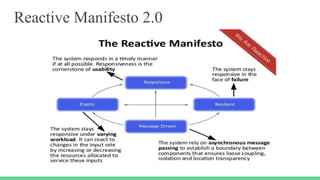
Reactive Manifesto 2.0
Reactive Programming vs Reactive Systems
Reactive programming is about Data Flows and Change propagation
Reactive System is about Message-driven based Control Flows and System
responsiveness even under load (Scalability) or partial failure (Resilient)
Why Reactive Systems ?
Why Reactive
● The driver for Reactive is the efficient resource utilization, or in other words,
spending less money on servers and data centres
● The promise of Reactive is that you can do more with less, specifically you can
process higher loads with fewer threads
● Stagnation in CPU Clock Speed 4GHz
● Highest clock speeds requiring cooling through liquid nitrogen are stuck
between 8.5 and 9 GHz
Why Reactive
● Increased investments in parallelism for both - hardware and software
● Parallelism in hardware with Multicore processors
● Software OS support for Non-Blocking I/O
○ Linux Kernel 2.6 release in 2006, Support Asynchronous I/O, POSIX AIO API
● Rise of functional programming and Concurrency
● Cloud computing costs, microservices latency makes Reactive programming a
good choice
Benefits Reactive Streams
- Efficient in handling of system resources using
asynchronous Non-Blocking I/O
- Cost effective in Cloud
- Reactive streams are designed to solve the central issue
with asynchronous programming Backpressure
- Individual Stream items can be on specialized hardware
(GPU, APU, RDMA)
Remote Direct Memory Access (RDMA) is a technology that allows computers in a network to exchange data in main memory without
involving the CPU
Backpressure
What is Backpressure ?
What is Backpressure
Observable is emitting items more rapidly than an operator or
observer can consume.
Backpressure Overflow Strategy
FluxSink.OverflowStrategy.BUFFER
Buffer all signals if the downstream can't keep up
FluxSink.OverflowStrategy.DROP
Drop the incoming signal if the downstream is not ready to receive it
FluxSink.OverflowStrategy.ERROR
Signal an IllegalStateException when the downstream can't keep up
FluxSink.OverflowStrategy.IGNORE
Completely ignore downstream backpressure requests
FluxSink.OverflowStrategy.LATEST
Downstream will get only the latest signals from upstream
Node.js & Reactive Programming
● Node runs on single thread and excellent choice for I/O based processing
● Node supports Streams similar to Java but imperative streams. The data flows
and change propagation are missing
● Libraries just RxJS, bacon.js add reactive abstraction over Node.js
Reactive Libraries on JVM
● RxJava
● Spring Reactor
● Vert.x
● Java v9 Flow APIs
How Reactive Libraries Work
● Graph Processing algorithm that captures the
dependencies among the reactive values and the language
runtime uses the graph to keep track of which
computations must be executed again when one of the
inputs changes
● Change propagation techniques Pull, Push or Hybrid
Reactive Stream Specification (RS)
Reactive Streams standard for Asynchronous Stream processing with Non-blocking
Back Pressure
Runtime environments (JVM and JavaScript) as well as network protocols
www.reactive-streams.org
Spring Reactor
Spring Reactor Architecture
Reactor Types
Reactor supports two types
● Flux<T>
● Mono<T>
Flux (Publisher/Observable)
Flux is a Reactive Streams Publisher with rx operators that emits 0 to N elements,
and then completes (successfully or with an error).
Observer subscribes to an Observable, Observer reacts/operates to item or
sequence of items the Observable emits
Mono (Publisher/Observable)
Mono is a Reactive Streams Publisher with rx operators that emits 0 to 1 elements,
and then completes (successfully or with an error)
Reactor code
Reactor code
Reactor code
Reactor code
Reactor code
Non-Blocking
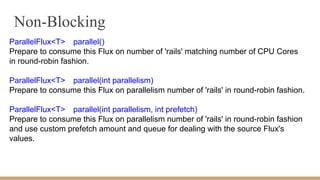
ParallelFlux<T> parallel()
Prepare to consume this Flux on number of 'rails' matching number of CPU Cores
in round-robin fashion.
ParallelFlux<T> parallel(int parallelism)
Prepare to consume this Flux on parallelism number of 'rails' in round-robin fashion.
ParallelFlux<T> parallel(int parallelism, int prefetch)
Prepare to consume this Flux on parallelism number of 'rails' in round-robin fashion
and use custom prefetch amount and queue for dealing with the source Flux's
values.
Operators
Operators operate on Observables
Operators By Category
● Creating Observables
● Transforming Observables
● Filtering Observables
● Combining Observables
● Backpressure Observables
Stateful/Stateless Operators
● Stateless Operators - filter, flatMap
● Stateful Operators - Sort, Distinct
Streaming Database Access
Reactive Data Access
● Couchbase Reactive Streams Java SDK Driver, providing asynchronous
stream processing with non-blocking backpressure.
● Fully implements the Reactive Streams API for providing interop with other
reactive streams within the JVM ecosystem.
Reactive Data Access
List<JsonDocument> comments =
bucket
.async()
.get("post::1")
.flatMap(post -> Observable.from(post.content().getArray("comments").toList()))
.flatMap(commentId -> bucket.async().get((String) commentId))
.filter(comment -> comment.content().getBoolean("published"))
.take(2)
Workshop
Ref
https://www.ibm.com/developerworks/library/l-async/
https://projectreactor.io/docs/core/release/api/
http://reactivex.io/documentation/operators/backpressure.html
https://en.wikipedia.org/wiki/Reactive_programming

Reactive systems

  • 1.
  • 2.
    Agenda Part - 1 ●Intro to Reactive Systems ● Reactive Programming Vs Reactive Systems ● Why Reactive Systems ● Side-effects ● Reactive Data Access Part - 2 ● Workshop
  • 3.
  • 4.
    Programming puzzle a =1; b = a + 1; a = 2; print a; ---> 2 print b; ---> ?
  • 6.
    Programming puzzle a =1; b = a + 1; a = 2; print a; ---> 2 print b; ---> ? 2 or 3
  • 7.
    Programming puzzle a =1; b = a + 1; a = 2; print a; ---> 2 print b; ---> ? 2 3
  • 8.
    Programming puzzle a =1; b = a + 1; a = 2; print a; ---> 2 print b; ---> ? 2 3 Imperative Reactive
  • 9.
  • 10.
    Reactive Programming Programming paradigmoriented around data flows and propagation of change -Wiki Functional programming with asynchronous data streams
  • 11.
    Functional Reactive Programming ●Reactive programming is based on the functional constructs ● Functional programming principles are essential in understanding RP ● Functional programming provides Declarative, Composable and Concurrent code ● Learn to replace loops with recursion, traverse data structures without iterators, do input/output using monads, and dealing with Immutable data sources. ● Exceptions are side-effects that undermine type system and functional purity
  • 12.
    Functional Programming ● PureFunctions, Higher-Order Functions, Monads, Currying and Immutable data ● Pure functions does not have side-effects, for a given inputs it always have same output, e.g., mathematical functions ● Higher-Order Functions, functions which takes at least one more functions as parameters and return a function (e.g., Lambds’s) ● Monads wraps data value and provide series of computational operators (e.g., Streams/Optional) ● Currying is technique of translating the evaluation of a function that takes multiple arguments into evaluating a sequence of functions, each with a single argument
  • 13.
    Reactive Programming Rx =Observable + Observer + Scheduler
  • 14.
    Observable Observable is thecombination of GOF's Observer and Iterable pattern ● The ability of consumer to push elements to consumer ● The ability for the producer to signal to the consumer that there is no more data available. ● The ability for the producer to signal to the consumer that an error has occurred.
  • 15.
    Reactive Programming ● Reactiveapplications use observable models, event streams and stateful clients. ● Observable models enable other systems to receive events when state changes.
  • 16.
    Polyglot Reactive Libraries Rx.Net,RxJava, RxJS, RxScala, RxSwift, RxRuby, RxPHP
  • 17.
    Reactive Programming ● Imperativeprogramming is a Pull model (hasNext, Next) ● Reactive programming is Push model, the elements will be pushed down the stream as soon as they are available ● Difference is the direction of the data flow
  • 18.
    Pull model &Thread Block Consumer pulls values from the producer and the thread is blocked in the pull model until the elements arrive.
  • 19.
    Reactive streams ● Mouseand Keyboard interaction ● Stock Prices ● System Events
  • 20.
    Reactive Programming vsReactive Systems
  • 21.
  • 22.
    Reactive Programming vsReactive Systems Reactive programming is about Data Flows and Change propagation Reactive System is about Message-driven based Control Flows and System responsiveness even under load (Scalability) or partial failure (Resilient)
  • 23.
  • 24.
    Why Reactive ● Thedriver for Reactive is the efficient resource utilization, or in other words, spending less money on servers and data centres ● The promise of Reactive is that you can do more with less, specifically you can process higher loads with fewer threads ● Stagnation in CPU Clock Speed 4GHz ● Highest clock speeds requiring cooling through liquid nitrogen are stuck between 8.5 and 9 GHz
  • 25.
    Why Reactive ● Increasedinvestments in parallelism for both - hardware and software ● Parallelism in hardware with Multicore processors ● Software OS support for Non-Blocking I/O ○ Linux Kernel 2.6 release in 2006, Support Asynchronous I/O, POSIX AIO API ● Rise of functional programming and Concurrency ● Cloud computing costs, microservices latency makes Reactive programming a good choice
  • 26.
    Benefits Reactive Streams -Efficient in handling of system resources using asynchronous Non-Blocking I/O - Cost effective in Cloud - Reactive streams are designed to solve the central issue with asynchronous programming Backpressure - Individual Stream items can be on specialized hardware (GPU, APU, RDMA) Remote Direct Memory Access (RDMA) is a technology that allows computers in a network to exchange data in main memory without involving the CPU
  • 27.
  • 28.
    What is Backpressure Observableis emitting items more rapidly than an operator or observer can consume.
  • 29.
    Backpressure Overflow Strategy FluxSink.OverflowStrategy.BUFFER Bufferall signals if the downstream can't keep up FluxSink.OverflowStrategy.DROP Drop the incoming signal if the downstream is not ready to receive it FluxSink.OverflowStrategy.ERROR Signal an IllegalStateException when the downstream can't keep up FluxSink.OverflowStrategy.IGNORE Completely ignore downstream backpressure requests FluxSink.OverflowStrategy.LATEST Downstream will get only the latest signals from upstream
  • 30.
    Node.js & ReactiveProgramming ● Node runs on single thread and excellent choice for I/O based processing ● Node supports Streams similar to Java but imperative streams. The data flows and change propagation are missing ● Libraries just RxJS, bacon.js add reactive abstraction over Node.js
  • 31.
    Reactive Libraries onJVM ● RxJava ● Spring Reactor ● Vert.x ● Java v9 Flow APIs
  • 32.
    How Reactive LibrariesWork ● Graph Processing algorithm that captures the dependencies among the reactive values and the language runtime uses the graph to keep track of which computations must be executed again when one of the inputs changes ● Change propagation techniques Pull, Push or Hybrid
  • 33.
    Reactive Stream Specification(RS) Reactive Streams standard for Asynchronous Stream processing with Non-blocking Back Pressure Runtime environments (JVM and JavaScript) as well as network protocols www.reactive-streams.org
  • 34.
  • 35.
  • 36.
    Reactor Types Reactor supportstwo types ● Flux<T> ● Mono<T>
  • 37.
    Flux (Publisher/Observable) Flux isa Reactive Streams Publisher with rx operators that emits 0 to N elements, and then completes (successfully or with an error). Observer subscribes to an Observable, Observer reacts/operates to item or sequence of items the Observable emits
  • 38.
    Mono (Publisher/Observable) Mono isa Reactive Streams Publisher with rx operators that emits 0 to 1 elements, and then completes (successfully or with an error)
  • 39.
  • 40.
  • 41.
  • 42.
  • 43.
  • 44.
    Non-Blocking ParallelFlux<T> parallel() Prepare toconsume this Flux on number of 'rails' matching number of CPU Cores in round-robin fashion. ParallelFlux<T> parallel(int parallelism) Prepare to consume this Flux on parallelism number of 'rails' in round-robin fashion. ParallelFlux<T> parallel(int parallelism, int prefetch) Prepare to consume this Flux on parallelism number of 'rails' in round-robin fashion and use custom prefetch amount and queue for dealing with the source Flux's values.
  • 45.
    Operators Operators operate onObservables Operators By Category ● Creating Observables ● Transforming Observables ● Filtering Observables ● Combining Observables ● Backpressure Observables
  • 46.
    Stateful/Stateless Operators ● StatelessOperators - filter, flatMap ● Stateful Operators - Sort, Distinct
  • 47.
  • 48.
    Reactive Data Access ●Couchbase Reactive Streams Java SDK Driver, providing asynchronous stream processing with non-blocking backpressure. ● Fully implements the Reactive Streams API for providing interop with other reactive streams within the JVM ecosystem.
  • 49.
    Reactive Data Access List<JsonDocument>comments = bucket .async() .get("post::1") .flatMap(post -> Observable.from(post.content().getArray("comments").toList())) .flatMap(commentId -> bucket.async().get((String) commentId)) .filter(comment -> comment.content().getBoolean("published")) .take(2)
  • 50.
  • 51.