Embracing Reactive
Streams
Java 9 & Spring 5
1
One doesn’t need to be a subject
matter expert in order to share
knowledge. Whilst the one
sharing must be open to
criticism, the one listening has
to fact check, give feedback and
spread what has been learned.
The sharing process has to be
organic.
2
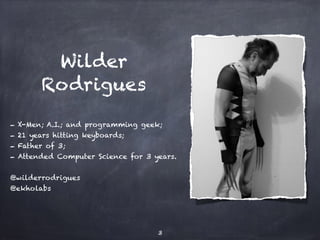
Wilder
Rodrigues
- X-Men; A.I.; and programming geek;
- 21 years hitting keyboards;
- Father of 3;
- Attended Computer Science for 3 years.
@wilderrodrigues
@ekholabs
3
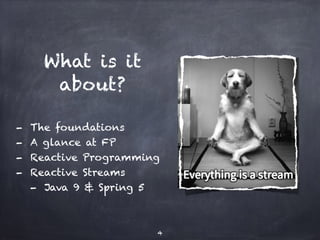
What is it
about?
- The foundations
- A glance at FP
- Reactive Programming
- Reactive Streams
- Java 9 & Spring 5
4
The Foundations
5
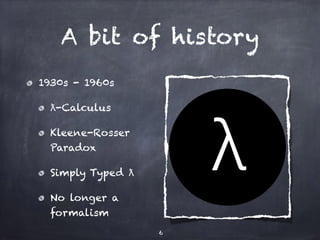
A bit of history
1930s - 1960s
ƛ-Calculus
Kleene-Rosser
Paradox
Simply Typed ƛ
No longer a
formalism
6
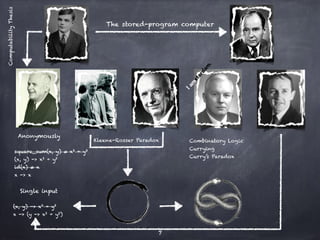
Anonymously
square_sum(x, y) = x2 + y2
(x, y) -> x2 + y2
id(x) = x
x -> x
(x, y) -> x2 + y2
x -> (y -> x2 + y2)
Single input
The stored-program computer
Combinatory Logic
Currying
Curry’s Paradox
Kleene-Rosser Paradox
ComputabilityThesis
7
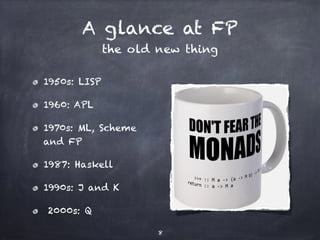
A glance at FP
the old new thing
1950s: LISP
1960: APL
1970s: ML, Scheme
and FP
1987: Haskell
1990s: J and K
2000s: Q
8
Concepts
Higher-order functions
First-class functions
Pure functions
Recursion
Strict vs non-strict evaluation
Type systems
Referential Transparency
9
Reactive
Programming
Propagation of changes
Dependency graph
Propagation algorithms
Back-pressure
Higher-order RP
Lazy evaluation
10
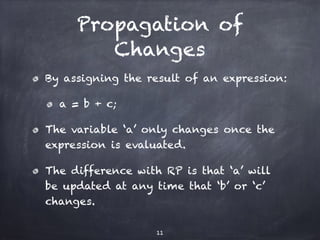
Propagation of
Changes
By assigning the result of an expression:
a = b + c;
The variable ‘a’ only changes once the
expression is evaluated.
The difference with RP is that ‘a’ will
be updated at any time that ‘b’ or ‘c’
changes.
11
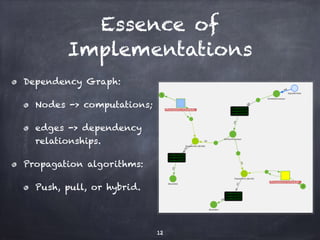
Essence of
Implementations
Dependency Graph:
Nodes -> computations;
edges -> dependency
relationships.
Propagation algorithms:
Push, pull, or hybrid.
12
Essence of
Implementations
Higher-order RP
Data flows -> Data
flows
Turing completeness
Lazy evaluation
length([2*2, 3*3, 4/0])
13
Reactive Streams
or flow-controlled components
14
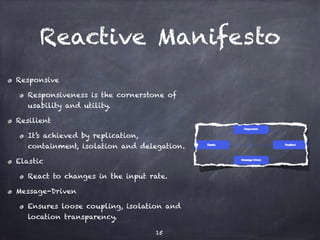
Reactive Manifesto
Responsive
Responsiveness is the cornerstone of
usability and utility.
Resilient
It’s achieved by replication,
containment, isolation and delegation.
Elastic
React to changes in the input rate.
Message-Driven
Ensures loose coupling, isolation and
location transparency.
15
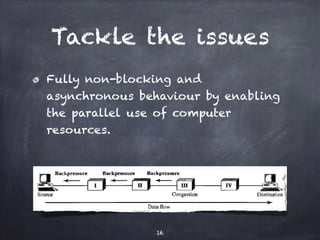
Tackle the issues
Fully non-blocking and
asynchronous behaviour by enabling
the parallel use of computer
resources.
16
Reactive
Generations
0th gen.: consists of j.u.Observable and its
callback cousins addXXXListener() -> JDK 1.0
1st gen.: issues addressed by Meijer & MS
and first libs born -> Rx.NET,
Reactive4Java and RxJava.
2nd gen.: issues on synchronous
cancellation and back-pressure address by
the RxJava team.
17
Reactive
Generations
3rd gen.: fix back-pressure properly with
Reactive Stream spec -> 4 interfaces, 30 rules
and 7 methods. Behold the trinity: RxJava 2.x,
Project Reactor and Akka-Streams.
4th gen.: fluent libraries on top of Reactive
Streams spec now called operator-fusion.
5th gen.: extensions to support reactive IO
operations in the form of bi-directional
channels.
18
0th generation -
DDP
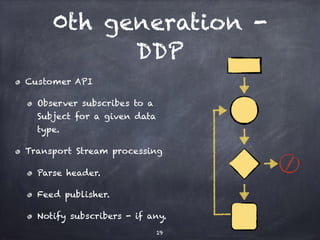
Customer API
Observer subscribes to a
Subject for a given data
type.
Transport Stream processing
Parse header.
Feed publisher.
Notify subscribers - if any.
19
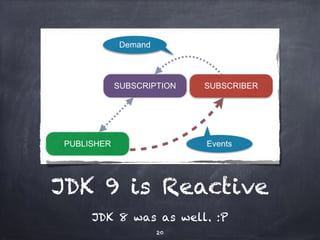
JDK 9 is Reactive
JDK 8 was as well. :P
20
Interfaces and static methods for establishing flow-
controlled components.
Contains seven “one-way” message style defined
methods.
Non-blocking back pressure with a pull strategy, where
the consumer requests a number of messages to the
producer.
Collaboration between people from Kaazing, Netflix,
Pivotal, Red Hat, Twitter, Typesafe, and others.
21
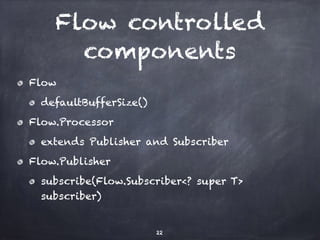
Flow controlled
components
Flow
defaultBufferSize()
Flow.Processor
extends Publisher and Subscriber
Flow.Publisher
subscribe(Flow.Subscriber<? super T>
subscriber)
22
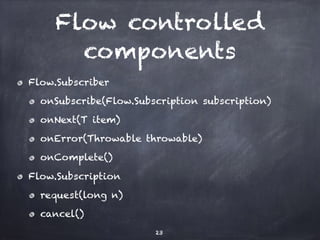
Flow controlled
components
Flow.Subscriber
onSubscribe(Flow.Subscription subscription)
onNext(T item)
onError(Throwable throwable)
onComplete()
Flow.Subscription
request(long n)
cancel()
23
Demo
part I
24
Spring 5
Web Reactive Framework
25
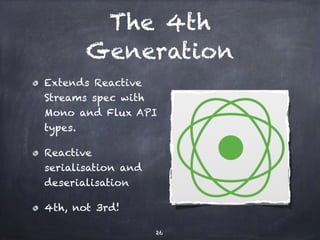
The 4th
Generation
Extends Reactive
Streams spec with
Mono and Flux API
types.
Reactive
serialisation and
deserialisation
4th, not 3rd!
26
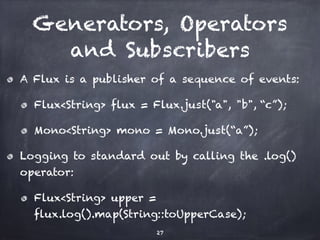
Generators, Operators
and Subscribers
A Flux is a publisher of a sequence of events:
Flux<String> flux = Flux.just("a", "b", “c”);
Mono<String> mono = Mono.just(“a”);
Logging to standard out by calling the .log()
operator:
Flux<String> upper =
flux.log().map(String::toUpperCase);
27
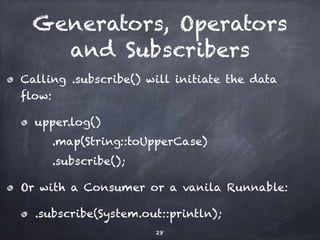
Generators, Operators
and Subscribers
Calling .subscribe() will initiate the data
flow:
upper.log()
.map(String::toUpperCase)
.subscribe();
Or with a Consumer or a vanila Runnable:
.subscribe(System.out::println);
28
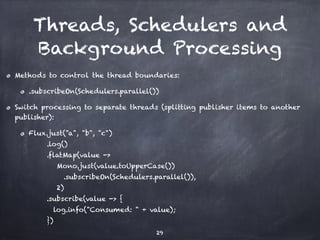
Threads, Schedulers and
Background Processing
Methods to control the thread boundaries:
.subscribeOn(Schedulers.parallel())
Switch processing to separate threads (splitting publisher items to another
publisher):
Flux.just("a", "b", "c")
.log()
.flatMap(value ->
Mono.just(value.toUpperCase())
.subscribeOn(Schedulers.parallel()),
2)
.subscribe(value -> {
log.info("Consumed: " + value);
})
29
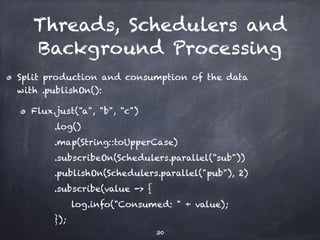
Threads, Schedulers and
Background Processing
Split production and consumption of the data
with .publishOn():
Flux.just("a", "b", "c")
.log()
.map(String::toUpperCase)
.subscribeOn(Schedulers.parallel("sub"))
.publishOn(Schedulers.parallel("pub"), 2)
.subscribe(value -> {
log.info("Consumed: " + value);
});
30
Reactive Web
Reactive web framework:
@[Rest]Controller
programming model, but
on a reactive, non-
blocking engine.
Reactive WebClient with
full back-pressure
support.
31
Demo
part II
32
References
https://en.wikipedia.org/wiki/Lambda_calculus
https://en.wikipedia.org/wiki/Turing_completeness
https://en.wikipedia.org/wiki/Universal_Turing_machine
https://en.wikipedia.org/wiki/Kleene%E2%80%93Rosser_paradox
https://en.wikipedia.org/wiki/Curry%27s_paradox
https://en.wikipedia.org/wiki/Church%E2%80%93Turing_thesis
https://en.wikipedia.org/wiki/Currying
https://en.wikipedia.org/wiki/Von_Neumann_architecture
http://www.reactive-streams.org/
http://www.reactivemanifesto.org/
https://en.wikipedia.org/wiki/Functional_programming
https://en.wikipedia.org/wiki/Reactive_programming#Higher-order_reactive_programming
https://en.wikipedia.org/wiki/Functional_reactive_programming
http://akarnokd.blogspot.nl/2016/03/operator-fusion-part-1.html
https://github.com/reactor/reactor-core/blob/master/README.md
33
34

Embracing Reactive Streams with Java 9 and Spring 5