© Copyright 2019 Pivotal Software, Inc. All rights Reserved.
Reactive Relational
Database Connectivity
Ben Hale – R2DBC Lead, Cloud Foundry Java Lead
@nebhale
Reactive
Programming
! Reactive Programming is the next frontier in
Java for high-efficiency applications
! Fundamentally non-blocking and often paired
with asynchronous behaviors
! Reactive has no opinion on async and many
flows are totally synchronous
! Key differentiator from async is Reactive (pull-
push) back pressure
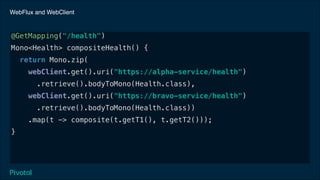
WebFlux and WebClient
@GetMapping("/health")
Mono<Health> compositeHealth() {
return Mono.zip(
webClient.get().uri("https://alpha-service/health")
.retrieve().bodyToMono(Health.class),
webClient.get().uri("https://bravo-service/health")
.retrieve().bodyToMono(Health.class))
.map(t -> composite(t.getT1(), t.getT2()));
}
Roadblocks
! There are still some barriers to using Reactive
everywhere*
! Cross-process back pressure (networking)
! Working on RSocket to solve this issue
! Simon Baslé, Up Next
! Data Access
! MongoDB, Apache Cassandra, Couchbase
and Redis
! No Relational Database Access
An API designed from the ground
up for reactive programming
https://r2dbc.io
Design Principals
! Utilize Reactive Streams Types and Patterns
! Be completely non-blocking, all the way to the
database
! Utilize wire-protocol features where
available
! Shrink the driver SPI to the minimal set of
operations that are implementation specific,
regardless of usability
! Enable multiple "humane" APIs to be built on top
of the driver
Driver SPI
! One of JDBC's biggest failings was that the
same API had to serve as both a humane API for
users as well as an inhumane API for alternative
clients like JPA, jOOQ, Jdbi, etc.
! This lead to both an API that users didn't like
using and that driver authors didn't like
implementing
! It also lead to drivers duplicating effort
implementing the same "humane" affordances
like ? binding
Driver SPI - Connection Factory
Publisher<Connection> create()
ConnectionFactoryMetadata getMetadata()
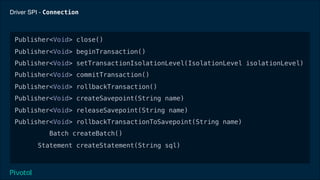
Driver SPI - Connection
Publisher<Void> close()
Publisher<Void> beginTransaction()
Publisher<Void> setTransactionIsolationLevel(IsolationLevel isolationLevel)
Publisher<Void> commitTransaction()
Publisher<Void> rollbackTransaction()
Publisher<Void> createSavepoint(String name)
Publisher<Void> releaseSavepoint(String name)
Publisher<Void> rollbackTransactionToSavepoint(String name)
Batch createBatch()
Statement createStatement(String sql)
Driver SPI - Statement
Statement bind(Object identifier, Object value)
Statement bind(int index, Object value)
Statement bind(int index, <primitive types> value)
Statement bindNull(Object identifier, Class<?> type)
Statement bindNull(int index, Class<?> type)
Statement add()
Statement returnGeneratedValues(String... columns)
Publisher<Result> execute()
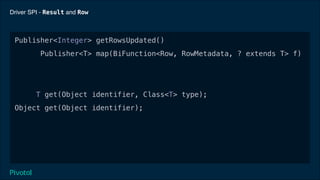
Driver SPI - Result and Row
Publisher<Integer> getRowsUpdated()
Publisher<T> map(BiFunction<Row, RowMetadata, ? extends T> f)
T get(Object identifier, Class<T> type);
Object get(Object identifier);
Simple Select
Publisher<Object> values = connectionFactory.create()
.flatMapMany(conn ->
conn.createStatement("SELECT value FROM test")
.execute()
.flatMap(result ->
result.map((row, metadata) -> row.get("value"))))
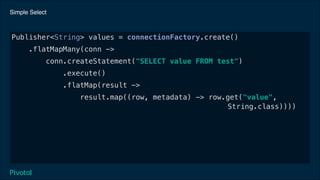
Simple Select
Publisher<String> values = connectionFactory.create()
.flatMapMany(conn ->
conn.createStatement("SELECT value FROM test")
.execute()
.flatMap(result ->
result.map((row, metadata) -> row.get("value",

String.class))))
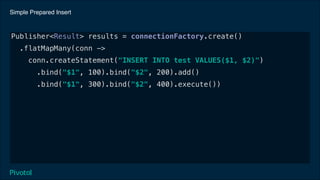
Simple Prepared Insert
Publisher<Result> results = connectionFactory.create()
.flatMapMany(conn ->
conn.createStatement("INSERT INTO test VALUES($1, $2)")
.bind("$1", 100).bind("$2", 200).add()
.bind("$1", 300).bind("$2", 400).execute())
Transactional Prepared Insert
Publisher<Result> results = connectionFactory.create()
.flatMapMany(conn ->
conn.beginTransaction()
.thenMany(conn.createStatement("INSERT INTO test VALUES($1)")
.bind("$1", 100).add()
.bind("$1", 200).execute())
.delayUntil(p -> conn.commitTransaction())
.onErrorResume(t ->
conn.rollbackTransaction().then(Mono.error(t))))
Great! But a Bit
Verbose
! The Driver SPI contains the minimal set of
operations that are implementation specific and
nothing more
! Definitely usable, but very verbose and prone to
errors
! Explicit transaction management is
analogous to try-catch-finally-try-
catch in JDBC
! What we need is a "humane" client API. In fact
we need many humane client APIs!
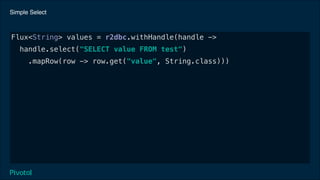
Simple Select
Flux<String> values = r2dbc.withHandle(handle ->
handle.select("SELECT value FROM test")
.mapRow(row -> row.get("value", String.class)))
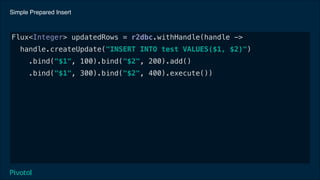
Simple Prepared Insert
Flux<Integer> updatedRows = r2dbc.withHandle(handle ->
handle.createUpdate("INSERT INTO test VALUES($1, $2)")
.bind("$1", 100).bind("$2", 200).add()
.bind("$1", 300).bind("$2", 400).execute())
Transactional Prepared Insert
Flux<String> updatedRows = r2dbc.inTransaction(handle ->
handle.createUpdate("INSERT INTO test VALUES($1, $2)")
.bind("$1", 100).bind("$2", 200).add()
.bind("$1", 300).bind("$2", 400).execute())
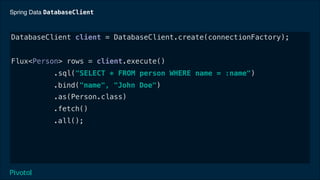
Spring Data DatabaseClient
DatabaseClient client = DatabaseClient.create(connectionFactory);
Flux<Person> rows = client.execute()
.sql("SELECT * FROM person WHERE name = :name")
.bind("name", "John Doe")
.as(Person.class)
.fetch()
.all();
Spring Data Repository
interface CustomerRepository extends
ReactiveCrudRepository<Customer, Long> {
@Query("select * from … WHERE lastname = :lastname")
Flux<Customer> findByLastname(String lastname);
}
repository.findByLastname("Matthews")
.doOnEach(c -> System.out.println(c.firstname))
Connection URLs
r2dbcs:postgresql://localhost:5432/db?schema=test
r2dbc:pool:postgresql://localhost:5432/db?schema=test,size=4
ConnectionFactory connectionFactory =
ConnectionFactories.get("r2dbcs:postgresql://localhost:5432/

db?schema=test");
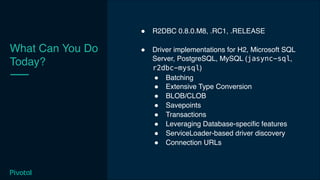
What Can You Do
Today?
! R2DBC 0.8.0.M8, .RC1, .RELEASE
! Driver implementations for H2, Microsoft SQL
Server, PostgreSQL, MySQL (jasync-sql,
r2dbc-mysql)
! Batching
! Extensive Type Conversion
! BLOB/CLOB
! Savepoints
! Transactions
! Leveraging Database-specific features
! ServiceLoader-based driver discovery
! Connection URLs
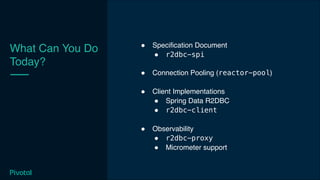
What Can You Do
Today?
! Specification Document
! r2dbc-spi
! Connection Pooling (reactor-pool)
! Client Implementations
! Spring Data R2DBC
! r2dbc-client
! Observability
! r2dbc-proxy
! Micrometer support
What About the
Alternatives?
! Wrap JDBC in a thread pool
! Unbounded queue leads to resource
exhaustion
! Bounded queue leads to blocking
! Other specifications
! In early stages and similar in design
! Typically a small number of implementations
! Collaboration likely as the market won't
support multiple specifications
Safe Harbor
Statement
The following is intended to outline the general direction of
Pivotal's offerings. It is intended for information purposes
only and may not be incorporated into any contract. Any
information regarding pre-release of Pivotal offerings,
future updates or other planned modifications is subject to
ongoing evaluation by Pivotal and is subject to change.
This information is provided without warranty or any kind,
express or implied, and is not a commitment to deliver any
material, code, or functionality, and should not be relied
upon in making purchasing decisions regarding Pivotal's
offerings. These purchasing decisions should only be
based on features currently available. The development,
release, and timing of any features or functionality
described for Pivotal's offerings in this presentation remain
at the sole discretion of Pivotal. Pivotal has no obligation
to update forward looking information in this presentation.
What Does the
Future Hold?
! Additions/improvements to SPI
! Stored procedures
! Auto-commit, fetch size
! Additional implementations
! Google Cloud Spanner
! SAP Hanna and DB2 are investigating
! Prefer database vendors to own drivers
long-term
! Additional clients
! JOOQ, Jdbi, MyBatis have initial support
Resources
! Website

https://r2dbc.io
! Twitter

@r2dbc
! GitHub

https://github.com/r2dbc
! Mailing List

https://groups.google.com/forum/#!forum/r2dbc
! Weekly Call

Fridays 0630 PT/0930 ET/1530 CET
Questions

Reactive Relational Database Connectivity

  • 1.
    © Copyright 2019Pivotal Software, Inc. All rights Reserved. Reactive Relational Database Connectivity Ben Hale – R2DBC Lead, Cloud Foundry Java Lead @nebhale
  • 2.
    Reactive Programming ! Reactive Programmingis the next frontier in Java for high-efficiency applications ! Fundamentally non-blocking and often paired with asynchronous behaviors ! Reactive has no opinion on async and many flows are totally synchronous ! Key differentiator from async is Reactive (pull- push) back pressure
  • 3.
    WebFlux and WebClient @GetMapping("/health") Mono<Health>compositeHealth() { return Mono.zip( webClient.get().uri("https://alpha-service/health") .retrieve().bodyToMono(Health.class), webClient.get().uri("https://bravo-service/health") .retrieve().bodyToMono(Health.class)) .map(t -> composite(t.getT1(), t.getT2())); }
  • 4.
    Roadblocks ! There arestill some barriers to using Reactive everywhere* ! Cross-process back pressure (networking) ! Working on RSocket to solve this issue ! Simon Baslé, Up Next ! Data Access ! MongoDB, Apache Cassandra, Couchbase and Redis ! No Relational Database Access
  • 5.
    An API designedfrom the ground up for reactive programming https://r2dbc.io
  • 6.
    Design Principals ! UtilizeReactive Streams Types and Patterns ! Be completely non-blocking, all the way to the database ! Utilize wire-protocol features where available ! Shrink the driver SPI to the minimal set of operations that are implementation specific, regardless of usability ! Enable multiple "humane" APIs to be built on top of the driver
  • 7.
    Driver SPI ! Oneof JDBC's biggest failings was that the same API had to serve as both a humane API for users as well as an inhumane API for alternative clients like JPA, jOOQ, Jdbi, etc. ! This lead to both an API that users didn't like using and that driver authors didn't like implementing ! It also lead to drivers duplicating effort implementing the same "humane" affordances like ? binding
  • 8.
    Driver SPI -Connection Factory Publisher<Connection> create() ConnectionFactoryMetadata getMetadata()
  • 9.
    Driver SPI -Connection Publisher<Void> close() Publisher<Void> beginTransaction() Publisher<Void> setTransactionIsolationLevel(IsolationLevel isolationLevel) Publisher<Void> commitTransaction() Publisher<Void> rollbackTransaction() Publisher<Void> createSavepoint(String name) Publisher<Void> releaseSavepoint(String name) Publisher<Void> rollbackTransactionToSavepoint(String name) Batch createBatch() Statement createStatement(String sql)
  • 10.
    Driver SPI -Statement Statement bind(Object identifier, Object value) Statement bind(int index, Object value) Statement bind(int index, <primitive types> value) Statement bindNull(Object identifier, Class<?> type) Statement bindNull(int index, Class<?> type) Statement add() Statement returnGeneratedValues(String... columns) Publisher<Result> execute()
  • 11.
    Driver SPI -Result and Row Publisher<Integer> getRowsUpdated() Publisher<T> map(BiFunction<Row, RowMetadata, ? extends T> f) T get(Object identifier, Class<T> type); Object get(Object identifier);
  • 12.
    Simple Select Publisher<Object> values= connectionFactory.create() .flatMapMany(conn -> conn.createStatement("SELECT value FROM test") .execute() .flatMap(result -> result.map((row, metadata) -> row.get("value"))))
  • 13.
    Simple Select Publisher<String> values= connectionFactory.create() .flatMapMany(conn -> conn.createStatement("SELECT value FROM test") .execute() .flatMap(result -> result.map((row, metadata) -> row.get("value",
 String.class))))
  • 14.
    Simple Prepared Insert Publisher<Result>results = connectionFactory.create() .flatMapMany(conn -> conn.createStatement("INSERT INTO test VALUES($1, $2)") .bind("$1", 100).bind("$2", 200).add() .bind("$1", 300).bind("$2", 400).execute())
  • 15.
    Transactional Prepared Insert Publisher<Result>results = connectionFactory.create() .flatMapMany(conn -> conn.beginTransaction() .thenMany(conn.createStatement("INSERT INTO test VALUES($1)") .bind("$1", 100).add() .bind("$1", 200).execute()) .delayUntil(p -> conn.commitTransaction()) .onErrorResume(t -> conn.rollbackTransaction().then(Mono.error(t))))
  • 16.
    Great! But aBit Verbose ! The Driver SPI contains the minimal set of operations that are implementation specific and nothing more ! Definitely usable, but very verbose and prone to errors ! Explicit transaction management is analogous to try-catch-finally-try- catch in JDBC ! What we need is a "humane" client API. In fact we need many humane client APIs!
  • 17.
    Simple Select Flux<String> values= r2dbc.withHandle(handle -> handle.select("SELECT value FROM test") .mapRow(row -> row.get("value", String.class)))
  • 18.
    Simple Prepared Insert Flux<Integer>updatedRows = r2dbc.withHandle(handle -> handle.createUpdate("INSERT INTO test VALUES($1, $2)") .bind("$1", 100).bind("$2", 200).add() .bind("$1", 300).bind("$2", 400).execute())
  • 19.
    Transactional Prepared Insert Flux<String>updatedRows = r2dbc.inTransaction(handle -> handle.createUpdate("INSERT INTO test VALUES($1, $2)") .bind("$1", 100).bind("$2", 200).add() .bind("$1", 300).bind("$2", 400).execute())
  • 20.
    Spring Data DatabaseClient DatabaseClientclient = DatabaseClient.create(connectionFactory); Flux<Person> rows = client.execute() .sql("SELECT * FROM person WHERE name = :name") .bind("name", "John Doe") .as(Person.class) .fetch() .all();
  • 21.
    Spring Data Repository interfaceCustomerRepository extends ReactiveCrudRepository<Customer, Long> { @Query("select * from … WHERE lastname = :lastname") Flux<Customer> findByLastname(String lastname); } repository.findByLastname("Matthews") .doOnEach(c -> System.out.println(c.firstname))
  • 22.
  • 23.
    What Can YouDo Today? ! R2DBC 0.8.0.M8, .RC1, .RELEASE ! Driver implementations for H2, Microsoft SQL Server, PostgreSQL, MySQL (jasync-sql, r2dbc-mysql) ! Batching ! Extensive Type Conversion ! BLOB/CLOB ! Savepoints ! Transactions ! Leveraging Database-specific features ! ServiceLoader-based driver discovery ! Connection URLs
  • 24.
    What Can YouDo Today? ! Specification Document ! r2dbc-spi ! Connection Pooling (reactor-pool) ! Client Implementations ! Spring Data R2DBC ! r2dbc-client ! Observability ! r2dbc-proxy ! Micrometer support
  • 25.
    What About the Alternatives? !Wrap JDBC in a thread pool ! Unbounded queue leads to resource exhaustion ! Bounded queue leads to blocking ! Other specifications ! In early stages and similar in design ! Typically a small number of implementations ! Collaboration likely as the market won't support multiple specifications
  • 26.
    Safe Harbor Statement The followingis intended to outline the general direction of Pivotal's offerings. It is intended for information purposes only and may not be incorporated into any contract. Any information regarding pre-release of Pivotal offerings, future updates or other planned modifications is subject to ongoing evaluation by Pivotal and is subject to change. This information is provided without warranty or any kind, express or implied, and is not a commitment to deliver any material, code, or functionality, and should not be relied upon in making purchasing decisions regarding Pivotal's offerings. These purchasing decisions should only be based on features currently available. The development, release, and timing of any features or functionality described for Pivotal's offerings in this presentation remain at the sole discretion of Pivotal. Pivotal has no obligation to update forward looking information in this presentation.
  • 27.
    What Does the FutureHold? ! Additions/improvements to SPI ! Stored procedures ! Auto-commit, fetch size ! Additional implementations ! Google Cloud Spanner ! SAP Hanna and DB2 are investigating ! Prefer database vendors to own drivers long-term ! Additional clients ! JOOQ, Jdbi, MyBatis have initial support
  • 28.
    Resources ! Website
 https://r2dbc.io ! Twitter
 @r2dbc !GitHub
 https://github.com/r2dbc ! Mailing List
 https://groups.google.com/forum/#!forum/r2dbc ! Weekly Call
 Fridays 0630 PT/0930 ET/1530 CET
  • 29.