Java & JEE Training
Session 26 – Servlets – A deeper look
Page 1Classification: Restricted
Agenda
• HTTP Servlets and Java EE a deeper look
Java & JEE Training
Introduction to JEE
Page 3Classification: Restricted
Review of previous session…
….
Page 4Classification: Restricted
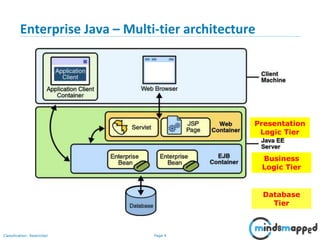
Enterprise Java – Multi-tier architecture
Presentation
Logic Tier
Business
Logic Tier
Database
Tier
Page 5Classification: Restricted
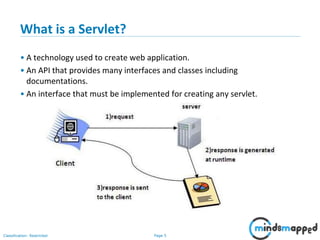
What is a Servlet?
• A technology used to create web application.
• An API that provides many interfaces and classes including
documentations.
• An interface that must be implemented for creating any servlet.
Page 6Classification: Restricted
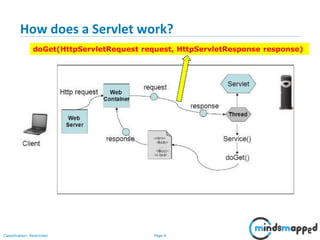
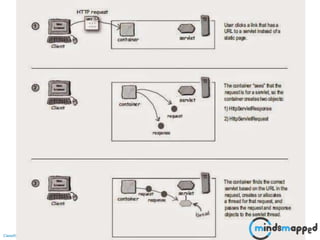
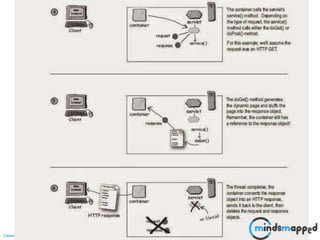
How does a Servlet work?
doGet(HttpServletRequest request, HttpServletResponse response)
Page 7Classification: Restricted
Page 8Classification: Restricted
Page 9Classification: Restricted
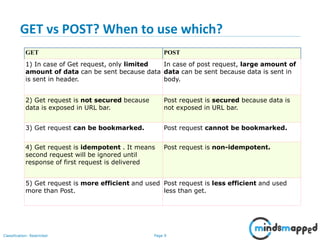
GET vs POST? When to use which?
GET POST
1) In case of Get request, only limited
amount of data can be sent because data
is sent in header.
In case of post request, large amount of
data can be sent because data is sent in
body.
2) Get request is not secured because
data is exposed in URL bar.
Post request is secured because data is
not exposed in URL bar.
3) Get request can be bookmarked. Post request cannot be bookmarked.
4) Get request is idempotent . It means
second request will be ignored until
response of first request is delivered
Post request is non-idempotent.
5) Get request is more efficient and used
more than Post.
Post request is less efficient and used
less than get.
Page 10Classification: Restricted
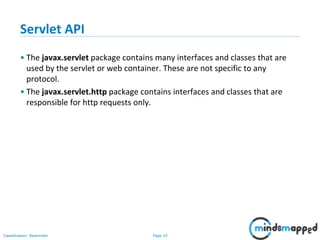
Servlet API
• The javax.servlet package contains many interfaces and classes that are
used by the servlet or web container. These are not specific to any
protocol.
• The javax.servlet.http package contains interfaces and classes that are
responsible for http requests only.
Page 11Classification: Restricted
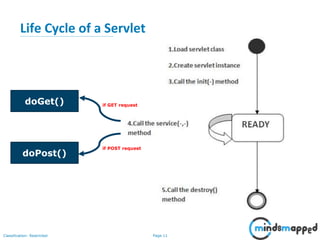
Life Cycle of a Servlet
doGet()
doPost()
if GET request
if POST request
Servlets: Let’s look at it in more depth
Page 13Classification: Restricted
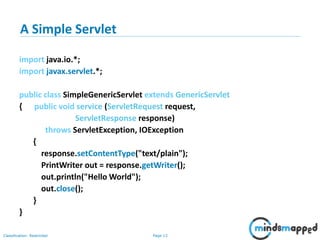
A Simple Servlet
import java.io.*;
import javax.servlet.*;
public class SimpleGenericServlet extends GenericServlet
{ public void service (ServletRequest request,
ServletResponse response)
throws ServletException, IOException
{
response.setContentType("text/plain");
PrintWriter out = response.getWriter();
out.println("Hello World");
out.close();
}
}
Note: no main method. Servlet run by server, just as applet run by browser
Page 14Classification: Restricted
A Simple Servlet
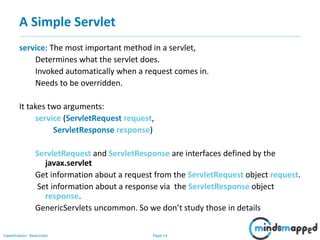
service: The most important method in a servlet,
Determines what the servlet does.
Invoked automatically when a request comes in.
Needs to be overridden.
It takes two arguments:
service (ServletRequest request,
ServletResponse response)
ServletRequest and ServletResponse are interfaces defined by the
javax.servlet
Get information about a request from the ServletRequest object request.
Set information about a response via the ServletResponse object
response.
GenericServlets uncommon. So we don’t study those in details
Page 15Classification: Restricted
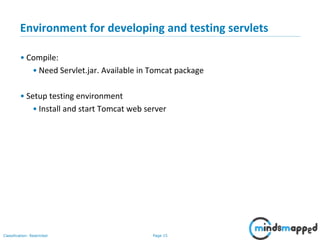
Environment for developing and testing servlets
• Compile:
• Need Servlet.jar. Available in Tomcat package
• Setup testing environment
• Install and start Tomcat web server
Page 16Classification: Restricted
General Information about Servlets
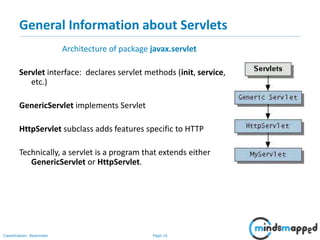
Architecture of package javax.servlet
Servlet interface: declares servlet methods (init, service,
etc.)
GenericServlet implements Servlet
HttpServlet subclass adds features specific to HTTP
Technically, a servlet is a program that extends either
GenericServlet or HttpServlet.
Page 17Classification: Restricted
General Information about Servlets
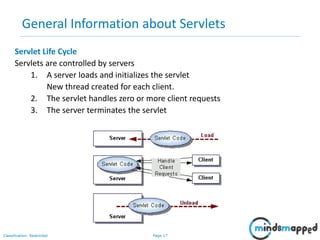
Servlet Life Cycle
Servlets are controlled by servers
1. A server loads and initializes the servlet
New thread created for each client.
2. The servlet handles zero or more client requests
3. The server terminates the servlet
Page 18Classification: Restricted
Servlet Life Cycle
Methods
public void init():
Called only once when servlet is being created.
Good place for set up, open Database, etc.
public void service():
Called once for each request.
In HttpServlet, it delegates requests to doGet, doPost, etc.
public void destroy():
Called when server decides to terminate the servlet.
Release resources.
Page 19Classification: Restricted
HTTP Servlets
• HTTP requests include
• GET, HEAD, POST, PUT, DELETE, TRACE, OPTIONS
• The default is GET.
• The usual ones used by JSP/Servlet technology are GET or POST.
• Other requests carry more meaning while designing RESTful API or RESTful
architecture.
Page 20Classification: Restricted
HTTP Servlets
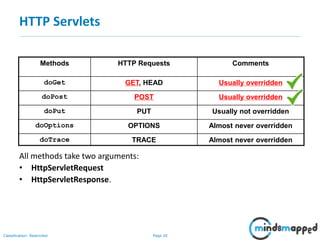
All methods take two arguments:
• HttpServletRequest
• HttpServletResponse.
Methods HTTP Requests Comments
doGet GET, HEAD Usually overridden
doPost POST Usually overridden
doPut PUT Usually not overridden
doOptions OPTIONS Almost never overridden
doTrace TRACE Almost never overridden
Page 21Classification: Restricted
HTTP Servlets
• javax.servlet.http.HttpServlet
• subclass of GenericServlet, hence has service method
• class has already overridden the service method to delegate requests
to special purpose methods such as doGet and doPost.
• Don’t override the service method when sub classing HttpServlet.
Instead, refine the special purpose methods, mostly doGet and doPost.
Page 22Classification: Restricted
• javax.servlet.http.HttpServletRequest Objects
• Extends the ServletRequest
• Provide access to HTTP header data and the parameters of the request.
• Can get values of individual parameters using the following methods
• getParameterNames method provides the names of the
parameters
• getParameter method returns the value of a named parameter.
• getParameterValues method returns an array of all values of a
parameter if it has more than one values.
HTTP Servlets
Page 23Classification: Restricted
• HttpServletResponse Objects
• Provide two ways of returning data to the user:
• getWriter method returns a PrintWriter for sending text data to
client
• getOutputStream method returns a ServletOutputStream for
sending binary data to client.
• Need to close the Writer or ServletOutputStream after you send
the response.
• HTTP Header Data
• Must set HTTP header data before you access the Writer or
OutputStream.
• HttpServletResponse interface provides methods to manipulate
the header data.
• For example, the setContentType method sets the content type.
(This header is often the only one manually set.)
HTTP Servlets
Page 24Classification: Restricted
What is a MIME Type?
• The MIME type is the mechanism to tell the client the variety of document
transmitted: the extension of a file name has no meaning on the web.
• It is, therefore, important that the server is correctly set up, so that the
correct MIME type is transmitted with each document.
• Browsers often use the MIME-type to determine what default action to do
when a resource is fetched.
HTTP Servlets
Page 25Classification: Restricted
Commonly used MIME Types:
• text/plain
• text/css
• text/html
• application/pdf
• image/jpeg
• image/png
• audio/mpeg
• video/mp4
Note: A MIME type is insensitive to the case, but traditionally is written all in
lower case.
HTTP Servlets
Images
Audio/Video
Page 26Classification: Restricted
Handling GET requests: Override the doGet method
public class BookDetailServlet extends HttpServlet
{ public void doGet (HttpServletRequest request,
HttpServletResponse response)
throws ServletException, IOException
{ ...
// set content-type header before accessing the Writer
response.setContentType("text/html");
PrintWriter out = response.getWriter();
out.println(...); // then write the response
//Get the identifier of the book from request
String bookId = request.getParameter("bookId");
if (bookId != null)
{ out.println( information about the book );}
out.close();
……
HTTP Servlets
Page 27Classification: Restricted
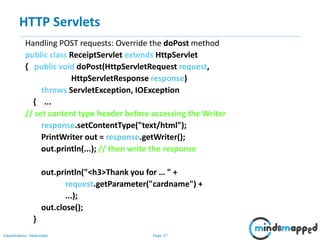
Handling POST requests: Override the doPost method
public class ReceiptServlet extends HttpServlet
{ public void doPost(HttpServletRequest request,
HttpServletResponse response)
throws ServletException, IOException
{ ...
// set content type header before accessing the Writer
response.setContentType("text/html");
PrintWriter out = response.getWriter();
out.println(...); // then write the response
out.println("<h3>Thank you for … " +
request.getParameter("cardname") +
...);
out.close();
}
HTTP Servlets
Page 28Classification: Restricted
• Handling both GET and POST requests in the same way
public class BookDetailServlet extends HttpServlet
{ public void doGet (HttpServletRequest request,
HttpServletResponse response)
throws ServletException, IOException
{
// codes for handling the request
}
public void doPost (HttpServletRequest request,
HttpServletResponse response)
throws ServletException, IOException
{
doGet( request, response);
}
}
HTTP Servlets
Page 29Classification: Restricted
• Servlet coding
• Demo on complete Web App flow
Topics to be covered in next session
Page 30Classification: Restricted
Thank you!

Session 26 - Servlets Part 2

  • 1.
    Java & JEETraining Session 26 – Servlets – A deeper look
  • 2.
    Page 1Classification: Restricted Agenda •HTTP Servlets and Java EE a deeper look
  • 3.
    Java & JEETraining Introduction to JEE
  • 4.
    Page 3Classification: Restricted Reviewof previous session… ….
  • 5.
    Page 4Classification: Restricted EnterpriseJava – Multi-tier architecture Presentation Logic Tier Business Logic Tier Database Tier
  • 6.
    Page 5Classification: Restricted Whatis a Servlet? • A technology used to create web application. • An API that provides many interfaces and classes including documentations. • An interface that must be implemented for creating any servlet.
  • 7.
    Page 6Classification: Restricted Howdoes a Servlet work? doGet(HttpServletRequest request, HttpServletResponse response)
  • 8.
  • 9.
  • 10.
    Page 9Classification: Restricted GETvs POST? When to use which? GET POST 1) In case of Get request, only limited amount of data can be sent because data is sent in header. In case of post request, large amount of data can be sent because data is sent in body. 2) Get request is not secured because data is exposed in URL bar. Post request is secured because data is not exposed in URL bar. 3) Get request can be bookmarked. Post request cannot be bookmarked. 4) Get request is idempotent . It means second request will be ignored until response of first request is delivered Post request is non-idempotent. 5) Get request is more efficient and used more than Post. Post request is less efficient and used less than get.
  • 11.
    Page 10Classification: Restricted ServletAPI • The javax.servlet package contains many interfaces and classes that are used by the servlet or web container. These are not specific to any protocol. • The javax.servlet.http package contains interfaces and classes that are responsible for http requests only.
  • 12.
    Page 11Classification: Restricted LifeCycle of a Servlet doGet() doPost() if GET request if POST request
  • 13.
    Servlets: Let’s lookat it in more depth
  • 14.
    Page 13Classification: Restricted ASimple Servlet import java.io.*; import javax.servlet.*; public class SimpleGenericServlet extends GenericServlet { public void service (ServletRequest request, ServletResponse response) throws ServletException, IOException { response.setContentType("text/plain"); PrintWriter out = response.getWriter(); out.println("Hello World"); out.close(); } } Note: no main method. Servlet run by server, just as applet run by browser
  • 15.
    Page 14Classification: Restricted ASimple Servlet service: The most important method in a servlet, Determines what the servlet does. Invoked automatically when a request comes in. Needs to be overridden. It takes two arguments: service (ServletRequest request, ServletResponse response) ServletRequest and ServletResponse are interfaces defined by the javax.servlet Get information about a request from the ServletRequest object request. Set information about a response via the ServletResponse object response. GenericServlets uncommon. So we don’t study those in details
  • 16.
    Page 15Classification: Restricted Environmentfor developing and testing servlets • Compile: • Need Servlet.jar. Available in Tomcat package • Setup testing environment • Install and start Tomcat web server
  • 17.
    Page 16Classification: Restricted GeneralInformation about Servlets Architecture of package javax.servlet Servlet interface: declares servlet methods (init, service, etc.) GenericServlet implements Servlet HttpServlet subclass adds features specific to HTTP Technically, a servlet is a program that extends either GenericServlet or HttpServlet.
  • 18.
    Page 17Classification: Restricted GeneralInformation about Servlets Servlet Life Cycle Servlets are controlled by servers 1. A server loads and initializes the servlet New thread created for each client. 2. The servlet handles zero or more client requests 3. The server terminates the servlet
  • 19.
    Page 18Classification: Restricted ServletLife Cycle Methods public void init(): Called only once when servlet is being created. Good place for set up, open Database, etc. public void service(): Called once for each request. In HttpServlet, it delegates requests to doGet, doPost, etc. public void destroy(): Called when server decides to terminate the servlet. Release resources.
  • 20.
    Page 19Classification: Restricted HTTPServlets • HTTP requests include • GET, HEAD, POST, PUT, DELETE, TRACE, OPTIONS • The default is GET. • The usual ones used by JSP/Servlet technology are GET or POST. • Other requests carry more meaning while designing RESTful API or RESTful architecture.
  • 21.
    Page 20Classification: Restricted HTTPServlets All methods take two arguments: • HttpServletRequest • HttpServletResponse. Methods HTTP Requests Comments doGet GET, HEAD Usually overridden doPost POST Usually overridden doPut PUT Usually not overridden doOptions OPTIONS Almost never overridden doTrace TRACE Almost never overridden
  • 22.
    Page 21Classification: Restricted HTTPServlets • javax.servlet.http.HttpServlet • subclass of GenericServlet, hence has service method • class has already overridden the service method to delegate requests to special purpose methods such as doGet and doPost. • Don’t override the service method when sub classing HttpServlet. Instead, refine the special purpose methods, mostly doGet and doPost.
  • 23.
    Page 22Classification: Restricted •javax.servlet.http.HttpServletRequest Objects • Extends the ServletRequest • Provide access to HTTP header data and the parameters of the request. • Can get values of individual parameters using the following methods • getParameterNames method provides the names of the parameters • getParameter method returns the value of a named parameter. • getParameterValues method returns an array of all values of a parameter if it has more than one values. HTTP Servlets
  • 24.
    Page 23Classification: Restricted •HttpServletResponse Objects • Provide two ways of returning data to the user: • getWriter method returns a PrintWriter for sending text data to client • getOutputStream method returns a ServletOutputStream for sending binary data to client. • Need to close the Writer or ServletOutputStream after you send the response. • HTTP Header Data • Must set HTTP header data before you access the Writer or OutputStream. • HttpServletResponse interface provides methods to manipulate the header data. • For example, the setContentType method sets the content type. (This header is often the only one manually set.) HTTP Servlets
  • 25.
    Page 24Classification: Restricted Whatis a MIME Type? • The MIME type is the mechanism to tell the client the variety of document transmitted: the extension of a file name has no meaning on the web. • It is, therefore, important that the server is correctly set up, so that the correct MIME type is transmitted with each document. • Browsers often use the MIME-type to determine what default action to do when a resource is fetched. HTTP Servlets
  • 26.
    Page 25Classification: Restricted Commonlyused MIME Types: • text/plain • text/css • text/html • application/pdf • image/jpeg • image/png • audio/mpeg • video/mp4 Note: A MIME type is insensitive to the case, but traditionally is written all in lower case. HTTP Servlets Images Audio/Video
  • 27.
    Page 26Classification: Restricted HandlingGET requests: Override the doGet method public class BookDetailServlet extends HttpServlet { public void doGet (HttpServletRequest request, HttpServletResponse response) throws ServletException, IOException { ... // set content-type header before accessing the Writer response.setContentType("text/html"); PrintWriter out = response.getWriter(); out.println(...); // then write the response //Get the identifier of the book from request String bookId = request.getParameter("bookId"); if (bookId != null) { out.println( information about the book );} out.close(); …… HTTP Servlets
  • 28.
    Page 27Classification: Restricted HandlingPOST requests: Override the doPost method public class ReceiptServlet extends HttpServlet { public void doPost(HttpServletRequest request, HttpServletResponse response) throws ServletException, IOException { ... // set content type header before accessing the Writer response.setContentType("text/html"); PrintWriter out = response.getWriter(); out.println(...); // then write the response out.println("<h3>Thank you for … " + request.getParameter("cardname") + ...); out.close(); } HTTP Servlets
  • 29.
    Page 28Classification: Restricted •Handling both GET and POST requests in the same way public class BookDetailServlet extends HttpServlet { public void doGet (HttpServletRequest request, HttpServletResponse response) throws ServletException, IOException { // codes for handling the request } public void doPost (HttpServletRequest request, HttpServletResponse response) throws ServletException, IOException { doGet( request, response); } } HTTP Servlets
  • 30.
    Page 29Classification: Restricted •Servlet coding • Demo on complete Web App flow Topics to be covered in next session
  • 31.