React Native
& the Future of Web Technology
Mark Wilcox - Senior Analyst & Technology Lead
VisionMobile
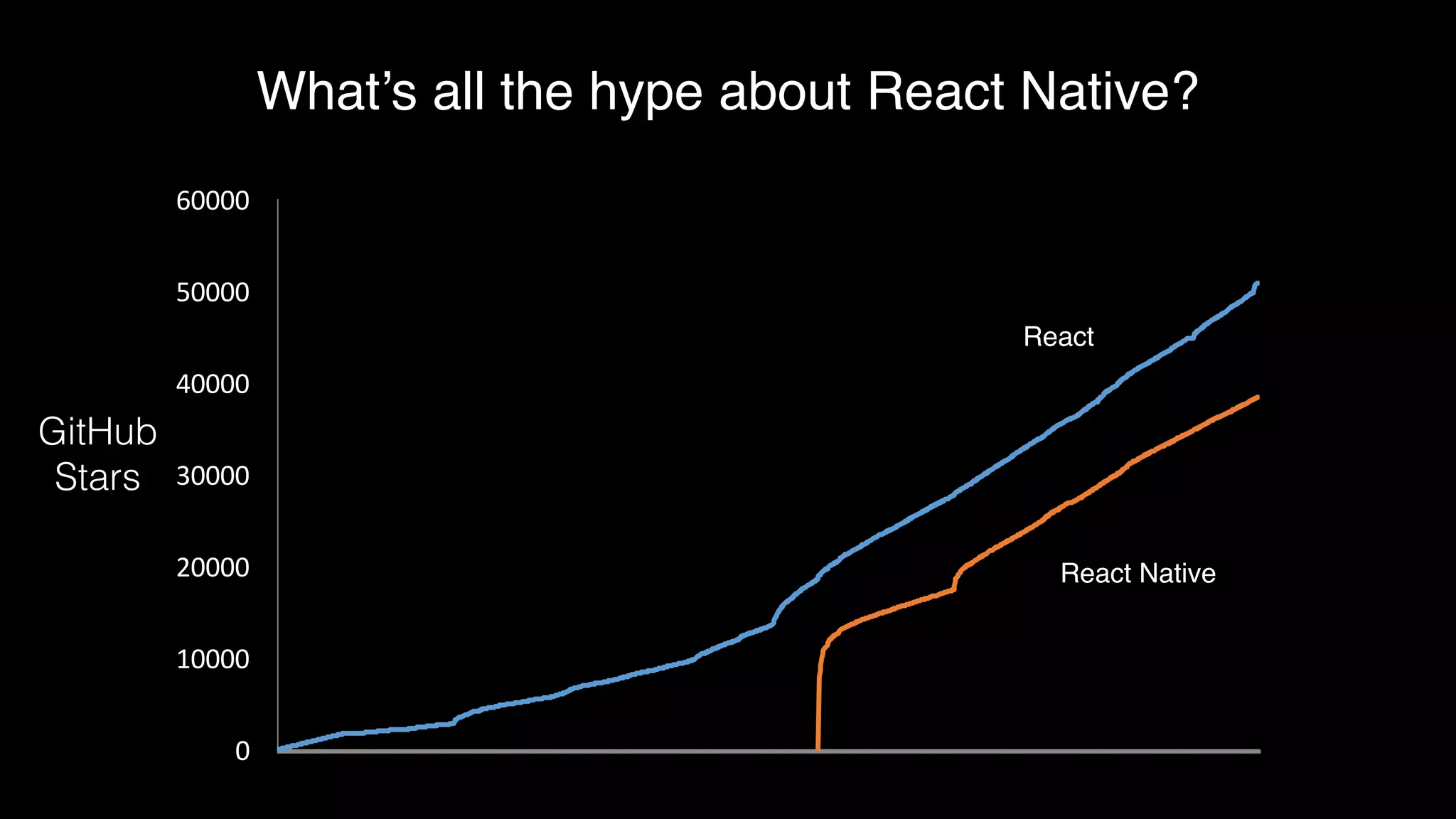
What’s all the hype about React Native?
React
0
10000
20000
30000
40000
50000
60000
1
21
41
61
81
101
121
141
161
181
201
221
241
261
281
301
321
341
361
381
401
421
441
461
481
501
521
541
561
581
601
621
641
661
681
701
721
741
761
781
801
821
841
861
881
901
921
941
961
981
1001
1021
1041
1061
1081
1101
1121
1141
1161
1181
1201
1221
1241
React Native
GitHub
Stars
What’s all the hype about React Native?
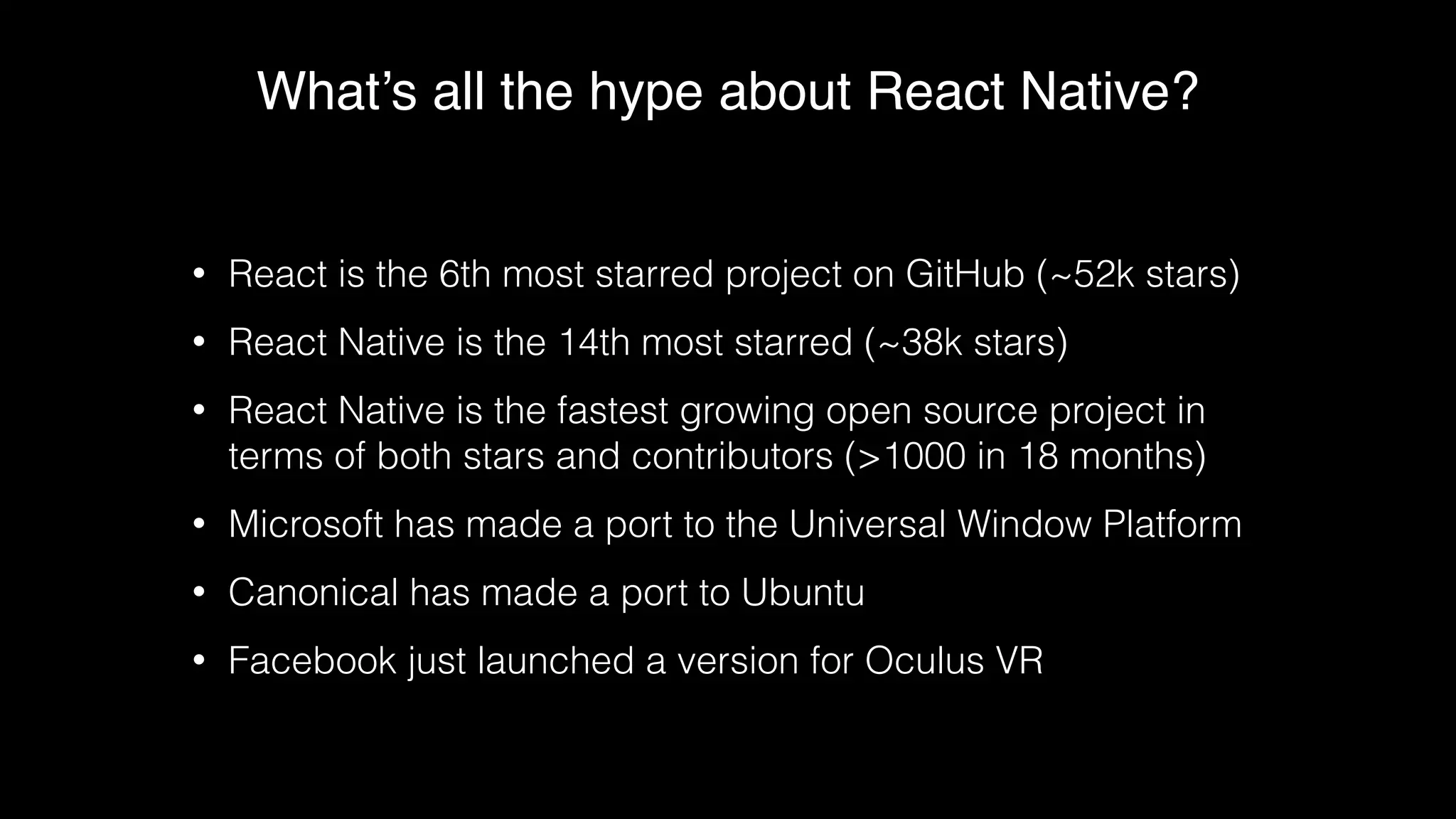
• React is the 6th most starred project on GitHub (~52k stars)
• React Native is the 14th most starred (~38k stars)
• React Native is the fastest growing open source project in
terms of both stars and contributors (>1000 in 18 months)
• Microsoft has made a port to the Universal Window Platform
• Canonical has made a port to Ubuntu
• Facebook just launched a version for Oculus VR
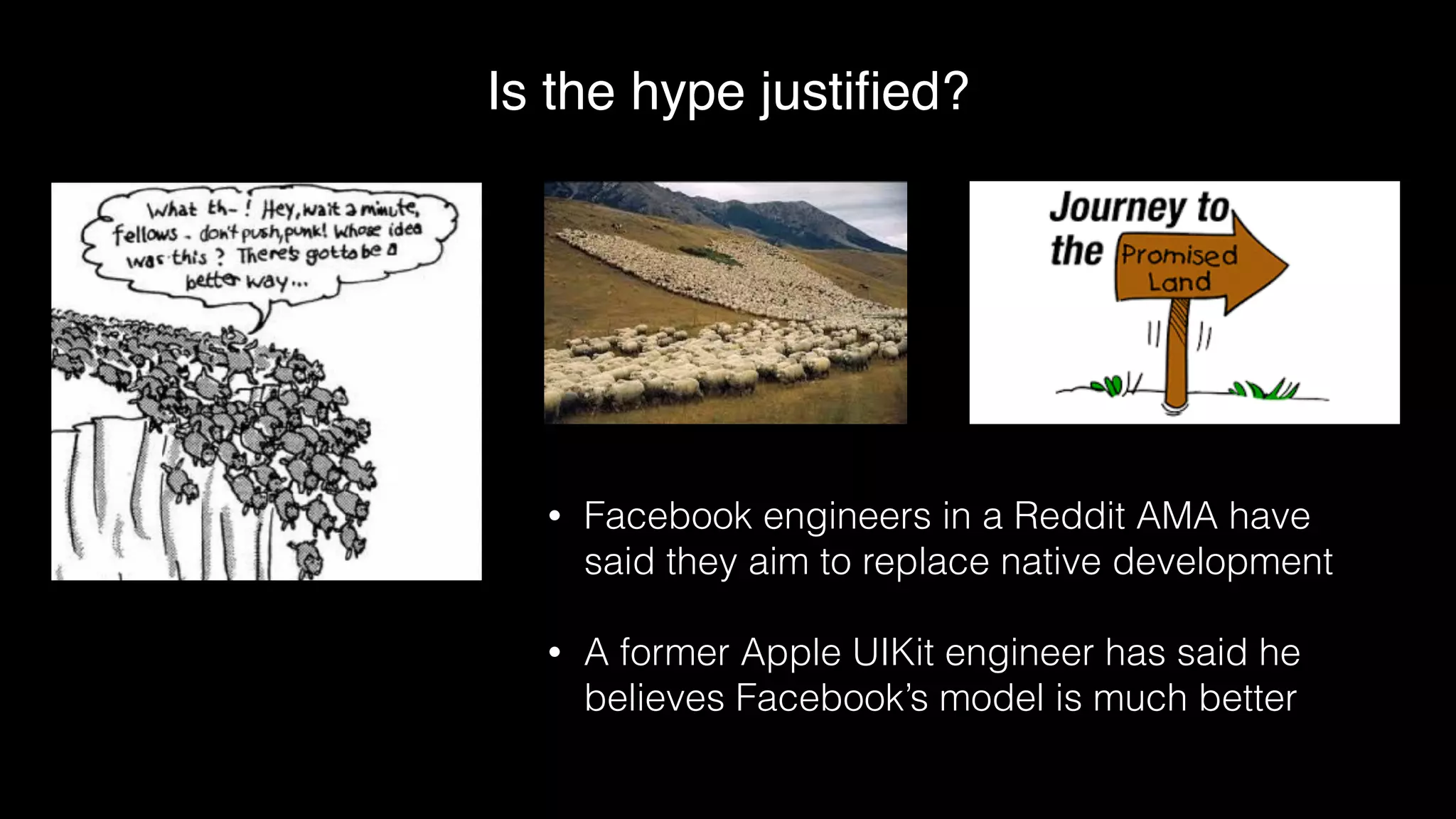
Is the hype justified?
• Facebook engineers in a Reddit AMA have
said they aim to replace native development
• A former Apple UIKit engineer has said he
believes Facebook’s model is much better
Can Facebook be trusted?
Closed
Can Facebook be trusted?
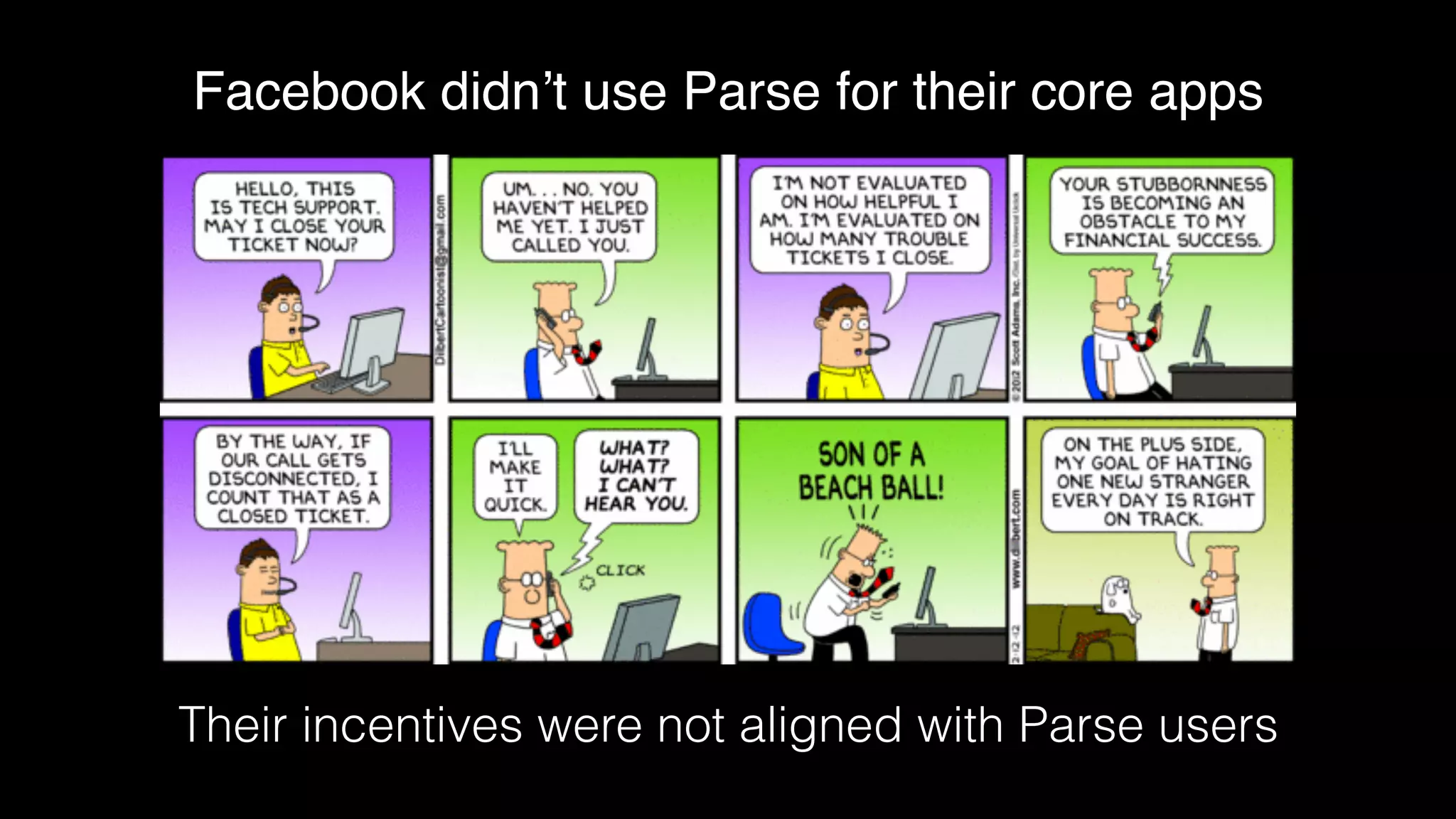
It’s all about incentives!
Facebook didn’t use Parse for their core apps
Their incentives were not aligned with Parse users
Facebook use React Native extensively in production
• They are deeply committed to React, it’s what most of their
web apps are built with
• React Native was used to build Facebook Ad Manager
• It was used for much of Facebook Groups
• Following the success of these early experiments, Facebook
is growing their React Native team and is deploying new
features with it on the main app and Instagram
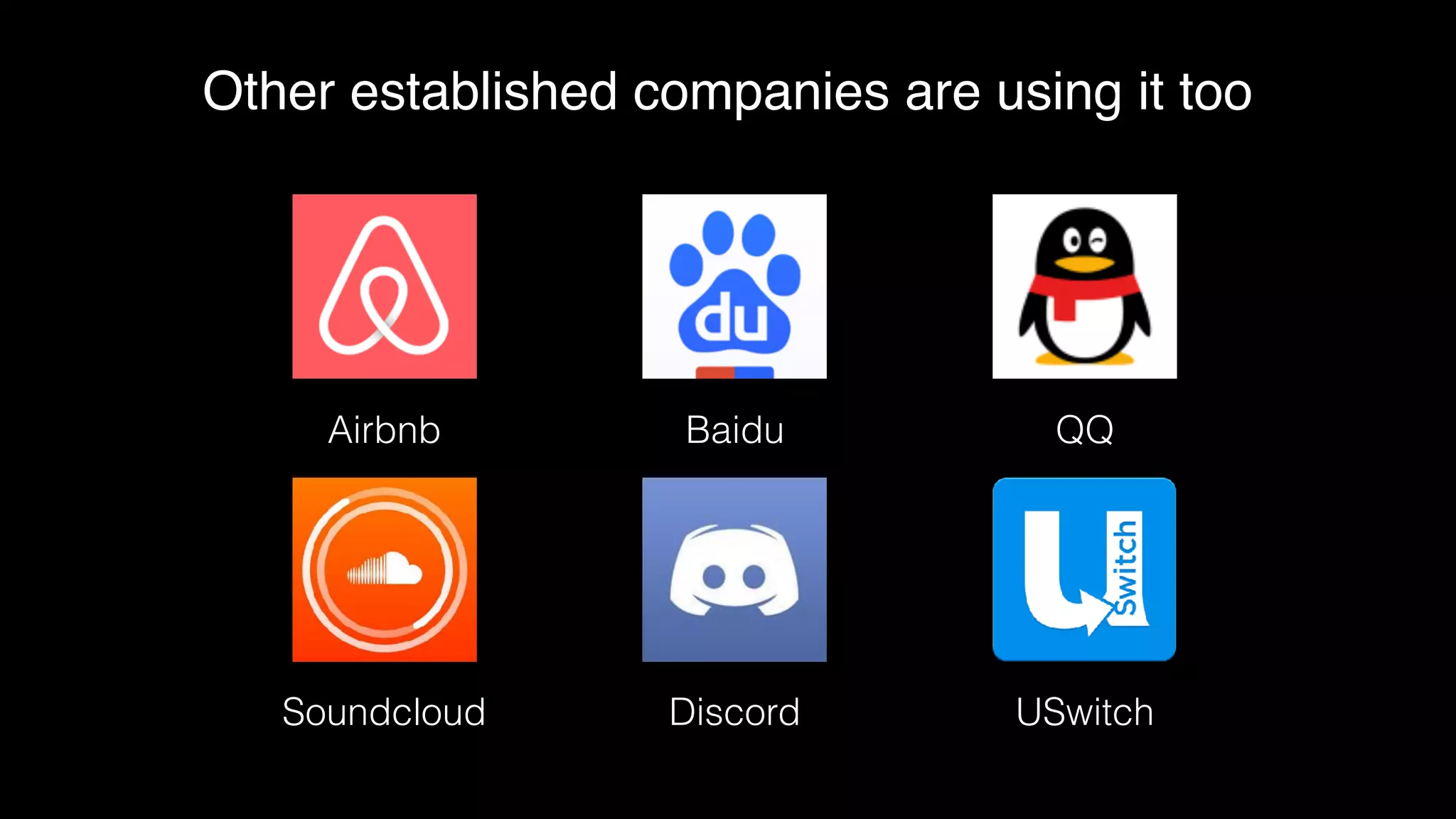
Other established companies are using it too
Airbnb Baidu QQ
Soundcloud Discord USwitch
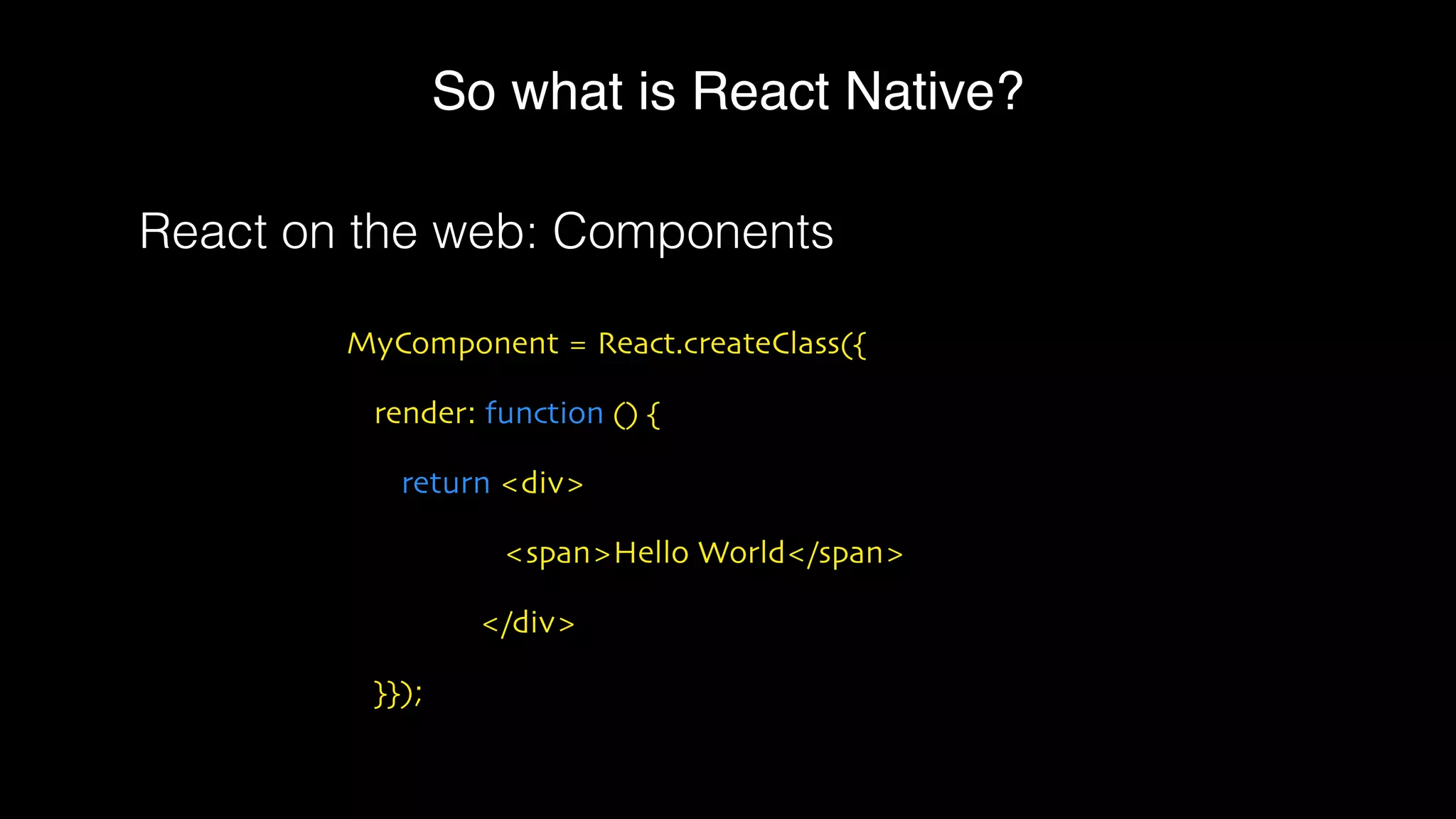
So what is React Native?
MyComponent = React.createClass({
render: function () {
return <div>
<span>Hello World</span>
</div>
}});
React on the web: Components
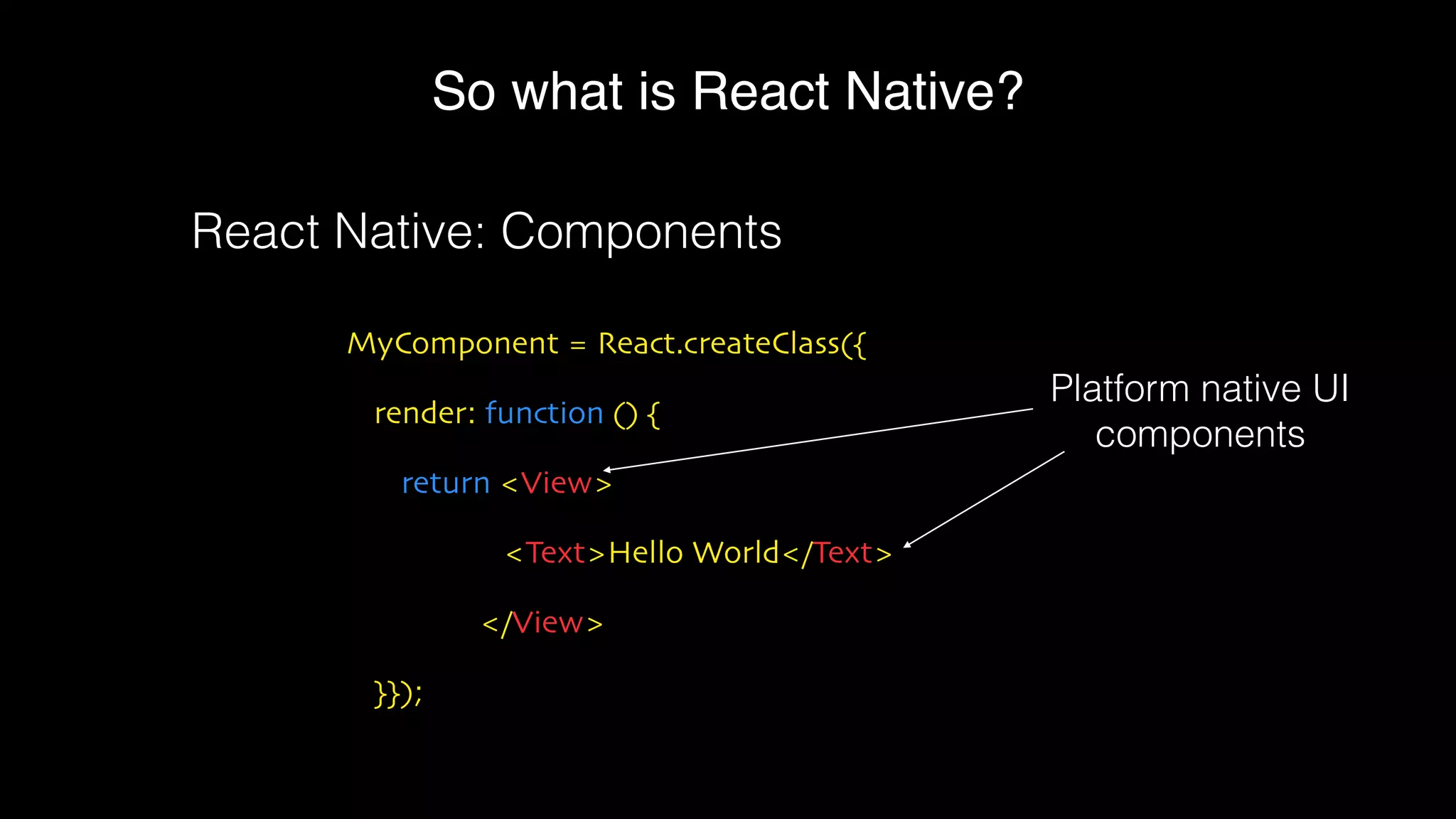
So what is React Native?
MyComponent = React.createClass({
render: function () {
return <View>
<Text>Hello World</Text>
</View>
}});
React Native: Components
Platform native UI
components
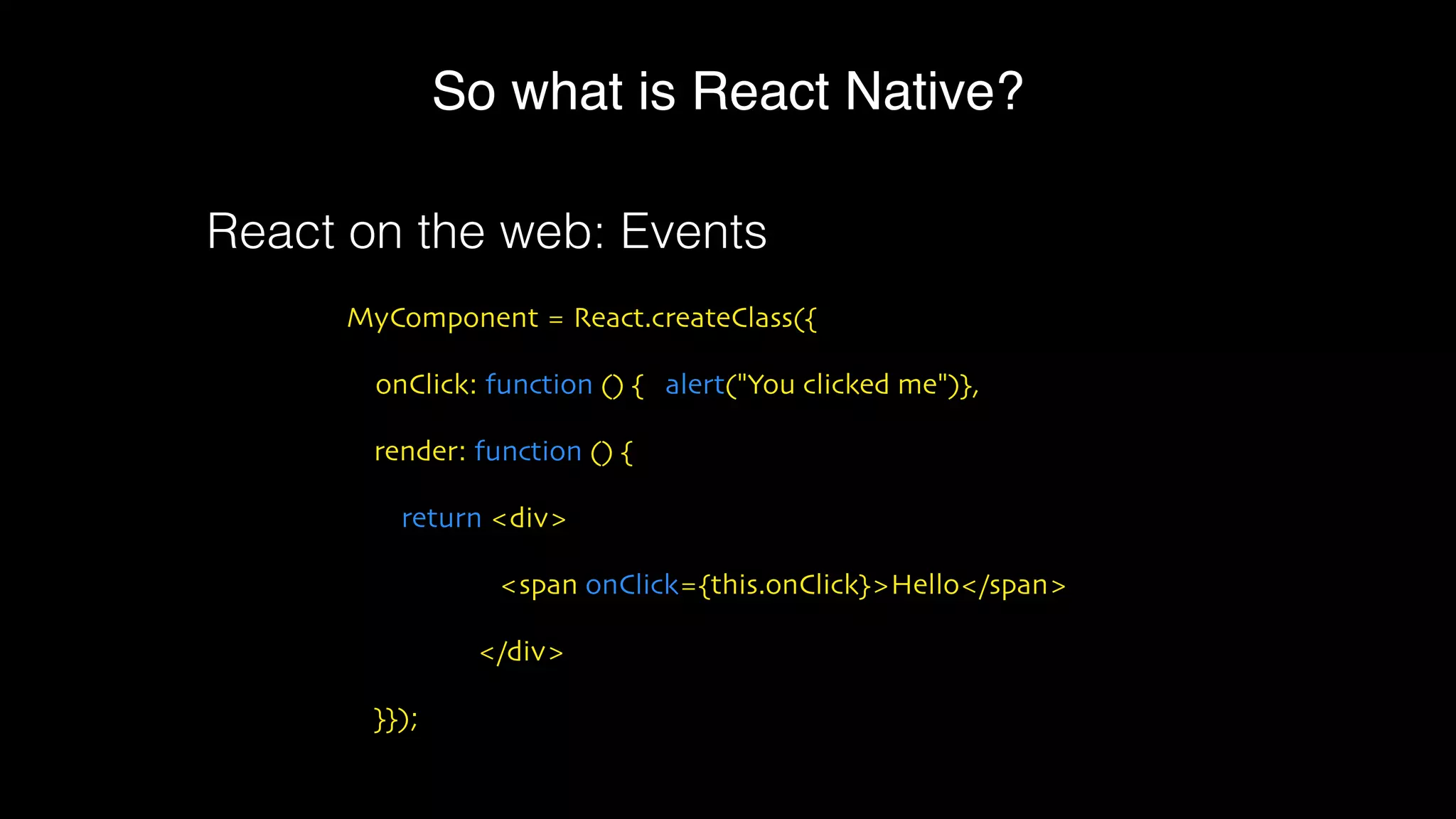
So what is React Native?
MyComponent = React.createClass({
onClick: function () { alert("You clicked me")},
render: function () {
return <div>
<span onClick={this.onClick}>Hello</span>
</div>
}});
React on the web: Events
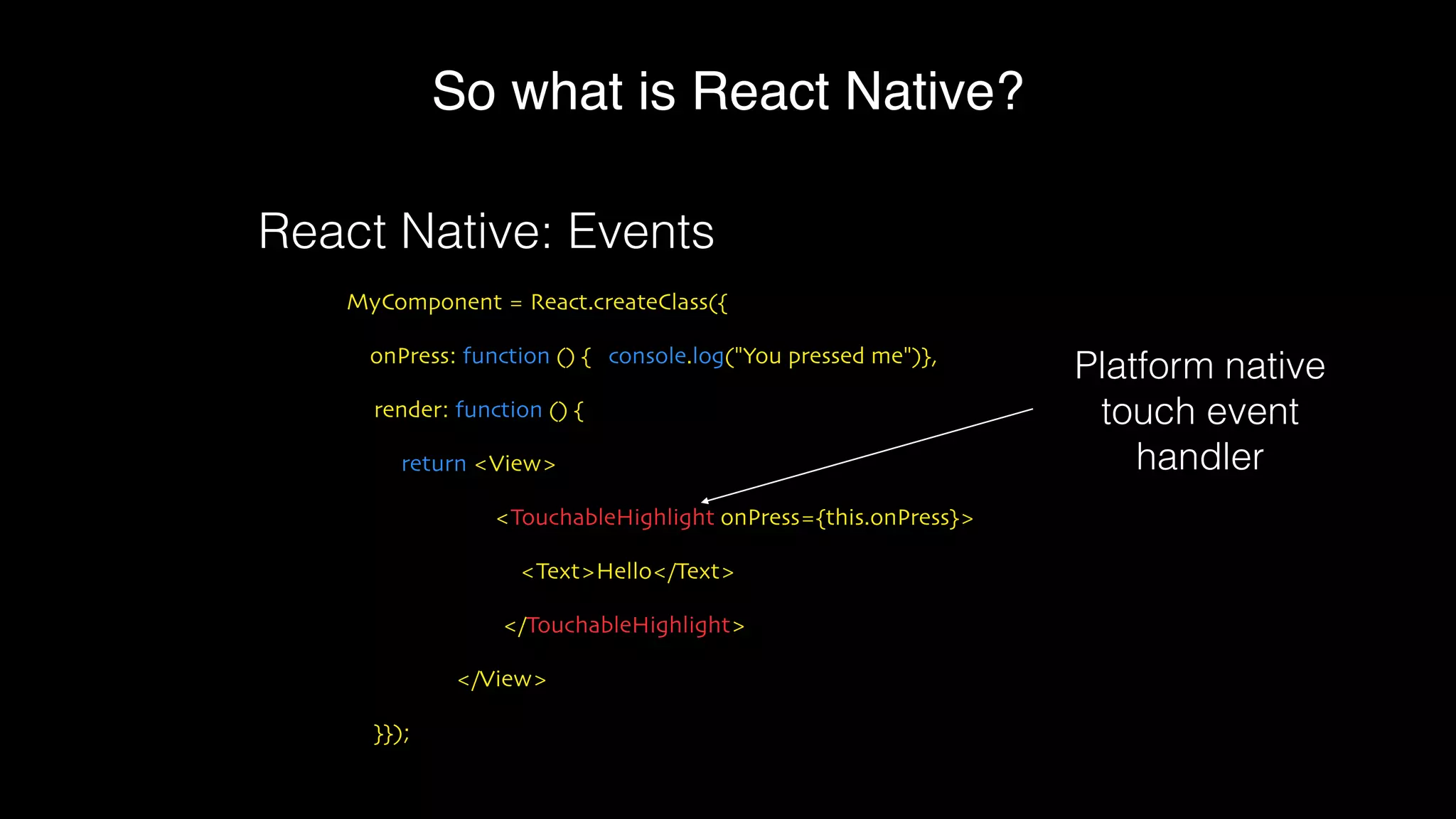
So what is React Native?
MyComponent = React.createClass({
onPress: function () { console.log("You pressed me")},
render: function () {
return <View>
<TouchableHighlight onPress={this.onPress}>
<Text>Hello</Text>
</TouchableHighlight>
</View>
}});
React Native: Events
Platform native
touch event
handler
So what is React Native?
MyComponent = React.createClass({
render: function () {
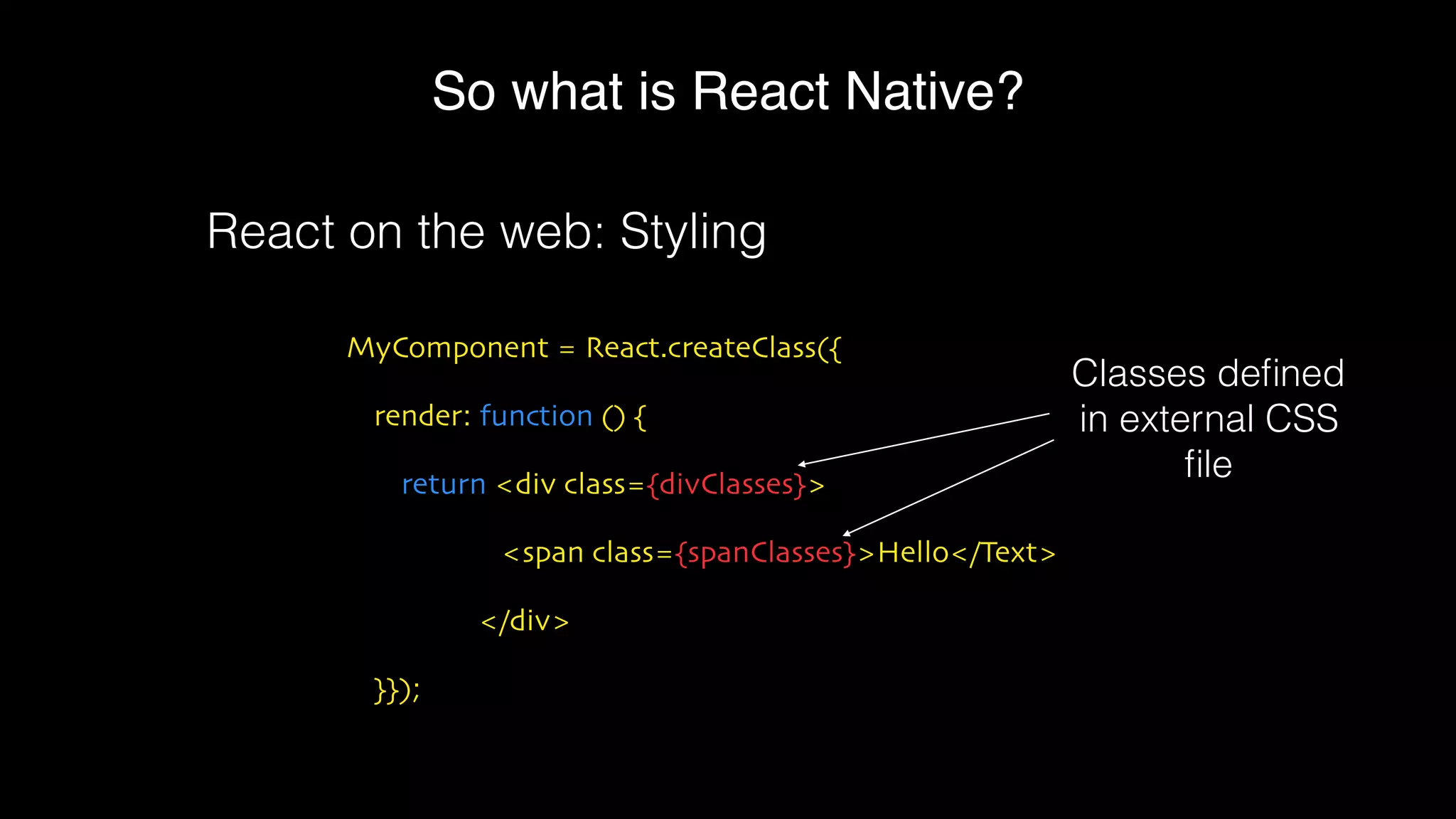
return <div class={divClasses}>
<span class={spanClasses}>Hello</Text>
</div>
}});
React on the web: Styling
Classes defined
in external CSS
file
So what is React Native?
MyComponent = React.createClass({
render: function () {
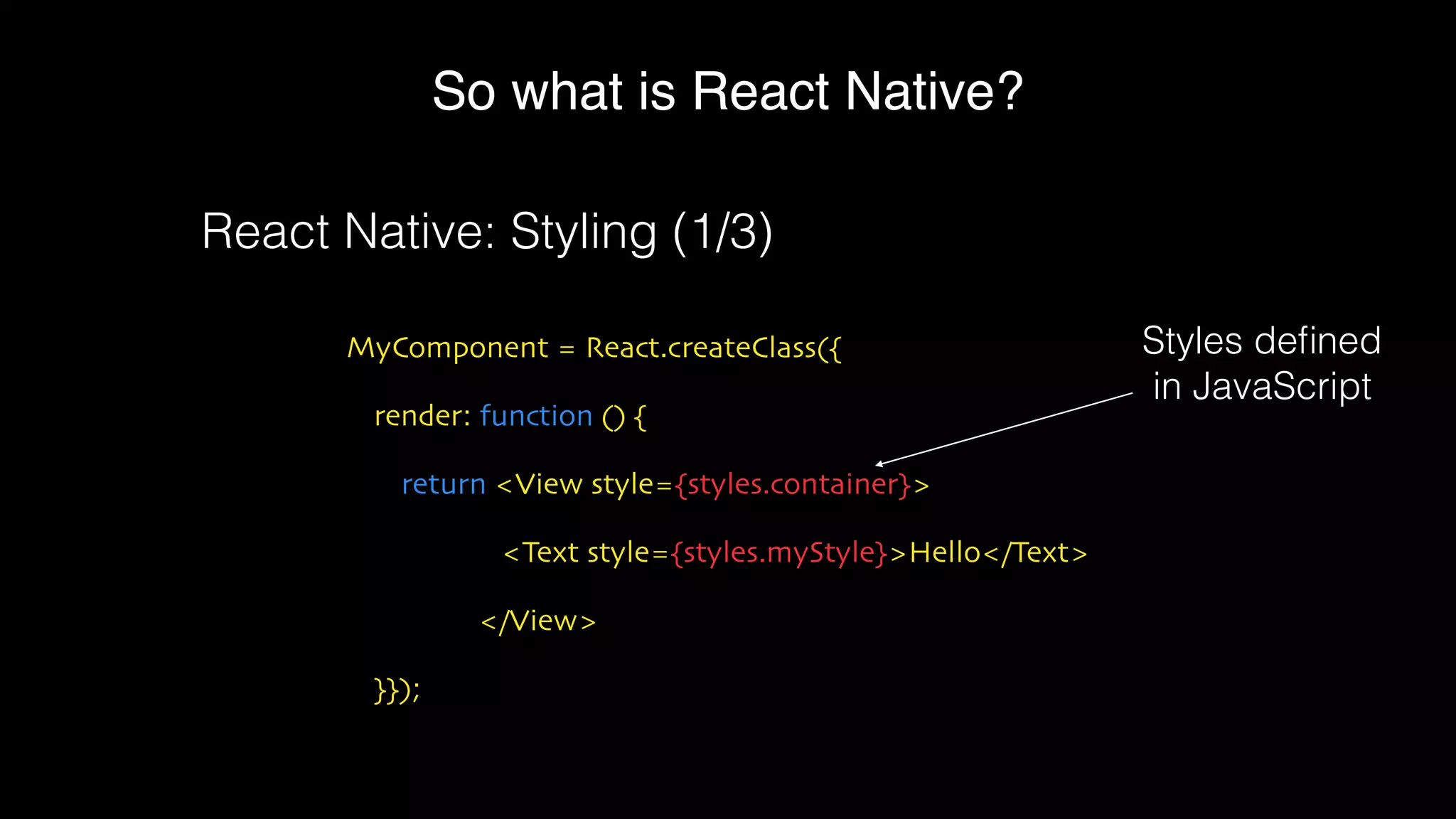
return <View style={styles.container}>
<Text style={styles.myStyle}>Hello</Text>
</View>
}});
React Native: Styling (1/3)
Styles defined
in JavaScript
So what is React Native?
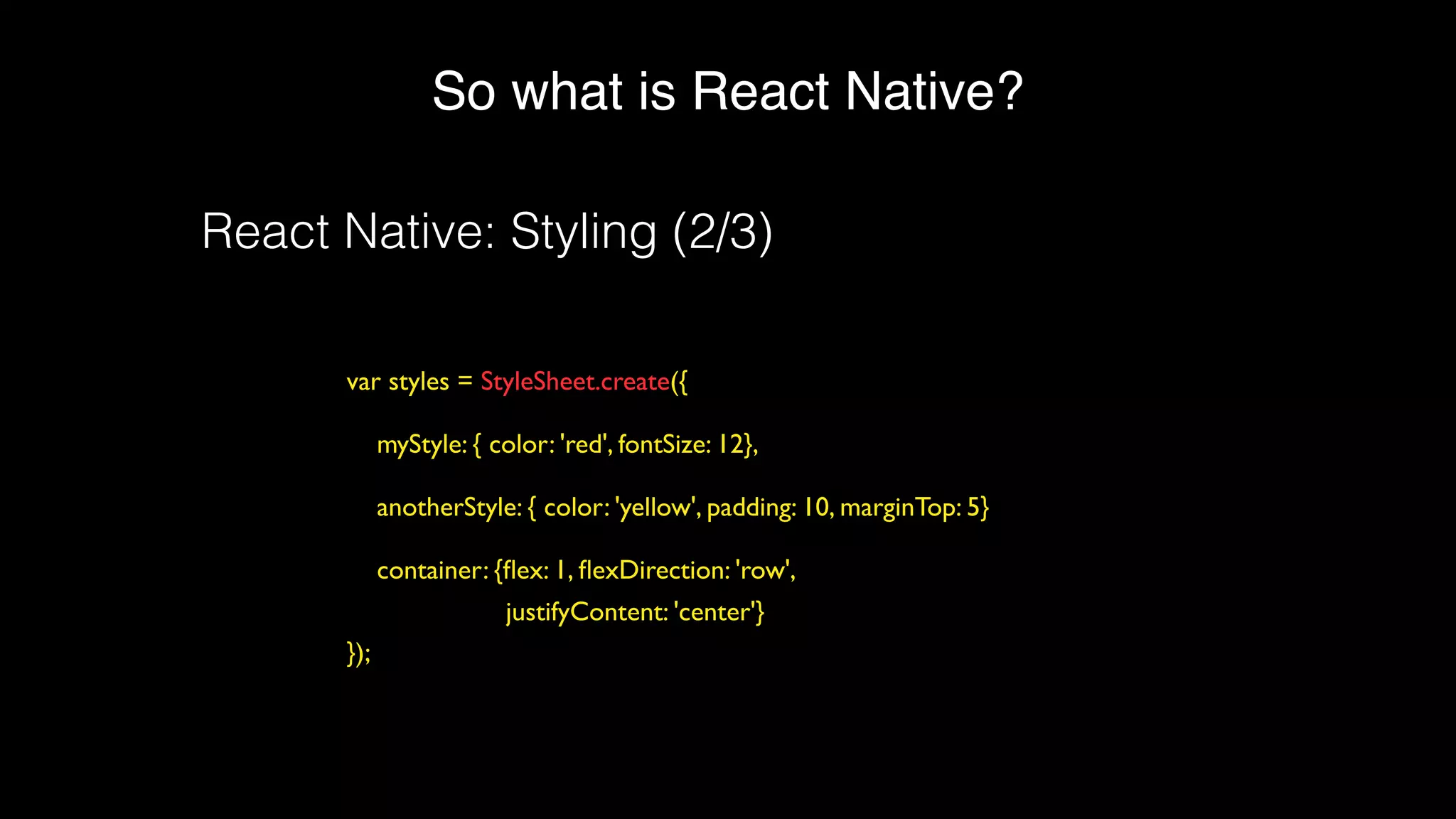
var styles = StyleSheet.create({
myStyle: { color: 'red', fontSize: 12},
anotherStyle: { color: 'yellow', padding: 10, marginTop: 5}
container: {flex: 1, flexDirection: 'row',
justifyContent: 'center'}
});
React Native: Styling (2/3)
So what is React Native?
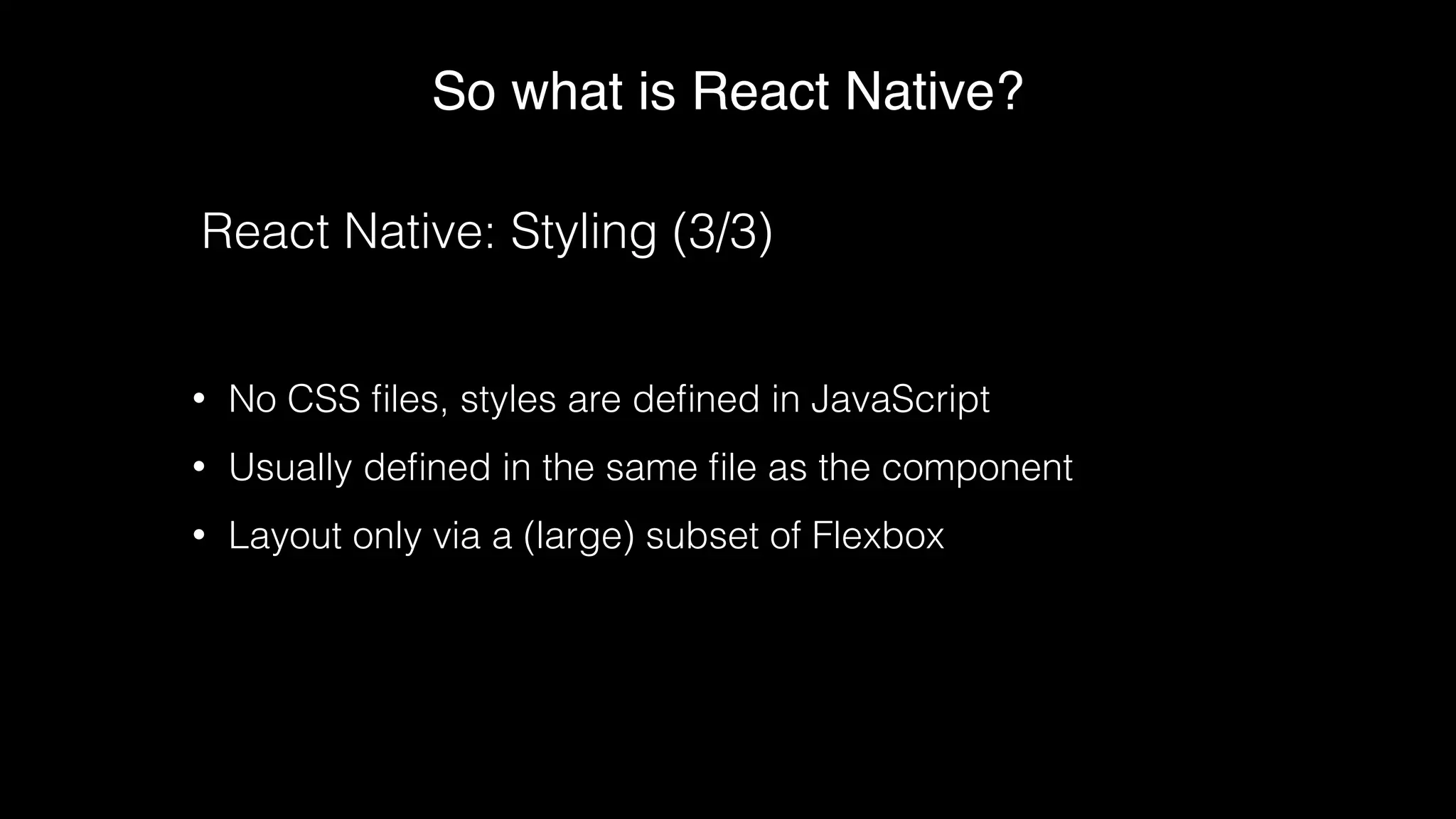
React Native: Styling (3/3)
• No CSS files, styles are defined in JavaScript
• Usually defined in the same file as the component
• Layout only via a (large) subset of Flexbox
How does it work?
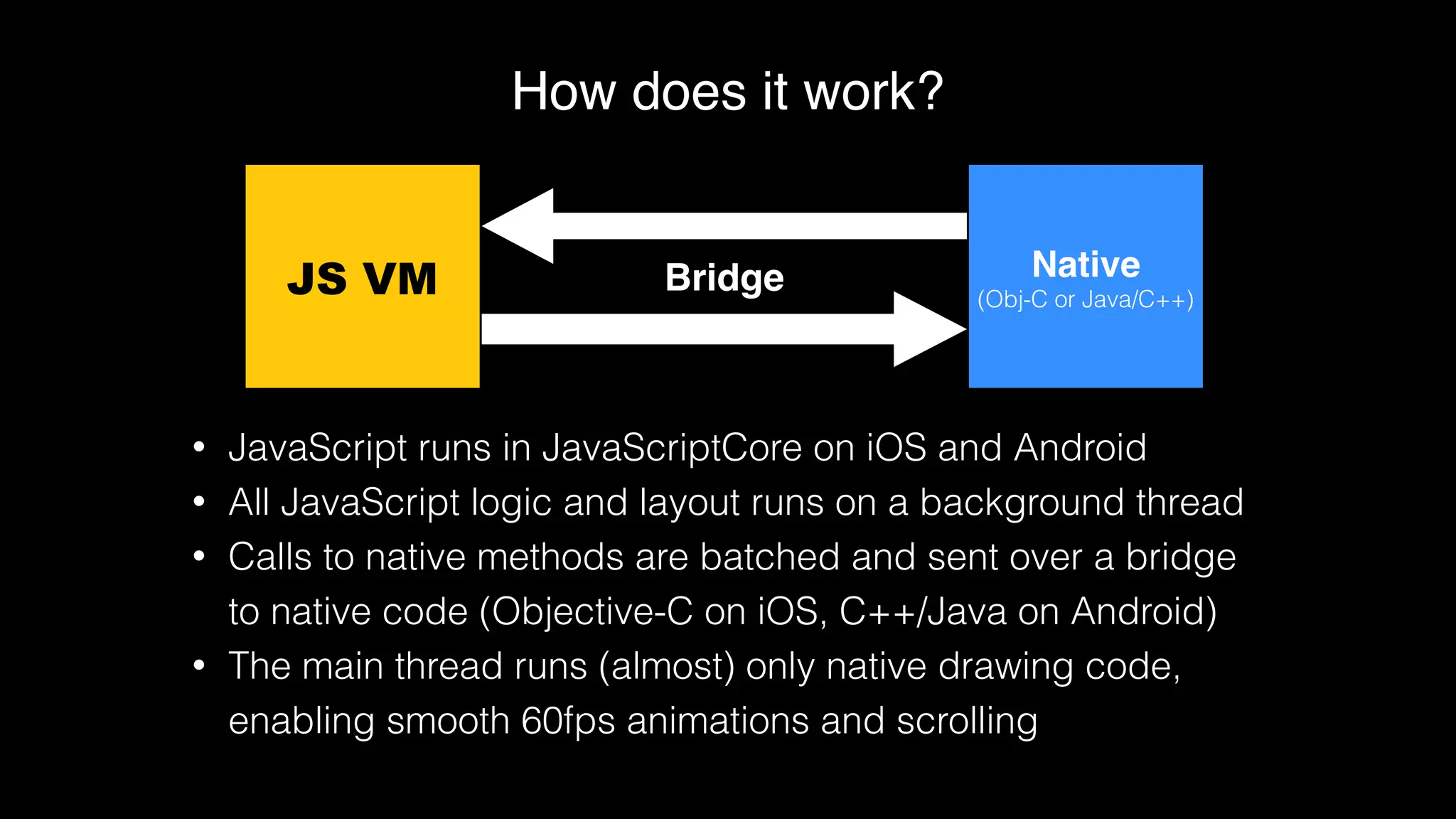
• JavaScript runs in JavaScriptCore on iOS and Android
• All JavaScript logic and layout runs on a background thread
• Calls to native methods are batched and sent over a bridge
to native code (Objective-C on iOS, C++/Java on Android)
• The main thread runs (almost) only native drawing code,
enabling smooth 60fps animations and scrolling
Native
(Obj-C or Java/C++)
JS VM Bridge
How does it work?
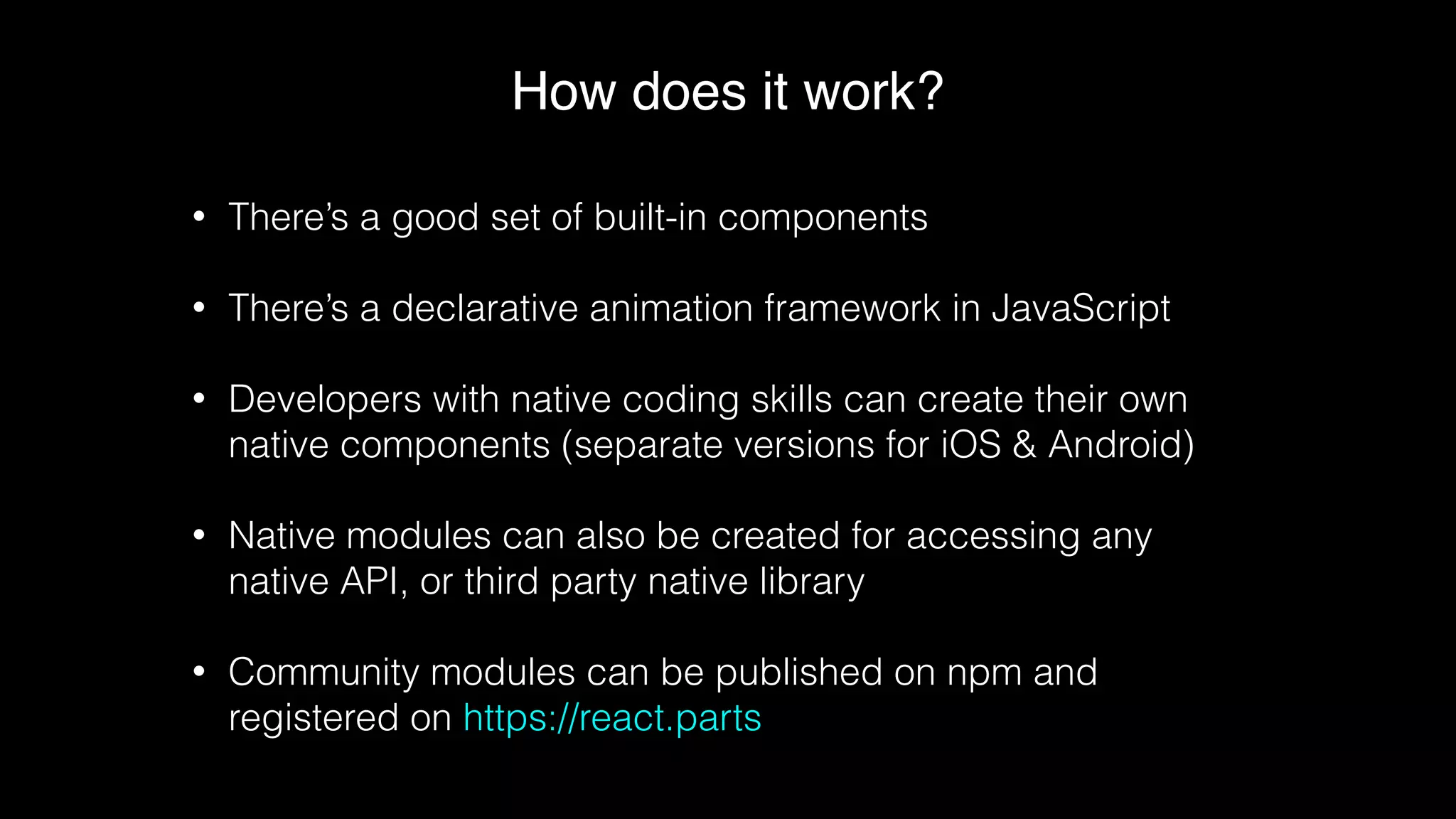
• There’s a good set of built-in components
• There’s a declarative animation framework in JavaScript
• Developers with native coding skills can create their own
native components (separate versions for iOS & Android)
• Native modules can also be created for accessing any
native API, or third party native library
• Community modules can be published on npm and
registered on https://react.parts
Why does it matter?
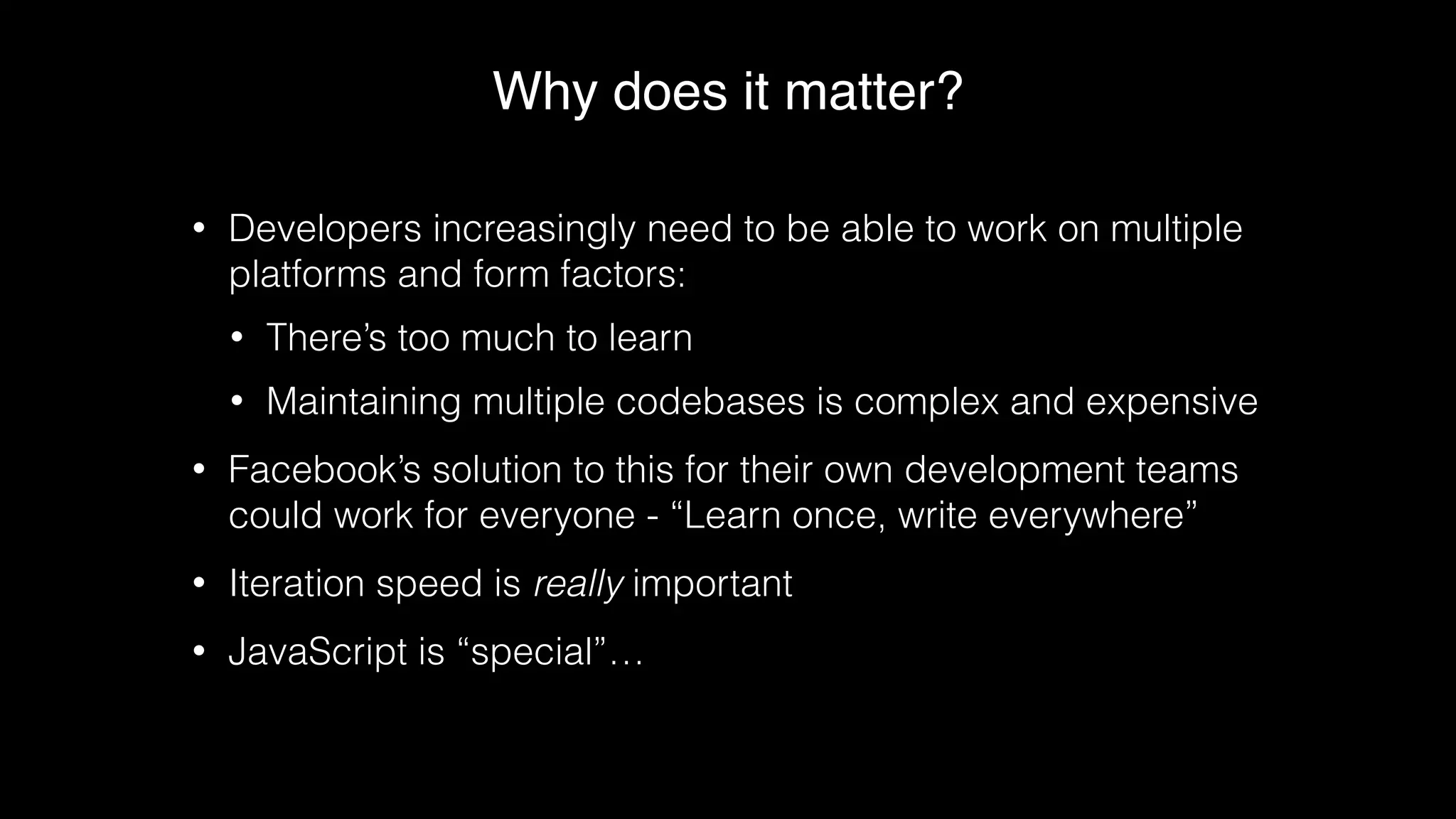
• Developers increasingly need to be able to work on multiple
platforms and form factors:
• There’s too much to learn
• Maintaining multiple codebases is complex and expensive
• Facebook’s solution to this for their own development teams
could work for everyone - “Learn once, write everywhere”
• Iteration speed is really important
• JavaScript is “special”…
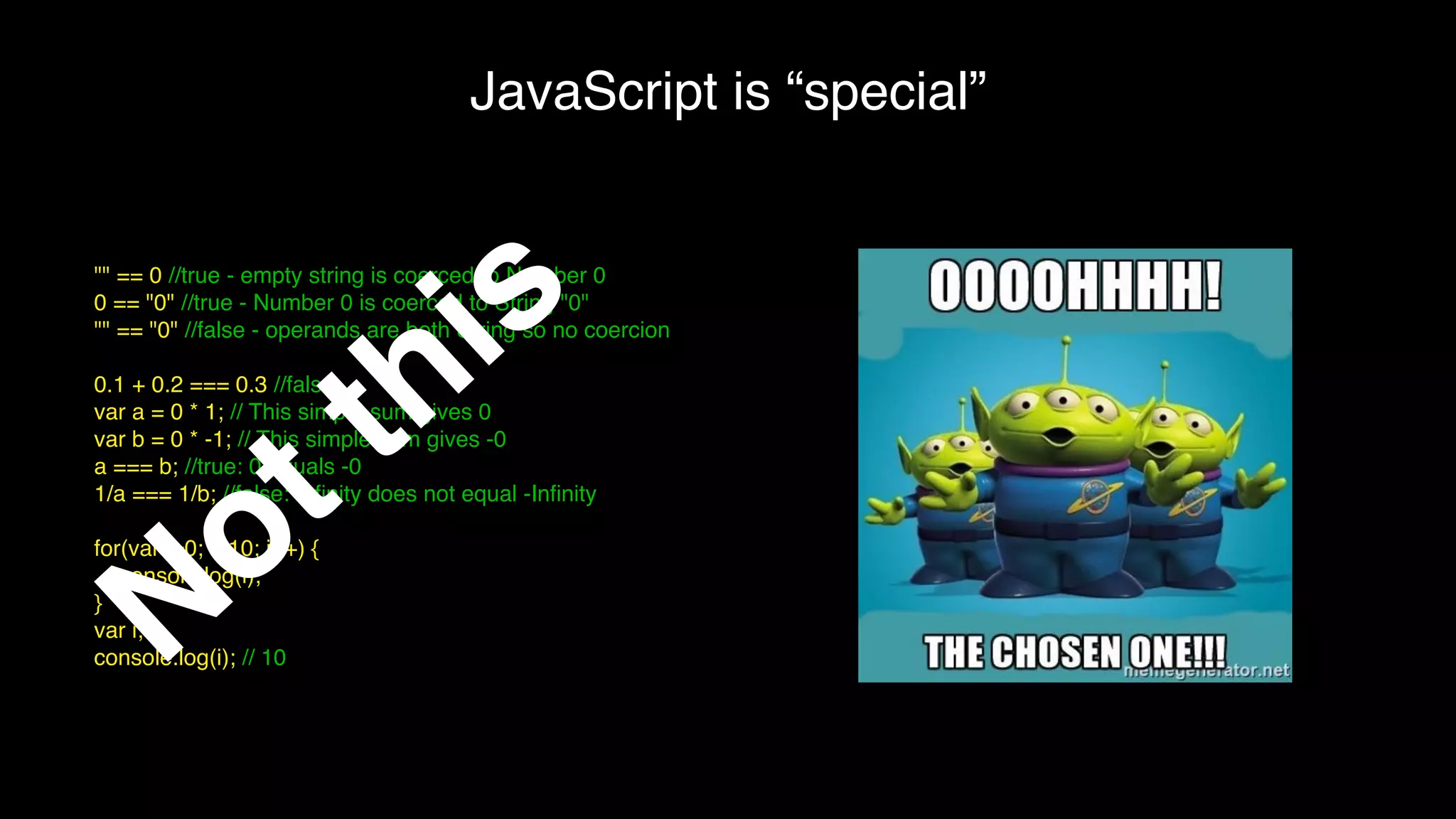
JavaScript is “special”
"" == 0 //true - empty string is coerced to Number 0
0 == "0" //true - Number 0 is coerced to String "0"
"" == "0" //false - operands are both String so no coercion
0.1 + 0.2 === 0.3 //false
var a = 0 * 1; // This simple sum gives 0
var b = 0 * -1; // This simple sum gives -0
a === b; //true: 0 equals -0
1/a === 1/b; //false: Infinity does not equal -Infinity
for(var i=0; i<10; i++) {
console.log(i);
}
var i;
console.log(i); // 10Not this
JavaScript is “special”
• JavaScript, and transpiled to JavaScript languages, are the
only choice on the web
• JavaScript is one of very few languages you can run on
almost all platforms outside the browser
• JavaScript is the only language you can download to iOS
devices to update apps outside the App Store
• So… JavaScript is the best suited language for iterating
quickly across multiple platforms - good job it evolving now
The future of web technology?
• Some of the React Native team have described what they’re
doing as building polyfills for web standards that haven’t
been fully developed yet
• This fits with the way other areas of web technology evolve
now, like JavaScript itself and Babel, or TypeScript / Flow
• Despite suggestions that React and Web Components are
competitors, they are complementary and compatible
• If we could create low-level components for mobile web apps
that were not tied to the DOM, what would they look like?
React Native for Web!
• Wait! Surely we already have React for the web?
• The low-level building blocks for React & React Native apps
are different, so a implementing the React Native primitives
helps make code portable, but…
• Twitter engineers weren’t actively deploying React Native
apps when they created React Native for Web
• They found that React Native’s consistent approach to style,
animation, touch, viewport adaptation, accessibility, themes &
RTL layout helped solve problems in their web apps
What’s wrong with React Native?
• Nothing’s perfect
• React Native is not great for teams with no native developers
(or people willing to learn) yet
• React Native is still evolving very fast and it can be quite a lot
of effort to keep up with the latest changes
• There are lots of 3rd party modules of poor quality - it’s not
easy to tell until you start to use them, unless you’re an
experienced native developer
• There are issues with animations synced with system
animations (e.g. keyboard sliding in from the bottom)
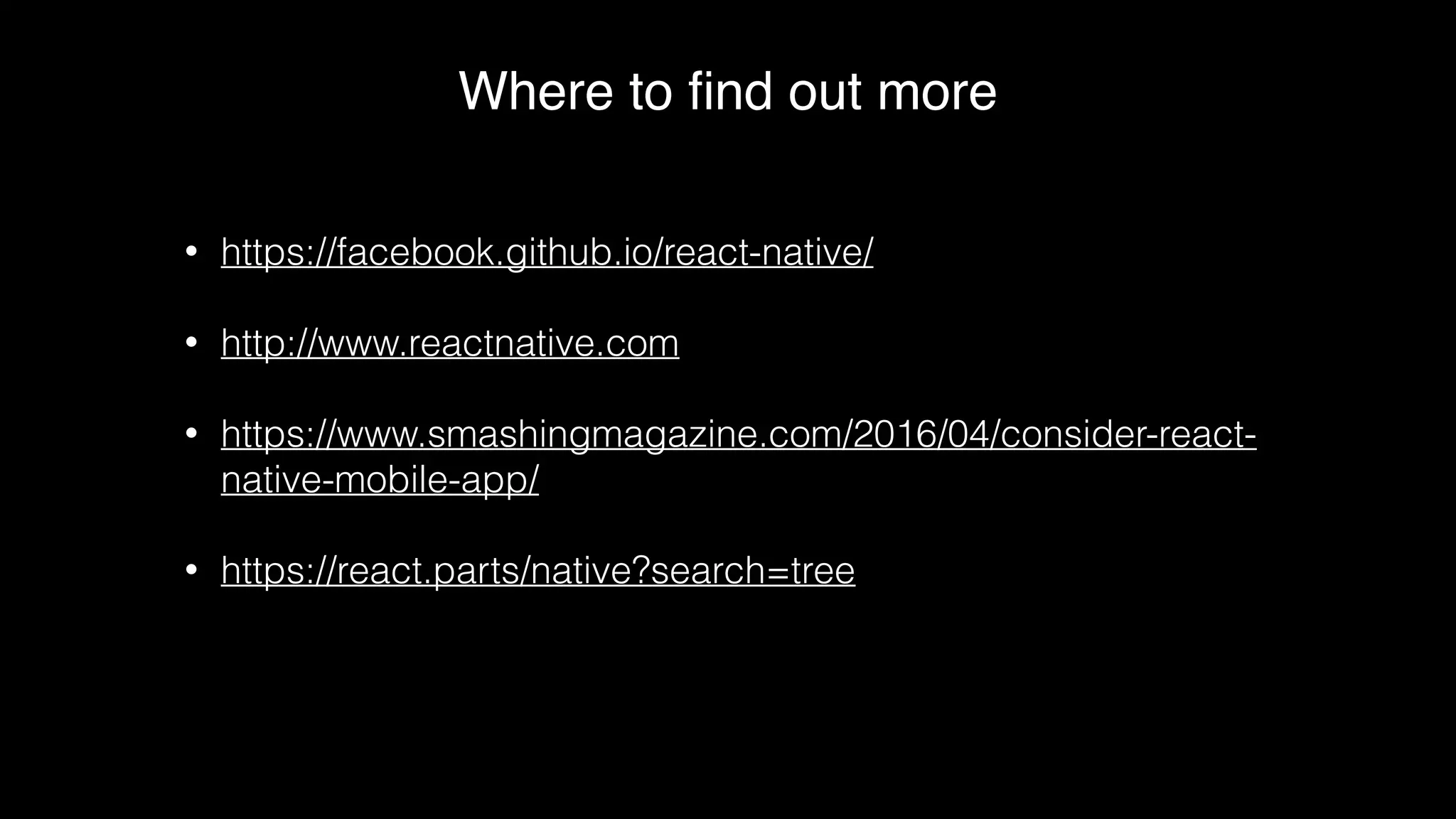
Where to find out more
• https://facebook.github.io/react-native/
• http://www.reactnative.com
• https://www.smashingmagazine.com/2016/04/consider-react-
native-mobile-app/
• https://react.parts/native?search=tree
Questions?

React Native and the future of web technology (Mark Wilcox) - GreeceJS #15

  • 1.
    React Native & theFuture of Web Technology Mark Wilcox - Senior Analyst & Technology Lead VisionMobile
  • 2.
    What’s all thehype about React Native? React 0 10000 20000 30000 40000 50000 60000 1 21 41 61 81 101 121 141 161 181 201 221 241 261 281 301 321 341 361 381 401 421 441 461 481 501 521 541 561 581 601 621 641 661 681 701 721 741 761 781 801 821 841 861 881 901 921 941 961 981 1001 1021 1041 1061 1081 1101 1121 1141 1161 1181 1201 1221 1241 React Native GitHub Stars
  • 3.
    What’s all thehype about React Native? • React is the 6th most starred project on GitHub (~52k stars) • React Native is the 14th most starred (~38k stars) • React Native is the fastest growing open source project in terms of both stars and contributors (>1000 in 18 months) • Microsoft has made a port to the Universal Window Platform • Canonical has made a port to Ubuntu • Facebook just launched a version for Oculus VR
  • 4.
    Is the hypejustified? • Facebook engineers in a Reddit AMA have said they aim to replace native development • A former Apple UIKit engineer has said he believes Facebook’s model is much better
  • 5.
    Can Facebook betrusted? Closed
  • 6.
    Can Facebook betrusted? It’s all about incentives!
  • 7.
    Facebook didn’t useParse for their core apps Their incentives were not aligned with Parse users
  • 8.
    Facebook use ReactNative extensively in production • They are deeply committed to React, it’s what most of their web apps are built with • React Native was used to build Facebook Ad Manager • It was used for much of Facebook Groups • Following the success of these early experiments, Facebook is growing their React Native team and is deploying new features with it on the main app and Instagram
  • 9.
    Other established companiesare using it too Airbnb Baidu QQ Soundcloud Discord USwitch
  • 10.
    So what isReact Native? MyComponent = React.createClass({ render: function () { return <div> <span>Hello World</span> </div> }}); React on the web: Components
  • 11.
    So what isReact Native? MyComponent = React.createClass({ render: function () { return <View> <Text>Hello World</Text> </View> }}); React Native: Components Platform native UI components
  • 12.
    So what isReact Native? MyComponent = React.createClass({ onClick: function () { alert("You clicked me")}, render: function () { return <div> <span onClick={this.onClick}>Hello</span> </div> }}); React on the web: Events
  • 13.
    So what isReact Native? MyComponent = React.createClass({ onPress: function () { console.log("You pressed me")}, render: function () { return <View> <TouchableHighlight onPress={this.onPress}> <Text>Hello</Text> </TouchableHighlight> </View> }}); React Native: Events Platform native touch event handler
  • 14.
    So what isReact Native? MyComponent = React.createClass({ render: function () { return <div class={divClasses}> <span class={spanClasses}>Hello</Text> </div> }}); React on the web: Styling Classes defined in external CSS file
  • 15.
    So what isReact Native? MyComponent = React.createClass({ render: function () { return <View style={styles.container}> <Text style={styles.myStyle}>Hello</Text> </View> }}); React Native: Styling (1/3) Styles defined in JavaScript
  • 16.
    So what isReact Native? var styles = StyleSheet.create({ myStyle: { color: 'red', fontSize: 12}, anotherStyle: { color: 'yellow', padding: 10, marginTop: 5} container: {flex: 1, flexDirection: 'row', justifyContent: 'center'} }); React Native: Styling (2/3)
  • 17.
    So what isReact Native? React Native: Styling (3/3) • No CSS files, styles are defined in JavaScript • Usually defined in the same file as the component • Layout only via a (large) subset of Flexbox
  • 18.
    How does itwork? • JavaScript runs in JavaScriptCore on iOS and Android • All JavaScript logic and layout runs on a background thread • Calls to native methods are batched and sent over a bridge to native code (Objective-C on iOS, C++/Java on Android) • The main thread runs (almost) only native drawing code, enabling smooth 60fps animations and scrolling Native (Obj-C or Java/C++) JS VM Bridge
  • 19.
    How does itwork? • There’s a good set of built-in components • There’s a declarative animation framework in JavaScript • Developers with native coding skills can create their own native components (separate versions for iOS & Android) • Native modules can also be created for accessing any native API, or third party native library • Community modules can be published on npm and registered on https://react.parts
  • 20.
    Why does itmatter? • Developers increasingly need to be able to work on multiple platforms and form factors: • There’s too much to learn • Maintaining multiple codebases is complex and expensive • Facebook’s solution to this for their own development teams could work for everyone - “Learn once, write everywhere” • Iteration speed is really important • JavaScript is “special”…
  • 21.
    JavaScript is “special” ""== 0 //true - empty string is coerced to Number 0 0 == "0" //true - Number 0 is coerced to String "0" "" == "0" //false - operands are both String so no coercion 0.1 + 0.2 === 0.3 //false var a = 0 * 1; // This simple sum gives 0 var b = 0 * -1; // This simple sum gives -0 a === b; //true: 0 equals -0 1/a === 1/b; //false: Infinity does not equal -Infinity for(var i=0; i<10; i++) { console.log(i); } var i; console.log(i); // 10Not this
  • 22.
    JavaScript is “special” •JavaScript, and transpiled to JavaScript languages, are the only choice on the web • JavaScript is one of very few languages you can run on almost all platforms outside the browser • JavaScript is the only language you can download to iOS devices to update apps outside the App Store • So… JavaScript is the best suited language for iterating quickly across multiple platforms - good job it evolving now
  • 23.
    The future ofweb technology? • Some of the React Native team have described what they’re doing as building polyfills for web standards that haven’t been fully developed yet • This fits with the way other areas of web technology evolve now, like JavaScript itself and Babel, or TypeScript / Flow • Despite suggestions that React and Web Components are competitors, they are complementary and compatible • If we could create low-level components for mobile web apps that were not tied to the DOM, what would they look like?
  • 24.
    React Native forWeb! • Wait! Surely we already have React for the web? • The low-level building blocks for React & React Native apps are different, so a implementing the React Native primitives helps make code portable, but… • Twitter engineers weren’t actively deploying React Native apps when they created React Native for Web • They found that React Native’s consistent approach to style, animation, touch, viewport adaptation, accessibility, themes & RTL layout helped solve problems in their web apps
  • 25.
    What’s wrong withReact Native? • Nothing’s perfect • React Native is not great for teams with no native developers (or people willing to learn) yet • React Native is still evolving very fast and it can be quite a lot of effort to keep up with the latest changes • There are lots of 3rd party modules of poor quality - it’s not easy to tell until you start to use them, unless you’re an experienced native developer • There are issues with animations synced with system animations (e.g. keyboard sliding in from the bottom)
  • 26.
    Where to findout more • https://facebook.github.io/react-native/ • http://www.reactnative.com • https://www.smashingmagazine.com/2016/04/consider-react- native-mobile-app/ • https://react.parts/native?search=tree
  • 27.