Unit 8- Imperialism
 I. Roosevelt’s Foreign Policy
 A. Panama Canal
 Panama was a territory of Columbia-
negotiations broke down for a canal
 US helped Panama fight for independence
 15 days later, US payed Panama $10M plus
$.25M/year in land rental fees for the canal
 B. Russo-Japanese War
 Russia and Japan were competing for Korea
 Japan won several battles, but were running
out of men and money
 Japan asked TR to mediate- he helped
negotiate a treaty on his Pres. Yacht in NH
 TR won the Nobel Peace Prize in 1906
 C. Roosevelt Corollary
 Monroe Doctrine (1823) demanded that
Europe stay out of Latin American affairs
 TR added his corollary in 1904 saying that US
would use force to protect its LA interests
 “Speak softly and carry a big stick; you will go
far” (Big Stick Diplomacy)
 II. Dollar Diplomacy- The US government
guaranteed loans to foreign countries by American
businesspeople (Taft)
 Kept Europe out of Latin America
 III. Missionary Diplomacy- Wilson believed the
US had a moral duty to ignore LA countries that
were not democracies
 A. Mexican Revolution- Political unrest in
Mexico threatened US investments and
diplomacy
 B. US and Mexico came close to war
 C. Pancho Villa- Mexican rebel leader that
opposed new Mexican government
 Villa and his men killed several Americans in
Mexico that were operating mines
 They later killed 17 Americans in NM
 D. John J. Pershing- General sent by Wilson to
Mexico to find Villa dead or alive
 150,000 troops were sent to Mexican border
 US and Mexico almost went to war, US backed
down because of WWI
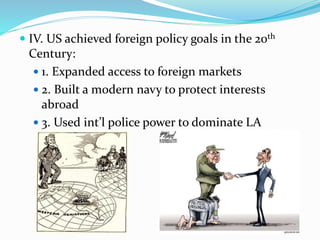
 IV. US achieved foreign policy goals in the 20th
Century:
 1. Expanded access to foreign markets
 2. Built a modern navy to protect interests
abroad
 3. Used int’l police power to dominate LA

Unit 8 notes 4

  • 1.
  • 2.
     I. Roosevelt’sForeign Policy  A. Panama Canal  Panama was a territory of Columbia- negotiations broke down for a canal  US helped Panama fight for independence  15 days later, US payed Panama $10M plus $.25M/year in land rental fees for the canal
  • 3.
     B. Russo-JapaneseWar  Russia and Japan were competing for Korea  Japan won several battles, but were running out of men and money  Japan asked TR to mediate- he helped negotiate a treaty on his Pres. Yacht in NH  TR won the Nobel Peace Prize in 1906
  • 4.
     C. RooseveltCorollary  Monroe Doctrine (1823) demanded that Europe stay out of Latin American affairs  TR added his corollary in 1904 saying that US would use force to protect its LA interests  “Speak softly and carry a big stick; you will go far” (Big Stick Diplomacy)
  • 5.
     II. DollarDiplomacy- The US government guaranteed loans to foreign countries by American businesspeople (Taft)  Kept Europe out of Latin America
  • 6.
     III. MissionaryDiplomacy- Wilson believed the US had a moral duty to ignore LA countries that were not democracies  A. Mexican Revolution- Political unrest in Mexico threatened US investments and diplomacy  B. US and Mexico came close to war
  • 7.
     C. PanchoVilla- Mexican rebel leader that opposed new Mexican government  Villa and his men killed several Americans in Mexico that were operating mines  They later killed 17 Americans in NM
  • 8.
     D. JohnJ. Pershing- General sent by Wilson to Mexico to find Villa dead or alive  150,000 troops were sent to Mexican border  US and Mexico almost went to war, US backed down because of WWI
  • 9.
     IV. USachieved foreign policy goals in the 20th Century:  1. Expanded access to foreign markets  2. Built a modern navy to protect interests abroad  3. Used int’l police power to dominate LA