MOUNT ZION COLLEGE OF ENGINEERING &
TECHNOLOGY
 PROJECT GUIDE -MS. MENAKA, M.TECH,
ASSISTANT PROFESSOR,
CIVIL DEPT,
MZCET.
 BATCH MEMBERS - L.ARUL PANDIAN
-P.ARUN PANDIYAN
-P.SHIVAJI
RCC BOX CULVERT
 ABSTRACT
 LITERATURE REVIEW
 ADVANTAGE
 METHODOLOGY
 PLAN
 DESIGN
 AUTOCADD DRAWING
 STADD PRO
 CONCLUSION
 REFERENCE
 This project deals with the planning, designing of the
RCC BOX CULVERT.
 Carrying out a complete planning and design of the
main structural elements.
 In this project a brief planning of RCC BOX
CULVERT is done using AUTOCAD 2014 software
and the design of the main structural elements are
carried out manually.
 Kornel Kerenyi, J. Sterling Jones, Kevin Goeden,
Richard Phillips, and PaulOien,
Study done by the South Dakota DOT on the effect
of inlet geometry on the flow of water through precast
and cast-in-place concrete box culverts.
 Load Performance of In Situ Corrugated Steel
Highway CulvertsJ. Perf. Constr. Fac.
This examines a study of 39 in-service corrugated
steel culverts in Ohio of varying sizes. The strains of
the culverts resulting from the dynamic and static loads
of trucks driving across the bridges were
experimentally obtained. The researchers look for a
correlation between backfill height and loading
conditions and the strain induced.
 Vinod and Chava
They studied study about design of box culvert and
comparative study of reinforcement details. They had
done analysis on box culvert using STAAD Pro and
SAP200 and find out B.M, S.F. and stresses. Size of the
box culvert was 3mx3m. Area of reinforcement for top
and bottom slab was also calculated.
 Pavan D. Tikate and S.N. Tande
They studied the effect of the variation of cushion
depth, coefficient of earth pressure, width or angle of
dispersion on the structural behaviour of the three-
dimensional box culvert and to examine the accuracy of
FEM by comparing the FEM results with IS Code
methods.
 The box is structurally strong, stable and safe and easy
to construct.
 The main advantage is, it can be placed at any elevation
within the embankment with varying cushion which is
not possible for other type of culverts.
 A multi cell box can cater for large discharge and can
be accommodated within smaller height of
embankment.
 Bearings are not needed.
 It does not require separate elaborate foundation and
can be placed on soft soil by providing suitable base
slab projection to reduce base pressure within the safe
bearing capacity of foundation soil.
 It is convenient to extend the existing culvert in the
event of widening of the carriageway at a later date as
per future requirement, without any problem of design
and/or construction.
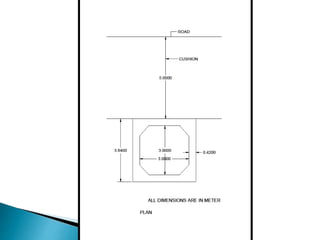
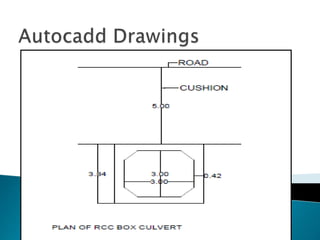
 PLAN OF BOX CULVERT
size of box culvert is 3mx3m.For box[1/3 x
3/0]and[1/3 x 3/5]
 DESIGN OF BOX CULVERT
 Load calculation
 Moment calculation
 Distribution factor
 Moment distribution
 Design of section
 AUTOCADD DRAWINGS
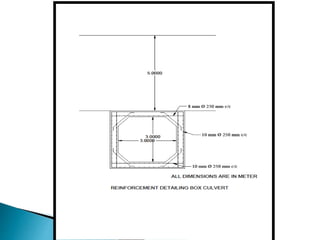
 Plan of box culvert
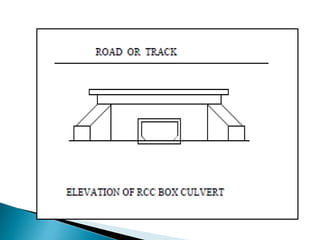
 Elevation of box culvert
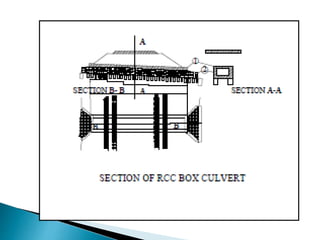
 Section of box culvert
 STADD PRO ANALYSIS
STAAD is a structural analysis and design
computer program. It is widely used in analyzing and
designing structures such as – building, bridges,
towers, transportation, industrial and utility
4.1 RCC BOX CULVERT, SPECIFICATION:
[1/3 x 3/0]
Design a box culvert size of [1/3 x 3/0] , except
the cushion which is 5.0 m total height above top
slab which is constructed in embankment which
come in the way of natural flow of storm water and
refer the given data below.
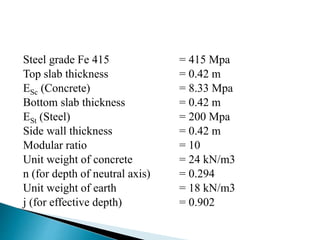
SPECIFICATION
Clear span = 3 m
Concrete grade M25 = 25 Mpa
Clear height = 3 m
Steel grade Fe 415 = 415 Mpa
Top slab thickness = 0.42 m
ESc (Concrete) = 8.33 Mpa
Bottom slab thickness = 0.42 m
ESt (Steel) = 200 Mpa
Side wall thickness = 0.42 m
Modular ratio = 10
Unit weight of concrete = 24 kN/m3
n (for depth of neutral axis) = 0.294
Unit weight of earth = 18 kN/m3
j (for effective depth) = 0.902
Unit weight of water = 10 kN/m3
k (for moment of resistance) = 1.105 Mpa
Co-efficient of earth pressure at rest = 0.5
Total cushion on top = 0.0 m
Thickness of wearing coat = 0.065 m
Carriageway = 8 lane divided
All dimensions are in meter
All moments are in kN. m and shear force in kN.
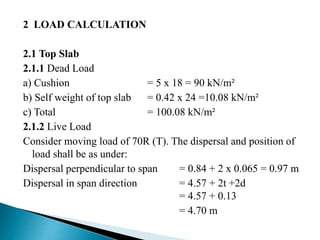
2 LOAD CALCULATION
2.1 Top Slab
2.1.1 Dead Load
a) Cushion = 5 x 18 = 90 kN/m²
b) Self weight of top slab = 0.42 x 24 =10.08 kN/m²
c) Total = 100.08 kN/m²
2.1.2 Live Load
Consider moving load of 70R (T). The dispersal and position of
load shall be as under:
Dispersal perpendicular to span = 0.84 + 2 x 0.065 = 0.97 m
Dispersal in span direction = 4.57 + 2t +2d
= 4.57 + 0.13
= 4.70 m
Note:
1) Since the length of wheel is more than total width of
box at top that is 3.84 m further dispersal by “2d” shall
not be possible, hence not taken. In case where the
length of load is less than the width of box but works
out more when “2d” is added, the dispersed length shall
be restricted to top width of box.
2) As the load of wheel after dispersal does not over lap,
both wheels need to be taken separately.
3) For dispersal refer IRC:21-2000 Clause 305.16.3.
4) Impact as per IRC:6-2000 Clause 211 shall be taken.
5) This shall be the load when α is zero and live load is
taken to disperse through wearing coat only.
Load per unit area = 350/4.7 x 0.97 = 76.77 kN/m²
Impact factor for 70R(T) shall be 25 % as per IRC:6-2000
Load including impact = 95.96 kN/m²
2.1.3 Total Load
(D.L.+L.L.) = 12.08 + 95.96 = 108.04 kN/m²
2.2 Bottom Slab
2.2.1 Dead Load
Load from top slab = 12.08 kN/m²
Load of walls = 2 x 3 x 0.42 x 24/3.84
= 15.75 kN/m²
Total Load = 27.83 kN/m²
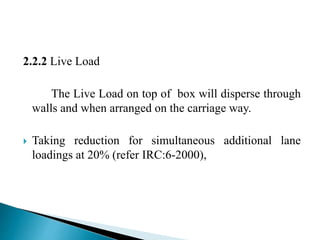
2.2.2 Live Load
The Live Load on top of box will disperse through
walls and when arranged on the carriage way.
 Taking reduction for simultaneous additional lane
loadings at 20% (refer IRC:6-2000),
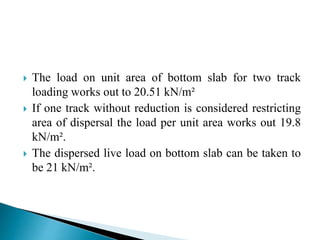
 The load on unit area of bottom slab for two track
loading works out to 20.51 kN/m²
 If one track without reduction is considered restricting
area of dispersal the load per unit area works out 19.8
kN/m².
 The dispersed live load on bottom slab can be taken to
be 21 kN/m².
2.2.3 Total Load
(DL +LL) = 27.83 + 21 = 48.83 kN/m²
Adopt 50 kN/m²
2.3 Side Wall
2.3.1 Case 1: Box empty, earth pressure with live load surcharge
equivalent to 1.2 m height of earth on both sides fills.
Earth Pressure at base due to live load surcharge = 1.2 x 18 x 0.5
= 10.8 kN/m²
Earth Pressure at base due to earth fill = 18 x 3.42 x 0.5
= 30.78 kN/m²
2.3.2 Case 2 : Box full, Live load surcharge on side fill.
Water pressure inside and out side will balance each
other and hence not taken.
Earth Pressure at base due to live load surcharge
= 10.8 kN/m²
Earth Pressure at base due to submerged earth
= (18-10) x 3.42 x 0.5
= 13.68 kN/m²
2.3.3 Case 3 : Box full, no live load surcharge on side
fill.
Earth Pressure at base due to submerged earth
= 8 x 3.42 x 0.5
= 13.68 kN/m²
Earth Pressure due to live load = 0
2.4 Base Pressure
2.4.1 Dead load
Load from top slab and walls including wearing course
= 27.83 kN/m²
Self weight of bottom slab = 0.42 x 24 = 10.08 kN/m²
Total Load = 37.91 kN/m²
2.4.2 Live Load
There is no live load except coming from top slab without
impact = 21 kN/m²
2.4.3 Base pressure = 58.91 kN/m² (Is safe for a S.B.C of 150
kN/m²)
3 MOMENT CALCULATION
3.1 Top Slab
Fixed end moment due to dead load
= 12.08 x 3.42 x 3.42/12
= 11.77
Fixed end moment due to live load
= 95.96 x 3.42 x 3.42/12
= 93.55
Total fixed end moment = 105.30 kN.m
Mid span moment due to dead load = 12.08 x 3.42 x 3.42/8
= 17.66
Mid span moment due to live load = 95.96 x 3.42 x 3.42/8
= 140.30
Total Mid Span Moment = 157.96 kN.m
3.2 Bottom Slab
Fixed end moment due to dead load = 27.13
Fixed end moment due to live load = 20.5
Total fixed end moment = 47.63 kN.m
Mid span moment due to dead load = 40.69
Mid span moment due to live load = 30.75
Total Mid Span Moment = 71.45 kN.m
3.3 Side Wall
3.3.1 Case 1 : Box empty, surcharge load on side fill.
F.E.M at top due to dead load = 12
F.E.M at top due to live load = 10.8 x 3.42 x 3.42/12
= 10.53
Total F.E.M at top = 22.53 kN.m
F.E.M at base due to dead load = 18 kN.m
F.E.M at base due to live load = 10.53
Total F.E.M at base = 28.53 kN.m
Mid span moment due to dead load= 22.5
Mid span moment due to live load = 10.8 x 3.42 x 3.42/8
= 15.79
Total Mid Span Moment = 38.29 kN.m
3.3.2 Case 2 : Box full, live load surcharge on side fill.
F.E.M at top due to dead load = 13.68 x 3.42 x 3.42/30
= 5.33
F.E.M at top due to live load = 10.53
Total F.E.M at top slab = 15.86 kN.m
F.E.M at base due to dead load =13.68 x 3.42 x 3.42/20
= 8
F.E.M at base due to live load = 10.53
Total F.E.M at bottom = 18.53 kN.m
Mid span moment due to DL = 13.86 x 3.42 x 3.42/16
= 10
Mid span moment due to live load = 15.79
Total Mid Span Moment = 25.79 kN.m
3.3.3 Case 3 : Box full, no live load surcharge
F.E.M at top due to dead load = 5.33
F.E.M due to live load = 0
Total F.E.M at top = 5.33 kN.m
F.E.M at base due to dead load = 8
F.E.M at base due to live load = 0
Total F.E.M at base = 8 kN.m
Mid span moment due to dead load = 10
Mid span moment due to live load = 0
Total Mid Span Moment = 10 kN.m
4 DISTRIBUTION FACTORS
Junction Members 4EI/L =
K d³/L
SUM
4EI/L
Distributi
on
factors
A & B AB/AD,
BA/BC
K 0.423
/3.42
2K0.423
/3.42
0.5
0.5
C & D DA/DC,
CD/CB
K 0.423
/3.42
2K 0.423
/3.42
0.5
0.5
5 MOMENT DISTRIBUTION
5.1 F.E.M Due to Dead Load
Mab = Mba = 11.77 kN.m
Mdc = Mcd = 27.13 kN.m
Mad = Mbc = 12 kN.m (case 1),
5.33 kN.m (case 2),
5.33 kN.m (case 3).
Mda = Mcb = 18 kN.m (case 1),
8 kN.m (case 2),
8 kN.m (case 3)
5.2 F.E.M Due to Live Load
Mab = Mba = 93.55 kN.m
Mdc = Mcd = 20.50 kN.m
Mad= Mbc =10.53 kN.m (case 1),
10.53 kN.m (case 2),
0 (case 3)
Mda = Mcb = 10.53 kN.m (case 1),
10.53 kN.m (case 2),
0 (case 3)
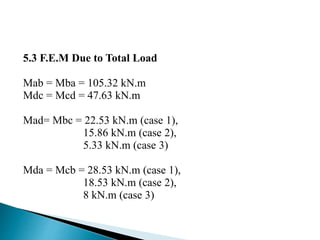
5.3 F.E.M Due to Total Load
Mab = Mba = 105.32 kN.m
Mdc = Mcd = 47.63 kN.m
Mad= Mbc = 22.53 kN.m (case 1),
15.86 kN.m (case 2),
5.33 kN.m (case 3)
Mda = Mcb = 28.53 kN.m (case 1),
18.53 kN.m (case 2),
8 kN.m (case 3)
 Table 1 Moment Distribution for Total Load on Top &
Bottom Slab and Case 1 Load on Walls
Joint A B C D
Member AB AD BA BC CB CD DC DA
DF 0.500 0.500 0.500 0.500 0.500 0.500 0.500 0.500
F.E.M -105.32 22.53 105.32 -22.53 28.53 -47.63 47.63 -28.53
DIST 41.39 41.39 -41.39 -41.39 9.55 9.55 -9.55 -9.55
CO -20.69 -4.78 20.693 4.776 -20.69 -4.776 4.776 20.693
DIST 12.73 12.73 -12.73 -12.73 12.73 12.73 -12.73 -12.73
CO -6.37 -6.37 6.367 6.367 -6.367 -6.367 6.37 6.367
DIST 6.37 6.37 -6.37 -6.37 6.37 6.37 -6.37 -6.37
CO -3.18 -3.18 3.184 3.184 -3.184 -3.184 3.184 3.184
DIST 3.18 3.18 -3.18 -3.18 3.18 3.18 -3.18 -3.18
CO -1.59 -1.59 1.592 1.592 -1.592 -1.592 1.592 1.592
DIST 1.59 1.59 -1.59 -1.59 1.59 1.59 -1.59 -1.59
FINAL -71.89 71.89 71.89 -71.89 30.12 -30.12 30.12 -30.12
 Table 2 Support Moments
LOAD DISTRIBUTED MOMENTS AT SUPPORTS REMARKS
CASE MAB MDC MAD MDA
(MBA) (MCD) (MBC) (MCB)
DEAD
LOAD
(1) -10.72 23.74 10.72 - 23.74 Load on top
slab and
bottom slab
remains
same in all
cases, only
load on side
wall varies.
Without
braking
Force.
(2) -6.96 19.15 6.96 - 19.15
(3) -6.96 19.15 6.96 - 19.15
LIVE
LOAD
(1) -61.17 6.38 61.17 - 6.38
(2) -61.17 6.38 61.17 - 6.38
(3) -55.91 1.12 55.91 - 1.12
TOTAL
LOAD
(1) -71.89 30.12 71.89 - 30.12
(2) -68.13 25.53 68.13 -25.53
(3) -62.87 20.27 62.87 - 20.27
Maximum All cases 71.89 30.12 71.89 30.12
Members Case 1 Case2 Case3 Remarks
MAB 157.96 - 71.89
= 86.07
157.96 - 68.13
= 89.83
157.96 - 62.87
=95.09
When
surcharge is
not taken the
wall bends
outwardly in
all three cases.
MDC 71.45 - 30.12
= 41.33
71.45 - 25.53
= 45.92
71.45 - 20.27
= 51.18
MAD 38.29 - (71.89
+ 30.12)/2AQ
= -12.72
25.79 - (68.13
+ 25.53)/2
= -21.04
10 - (62.87 +
20.27)/2
= -31.57
6 BRAKING FORCE
6.1 LOAD: one wheel load is considered as there is no over
lapping.
No impact as per IRC:6-2000 Clause 214.2.
The braking force shall be 20 % for the first lane load
The braking force = 350 x 20/100 = 70 kN
Load on top of box which will affect the box
= 3.84 x 70/4.7 = 57.19 kN
6.2 Moment Due to Braking Force
MAD=MDA=MCB=MBC = 57.19 x 3.42/2 = 97.79 kN.m
The moments at top and bottom slab ends shall all be zero.
After distribution of moments among all the
members a moment of 48.9kN.m is obtained at all ends.
This moment is added to the maximum moments
obtained for various combination of loadings at the
ends of members to get design moments.
Since braking force can also act from the reverse
direction the moment at junctions are added
irrespective of its sign.
Load Case Maximum Distributed Moments at Supports
Mab Mdc Mad Mda
Total Load Maximum of
all cases
71.89 30.12 71.89 30.12
Braking
Force
Distributed
Moments at
support
48.90 48.90 48.90 48.90
Design
Moments
Support
Moments
including
braking
120.79 79.02 120.79 79.02
Table 5 Moment and Reinforcement at Salient Section
Member MAB MDC Mid span
AB DC AD
Moment in
kN .m
120.79 79.02 95.09 51.18 31.57
Area of
steel in mm²
1849.6 1299.8 1456 841.8 483.4
7.2 Top Slab
Maximum moment support/mid span including breaking
= 120.79 kN.m
Depth required = = 330.6 mm
Provided 362 mm is safe
Ast = =
= 1849.6 mm2
Check for Shear
Shear force at deff from face of wall
= =117.54 kN
Shear Stress = 0.3247 N/mm² > 0.312 N/mm²
permissible
Steel percentage = = 0.511
Permissible shear stress = =0.312 N/mm2
Increase tension steel to increase permissible shear stress.
Required steel = = 0.5735%
Steel area = = 2076 mm2
Hence, provide tension steel = 2076 mm² in place of 1849.6 mm²
required for moment only.
7.3 Bottom Slab
B.M. (Max) = 79.02 kN.m
d = = 267.4mm
Provided 337 mm is OK.
Ast = = 1299.8 mm2
Check for Shear
SF = = 54.53kN
Shear Stress = 0.1613 N/mm² < 0.2715N/mm²
permissible, hence safe.
7.4 Side Walls
Moment at junction are same as slabs hence same tensile bars
shall continue.
Check for Shear
RA =18.460 + 17.545 = 36.01 kN
RD = 18.468 + 35.090 = 53.56 kN
S.F. at deff from
D= RD –
= 53.56 – 11.92 – 4.45 = 37.19 kN
S.F. at deff from
A= RA – 0.5x 3.708x 0.412-4.45
=36.01- 0.764 – 4.45
= 30.796 kN
Maximum Shear Stress (near base) = 0.100 N/mm² (safe)
Design a box culvert size of [1/3 x 3/5] ,except the
cushion which is 5.0 m total height above top slab which is
constructed in embankment which come in the way of
natural flow of storm water and refer the given data below.
SPECIFICATION
Clear span = 3 m
Concrete grade M25 = 25 Mpa
Clear height = 3 m
Steel grade Fe 415 = 415 Mpa
Top slab thickness = 0.42 m
ESc (Concrete) = 8.33 Mpa
Bottom slab thickness = 0.42 m
ESt (Steel) = 200 Mpa
Side wall thickness = 0.42 m
Modular ratio = 10
Unit weight of concrete = 24 kN/m3
n (for depth of neutral axis) = 0.294
Unit weight of earth = 18 kN/m3
j (for effective depth) = 0.902
Unit weight of water = 10 kN/m3
k (for moment of resistance) = 1.105 Mpa
Co-efficient of earth pressure at rest = 0.5
Total cushion on top = 0.0 m
Thickness of wearing coat = 0.065 m
Carriageway = 8 lane divided
All dimensions are in meter
All moments are in kN. m and shear force in kN.
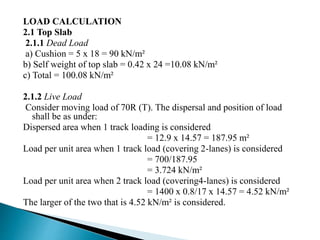
LOAD CALCULATION
2.1 Top Slab
2.1.1 Dead Load
a) Cushion = 5 x 18 = 90 kN/m²
b) Self weight of top slab = 0.42 x 24 =10.08 kN/m²
c) Total = 100.08 kN/m²
2.1.2 Live Load
Consider moving load of 70R (T). The dispersal and position of load
shall be as under:
Dispersed area when 1 track loading is considered
= 12.9 x 14.57 = 187.95 m²
Load per unit area when 1 track load (covering 2-lanes) is considered
= 700/187.95
= 3.724 kN/m²
Load per unit area when 2 track load (covering4-lanes) is considered
= 1400 x 0.8/17 x 14.57 = 4.52 kN/m²
The larger of the two that is 4.52 kN/m² is considered.
Note:
1) As the load of wheel after dispersal over lap both wheels need to be taken
together.
2) For dispersal refer IRC:21-2000 Clause 305.16.4.
3) No impact as per IRC:6-2000 Clause 211.7 due to cushion more than 3.0m.
2.1.3 Total load = 104.6 kN/m²
2.2 Bottom Slab
2.2.1 Dead Load
Load from top slab including cushion=100.08 kN/m²
Load of walls = 2 x 3 x 0.42 x 24/3.84 = 15.75 kN/m²
Total load = 115.83 kN/m²
Live Load
Load from top slab without impact= 4.52 kN/m²
Note: Some designers take further dispersal of
liveload from top slab. Although further dispersal
through walls can not be denied but will affect only
marginally,therefore, the load on top without impact
can be taken for bottom slab also, which is already
without impact in this case.
2.3 Side Wall
2.3.1 Case 1: Box empty, earth pressure with live load
surcharge equivalent to 1.2 m hight of earth on both sides
fills.
Pressure due to submerged earth =13.68 kN/m²
Pressure due to earth surcharge = 45 kN/m²
Pressure due to live load surcharge = 1.2 x 18 x 0.5 = 10.80
kN/m²
Pressure due to earth surcharge = 5 x 18 x 0.5 = 45 kN/m²
Pressure due to earth fill = 0.5 x 18 x 3.42
= 30.78 kN/m²
2.3.2Case 2 : Box full, Live load surcharge on side fill.
Water pressure inside and outside will balance each other
and hence not taken.
Pressure due to live load surcharge= 10.8 = 10.8 kN/m²
Pressure due to earth surcharge =45=45 kN/m²
Pressure due to submerged earth =0.5x(18-10) x 3.42
=13.68 kN/m²
2.3.3Case 3 :Box full, no live load surcharge on side fill.
2.4 Base Pressure
Dead load
Load from top slab and walls including cushion
=115.83kN/m²
Self weight of bottom slab = 0.42 x 24 =10.08 kN/m²
Total Load = 125.91 kN/m²
Live Load
There is no live load except coming from top slab
without impact = 4.52 kN/m²
2.4.1 Base pressure = 130.43 kN/m²
(Is safe for a S.B.C of 150 kN/m²)
3 MOMENT CALCULATION
3.1 Top Slab
Fixed end moment due to dead load= 100.08 x 3.42 x 3.42 /12
= 97.55
Fixed end moment due to live load = 4.52 x 3.42 x 3.42/12
= 4.41
Total fixed end moment = 101.96 kN.m
Mid span moment due to dead load =100.08 x 3.42 x 3.42/8
= 146.32
Mid span moment due to live load = 4.52 x 3.42 x 3.42/8
= 6.61
Total Mid Span Moment =152.93 kN.m
3.2 Bottom Slab
Fixed end moment due to DL =115.83 x 3.42 x 3.42/12
= 112.9
Fixed end moment due to LL = 4.41
Total fixed end moment = 117.31 kN.m
Mid span moment due to DL = 115.83 x 3.42 x 3.42/8
= 169.35
Mid span moment due to LL = 6.61
Total Mid Span Moment = 175.96 kN.m
3.3 Side Wall
3.3.1Case 1: Box empty, earth pressure with live load surcharge equivalent to
1.2 m height of earth on both sides fills.
3.3.1 Case 1 : Box empty, surcharge load on side fill
F.E.M at top due to dead load = 45 x 3.42 x 3.42/12 +30.78 x 3.42 x 3.42/30
= 55.86
F.E.M at top due to live load = 10.8 x 3.42 x 3.42/12 = 10.53
Total F.E.M at top = 66.39 kN.m
F.E.M at base due to DL = 43.86+30.78 x 3.42 x 3.42/20
= 61.86 kN.m
F.E.M at base due to LL = 10.53
Total F.E.M at base = 72.39 kN.m
Mid span moment (DL) = 45x3.42x3.42/8+30.78x3.42x3.42/16
= 88.29
Mid span moment (LL) = 10.8 x 3.42 x 3.42/8 = 15.79
Total Mid Span Moment =104.08 kN.m
3.3.2 Case 2 : Box full, live load surcharge on side fill.
F.E.M at top (DL) = 43.86+13.68 x 3.42 x 3.42/30
= 49.19
F.E.M at top (LL) = 10.53
Total F.E.M at top = 59.72 kN.m
F.E.M at base (DL) = 43.86+13.68 x 3.42 x 3.42/20
= 51.86
F.E.M at base (LL) = 10.53
Total F.E.M at bottom = 62.39 kN.m
Mid span moment (DL) = 65.79+13.68 x 3.42 x 3.42/16
= 75.79
Mid span moment (LL) = 15.79
Total Mid Span Moment = 91.58 kN.m
3.3.3 Case 3 : Box full, no live load surcharge
F.E.M at top due to dead load = 43.86 + 5.33
=49.19 kN.m
F.E.M due to live load = 0
Total F.E.M at top = 49.19
F.E.M at base due to dead load = 43.86 + 8 = 51.86
F.E.M at base due to live load = 0
Total F.E.M at base = 51.86 kN.m
Mid span moment due to DL
= 65.79+13.68x3.42x3.42/16
= 75.79
Mid span moment due to live load = 0
Total Mid Span Moment = 75.79 kN.m
4 DISTRIBUTION FACTORS
Junction Members 4EI/L =
K d³/L
SUM
4EI/L
Distributi
on
factors
A & B AB/AD,
BA/BC
K 0.423
/3.42
2K0.423
/3.42
0.5
0.5
C & D DA/DC,
CD/CB
K 0.423
/3.42
2K 0.423
/3.42
0.5
0.5
5 MOMENT DISTRIBUTION
5.1 F.E.M Due to Dead Load
Mab= Mba= 97.54 kN.m
Mdc= Mcd= 112.90 kN.m
Mad= Mbc= 55.86 kN.m (case 1),
49.19 kN.m (case 2),
49.19 kN.m (case 3)
Mda= Mcb= 61.86 kN.m (case 1),
51.86 kN.m (case 2),
51.86 kN.m (case 3)
5.2 F.E.M Due to Live Load
Mab= Mba= 4.41 kN.m
Mdc= Mcd= 4.41 kN.m
Mad= Mbc= 10.53 kN.m (case 1),
10.53 kN.m(case 2),
0 (case 3)
Mda= Mcb= 10.53 kN.m (case 1),
0.53 kN.m (case 2),
0 (case 3)
5.3 F.E.M Due to Total Load
Mab= Mba= 101.95 kN.m
Mdc= Mcd= 117.31 kN.m
Mad= Mbc= 66.39 kN.m (case 1),
59.72 kN.m(case 2),
49.19 kN.m (case 3)
Mda= Mcb= 72.39 kN.m (case 1),
62.39 kN.m (case 2),
51.86 kN.m (case 3)
 Table 1 Moment Distribution for Total Load on Top
& Bottom Slab and Case 1 Load on Walls
Joint A B C D
Member AB AD BA BC CB CD DC DA
DF 0.500 0.500 0.500 0.500 0.500 0.500 0.500 0.500
F.E.M -101.955 66.39 101.955 -66.389 72.389 -117.307 117.307 -72.389
DIST 17.78 17.78 -17.78 -17.78 22.46 22.46 -22.46 -22.46
CO -8.89 -11.23 8.892 11.229 -8.892 -11.229 11.229 8.892
DIST 10.06 10.06 -10.06 -10.06 10.06 10.06 -10.06 -10.06
CO -5.03 -5.03 5.03 5.030 -5.030 -5.03 5.03 5.03
DIST 5.03 5.03 -5.03 -5.30 5.03 5.03 -5.03 -5.03
CO -2.52 -2.52 2.515 2.515 -2.515 -2.515 2.515 2.515
DIST 2.52 2.52 -2.52 -2.52 2.52 2.52 -2.52 -2.52
CO -1.26 -1.26 1.258 1.258 -1.258 -1.258 1.258 1.258
DIST 1.26 1.26 -1.26 -1.26 1.26 1.26 -1.26 -1.26
FINAL -83.00 83.00 83.00 83.00 96.02 -96.02 96.02 -96.02
 Table 2 Support Moments
LOAD DISTRIBUTED MOMENTS AT SUPPORTS REMARKS
CASE MAB MDC MAD MDA
(MBA) (MCD) (MBC) (MCB)
DEAD
LOAD
(1) -75.54 88.55 75.54 -88.55 Load on top
slab and
bottom slab
remains
same in all
cases, only
load on side
wall varies .
no braking
force need
be
considered
due to
cushion.
(2) -71.79 83.97 71.79 -83.97
(3) -71.79 83.97 71.79 -83.97
LIVE
LOAD
(1) -7.47 7.47 7.47 -7.47
(2) -7.47 7.47 7.47 -7.47
(3) -2.20 2.20 2.20 -2.20
TOTAL
LOAD
(1) -83.00 96.02 83.00 -96.02
(2) -79.25 91.43 79.25 -91.43
(3) -73.99 86.17 73.99 -86.17
Maximum All cases -83.00 96.02 83.00 -96.02
Members Case 1 Case2 Case3 Remarks
MAB 152.93-
83.0=69.93
152.93-
79.25=73.68
152.93-
73.99=78.94
When surcharge
is not taken the
wall bends
outwardly.
MDC 175.96-
96.02=79.94
175.96-
91.43=84.53
175.96-
86.17=89.79
MAD 104.08-
(83+96.02)/2
=14.57
91.58-
(79.25+91.43)/2
=6.24
75.79-
(73.99+86.17)/2
=-4.29
6 DESIGN OF SECTION
Table 4 Moment and Reinforcement at Salient Section
Member MAB MDC Mid span
AB DC AD
Moment in
kN .m
83.0 96.02 78.94 89.79 14.57
Area of
steel in
mm²
1271 1579 1209 1477 223
6.1 Top Slab
Maximum moment support/mid span = 83.0 kN.m
Depth required =274 mm ,
provided =362mm
(420-50-8=362) is ok
Ast =1271mm²
CHECK FOR SHEAR
Shear force at d eff from face of wall113.80 kN
Shear stress =0.3144 N/mm²
Permissible shear stress =0.2623 N/mm²
% of steel =0.351
[Refer IRC : 21:2000 Table 12 B]
Provide shear reinforcement
Shear capacity = 0.2623 x 1000 x 362 = 94953N
= 94.95 kN
Balance Shear = 113.80 – 94.95 = 18.85 kN
Take spacing 250 c/c of 8 mm
Shear capacity of section = 0.2623 x 362 = 94.95kN
Say x is the distance from the face of wall where shear force
equals shear capacity of the section.
Then, x = 0.543 m, say 600 mm
Provide shear reinforcement upto 600 mm from face of near wall
on both sides.
6.2 Bottom Slab
Maximum Moment support/mid span = 96.02 kN.m
Depth required =294.8 mm
Provided = 420–75–8
= 337 mm is o.k.
Ast =1579.4 mm²
Check for Shear
Shear force =133.95 kN
shear Stress = 0.3975 N/mm²
Permissible shear stress =0.299 N/m²
% steel =0.4685
Provide shear reinforcements
Shear Capacity = 0.299 x 337 x 1000
= 100763 N =100.76 kN
Balance shear force = 133.95 – 100.760 =33.19 kN
Asw =123 mm²
Provide 10ф @ 250 mm c/c
x is the distance from face of wall where shear
force equals shear capacity of the section
Then,
and x = 0.613 m say 650 mm
Provide shear reinforcement upto 650 mm from face of near wall
on both sides.
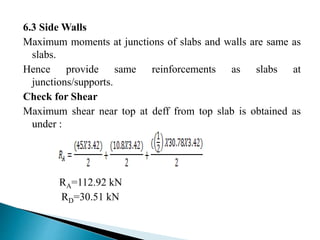
6.3 Side Walls
Maximum moments at junctions of slabs and walls are same as
slabs.
Hence provide same reinforcements as slabs at
junctions/supports.
Check for Shear
Maximum shear near top at deff from top slab is obtained as
under :
RA=112.92 kN
RD=30.51 kN
S.F. near top at
deff =112.96 – 45 x 0.622 – 10.8 x 0.622 – ½ x 5.6 x 0.622
=76.51kN
Maximum shear stress =0.2166 N/mm²
Less than 0.23 N/mm²hence safe for 0.25% steel.
WHOLE STRUCTURE DISPLACEMENT
REACTION BASE PRESSURE
FORCES BEAM STRESS
GRAPHS 3D VIEW
GEOMETRY PROPERTY
SHEAR BENDING DEFLECTION
CONCRETE DESIGN
At the completion of the project, We conclude that
there is difference between theoretical and the practical work.
As per the Indian standard code specification, the manual
design of structural elements and the plan of RCC BOX
CULVERT using AUTOCAD and STADD PRO we have been
completed successfully.
1. IRC:5-1998, “Standard Specifications and Code of Practice for Road Bridges”, Section I.
2. IS:1893-1984, “Criteria for Earthquake Resistant Design of Structures”, Fourth Revision.
3. IRC:78-2000, “Standard Specifications and Code of Practice for Road Bridges”, Section VII,
Foundation and Substructure.
4. Terzaghi and Karl, “Theoretical Soil Mechanics”, John Wiley and Sons, ING. Tenth Printing,
1962.
5. Gulhati, Shashi K. and Datta, Manoj, “Geotechnical Engineering”, Tata McGraw-Hill
Publishing Company Limited, 2005.
6. IRC:21-2000, “Standard Specifications and Code of Practice for Road Bridges”, Section III.
7. MORT&H (Ministry of Road Transport and Highways), “Standard Drawings for Box Cell
Culverts”, New Delhi, 2000.
8. Krishna, Jai and Jain, O.P., “Plain and Reinforced Concrete”, Volume II, Nem Chand & Bros.,
Roorkee (U.P.), 1966.
9. AASHTO (American Association of State Highways and Transportation Officials), “Standard
Specifications for Highway Bridges”, 17th Edition, 2002.
10. IRC:6-2000, “Standard Specifications and Code of Practice for Road Bridges”, Section II.
11. Ramamurtham, S., “Design of Reinforced Concrete Structures”, Dhanpat Rai Publishing
Company, Tenth Edition, 1985.
Rcc box culvert

Rcc box culvert

  • 1.
    MOUNT ZION COLLEGEOF ENGINEERING & TECHNOLOGY
  • 2.
     PROJECT GUIDE-MS. MENAKA, M.TECH, ASSISTANT PROFESSOR, CIVIL DEPT, MZCET.  BATCH MEMBERS - L.ARUL PANDIAN -P.ARUN PANDIYAN -P.SHIVAJI
  • 3.
  • 4.
     ABSTRACT  LITERATUREREVIEW  ADVANTAGE  METHODOLOGY  PLAN  DESIGN  AUTOCADD DRAWING  STADD PRO  CONCLUSION  REFERENCE
  • 5.
     This projectdeals with the planning, designing of the RCC BOX CULVERT.  Carrying out a complete planning and design of the main structural elements.  In this project a brief planning of RCC BOX CULVERT is done using AUTOCAD 2014 software and the design of the main structural elements are carried out manually.
  • 6.
     Kornel Kerenyi,J. Sterling Jones, Kevin Goeden, Richard Phillips, and PaulOien, Study done by the South Dakota DOT on the effect of inlet geometry on the flow of water through precast and cast-in-place concrete box culverts.
  • 7.
     Load Performanceof In Situ Corrugated Steel Highway CulvertsJ. Perf. Constr. Fac. This examines a study of 39 in-service corrugated steel culverts in Ohio of varying sizes. The strains of the culverts resulting from the dynamic and static loads of trucks driving across the bridges were experimentally obtained. The researchers look for a correlation between backfill height and loading conditions and the strain induced.
  • 8.
     Vinod andChava They studied study about design of box culvert and comparative study of reinforcement details. They had done analysis on box culvert using STAAD Pro and SAP200 and find out B.M, S.F. and stresses. Size of the box culvert was 3mx3m. Area of reinforcement for top and bottom slab was also calculated.
  • 9.
     Pavan D.Tikate and S.N. Tande They studied the effect of the variation of cushion depth, coefficient of earth pressure, width or angle of dispersion on the structural behaviour of the three- dimensional box culvert and to examine the accuracy of FEM by comparing the FEM results with IS Code methods.
  • 10.
     The boxis structurally strong, stable and safe and easy to construct.  The main advantage is, it can be placed at any elevation within the embankment with varying cushion which is not possible for other type of culverts.  A multi cell box can cater for large discharge and can be accommodated within smaller height of embankment.  Bearings are not needed.
  • 11.
     It doesnot require separate elaborate foundation and can be placed on soft soil by providing suitable base slab projection to reduce base pressure within the safe bearing capacity of foundation soil.  It is convenient to extend the existing culvert in the event of widening of the carriageway at a later date as per future requirement, without any problem of design and/or construction.
  • 12.
     PLAN OFBOX CULVERT size of box culvert is 3mx3m.For box[1/3 x 3/0]and[1/3 x 3/5]  DESIGN OF BOX CULVERT  Load calculation  Moment calculation  Distribution factor  Moment distribution  Design of section
  • 13.
     AUTOCADD DRAWINGS Plan of box culvert  Elevation of box culvert  Section of box culvert  STADD PRO ANALYSIS STAAD is a structural analysis and design computer program. It is widely used in analyzing and designing structures such as – building, bridges, towers, transportation, industrial and utility
  • 15.
    4.1 RCC BOXCULVERT, SPECIFICATION: [1/3 x 3/0] Design a box culvert size of [1/3 x 3/0] , except the cushion which is 5.0 m total height above top slab which is constructed in embankment which come in the way of natural flow of storm water and refer the given data below. SPECIFICATION Clear span = 3 m Concrete grade M25 = 25 Mpa Clear height = 3 m
  • 16.
    Steel grade Fe415 = 415 Mpa Top slab thickness = 0.42 m ESc (Concrete) = 8.33 Mpa Bottom slab thickness = 0.42 m ESt (Steel) = 200 Mpa Side wall thickness = 0.42 m Modular ratio = 10 Unit weight of concrete = 24 kN/m3 n (for depth of neutral axis) = 0.294 Unit weight of earth = 18 kN/m3 j (for effective depth) = 0.902
  • 17.
    Unit weight ofwater = 10 kN/m3 k (for moment of resistance) = 1.105 Mpa Co-efficient of earth pressure at rest = 0.5 Total cushion on top = 0.0 m Thickness of wearing coat = 0.065 m Carriageway = 8 lane divided All dimensions are in meter All moments are in kN. m and shear force in kN.
  • 19.
    2 LOAD CALCULATION 2.1Top Slab 2.1.1 Dead Load a) Cushion = 5 x 18 = 90 kN/m² b) Self weight of top slab = 0.42 x 24 =10.08 kN/m² c) Total = 100.08 kN/m² 2.1.2 Live Load Consider moving load of 70R (T). The dispersal and position of load shall be as under: Dispersal perpendicular to span = 0.84 + 2 x 0.065 = 0.97 m Dispersal in span direction = 4.57 + 2t +2d = 4.57 + 0.13 = 4.70 m
  • 20.
    Note: 1) Since thelength of wheel is more than total width of box at top that is 3.84 m further dispersal by “2d” shall not be possible, hence not taken. In case where the length of load is less than the width of box but works out more when “2d” is added, the dispersed length shall be restricted to top width of box.
  • 21.
    2) As theload of wheel after dispersal does not over lap, both wheels need to be taken separately. 3) For dispersal refer IRC:21-2000 Clause 305.16.3. 4) Impact as per IRC:6-2000 Clause 211 shall be taken. 5) This shall be the load when α is zero and live load is taken to disperse through wearing coat only.
  • 22.
    Load per unitarea = 350/4.7 x 0.97 = 76.77 kN/m² Impact factor for 70R(T) shall be 25 % as per IRC:6-2000 Load including impact = 95.96 kN/m² 2.1.3 Total Load (D.L.+L.L.) = 12.08 + 95.96 = 108.04 kN/m² 2.2 Bottom Slab 2.2.1 Dead Load Load from top slab = 12.08 kN/m² Load of walls = 2 x 3 x 0.42 x 24/3.84 = 15.75 kN/m² Total Load = 27.83 kN/m²
  • 23.
    2.2.2 Live Load TheLive Load on top of box will disperse through walls and when arranged on the carriage way.  Taking reduction for simultaneous additional lane loadings at 20% (refer IRC:6-2000),
  • 24.
     The loadon unit area of bottom slab for two track loading works out to 20.51 kN/m²  If one track without reduction is considered restricting area of dispersal the load per unit area works out 19.8 kN/m².  The dispersed live load on bottom slab can be taken to be 21 kN/m².
  • 25.
    2.2.3 Total Load (DL+LL) = 27.83 + 21 = 48.83 kN/m² Adopt 50 kN/m² 2.3 Side Wall 2.3.1 Case 1: Box empty, earth pressure with live load surcharge equivalent to 1.2 m height of earth on both sides fills. Earth Pressure at base due to live load surcharge = 1.2 x 18 x 0.5 = 10.8 kN/m² Earth Pressure at base due to earth fill = 18 x 3.42 x 0.5 = 30.78 kN/m²
  • 26.
    2.3.2 Case 2: Box full, Live load surcharge on side fill. Water pressure inside and out side will balance each other and hence not taken. Earth Pressure at base due to live load surcharge = 10.8 kN/m² Earth Pressure at base due to submerged earth = (18-10) x 3.42 x 0.5 = 13.68 kN/m² 2.3.3 Case 3 : Box full, no live load surcharge on side fill. Earth Pressure at base due to submerged earth = 8 x 3.42 x 0.5 = 13.68 kN/m² Earth Pressure due to live load = 0
  • 27.
    2.4 Base Pressure 2.4.1Dead load Load from top slab and walls including wearing course = 27.83 kN/m² Self weight of bottom slab = 0.42 x 24 = 10.08 kN/m² Total Load = 37.91 kN/m² 2.4.2 Live Load There is no live load except coming from top slab without impact = 21 kN/m² 2.4.3 Base pressure = 58.91 kN/m² (Is safe for a S.B.C of 150 kN/m²)
  • 28.
    3 MOMENT CALCULATION 3.1Top Slab Fixed end moment due to dead load = 12.08 x 3.42 x 3.42/12 = 11.77 Fixed end moment due to live load = 95.96 x 3.42 x 3.42/12 = 93.55 Total fixed end moment = 105.30 kN.m Mid span moment due to dead load = 12.08 x 3.42 x 3.42/8 = 17.66 Mid span moment due to live load = 95.96 x 3.42 x 3.42/8 = 140.30 Total Mid Span Moment = 157.96 kN.m
  • 29.
    3.2 Bottom Slab Fixedend moment due to dead load = 27.13 Fixed end moment due to live load = 20.5 Total fixed end moment = 47.63 kN.m Mid span moment due to dead load = 40.69 Mid span moment due to live load = 30.75 Total Mid Span Moment = 71.45 kN.m
  • 30.
    3.3 Side Wall 3.3.1Case 1 : Box empty, surcharge load on side fill. F.E.M at top due to dead load = 12 F.E.M at top due to live load = 10.8 x 3.42 x 3.42/12 = 10.53 Total F.E.M at top = 22.53 kN.m F.E.M at base due to dead load = 18 kN.m F.E.M at base due to live load = 10.53 Total F.E.M at base = 28.53 kN.m Mid span moment due to dead load= 22.5 Mid span moment due to live load = 10.8 x 3.42 x 3.42/8 = 15.79 Total Mid Span Moment = 38.29 kN.m
  • 31.
    3.3.2 Case 2: Box full, live load surcharge on side fill. F.E.M at top due to dead load = 13.68 x 3.42 x 3.42/30 = 5.33 F.E.M at top due to live load = 10.53 Total F.E.M at top slab = 15.86 kN.m F.E.M at base due to dead load =13.68 x 3.42 x 3.42/20 = 8 F.E.M at base due to live load = 10.53 Total F.E.M at bottom = 18.53 kN.m Mid span moment due to DL = 13.86 x 3.42 x 3.42/16 = 10 Mid span moment due to live load = 15.79 Total Mid Span Moment = 25.79 kN.m
  • 32.
    3.3.3 Case 3: Box full, no live load surcharge F.E.M at top due to dead load = 5.33 F.E.M due to live load = 0 Total F.E.M at top = 5.33 kN.m F.E.M at base due to dead load = 8 F.E.M at base due to live load = 0 Total F.E.M at base = 8 kN.m Mid span moment due to dead load = 10 Mid span moment due to live load = 0 Total Mid Span Moment = 10 kN.m
  • 33.
    4 DISTRIBUTION FACTORS JunctionMembers 4EI/L = K d³/L SUM 4EI/L Distributi on factors A & B AB/AD, BA/BC K 0.423 /3.42 2K0.423 /3.42 0.5 0.5 C & D DA/DC, CD/CB K 0.423 /3.42 2K 0.423 /3.42 0.5 0.5
  • 34.
    5 MOMENT DISTRIBUTION 5.1F.E.M Due to Dead Load Mab = Mba = 11.77 kN.m Mdc = Mcd = 27.13 kN.m Mad = Mbc = 12 kN.m (case 1), 5.33 kN.m (case 2), 5.33 kN.m (case 3). Mda = Mcb = 18 kN.m (case 1), 8 kN.m (case 2), 8 kN.m (case 3)
  • 35.
    5.2 F.E.M Dueto Live Load Mab = Mba = 93.55 kN.m Mdc = Mcd = 20.50 kN.m Mad= Mbc =10.53 kN.m (case 1), 10.53 kN.m (case 2), 0 (case 3) Mda = Mcb = 10.53 kN.m (case 1), 10.53 kN.m (case 2), 0 (case 3)
  • 36.
    5.3 F.E.M Dueto Total Load Mab = Mba = 105.32 kN.m Mdc = Mcd = 47.63 kN.m Mad= Mbc = 22.53 kN.m (case 1), 15.86 kN.m (case 2), 5.33 kN.m (case 3) Mda = Mcb = 28.53 kN.m (case 1), 18.53 kN.m (case 2), 8 kN.m (case 3)
  • 37.
     Table 1Moment Distribution for Total Load on Top & Bottom Slab and Case 1 Load on Walls Joint A B C D Member AB AD BA BC CB CD DC DA DF 0.500 0.500 0.500 0.500 0.500 0.500 0.500 0.500 F.E.M -105.32 22.53 105.32 -22.53 28.53 -47.63 47.63 -28.53 DIST 41.39 41.39 -41.39 -41.39 9.55 9.55 -9.55 -9.55 CO -20.69 -4.78 20.693 4.776 -20.69 -4.776 4.776 20.693 DIST 12.73 12.73 -12.73 -12.73 12.73 12.73 -12.73 -12.73 CO -6.37 -6.37 6.367 6.367 -6.367 -6.367 6.37 6.367 DIST 6.37 6.37 -6.37 -6.37 6.37 6.37 -6.37 -6.37 CO -3.18 -3.18 3.184 3.184 -3.184 -3.184 3.184 3.184 DIST 3.18 3.18 -3.18 -3.18 3.18 3.18 -3.18 -3.18 CO -1.59 -1.59 1.592 1.592 -1.592 -1.592 1.592 1.592 DIST 1.59 1.59 -1.59 -1.59 1.59 1.59 -1.59 -1.59 FINAL -71.89 71.89 71.89 -71.89 30.12 -30.12 30.12 -30.12
  • 38.
     Table 2Support Moments LOAD DISTRIBUTED MOMENTS AT SUPPORTS REMARKS CASE MAB MDC MAD MDA (MBA) (MCD) (MBC) (MCB) DEAD LOAD (1) -10.72 23.74 10.72 - 23.74 Load on top slab and bottom slab remains same in all cases, only load on side wall varies. Without braking Force. (2) -6.96 19.15 6.96 - 19.15 (3) -6.96 19.15 6.96 - 19.15 LIVE LOAD (1) -61.17 6.38 61.17 - 6.38 (2) -61.17 6.38 61.17 - 6.38 (3) -55.91 1.12 55.91 - 1.12 TOTAL LOAD (1) -71.89 30.12 71.89 - 30.12 (2) -68.13 25.53 68.13 -25.53 (3) -62.87 20.27 62.87 - 20.27 Maximum All cases 71.89 30.12 71.89 30.12
  • 39.
    Members Case 1Case2 Case3 Remarks MAB 157.96 - 71.89 = 86.07 157.96 - 68.13 = 89.83 157.96 - 62.87 =95.09 When surcharge is not taken the wall bends outwardly in all three cases. MDC 71.45 - 30.12 = 41.33 71.45 - 25.53 = 45.92 71.45 - 20.27 = 51.18 MAD 38.29 - (71.89 + 30.12)/2AQ = -12.72 25.79 - (68.13 + 25.53)/2 = -21.04 10 - (62.87 + 20.27)/2 = -31.57
  • 40.
    6 BRAKING FORCE 6.1LOAD: one wheel load is considered as there is no over lapping. No impact as per IRC:6-2000 Clause 214.2. The braking force shall be 20 % for the first lane load The braking force = 350 x 20/100 = 70 kN Load on top of box which will affect the box = 3.84 x 70/4.7 = 57.19 kN 6.2 Moment Due to Braking Force MAD=MDA=MCB=MBC = 57.19 x 3.42/2 = 97.79 kN.m The moments at top and bottom slab ends shall all be zero.
  • 41.
    After distribution ofmoments among all the members a moment of 48.9kN.m is obtained at all ends. This moment is added to the maximum moments obtained for various combination of loadings at the ends of members to get design moments. Since braking force can also act from the reverse direction the moment at junctions are added irrespective of its sign.
  • 42.
    Load Case MaximumDistributed Moments at Supports Mab Mdc Mad Mda Total Load Maximum of all cases 71.89 30.12 71.89 30.12 Braking Force Distributed Moments at support 48.90 48.90 48.90 48.90 Design Moments Support Moments including braking 120.79 79.02 120.79 79.02
  • 43.
    Table 5 Momentand Reinforcement at Salient Section Member MAB MDC Mid span AB DC AD Moment in kN .m 120.79 79.02 95.09 51.18 31.57 Area of steel in mm² 1849.6 1299.8 1456 841.8 483.4
  • 44.
    7.2 Top Slab Maximummoment support/mid span including breaking = 120.79 kN.m Depth required = = 330.6 mm Provided 362 mm is safe Ast = = = 1849.6 mm2
  • 45.
    Check for Shear Shearforce at deff from face of wall = =117.54 kN Shear Stress = 0.3247 N/mm² > 0.312 N/mm² permissible Steel percentage = = 0.511 Permissible shear stress = =0.312 N/mm2 Increase tension steel to increase permissible shear stress. Required steel = = 0.5735% Steel area = = 2076 mm2 Hence, provide tension steel = 2076 mm² in place of 1849.6 mm² required for moment only.
  • 46.
    7.3 Bottom Slab B.M.(Max) = 79.02 kN.m d = = 267.4mm Provided 337 mm is OK. Ast = = 1299.8 mm2 Check for Shear SF = = 54.53kN Shear Stress = 0.1613 N/mm² < 0.2715N/mm² permissible, hence safe.
  • 47.
    7.4 Side Walls Momentat junction are same as slabs hence same tensile bars shall continue. Check for Shear RA =18.460 + 17.545 = 36.01 kN RD = 18.468 + 35.090 = 53.56 kN S.F. at deff from D= RD – = 53.56 – 11.92 – 4.45 = 37.19 kN S.F. at deff from A= RA – 0.5x 3.708x 0.412-4.45 =36.01- 0.764 – 4.45 = 30.796 kN Maximum Shear Stress (near base) = 0.100 N/mm² (safe)
  • 48.
    Design a boxculvert size of [1/3 x 3/5] ,except the cushion which is 5.0 m total height above top slab which is constructed in embankment which come in the way of natural flow of storm water and refer the given data below. SPECIFICATION Clear span = 3 m Concrete grade M25 = 25 Mpa Clear height = 3 m Steel grade Fe 415 = 415 Mpa Top slab thickness = 0.42 m ESc (Concrete) = 8.33 Mpa Bottom slab thickness = 0.42 m
  • 49.
    ESt (Steel) =200 Mpa Side wall thickness = 0.42 m Modular ratio = 10 Unit weight of concrete = 24 kN/m3 n (for depth of neutral axis) = 0.294 Unit weight of earth = 18 kN/m3 j (for effective depth) = 0.902 Unit weight of water = 10 kN/m3 k (for moment of resistance) = 1.105 Mpa Co-efficient of earth pressure at rest = 0.5 Total cushion on top = 0.0 m Thickness of wearing coat = 0.065 m Carriageway = 8 lane divided All dimensions are in meter All moments are in kN. m and shear force in kN.
  • 50.
    LOAD CALCULATION 2.1 TopSlab 2.1.1 Dead Load a) Cushion = 5 x 18 = 90 kN/m² b) Self weight of top slab = 0.42 x 24 =10.08 kN/m² c) Total = 100.08 kN/m² 2.1.2 Live Load Consider moving load of 70R (T). The dispersal and position of load shall be as under: Dispersed area when 1 track loading is considered = 12.9 x 14.57 = 187.95 m² Load per unit area when 1 track load (covering 2-lanes) is considered = 700/187.95 = 3.724 kN/m² Load per unit area when 2 track load (covering4-lanes) is considered = 1400 x 0.8/17 x 14.57 = 4.52 kN/m² The larger of the two that is 4.52 kN/m² is considered.
  • 51.
    Note: 1) As theload of wheel after dispersal over lap both wheels need to be taken together. 2) For dispersal refer IRC:21-2000 Clause 305.16.4. 3) No impact as per IRC:6-2000 Clause 211.7 due to cushion more than 3.0m. 2.1.3 Total load = 104.6 kN/m² 2.2 Bottom Slab 2.2.1 Dead Load Load from top slab including cushion=100.08 kN/m² Load of walls = 2 x 3 x 0.42 x 24/3.84 = 15.75 kN/m² Total load = 115.83 kN/m²
  • 52.
    Live Load Load fromtop slab without impact= 4.52 kN/m² Note: Some designers take further dispersal of liveload from top slab. Although further dispersal through walls can not be denied but will affect only marginally,therefore, the load on top without impact can be taken for bottom slab also, which is already without impact in this case.
  • 53.
    2.3 Side Wall 2.3.1Case 1: Box empty, earth pressure with live load surcharge equivalent to 1.2 m hight of earth on both sides fills. Pressure due to submerged earth =13.68 kN/m² Pressure due to earth surcharge = 45 kN/m² Pressure due to live load surcharge = 1.2 x 18 x 0.5 = 10.80 kN/m² Pressure due to earth surcharge = 5 x 18 x 0.5 = 45 kN/m² Pressure due to earth fill = 0.5 x 18 x 3.42 = 30.78 kN/m²
  • 54.
    2.3.2Case 2 :Box full, Live load surcharge on side fill. Water pressure inside and outside will balance each other and hence not taken. Pressure due to live load surcharge= 10.8 = 10.8 kN/m² Pressure due to earth surcharge =45=45 kN/m² Pressure due to submerged earth =0.5x(18-10) x 3.42 =13.68 kN/m² 2.3.3Case 3 :Box full, no live load surcharge on side fill.
  • 55.
    2.4 Base Pressure Deadload Load from top slab and walls including cushion =115.83kN/m² Self weight of bottom slab = 0.42 x 24 =10.08 kN/m² Total Load = 125.91 kN/m² Live Load There is no live load except coming from top slab without impact = 4.52 kN/m² 2.4.1 Base pressure = 130.43 kN/m² (Is safe for a S.B.C of 150 kN/m²)
  • 56.
    3 MOMENT CALCULATION 3.1Top Slab Fixed end moment due to dead load= 100.08 x 3.42 x 3.42 /12 = 97.55 Fixed end moment due to live load = 4.52 x 3.42 x 3.42/12 = 4.41 Total fixed end moment = 101.96 kN.m Mid span moment due to dead load =100.08 x 3.42 x 3.42/8 = 146.32 Mid span moment due to live load = 4.52 x 3.42 x 3.42/8 = 6.61 Total Mid Span Moment =152.93 kN.m
  • 57.
    3.2 Bottom Slab Fixedend moment due to DL =115.83 x 3.42 x 3.42/12 = 112.9 Fixed end moment due to LL = 4.41 Total fixed end moment = 117.31 kN.m Mid span moment due to DL = 115.83 x 3.42 x 3.42/8 = 169.35 Mid span moment due to LL = 6.61 Total Mid Span Moment = 175.96 kN.m
  • 58.
    3.3 Side Wall 3.3.1Case1: Box empty, earth pressure with live load surcharge equivalent to 1.2 m height of earth on both sides fills. 3.3.1 Case 1 : Box empty, surcharge load on side fill F.E.M at top due to dead load = 45 x 3.42 x 3.42/12 +30.78 x 3.42 x 3.42/30 = 55.86 F.E.M at top due to live load = 10.8 x 3.42 x 3.42/12 = 10.53 Total F.E.M at top = 66.39 kN.m
  • 59.
    F.E.M at basedue to DL = 43.86+30.78 x 3.42 x 3.42/20 = 61.86 kN.m F.E.M at base due to LL = 10.53 Total F.E.M at base = 72.39 kN.m Mid span moment (DL) = 45x3.42x3.42/8+30.78x3.42x3.42/16 = 88.29 Mid span moment (LL) = 10.8 x 3.42 x 3.42/8 = 15.79 Total Mid Span Moment =104.08 kN.m
  • 60.
    3.3.2 Case 2: Box full, live load surcharge on side fill. F.E.M at top (DL) = 43.86+13.68 x 3.42 x 3.42/30 = 49.19 F.E.M at top (LL) = 10.53 Total F.E.M at top = 59.72 kN.m F.E.M at base (DL) = 43.86+13.68 x 3.42 x 3.42/20 = 51.86 F.E.M at base (LL) = 10.53 Total F.E.M at bottom = 62.39 kN.m Mid span moment (DL) = 65.79+13.68 x 3.42 x 3.42/16 = 75.79 Mid span moment (LL) = 15.79 Total Mid Span Moment = 91.58 kN.m
  • 61.
    3.3.3 Case 3: Box full, no live load surcharge F.E.M at top due to dead load = 43.86 + 5.33 =49.19 kN.m F.E.M due to live load = 0 Total F.E.M at top = 49.19 F.E.M at base due to dead load = 43.86 + 8 = 51.86 F.E.M at base due to live load = 0 Total F.E.M at base = 51.86 kN.m Mid span moment due to DL = 65.79+13.68x3.42x3.42/16 = 75.79 Mid span moment due to live load = 0 Total Mid Span Moment = 75.79 kN.m
  • 62.
    4 DISTRIBUTION FACTORS JunctionMembers 4EI/L = K d³/L SUM 4EI/L Distributi on factors A & B AB/AD, BA/BC K 0.423 /3.42 2K0.423 /3.42 0.5 0.5 C & D DA/DC, CD/CB K 0.423 /3.42 2K 0.423 /3.42 0.5 0.5
  • 63.
    5 MOMENT DISTRIBUTION 5.1F.E.M Due to Dead Load Mab= Mba= 97.54 kN.m Mdc= Mcd= 112.90 kN.m Mad= Mbc= 55.86 kN.m (case 1), 49.19 kN.m (case 2), 49.19 kN.m (case 3) Mda= Mcb= 61.86 kN.m (case 1), 51.86 kN.m (case 2), 51.86 kN.m (case 3)
  • 64.
    5.2 F.E.M Dueto Live Load Mab= Mba= 4.41 kN.m Mdc= Mcd= 4.41 kN.m Mad= Mbc= 10.53 kN.m (case 1), 10.53 kN.m(case 2), 0 (case 3) Mda= Mcb= 10.53 kN.m (case 1), 0.53 kN.m (case 2), 0 (case 3)
  • 65.
    5.3 F.E.M Dueto Total Load Mab= Mba= 101.95 kN.m Mdc= Mcd= 117.31 kN.m Mad= Mbc= 66.39 kN.m (case 1), 59.72 kN.m(case 2), 49.19 kN.m (case 3) Mda= Mcb= 72.39 kN.m (case 1), 62.39 kN.m (case 2), 51.86 kN.m (case 3)
  • 66.
     Table 1Moment Distribution for Total Load on Top & Bottom Slab and Case 1 Load on Walls Joint A B C D Member AB AD BA BC CB CD DC DA DF 0.500 0.500 0.500 0.500 0.500 0.500 0.500 0.500 F.E.M -101.955 66.39 101.955 -66.389 72.389 -117.307 117.307 -72.389 DIST 17.78 17.78 -17.78 -17.78 22.46 22.46 -22.46 -22.46 CO -8.89 -11.23 8.892 11.229 -8.892 -11.229 11.229 8.892 DIST 10.06 10.06 -10.06 -10.06 10.06 10.06 -10.06 -10.06 CO -5.03 -5.03 5.03 5.030 -5.030 -5.03 5.03 5.03 DIST 5.03 5.03 -5.03 -5.30 5.03 5.03 -5.03 -5.03 CO -2.52 -2.52 2.515 2.515 -2.515 -2.515 2.515 2.515 DIST 2.52 2.52 -2.52 -2.52 2.52 2.52 -2.52 -2.52 CO -1.26 -1.26 1.258 1.258 -1.258 -1.258 1.258 1.258 DIST 1.26 1.26 -1.26 -1.26 1.26 1.26 -1.26 -1.26 FINAL -83.00 83.00 83.00 83.00 96.02 -96.02 96.02 -96.02
  • 67.
     Table 2Support Moments LOAD DISTRIBUTED MOMENTS AT SUPPORTS REMARKS CASE MAB MDC MAD MDA (MBA) (MCD) (MBC) (MCB) DEAD LOAD (1) -75.54 88.55 75.54 -88.55 Load on top slab and bottom slab remains same in all cases, only load on side wall varies . no braking force need be considered due to cushion. (2) -71.79 83.97 71.79 -83.97 (3) -71.79 83.97 71.79 -83.97 LIVE LOAD (1) -7.47 7.47 7.47 -7.47 (2) -7.47 7.47 7.47 -7.47 (3) -2.20 2.20 2.20 -2.20 TOTAL LOAD (1) -83.00 96.02 83.00 -96.02 (2) -79.25 91.43 79.25 -91.43 (3) -73.99 86.17 73.99 -86.17 Maximum All cases -83.00 96.02 83.00 -96.02
  • 68.
    Members Case 1Case2 Case3 Remarks MAB 152.93- 83.0=69.93 152.93- 79.25=73.68 152.93- 73.99=78.94 When surcharge is not taken the wall bends outwardly. MDC 175.96- 96.02=79.94 175.96- 91.43=84.53 175.96- 86.17=89.79 MAD 104.08- (83+96.02)/2 =14.57 91.58- (79.25+91.43)/2 =6.24 75.79- (73.99+86.17)/2 =-4.29
  • 69.
    6 DESIGN OFSECTION Table 4 Moment and Reinforcement at Salient Section Member MAB MDC Mid span AB DC AD Moment in kN .m 83.0 96.02 78.94 89.79 14.57 Area of steel in mm² 1271 1579 1209 1477 223
  • 70.
    6.1 Top Slab Maximummoment support/mid span = 83.0 kN.m Depth required =274 mm , provided =362mm (420-50-8=362) is ok Ast =1271mm² CHECK FOR SHEAR Shear force at d eff from face of wall113.80 kN Shear stress =0.3144 N/mm² Permissible shear stress =0.2623 N/mm² % of steel =0.351 [Refer IRC : 21:2000 Table 12 B]
  • 71.
    Provide shear reinforcement Shearcapacity = 0.2623 x 1000 x 362 = 94953N = 94.95 kN Balance Shear = 113.80 – 94.95 = 18.85 kN Take spacing 250 c/c of 8 mm Shear capacity of section = 0.2623 x 362 = 94.95kN Say x is the distance from the face of wall where shear force equals shear capacity of the section. Then, x = 0.543 m, say 600 mm Provide shear reinforcement upto 600 mm from face of near wall on both sides.
  • 72.
    6.2 Bottom Slab MaximumMoment support/mid span = 96.02 kN.m Depth required =294.8 mm Provided = 420–75–8 = 337 mm is o.k. Ast =1579.4 mm² Check for Shear Shear force =133.95 kN shear Stress = 0.3975 N/mm² Permissible shear stress =0.299 N/m² % steel =0.4685
  • 73.
    Provide shear reinforcements ShearCapacity = 0.299 x 337 x 1000 = 100763 N =100.76 kN Balance shear force = 133.95 – 100.760 =33.19 kN Asw =123 mm² Provide 10ф @ 250 mm c/c x is the distance from face of wall where shear force equals shear capacity of the section Then, and x = 0.613 m say 650 mm Provide shear reinforcement upto 650 mm from face of near wall on both sides.
  • 74.
    6.3 Side Walls Maximummoments at junctions of slabs and walls are same as slabs. Hence provide same reinforcements as slabs at junctions/supports. Check for Shear Maximum shear near top at deff from top slab is obtained as under : RA=112.92 kN RD=30.51 kN
  • 75.
    S.F. near topat deff =112.96 – 45 x 0.622 – 10.8 x 0.622 – ½ x 5.6 x 0.622 =76.51kN Maximum shear stress =0.2166 N/mm² Less than 0.23 N/mm²hence safe for 0.25% steel.
  • 80.
  • 81.
  • 82.
  • 83.
  • 84.
  • 85.
  • 86.
  • 87.
    At the completionof the project, We conclude that there is difference between theoretical and the practical work. As per the Indian standard code specification, the manual design of structural elements and the plan of RCC BOX CULVERT using AUTOCAD and STADD PRO we have been completed successfully.
  • 88.
    1. IRC:5-1998, “StandardSpecifications and Code of Practice for Road Bridges”, Section I. 2. IS:1893-1984, “Criteria for Earthquake Resistant Design of Structures”, Fourth Revision. 3. IRC:78-2000, “Standard Specifications and Code of Practice for Road Bridges”, Section VII, Foundation and Substructure. 4. Terzaghi and Karl, “Theoretical Soil Mechanics”, John Wiley and Sons, ING. Tenth Printing, 1962. 5. Gulhati, Shashi K. and Datta, Manoj, “Geotechnical Engineering”, Tata McGraw-Hill Publishing Company Limited, 2005. 6. IRC:21-2000, “Standard Specifications and Code of Practice for Road Bridges”, Section III. 7. MORT&H (Ministry of Road Transport and Highways), “Standard Drawings for Box Cell Culverts”, New Delhi, 2000. 8. Krishna, Jai and Jain, O.P., “Plain and Reinforced Concrete”, Volume II, Nem Chand & Bros., Roorkee (U.P.), 1966. 9. AASHTO (American Association of State Highways and Transportation Officials), “Standard Specifications for Highway Bridges”, 17th Edition, 2002. 10. IRC:6-2000, “Standard Specifications and Code of Practice for Road Bridges”, Section II. 11. Ramamurtham, S., “Design of Reinforced Concrete Structures”, Dhanpat Rai Publishing Company, Tenth Edition, 1985.