Jacques Myburgh
Existential Coach
ThroughTheLine Coaching
Oct 2013
Project Management South Africa
 Science degree in Information Systems & Geology
 Corporate IT environment
 MBA (Oxford-Brookes, UK) in Strategic Marketing
Management, with thesis in change facilitation
 Organisational change management
 Project, program & project office management, and served on
PMSA Western Cape committee
 Business intelligence – monitoring and reporting of corporate
business performance
 Coaching part-time for the last 5 years – management
coaching, business coaching, midlife coaching, SLOW coaching
 Current research in monitoring and evaluation of the strategy
to professionalise the coaching industry in South Africa as part
of an MPhil in Management Coaching (USB). Due date –
Dec2013
Monitoring and Evaluating Projects and Programs:
A Stakeholder Perspective
Using a results-based evaluation framework to determine the
efficiency and effectiveness of a project.
This workshop:
 Introduces the results-based evaluation framework, how it monitors efficiency and evaluates
effectiveness,
 Reviews stakeholder management,
 Describes the process of designing an impact-map to ensure stakeholder satisfaction, and
 Provides a practical opportunity to implement the framework on a current or planned project
On completion of the workshop, you will be able to:
 Describe the difference between monitoring and evaluation,
 Distinguish between project stakeholders, in a wide and narrow sense,
 Map project activities through to results, and
 Document the relationships in your project between deliverables, project outcome, performance
indicators, and impact on stakeholders.
Results-based monitoring & evaluation
(RBM&E)
"Results-based monitoring and evaluation is a
management tool to help track progress and
demonstrate the impact of development projects,
programs, and policies" (Morra Imas & Rist, 2009:105).
 Results-based monitoring
"Continuous process of collecting and analysing information on
key indicators in order to measure progress toward goals" (Morra
Imas & Rist, 2009:108).
 Results-based evaluation
Assessment of a planned, ongoing, or completed intervention to
determine its relevance, efficiency, effectiveness, impact, and
sustainability" (Morra Imas & Rist, 2009:108).
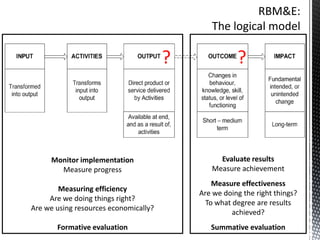
Monitor implementation
Measure progress
Measuring efficiency
Are we doing things right?
Are we using resources economically?
Formative evaluation
Evaluate results
Measure achievement
Measure effectiveness
Are we doing the right things?
To what degree are results
achieved?
Summative evaluation
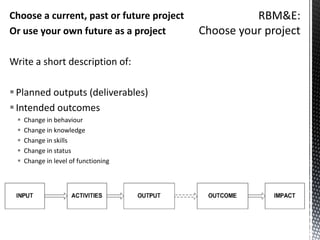
Choose a current, past or future project
Or use your own future as a project
Write a short description of:
Planned outputs (deliverables)
Intended outcomes
 Change in behaviour
 Change in knowledge
 Change in skills
 Change in status
 Change in level of functioning
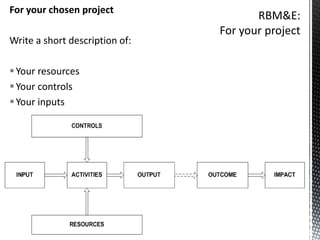
For your chosen project
Write a short description of:
Your resources
Your controls
Your inputs
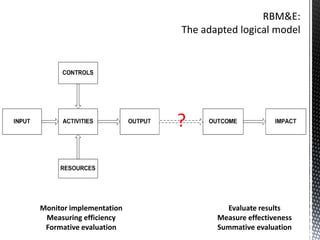
Monitor implementation
Measuring efficiency
Formative evaluation
Evaluate results
Measure effectiveness
Summative evaluation
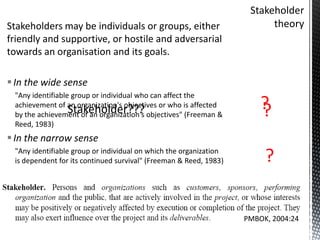
Stakeholders may be individuals or groups, either
friendly and supportive, or hostile and adversarial
towards an organisation and its goals.
In the wide sense
"Any identifiable group or individual who can affect the
achievement of an organization's objectives or who is affected
by the achievement of an organization's objectives" (Freeman &
Reed, 1983)
In the narrow sense
"Any identifiable group or individual on which the organization
is dependent for its continued survival" (Freeman & Reed, 1983)
PMBOK, 2004:24
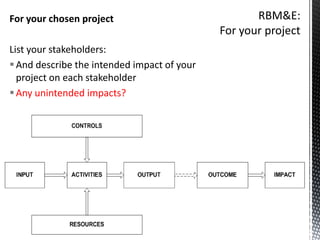
For your chosen project
List your stakeholders:
And describe the intended impact of your
project on each stakeholder
Any unintended impacts?
Important aspect of stakeholders
Bi-directional
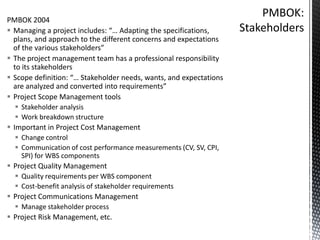
PMBOK 2004
 Managing a project includes: “… Adapting the
specifications, plans, and approach to the different concerns and
expectations of the various stakeholders”
 The project management team has a professional responsibility
to its stakeholders
 Scope definition: “… Stakeholder needs, wants, and expectations
are analyzed and converted into requirements”
 Project Scope Management tools
 Stakeholder analysis
 Work breakdown structure
 Important in Project Cost Management
 Change control
 Communication of cost performance measurements
(CV, SV, CPI, SPI) for WBS components
 Project Quality Management
 Quality requirements per WBS component
 Cost-benefit analysis of stakeholder requirements
 Project Communications Management
 Manage stakeholder process
 Project Risk Management, etc.
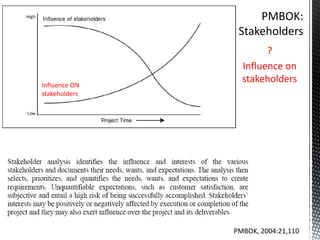
PMBOK, 2004:21,110
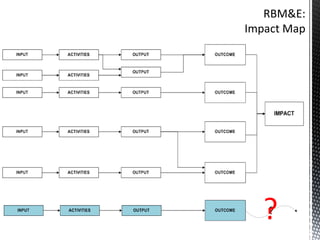
?
Influence on
stakeholdersInfluence ON
stakeholders
??
For your chosen project
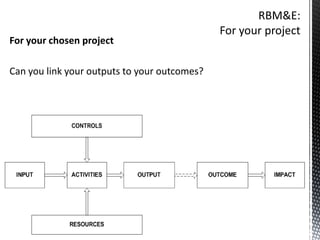
Can you link your outputs to your outcomes?
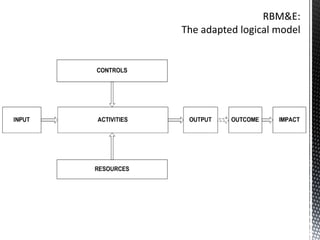
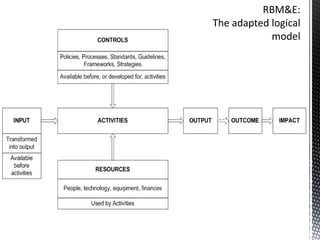
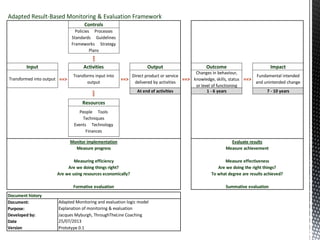
Controls
Policies Processes
Standards Guidelines
Frameworks Strategy
Plans
Input Activities Output Outcome Impact
Transformed into output ==>
Transforms input into
output
==>
Direct product or service
delivered by activities
==>
Changes in behaviour,
knowledge, skills, status
or level of functioning
==>
Fundamental intended
and unintended change
At end of activities 1 - 6 years 7 - 10 years
Resources
People Tools
Techniques
Events Technology
Finances
Document history
Document:
Purpose:
Developed by: Jacques Myburgh, ThroughTheLine Coaching
Date
Version
25/07/2013
Prototype 0.1
Adapted Result-Based Monitoring & Evaluation Framework
Monitor implementation
Measure progress
Measuring efficiency
Are we doing things right?
Are we using resources economically?
Formative evaluation
Evaluate results
Measure achievement
Measure effectiveness
Are we doing the right things?
To what degree are results achieved?
Summative evaluation
Adapted Monitoring and evaluation logic model
Explanation of monitoring & evaluation
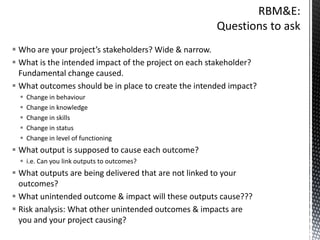
 Who are your project’s stakeholders? Wide & narrow.
 What is the intended impact of the project on each stakeholder?
Fundamental change caused.
 What outcomes should be in place to create the intended impact?
 Change in behaviour
 Change in knowledge
 Change in skills
 Change in status
 Change in level of functioning
 What output is supposed to cause each outcome?
 i.e. Can you link outputs to outcomes?
 What outputs are being delivered that are not linked to your
outcomes?
 What unintended outcome & impact will these outputs cause???
 Risk analysis: What other unintended outcomes & impacts are
you and your project causing?
Jacques Myburgh
Existential Coach
ThroughTheLine Coaching
083-261-8820
throughthelinecoaching@gmail.com
http://youtu.be/5f4rNEsyEYY
Project Management South Africa

Monitoring & Evaluating projects & programs: A stakeholder perspective

  • 1.
    Jacques Myburgh Existential Coach ThroughTheLineCoaching Oct 2013 Project Management South Africa
  • 2.
     Science degreein Information Systems & Geology  Corporate IT environment  MBA (Oxford-Brookes, UK) in Strategic Marketing Management, with thesis in change facilitation  Organisational change management  Project, program & project office management, and served on PMSA Western Cape committee  Business intelligence – monitoring and reporting of corporate business performance  Coaching part-time for the last 5 years – management coaching, business coaching, midlife coaching, SLOW coaching  Current research in monitoring and evaluation of the strategy to professionalise the coaching industry in South Africa as part of an MPhil in Management Coaching (USB). Due date – Dec2013
  • 3.
    Monitoring and EvaluatingProjects and Programs: A Stakeholder Perspective Using a results-based evaluation framework to determine the efficiency and effectiveness of a project. This workshop:  Introduces the results-based evaluation framework, how it monitors efficiency and evaluates effectiveness,  Reviews stakeholder management,  Describes the process of designing an impact-map to ensure stakeholder satisfaction, and  Provides a practical opportunity to implement the framework on a current or planned project On completion of the workshop, you will be able to:  Describe the difference between monitoring and evaluation,  Distinguish between project stakeholders, in a wide and narrow sense,  Map project activities through to results, and  Document the relationships in your project between deliverables, project outcome, performance indicators, and impact on stakeholders.
  • 4.
    Results-based monitoring &evaluation (RBM&E) "Results-based monitoring and evaluation is a management tool to help track progress and demonstrate the impact of development projects, programs, and policies" (Morra Imas & Rist, 2009:105).  Results-based monitoring "Continuous process of collecting and analysing information on key indicators in order to measure progress toward goals" (Morra Imas & Rist, 2009:108).  Results-based evaluation Assessment of a planned, ongoing, or completed intervention to determine its relevance, efficiency, effectiveness, impact, and sustainability" (Morra Imas & Rist, 2009:108).
  • 5.
    Monitor implementation Measure progress Measuringefficiency Are we doing things right? Are we using resources economically? Formative evaluation Evaluate results Measure achievement Measure effectiveness Are we doing the right things? To what degree are results achieved? Summative evaluation
  • 6.
    Choose a current,past or future project Or use your own future as a project Write a short description of: Planned outputs (deliverables) Intended outcomes  Change in behaviour  Change in knowledge  Change in skills  Change in status  Change in level of functioning
  • 9.
    For your chosenproject Write a short description of: Your resources Your controls Your inputs
  • 10.
    Monitor implementation Measuring efficiency Formativeevaluation Evaluate results Measure effectiveness Summative evaluation
  • 11.
    Stakeholders may beindividuals or groups, either friendly and supportive, or hostile and adversarial towards an organisation and its goals. In the wide sense "Any identifiable group or individual who can affect the achievement of an organization's objectives or who is affected by the achievement of an organization's objectives" (Freeman & Reed, 1983) In the narrow sense "Any identifiable group or individual on which the organization is dependent for its continued survival" (Freeman & Reed, 1983) PMBOK, 2004:24
  • 12.
    For your chosenproject List your stakeholders: And describe the intended impact of your project on each stakeholder Any unintended impacts?
  • 13.
    Important aspect ofstakeholders Bi-directional
  • 14.
    PMBOK 2004  Managinga project includes: “… Adapting the specifications, plans, and approach to the different concerns and expectations of the various stakeholders”  The project management team has a professional responsibility to its stakeholders  Scope definition: “… Stakeholder needs, wants, and expectations are analyzed and converted into requirements”  Project Scope Management tools  Stakeholder analysis  Work breakdown structure  Important in Project Cost Management  Change control  Communication of cost performance measurements (CV, SV, CPI, SPI) for WBS components  Project Quality Management  Quality requirements per WBS component  Cost-benefit analysis of stakeholder requirements  Project Communications Management  Manage stakeholder process  Project Risk Management, etc.
  • 15.
  • 16.
  • 17.
    For your chosenproject Can you link your outputs to your outcomes?
  • 18.
    Controls Policies Processes Standards Guidelines FrameworksStrategy Plans Input Activities Output Outcome Impact Transformed into output ==> Transforms input into output ==> Direct product or service delivered by activities ==> Changes in behaviour, knowledge, skills, status or level of functioning ==> Fundamental intended and unintended change At end of activities 1 - 6 years 7 - 10 years Resources People Tools Techniques Events Technology Finances Document history Document: Purpose: Developed by: Jacques Myburgh, ThroughTheLine Coaching Date Version 25/07/2013 Prototype 0.1 Adapted Result-Based Monitoring & Evaluation Framework Monitor implementation Measure progress Measuring efficiency Are we doing things right? Are we using resources economically? Formative evaluation Evaluate results Measure achievement Measure effectiveness Are we doing the right things? To what degree are results achieved? Summative evaluation Adapted Monitoring and evaluation logic model Explanation of monitoring & evaluation
  • 19.
     Who areyour project’s stakeholders? Wide & narrow.  What is the intended impact of the project on each stakeholder? Fundamental change caused.  What outcomes should be in place to create the intended impact?  Change in behaviour  Change in knowledge  Change in skills  Change in status  Change in level of functioning  What output is supposed to cause each outcome?  i.e. Can you link outputs to outcomes?  What outputs are being delivered that are not linked to your outcomes?  What unintended outcome & impact will these outputs cause???  Risk analysis: What other unintended outcomes & impacts are you and your project causing?
  • 20.
    Jacques Myburgh Existential Coach ThroughTheLineCoaching 083-261-8820 throughthelinecoaching@gmail.com http://youtu.be/5f4rNEsyEYY Project Management South Africa