RBI’s Development And Regulatory
Policy
CA Divakar Vijayasarathy
Credits & Acknowledgements
R Subash
Gracelin Lita
T.K. Sundara Rajan
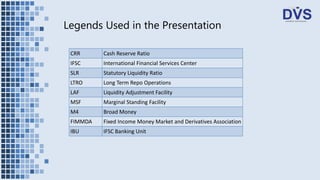
Legends Used in the Presentation
CRR Cash Reserve Ratio
IFSC International Financial Services Center
SLR Statutory Liquidity Ratio
LTRO Long Term Repo Operations
LAF Liquidity Adjustment Facility
MSF Marginal Standing Facility
M4 Broad Money
FIMMDA Fixed Income Money Market and Derivatives Association
IBU IFSC Banking Unit
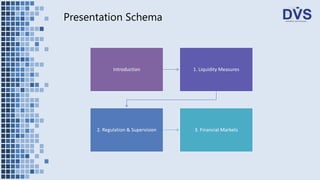
Presentation Schema
Introduction 1. Liquidity Measures
2. Regulation & Supervision 3. Financial Markets
Liquidity Measures
Under LTRO, RBI provides longer term (one- to three-year) loans to banks at the prevailing repo rate.
Since banks are able to get long term loans at the prevailing repo rate which are exclusively to be
used for investment purposes, companies with good standing shall have access to funds of these
banks.
As a result there would be increased credit flow in the economy.
Targeted Long Term Repo Operations
The Reserve Bank will conduct auctions of targeted term repos of up to three years tenor of
appropriate sizes for a total amount of up to ₹1,00,000 crore at a floating rate, linked to the
policy repo rate. The first auction of ₹25,000 crore was conducted on 28th March, 2020.
Liquidity availed under the scheme by banks has to be deployed in investment grade
corporate bonds, commercial paper and non-convertible debentures over and above the
outstanding level of their investments in these bonds as on March 25, 2020.
Current
Proposal
Contd.
As per RBI guidelines on non-SLR investments Investment grade bonds are those bonds which
have been assigned an investment grade by a credit rating agency registered with SEBI.
The investment grade assigned by CRISIL ranges from BBB to AAA.
The credit ratings would be reviewed by IBA/FIMMDA at least once a year.
• LTROs would reduce the cost of borrowings and would also increase flow
of credit to the eligible corporates in the economy
• The annual growth rate of investment by banks in such assets has
decreased over the last year. However, the current proposal would
encourage banks to invest in corporate bonds and other instruments
Impact
Flow of Financial Resources from Scheduled Commercial
Banks to the Commercial Sector
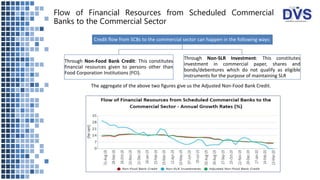
Credit flow from SCBs to the commercial sector can happen in the following ways:
Through Non-Food Bank Credit: This constitutes
financial resources given to persons other than
Food Corporation Institutions (FCI).
Through Non-SLR Investment: This constitutes
investment in commercial paper, shares and
bonds/debentures which do not qualify as eligible
instruments for the purpose of maintaining SLR
The aggregate of the above two figures give us the Adjusted Non-Food Bank Credit.
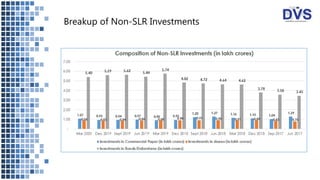
Breakup of Non-SLR Investments
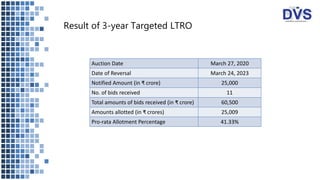
Result of 3-year Targeted LTRO
Auction Date March 27, 2020
Date of Reversal March 24, 2023
Notified Amount (in ₹ crore) 25,000
No. of bids received 11
Total amounts of bids received (in ₹ crore) 60,500
Amounts allotted (in ₹ crores) 25,009
Pro-rata Allotment Percentage 41.33%
Cash Reserve Ratio
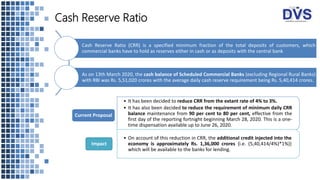
Cash Reserve Ratio (CRR) is a specified minimum fraction of the total deposits of customers, which
commercial banks have to hold as reserves either in cash or as deposits with the central bank
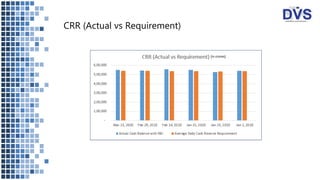
As on 13th March 2020, the cash balance of Scheduled Commercial Banks (excluding Regional Rural Banks)
with RBI was Rs. 5,51,020 crores with the average daily cash reserve requirement being Rs. 5,40,414 crores.
• It has been decided to reduce CRR from the extant rate of 4% to 3%.
• It has also been decided to reduce the requirement of minimum daily CRR
balance maintenance from 90 per cent to 80 per cent, effective from the
first day of the reporting fortnight beginning March 28, 2020. This is a one-
time dispensation available up to June 26, 2020.
Current Proposal
• On account of this reduction in CRR, the additional credit injected into the
economy is approximately Rs. 1,36,000 crores {i.e. (5,40,414/4%)*1%)}
which will be available to the banks for lending.
Impact
CRR (Actual vs Requirement)
Effect of Reduction in CRR
This inverse relationship could be seen again
in the coming months.
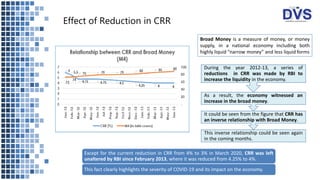
It could be seen from the figure that CRR has
an inverse relationship with Broad Money.
As a result, the economy witnessed an
increase in the broad money.
During the year 2012-13, a series of
reductions in CRR was made by RBI to
increase the liquidity in the economy.
Except for the current reduction in CRR from 4% to 3% in March 2020, CRR was left
unaltered by RBI since February 2013, where it was reduced from 4.25% to 4%.
This fact clearly highlights the severity of COVID-19 and its impact on the economy.
Broad Money is a measure of money, or money
supply, in a national economy including both
highly liquid “narrow money” and less liquid forms
Widening of Monetary Policy Rate Corridor
A liquidity adjustment facility (LAF) is a tool used in monetary policy that allows banks to borrow money through
repurchase agreements (repos) or for banks to make loans to the RBI through reverse repo agreements.
The LAF gap i.e. the difference between repo and reverse repo rate was previously at 25 bps with reverse
repo rate pegged lower than the policy repo rate.
A lower LAF gap would act as an incentive for the banks to park their money in central bank.
The repo rate and reverse repo rate for the quarter ended December 2019 was 4.9% and 5.15% respectively.
• The Reverse Repo Rate will now be pegged 40 bps lower than the policy repo rate as against the
existing gap of 25 bps.
• The proposed repo and reverse repo will be 4.4 per cent and 4 per cent respectively.
• While the repo rate has been reduced by 75 bps, the reverse repo rate has been reduced by 90 bps
Current
Proposal
• The relatively higher reduction in reverse repo rate, makes it unattractive
for the banks to park their money with the central bank.
• Alternatively the banks would lend money in the market for better returns
which will increase the credit availability in the economy.
Impact
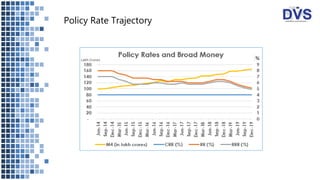
Policy Rate Trajectory
Marginal Standing Facility
The interest rate of funds availed under this facility will be pegged higher than the prevailing
policy repo rate.
All SLR-eligible transferable Government of India dated Securities/Treasury Bills and State
Development Loans (SDL) are eligible securities for the purpose of MSF.
The funds will be borrowed under the facility against the banks’ SLR Holdings.
This limit was increased from 1% to 2% of NDTL on 17th April, 2012.
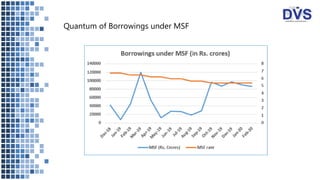
MSF is a scheme introduced by RBI on 7th May 2011, wherein Scheduled Commercial Banks
may borrow overnight up to 1% of their respective Net Demand and Time Liabilities (NDTL).
Contd.
It has been decided to increase the borrowing limit of SCBs (excluding regional
rural banks) from 2% to 3% of the NDTL with immediate effect.
This measure will be available only up to 30th June 2020.
It has been decided to increase the accommodation under MSF from 2 per
cent of SLR to 3 per cent with immediate effect.
That is there would be a general waiver of default for SLR falling below the
minimum requirement to the extent of 3% of SLR.
• The above three measures relating to TLTRO, CRR and MSF
will inject a total liquidity of 3.74 lakh crores to the system.
Impact
Current Proposal
Quantum of Borrowings under MSF
Regulation and Supervision
Capital Conservation Buffer (CCB)
Impact: The further deferment of CCB would reduce the liquidity stress and the compliance burden on the banks.
The capital conservation buffer was introduced by Basel III Committee to ensure that banks have an
additional layer of usable capital that can be drawn down when losses are incurred.
The buffer was implemented in full as of 2019 and is set at 2.5% of total risk-weighted assets.
It must be met with Common Equity Tier 1 (CET1) capital (i.e. owner’s funds) only, and it is established
above the regulatory minimum capital requirement.
The capital conservation buffer can be drawn down only when a bank faces a systemic stress.
Whenever the buffer falls below 2.5%, automatic constraints on capital distribution (for example, dividends,
share buybacks and discretionary bonus payments) will be imposed so that the buffer can be replenished.
Current
Proposal
• As per Basel standards, the CCB was to be implemented in 4 equal tranches of 0.625% and the
transition to full CCB of 2.5% was set to be completed by 31 March 2019.
• However it was deferred to March 31, 2020.
• Now, it has been decided to further defer the implementation of the last tranche of 0.625 per
cent of the CCB from March 31, 2020 to September 30, 2020.
Deferring Implementation of Net Stable
Funding Ratio (NSFR)
One of the main objective of NSFR is to prevent huge bank bailouts due to failure of assets.
A sustainable funding structure is intended to reduce the likelihood that, disruptions to a
bank’s regular sources of funding will erode its liquidity position in a way that would
increase the risk of its failure and potentially lead to broader systemic stress.
This ratio should be equal to at least 100% on an ongoing basis.
The NSFR, which is one of the Basel Committee’s key reforms to promote a more resilient
banking sector, is defined as the amount of available stable funding relative to the amount
of required stable funding.
Contd.
“Available stable funding” is defined as the portion of capital and liabilities expected to be
reliable over the time horizon considered by the NSFR, which extends to one year.
The amount of such stable funding required ("Required stable funding") of a specific institution
is a function of the liquidity characteristics and residual maturities of the various assets held by
that institution as well as those of its off-balance sheet (OBS) exposures.
• NSFR was required to be introduced by banks in India from April 1, 2020.
• It has now been decided to defer the implementation of NSFR by six months
to October 1, 2020.
Current
Proposal
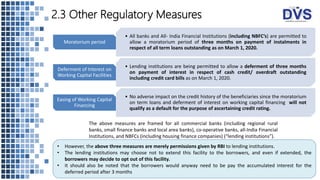
2.3 Other Regulatory Measures
• All banks and All- India Financial Institutions (including NBFC’s) are permitted to
allow a moratorium period of three months on payment of instalments in
respect of all term loans outstanding as on March 1, 2020.
Moratorium period
• Lending institutions are being permitted to allow a deferment of three months
on payment of interest in respect of cash credit/ overdraft outstanding
including credit card bills as on March 1, 2020.
Deferment of Interest on
Working Capital Facilities
• No adverse impact on the credit history of the beneficiaries since the moratorium
on term loans and deferment of interest on working capital financing will not
qualify as a default for the purpose of ascertaining credit rating.
Easing of Working Capital
Financing
• However, the above three measures are merely permissions given by RBI to lending institutions.
• The lending institutions may choose not to extend this facility to the borrowers, and even if extended, the
borrowers may decide to opt out of this facility.
• It should also be noted that the borrowers would anyway need to be pay the accumulated interest for the
deferred period after 3 months
The above measures are framed for all commercial banks (including regional rural
banks, small finance banks and local area banks), co-operative banks, all-India Financial
Institutions, and NBFCs (including housing finance companies) (“lending institutions”).
Financial Markets
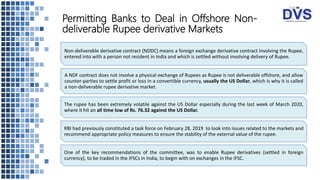
Permitting Banks to Deal in Offshore Non-
deliverable Rupee derivative Markets
Non-deliverable derivative contract (NDDC) means a foreign exchange derivative contract involving the Rupee,
entered into with a person not resident in India and which is settled without involving delivery of Rupee.
A NDF contract does not involve a physical exchange of Rupees as Rupee is not deliverable offshore, and allow
counter-parties to settle profit or loss in a convertible currency, usually the US Dollar, which is why it is called
a non-deliverable rupee derivative market.
The rupee has been extremely volatile against the US Dollar especially during the last week of March 2020,
where it hit an all time low of Rs. 76.32 against the US Dollar.
RBI had previously constituted a task force on February 28, 2019 to look into issues related to the markets and
recommend appropriate policy measures to ensure the stability of the external value of the rupee.
One of the key recommendations of the committee, was to enable Rupee derivatives (settled in foreign
currency), to be traded in the IFSCs in India, to begin with on exchanges in the IFSC.
Contd.
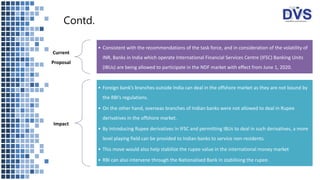
Current
Proposal
• Consistent with the recommendations of the task force, and in consideration of the volatility of
INR, Banks in India which operate International Financial Services Centre (IFSC) Banking Units
(IBUs) are being allowed to participate in the NDF market with effect from June 1, 2020.
Impact
• Foreign bank’s branches outside India can deal in the offshore market as they are not bound by
the RBI’s regulations.
• On the other hand, overseas branches of Indian banks were not allowed to deal in Rupee
derivatives in the offshore market.
• By introducing Rupee derivatives in IFSC and permitting IBUs to deal in such derivatives, a more
level playing field can be provided to Indian banks to service non-residents.

• This move would also help stabilize the rupee value in the international money market
• RBI can also intervene through the Nationalised Bank in stabilising the rupee.
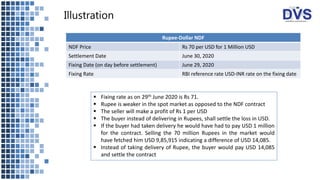
Illustration
 Fixing rate as on 29th June 2020 is Rs 71.
 Rupee is weaker in the spot market as opposed to the NDF contract
 The seller will make a profit of Rs 1 per USD
 The buyer instead of delivering in Rupees, shall settle the loss in USD.
 If the buyer had taken delivery he would have had to pay USD 1 million
for the contract. Selling the 70 million Rupees in the market would
have fetched him USD 9,85,915 indicating a difference of USD 14,085.
 Instead of taking delivery of Rupee, the buyer would pay USD 14,085
and settle the contract
Rupee-Dollar NDF
NDF Price Rs 70 per USD for 1 Million USD
Settlement Date June 30, 2020
Fixing Date (on day before settlement) June 29, 2020
Fixing Rate RBI reference rate USD-INR rate on the fixing date
“COVID-19 is upon us, but this too shall pass”
- Shaktikanta Das
Thank You.
Thank You!
Scan the QR Code to Join our
Research Group on WhatsApp
Scan the QR Code to explore more
Research from our Website
DVS Advisors LLP
India-Singapore-London-Dubai-Malaysia-Africa
www.dvsca.com
Copyrights © 2020 DVS Advisors LLP

Rbi's development and regulatory policy

  • 1.
    RBI’s Development AndRegulatory Policy CA Divakar Vijayasarathy
  • 2.
    Credits & Acknowledgements RSubash Gracelin Lita T.K. Sundara Rajan
  • 3.
    Legends Used inthe Presentation CRR Cash Reserve Ratio IFSC International Financial Services Center SLR Statutory Liquidity Ratio LTRO Long Term Repo Operations LAF Liquidity Adjustment Facility MSF Marginal Standing Facility M4 Broad Money FIMMDA Fixed Income Money Market and Derivatives Association IBU IFSC Banking Unit
  • 4.
    Presentation Schema Introduction 1.Liquidity Measures 2. Regulation & Supervision 3. Financial Markets
  • 5.
  • 6.
    Under LTRO, RBIprovides longer term (one- to three-year) loans to banks at the prevailing repo rate. Since banks are able to get long term loans at the prevailing repo rate which are exclusively to be used for investment purposes, companies with good standing shall have access to funds of these banks. As a result there would be increased credit flow in the economy. Targeted Long Term Repo Operations The Reserve Bank will conduct auctions of targeted term repos of up to three years tenor of appropriate sizes for a total amount of up to ₹1,00,000 crore at a floating rate, linked to the policy repo rate. The first auction of ₹25,000 crore was conducted on 28th March, 2020. Liquidity availed under the scheme by banks has to be deployed in investment grade corporate bonds, commercial paper and non-convertible debentures over and above the outstanding level of their investments in these bonds as on March 25, 2020. Current Proposal
  • 7.
    Contd. As per RBIguidelines on non-SLR investments Investment grade bonds are those bonds which have been assigned an investment grade by a credit rating agency registered with SEBI. The investment grade assigned by CRISIL ranges from BBB to AAA. The credit ratings would be reviewed by IBA/FIMMDA at least once a year. • LTROs would reduce the cost of borrowings and would also increase flow of credit to the eligible corporates in the economy • The annual growth rate of investment by banks in such assets has decreased over the last year. However, the current proposal would encourage banks to invest in corporate bonds and other instruments Impact
  • 8.
    Flow of FinancialResources from Scheduled Commercial Banks to the Commercial Sector Credit flow from SCBs to the commercial sector can happen in the following ways: Through Non-Food Bank Credit: This constitutes financial resources given to persons other than Food Corporation Institutions (FCI). Through Non-SLR Investment: This constitutes investment in commercial paper, shares and bonds/debentures which do not qualify as eligible instruments for the purpose of maintaining SLR The aggregate of the above two figures give us the Adjusted Non-Food Bank Credit.
  • 9.
    Breakup of Non-SLRInvestments
  • 10.
    Result of 3-yearTargeted LTRO Auction Date March 27, 2020 Date of Reversal March 24, 2023 Notified Amount (in ₹ crore) 25,000 No. of bids received 11 Total amounts of bids received (in ₹ crore) 60,500 Amounts allotted (in ₹ crores) 25,009 Pro-rata Allotment Percentage 41.33%
  • 11.
    Cash Reserve Ratio CashReserve Ratio (CRR) is a specified minimum fraction of the total deposits of customers, which commercial banks have to hold as reserves either in cash or as deposits with the central bank As on 13th March 2020, the cash balance of Scheduled Commercial Banks (excluding Regional Rural Banks) with RBI was Rs. 5,51,020 crores with the average daily cash reserve requirement being Rs. 5,40,414 crores. • It has been decided to reduce CRR from the extant rate of 4% to 3%. • It has also been decided to reduce the requirement of minimum daily CRR balance maintenance from 90 per cent to 80 per cent, effective from the first day of the reporting fortnight beginning March 28, 2020. This is a one- time dispensation available up to June 26, 2020. Current Proposal • On account of this reduction in CRR, the additional credit injected into the economy is approximately Rs. 1,36,000 crores {i.e. (5,40,414/4%)*1%)} which will be available to the banks for lending. Impact
  • 12.
    CRR (Actual vsRequirement)
  • 13.
    Effect of Reductionin CRR This inverse relationship could be seen again in the coming months. It could be seen from the figure that CRR has an inverse relationship with Broad Money. As a result, the economy witnessed an increase in the broad money. During the year 2012-13, a series of reductions in CRR was made by RBI to increase the liquidity in the economy. Except for the current reduction in CRR from 4% to 3% in March 2020, CRR was left unaltered by RBI since February 2013, where it was reduced from 4.25% to 4%. This fact clearly highlights the severity of COVID-19 and its impact on the economy. Broad Money is a measure of money, or money supply, in a national economy including both highly liquid “narrow money” and less liquid forms
  • 14.
    Widening of MonetaryPolicy Rate Corridor A liquidity adjustment facility (LAF) is a tool used in monetary policy that allows banks to borrow money through repurchase agreements (repos) or for banks to make loans to the RBI through reverse repo agreements. The LAF gap i.e. the difference between repo and reverse repo rate was previously at 25 bps with reverse repo rate pegged lower than the policy repo rate. A lower LAF gap would act as an incentive for the banks to park their money in central bank. The repo rate and reverse repo rate for the quarter ended December 2019 was 4.9% and 5.15% respectively. • The Reverse Repo Rate will now be pegged 40 bps lower than the policy repo rate as against the existing gap of 25 bps. • The proposed repo and reverse repo will be 4.4 per cent and 4 per cent respectively. • While the repo rate has been reduced by 75 bps, the reverse repo rate has been reduced by 90 bps Current Proposal • The relatively higher reduction in reverse repo rate, makes it unattractive for the banks to park their money with the central bank. • Alternatively the banks would lend money in the market for better returns which will increase the credit availability in the economy. Impact
  • 15.
  • 16.
    Marginal Standing Facility Theinterest rate of funds availed under this facility will be pegged higher than the prevailing policy repo rate. All SLR-eligible transferable Government of India dated Securities/Treasury Bills and State Development Loans (SDL) are eligible securities for the purpose of MSF. The funds will be borrowed under the facility against the banks’ SLR Holdings. This limit was increased from 1% to 2% of NDTL on 17th April, 2012. MSF is a scheme introduced by RBI on 7th May 2011, wherein Scheduled Commercial Banks may borrow overnight up to 1% of their respective Net Demand and Time Liabilities (NDTL).
  • 17.
    Contd. It has beendecided to increase the borrowing limit of SCBs (excluding regional rural banks) from 2% to 3% of the NDTL with immediate effect. This measure will be available only up to 30th June 2020. It has been decided to increase the accommodation under MSF from 2 per cent of SLR to 3 per cent with immediate effect. That is there would be a general waiver of default for SLR falling below the minimum requirement to the extent of 3% of SLR. • The above three measures relating to TLTRO, CRR and MSF will inject a total liquidity of 3.74 lakh crores to the system. Impact Current Proposal
  • 18.
  • 19.
  • 20.
    Capital Conservation Buffer(CCB) Impact: The further deferment of CCB would reduce the liquidity stress and the compliance burden on the banks. The capital conservation buffer was introduced by Basel III Committee to ensure that banks have an additional layer of usable capital that can be drawn down when losses are incurred. The buffer was implemented in full as of 2019 and is set at 2.5% of total risk-weighted assets. It must be met with Common Equity Tier 1 (CET1) capital (i.e. owner’s funds) only, and it is established above the regulatory minimum capital requirement. The capital conservation buffer can be drawn down only when a bank faces a systemic stress. Whenever the buffer falls below 2.5%, automatic constraints on capital distribution (for example, dividends, share buybacks and discretionary bonus payments) will be imposed so that the buffer can be replenished. Current Proposal • As per Basel standards, the CCB was to be implemented in 4 equal tranches of 0.625% and the transition to full CCB of 2.5% was set to be completed by 31 March 2019. • However it was deferred to March 31, 2020. • Now, it has been decided to further defer the implementation of the last tranche of 0.625 per cent of the CCB from March 31, 2020 to September 30, 2020.
  • 21.
    Deferring Implementation ofNet Stable Funding Ratio (NSFR) One of the main objective of NSFR is to prevent huge bank bailouts due to failure of assets. A sustainable funding structure is intended to reduce the likelihood that, disruptions to a bank’s regular sources of funding will erode its liquidity position in a way that would increase the risk of its failure and potentially lead to broader systemic stress. This ratio should be equal to at least 100% on an ongoing basis. The NSFR, which is one of the Basel Committee’s key reforms to promote a more resilient banking sector, is defined as the amount of available stable funding relative to the amount of required stable funding.
  • 22.
    Contd. “Available stable funding”is defined as the portion of capital and liabilities expected to be reliable over the time horizon considered by the NSFR, which extends to one year. The amount of such stable funding required ("Required stable funding") of a specific institution is a function of the liquidity characteristics and residual maturities of the various assets held by that institution as well as those of its off-balance sheet (OBS) exposures. • NSFR was required to be introduced by banks in India from April 1, 2020. • It has now been decided to defer the implementation of NSFR by six months to October 1, 2020. Current Proposal
  • 23.
    2.3 Other RegulatoryMeasures • All banks and All- India Financial Institutions (including NBFC’s) are permitted to allow a moratorium period of three months on payment of instalments in respect of all term loans outstanding as on March 1, 2020. Moratorium period • Lending institutions are being permitted to allow a deferment of three months on payment of interest in respect of cash credit/ overdraft outstanding including credit card bills as on March 1, 2020. Deferment of Interest on Working Capital Facilities • No adverse impact on the credit history of the beneficiaries since the moratorium on term loans and deferment of interest on working capital financing will not qualify as a default for the purpose of ascertaining credit rating. Easing of Working Capital Financing • However, the above three measures are merely permissions given by RBI to lending institutions. • The lending institutions may choose not to extend this facility to the borrowers, and even if extended, the borrowers may decide to opt out of this facility. • It should also be noted that the borrowers would anyway need to be pay the accumulated interest for the deferred period after 3 months The above measures are framed for all commercial banks (including regional rural banks, small finance banks and local area banks), co-operative banks, all-India Financial Institutions, and NBFCs (including housing finance companies) (“lending institutions”).
  • 24.
  • 25.
    Permitting Banks toDeal in Offshore Non- deliverable Rupee derivative Markets Non-deliverable derivative contract (NDDC) means a foreign exchange derivative contract involving the Rupee, entered into with a person not resident in India and which is settled without involving delivery of Rupee. A NDF contract does not involve a physical exchange of Rupees as Rupee is not deliverable offshore, and allow counter-parties to settle profit or loss in a convertible currency, usually the US Dollar, which is why it is called a non-deliverable rupee derivative market. The rupee has been extremely volatile against the US Dollar especially during the last week of March 2020, where it hit an all time low of Rs. 76.32 against the US Dollar. RBI had previously constituted a task force on February 28, 2019 to look into issues related to the markets and recommend appropriate policy measures to ensure the stability of the external value of the rupee. One of the key recommendations of the committee, was to enable Rupee derivatives (settled in foreign currency), to be traded in the IFSCs in India, to begin with on exchanges in the IFSC.
  • 26.
    Contd. Current Proposal • Consistent withthe recommendations of the task force, and in consideration of the volatility of INR, Banks in India which operate International Financial Services Centre (IFSC) Banking Units (IBUs) are being allowed to participate in the NDF market with effect from June 1, 2020. Impact • Foreign bank’s branches outside India can deal in the offshore market as they are not bound by the RBI’s regulations. • On the other hand, overseas branches of Indian banks were not allowed to deal in Rupee derivatives in the offshore market. • By introducing Rupee derivatives in IFSC and permitting IBUs to deal in such derivatives, a more level playing field can be provided to Indian banks to service non-residents. • This move would also help stabilize the rupee value in the international money market • RBI can also intervene through the Nationalised Bank in stabilising the rupee.
  • 27.
    Illustration  Fixing rateas on 29th June 2020 is Rs 71.  Rupee is weaker in the spot market as opposed to the NDF contract  The seller will make a profit of Rs 1 per USD  The buyer instead of delivering in Rupees, shall settle the loss in USD.  If the buyer had taken delivery he would have had to pay USD 1 million for the contract. Selling the 70 million Rupees in the market would have fetched him USD 9,85,915 indicating a difference of USD 14,085.  Instead of taking delivery of Rupee, the buyer would pay USD 14,085 and settle the contract Rupee-Dollar NDF NDF Price Rs 70 per USD for 1 Million USD Settlement Date June 30, 2020 Fixing Date (on day before settlement) June 29, 2020 Fixing Rate RBI reference rate USD-INR rate on the fixing date
  • 28.
    “COVID-19 is uponus, but this too shall pass” - Shaktikanta Das Thank You.
  • 29.
    Thank You! Scan theQR Code to Join our Research Group on WhatsApp Scan the QR Code to explore more Research from our Website DVS Advisors LLP India-Singapore-London-Dubai-Malaysia-Africa www.dvsca.com Copyrights © 2020 DVS Advisors LLP