MONETARY POLICY
By Arjun Maurya
S.Y.B.M.S
ROLL NUMBER:222204
BGPS’ MUMBAI COLLEGE OF ARTS,
COMMERCE, SCIENCE
SUBJECT: ECONOMICS
SUBJECT PROFESSOR: DEEPA YADAV
MONETARY POLICY-MEANING
 Use of Monetary instruments by Central Bank to
regulate the availability, cost & use of money and
credit to promote economic growth.
 To regulate Demand for & Supply of Money with
the Public & flow of credit
 It is in the nature of Demand side Macro Economic
policy & works by stimulating or discouraging
investment & consumption spending on goods and
services
OBJECTIVES OF MONETARY POLICY
 General objectives include:
1. Maintenance of economic growth
2. Ensuring an adequate flow of credit to the
productive sectors
3. Sustaining a moderate structure of interest rates
to encourage investments
4. Creation of an efficient market for govt. securities
5. Maintenance of price stability (controlling
inflation)
6. Achieving high level of economic growth
7. Maintenance of full employment
ANALYTICS OF MONETARY POLICY
Monetary Policy intend to impact macro-economic
variables such as aggregate demand, quantity of
money & credit, interest rates, etc.
It influences the Price level & National Income
through mainly 4 mechanisms:-
 The interest rate channel
 The exchange rate channel
 The quantum channel (eg. Money supply & credit)
 The asset price channel (via equity & real estate prices)
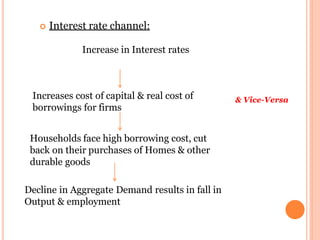
 Interest rate channel:
Increase in Interest rates
Increases cost of capital & real cost of
borrowings for firms
Households face high borrowing cost, cut
back on their purchases of Homes & other
durable goods
Decline in Aggregate Demand results in fall in
Output & employment
& Vice-Versa
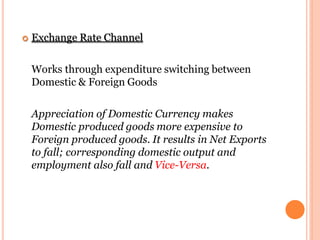
 Exchange Rate Channel
Works through expenditure switching between
Domestic & Foreign Goods
Appreciation of Domestic Currency makes
Domestic produced goods more expensive to
Foreign produced goods. It results in Net Exports
to fall; corresponding domestic output and
employment also fall and Vice-Versa.
 Quantum Channel:
Basically, there are two distinct credit channels –
Bank Lending channel – An open market operation
may lead to increase or decrease in supply of bank
reserves, which will in turn increase or decrease
Banks’ lending firms .
Balance Sheet Channel – Increase or Decrease in
interest rates will relatively increase or decrease
firm’s cost of capital and the same interest rates
also works to rise or fall in capitalized value of
assets, thereby impacting Balance Sheet of a Firm.
 Standard Asset Price Channel:
Rise or fall in interest rates will relatively make
Debt or Equity attractive.
Increase in short term interest rates will make Debt
more attractive to investors leading to fall in equity
prices which will further impact on consumption of
households, output & employment.
& Vice-Versa
OPERATING PROCEDURE
 Operating framework relates to all aspects of
Implementing of Monetary Policy including:
choosing operating target i.e. the variable (inflation)
that monetary policy can influence
choosing intermediate target i.e. the variable
(economic stability) that central bank can hope to
influence through operating target
choosing policy instruments or the tools that a central
bank can use to influence money market & credit
conditions and pursue its monetary objectives
OPERATING INSTRUMENTS
 Cash Reserve Ratio
 Fraction of total net demand & time liabilities
(NDTL) of a schedule commercial bank which it
should maintain with RBI as Cash Deposit.
 No interest is paid by RBI on such deposit
 Failure of bank to meet such requirement would
attract penalty
 Higher the CRR, lower the liquidity in the economy
& vice-versa
 Current CRR rate in India is 4%
 Statutory Liquidity Ratio
 All commercial banks should maintain a certain
percentage (currently 18.50%) of their total NDTL
in one of the following forms:
Cash
Gold, or
Investments including T-bills, Securities issued by
Govt. under Market borrowing Programme & Market
Stabilization scheme, State development loans issued
by state govt. & any other specified instruments.
 Changes in SLR majorly influence the availability of
resource in the banking system for lending.
 Liquidity Adjustment Facility
 Central Bank provides liquidity to banks during
shortage through its Discount window.
 In LAF facility, Banks can borrow via Discount
window against collateral of securities like
commercial bills, govt. securities, treasury bills or
other eligible papers
 Currently RBI provides financial facility through
repo/reverse repos under LAF facility
 Banks can also park their excess funds with RBI
under this facility.
Repo Rate Reverse Repo Rate
RBI charges when funds
borrowed by Banks (5.15%)
Commercial banks charges
when funds borrowed by
RBI(4.9%)
Banks have to pay high rate of
interest against amount
borrowed and controls excess
liquidity from the markets
Banks are offered high gains
and economic system is
injected with liquidity
Involves selling of securities to
RBI & a fixed rate is charged
while repurchasing in future
Transferring of funds from one
bank account to RBI account
It controls inflation It controls money supply in
market
It helps to deal with deficiency
of funds
It helps to deal with liquidity
in the market
 Marginal Standing Facility
Facility under which commercial banks can borrow
additional amount of loan from RBI over & above
what is available to them under LAF facility by
dipping into their SLR upto a limit at a penal rate of
interest.
Minimum amount which can accessed is Rs.1 crore
MSF would be the last resort for banks once they
exhaust with all borrowing options.
MSF rate being a penal rate automatically gets
adjusted to a fixed % above repo rate
MSF rate is presently aligned with Bank Rate
 Bank Rate
Under section 49 of the RBI Act 1934, Bank rate-
“Standard Rate at which the RBI is prepared to buy
or re-discount bills of exchange or other
commercial paper eligible for purchase under the
Act.”
In general terms, Bank Rate is the rate of interest
charged by RBI for providing loans to the banking
system. It is currently aligned with the MSF
rate(5.65%).
 Market Stabilization Scheme:
It was introduced in 2004. It refers to monetary
policy intervention by RBI to withdraw excess
liquidity or money supply by selling securities in the
economy, by selling govt. bonds.
It is used when there is high liquidity in the system
The issued securities are govt. bonds or Market
Stabilization Bonds.
Securities are originally owned by Govt. though sold
by RBI as banker to the govt.
The Securities issued are bought by financial
institutions.
 Open Market Operations
Market operations conducted by RBI by way of sale
or purchase of govt. securities to or from the
market with an objective to adjust rupee liquidity
conditions in the market.
When RBI feels excess liquidity in the market, it
sells securities against rupees.
When liquidity conditions are tight , RBI buys
securities from the market, thereby releasing
liquidity in the economy.
Conclusion
Thank you🙏🙏

Ppt for monetary policy.pptx

  • 1.
    MONETARY POLICY By ArjunMaurya S.Y.B.M.S ROLL NUMBER:222204 BGPS’ MUMBAI COLLEGE OF ARTS, COMMERCE, SCIENCE SUBJECT: ECONOMICS SUBJECT PROFESSOR: DEEPA YADAV
  • 2.
    MONETARY POLICY-MEANING  Useof Monetary instruments by Central Bank to regulate the availability, cost & use of money and credit to promote economic growth.  To regulate Demand for & Supply of Money with the Public & flow of credit  It is in the nature of Demand side Macro Economic policy & works by stimulating or discouraging investment & consumption spending on goods and services
  • 3.
    OBJECTIVES OF MONETARYPOLICY  General objectives include: 1. Maintenance of economic growth 2. Ensuring an adequate flow of credit to the productive sectors 3. Sustaining a moderate structure of interest rates to encourage investments 4. Creation of an efficient market for govt. securities 5. Maintenance of price stability (controlling inflation) 6. Achieving high level of economic growth 7. Maintenance of full employment
  • 4.
    ANALYTICS OF MONETARYPOLICY Monetary Policy intend to impact macro-economic variables such as aggregate demand, quantity of money & credit, interest rates, etc. It influences the Price level & National Income through mainly 4 mechanisms:-  The interest rate channel  The exchange rate channel  The quantum channel (eg. Money supply & credit)  The asset price channel (via equity & real estate prices)
  • 5.
     Interest ratechannel: Increase in Interest rates Increases cost of capital & real cost of borrowings for firms Households face high borrowing cost, cut back on their purchases of Homes & other durable goods Decline in Aggregate Demand results in fall in Output & employment & Vice-Versa
  • 6.
     Exchange RateChannel Works through expenditure switching between Domestic & Foreign Goods Appreciation of Domestic Currency makes Domestic produced goods more expensive to Foreign produced goods. It results in Net Exports to fall; corresponding domestic output and employment also fall and Vice-Versa.
  • 7.
     Quantum Channel: Basically,there are two distinct credit channels – Bank Lending channel – An open market operation may lead to increase or decrease in supply of bank reserves, which will in turn increase or decrease Banks’ lending firms . Balance Sheet Channel – Increase or Decrease in interest rates will relatively increase or decrease firm’s cost of capital and the same interest rates also works to rise or fall in capitalized value of assets, thereby impacting Balance Sheet of a Firm.
  • 8.
     Standard AssetPrice Channel: Rise or fall in interest rates will relatively make Debt or Equity attractive. Increase in short term interest rates will make Debt more attractive to investors leading to fall in equity prices which will further impact on consumption of households, output & employment. & Vice-Versa
  • 9.
    OPERATING PROCEDURE  Operatingframework relates to all aspects of Implementing of Monetary Policy including: choosing operating target i.e. the variable (inflation) that monetary policy can influence choosing intermediate target i.e. the variable (economic stability) that central bank can hope to influence through operating target choosing policy instruments or the tools that a central bank can use to influence money market & credit conditions and pursue its monetary objectives
  • 10.
    OPERATING INSTRUMENTS  CashReserve Ratio  Fraction of total net demand & time liabilities (NDTL) of a schedule commercial bank which it should maintain with RBI as Cash Deposit.  No interest is paid by RBI on such deposit  Failure of bank to meet such requirement would attract penalty  Higher the CRR, lower the liquidity in the economy & vice-versa  Current CRR rate in India is 4%
  • 11.
     Statutory LiquidityRatio  All commercial banks should maintain a certain percentage (currently 18.50%) of their total NDTL in one of the following forms: Cash Gold, or Investments including T-bills, Securities issued by Govt. under Market borrowing Programme & Market Stabilization scheme, State development loans issued by state govt. & any other specified instruments.  Changes in SLR majorly influence the availability of resource in the banking system for lending.
  • 12.
     Liquidity AdjustmentFacility  Central Bank provides liquidity to banks during shortage through its Discount window.  In LAF facility, Banks can borrow via Discount window against collateral of securities like commercial bills, govt. securities, treasury bills or other eligible papers  Currently RBI provides financial facility through repo/reverse repos under LAF facility  Banks can also park their excess funds with RBI under this facility.
  • 13.
    Repo Rate ReverseRepo Rate RBI charges when funds borrowed by Banks (5.15%) Commercial banks charges when funds borrowed by RBI(4.9%) Banks have to pay high rate of interest against amount borrowed and controls excess liquidity from the markets Banks are offered high gains and economic system is injected with liquidity Involves selling of securities to RBI & a fixed rate is charged while repurchasing in future Transferring of funds from one bank account to RBI account It controls inflation It controls money supply in market It helps to deal with deficiency of funds It helps to deal with liquidity in the market
  • 14.
     Marginal StandingFacility Facility under which commercial banks can borrow additional amount of loan from RBI over & above what is available to them under LAF facility by dipping into their SLR upto a limit at a penal rate of interest. Minimum amount which can accessed is Rs.1 crore MSF would be the last resort for banks once they exhaust with all borrowing options. MSF rate being a penal rate automatically gets adjusted to a fixed % above repo rate MSF rate is presently aligned with Bank Rate
  • 15.
     Bank Rate Undersection 49 of the RBI Act 1934, Bank rate- “Standard Rate at which the RBI is prepared to buy or re-discount bills of exchange or other commercial paper eligible for purchase under the Act.” In general terms, Bank Rate is the rate of interest charged by RBI for providing loans to the banking system. It is currently aligned with the MSF rate(5.65%).
  • 16.
     Market StabilizationScheme: It was introduced in 2004. It refers to monetary policy intervention by RBI to withdraw excess liquidity or money supply by selling securities in the economy, by selling govt. bonds. It is used when there is high liquidity in the system The issued securities are govt. bonds or Market Stabilization Bonds. Securities are originally owned by Govt. though sold by RBI as banker to the govt. The Securities issued are bought by financial institutions.
  • 17.
     Open MarketOperations Market operations conducted by RBI by way of sale or purchase of govt. securities to or from the market with an objective to adjust rupee liquidity conditions in the market. When RBI feels excess liquidity in the market, it sells securities against rupees. When liquidity conditions are tight , RBI buys securities from the market, thereby releasing liquidity in the economy.
  • 18.
  • 19.