International Journal of Mathematical Education in
Science and Technology, Vol. 38, No. 8, 15 December 2007, 1075–1092
A case study of dynamic visualization and problem solving
ILANA LAVY*
The Max Stern Academic College of Emek Yezreel, Israel
(Received 24 January 2006)
This paper reports an example of a situation in which university students had to
solve geometrical problems presented to them dynamically using the interactive
computerized environment of the ‘MicroWorlds Project Builder’. In the process
of the problem solving, the students used ten different solution strategies. The
unsuccessful strategies were then classified into three main categories: distracting,
reducing and confusing. One student group had to solve the same problem in its
non-dynamic version. The results received from both groups were compared and
analysed. Analysis of the solution strategies and the process of the categorization
revealed that the percentage of success in both groups was similar and in the case
of the given problem, the dynamic visual mode of the problem distracted the
students’ attention away from proper handling of the solution of the problem.
1. Introduction
A great deal of research has discussed the advantages of visualization with regard to
problem solving [1–5]. Visualization enables various ways of thinking, different from
traditional approaches where formalism and symbolism dominate teaching. Visual
thought can offer an alternative and powerful resource in learning mathematics.
Kosslyn [6] argued that one of the main components of imagery processing involved
representation. Problem representation has been viewed as an important stage of the
problem solving process [7]. In the initial stages of the problem solving process it is
beneficial to represent the problem in a visual manner [8].
Research also discusses difficulties which involved imagery with regard to visual
thinking [1, 2]: (1) The one-case concreteness of an image or diagram may tie thought
to irrelevant details, or may even bring in false data. (2) An image of a
standard figure may induce inflexible thinking which prevents the recognition of a
concept in a nonstandard diagram. (3) An uncontrollable image may persist, thereby
preventing the opening up of more fruitful avenues of thought, a difficulty which is
particularly severe if the image is vivid. (4) Imagery which is vague needs to be
coupled with rigorous analytical thought processes if it is to be helpful.
Distinction should be drawn between difficulties that are intrinsic to visualization
such as the difficulties described in the previous paragraph and difficulties that are
*Email: llanaL@yvc.ac.il
International Journal of Mathematical Education in Science and Technology
ISSN 0020–739X print/ISSN 1464–5211 online ß 2007 Taylor & Francis
http://www.tandf.co.uk/journals
DOI: 10.1080/00207390601129196
extrinsic to visualization such as described in the given task. Intrinsic difficulties are
difficulties that emerge as a consequence of visual thinking. Extrinsic difficulties are
difficulties that emerge as a consequence of the use of certain modes of visual
representations of a problem. In the case of the problem given in this study,
questions might be raised whether intrinsic and extrinsic difficulties have a reciprocal
influence on each other.
One of the possible ways to visualize a problem is by the use of a computerized
environment. When a visualized problem is presented in an interactive computerized
environment, the interactivity enables continuity in the process of thinking about
the problem since the learner gets immediate feedback to his or her operation,
which might motivate him or her to keep on trying various options in order to
solve the problem. The ability to solve a problem interactively also enables the
checking of an enormous number of situations rapidly and with an immediate
response, and as a result facilitates the process of problem solving. Finally, in
certain interactive environments, the software enables one to examine a conjecture
so that one can see if a hypothesis is valid before making any great efforts trying
to prove it.
Being aware of all the above advantages along with the possible difficulties, the
author gave one group of university students a dynamic visualized geometrical
problem that was presented to them in the ‘MicroWorlds Project-Builder’ (MWPB)
environment; to a second group of students the author gave the non-dynamic version
of the same problem, and was surprised by the results obtained.
2. Literature survey
The present study examines the effect of visual representation of a geometrical
problem given in the interactive environment of the ‘‘Microworlds Project Builder’’
on the process of solving the said problem. Hence, the literature survey includes
references to the role of visualization regarding problem solving and to the evolution
of mathematical microworlds in general and to the environment of the ‘MicroWorlds
Project Builder’ in particular.
2.1. The evolution of mathematical microworlds
‘Microworlds are environments where people can explore and learn from what they
receive back from the computer in return for their exploration’ [9, p. 30].
Mathematical Microworlds developed in recent years met the need for a learning
environment in which learners could create a common language and be engaged in
mathematical processes such as generalization, abstraction, problem solving and
gradual transition from intuitive to formal description of mathematical concepts.
One of the purposes of using Microworlds was to connect intuitive and formal
aspects of thinking. Hoyles and Noss [10] suggested a definition of the Microworld
concept that relates to the following components: technical (software), pedagogical,
the learner and the context.
‘A microworld cannot be defined in isolation from either the learner, the
teacher or the setting; activity in the Microworld will be shaped by the past
experience and intuitions of the learner, and by the aims and expectations of the
teacher’ [10].
1076 I. Lavy
Various researchers were motivated by Papert’s vision, appearing in his book,
Mindstorms that: ‘. . . Children get to know what it is like to explore the properties of
a chosen microworld undisturbed by extraneous questions. In doing so they learn to
transfer habits of exploration from their personal lives to the formal domain of
scientific theory construction’ [11, p. 117]. Researchers developed Microworlds in
science and mathematics [12–16]. Some examples of mathematical Microworlds are:
‘Mathsticks’ – developed by Noss, Healy and Hoyles [15] for learning algebraic
themes; ‘Turtles Mirrors’ – developed by Hoyles and Healy [16] for learning
reflective symmetry. Sinclair, Zazkis and Liljedahl [17] explored the impact of the
MicroWorld Number Worlds on the understanding of pre-service elementary
teachers of concepts and relationships underlying elementary number theory. They
found that interaction with Number Worlds had a positive effect in helping
participants construct those concepts.
The above mentioned microworlds serve as settings for developing problem-
solving skills and mathematical thinking, and only partly for the use of
programming. While being aware of the fact that programming is time-consuming,
too hard, and diverts attention from the underlying knowledge goals, in their
rethinking of the microworld ideas, Hoyles, Noss and Adamson [9] wrote that a
microworld without programming runs the risk of avoiding just the thing that gives a
microworld its power.
Edwards [18] distinguished between ‘internal’ representations, which are
constructed by the learner and which may involve both conventional and ‘private’
imagery, and ‘external’ representations: socially-shared, externally displayed nota-
tions and means of expressing ideas which are encountered in the course of learning
about mathematics. Computer microworlds can be viewed as specific forms of
external representations of mathematical ideas.
2.1.1. The ‘‘Microworlds Project Builder’’. The present research was carried out in
an interactive computerized environment called ‘MicroWorlds Project Builder’.y The
MWPB is an interactive LOGO based programming environment consisting of
objects (i.e. turtle, textbox, button, colour and slider) and a set of operations such as
changing the turtle shape, making it move in different directions with varying speeds
and so forth.
The general aim of the course in which this research was carried out is to expose
the students to innovative learning/teaching approaches. In this course the students
interact with activities including major computer science concepts such as objects,
variables, procedures, functions and recursion through engagement with program-
ming in the Logo language which takes place in an interactive multimedia
environment.
One of the MWPB’s objects are the colours. The operation of a programmed
colour can be done in two different ways: (a) by clicking with the mouse on the
programmed colour; and (b) by a turtle touching the programmed colour. When
either of the two options is performed, certain commands that were previously
programmed for that specific colour will be executed. For example, one can program
the blue colour to change the shape of the turtle when the turtle touches it, or one can
yMicroWorlds Project Builder is a product of Logo Computer Systems Inc. (LCSI). For more
details see the company’s Web site: http://www.microworlds.com
Dynamic visualization and problem solving 1077
program the pink colour to change the shape of the currenty turtle when she/he clicks
with the mouse on the pink colour.
In the problem presented to the students the programmed attributes of the
colours were used. In the present study, although a new microworld was not
developed, a simple environment was used, which can be viewed as a kind of
microworld since it consists of two colours (of the shape and of the background),
a turtle and simple Logo commands.
2.2. Visualization and problem solving
Visualization has an important role in the development of thinking and
mathematical understanding and in the transition from concrete to abstract thinking
with regard to problem solving.
Computing technology is making it much more rewarding for mathematics to
use graphics, and in turn mathematics is showing an increased interest in visual
approaches to both teaching and research. [18, p. 75]
Presmeg [1, 2, 19, 20] classified the different types of visualization appearing in
mathematical activities in general and in problem solving in particular: concrete
pictorial imagery, pattern imagery, memory images of formulae, kinesthetic imagery
and dynamic imagery.
Visualization is a process of construction or use in geometrical or graphical
presentations of concepts, or ideas built by means of paper and pencil, a computer
software or imagination. Visualization is important for building a concept image,
and helps in understanding of concepts [21]. In addition, it is considered in
supporting intuition and in the learning of mathematical concepts [22]. There is a
distinction between external presentation (signifier) and an internal presentation
(signified) of concepts [23–26]. The external representations of concepts include
diagrams, graphs and models and are essential for communication while the internal
representations of concepts include mental or cognitive models with which a person
examines and interprets new knowledge. Within the latter process modifications are
made in case there is no match between the existing models and the new knowledge.
The internal presentations are invisible and their existence can be inferred by
observations of the learning process. Steen (in [18]) wrote that mathematics is the
science of patterns and the mathematician looks for patterns in numbers, in space,
in the computer and in the imagination.
Zimmermann and Cunningham [29] refer to visualization which is computer
based. The graphics and the dynamics provided by computers enabled visual
presentation of mathematical ideas and concepts. The problem given to the
participants in this study was computer-based and presented in a visual mode.
Although researchers pointed out various advantages regarding the use of
visualization in the process of problem solving, some of them refer to the difficulties
that might be raised [1, 27]. Dreyfus [22] indicated that it is important to be aware of
difficulties that might arise due to improper use in visualization, difficulties in
reading graphs properly, lack of distinction between the geometrical image and its
yThe turtle, which made the last movement or operation on the computer screen, is considered
to be the current turtle.
1078 I. Lavy
visual presentation. Dreyfus also pointed out the phenomenon that visualization
does not have a proper status in mathematics education and that those causing
this situation are the mathematicians themselves. Although most of them use visual
justifications while working on a proof, when the proof is completed – they omit
from the proof all the visual elements. Thus it can be inferred that visual
justifications are good only as a supportive tool. Dreyfus claimed that this status
given to visual justification is not warranted and he presented examples from
geometry that demonstrate the fact that proofs without their visual parts are difficult
to comprehend. Arcavi [27] classified the difficulties surrounding visualization into
three main categories: cultural, cognitive and sociological. The cultural category
refers to the beliefs and values regarding what is mathematically legitimate or
acceptable and what is not. The cognitive difficulties refer to the discussion regarding
the issue of whether visual thinking is easier or more difficult. In addition, reasoning
with concepts in visual settings may imply that there are not always procedurally
‘safe’ routines to rely on and as a consequence this mode of cognition is rejected by
students. The sociological difficulties refer to issues of teaching. Some teachers find
analytic representations, which are sequential in nature, to be more appropriate and
efficient than visual representations [28].
The present study examines a situation in which a certain visualization of a
specific problem does not facilitate the process of solving it. By ‘certain visualization’
is meant the dynamic version of the given problem presented to the students from
which they had to infer the geometrical problem and solve it. The results obtained
from the student group that had to solve the non-dynamic version of the same
problem were similar in their percentage of success to the solutions received from the
dynamic version.
3. The study
3.1. The participants
92 undergraduate university students participated in this research. Most of them
were second or third semester students. The research was carried out during five
consecutive semesters and in each semester between 15 to 20 students participated.
They were all students of the computer-teaching education department. Only an
insignificant number of them were students of higher semesters. All the students had
previously studied additional courses in programming. There was no preliminary
testing of the students regarding their visual skills. 78 of the participants had to solve
the problems which were presented in dynamic visualized version, while 4 of the
students were given the same problems without their dynamic visualized version.
The results from both groups were compared.
3.2. The tasks
3.2.1. The dynamic visualized version. As part of the curriculum, the study
participants have to take a course in which computing principals such as procedures,
functions, recursion and so forth are taught. The environment used in this course is
the ‘MicroWorlds Project Builder’ (MWPB).
Dynamic visualization and problem solving 1079
As was previously mentioned one of the MWPB’s objects are the colours.
The colours can be operated in two different ways: (a) by clicking with the mouse
on the programmed colour; and (b) by a turtle touching the programmed colour.
When either of these two options is chosen, certain commands that were previously
programmed for that specific colour will be executed. For example, one can program
the blue colour to change the shape of the turtle when a turtle touches it, or one can
program the blue colour to change the shape of the current turtle when she/he clicks
with the mouse on the blue colour.
In the present study the effect of visualized representation of a geometrical
problem on the students’ competence to solve the problem was examined. Using the
above properties of the colours, the students were given the following problem:
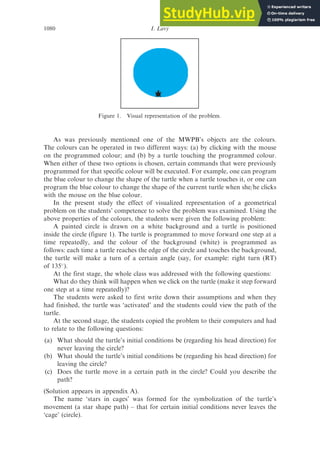
A painted circle is drawn on a white background and a turtle is positioned
inside the circle (figure 1). The turtle is programmed to move forward one step at a
time repeatedly, and the colour of the background (white) is programmed as
follows: each time a turtle reaches the edge of the circle and touches the background,
the turtle will make a turn of a certain angle (say, for example: right turn (RT)
of 135
).
At the first stage, the whole class was addressed with the following questions:
What do they think will happen when we click on the turtle (make it step forward
one step at a time repeatedly)?
The students were asked to first write down their assumptions and when they
had finished, the turtle was ‘activated’ and the students could view the path of the
turtle.
At the second stage, the students copied the problem to their computers and had
to relate to the following questions:
(a) What should the turtle’s initial conditions be (regarding his head direction) for
never leaving the circle?
(b) What should the turtle’s initial conditions be (regarding his head direction) for
leaving the circle?
(c) Does the turtle move in a certain path in the circle? Could you describe the
path?
(Solution appears in appendix A).
The name ‘stars in cages’ was formed for the symbolization of the turtle’s
movement (a star shape path) – that for certain initial conditions never leaves the
‘cage’ (circle).
Figure 1. Visual representation of the problem.
1080 I. Lavy
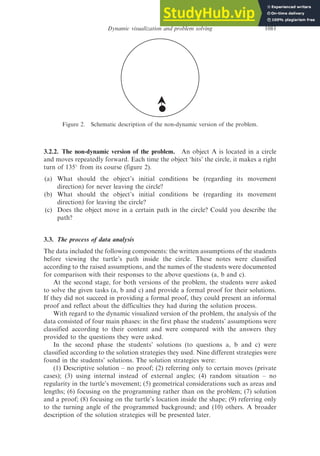
3.2.2. The non-dynamic version of the problem. An object A is located in a circle
and moves repeatedly forward. Each time the object ‘hits’ the circle, it makes a right
turn of 135
from its course (figure 2).
(a) What should the object’s initial conditions be (regarding its movement
direction) for never leaving the circle?
(b) What should the object’s initial conditions be (regarding its movement
direction) for leaving the circle?
(c) Does the object move in a certain path in the circle? Could you describe the
path?
3.3. The process of data analysis
The data included the following components: the written assumptions of the students
before viewing the turtle’s path inside the circle. These notes were classified
according to the raised assumptions, and the names of the students were documented
for comparison with their responses to the above questions (a, b and c).
At the second stage, for both versions of the problem, the students were asked
to solve the given tasks (a, b and c) and provide a formal proof for their solutions.
If they did not succeed in providing a formal proof, they could present an informal
proof and reflect about the difficulties they had during the solution process.
With regard to the dynamic visualized version of the problem, the analysis of the
data consisted of four main phases: in the first phase the students’ assumptions were
classified according to their content and were compared with the answers they
provided to the questions they were asked.
In the second phase the students’ solutions (to questions a, b and c) were
classified according to the solution strategies they used. Nine different strategies were
found in the students’ solutions. The solution strategies were:
(1) Descriptive solution – no proof; (2) referring only to certain moves (private
cases); (3) using internal instead of external angles; (4) random situation – no
regularity in the turtle’s movement; (5) geometrical considerations such as areas and
lengths; (6) focusing on the programming rather than on the problem; (7) solution
and a proof; (8) focusing on the turtle’s location inside the shape; (9) referring only
to the turning angle of the programmed background; and (10) others. A broader
description of the solution strategies will be presented later.
Figure 2. Schematic description of the non-dynamic version of the problem.
Dynamic visualization and problem solving 1081
In the third phase of the data analysis, the unsuccessful strategies used by the
students were classified into three main categories according to the character of the
resulting solution strategies. The categories are: distracting, reducing and confusing.
A detailed description and examples of the said categories will be presented later.
The fourth phase includes the analysis and discussion of the reported difficulties
received from the students during the solution process and a discussion which refers
to the synthesis of the third and the fourth phase will be presented.
Finally, a comparison between the results received from both versions of the
problem is presented and analysed.
4. Results and discussion
With regard to the dynamic visualized version, analysis of the students’ solutions
revealed that the majority (75 out of 78) did not succeed in providing a complete
solution including formal proof for the given problem. In their attempts to solve the
problem, the students used a variety of strategies. Although they were asked to
reflect on the difficulties they had in the process of the problem solving, only a few of
them actually cooperated and handed in a report of the difficulties they experienced
during the process of the problem solving.
First, the various assumptions raised by the students regarding the movement of
the turtle will be presented and discussed. Second, the distribution of the strategies
used by the students will be discussed, and each strategy will be explained. Third, a
categorization of the various strategies will be presented. Fourth, the students’
excerpts regarding the difficulties they tackled during the solution process will be
presented and analysed. Fifth, a comparison between the students’ solutions for the
two versions of the problem will be presented and finally a synthesized summary will
be given.
4.1. Students’ assumptions regarding the movement of the turtle – dynamic
visualized version
As was previously mentioned, the students were asked to raise conjectures regarding
the turtle’s path inside the circle before they could view the turtle’s actual movement
on the computer screen.
The most common conjecture (70 out of 78) was that the turtle will make one
turn of 135
and then will leave the circle. Eight students conjectured that the turtle
will never escape the circle since each time it touches the background, it makes a turn
of 135
.
Then the students were asked to describe the path the turtle makes in the circle.
70 students said there is no certain path, while eight students said the turtle has a
certain path but they cannot figure its nature. At this point of the discussion, 15 of
them suggested that the turtle should draw the path of its movement (by the Logo
command: pd (¼ pen down)). When the result of their suggestion was demonstrated
to them, they were amazed. The turtle drew a straight line and escaped the circle.
Then one of the good students laughed and said: ‘of course! It never touches the colour
of the background since it stays only on the colour of its pen’.
At this stage of the discussion, the turtle’s motion in the circle was demonstrated
to the class: (1) when it moves in a radial direction; (2) when it escapes the circle; and
1082 I. Lavy
(3) when it moves parallel to the radial direction. Then the students were asked to try
to solve the given problem individually using programming and/or geometrical
considerations.
Analysis of the solutions handed in by the students revealed that none of them
used programming in the process of the problem solving despite the fact that at this
stage of the course all of them knew how to program very well. When some of them
were asked coincidentally why they did not use programming the most common
answer was: ‘I did not feel that it (programming) will support the solving process of the
problem and I felt that instead of investing a big effort in the programming which I am
not sure that will help me to solve the problem, it is better for me to focus on the
geometrical attributes of the problem’. The above students’ reaction is consistent with
Hoyles, Noss and Adamson [9], who claim that although a microworld
without programming runs a risk of avoiding just the thing that gives a microworld
it’s power – it takes too much time, is too hard and diverts attention from the
underlying knowledge goals.
4.2. Distribution of the solution strategies used by the students – dynamic visualized
version
In the individual part of working on the given problem, the students had to solve the
problem and present it to the researcher after two weeks. The students’ solutions
were then classified into 10 solution categories according to the nature of the
presented solution. Table 1 demonstrates the distribution of the students’ solutions
strategies. In the following section, a description of each strategy will be presented.
4.3. Solution strategies – dynamic visualized version
1. Descriptive solution – no proof. Twenty-one students (out of 78) provided a
descriptive solution of the problem. The students’ solutions included an informal
description of the turtle’s path as it moves in a radial direction. They also provided
an informal description of the cases in which the turtle will escape the circle or will
never escape it. Although they did not support their solution with mathematical
Table 1. The distribution of the solution strategies used by the students.
# Strategy
No. of
students %
1. Descriptive solution – no proof 21 27
2. Referring only to certain moves (private cases) 15 19.2
3. Using internal instead of external angles 14 18
4. Random situation – no regularity in the turtle’s movement 10 12.8
5. Geometrical considerations such as areas and lengths 4 5.2
6. Focusing on the programming rather than on the problem 3 3.8
7. Solution and a proof 3 3.8
8. Focusing on the turtle’s location inside the shape 2 2.6
9. Referring only to the turning angle of the
programmed background
1 1.2
10. Others 5 6.4
Total 78 100
Dynamic visualization and problem solving 1083
justifications, their description regarding the turtle’s ‘behaviour’ in the various cases
was correct. It should also be noted that none of them provided a formal proof of the
solution.
2. Referring only to certain moves (private cases). 15 students (out of 78),
approximately 20% of the study participants, referred in their solutions’ attempts to
certain moves of the turtle inside the circle only. Namely, they referred to the case in
which the turtle moves in a radial direction. These students described the path the
turtle makes when it moves in a radial direction but most of them did not provide a
formal proof for this case. Although in the list of questions attached to the problem
situation they were explicitly asked to indicate the cases in which the turtle will
escape the circle, when they referred to motion in a radial direction, they said that
the turtle will never escape the circle and actually did not provide an answer to any
other case.
3. Using internal instead of external angles. When trying to use geometrical
considerations in their solution’s attempts, 14 students (out of 78) failed to
differentiate between internal and external angles. They referred to the turtle’s
turning angle as an internal rather than external angle and as a consequence received
incorrect patterns.
4. Random situation – no regularity in the turtle’s movement. Ten students (out of
78) reported that after a long period of time watching the turtle’s movement inside
the circle they came to the conclusion that there is no regularity in the turtle’s
movement – its movement is not dependent on any parameters and they think that
the turtle moves randomly.
5. Geometrical considerations such as areas and lengths. In order to justify why in
certain cases the turtle will never escape the circle and in other cases it will escape the
circle, four students supported their solutions by geometrical considerations such as
triangles’ areas and lengths of sides. However, since they took under consideration
internal instead of external angles, their justifications were in fact incorrect.
6. Focusing on the programming rather than on the problem. Three students (out of
78) referred in their solutions’ attempts to aspects relating to the programming of the
background’s colour or of the turtle rather than to geometrical aspects connected to
the problem. That is, they focused on the case in which the command: RT (right
turn) 135
is executed once or many times. They said that if the command is executed
once – the turtle will escape the circle, but if the command is executed many
times – the turtle will never escape the circle.
7. Solution and proof. Only three students (out of 78) provided a complete solution
which resembles the solution appearing in the appendix. Their solution included
claims and formal proof to the various cases of the problem.
8. Focusing on the turtle’s location inside the shape. The solution attempts of two
students were focused on the starting point of the turtle. They said the turtle’s
starting location, regardless of the turtle’s head direction, is the only reason for the
turtle to escape forever from the circle. If the turtle is located in certain starting
points – it will escape the circle or else it will never escape the circle.
9. Referring only to the turning angle of the programmed background. One of the
students tried to solve the problem by referring only to the turning angle of the
1084 I. Lavy
programmed background. He said that for certain turning angles the turtle will
escape the circle and for other angles it will never escape the circle.
10. Others. This strategy is termed ‘others’ since it includes those students (5) that
gave no solution to the problem and just provided a description of the problem in
their own words.
4.4. Categorization – dynamic visualized version
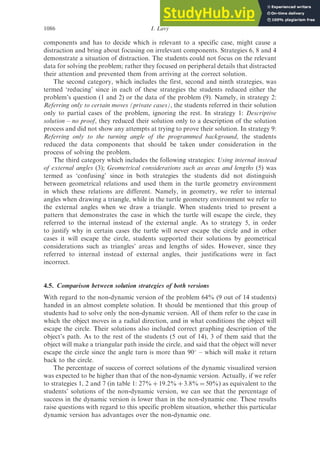
The above solution strategies (except no. 7 and 10) were classified into three main
categories according to their characteristics. The categories are: distracting, reducing
and confusing. The category ‘distracting’ includes the solution strategies 4, 6 and 8;
the category ‘reducing’ includes the solution strategies 1, 2 and 9, and the category
‘confusing’ includes the solution strategies 3 and 5 (figure 3).
Observation of the solution strategies 4, 6 and 8 reveals that these strategies
originated in a situation of distraction. Namely, random situation – no regularity in
the turtle’s movement (4); focusing on the programming rather on the problem (6) and
focusing on the turtle’s location inside the shape (8). The visual representation of the
problem includes additional factors that could distract the students’ attention in the
process of the problem solving. While in a ‘regular’ geometrical problem, the data of
the problem is usually well defined, in this case the student has to decide which data
components are relevant to each case, such as positioning the turtle in a radial
direction or whether the background colour is programmed to make a certain turn
only one or many times. The situation in which the student has a large log of data
Reducing
Confusing
Distracting
9. Referring only to the turning angle
of the programmed background
2. Referring only to certain moves
(private cases)
1. Descriptive solution – no proof
4. Random situation – no regularity in
the turtle
,
s movement
6. Focusing on the programming
rather than on the problem
8. Focusing on the turtle
,
s location
inside the shape
5. Geometrical considerations such as
areas and lengths
3. Using internal instead of external
angles
Figure 3. Schematic description of categories and solution strategies.
Dynamic visualization and problem solving 1085
components and has to decide which is relevant to a specific case, might cause a
distraction and bring about focusing on irrelevant components. Strategies 6, 8 and 4
demonstrate a situation of distraction. The students could not focus on the relevant
data for solving the problem; rather they focused on peripheral details that distracted
their attention and prevented them from arriving at the correct solution.
The second category, which includes the first, second and ninth strategies, was
termed ‘reducing’ since in each of these strategies the students reduced either the
problem’s question (1 and 2) or the data of the problem (9). Namely, in strategy 2:
Referring only to certain moves (private cases), the students referred in their solution
only to partial cases of the problem, ignoring the rest. In strategy 1: Descriptive
solution – no proof, they reduced their solution only to a description of the solution
process and did not show any attempts at trying to prove their solution. In strategy 9:
Referring only to the turning angle of the programmed background, the students
reduced the data components that should be taken under consideration in the
process of solving the problem.
The third category which includes the following strategies: Using internal instead
of external angles (3); Geometrical considerations such as areas and lengths (5) was
termed as ‘confusing’ since in both strategies the students did not distinguish
between geometrical relations and used them in the turtle geometry environment
in which these relations are different. Namely, in geometry, we refer to internal
angles when drawing a triangle, while in the turtle geometry environment we refer to
the external angles when we draw a triangle. When students tried to present a
pattern that demonstrates the case in which the turtle will escape the circle, they
referred to the internal instead of the external angle. As to strategy 5, in order
to justify why in certain cases the turtle will never escape the circle and in other
cases it will escape the circle, students supported their solutions by geometrical
considerations such as triangles’ areas and lengths of sides. However, since they
referred to internal instead of external angles, their justifications were in fact
incorrect.
4.5. Comparison between solution strategies of both versions
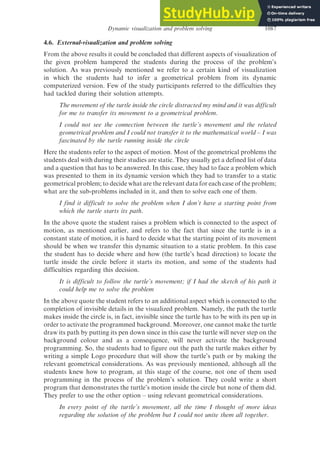
With regard to the non-dynamic version of the problem 64% (9 out of 14 students)
handed in an almost complete solution. It should be mentioned that this group of
students had to solve only the non-dynamic version. All of them refer to the case in
which the object moves in a radial direction, and in what conditions the object will
escape the circle. Their solutions also included correct graphing description of the
object’s path. As to the rest of the students (5 out of 14), 3 of them said that the
object will make a triangular path inside the circle, and said that the object will never
escape the circle since the angle turn is more than 90
– which will make it return
back to the circle.
The percentage of success of correct solutions of the dynamic visualized version
was expected to be higher than that of the non-dynamic version. Actually, if we refer
to strategies 1, 2 and 7 (in table 1: 27% þ 19.2% þ 3.8% ¼ 50%) as equivalent to the
students’ solutions of the non-dynamic version, we can see that the percentage of
success in the dynamic version is lower than in the non-dynamic one. These results
raise questions with regard to this specific problem situation, whether this particular
dynamic version has advantages over the non-dynamic one.
1086 I. Lavy
4.6. External-visualization and problem solving
From the above results it could be concluded that different aspects of visualization of
the given problem hampered the students during the process of the problem’s
solution. As was previously mentioned we refer to a certain kind of visualization
in which the students had to infer a geometrical problem from its dynamic
computerized version. Few of the study participants referred to the difficulties they
had tackled during their solution attempts.
The movement of the turtle inside the circle distracted my mind and it was difficult
for me to transfer its movement to a geometrical problem.
I could not see the connection between the turtle’s movement and the related
geometrical problem and I could not transfer it to the mathematical world – I was
fascinated by the turtle running inside the circle
Here the students refer to the aspect of motion. Most of the geometrical problems the
students deal with during their studies are static. They usually get a defined list of data
and a question that has to be answered. In this case, they had to face a problem which
was presented to them in its dynamic version which they had to transfer to a static
geometrical problem; to decide what are the relevant data for each case of the problem;
what are the sub-problems included in it, and then to solve each one of them.
I find it difficult to solve the problem when I don’t have a starting point from
which the turtle starts its path.
In the above quote the student raises a problem which is connected to the aspect of
motion, as mentioned earlier, and refers to the fact that since the turtle is in a
constant state of motion, it is hard to decide what the starting point of its movement
should be when we transfer this dynamic situation to a static problem. In this case
the student has to decide where and how (the turtle’s head direction) to locate the
turtle inside the circle before it starts its motion, and some of the students had
difficulties regarding this decision.
It is difficult to follow the turtle’s movement; if I had the sketch of his path it
could help me to solve the problem
In the above quote the student refers to an additional aspect which is connected to the
completion of invisible details in the visualized problem. Namely, the path the turtle
makes inside the circle is, in fact, invisible since the turtle has to be with its pen up in
order to activate the programmed background. Moreover, one cannot make the turtle
draw its path by putting its pen down since in this case the turtle will never step on the
background colour and as a consequence, will never activate the background
programming. So, the students had to figure out the path the turtle makes either by
writing a simple Logo procedure that will show the turtle’s path or by making the
relevant geometrical considerations. As was previously mentioned, although all the
students knew how to program, at this stage of the course, not one of them used
programming in the process of the problem’s solution. They could write a short
program that demonstrates the turtle’s motion inside the circle but none of them did.
They prefer to use the other option – using relevant geometrical considerations.
In every point of the turtle’s movement, all the time I thought of more ideas
regarding the solution of the problem but I could not unite them all together.
Dynamic visualization and problem solving 1087
In this excerpt the student refers to a problem connected to the visualization of the
problem. The moving turtle gives the impression of a situation in which many factors
are involved. When one freezes the turtle, one gets a set of parameters regarding the
turtle’s location and direction of movement. The receiving of different values for
each starting point of the turtle probably made the students think that there are
enormous possibilities which had to be considered in the process of the problem
solving, and when they were asked to come up with a general solution, they were
confused.
When comparing the results received from both versions of the problem, in the
case of the given problem, which can be considered as not an easy one, we could see
that its dynamic computerized version did not facilitate the process of the problem
solving. According to the students’ references, this visualized version of the
geometrical problem caused an ‘information flood’ from which the student has to
select the relevant data needed for the problem solving. Some of the students had
difficulties acting in this way since it was not familiar to them. The unfamiliarity
originated in the fact that usually they are used to handle problems with a defined list
of data and do not need to select relevant data from a given situation in the process
of the problem solving. This ‘information flood’ created the feeling that the given
problem constituted of many subproblems, and as a consequence caused some of the
students to apply strategies based on reduction. Moreover, the information flood
also caused distraction. Some of them focused on data components that were
irrelevant to the process of the problem solving.
5. Concluding remarks
In the present study a situation was demonstrated in which undergraduate university
students from computer science teaching education were asked to solve a geometrical
problem represented in two versions: a dynamic computerized version and a
non-dynamic (pen and paper) version. With regard to the dynamic version, the
students used various solution strategies during their attempts to solve the problem.
The unsuccessful solution strategies were further categorized into three main
categories according to the characteristics of strategies used. These categories
indicate some difficulties the dynamic visual representation caused. The categories
were: reducing, confusing and distracting. Comparison between the solutions
received from both versions of the problem reveals that, in the case of the given
problem, the percentage of success in both versions was similar, which might lead to
the conclusion that the visualized dynamic representation of the given geometrical
problem did not facilitate the process of the problem solving. The dynamic visualized
representation of the given problem created an ‘information flood’ for the students
from which they had to filter the relevant data for the process of problem solving.
Some of the students had difficulties in filtering the relevant data and as a result
failed to solve the problem. The data ‘flood’ gave the impression that the problem is
constituted intrinsically from many subproblems and as a result a number of the
solution strategies used by some students included reduction of the data components.
Although the act of reduction can often be used as a constructive strategy in the
process of problem solving, in this case, it caused situations in which the students
failed to solve the problem.
1088 I. Lavy
The dynamics representation of the visualized problem gave the impression that
there might be additional variables that had to be considered during the process of
the problem solving, while when students get a ‘traditional’ geometrical problem,
its data components are well defined. The visualized dynamic representation
of the problem creates the need to filter the data before attempting to solve the
problem – to relate only to the data necessary for its solution.
Finally, being aware of the importance of incorporating adequate computer
software into the learning of mathematics, the findings of this paper imply that
teachers should be aware of the fact that in some cases the use of computer-based
activity might not necessarily facilitate the process of learning. In the case described
it was revealed that the use of computer software inhibited learning from the
students’ perspective. However, from the teachers’ perspective such an experience
can provide an opportunity to gain a deeper insight into the process of learning.
Teachers should be ready to cope with such situations and discuss them with their
students.
Appendix A
The solution of this problem refers to three main possibilities: C1: the turtle starts
his motion in a radial direction; C2: sufficient and necessary condition to escape
from the circle (local); C3: the programmed turn angle of the background is in
each step.
C1: If the turtle starts his motion in a radial direction, it will never leave the circle.
Proof: We define a basic step which includes the
Following moves:
FD M1
RT 135
FD M2
RT 135
This basic step comprises a constant distance M1 þ M2 and a total turn of 90
to the
left. Four basic steps will bring the turtle to the starting point from which it repeats
the same path again and again (figure 4).
M1
M2
Figure 4. The case of C1.
Dynamic visualization and problem solving 1089
C2: Sufficient and necessary condition to escape from the circle (local).
The turtle will escape from the circle if 180
  135
(the hitting angle of the turtle
at the circle edge is ) (figure 5).
When 180
  135
the turtle will move in an 8-sided star path (figure 5).
Proof: We will define a basic step which comprises the following moves:
FD M1 RT 135
FD M2 RT 135
FD M3 RT 135
FD M4 RT 135
The basic step comprises the constant distance M1 þ M2 þ M3 þ M4 and a total
turn of 90
to the left. Eight basic steps will bring the turtle to the starting point
(figure 6).
C3: In the case the programmed turn angle of the background is in each step, the
number of vertices of its path inside the circle will be: LCM ( , 360)/
Proof: To get back to the starting point of its motion, the total turn of the
turtle should be a multiple of 360
. At each step the turtle turns and it will be
back to the starting point for the first time after a LCM(360, ) turn. If in
each step the turtle makes a turn, it will touch the circle perimeter LCM ( , 360)/
times.
α
α
Figure 5. The hitting angle of the turtle at the circle edge.
M1
M2
M3
M4
Figure 6. The schematic description of the basic steps.
1090 I. Lavy
References
[1] Presmeg, N., 1986a, Visualization in high-school mathematics. For the Learning of
Mathematics, 6(3), 42–46.
[2] Presmeg, N., 1986b, Visualization and mathematical giftedness. Educational Studies in
Mathematics, 17(3), 297–311.
[3] Kent, L.B., 2000, Connecting integers of meaningful context. Mathematics Teaching in the
Middle School, 6(1), 62–66.
[4] Mariotti, M.A., 2000, Introduction to proof: the mediation of a dynamic software
environment. Educational Studies in Mathematics, 44(1–2), 25–53.
[5] Slovin, H., 2000, Moving to proportional reasoning. Mathematics Teaching in the Middle
School, 6(1), 58–60.
[6] Kosslyn, S.M., 1983, Ghosts in the Mind’s Machine: Creating and Using Images in the
Brain (New York: W.W.Norton); Hershkowitz, R., 1989, Visualization in geometry – two
sides of the coin. Focus on Learning Problems in Mathematics, 11(1), 61–76.
[7] Mayer, R.E., 1992, Thinking, Problem Solving, Cognition, 2nd edn (New York: W.H.
Freeman).
[8] Lowrie, T. and Hill, D., 1996, The development of a dynamic problem-solving model.
Journal of Science and Mathematics Education in Southeast Asia, XXIX(1), 1–11.
[9] Hoyles, C., Noss, R. and Adamson, R., 2002, Rethinking the microworlds idea. Journal of
Educational Computing Research, 27(12), 29–53.
[10] Hoyles, C. and Noss, R., 1987, Synthesizing mathematical conceptions and their
formalization through the construction of a Logo-based school mathematics curriculum.
International Journal of Mathematics Education, Science, and Technology, 18, 581–595.
[11] Papert, S., 1980, Mindstorms: Children, Computers, and Powerful Ideas. (New York:
Basic Books).
[12] diSessa, A., 1982, Unlearning Aristotelian physics: a study of knowledge-based learning.
Cognitive Science, 6, 37–75.
[13] Edwards, L., 1992, A Logo microworld for transformation geometry. In: C. Hoyles and
R. Noss (Eds) Learning Logo and Mathematics (Cambridge, MA: MIT Press),
pp. 127–155.
[14] Sendova, E. and Sendov, B., 1993, Learning to speak mathematically and speaking
mathematically to learn in the Logo-based environment ‘‘Geomland’’. 4th European Logo
Conference, Athens Greece, pp. 281–288.
[15] Noss, R., Healy, L. and Hoyles, C., 1997, The construction of mathematical meanings:
connecting the visual with the symbolic. Educational Studies in Mathematics, 33(2),
202–231.
[16] Hoyles, C. and Healy, L., 1997, Unfolding meanings for reflective symmetry.
International Journal of Computers for Mathematics Learning, 2(1), 27–59.
[17] Sinclair, N., Zazkis, R. and Liljedahl, P., 2003, Number worlds: visual and experimental
access to elementary number theory concepts. International Journal of Computers for
Mathematical Learning, 8(3), 235–263.
[18] Edwards, L.D., 1995, Microworlds as representations. In: A.A. diSessa, C. Hoyles and
R. Noss (Eds) Computers and Exploratory Learning, NATO ASI Series (VIII: Springer
Verlag), pp. 127–154.
[19] Presmeg, N., 1989, Visualization in multicultural mathematics classrooms. Focus on
Learning Problems in Mathematics, 11(1–2), 17–24.
[20] Presmeg, N., 1992, Prototypes, metaphors, metonymies and imaginative rationality in
high school mathematics. Educational Studies in Mathematics, 23(6), 595–610.
[21] Hershkowitz, R., 1990, Psychological aspects of learning geometry. In: P. Nesher and
J. Kilpatrick (Eds) Mathematics and Cognition (Cambridge: Cambridge University Press),
pp. 70–95.
[22] Dreyfus, T., 1991, On the status of visual reasoning in Mathematics and Mathematics
Education. Proceedings of the 15th International Conference for the Psychology of
Mathematical Education, Vol. 1, pp. 33–48.
[23] Kaput, J.J., 1987, Towards a theory of symbol use in mathematics. In: C. Janvier (Ed.)
Problems of Representation in the Teaching and Learning of Mathematics (Hillsdale, NJ:
Lawrence Erlbaum Associates), pp. 159–195.
Dynamic visualization and problem solving 1091
[24] Kaput, J.J., 1989, Supporting concrete visual thinking in multiplicative reasoning:
difficulties and opportunities. Focus on Learning Problems in Mathematics, 11(1), 35–47.
[25] Janvier, C., 1987, Representation and understanding: the notion of function as an
example. In: C. Janvier (Ed.) Problems of Representation in the Teaching and Learning of
Mathematics (Hillsdale, NJ: Lawrence Erlbaum Associates), pp. 67–71.
[26] Janvier, C., Girardon, C. and Morand, J.-C., 1993, Mathematical symbols and
representations. In: P.S. Wilson (Ed.) Research Ideas for the Classroom, High School
Mathematics (New York: Macmillan), pp. 79–102.
[27] Arcavi, A., 2003, The role of visual representations in the learning of mathematics.
Educational Studies in Mathematics, 52, 215–241.
[28] Presmeg, N., (1991), Classroom aspects which influence use of visual imagery in high
school mathematics. In: F. Furunghetti (Ed.) Proceedings of Fifteenth International
Conference on the Psychology of Mathematics Education (PME) Conference, Assisi, Italy,
Vol. 3, pp. 191–198.
[29] Zimmermann, W. and Cunningham, S., 1991, What is mathematical visualization?
In: W. Zimmermann and S. Cunningham (Eds) Visualization in Teaching and Learning
Mathematics (Washington: Mathematical Association of America), pp. 1–8.
1092 I. Lavy

A Case Study Of Dynamic Visualization And Problem Solving

  • 1.
    International Journal ofMathematical Education in Science and Technology, Vol. 38, No. 8, 15 December 2007, 1075–1092 A case study of dynamic visualization and problem solving ILANA LAVY* The Max Stern Academic College of Emek Yezreel, Israel (Received 24 January 2006) This paper reports an example of a situation in which university students had to solve geometrical problems presented to them dynamically using the interactive computerized environment of the ‘MicroWorlds Project Builder’. In the process of the problem solving, the students used ten different solution strategies. The unsuccessful strategies were then classified into three main categories: distracting, reducing and confusing. One student group had to solve the same problem in its non-dynamic version. The results received from both groups were compared and analysed. Analysis of the solution strategies and the process of the categorization revealed that the percentage of success in both groups was similar and in the case of the given problem, the dynamic visual mode of the problem distracted the students’ attention away from proper handling of the solution of the problem. 1. Introduction A great deal of research has discussed the advantages of visualization with regard to problem solving [1–5]. Visualization enables various ways of thinking, different from traditional approaches where formalism and symbolism dominate teaching. Visual thought can offer an alternative and powerful resource in learning mathematics. Kosslyn [6] argued that one of the main components of imagery processing involved representation. Problem representation has been viewed as an important stage of the problem solving process [7]. In the initial stages of the problem solving process it is beneficial to represent the problem in a visual manner [8]. Research also discusses difficulties which involved imagery with regard to visual thinking [1, 2]: (1) The one-case concreteness of an image or diagram may tie thought to irrelevant details, or may even bring in false data. (2) An image of a standard figure may induce inflexible thinking which prevents the recognition of a concept in a nonstandard diagram. (3) An uncontrollable image may persist, thereby preventing the opening up of more fruitful avenues of thought, a difficulty which is particularly severe if the image is vivid. (4) Imagery which is vague needs to be coupled with rigorous analytical thought processes if it is to be helpful. Distinction should be drawn between difficulties that are intrinsic to visualization such as the difficulties described in the previous paragraph and difficulties that are *Email: llanaL@yvc.ac.il International Journal of Mathematical Education in Science and Technology ISSN 0020–739X print/ISSN 1464–5211 online ß 2007 Taylor & Francis http://www.tandf.co.uk/journals DOI: 10.1080/00207390601129196
  • 2.
    extrinsic to visualizationsuch as described in the given task. Intrinsic difficulties are difficulties that emerge as a consequence of visual thinking. Extrinsic difficulties are difficulties that emerge as a consequence of the use of certain modes of visual representations of a problem. In the case of the problem given in this study, questions might be raised whether intrinsic and extrinsic difficulties have a reciprocal influence on each other. One of the possible ways to visualize a problem is by the use of a computerized environment. When a visualized problem is presented in an interactive computerized environment, the interactivity enables continuity in the process of thinking about the problem since the learner gets immediate feedback to his or her operation, which might motivate him or her to keep on trying various options in order to solve the problem. The ability to solve a problem interactively also enables the checking of an enormous number of situations rapidly and with an immediate response, and as a result facilitates the process of problem solving. Finally, in certain interactive environments, the software enables one to examine a conjecture so that one can see if a hypothesis is valid before making any great efforts trying to prove it. Being aware of all the above advantages along with the possible difficulties, the author gave one group of university students a dynamic visualized geometrical problem that was presented to them in the ‘MicroWorlds Project-Builder’ (MWPB) environment; to a second group of students the author gave the non-dynamic version of the same problem, and was surprised by the results obtained. 2. Literature survey The present study examines the effect of visual representation of a geometrical problem given in the interactive environment of the ‘‘Microworlds Project Builder’’ on the process of solving the said problem. Hence, the literature survey includes references to the role of visualization regarding problem solving and to the evolution of mathematical microworlds in general and to the environment of the ‘MicroWorlds Project Builder’ in particular. 2.1. The evolution of mathematical microworlds ‘Microworlds are environments where people can explore and learn from what they receive back from the computer in return for their exploration’ [9, p. 30]. Mathematical Microworlds developed in recent years met the need for a learning environment in which learners could create a common language and be engaged in mathematical processes such as generalization, abstraction, problem solving and gradual transition from intuitive to formal description of mathematical concepts. One of the purposes of using Microworlds was to connect intuitive and formal aspects of thinking. Hoyles and Noss [10] suggested a definition of the Microworld concept that relates to the following components: technical (software), pedagogical, the learner and the context. ‘A microworld cannot be defined in isolation from either the learner, the teacher or the setting; activity in the Microworld will be shaped by the past experience and intuitions of the learner, and by the aims and expectations of the teacher’ [10]. 1076 I. Lavy
  • 3.
    Various researchers weremotivated by Papert’s vision, appearing in his book, Mindstorms that: ‘. . . Children get to know what it is like to explore the properties of a chosen microworld undisturbed by extraneous questions. In doing so they learn to transfer habits of exploration from their personal lives to the formal domain of scientific theory construction’ [11, p. 117]. Researchers developed Microworlds in science and mathematics [12–16]. Some examples of mathematical Microworlds are: ‘Mathsticks’ – developed by Noss, Healy and Hoyles [15] for learning algebraic themes; ‘Turtles Mirrors’ – developed by Hoyles and Healy [16] for learning reflective symmetry. Sinclair, Zazkis and Liljedahl [17] explored the impact of the MicroWorld Number Worlds on the understanding of pre-service elementary teachers of concepts and relationships underlying elementary number theory. They found that interaction with Number Worlds had a positive effect in helping participants construct those concepts. The above mentioned microworlds serve as settings for developing problem- solving skills and mathematical thinking, and only partly for the use of programming. While being aware of the fact that programming is time-consuming, too hard, and diverts attention from the underlying knowledge goals, in their rethinking of the microworld ideas, Hoyles, Noss and Adamson [9] wrote that a microworld without programming runs the risk of avoiding just the thing that gives a microworld its power. Edwards [18] distinguished between ‘internal’ representations, which are constructed by the learner and which may involve both conventional and ‘private’ imagery, and ‘external’ representations: socially-shared, externally displayed nota- tions and means of expressing ideas which are encountered in the course of learning about mathematics. Computer microworlds can be viewed as specific forms of external representations of mathematical ideas. 2.1.1. The ‘‘Microworlds Project Builder’’. The present research was carried out in an interactive computerized environment called ‘MicroWorlds Project Builder’.y The MWPB is an interactive LOGO based programming environment consisting of objects (i.e. turtle, textbox, button, colour and slider) and a set of operations such as changing the turtle shape, making it move in different directions with varying speeds and so forth. The general aim of the course in which this research was carried out is to expose the students to innovative learning/teaching approaches. In this course the students interact with activities including major computer science concepts such as objects, variables, procedures, functions and recursion through engagement with program- ming in the Logo language which takes place in an interactive multimedia environment. One of the MWPB’s objects are the colours. The operation of a programmed colour can be done in two different ways: (a) by clicking with the mouse on the programmed colour; and (b) by a turtle touching the programmed colour. When either of the two options is performed, certain commands that were previously programmed for that specific colour will be executed. For example, one can program the blue colour to change the shape of the turtle when the turtle touches it, or one can yMicroWorlds Project Builder is a product of Logo Computer Systems Inc. (LCSI). For more details see the company’s Web site: http://www.microworlds.com Dynamic visualization and problem solving 1077
  • 4.
    program the pinkcolour to change the shape of the currenty turtle when she/he clicks with the mouse on the pink colour. In the problem presented to the students the programmed attributes of the colours were used. In the present study, although a new microworld was not developed, a simple environment was used, which can be viewed as a kind of microworld since it consists of two colours (of the shape and of the background), a turtle and simple Logo commands. 2.2. Visualization and problem solving Visualization has an important role in the development of thinking and mathematical understanding and in the transition from concrete to abstract thinking with regard to problem solving. Computing technology is making it much more rewarding for mathematics to use graphics, and in turn mathematics is showing an increased interest in visual approaches to both teaching and research. [18, p. 75] Presmeg [1, 2, 19, 20] classified the different types of visualization appearing in mathematical activities in general and in problem solving in particular: concrete pictorial imagery, pattern imagery, memory images of formulae, kinesthetic imagery and dynamic imagery. Visualization is a process of construction or use in geometrical or graphical presentations of concepts, or ideas built by means of paper and pencil, a computer software or imagination. Visualization is important for building a concept image, and helps in understanding of concepts [21]. In addition, it is considered in supporting intuition and in the learning of mathematical concepts [22]. There is a distinction between external presentation (signifier) and an internal presentation (signified) of concepts [23–26]. The external representations of concepts include diagrams, graphs and models and are essential for communication while the internal representations of concepts include mental or cognitive models with which a person examines and interprets new knowledge. Within the latter process modifications are made in case there is no match between the existing models and the new knowledge. The internal presentations are invisible and their existence can be inferred by observations of the learning process. Steen (in [18]) wrote that mathematics is the science of patterns and the mathematician looks for patterns in numbers, in space, in the computer and in the imagination. Zimmermann and Cunningham [29] refer to visualization which is computer based. The graphics and the dynamics provided by computers enabled visual presentation of mathematical ideas and concepts. The problem given to the participants in this study was computer-based and presented in a visual mode. Although researchers pointed out various advantages regarding the use of visualization in the process of problem solving, some of them refer to the difficulties that might be raised [1, 27]. Dreyfus [22] indicated that it is important to be aware of difficulties that might arise due to improper use in visualization, difficulties in reading graphs properly, lack of distinction between the geometrical image and its yThe turtle, which made the last movement or operation on the computer screen, is considered to be the current turtle. 1078 I. Lavy
  • 5.
    visual presentation. Dreyfusalso pointed out the phenomenon that visualization does not have a proper status in mathematics education and that those causing this situation are the mathematicians themselves. Although most of them use visual justifications while working on a proof, when the proof is completed – they omit from the proof all the visual elements. Thus it can be inferred that visual justifications are good only as a supportive tool. Dreyfus claimed that this status given to visual justification is not warranted and he presented examples from geometry that demonstrate the fact that proofs without their visual parts are difficult to comprehend. Arcavi [27] classified the difficulties surrounding visualization into three main categories: cultural, cognitive and sociological. The cultural category refers to the beliefs and values regarding what is mathematically legitimate or acceptable and what is not. The cognitive difficulties refer to the discussion regarding the issue of whether visual thinking is easier or more difficult. In addition, reasoning with concepts in visual settings may imply that there are not always procedurally ‘safe’ routines to rely on and as a consequence this mode of cognition is rejected by students. The sociological difficulties refer to issues of teaching. Some teachers find analytic representations, which are sequential in nature, to be more appropriate and efficient than visual representations [28]. The present study examines a situation in which a certain visualization of a specific problem does not facilitate the process of solving it. By ‘certain visualization’ is meant the dynamic version of the given problem presented to the students from which they had to infer the geometrical problem and solve it. The results obtained from the student group that had to solve the non-dynamic version of the same problem were similar in their percentage of success to the solutions received from the dynamic version. 3. The study 3.1. The participants 92 undergraduate university students participated in this research. Most of them were second or third semester students. The research was carried out during five consecutive semesters and in each semester between 15 to 20 students participated. They were all students of the computer-teaching education department. Only an insignificant number of them were students of higher semesters. All the students had previously studied additional courses in programming. There was no preliminary testing of the students regarding their visual skills. 78 of the participants had to solve the problems which were presented in dynamic visualized version, while 4 of the students were given the same problems without their dynamic visualized version. The results from both groups were compared. 3.2. The tasks 3.2.1. The dynamic visualized version. As part of the curriculum, the study participants have to take a course in which computing principals such as procedures, functions, recursion and so forth are taught. The environment used in this course is the ‘MicroWorlds Project Builder’ (MWPB). Dynamic visualization and problem solving 1079
  • 6.
    As was previouslymentioned one of the MWPB’s objects are the colours. The colours can be operated in two different ways: (a) by clicking with the mouse on the programmed colour; and (b) by a turtle touching the programmed colour. When either of these two options is chosen, certain commands that were previously programmed for that specific colour will be executed. For example, one can program the blue colour to change the shape of the turtle when a turtle touches it, or one can program the blue colour to change the shape of the current turtle when she/he clicks with the mouse on the blue colour. In the present study the effect of visualized representation of a geometrical problem on the students’ competence to solve the problem was examined. Using the above properties of the colours, the students were given the following problem: A painted circle is drawn on a white background and a turtle is positioned inside the circle (figure 1). The turtle is programmed to move forward one step at a time repeatedly, and the colour of the background (white) is programmed as follows: each time a turtle reaches the edge of the circle and touches the background, the turtle will make a turn of a certain angle (say, for example: right turn (RT) of 135 ). At the first stage, the whole class was addressed with the following questions: What do they think will happen when we click on the turtle (make it step forward one step at a time repeatedly)? The students were asked to first write down their assumptions and when they had finished, the turtle was ‘activated’ and the students could view the path of the turtle. At the second stage, the students copied the problem to their computers and had to relate to the following questions: (a) What should the turtle’s initial conditions be (regarding his head direction) for never leaving the circle? (b) What should the turtle’s initial conditions be (regarding his head direction) for leaving the circle? (c) Does the turtle move in a certain path in the circle? Could you describe the path? (Solution appears in appendix A). The name ‘stars in cages’ was formed for the symbolization of the turtle’s movement (a star shape path) – that for certain initial conditions never leaves the ‘cage’ (circle). Figure 1. Visual representation of the problem. 1080 I. Lavy
  • 7.
    3.2.2. The non-dynamicversion of the problem. An object A is located in a circle and moves repeatedly forward. Each time the object ‘hits’ the circle, it makes a right turn of 135 from its course (figure 2). (a) What should the object’s initial conditions be (regarding its movement direction) for never leaving the circle? (b) What should the object’s initial conditions be (regarding its movement direction) for leaving the circle? (c) Does the object move in a certain path in the circle? Could you describe the path? 3.3. The process of data analysis The data included the following components: the written assumptions of the students before viewing the turtle’s path inside the circle. These notes were classified according to the raised assumptions, and the names of the students were documented for comparison with their responses to the above questions (a, b and c). At the second stage, for both versions of the problem, the students were asked to solve the given tasks (a, b and c) and provide a formal proof for their solutions. If they did not succeed in providing a formal proof, they could present an informal proof and reflect about the difficulties they had during the solution process. With regard to the dynamic visualized version of the problem, the analysis of the data consisted of four main phases: in the first phase the students’ assumptions were classified according to their content and were compared with the answers they provided to the questions they were asked. In the second phase the students’ solutions (to questions a, b and c) were classified according to the solution strategies they used. Nine different strategies were found in the students’ solutions. The solution strategies were: (1) Descriptive solution – no proof; (2) referring only to certain moves (private cases); (3) using internal instead of external angles; (4) random situation – no regularity in the turtle’s movement; (5) geometrical considerations such as areas and lengths; (6) focusing on the programming rather than on the problem; (7) solution and a proof; (8) focusing on the turtle’s location inside the shape; (9) referring only to the turning angle of the programmed background; and (10) others. A broader description of the solution strategies will be presented later. Figure 2. Schematic description of the non-dynamic version of the problem. Dynamic visualization and problem solving 1081
  • 8.
    In the thirdphase of the data analysis, the unsuccessful strategies used by the students were classified into three main categories according to the character of the resulting solution strategies. The categories are: distracting, reducing and confusing. A detailed description and examples of the said categories will be presented later. The fourth phase includes the analysis and discussion of the reported difficulties received from the students during the solution process and a discussion which refers to the synthesis of the third and the fourth phase will be presented. Finally, a comparison between the results received from both versions of the problem is presented and analysed. 4. Results and discussion With regard to the dynamic visualized version, analysis of the students’ solutions revealed that the majority (75 out of 78) did not succeed in providing a complete solution including formal proof for the given problem. In their attempts to solve the problem, the students used a variety of strategies. Although they were asked to reflect on the difficulties they had in the process of the problem solving, only a few of them actually cooperated and handed in a report of the difficulties they experienced during the process of the problem solving. First, the various assumptions raised by the students regarding the movement of the turtle will be presented and discussed. Second, the distribution of the strategies used by the students will be discussed, and each strategy will be explained. Third, a categorization of the various strategies will be presented. Fourth, the students’ excerpts regarding the difficulties they tackled during the solution process will be presented and analysed. Fifth, a comparison between the students’ solutions for the two versions of the problem will be presented and finally a synthesized summary will be given. 4.1. Students’ assumptions regarding the movement of the turtle – dynamic visualized version As was previously mentioned, the students were asked to raise conjectures regarding the turtle’s path inside the circle before they could view the turtle’s actual movement on the computer screen. The most common conjecture (70 out of 78) was that the turtle will make one turn of 135 and then will leave the circle. Eight students conjectured that the turtle will never escape the circle since each time it touches the background, it makes a turn of 135 . Then the students were asked to describe the path the turtle makes in the circle. 70 students said there is no certain path, while eight students said the turtle has a certain path but they cannot figure its nature. At this point of the discussion, 15 of them suggested that the turtle should draw the path of its movement (by the Logo command: pd (¼ pen down)). When the result of their suggestion was demonstrated to them, they were amazed. The turtle drew a straight line and escaped the circle. Then one of the good students laughed and said: ‘of course! It never touches the colour of the background since it stays only on the colour of its pen’. At this stage of the discussion, the turtle’s motion in the circle was demonstrated to the class: (1) when it moves in a radial direction; (2) when it escapes the circle; and 1082 I. Lavy
  • 9.
    (3) when itmoves parallel to the radial direction. Then the students were asked to try to solve the given problem individually using programming and/or geometrical considerations. Analysis of the solutions handed in by the students revealed that none of them used programming in the process of the problem solving despite the fact that at this stage of the course all of them knew how to program very well. When some of them were asked coincidentally why they did not use programming the most common answer was: ‘I did not feel that it (programming) will support the solving process of the problem and I felt that instead of investing a big effort in the programming which I am not sure that will help me to solve the problem, it is better for me to focus on the geometrical attributes of the problem’. The above students’ reaction is consistent with Hoyles, Noss and Adamson [9], who claim that although a microworld without programming runs a risk of avoiding just the thing that gives a microworld it’s power – it takes too much time, is too hard and diverts attention from the underlying knowledge goals. 4.2. Distribution of the solution strategies used by the students – dynamic visualized version In the individual part of working on the given problem, the students had to solve the problem and present it to the researcher after two weeks. The students’ solutions were then classified into 10 solution categories according to the nature of the presented solution. Table 1 demonstrates the distribution of the students’ solutions strategies. In the following section, a description of each strategy will be presented. 4.3. Solution strategies – dynamic visualized version 1. Descriptive solution – no proof. Twenty-one students (out of 78) provided a descriptive solution of the problem. The students’ solutions included an informal description of the turtle’s path as it moves in a radial direction. They also provided an informal description of the cases in which the turtle will escape the circle or will never escape it. Although they did not support their solution with mathematical Table 1. The distribution of the solution strategies used by the students. # Strategy No. of students % 1. Descriptive solution – no proof 21 27 2. Referring only to certain moves (private cases) 15 19.2 3. Using internal instead of external angles 14 18 4. Random situation – no regularity in the turtle’s movement 10 12.8 5. Geometrical considerations such as areas and lengths 4 5.2 6. Focusing on the programming rather than on the problem 3 3.8 7. Solution and a proof 3 3.8 8. Focusing on the turtle’s location inside the shape 2 2.6 9. Referring only to the turning angle of the programmed background 1 1.2 10. Others 5 6.4 Total 78 100 Dynamic visualization and problem solving 1083
  • 10.
    justifications, their descriptionregarding the turtle’s ‘behaviour’ in the various cases was correct. It should also be noted that none of them provided a formal proof of the solution. 2. Referring only to certain moves (private cases). 15 students (out of 78), approximately 20% of the study participants, referred in their solutions’ attempts to certain moves of the turtle inside the circle only. Namely, they referred to the case in which the turtle moves in a radial direction. These students described the path the turtle makes when it moves in a radial direction but most of them did not provide a formal proof for this case. Although in the list of questions attached to the problem situation they were explicitly asked to indicate the cases in which the turtle will escape the circle, when they referred to motion in a radial direction, they said that the turtle will never escape the circle and actually did not provide an answer to any other case. 3. Using internal instead of external angles. When trying to use geometrical considerations in their solution’s attempts, 14 students (out of 78) failed to differentiate between internal and external angles. They referred to the turtle’s turning angle as an internal rather than external angle and as a consequence received incorrect patterns. 4. Random situation – no regularity in the turtle’s movement. Ten students (out of 78) reported that after a long period of time watching the turtle’s movement inside the circle they came to the conclusion that there is no regularity in the turtle’s movement – its movement is not dependent on any parameters and they think that the turtle moves randomly. 5. Geometrical considerations such as areas and lengths. In order to justify why in certain cases the turtle will never escape the circle and in other cases it will escape the circle, four students supported their solutions by geometrical considerations such as triangles’ areas and lengths of sides. However, since they took under consideration internal instead of external angles, their justifications were in fact incorrect. 6. Focusing on the programming rather than on the problem. Three students (out of 78) referred in their solutions’ attempts to aspects relating to the programming of the background’s colour or of the turtle rather than to geometrical aspects connected to the problem. That is, they focused on the case in which the command: RT (right turn) 135 is executed once or many times. They said that if the command is executed once – the turtle will escape the circle, but if the command is executed many times – the turtle will never escape the circle. 7. Solution and proof. Only three students (out of 78) provided a complete solution which resembles the solution appearing in the appendix. Their solution included claims and formal proof to the various cases of the problem. 8. Focusing on the turtle’s location inside the shape. The solution attempts of two students were focused on the starting point of the turtle. They said the turtle’s starting location, regardless of the turtle’s head direction, is the only reason for the turtle to escape forever from the circle. If the turtle is located in certain starting points – it will escape the circle or else it will never escape the circle. 9. Referring only to the turning angle of the programmed background. One of the students tried to solve the problem by referring only to the turning angle of the 1084 I. Lavy
  • 11.
    programmed background. Hesaid that for certain turning angles the turtle will escape the circle and for other angles it will never escape the circle. 10. Others. This strategy is termed ‘others’ since it includes those students (5) that gave no solution to the problem and just provided a description of the problem in their own words. 4.4. Categorization – dynamic visualized version The above solution strategies (except no. 7 and 10) were classified into three main categories according to their characteristics. The categories are: distracting, reducing and confusing. The category ‘distracting’ includes the solution strategies 4, 6 and 8; the category ‘reducing’ includes the solution strategies 1, 2 and 9, and the category ‘confusing’ includes the solution strategies 3 and 5 (figure 3). Observation of the solution strategies 4, 6 and 8 reveals that these strategies originated in a situation of distraction. Namely, random situation – no regularity in the turtle’s movement (4); focusing on the programming rather on the problem (6) and focusing on the turtle’s location inside the shape (8). The visual representation of the problem includes additional factors that could distract the students’ attention in the process of the problem solving. While in a ‘regular’ geometrical problem, the data of the problem is usually well defined, in this case the student has to decide which data components are relevant to each case, such as positioning the turtle in a radial direction or whether the background colour is programmed to make a certain turn only one or many times. The situation in which the student has a large log of data Reducing Confusing Distracting 9. Referring only to the turning angle of the programmed background 2. Referring only to certain moves (private cases) 1. Descriptive solution – no proof 4. Random situation – no regularity in the turtle , s movement 6. Focusing on the programming rather than on the problem 8. Focusing on the turtle , s location inside the shape 5. Geometrical considerations such as areas and lengths 3. Using internal instead of external angles Figure 3. Schematic description of categories and solution strategies. Dynamic visualization and problem solving 1085
  • 12.
    components and hasto decide which is relevant to a specific case, might cause a distraction and bring about focusing on irrelevant components. Strategies 6, 8 and 4 demonstrate a situation of distraction. The students could not focus on the relevant data for solving the problem; rather they focused on peripheral details that distracted their attention and prevented them from arriving at the correct solution. The second category, which includes the first, second and ninth strategies, was termed ‘reducing’ since in each of these strategies the students reduced either the problem’s question (1 and 2) or the data of the problem (9). Namely, in strategy 2: Referring only to certain moves (private cases), the students referred in their solution only to partial cases of the problem, ignoring the rest. In strategy 1: Descriptive solution – no proof, they reduced their solution only to a description of the solution process and did not show any attempts at trying to prove their solution. In strategy 9: Referring only to the turning angle of the programmed background, the students reduced the data components that should be taken under consideration in the process of solving the problem. The third category which includes the following strategies: Using internal instead of external angles (3); Geometrical considerations such as areas and lengths (5) was termed as ‘confusing’ since in both strategies the students did not distinguish between geometrical relations and used them in the turtle geometry environment in which these relations are different. Namely, in geometry, we refer to internal angles when drawing a triangle, while in the turtle geometry environment we refer to the external angles when we draw a triangle. When students tried to present a pattern that demonstrates the case in which the turtle will escape the circle, they referred to the internal instead of the external angle. As to strategy 5, in order to justify why in certain cases the turtle will never escape the circle and in other cases it will escape the circle, students supported their solutions by geometrical considerations such as triangles’ areas and lengths of sides. However, since they referred to internal instead of external angles, their justifications were in fact incorrect. 4.5. Comparison between solution strategies of both versions With regard to the non-dynamic version of the problem 64% (9 out of 14 students) handed in an almost complete solution. It should be mentioned that this group of students had to solve only the non-dynamic version. All of them refer to the case in which the object moves in a radial direction, and in what conditions the object will escape the circle. Their solutions also included correct graphing description of the object’s path. As to the rest of the students (5 out of 14), 3 of them said that the object will make a triangular path inside the circle, and said that the object will never escape the circle since the angle turn is more than 90 – which will make it return back to the circle. The percentage of success of correct solutions of the dynamic visualized version was expected to be higher than that of the non-dynamic version. Actually, if we refer to strategies 1, 2 and 7 (in table 1: 27% þ 19.2% þ 3.8% ¼ 50%) as equivalent to the students’ solutions of the non-dynamic version, we can see that the percentage of success in the dynamic version is lower than in the non-dynamic one. These results raise questions with regard to this specific problem situation, whether this particular dynamic version has advantages over the non-dynamic one. 1086 I. Lavy
  • 13.
    4.6. External-visualization andproblem solving From the above results it could be concluded that different aspects of visualization of the given problem hampered the students during the process of the problem’s solution. As was previously mentioned we refer to a certain kind of visualization in which the students had to infer a geometrical problem from its dynamic computerized version. Few of the study participants referred to the difficulties they had tackled during their solution attempts. The movement of the turtle inside the circle distracted my mind and it was difficult for me to transfer its movement to a geometrical problem. I could not see the connection between the turtle’s movement and the related geometrical problem and I could not transfer it to the mathematical world – I was fascinated by the turtle running inside the circle Here the students refer to the aspect of motion. Most of the geometrical problems the students deal with during their studies are static. They usually get a defined list of data and a question that has to be answered. In this case, they had to face a problem which was presented to them in its dynamic version which they had to transfer to a static geometrical problem; to decide what are the relevant data for each case of the problem; what are the sub-problems included in it, and then to solve each one of them. I find it difficult to solve the problem when I don’t have a starting point from which the turtle starts its path. In the above quote the student raises a problem which is connected to the aspect of motion, as mentioned earlier, and refers to the fact that since the turtle is in a constant state of motion, it is hard to decide what the starting point of its movement should be when we transfer this dynamic situation to a static problem. In this case the student has to decide where and how (the turtle’s head direction) to locate the turtle inside the circle before it starts its motion, and some of the students had difficulties regarding this decision. It is difficult to follow the turtle’s movement; if I had the sketch of his path it could help me to solve the problem In the above quote the student refers to an additional aspect which is connected to the completion of invisible details in the visualized problem. Namely, the path the turtle makes inside the circle is, in fact, invisible since the turtle has to be with its pen up in order to activate the programmed background. Moreover, one cannot make the turtle draw its path by putting its pen down since in this case the turtle will never step on the background colour and as a consequence, will never activate the background programming. So, the students had to figure out the path the turtle makes either by writing a simple Logo procedure that will show the turtle’s path or by making the relevant geometrical considerations. As was previously mentioned, although all the students knew how to program, at this stage of the course, not one of them used programming in the process of the problem’s solution. They could write a short program that demonstrates the turtle’s motion inside the circle but none of them did. They prefer to use the other option – using relevant geometrical considerations. In every point of the turtle’s movement, all the time I thought of more ideas regarding the solution of the problem but I could not unite them all together. Dynamic visualization and problem solving 1087
  • 14.
    In this excerptthe student refers to a problem connected to the visualization of the problem. The moving turtle gives the impression of a situation in which many factors are involved. When one freezes the turtle, one gets a set of parameters regarding the turtle’s location and direction of movement. The receiving of different values for each starting point of the turtle probably made the students think that there are enormous possibilities which had to be considered in the process of the problem solving, and when they were asked to come up with a general solution, they were confused. When comparing the results received from both versions of the problem, in the case of the given problem, which can be considered as not an easy one, we could see that its dynamic computerized version did not facilitate the process of the problem solving. According to the students’ references, this visualized version of the geometrical problem caused an ‘information flood’ from which the student has to select the relevant data needed for the problem solving. Some of the students had difficulties acting in this way since it was not familiar to them. The unfamiliarity originated in the fact that usually they are used to handle problems with a defined list of data and do not need to select relevant data from a given situation in the process of the problem solving. This ‘information flood’ created the feeling that the given problem constituted of many subproblems, and as a consequence caused some of the students to apply strategies based on reduction. Moreover, the information flood also caused distraction. Some of them focused on data components that were irrelevant to the process of the problem solving. 5. Concluding remarks In the present study a situation was demonstrated in which undergraduate university students from computer science teaching education were asked to solve a geometrical problem represented in two versions: a dynamic computerized version and a non-dynamic (pen and paper) version. With regard to the dynamic version, the students used various solution strategies during their attempts to solve the problem. The unsuccessful solution strategies were further categorized into three main categories according to the characteristics of strategies used. These categories indicate some difficulties the dynamic visual representation caused. The categories were: reducing, confusing and distracting. Comparison between the solutions received from both versions of the problem reveals that, in the case of the given problem, the percentage of success in both versions was similar, which might lead to the conclusion that the visualized dynamic representation of the given geometrical problem did not facilitate the process of the problem solving. The dynamic visualized representation of the given problem created an ‘information flood’ for the students from which they had to filter the relevant data for the process of problem solving. Some of the students had difficulties in filtering the relevant data and as a result failed to solve the problem. The data ‘flood’ gave the impression that the problem is constituted intrinsically from many subproblems and as a result a number of the solution strategies used by some students included reduction of the data components. Although the act of reduction can often be used as a constructive strategy in the process of problem solving, in this case, it caused situations in which the students failed to solve the problem. 1088 I. Lavy
  • 15.
    The dynamics representationof the visualized problem gave the impression that there might be additional variables that had to be considered during the process of the problem solving, while when students get a ‘traditional’ geometrical problem, its data components are well defined. The visualized dynamic representation of the problem creates the need to filter the data before attempting to solve the problem – to relate only to the data necessary for its solution. Finally, being aware of the importance of incorporating adequate computer software into the learning of mathematics, the findings of this paper imply that teachers should be aware of the fact that in some cases the use of computer-based activity might not necessarily facilitate the process of learning. In the case described it was revealed that the use of computer software inhibited learning from the students’ perspective. However, from the teachers’ perspective such an experience can provide an opportunity to gain a deeper insight into the process of learning. Teachers should be ready to cope with such situations and discuss them with their students. Appendix A The solution of this problem refers to three main possibilities: C1: the turtle starts his motion in a radial direction; C2: sufficient and necessary condition to escape from the circle (local); C3: the programmed turn angle of the background is in each step. C1: If the turtle starts his motion in a radial direction, it will never leave the circle. Proof: We define a basic step which includes the Following moves: FD M1 RT 135 FD M2 RT 135 This basic step comprises a constant distance M1 þ M2 and a total turn of 90 to the left. Four basic steps will bring the turtle to the starting point from which it repeats the same path again and again (figure 4). M1 M2 Figure 4. The case of C1. Dynamic visualization and problem solving 1089
  • 16.
    C2: Sufficient andnecessary condition to escape from the circle (local). The turtle will escape from the circle if 180 135 (the hitting angle of the turtle at the circle edge is ) (figure 5). When 180 135 the turtle will move in an 8-sided star path (figure 5). Proof: We will define a basic step which comprises the following moves: FD M1 RT 135 FD M2 RT 135 FD M3 RT 135 FD M4 RT 135 The basic step comprises the constant distance M1 þ M2 þ M3 þ M4 and a total turn of 90 to the left. Eight basic steps will bring the turtle to the starting point (figure 6). C3: In the case the programmed turn angle of the background is in each step, the number of vertices of its path inside the circle will be: LCM ( , 360)/ Proof: To get back to the starting point of its motion, the total turn of the turtle should be a multiple of 360 . At each step the turtle turns and it will be back to the starting point for the first time after a LCM(360, ) turn. If in each step the turtle makes a turn, it will touch the circle perimeter LCM ( , 360)/ times. α α Figure 5. The hitting angle of the turtle at the circle edge. M1 M2 M3 M4 Figure 6. The schematic description of the basic steps. 1090 I. Lavy
  • 17.
    References [1] Presmeg, N.,1986a, Visualization in high-school mathematics. For the Learning of Mathematics, 6(3), 42–46. [2] Presmeg, N., 1986b, Visualization and mathematical giftedness. Educational Studies in Mathematics, 17(3), 297–311. [3] Kent, L.B., 2000, Connecting integers of meaningful context. Mathematics Teaching in the Middle School, 6(1), 62–66. [4] Mariotti, M.A., 2000, Introduction to proof: the mediation of a dynamic software environment. Educational Studies in Mathematics, 44(1–2), 25–53. [5] Slovin, H., 2000, Moving to proportional reasoning. Mathematics Teaching in the Middle School, 6(1), 58–60. [6] Kosslyn, S.M., 1983, Ghosts in the Mind’s Machine: Creating and Using Images in the Brain (New York: W.W.Norton); Hershkowitz, R., 1989, Visualization in geometry – two sides of the coin. Focus on Learning Problems in Mathematics, 11(1), 61–76. [7] Mayer, R.E., 1992, Thinking, Problem Solving, Cognition, 2nd edn (New York: W.H. Freeman). [8] Lowrie, T. and Hill, D., 1996, The development of a dynamic problem-solving model. Journal of Science and Mathematics Education in Southeast Asia, XXIX(1), 1–11. [9] Hoyles, C., Noss, R. and Adamson, R., 2002, Rethinking the microworlds idea. Journal of Educational Computing Research, 27(12), 29–53. [10] Hoyles, C. and Noss, R., 1987, Synthesizing mathematical conceptions and their formalization through the construction of a Logo-based school mathematics curriculum. International Journal of Mathematics Education, Science, and Technology, 18, 581–595. [11] Papert, S., 1980, Mindstorms: Children, Computers, and Powerful Ideas. (New York: Basic Books). [12] diSessa, A., 1982, Unlearning Aristotelian physics: a study of knowledge-based learning. Cognitive Science, 6, 37–75. [13] Edwards, L., 1992, A Logo microworld for transformation geometry. In: C. Hoyles and R. Noss (Eds) Learning Logo and Mathematics (Cambridge, MA: MIT Press), pp. 127–155. [14] Sendova, E. and Sendov, B., 1993, Learning to speak mathematically and speaking mathematically to learn in the Logo-based environment ‘‘Geomland’’. 4th European Logo Conference, Athens Greece, pp. 281–288. [15] Noss, R., Healy, L. and Hoyles, C., 1997, The construction of mathematical meanings: connecting the visual with the symbolic. Educational Studies in Mathematics, 33(2), 202–231. [16] Hoyles, C. and Healy, L., 1997, Unfolding meanings for reflective symmetry. International Journal of Computers for Mathematics Learning, 2(1), 27–59. [17] Sinclair, N., Zazkis, R. and Liljedahl, P., 2003, Number worlds: visual and experimental access to elementary number theory concepts. International Journal of Computers for Mathematical Learning, 8(3), 235–263. [18] Edwards, L.D., 1995, Microworlds as representations. In: A.A. diSessa, C. Hoyles and R. Noss (Eds) Computers and Exploratory Learning, NATO ASI Series (VIII: Springer Verlag), pp. 127–154. [19] Presmeg, N., 1989, Visualization in multicultural mathematics classrooms. Focus on Learning Problems in Mathematics, 11(1–2), 17–24. [20] Presmeg, N., 1992, Prototypes, metaphors, metonymies and imaginative rationality in high school mathematics. Educational Studies in Mathematics, 23(6), 595–610. [21] Hershkowitz, R., 1990, Psychological aspects of learning geometry. In: P. Nesher and J. Kilpatrick (Eds) Mathematics and Cognition (Cambridge: Cambridge University Press), pp. 70–95. [22] Dreyfus, T., 1991, On the status of visual reasoning in Mathematics and Mathematics Education. Proceedings of the 15th International Conference for the Psychology of Mathematical Education, Vol. 1, pp. 33–48. [23] Kaput, J.J., 1987, Towards a theory of symbol use in mathematics. In: C. Janvier (Ed.) Problems of Representation in the Teaching and Learning of Mathematics (Hillsdale, NJ: Lawrence Erlbaum Associates), pp. 159–195. Dynamic visualization and problem solving 1091
  • 18.
    [24] Kaput, J.J.,1989, Supporting concrete visual thinking in multiplicative reasoning: difficulties and opportunities. Focus on Learning Problems in Mathematics, 11(1), 35–47. [25] Janvier, C., 1987, Representation and understanding: the notion of function as an example. In: C. Janvier (Ed.) Problems of Representation in the Teaching and Learning of Mathematics (Hillsdale, NJ: Lawrence Erlbaum Associates), pp. 67–71. [26] Janvier, C., Girardon, C. and Morand, J.-C., 1993, Mathematical symbols and representations. In: P.S. Wilson (Ed.) Research Ideas for the Classroom, High School Mathematics (New York: Macmillan), pp. 79–102. [27] Arcavi, A., 2003, The role of visual representations in the learning of mathematics. Educational Studies in Mathematics, 52, 215–241. [28] Presmeg, N., (1991), Classroom aspects which influence use of visual imagery in high school mathematics. In: F. Furunghetti (Ed.) Proceedings of Fifteenth International Conference on the Psychology of Mathematics Education (PME) Conference, Assisi, Italy, Vol. 3, pp. 191–198. [29] Zimmermann, W. and Cunningham, S., 1991, What is mathematical visualization? In: W. Zimmermann and S. Cunningham (Eds) Visualization in Teaching and Learning Mathematics (Washington: Mathematical Association of America), pp. 1–8. 1092 I. Lavy