RATIONAL USE OF DRUGS
Chapter 1 Clinical Pharmacy II
Dr. Abuzar Khan
PhD Clinical Pharmacy
Drug Use Process
Importance of RDU
●Factors that have led sudden realization
for rational drug use are.
●Drug explosion
●Efforts to prevent the development of
resistance
●Growing awareness
●Increased cost of the treatment
●Consumer protection Act.
Irrational Use
●The examples of irrational use are
●Under-prescribing
●Incorrect prescribing
●Extravagant prescribing
●Over-prescribing
●Multiple prescribing
●Prescribing of drugs with unproven/doubtful efficacy
Definition
• Right Drug
– Patient
– Time
– Dose
– Route
– Economical
How RDU is possible
• Step I Patient Problem
– Identify pt problem
– Detailed history
– Drug history
– CC
• Step II Diagnosis
– A prerequisite to RDU
How RDU is possible
• Step III Therapeutic Objective
– Therapeutic objective of RA?
• Step IV Select Treatment
– Life style modification
– Drug selection (safety, efficacy, cost, ease of adm)
How RDU is possible
• Step V Start treatment
• Step VI results of Treatment
• Step VII Conclusion of therapy
COMPONENTS OF RDU PROGRAM
1. Teaching of Basics
• Pharmacology
• Therapeutics
• Guidelines
• Problem oriented
2. Essential Drug concept
• EML
• Drug selection
• Formulary
3. Drug Information
• Physician
• Public
• News letter, videos verbal
• Withstand promotional pressure
4. Drug use study
• Factors influencing drug use
• Monitoring prescribing practices
• Due, Dur
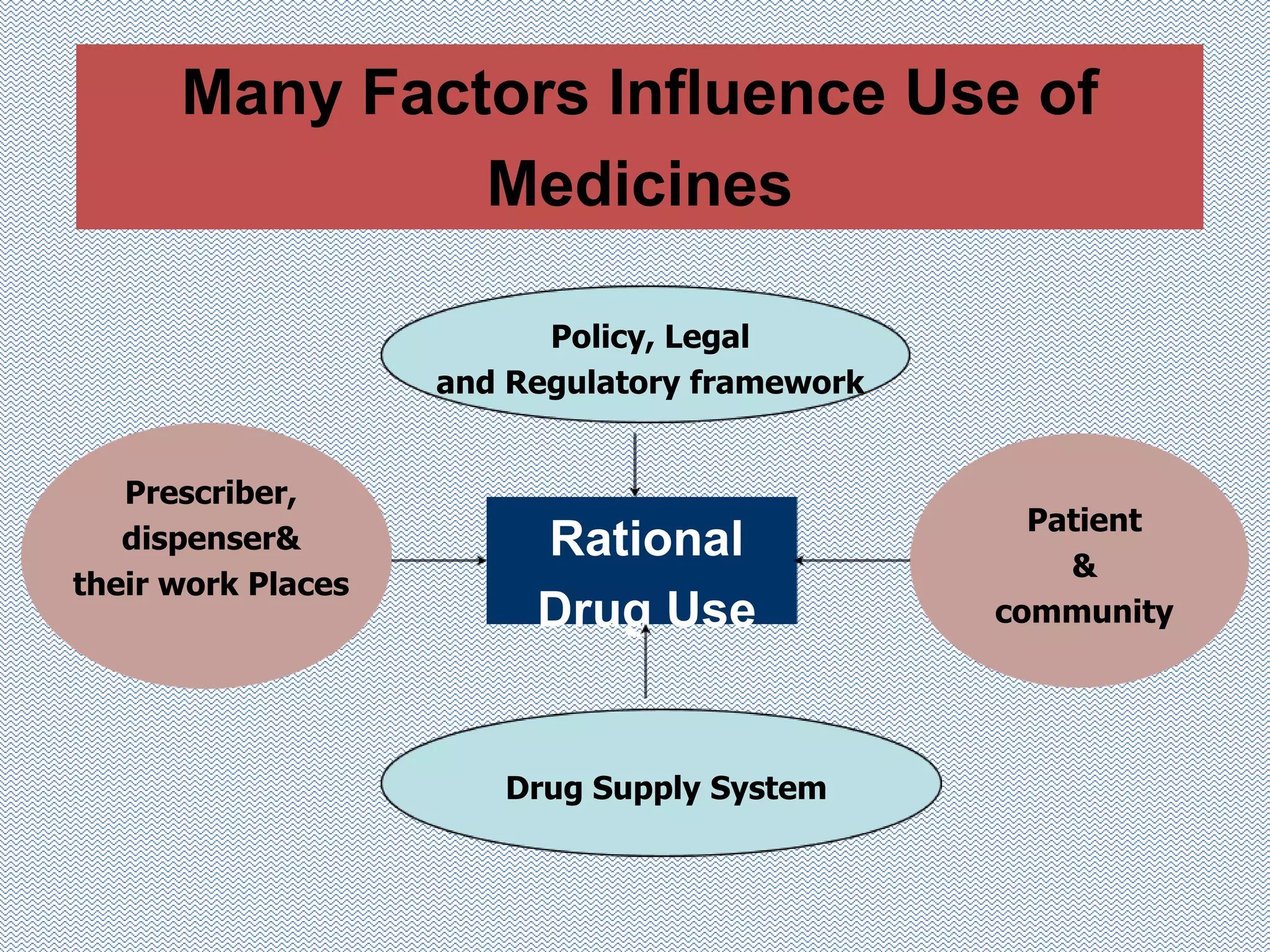
Many Factors Influence Use of
Medicines
Rational
Drug Use
Patient
&
community
Prescriber,
dispenser&
their work Places
Policy, Legal
and Regulatory framework
Drug Supply System
RATIONAL PRESCRIBING
Steps Rational Prescribing
1. Specific Diagnosis
2. Consider Pathophysiology
3. Therapeutic Objective
4. Drug of choice Selection
5. Dosing regimen
6. Drug action Monitoring
7. Patient education
Dispensing cycle
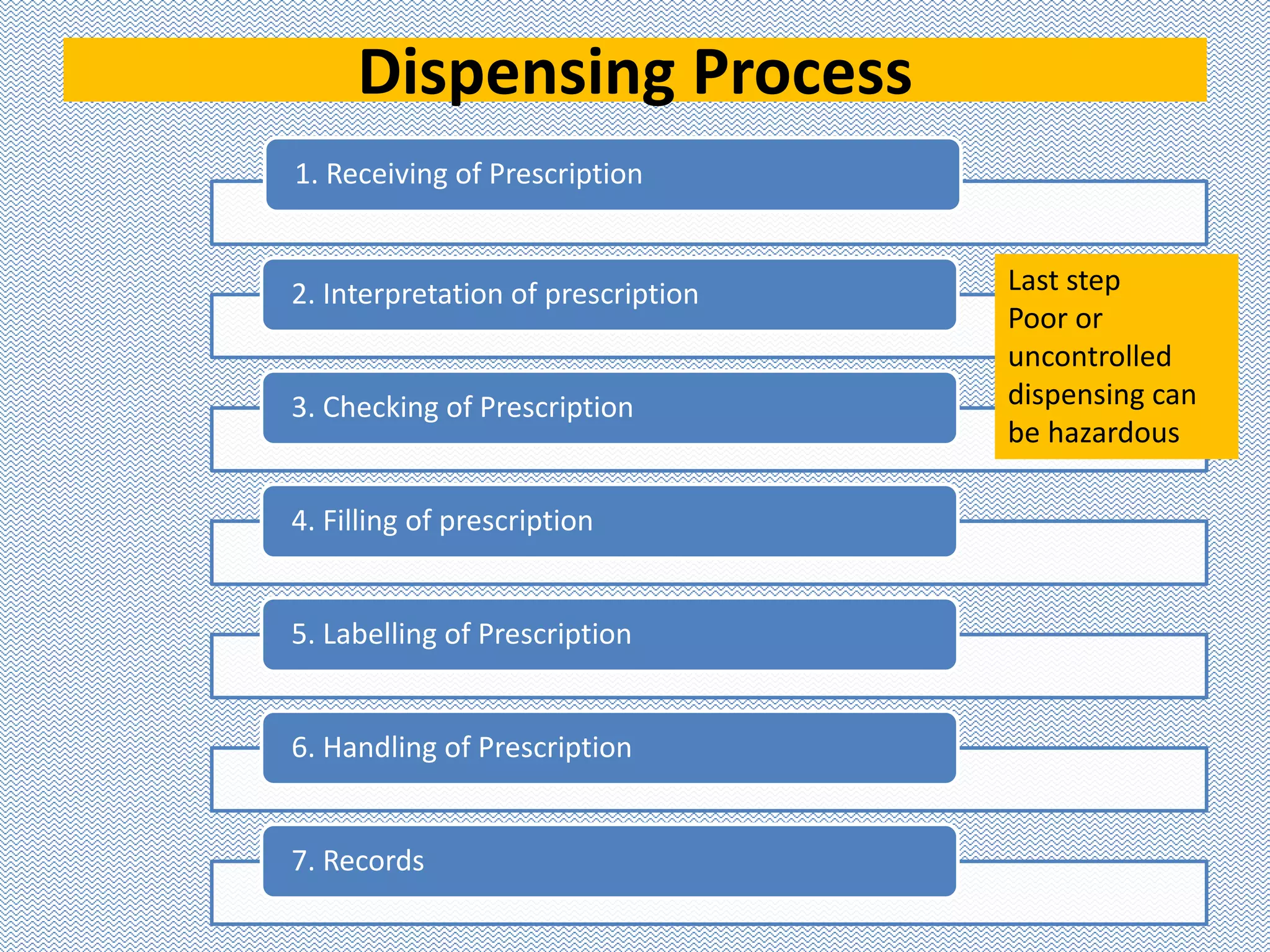
Dispensing Process
1. Receiving of Prescription
2. Interpretation of prescription
3. Checking of Prescription
4. Filling of prescription
5. Labelling of Prescription
6. Handling of Prescription
7. Records
Last step
Poor or
uncontrolled
dispensing can
be hazardous
Irrational Use of drugs
1
• Selection of drugs
2.
• Patients characteristics
3
• Information
4
• Incorrect prescribing
5
• Expensive drugs
Factors Responsible for Irrational use
1. Patients
2. Prescribers
3. Work Place
4. Drug
Regulations
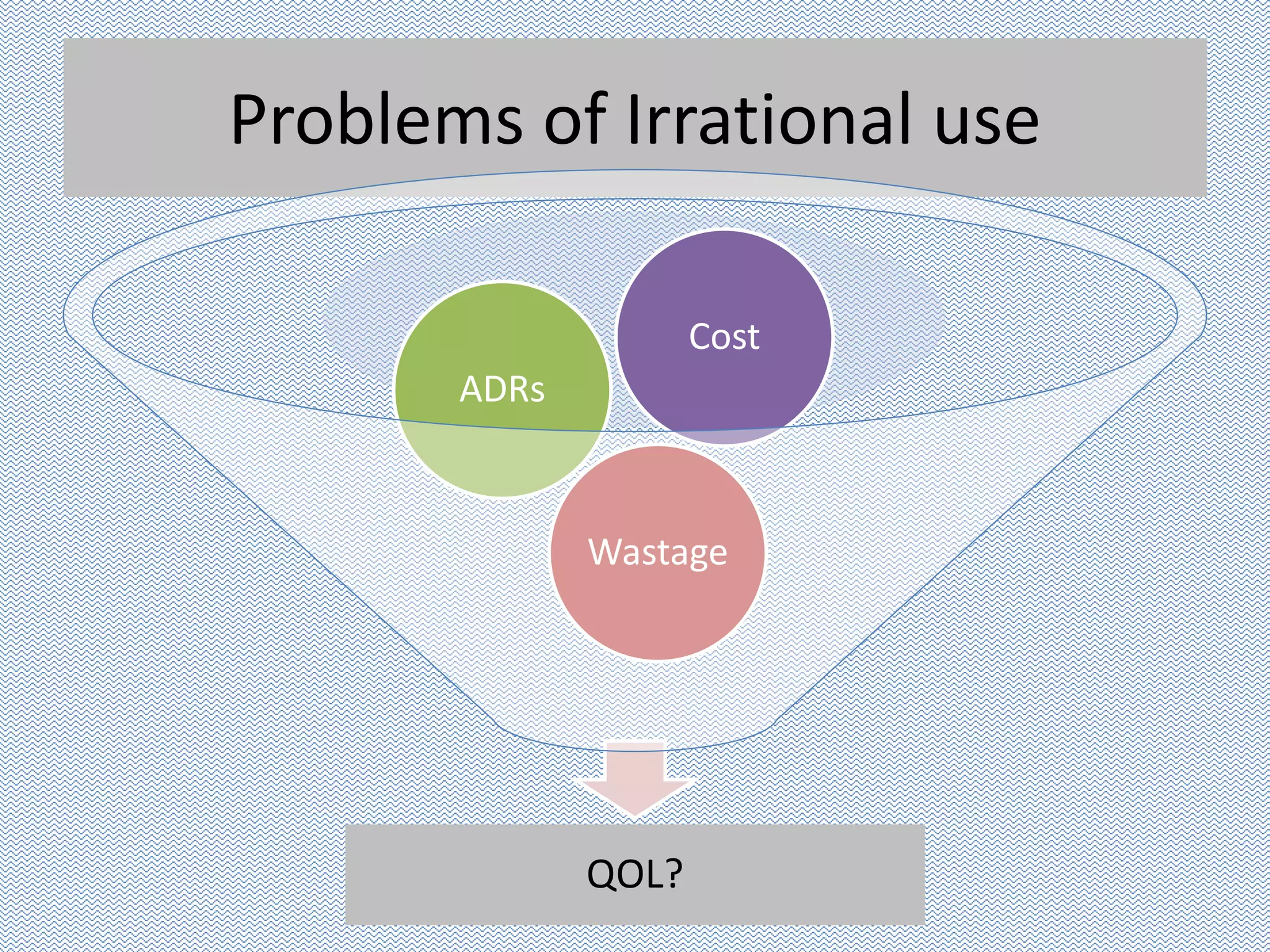
Problems of Irrational use
QOL?
Wastage
ADRs
Cost
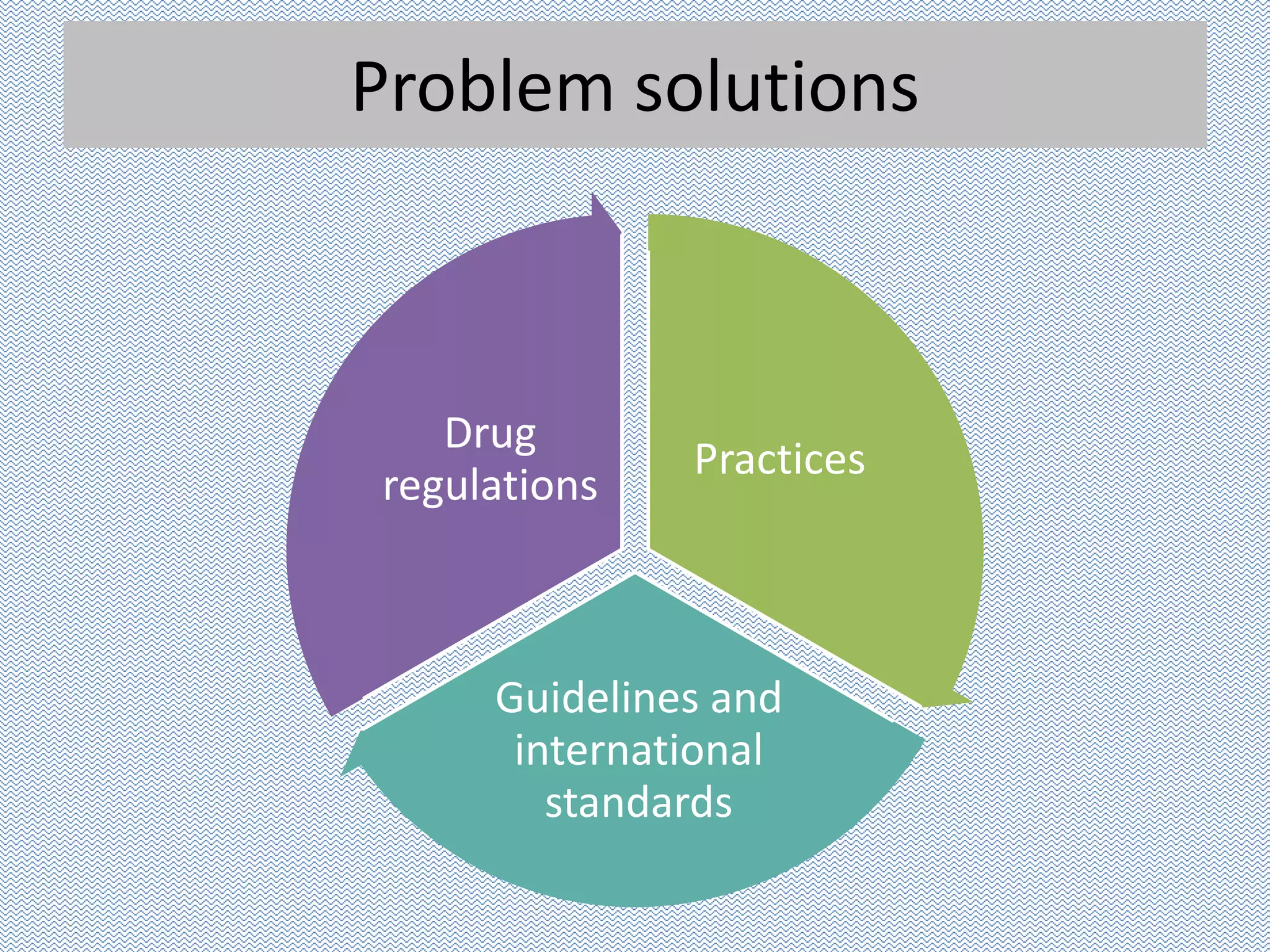
Problem solutions
Practices
Guidelines and
international
standards
Drug
regulations
DRUG USE INDICATORS
Rational Drug Use Chapter 1
Drug use indicators
• Drug Use Indicators are sets of objective
measures that can define the drug use
situation in a country
• Planning
• Supervising
• 1985 Nairobi Kenya WHO conference
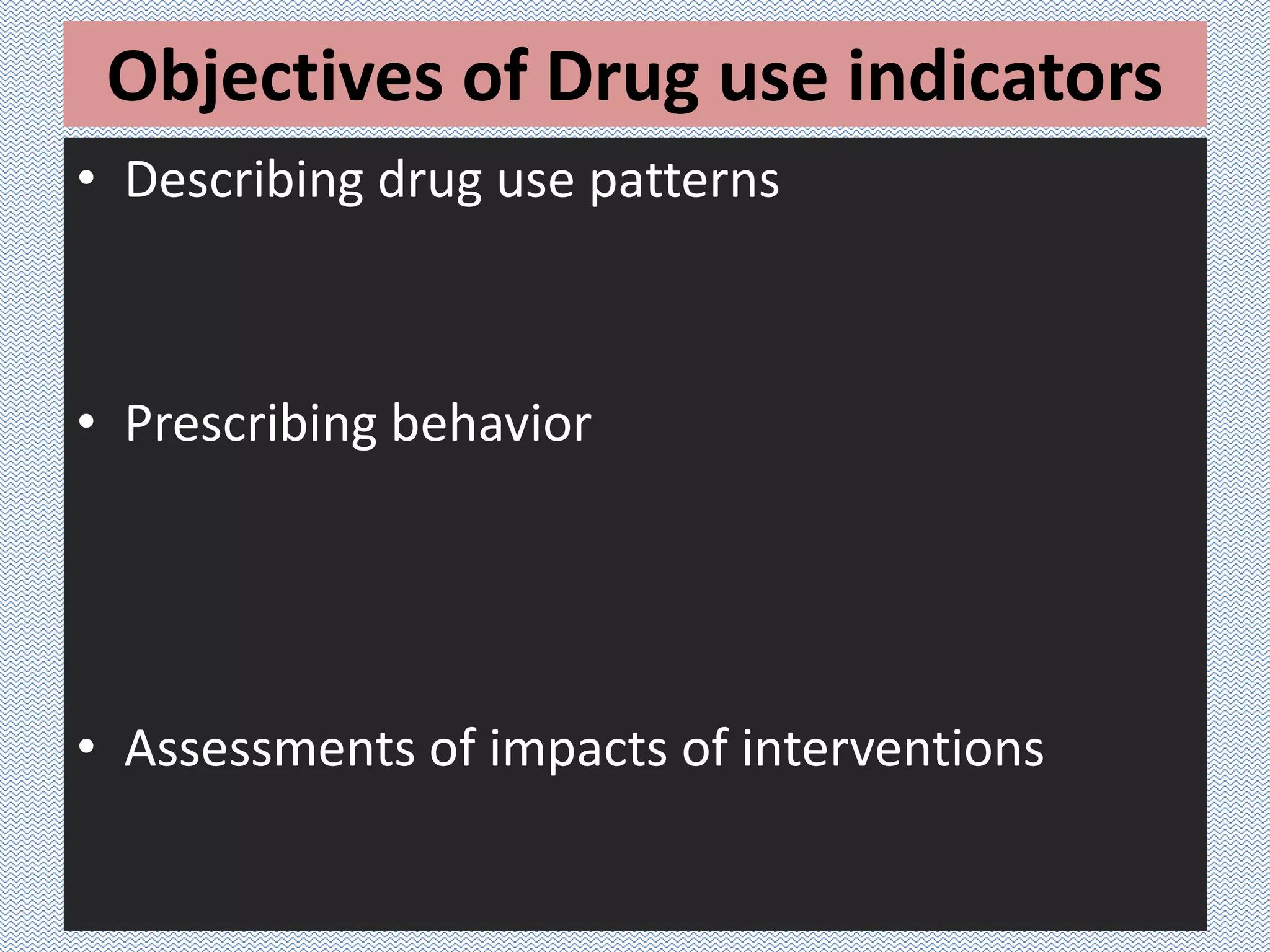
Objectives of Drug use indicators
• Describing drug use patterns
• Prescribing behavior
• Assessments of impacts of interventions
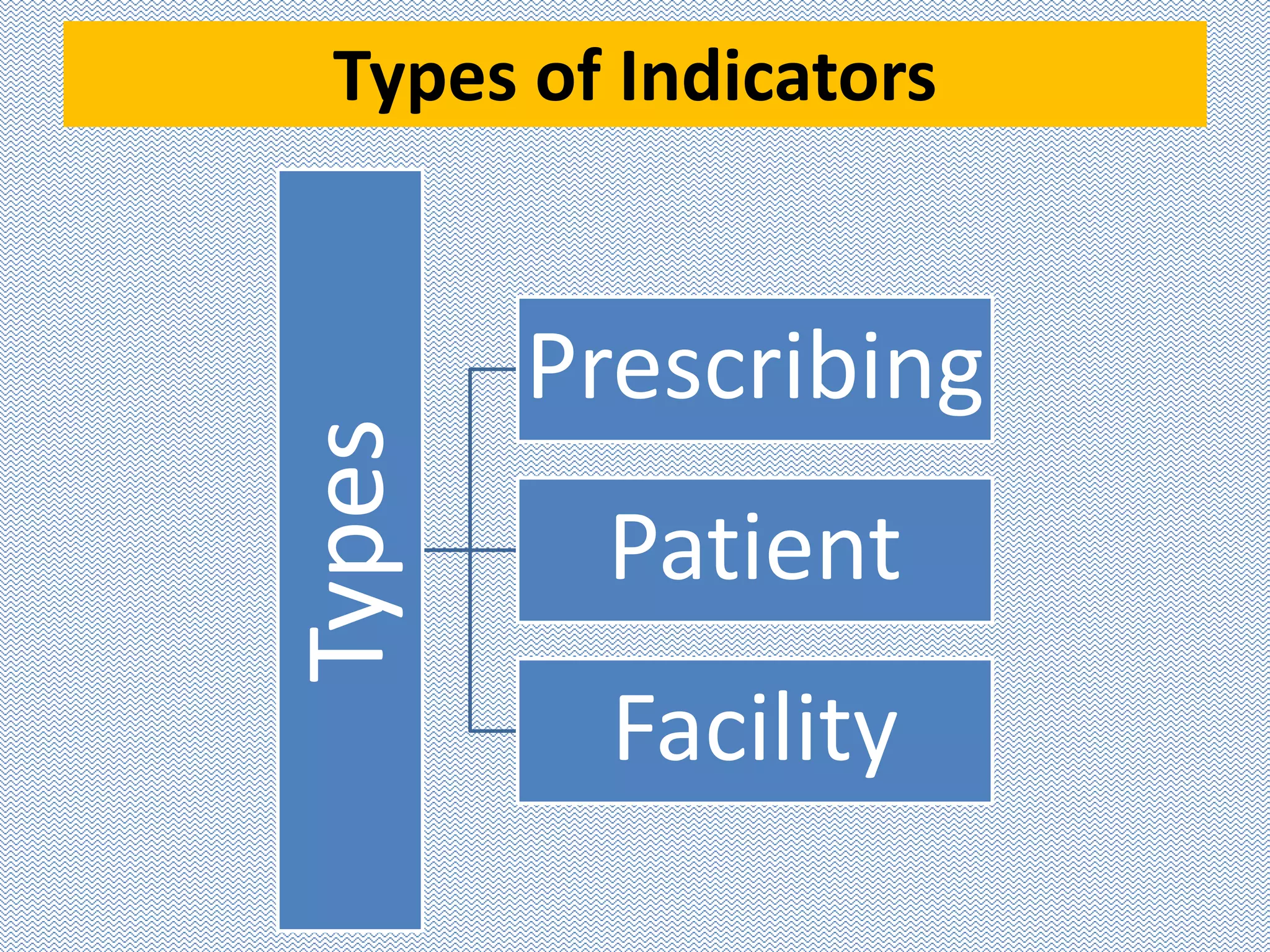
Types of Indicators
Types Prescribing
Patient
Facility
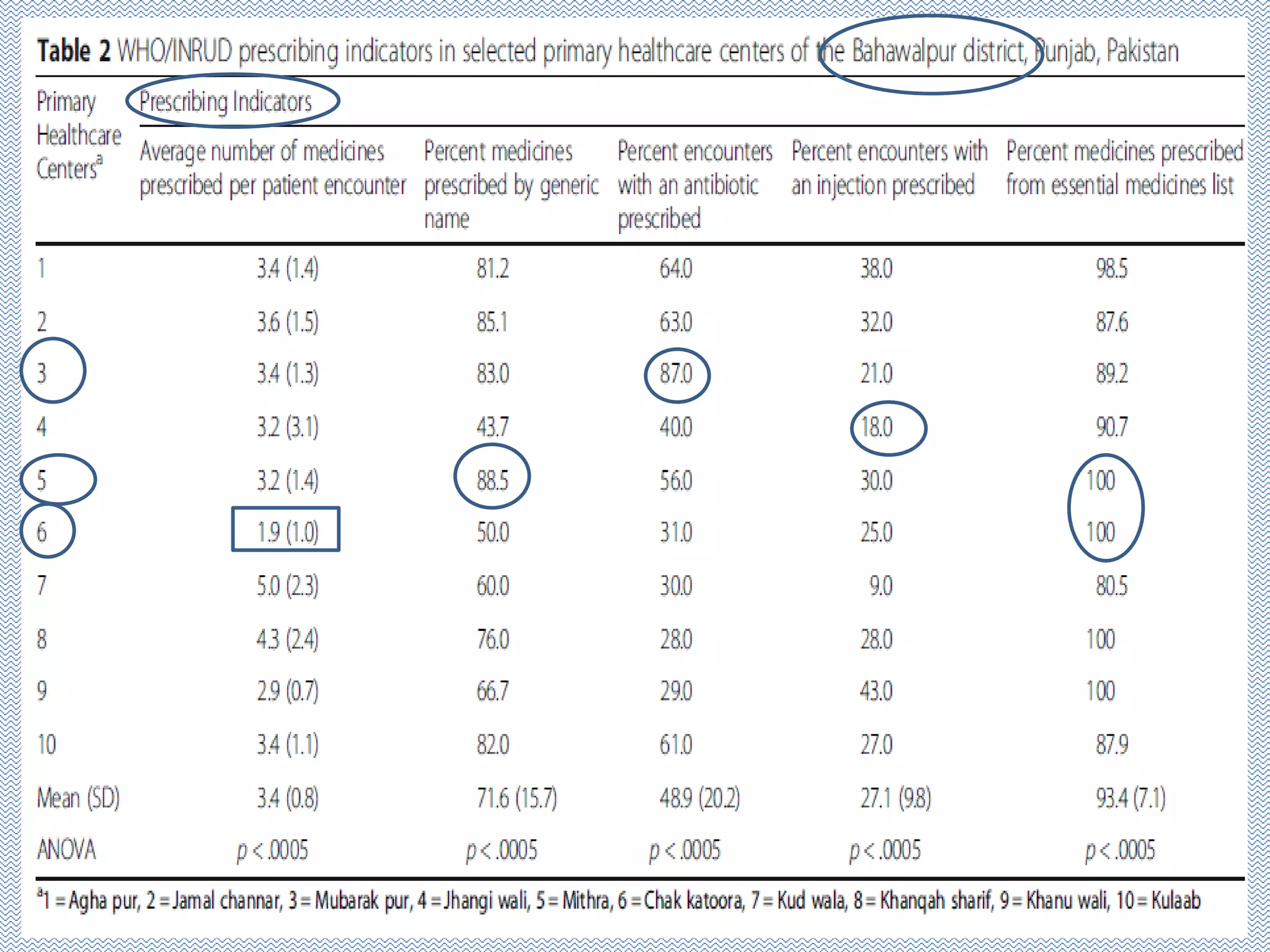
Prescribing Indicators
Prescribing
Average number of
drugs/ℛ
Percentage
antibiotics/ℛ
Percentage injections
Percentage generic
Percentage
prescribed from EML
Prescribing Indicators
Indications Standard Values
1. Average number of drugs per encounter 1.6 - 1.8
2.Percentage of encounters with an antibiotic prescribed 20.0 - 26.8
3.Percentage of encounters with an injection prescribed 13.4 - 24.1
4.Percentage of drugs prescribed by generic name 100.0
5.Percentage of drugs prescribed from the essential drug list or
formulary
100.0
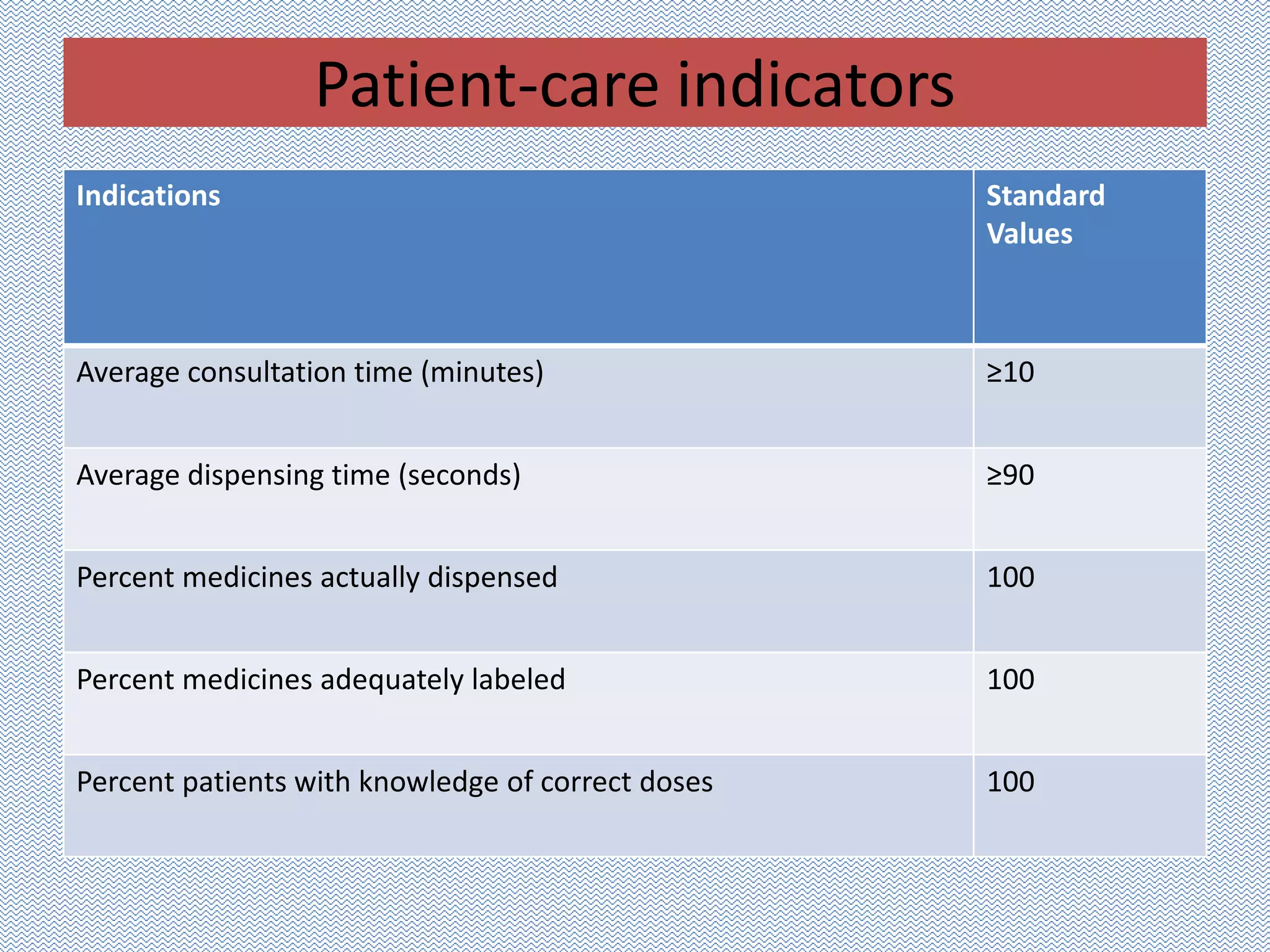
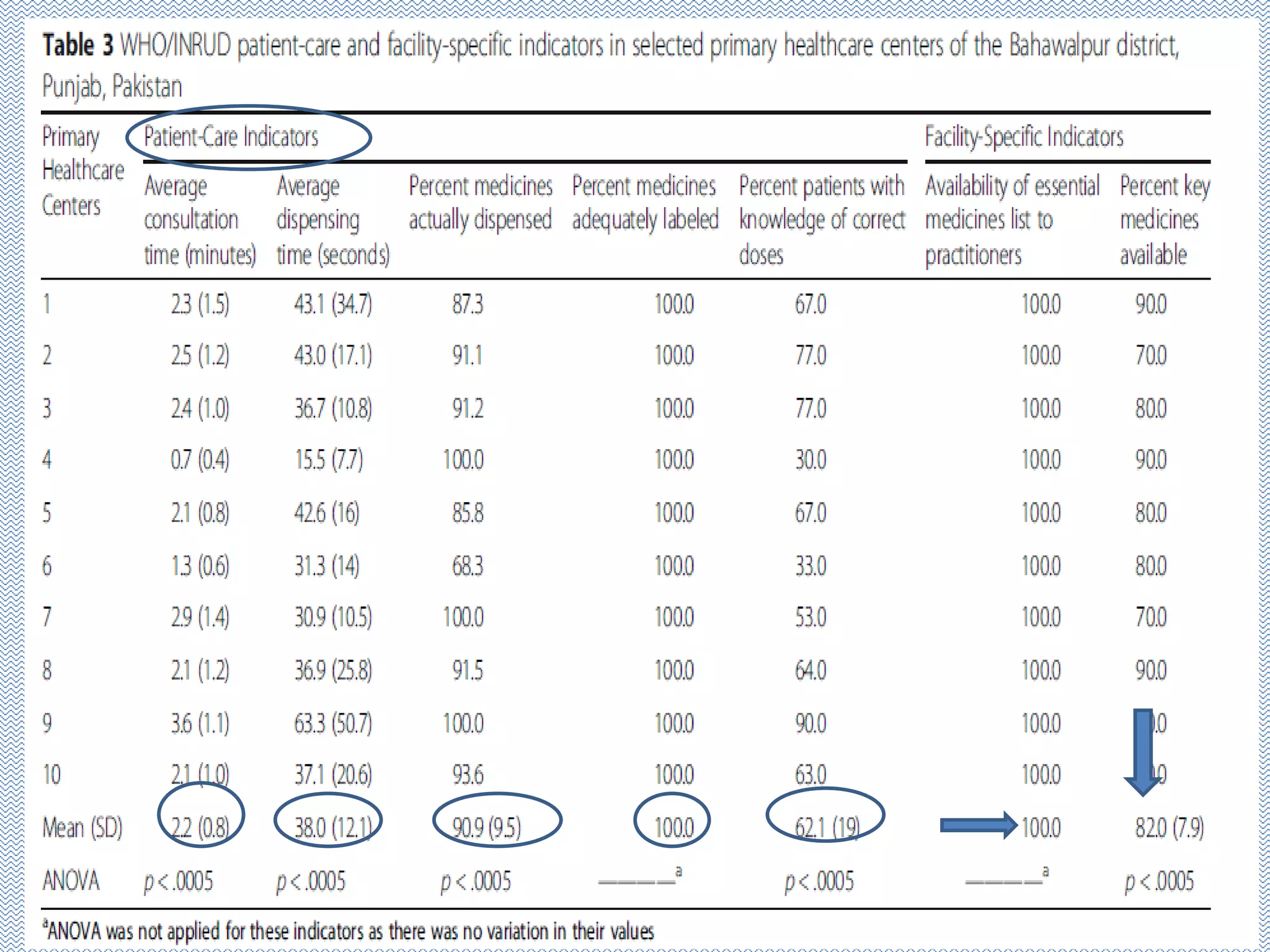
Patient-care indicators
Indications Standard
Values
Average consultation time (minutes) ≥10
Average dispensing time (seconds) ≥90
Percent medicines actually dispensed 100
Percent medicines adequately labeled 100
Percent patients with knowledge of correct doses 100
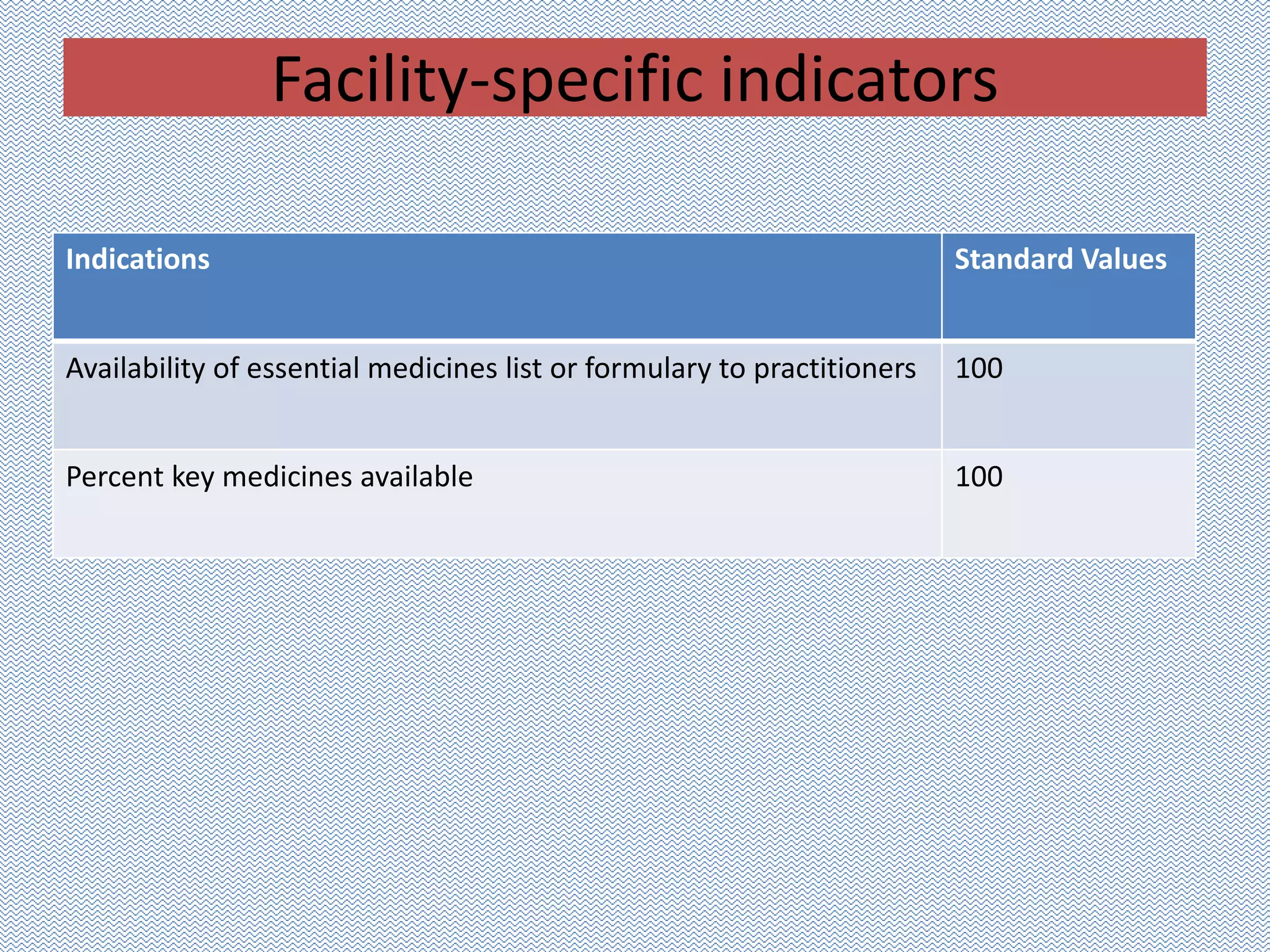
Facility-specific indicators
Indications Standard Values
Availability of essential medicines list or formulary to practitioners 100
Percent key medicines available 100
Research Characteristics
• Research is creative and systematic work
undertaken to increase the stock
of knowledge, including knowledge of
humans, culture and society, and the use of
this stock of knowledge to devise new
applications.
• Neutrality
• Reliability
• Validity
• Generalization
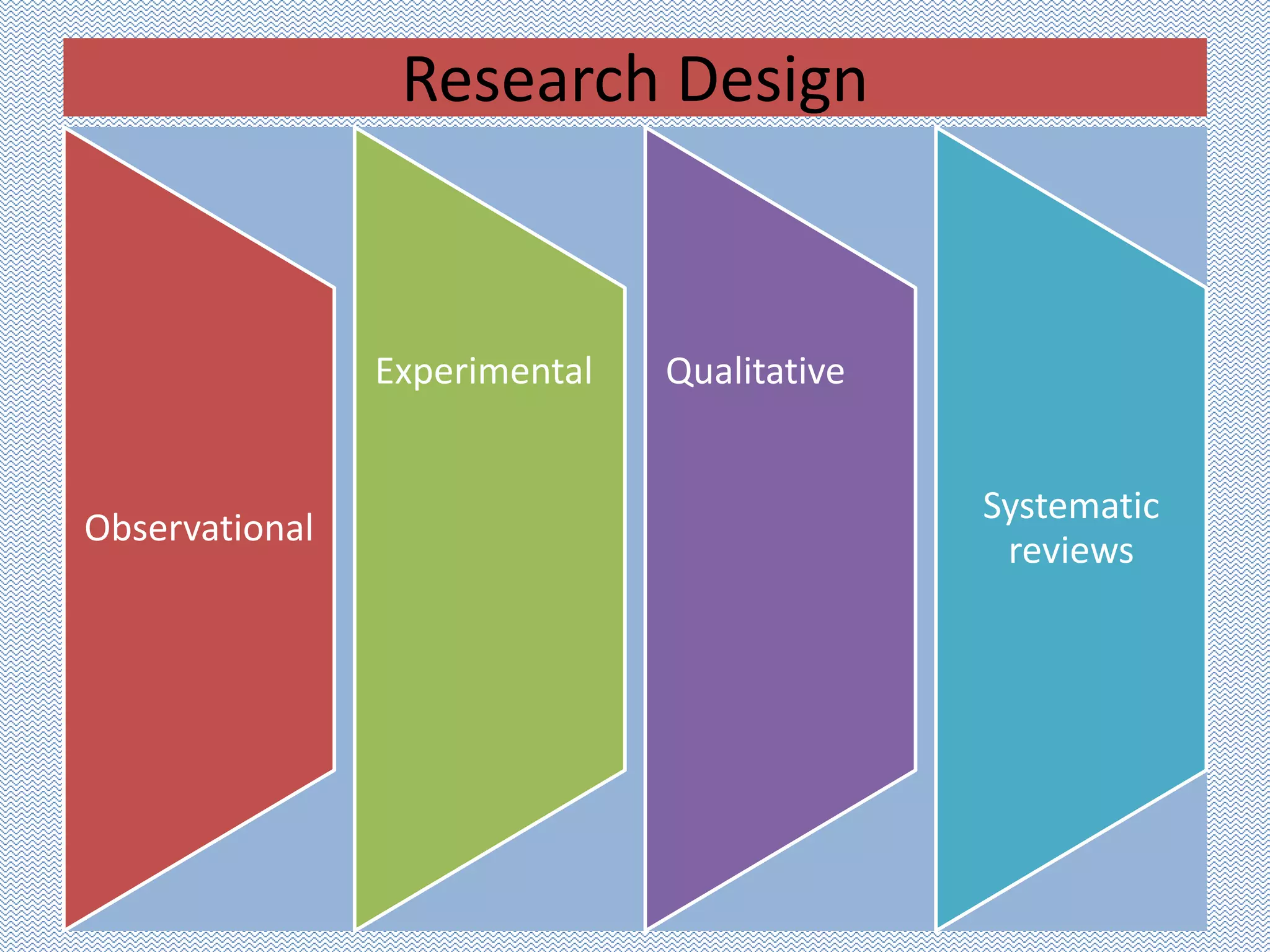
Research Design
Observational
Experimental Qualitative
Systematic
reviews
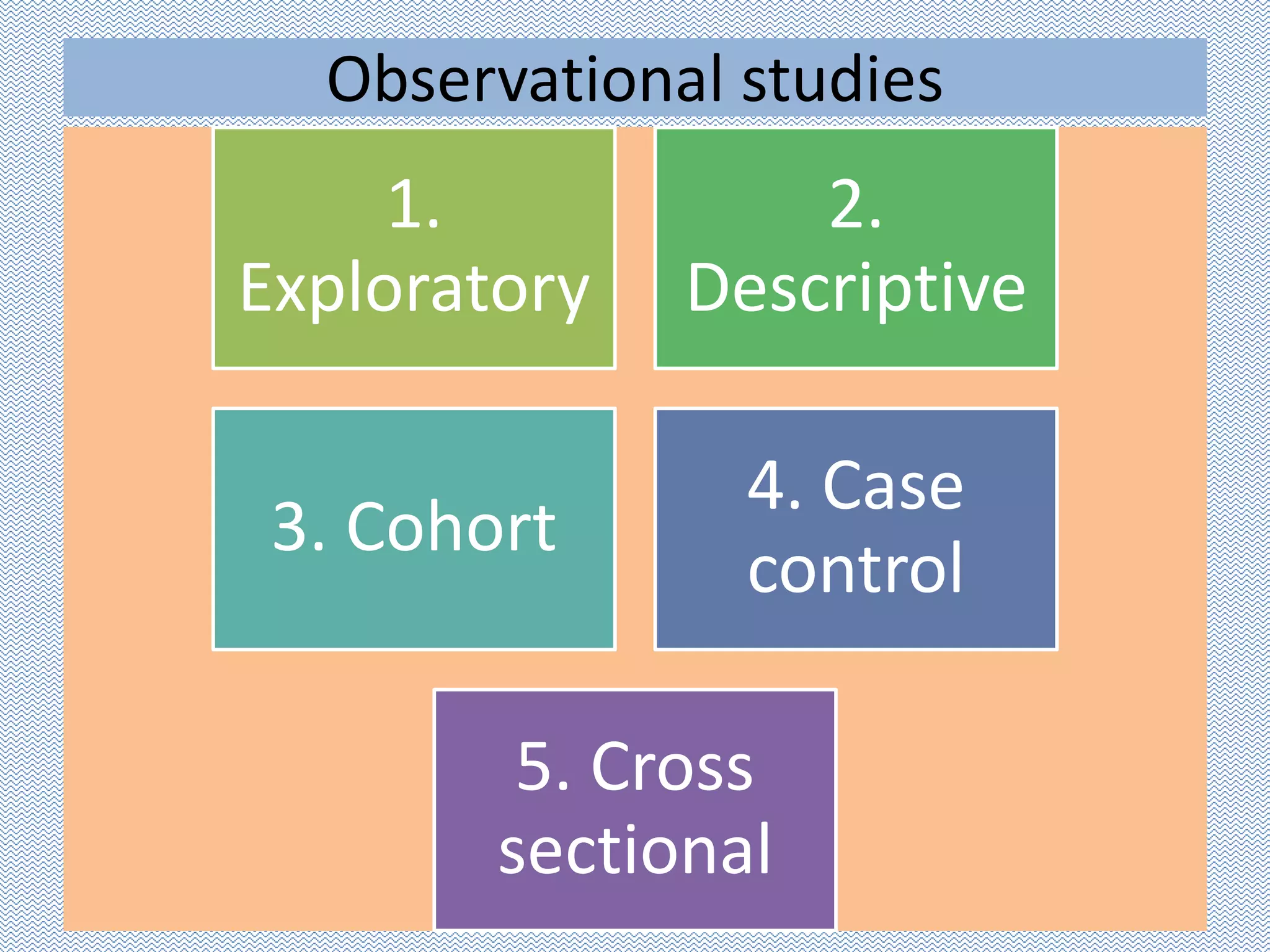
Observational studies
1.
Exploratory
2.
Descriptive
3. Cohort
4. Case
control
5. Cross
sectional
Experimental design
• Randomized control trials.
Other Design
• Qualitative research
• Systematic reviews
Sampling to study the drug use
Sampling
• Population:
• Sample:
• Participants:
Sampling
• The process through which a sample is
extracted from a population is called as
sampling.
Sampling
• Sampling errors:
– Systematic Errors
– Sampling bias
Types of sampling
• Sampling techniques are broadly categorized
into two major types:
1) Probability sampling methods
2) Non-probability sampling methods
Probability Sampling
• Random sampling
• Representative sampling
• Population must be precisely defined.
• Not used for general categories.
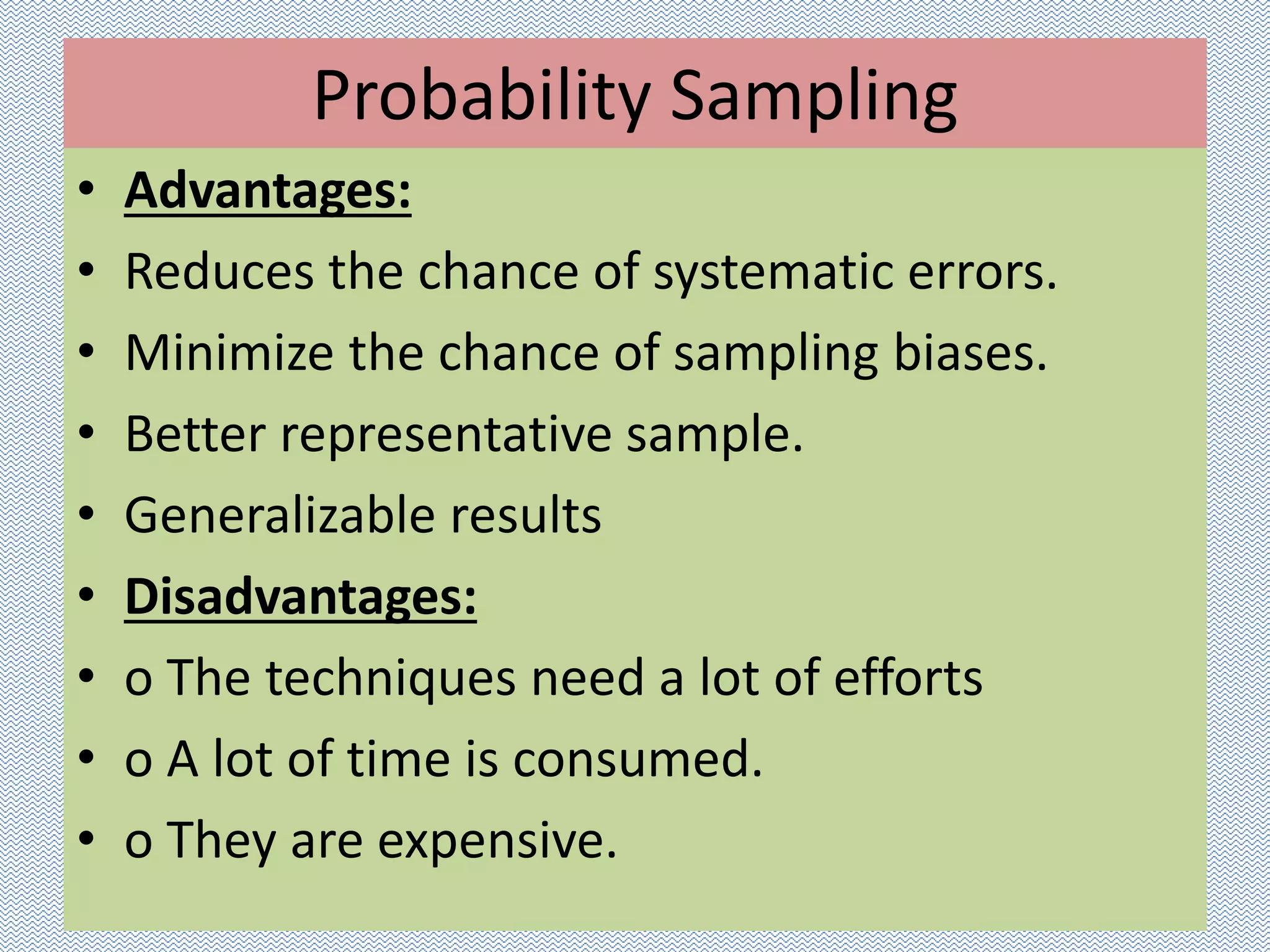
Probability Sampling
• Advantages:
• Reduces the chance of systematic errors.
• Minimize the chance of sampling biases.
• Better representative sample.
• Generalizable results
• Disadvantages:
• o The techniques need a lot of efforts
• o A lot of time is consumed.
• o They are expensive.
Probability Sampling
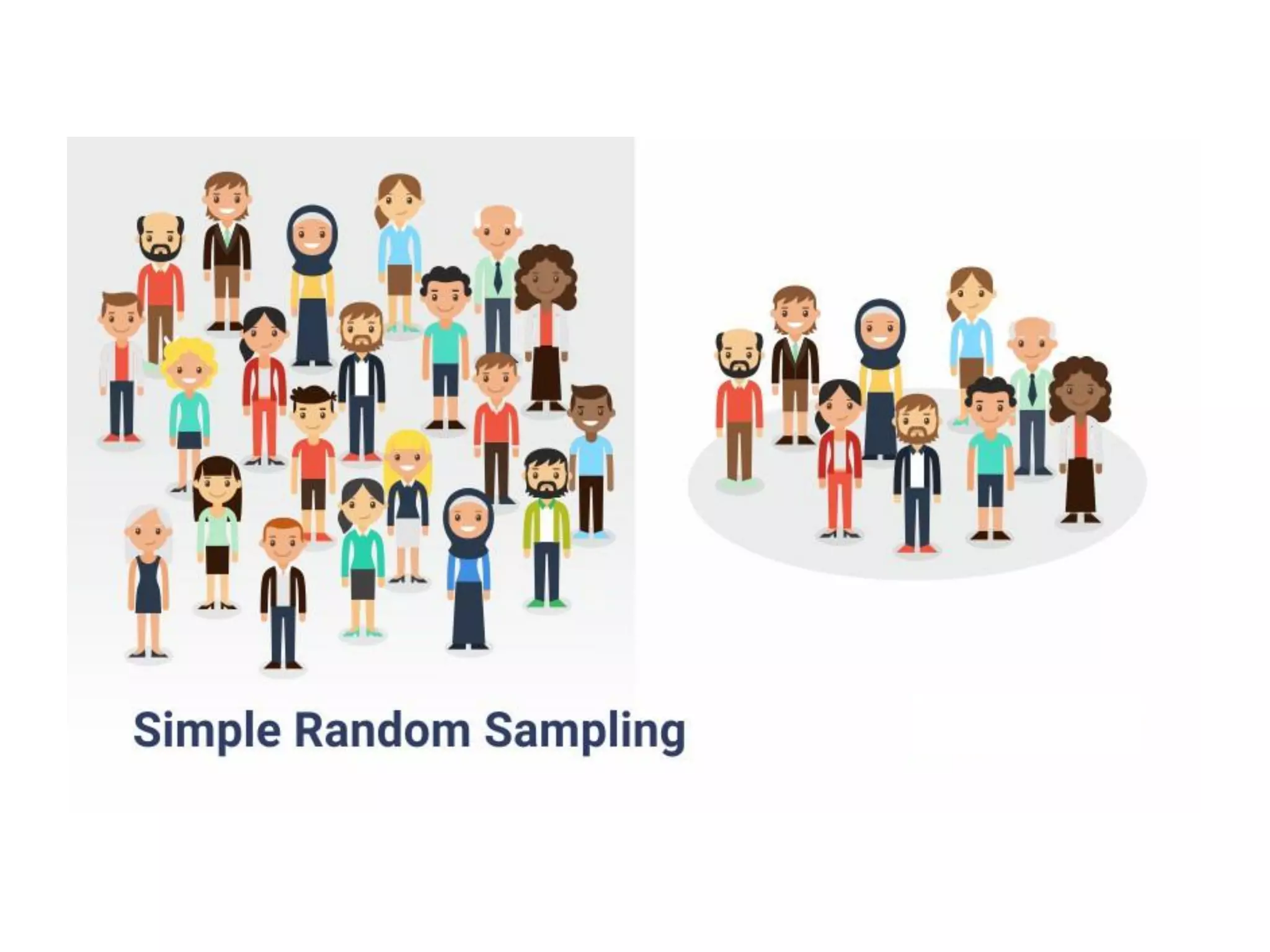
1. Random Sampling
2. Systematic Random Sampling
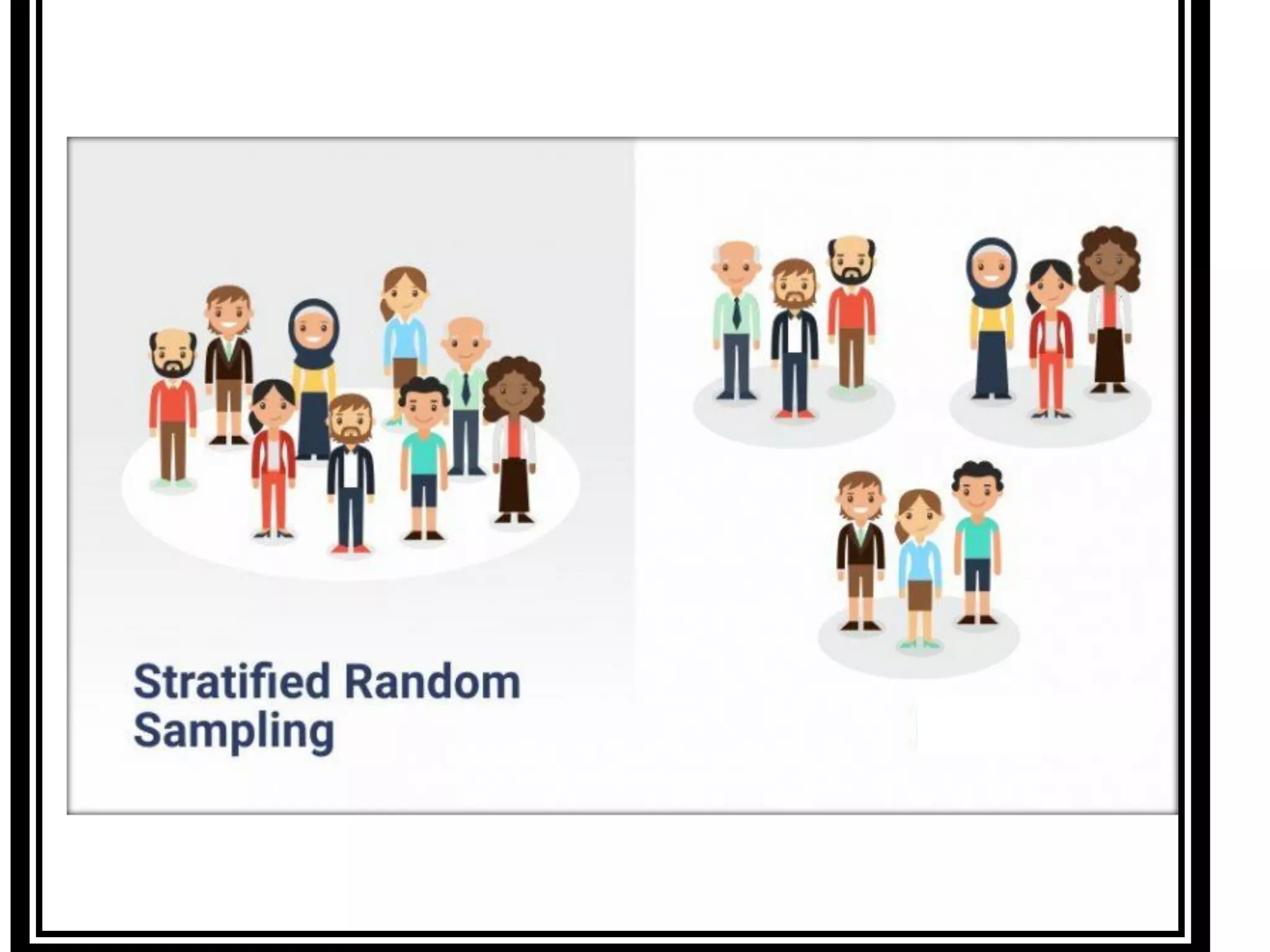
3. Stratified Random Sampling
4. Cluster Sampling
5. Multistage Sampling
Random Sampling
• Equal chance
• Elements can be listed
• Homogenous population
• Lottery
• Computer generated Tables.
• Selected participants are approached and
interviewed
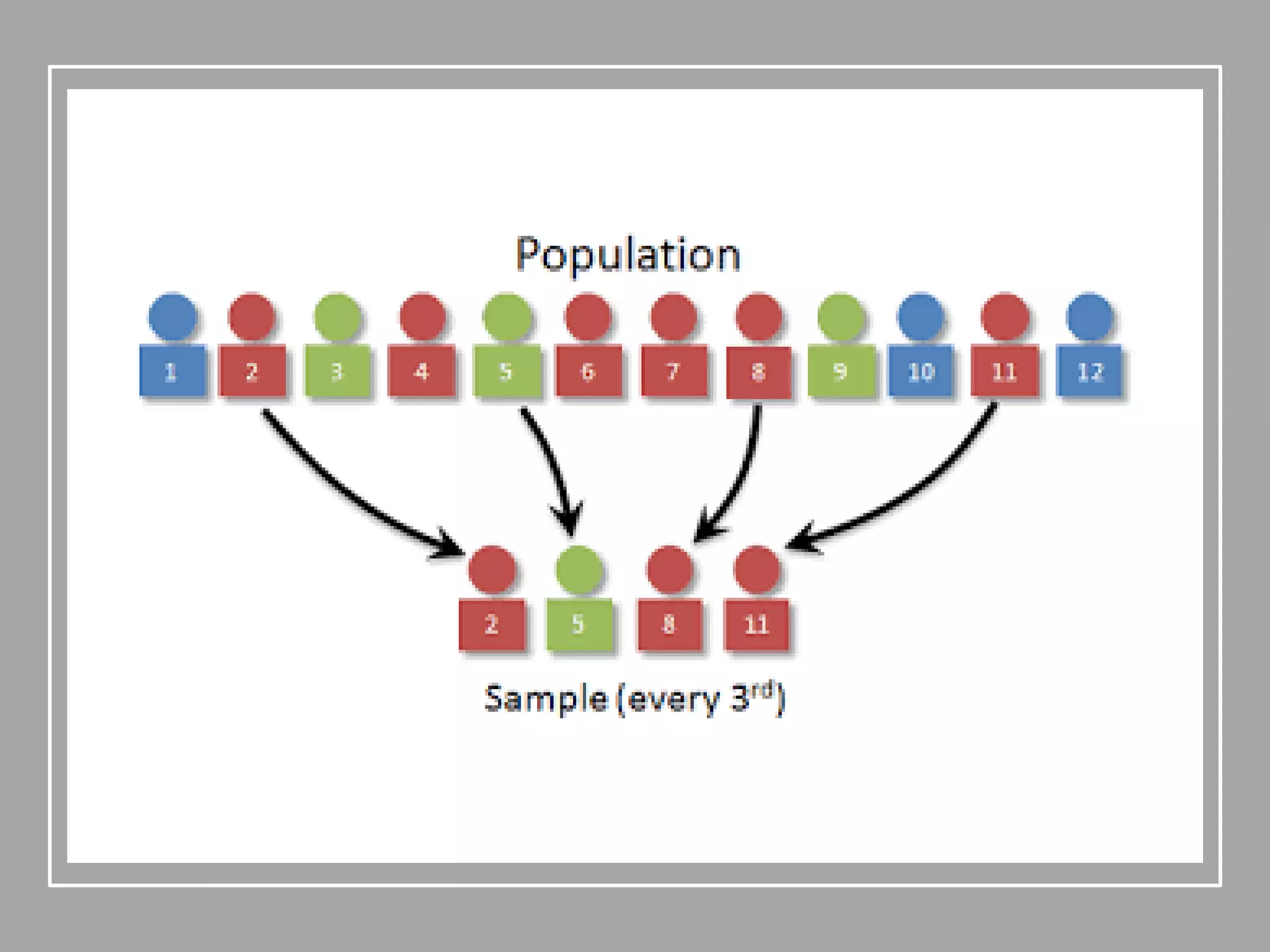
Systematic Random Sampling
• Homogenous Population
• Element selection is at regular interval.
• Interval in terms of time, space or order.
• Regularity and uniformity in selection makes
the sampling systematic.
• Selected participant is then approached and
investigated.
Stratified Random Sampling
• Heterogenous population
• Subgroups formation (Strata)
• The sample is selected from each stratum
randomly or systematically
• Allocation of sample from Strata
• Benefits best representation of sample
• Draw backs Cost, effort, proper definition
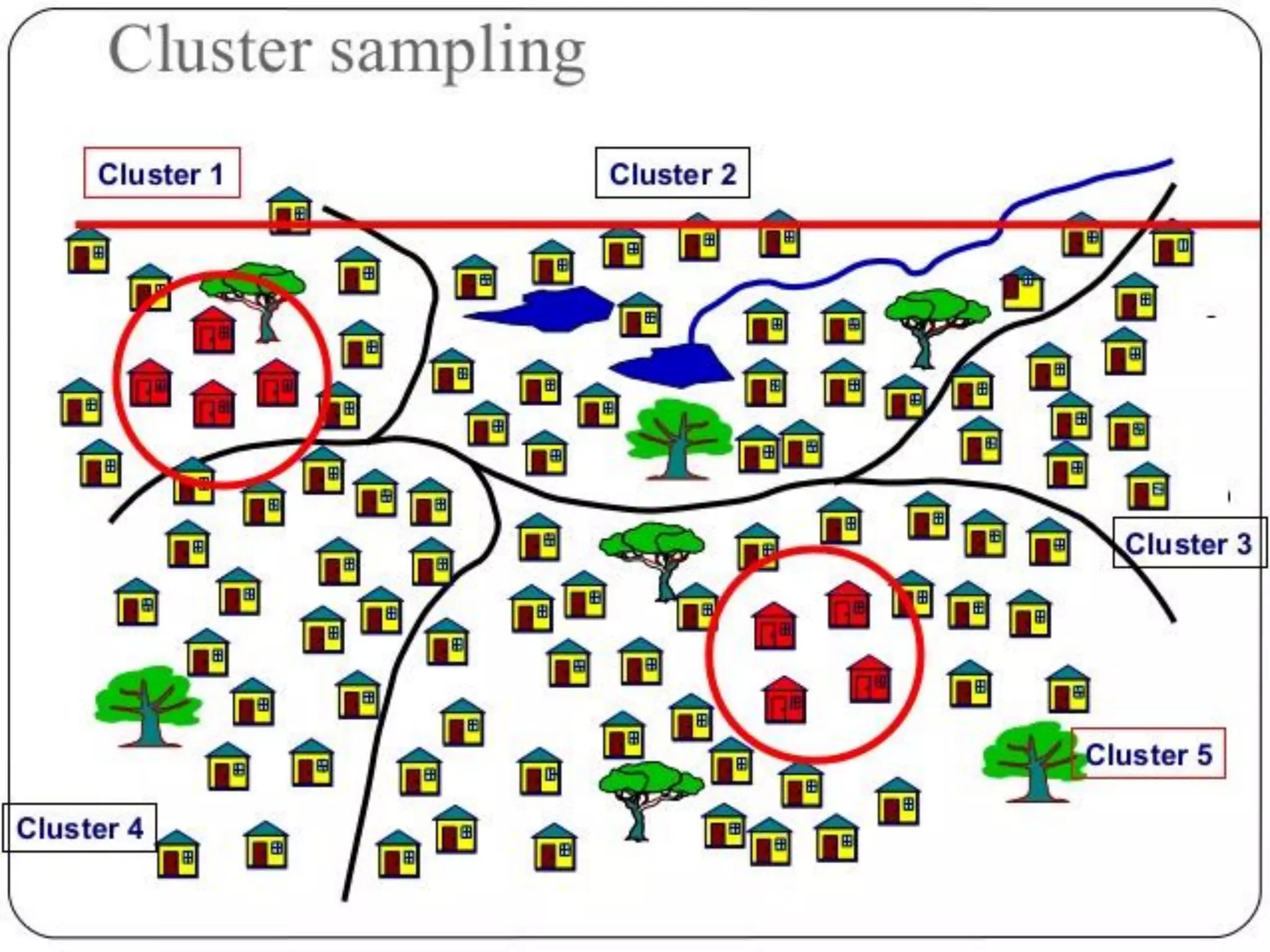
Cluster Sampling
• Wide geographical area
• Cluster
Multistage Sampling
• Two or more probability techniques are
combined.
Cluster + Stratified sampling
Non-probability sampling
• Every unit of population does not get an equal
chance of participation in the investigation.
• Advantage
– Less effort, cost and time
• Disadvantage
– Sampling errors, bias, lack of generalization
Non-probability sampling
1. Volunteer sampling
2. Convenient sampling
3. Purposive sampling
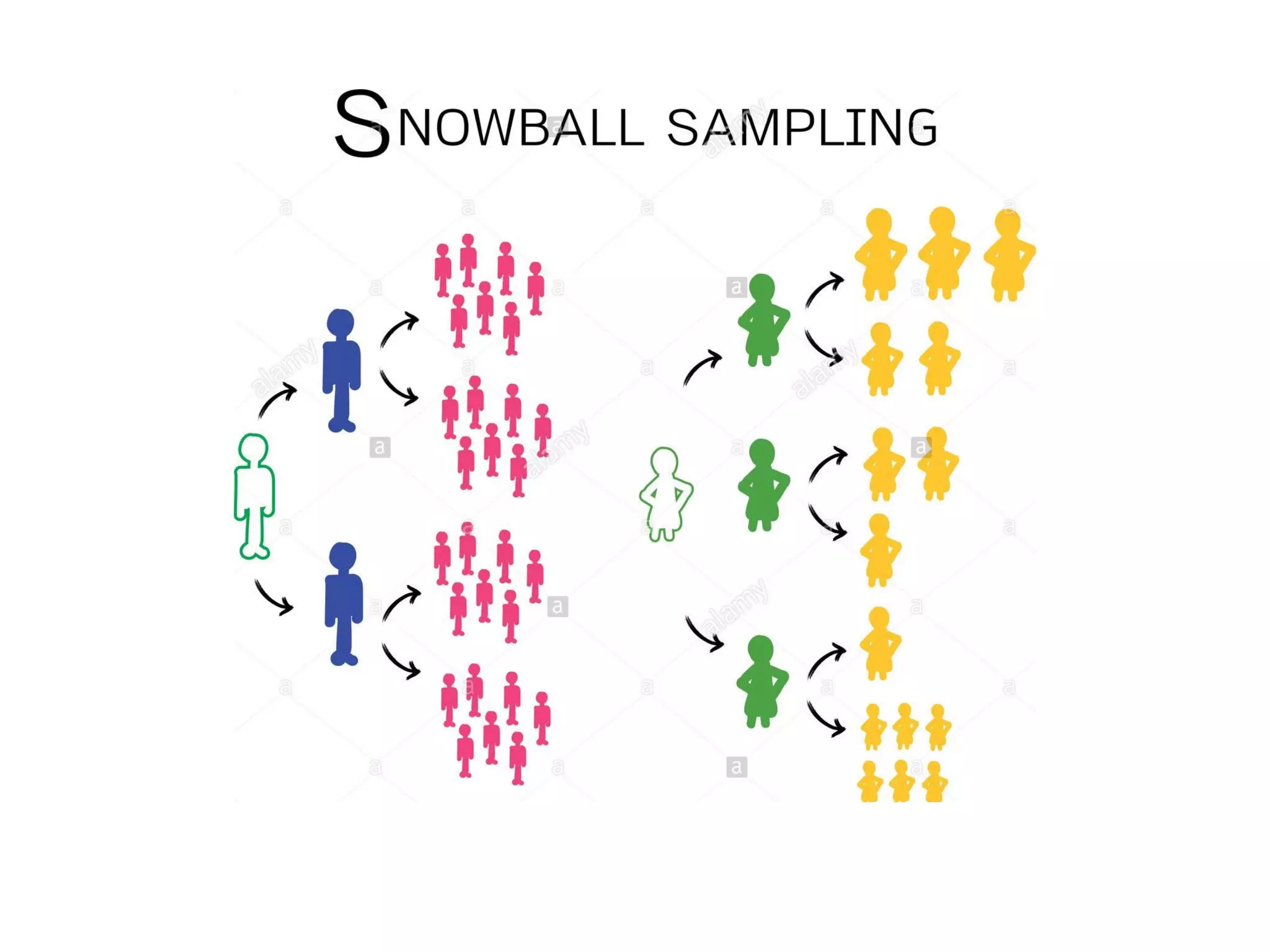
4. Snowball sampling
5. Matched Sampling
6. Genealogy Based Sampling
Purposive sampling
THANKS

Rational Drug Use-1.pdf