Drug Supply Management
11/02/2025
6.Drug Use
Drug use- is the process of prescribing, dispensing and use
of drug by patient.
Rational drug use refers to the correct, proper and
appropriate use of medicines.
• It means prescribing right drug, in adequate dose for the
sufficient duration & appropriate to the clinical needs of
the patient at lowest cost and the adherence of the
patients With Drug Treatment
• Rational use requires that patients receive the appropriate
medicine, in the proper dose, for an adequate period of
time, and at the lowest cost to them and their community
11/02/2025
Drug use process
Appropriate drug use in health facility setting is
a multidisciplinary responsibility that includes:
 Prescribing by the physician
 Preparation and dispensing by the pharmacy
department
 Medication administration by nurses or other
health care professionals
 Monitoring the effect of drug on the patient by all
members of the health care team
11/02/2025
Components of rational drug use
Rational prescribing
It is the responsibility of medicine prescriber
•Good Prescribing Practice (GPP) is prescribing the right drug at the right
time, in the right dosage of the right formulation and for the right length of
time.
• The following steps will help to remind prescribers of the rational
approach to therapeutics
The rational prescribing should meet:
• Appropriate indication.
• Appropriate drug.
• Appropriate patient.
• Appropriate patient information.
• Appropriate evaluation
11/02/2025
A prescriber need to:
• Makes an accurate diagnosis
• Decide whether the diagnosis require drug
treatment or not
• Selects the best drug in an adequate dose, for
sufficient length of time according to the
Standard Treatment Guideline(STG)
• Follows correct prescription writing
• Prescribe to the correct patient. Consider age,
contraindications, complication etc.
• Advice/counsel the patients
11/02/2025
Rational Dispensing
Pharmacy professionals are the responsible personnel to follow good
dispensing practices
•Good dispensing practices ensure that the correct drug is delivered to the
right patient, in the required dosage and quantities, with clear instructions,
and in package that maintains an acceptable potency and quality of the drug.
The Pharmacy professionals should,
• Handle drugs in a safe and hygienic manner and packed in appropriate
containers
• Counsel patients about his/her knowledge of the health problem and
the prescribed drugs
• Check possible adverse drug reactions in relation to other drugs
prescribed and the patient’s health condition
• Inform the patient about the dosage, duration of the drug therapy and
possible side effects where applicable
11/02/2025
It needs,
Ensuring Regular availability of needed drugs
in the dispensary
Good dispensing practice
Interpreting
Retrieval,
Formulating (counting, pouring and measuring)
Processing and labeling
Deliver of the drugs
Recording, documenting
 prepare and report drug consumption and revenue
11/02/2025
Patient Adherence (Compliance) With Drug
Treatment
• the drug should be taken correctly so that the
treatment will be successful.
• The patient should adhere to the drug therapy
prescribed
• In case of a problem he/she should contact
the pharmacist
• The pharmacist or physician should follow up
on the patients’ medication
11/02/2025
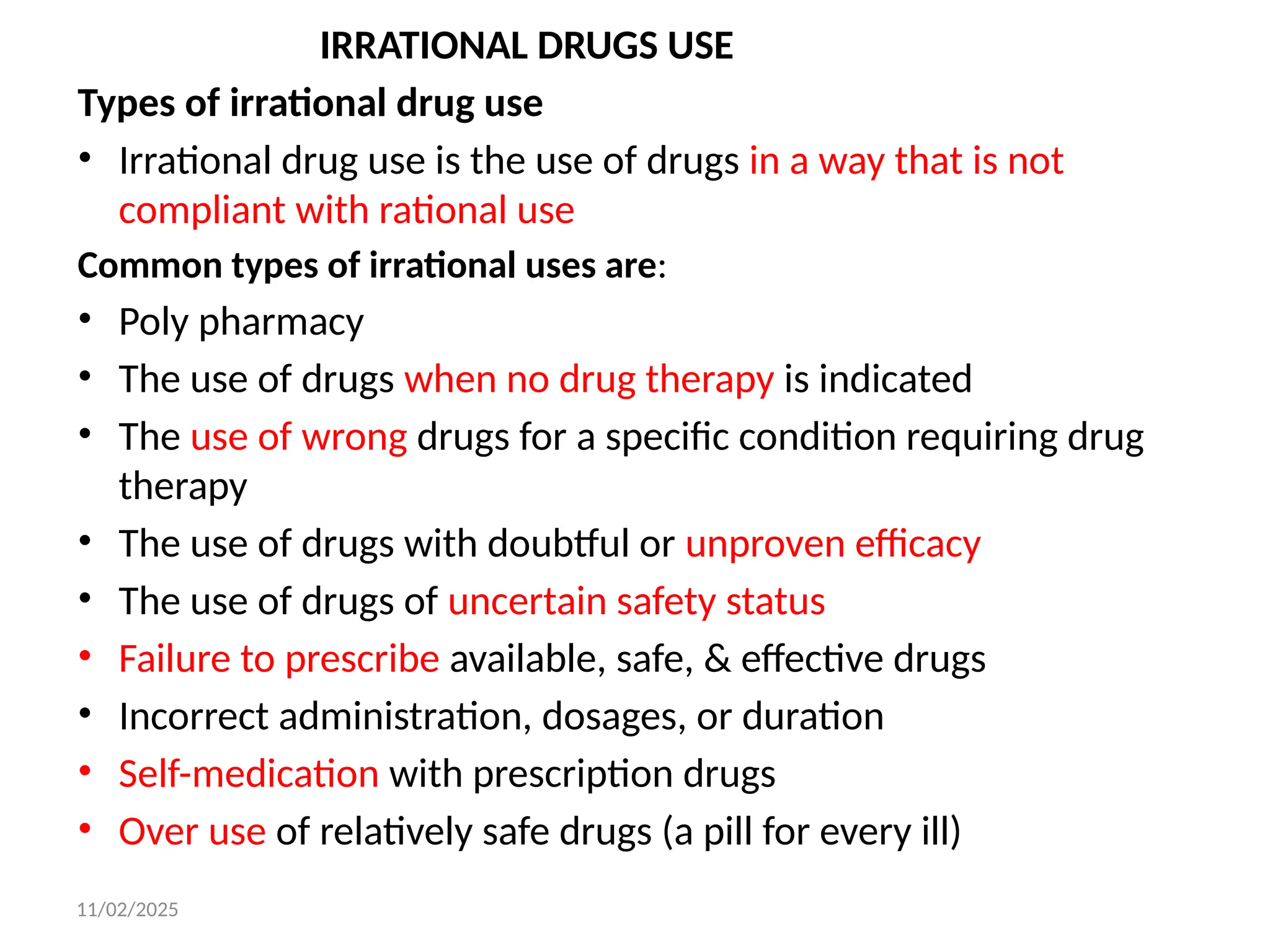
IRRATIONAL DRUGS USE
Types of irrational drug use
• Irrational drug use is the use of drugs in a way that is not
compliant with rational use
Common types of irrational uses are:
• Poly pharmacy
• The use of drugs when no drug therapy is indicated
• The use of wrong drugs for a specific condition requiring drug
therapy
• The use of drugs with doubtful or unproven efficacy
• The use of drugs of uncertain safety status
• Failure to prescribe available, safe, & effective drugs
• Incorrect administration, dosages, or duration
• Self-medication with prescription drugs
• Over use of relatively safe drugs (a pill for every ill)
11/02/2025
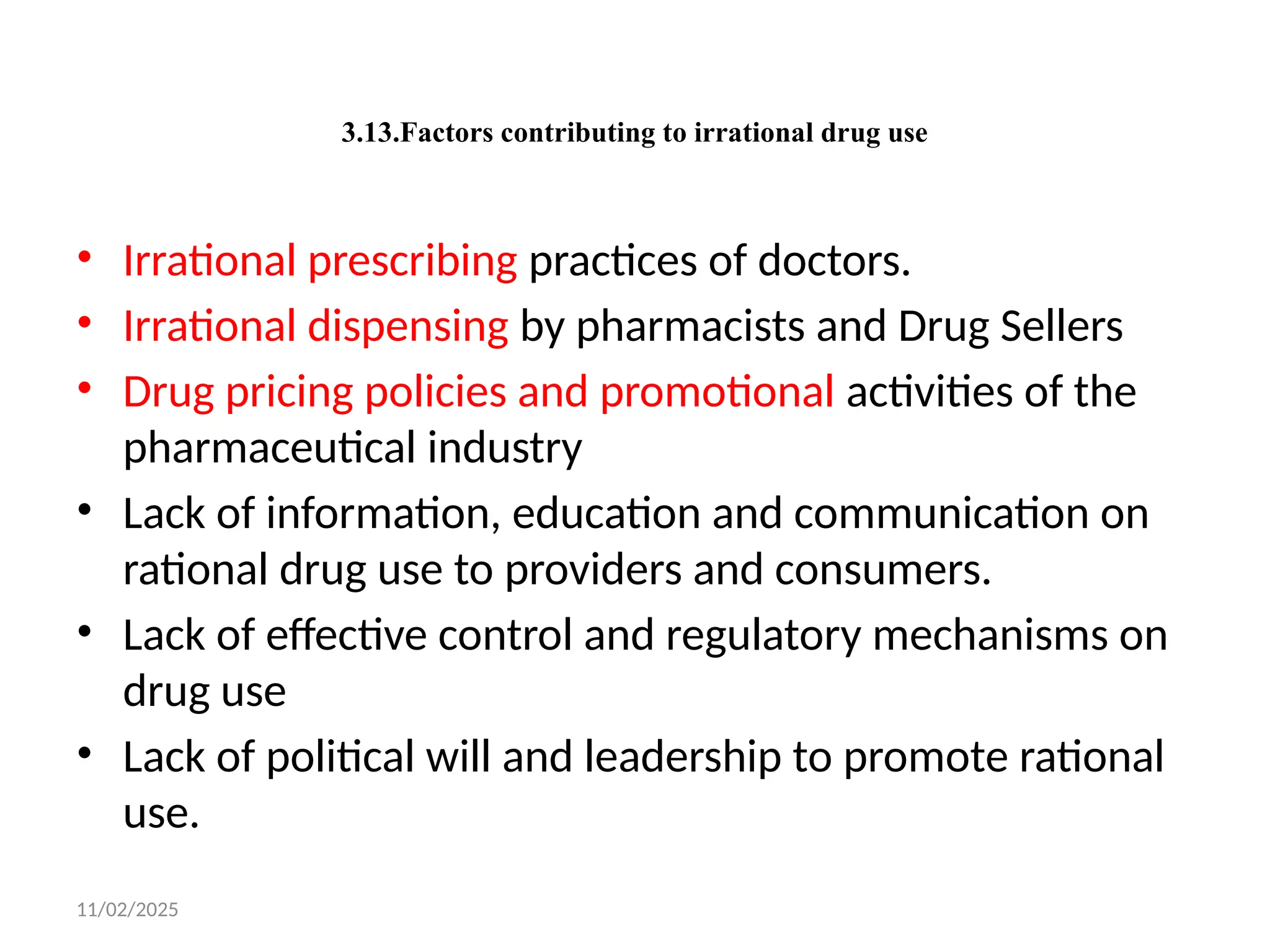
3.13.Factors contributing to irrational drug use
• Irrational prescribing practices of doctors.
• Irrational dispensing by pharmacists and Drug Sellers
• Drug pricing policies and promotional activities of the
pharmaceutical industry
• Lack of information, education and communication on
rational drug use to providers and consumers.
• Lack of effective control and regulatory mechanisms on
drug use
• Lack of political will and leadership to promote rational
use.
11/02/2025
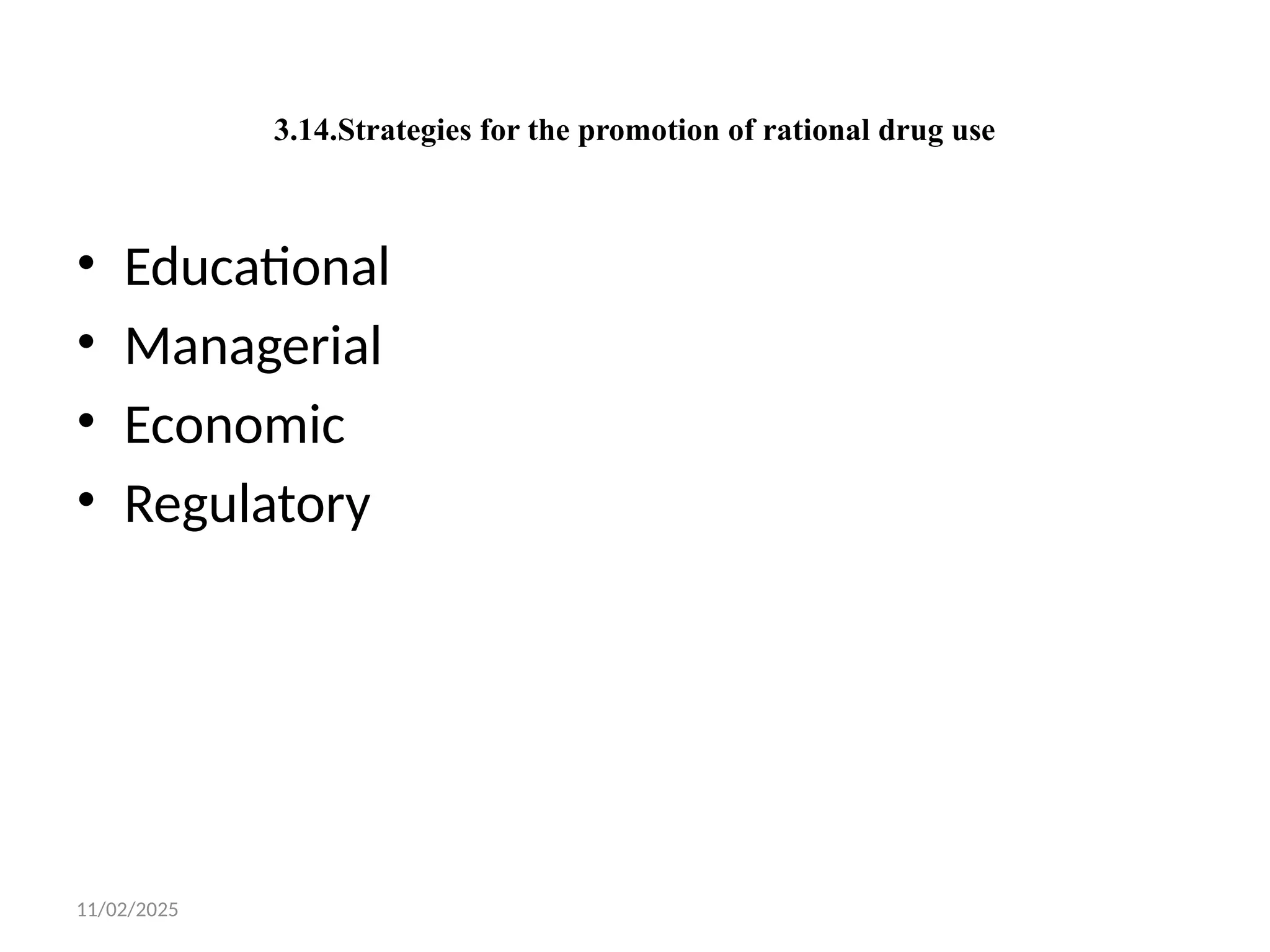
3.14.Strategies for the promotion of rational drug use
• Educational
• Managerial
• Economic
• Regulatory
11/02/2025
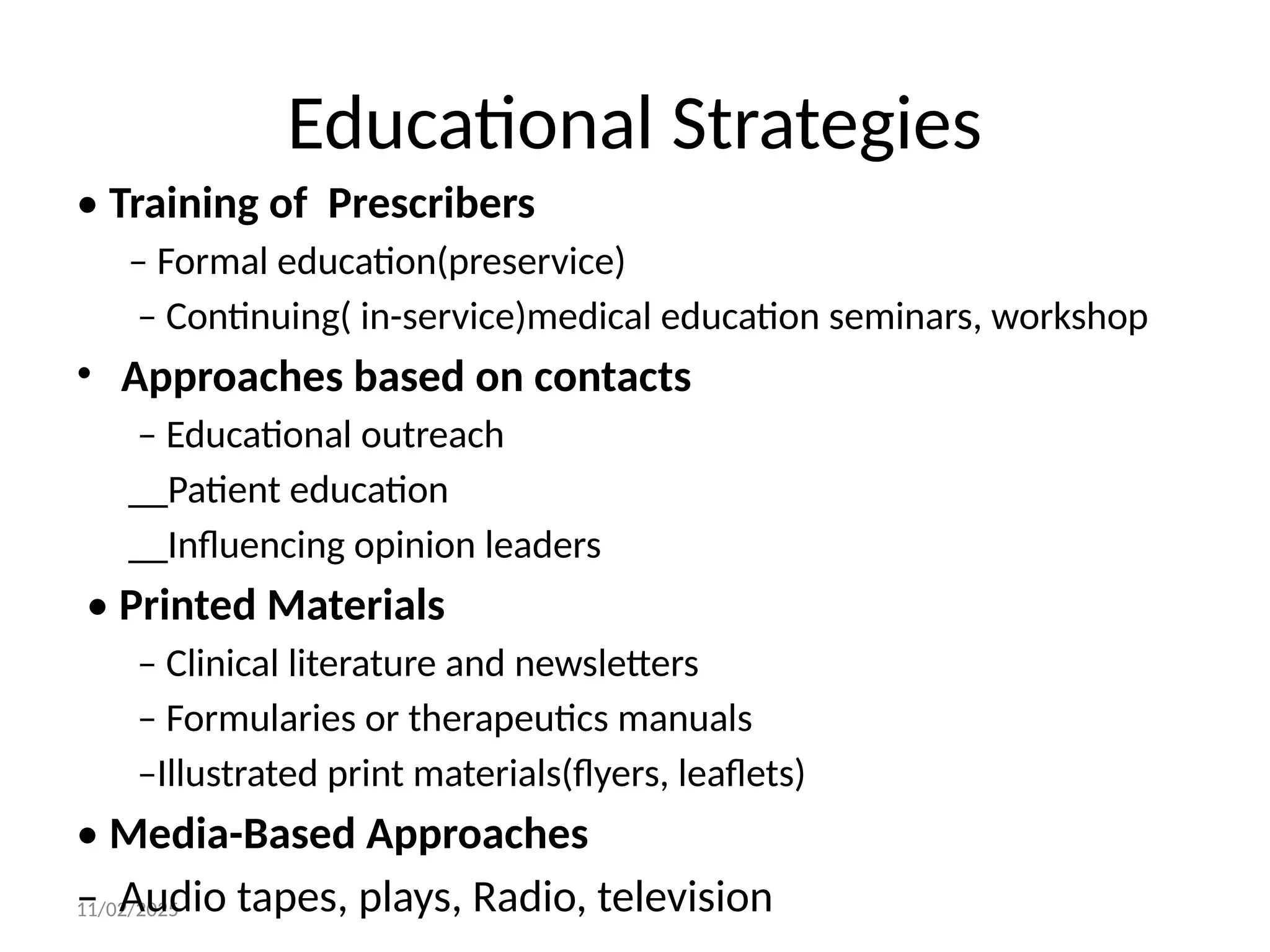
Educational Strategies
• Training of Prescribers
– Formal education(preservice)
– Continuing( in-service)medical education seminars, workshop
• Approaches based on contacts
– Educational outreach
__Patient education
__Influencing opinion leaders
• Printed Materials
– Clinical literature and newsletters
– Formularies or therapeutics manuals
–Illustrated print materials(flyers, leaflets)
• Media-Based Approaches
– Audio tapes, plays, Radio, television
11/02/2025
Managerial strategies
• Monitoring, supervising, and feedback
 of all health related teams and organizations
• Changes in selection, procurement,
distribution to ensure availability of essential
drugs .
• Strategies aimed at prescribers
 structured order forms,
Standard diagnostic &STG
• Dispensing strategies
 course of treatment packaging, labelling,
generic substitution
11/02/2025
Economic strategies:
price setting
Capitation- based budgeting
 insurance policies
 reimburse and user fees
11/02/2025
Regulatory strategies
 Medicines registration
Limited medicine list
Prescribing restrictions
Dispensing restriction
11/02/2025
4. Tools to investigate the use of medicines
• Irrational use of medicine
– reduces quality of care
– wastes resources
– may cause harm to patients.
• To address the problems associated with drug
use
 Measure, analyze and understand the cause
of the problem
11/02/2025
Stepwise approach to investigate the use of
medicines
• STEP 1 - General investigation to identify
problem areas inappropriate use of medicines.
• STEP 2- In-depth investigations of specific
problems
 determine the size, nature and reasons underlying
the problem.
 Prescription audit, Qualitative methods, Drug
utilization review
.
11/02/2025
Stepwise approach to investigate-----
STEP 3- Develop, implement and evaluate
strategies to correct the problem
– e.g. Strategies to promote more rational use of
medicines.
11/02/2025
Reasons to investigate drug use
• To describe current pattern of drug use
Measure consumption of drugs
 Compare use by individual health facilities or
prescriber
 Decide whether drug use is clinically justified or
cost effective
Learn the influence of prescribing on
pharmaceutical costs
• To correct specific drug use problems
Find and identify factors, and correct problems
• prescribing, dispensing or patient use
11/02/2025
• To monitor drug use over time
 Monitor quality of care within a health facility
/geographic area
 Monitor the efficiency and cost effectiveness of
prescribing
11/02/2025
Data Required to investigate drug use
 Quantitative and qualitative methods.
 Quantitative methods
 answer the question what is happening?
 describe the nature and extent of drug use practice
create rate, average, or other summary measure
 Qualitative methods
 answer why is it happening?
 Describe beliefs and motivation that underlie
particular practices.
 Observation, description, opinion or discussions
11/02/2025
WHO Drug Use Indicators
Drug use indicators
 describe drug use at a given point in time or to
monitor changes over time.
 Core and supplementary drug use indicator
 Developed to measure performance in three
general areas
i. Prescribing indicators
ii. Patient care Indicators
iii. Facility indicators
11/02/2025
1.Core drug use indicator (12)
• Prescribing indicator (5)→ retrospective/prospective
data
– Average number of drugs per encounter
– Percentage of drugs prescribed by generic name
– Percentage of encounter with an antibiotic
prescribed
– Percentage of encounter with an injection prescribed
– Percentage of drugs prescribed from EDL or
formulary
11/02/2025
Core drug use indicator…….
• Patient care indicators (5) → Only prospective
data
– Average consultation time
– Average dispensing time
– Percentage of drugs actually dispensed
– Percentage of drugs adequately labeled
– Patients’ knowledge of correct dosage
11/02/2025
Core drug use indicator……..
• Facility indicators (2)
– Availability of copy of EDL or formulary
– Availability of key drugs
11/02/2025
Complementary drug use indicator (7)
– Percentage of patients treated without drugs
– Average drug cost per encounter
– Percentage of drug costs spent on antibiotics
– Percentage of drug costs spent on injection
– Prescription in accordance with treatment
guidelines
– Percentage of patients satisfied with the care they
received
– Percentage of health facilities with access to
impartial pharmaceutical Info.
11/02/2025
5: Drug management information system
• An organized system for collecting, processing,
reporting, and using information for decision
making
• The information for each subsystem is
collected by means of
 record keeping documents
Information reporting forms
Feedback reports(analytical reports)
11/02/2025
Drug management information……
• The system will
 ensure availability of sufficient quantity of drugs and
consumable materials for the patient.
enhance the efficiency of clinical work, ease the
patients convenience and process drug prescriptions
effectively
help removing time wasting, saving resources, allow
easy access to medicine, as well as bring on more
security on the data compared to manual based
system.
Functions of DMIS
• provides the necessary information to make sound decisions in
the pharmaceutical sector
• Helps policy makers, program managers and health care
providers to monitor
 information related to patient adherence,
 drug resistance,
 availability of medicines and laboratory supplies, patient safety,
 product registration,
 product quality,
 financing and program management etc
11/02/2025
Functions of DMIS….
• able to synthesize the large volume of data
generated by pharmaceutical management
operations
then processes the data into information for use
in;
– planning activities
– estimating demand
– allocating resources
– monitoring and evaluating pharmaceutical management
operations
11/02/2025
Functions of DMIS ….
• improve accountability by creating audit trial
for products as they enter or leave a
pharmaceutical supply system.
• Clinical Screening: The Pharmacy Information
System can assist in patient care by the
monitoring of drug interactions, drug allergies
and other possible medication-related
complications.
11/02/2025
• Prescription Management: use to manage
prescription for inpatients and/or outpatients.
• Inventory Management: aid inventory
management by maintaining an internal
inventory of all pharmaceutical products,
providing alerts when the quantity of an item
is below a set quantity and providing an order
system that recommends the ordering of the
affected item and with the appropriate
quantity from approved suppliers
11/02/2025
• Report Generation: Most Pharmacy
Information Systems can generate reports
which range from determining medication
usage patterns in the hospital to the cost of
drugs purchased and /or dispensed within the
given time period
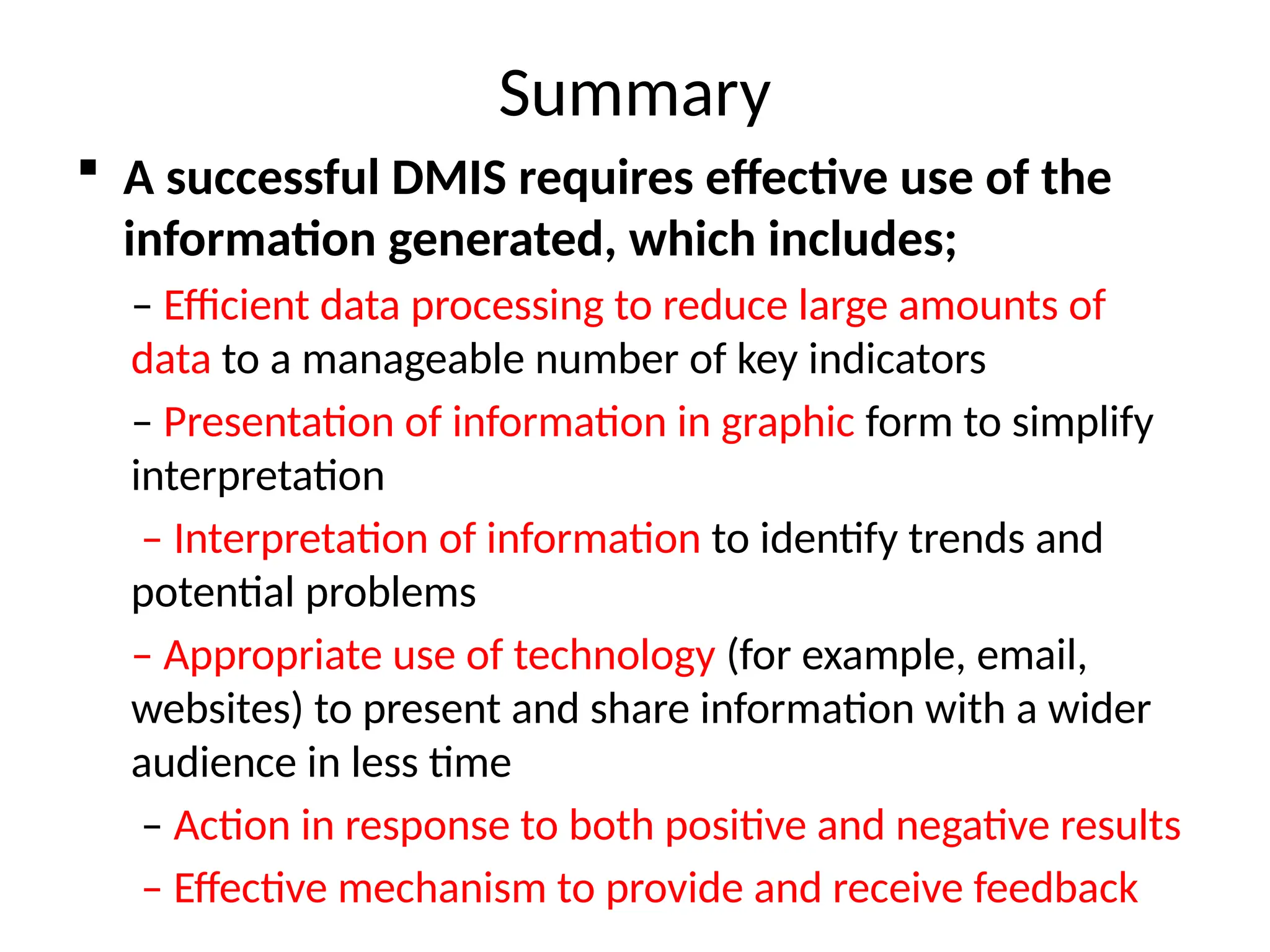
Summary
 A successful DMIS requires effective use of the
information generated, which includes;
– Efficient data processing to reduce large amounts of
data to a manageable number of key indicators
– Presentation of information in graphic form to simplify
interpretation
– Interpretation of information to identify trends and
potential problems
– Appropriate use of technology (for example, email,
websites) to present and share information with a wider
audience in less time
– Action in response to both positive and negative results
– Effective mechanism to provide and receive feedback
11/02/2025
6: Monitoring and evaluation
• Integral part of drug management cycle
• Provide a link between planning and
implementation
Monitoring – refers to reviewing on continuous
basis the degree to which program activities are
completed.
11/02/2025
• Monitoring is intended to
 Determine weather activities are being carried out as
planned
 Measure achievement targets
 Identify implementation problem to initiate corrective
action
 Identify and reinforce good performance
11/02/2025
Identify and strengthen weak performance
 Help target supervision to problem areas
Asses weather activities are having their
expected effects
Assess long term trends
Contribute to reviewing and revising program
priorities and plan
11/02/2025
Designing monitoring system
• A practical strategy for developing a monitoring
– Use supervisory visit
– Establish a streamlined routine reporting system
– Identify sentinel sites
• For more detailed recording and reporting
– Plan and conduct special studies
• is not available through either routine reporting
or sentinel sites.
No monitoring system is complete without feedback
11/02/2025
 Effective monitoring system requires prompt
follow up action.
 There are five types of action that a manager
can take
– Provide positive feedback
– Provide corrective feedback
– Reallocate resources or reassign staff
– Adjust plans and targets to be more realistic
on the basis of actual experience
– Request additional information to further
define a specific performance problem and
reason for the problem
11/02/2025
Evaluation
refers to analyzing progress towards meeting
objectives & goals.
• Evaluation type
A. Needs assessment (situation analysis)
• Design
• Assess current situation,
• develop program/project plan, acquire baseline
for comparison
11/02/2025
B. Formative evaluation (midterm review)
 Implementation
Focus on implementation progress towards goals
and objectives
improve program/project implementation
C. Summative evaluation (final evaluation)
 Assess program/project outputs
measure impact of program / project impact to
donor
recommend future action
11/02/2025
Thank you!!

6. presentation about the use of drugs class lecturer

  • 1.
  • 2.
    11/02/2025 6.Drug Use Drug use-is the process of prescribing, dispensing and use of drug by patient. Rational drug use refers to the correct, proper and appropriate use of medicines. • It means prescribing right drug, in adequate dose for the sufficient duration & appropriate to the clinical needs of the patient at lowest cost and the adherence of the patients With Drug Treatment • Rational use requires that patients receive the appropriate medicine, in the proper dose, for an adequate period of time, and at the lowest cost to them and their community
  • 3.
    11/02/2025 Drug use process Appropriatedrug use in health facility setting is a multidisciplinary responsibility that includes:  Prescribing by the physician  Preparation and dispensing by the pharmacy department  Medication administration by nurses or other health care professionals  Monitoring the effect of drug on the patient by all members of the health care team
  • 4.
    11/02/2025 Components of rationaldrug use Rational prescribing It is the responsibility of medicine prescriber •Good Prescribing Practice (GPP) is prescribing the right drug at the right time, in the right dosage of the right formulation and for the right length of time. • The following steps will help to remind prescribers of the rational approach to therapeutics The rational prescribing should meet: • Appropriate indication. • Appropriate drug. • Appropriate patient. • Appropriate patient information. • Appropriate evaluation
  • 5.
    11/02/2025 A prescriber needto: • Makes an accurate diagnosis • Decide whether the diagnosis require drug treatment or not • Selects the best drug in an adequate dose, for sufficient length of time according to the Standard Treatment Guideline(STG) • Follows correct prescription writing • Prescribe to the correct patient. Consider age, contraindications, complication etc. • Advice/counsel the patients
  • 6.
    11/02/2025 Rational Dispensing Pharmacy professionalsare the responsible personnel to follow good dispensing practices •Good dispensing practices ensure that the correct drug is delivered to the right patient, in the required dosage and quantities, with clear instructions, and in package that maintains an acceptable potency and quality of the drug. The Pharmacy professionals should, • Handle drugs in a safe and hygienic manner and packed in appropriate containers • Counsel patients about his/her knowledge of the health problem and the prescribed drugs • Check possible adverse drug reactions in relation to other drugs prescribed and the patient’s health condition • Inform the patient about the dosage, duration of the drug therapy and possible side effects where applicable
  • 7.
    11/02/2025 It needs, Ensuring Regularavailability of needed drugs in the dispensary Good dispensing practice Interpreting Retrieval, Formulating (counting, pouring and measuring) Processing and labeling Deliver of the drugs Recording, documenting  prepare and report drug consumption and revenue
  • 8.
    11/02/2025 Patient Adherence (Compliance)With Drug Treatment • the drug should be taken correctly so that the treatment will be successful. • The patient should adhere to the drug therapy prescribed • In case of a problem he/she should contact the pharmacist • The pharmacist or physician should follow up on the patients’ medication
  • 9.
    11/02/2025 IRRATIONAL DRUGS USE Typesof irrational drug use • Irrational drug use is the use of drugs in a way that is not compliant with rational use Common types of irrational uses are: • Poly pharmacy • The use of drugs when no drug therapy is indicated • The use of wrong drugs for a specific condition requiring drug therapy • The use of drugs with doubtful or unproven efficacy • The use of drugs of uncertain safety status • Failure to prescribe available, safe, & effective drugs • Incorrect administration, dosages, or duration • Self-medication with prescription drugs • Over use of relatively safe drugs (a pill for every ill)
  • 10.
    11/02/2025 3.13.Factors contributing toirrational drug use • Irrational prescribing practices of doctors. • Irrational dispensing by pharmacists and Drug Sellers • Drug pricing policies and promotional activities of the pharmaceutical industry • Lack of information, education and communication on rational drug use to providers and consumers. • Lack of effective control and regulatory mechanisms on drug use • Lack of political will and leadership to promote rational use.
  • 11.
    11/02/2025 3.14.Strategies for thepromotion of rational drug use • Educational • Managerial • Economic • Regulatory
  • 12.
    11/02/2025 Educational Strategies • Trainingof Prescribers – Formal education(preservice) – Continuing( in-service)medical education seminars, workshop • Approaches based on contacts – Educational outreach __Patient education __Influencing opinion leaders • Printed Materials – Clinical literature and newsletters – Formularies or therapeutics manuals –Illustrated print materials(flyers, leaflets) • Media-Based Approaches – Audio tapes, plays, Radio, television
  • 13.
    11/02/2025 Managerial strategies • Monitoring,supervising, and feedback  of all health related teams and organizations • Changes in selection, procurement, distribution to ensure availability of essential drugs . • Strategies aimed at prescribers  structured order forms, Standard diagnostic &STG • Dispensing strategies  course of treatment packaging, labelling, generic substitution
  • 14.
    11/02/2025 Economic strategies: price setting Capitation-based budgeting  insurance policies  reimburse and user fees
  • 15.
    11/02/2025 Regulatory strategies  Medicinesregistration Limited medicine list Prescribing restrictions Dispensing restriction
  • 16.
    11/02/2025 4. Tools toinvestigate the use of medicines • Irrational use of medicine – reduces quality of care – wastes resources – may cause harm to patients. • To address the problems associated with drug use  Measure, analyze and understand the cause of the problem
  • 17.
    11/02/2025 Stepwise approach toinvestigate the use of medicines • STEP 1 - General investigation to identify problem areas inappropriate use of medicines. • STEP 2- In-depth investigations of specific problems  determine the size, nature and reasons underlying the problem.  Prescription audit, Qualitative methods, Drug utilization review .
  • 18.
    11/02/2025 Stepwise approach toinvestigate----- STEP 3- Develop, implement and evaluate strategies to correct the problem – e.g. Strategies to promote more rational use of medicines.
  • 19.
    11/02/2025 Reasons to investigatedrug use • To describe current pattern of drug use Measure consumption of drugs  Compare use by individual health facilities or prescriber  Decide whether drug use is clinically justified or cost effective Learn the influence of prescribing on pharmaceutical costs • To correct specific drug use problems Find and identify factors, and correct problems • prescribing, dispensing or patient use
  • 20.
    11/02/2025 • To monitordrug use over time  Monitor quality of care within a health facility /geographic area  Monitor the efficiency and cost effectiveness of prescribing
  • 21.
    11/02/2025 Data Required toinvestigate drug use  Quantitative and qualitative methods.  Quantitative methods  answer the question what is happening?  describe the nature and extent of drug use practice create rate, average, or other summary measure  Qualitative methods  answer why is it happening?  Describe beliefs and motivation that underlie particular practices.  Observation, description, opinion or discussions
  • 22.
    11/02/2025 WHO Drug UseIndicators Drug use indicators  describe drug use at a given point in time or to monitor changes over time.  Core and supplementary drug use indicator  Developed to measure performance in three general areas i. Prescribing indicators ii. Patient care Indicators iii. Facility indicators
  • 23.
    11/02/2025 1.Core drug useindicator (12) • Prescribing indicator (5)→ retrospective/prospective data – Average number of drugs per encounter – Percentage of drugs prescribed by generic name – Percentage of encounter with an antibiotic prescribed – Percentage of encounter with an injection prescribed – Percentage of drugs prescribed from EDL or formulary
  • 24.
    11/02/2025 Core drug useindicator……. • Patient care indicators (5) → Only prospective data – Average consultation time – Average dispensing time – Percentage of drugs actually dispensed – Percentage of drugs adequately labeled – Patients’ knowledge of correct dosage
  • 25.
    11/02/2025 Core drug useindicator…….. • Facility indicators (2) – Availability of copy of EDL or formulary – Availability of key drugs
  • 26.
    11/02/2025 Complementary drug useindicator (7) – Percentage of patients treated without drugs – Average drug cost per encounter – Percentage of drug costs spent on antibiotics – Percentage of drug costs spent on injection – Prescription in accordance with treatment guidelines – Percentage of patients satisfied with the care they received – Percentage of health facilities with access to impartial pharmaceutical Info.
  • 27.
    11/02/2025 5: Drug managementinformation system • An organized system for collecting, processing, reporting, and using information for decision making • The information for each subsystem is collected by means of  record keeping documents Information reporting forms Feedback reports(analytical reports)
  • 28.
    11/02/2025 Drug management information…… •The system will  ensure availability of sufficient quantity of drugs and consumable materials for the patient. enhance the efficiency of clinical work, ease the patients convenience and process drug prescriptions effectively help removing time wasting, saving resources, allow easy access to medicine, as well as bring on more security on the data compared to manual based system.
  • 29.
    Functions of DMIS •provides the necessary information to make sound decisions in the pharmaceutical sector • Helps policy makers, program managers and health care providers to monitor  information related to patient adherence,  drug resistance,  availability of medicines and laboratory supplies, patient safety,  product registration,  product quality,  financing and program management etc
  • 30.
    11/02/2025 Functions of DMIS…. •able to synthesize the large volume of data generated by pharmaceutical management operations then processes the data into information for use in; – planning activities – estimating demand – allocating resources – monitoring and evaluating pharmaceutical management operations
  • 31.
    11/02/2025 Functions of DMIS…. • improve accountability by creating audit trial for products as they enter or leave a pharmaceutical supply system. • Clinical Screening: The Pharmacy Information System can assist in patient care by the monitoring of drug interactions, drug allergies and other possible medication-related complications.
  • 32.
    11/02/2025 • Prescription Management:use to manage prescription for inpatients and/or outpatients. • Inventory Management: aid inventory management by maintaining an internal inventory of all pharmaceutical products, providing alerts when the quantity of an item is below a set quantity and providing an order system that recommends the ordering of the affected item and with the appropriate quantity from approved suppliers
  • 33.
    11/02/2025 • Report Generation:Most Pharmacy Information Systems can generate reports which range from determining medication usage patterns in the hospital to the cost of drugs purchased and /or dispensed within the given time period
  • 34.
    Summary  A successfulDMIS requires effective use of the information generated, which includes; – Efficient data processing to reduce large amounts of data to a manageable number of key indicators – Presentation of information in graphic form to simplify interpretation – Interpretation of information to identify trends and potential problems – Appropriate use of technology (for example, email, websites) to present and share information with a wider audience in less time – Action in response to both positive and negative results – Effective mechanism to provide and receive feedback
  • 35.
    11/02/2025 6: Monitoring andevaluation • Integral part of drug management cycle • Provide a link between planning and implementation Monitoring – refers to reviewing on continuous basis the degree to which program activities are completed.
  • 36.
    11/02/2025 • Monitoring isintended to  Determine weather activities are being carried out as planned  Measure achievement targets  Identify implementation problem to initiate corrective action  Identify and reinforce good performance
  • 37.
    11/02/2025 Identify and strengthenweak performance  Help target supervision to problem areas Asses weather activities are having their expected effects Assess long term trends Contribute to reviewing and revising program priorities and plan
  • 38.
    11/02/2025 Designing monitoring system •A practical strategy for developing a monitoring – Use supervisory visit – Establish a streamlined routine reporting system – Identify sentinel sites • For more detailed recording and reporting – Plan and conduct special studies • is not available through either routine reporting or sentinel sites. No monitoring system is complete without feedback
  • 39.
    11/02/2025  Effective monitoringsystem requires prompt follow up action.  There are five types of action that a manager can take – Provide positive feedback – Provide corrective feedback – Reallocate resources or reassign staff – Adjust plans and targets to be more realistic on the basis of actual experience – Request additional information to further define a specific performance problem and reason for the problem
  • 40.
    11/02/2025 Evaluation refers to analyzingprogress towards meeting objectives & goals. • Evaluation type A. Needs assessment (situation analysis) • Design • Assess current situation, • develop program/project plan, acquire baseline for comparison
  • 41.
    11/02/2025 B. Formative evaluation(midterm review)  Implementation Focus on implementation progress towards goals and objectives improve program/project implementation C. Summative evaluation (final evaluation)  Assess program/project outputs measure impact of program / project impact to donor recommend future action
  • 42.