Raster Scan Display
Raster:-
Arectangular array of points or dot.
An image is subdivided into a sequence of
(usually horizontal) strips known as "scan lines“
which can be further divided into discrete pixels for
processing in a computer system.
2.
Continue…
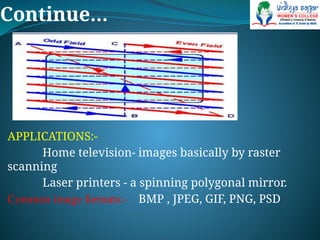
In a rasterscan system, the electron beam is
swept across the screen, one row at a time from top to
bottom.
As the electron beam moves across each row,
the beam intensity is turned on and off to create a
pattern of illuminated spots.
The return to the left of the screen, after
refreshing each scan line is called Horizontal retrace.
At the end of each frame the electron beam
returns to the top left corner of the screen to begin the
next frame is called Vertical retrace
Continue…
Picture definition isstored in a memory area
called the refresh buffer or frame buffer.
Refresh buffer or frame buffer is memory area
that holds the set of intensity values for all the screen
points.
Stored intensity values then retrieved from
refresh buffer and “painted” on the screen one row
(scan line) at a time. Object as set of discrete points
across each scan line
5.
Recall and continue…
Thequality of a raster image is determined by
the total number pixels (resolution), and the amount
of information in each pixel (color depth).
A black-and-white system: each screen point is
either on or off, so only one bit per pixel is needed to
control the intensity of screen positions. Such type of
frame buffer is called Bit map
High quality raster graphics system have 24 bits
per pixel in the frame buffer (a full color system or a
true color system)
Refreshing on raster scan displays is carried out
at the rate 60 to 80 frame per second.
Note:- Interlacing is primarily used for slower refresh
rates
Continue…
Disadvantage:-
To increase sizeof a raster image the pixels
defining the image are be increased in either number
or size Spreading the pixels over a larger area
causes the image to lose detail and clarity.
Produces jagged lines that are plotted as discrete
points
8.
RASTER SCAN SYSTEM
Inaddition to the central processing unit (CPU),
a special processor, called the video controller or
display controller, is used to control the operation of
the display device.
A fixed area of the system memory is reserved
for the frame buffer, and the video controller is given
direct access to the frame buffer memory.
Operation performed:-
1. Refreshing operation
2. Transformation (Areas of the screen can be
enlarged, reduces, or moved during the refresh cycles)
9.
Continue…
Frame buffer location,and the corresponding
screen positions, are referenced in Cartesian
coordinates
Scan lines are then labeled from ymax at the top
of the screen to 0 at the bottom. Along each scan line,
screen pixel positions are labeled from 0 to xmax.
Two registers are used to store the coordinates
of the screen pixels.
10.
Continue…
DISPLAY PROCESSOR
The purposeof the DP is to free the CPU from the
graphics chores.
A major task of the display processor is Scan
Conversion.
Scan Conversion: is digitizing a picture definition
given in an application program into a set of pixel
intensity values for storage in the frame buffer.
Graphic commands are translated by the graphics
package into a display file stored in the system memory.
This file is then accessed by the display processor
unit (DPU)(graphic controller) to refresh the screen.
Continue…
The electron beamis directed only to the part of
the screen where the picture is to be drawn rather
than scanning from left to right and top to bottom as
in raster scan. It is also called vector display, stroke-
writing display, or calligraphic display.
Picture definition is stored as a set of line-drawing
commands in an area of memory referred to as
the refresh display file. To display a specified picture,
the system cycles through the set of commands in the
display file, drawing each component line in turn.
After all the line-drawing commands are processed,
the system cycles back to the first line command in
the list.