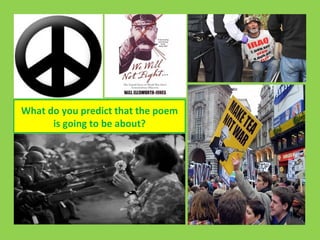
What do you predict that the poem
      is going to be about?
Conscientious Objector
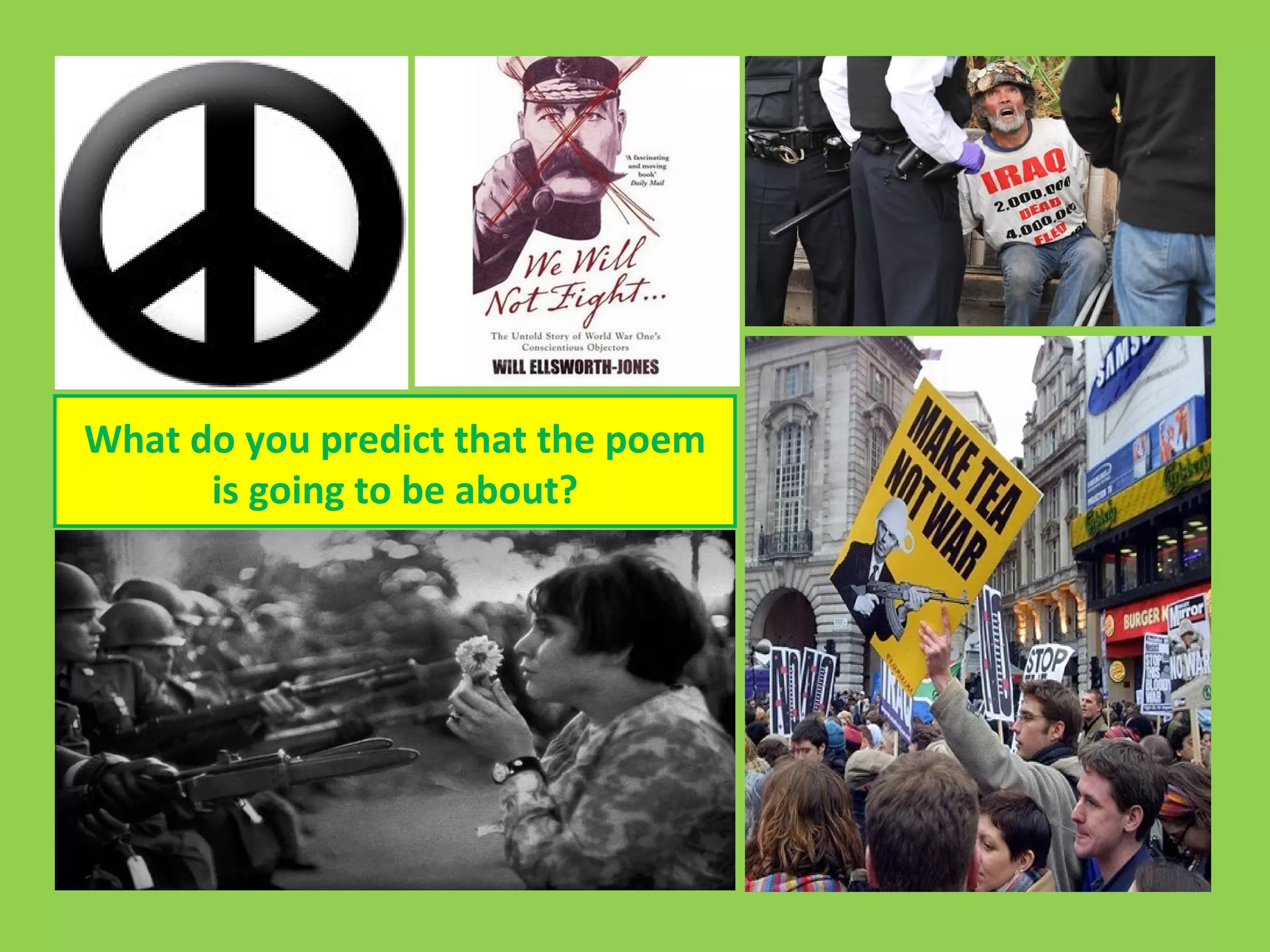
Learning Objective: To evaluate the
effect of personification in the
poem on the reader
 What is the meaning of this poster?

     Who is it aimed towards?

         Why is it effective?
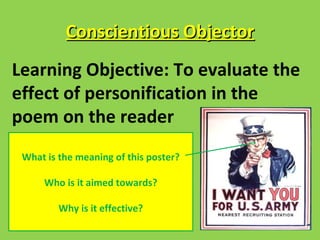
Imagine...

                   oncern,
T o w ho m it may c
                        rnment ha
                                     s stated         How would you react to
            ty’s Gove                   men,
Her Majes                   en and wo in
that all ab
            le-bodied
                         m
                                  , must jo            receiving this letter?
              age o f forty-five
below the
               forces.
 t he armed
                                      r current       What reasons could you
              e sent to   fight in ou
  You will b
   conflicts.                                        give that would mean you
                                           reason,
                             o utstanding             wouldn’t have to fight?
                u have an            training
    Unless yo            for battle
                 report
    you must
                   ext week.
    w ithin the n
                fully,
                                                     Why might people disagree
     Yours faith
                                                     strongly with being forced
                   f Defence
      Minister o                                          to fight in a war?
C o n g r a t u la t io n s !

  Yo u a r e n o w a
  c o n s c ie n t io u s
      o b je c t o r !
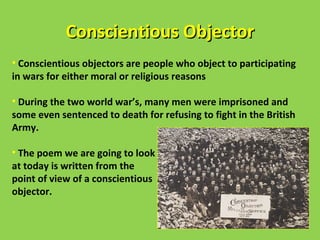
Conscientious Objector
• Conscientious objectors are people who object to participating
in wars for either moral or religious reasons

• During the two world war’s, many men were imprisoned and
some even sentenced to death for refusing to fight in the British
Army.

• The poem we are going to look
at today is written from the
point of view of a conscientious
objector.
Personification
• One of the key devices
  used in this poem is
  personification.

• What is personification?

• Which of these
  sentences are examples
  of personification?
The sea raced up the beach.
The angry shoulders of the
     mountain raged.
He was swallowed by the
  enormous armchair.
The plants grew like wildfire.
The gate creaked in the wind.
Reading the poem
• As we read through the poem, annotate any
  examples of personification that you hear.

• What is being personified?
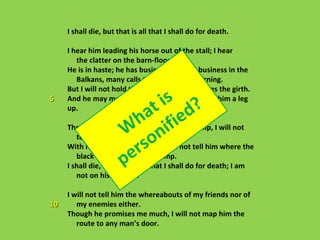
I shall die, but that is all that I shall do for death.

     I hear him leading his horse out of the stall; I hear
        the clatter on the barn-floor.
     He is in haste; he has business in Cuba, business in the
        Balkans, many calls to make in the morning.
     But I will not hold the bridle while he cinches the girth.
5
                                    is ?
     And he may mount by himself; I will not give him a leg
     up.
                              h ifat ied
                        W n
     Though he flick my shoulders with his whip, I will not

                                so
        tell him which way the fox ran.

                          er that I shall do for death; I am
     With his hoof on my breast, I will not tell him where the

                        p
        black boy hides in the swamp.
     I shall die, but that is all
        not on his pay-roll.

     I will not tell him the whereabouts of my friends nor of
10      my enemies either.
     Though he promises me much, I will not map him the
        route to any man’s door.
Paired Work
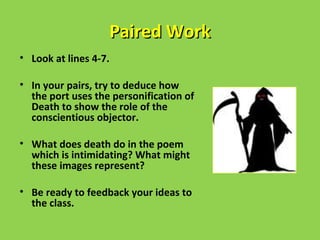
• Look at lines 4-7.

• In your pairs, try to deduce how
  the port uses the personification of
  Death to show the role of the
  conscientious objector.

• What does death do in the poem
  which is intimidating? What might
  these images represent?

• Be ready to feedback your ideas to
  the class.
Themes and Ideas
• Look at lines 3, 6 and 7.

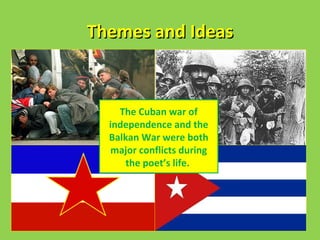
• Where does death Cuban war of
               The ‘Have business’?
                independence and the
                Balkan War were both
                major conflicts during
                    the poet’s life.
Themes and Ideas
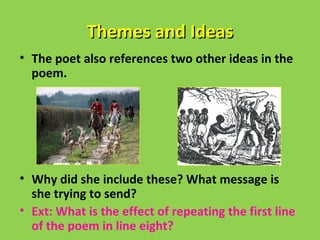
• The poet also references two other ideas in the
  poem.


• Why did she include these? What message is
  she trying to send?
• Ext: What is the effect of repeating the first line
  of the poem in line eight?
Independent Writing
• Write a paragraph in response to the following
  question.

 How does the poet create a voice and persona to
    convey the idea of conscience in the poem?

• You should refer to...
   – The personification of death
   – The use of first-person narration
   – The image of death as a horseman
Finally...
• Is it right that people should be allowed to
  refuse to fight for their country?
• Vote ‘yes’ or ‘no’ on your post-it, along with
  a reason for your vote.

Conscientious+objector prcent 5_b1_prcent_5d

  • 1.
    What do youpredict that the poem is going to be about?
  • 2.
    Conscientious Objector Learning Objective:To evaluate the effect of personification in the poem on the reader What is the meaning of this poster? Who is it aimed towards? Why is it effective?
  • 3.
    Imagine... oncern, T o w ho m it may c rnment ha s stated How would you react to ty’s Gove men, Her Majes en and wo in that all ab le-bodied m , must jo receiving this letter? age o f forty-five below the forces. t he armed r current What reasons could you e sent to fight in ou You will b conflicts. give that would mean you reason, o utstanding wouldn’t have to fight? u have an training Unless yo for battle report you must ext week. w ithin the n fully, Why might people disagree Yours faith strongly with being forced f Defence Minister o to fight in a war?
  • 4.
    C o ng r a t u la t io n s ! Yo u a r e n o w a c o n s c ie n t io u s o b je c t o r !
  • 5.
    Conscientious Objector • Conscientiousobjectors are people who object to participating in wars for either moral or religious reasons • During the two world war’s, many men were imprisoned and some even sentenced to death for refusing to fight in the British Army. • The poem we are going to look at today is written from the point of view of a conscientious objector.
  • 6.
    Personification • One ofthe key devices used in this poem is personification. • What is personification? • Which of these sentences are examples of personification?
  • 7.
    The sea racedup the beach.
  • 8.
    The angry shouldersof the mountain raged.
  • 9.
    He was swallowedby the enormous armchair.
  • 10.
    The plants grewlike wildfire.
  • 11.
    The gate creakedin the wind.
  • 12.
    Reading the poem •As we read through the poem, annotate any examples of personification that you hear. • What is being personified?
  • 13.
    I shall die,but that is all that I shall do for death. I hear him leading his horse out of the stall; I hear the clatter on the barn-floor. He is in haste; he has business in Cuba, business in the Balkans, many calls to make in the morning. But I will not hold the bridle while he cinches the girth. 5 is ? And he may mount by himself; I will not give him a leg up. h ifat ied W n Though he flick my shoulders with his whip, I will not so tell him which way the fox ran. er that I shall do for death; I am With his hoof on my breast, I will not tell him where the p black boy hides in the swamp. I shall die, but that is all not on his pay-roll. I will not tell him the whereabouts of my friends nor of 10 my enemies either. Though he promises me much, I will not map him the route to any man’s door.
  • 14.
    Paired Work • Lookat lines 4-7. • In your pairs, try to deduce how the port uses the personification of Death to show the role of the conscientious objector. • What does death do in the poem which is intimidating? What might these images represent? • Be ready to feedback your ideas to the class.
  • 15.
    Themes and Ideas •Look at lines 3, 6 and 7. • Where does death Cuban war of The ‘Have business’? independence and the Balkan War were both major conflicts during the poet’s life.
  • 16.
    Themes and Ideas •The poet also references two other ideas in the poem. • Why did she include these? What message is she trying to send? • Ext: What is the effect of repeating the first line of the poem in line eight?
  • 17.
    Independent Writing • Writea paragraph in response to the following question. How does the poet create a voice and persona to convey the idea of conscience in the poem? • You should refer to... – The personification of death – The use of first-person narration – The image of death as a horseman
  • 18.
    Finally... • Is itright that people should be allowed to refuse to fight for their country? • Vote ‘yes’ or ‘no’ on your post-it, along with a reason for your vote.