1 | P a g e
EFFECT OF SANDING ON FINISHING
PROPERTIES OF SHELLAC ON EUCALYPTUS
AND SHISHAM
A Dissertation report submitted in partial fulfilment of the requirement for the
degree of Master of Science in Wood Science and Technology at Forest Research
Institute (Deemed) University, Dehradun
By
RANJEETA DASH
Forest Research Institute, Dehradun
May, 2015
2 | P a g e
CHAPTER 1
1.1 Introduction:
Wood finishing basically refers to the process of embellishing and/or
protecting the surface. The process starts with surface preparation, either by
sanding by hand (typically using a sanding block) or power sander, scraping, or
planing. Imperfections or nail holes on the surface may be filled using wood putty
and pores may be filled using grain filler. The quality and the grit size of sanding
is one of the most important factors in wood finishing which determines the final
quality of a finished wood surface. The principal measure of the quality of
sanding is the surface roughness, so a greater understanding of the effect of
process parameters on surface roughness would encourage the optimization of
sanding operations. Though methods for quantification of surface roughness
have been standardized for homogenous materials, they are not applicable to
wood, and no other specific guidelines have been developed (Krish and Csiha
1999). A key problem encountered in sanding wood lies with classification of the
wood. Each wood is different: different density, hardness, grain orientation, pore
size, contrast of young and old wood, and different response to the sanding
process and therefore different grades and sequences of sandpaper grits are
required for different type of wood (Benny et al 2004). Roughness represents the
finer irregularities of the surface texture that are inherent in a sanding process.
However, profile data from any nominally flat surface contains not only
roughness, but also form errors and waviness that do not characterize the
processing (Gurau, 2010)
The two principal aspects that make it necessary to apply a suitable finish
to wood are dimensional stability and aesthetics. Wood needs to be sheltered
from changes in atmospheric humidity, microorganisms, insects, dirt and
surface wear, and from mechanical damage of its surface. The functional aspects
of finishing therefore should take into account all these factors in the service life
3 | P a g e
of a product and choose coatings appropriately. Aesthetics is the other aspect of
finishing. Wood in its naturally occurring form and color often needs to be
decorated, tainted for a more appealing look. Sometimes a suitable finish may
improve the surface look manifolds. Defects have to be covered for better look
and inferior grade timbers can be correctly processed to look like superior grade
timber.
Wood is a porous material. It contains countless holes of various sizes.
Wood being hygroscopic absorbs and releases moisture. Moisture within wood is
called moisture content. Moisture in the environment is either liquid water or
water vapor (humidity). Wood responds to changes in the level of moisture
around it. To increase the durability of the wood product it needs to be treated
and different coatings need to be applied. The aims of the coating on wood
surfaces are to increase the dimensional stability and mechanical properties of
the panels (Rybaczyk and Wojciechowski 1978, Chow and Redmond 1981,
Vansteenkiste 1981, Grigoriou 1987, Sparkes 1993, Nemli and Çolakoglu 2005,
Nemli et al. 2005, Tanritanir et al. 2006).
Any finish is only as good as the surface on which it is applied. Therefore
preparation of the surface is very important to obtain a good finish. Surface
preparation involves a number of steps such as sanding, bleaching wherever
necessary, staining, filling and sealing. Once the surface is prepared, top coats
of finish are applied. The spectrum of finishes available is very wide and an
appropriate finish for the end user needs to be carefully selected. The finishes of
wood can be divided into two major groups – penetrating and film forming
finishes.
Penetrating finishes are typically oils that do not heal as hard surface
layers. Film forming finishes cure into hard surface layers and can be built up
4 | P a g e
into any preferred thickness. Finishes can also be divided into evaporative (like
lacquer, shellac, and water based finishes) and reactive finishes (like linseed or
tung oil, catalyzed lacquers, varnishes) on the basis of how they cure or dry.
They can further be classified on a practical level as traditional and modern
finishes.
All treatments and methods are aimed at controlling the possible extent of
shrinking or swelling that the wood can undergo when in service. Coatings, on
the other hand, have only very little effect on the total amount of shrinking or
swelling, but can have a major effect on the rate of exchange of water vapour
between wood and the surrounding atmosphere. There is no known coating
which adheres to wood completely and is also completely impervious to water
vapour. Even the most effective coating will permit the eventual equilibration of
a coated wood object to the relative humidity and temperature conditions of its
surroundings (Badoni et al. 1990). The effectiveness of a finish in stopping
external water vapour from entering the wood is usually expressed as its
moisture excluding effectiveness (MEE). Finishes that block all moisture will be
100% effective, but in general practice no coating is 100% effective. Another
method to determine efficiency of a coating in blocking liquid water entry is to
calculate the water uptake coefficient (WUC)
It is a measure of the change in weight per square root of time
Mathematically it can be expressed as:
Wt = δ weight/t½
Its unit is kg hr -½
Lower value of WUC will reflect efficient moisture blocking
1.2 WOOD GLOSS/SHINE:
Usually gloss is considered to be an important factor while choosing
paints, lacquers and polishing formulations for their interior and exterior
5 | P a g e
locations of use. It is preferred to use low gloss paints because touch-ups are
easier and imperfections in the finish are less apparent. Gloss is basically the
specular reflection of light from the finished wood surface. Gloss of the surface
is measured by gloss meter defining gloss level using 60o gloss head angle. Gloss
of the surface depends on the use for which it is to be prepared, for instance, the
gloss of the surface in a well lit room should be kept low in contrary to the dim
lit room where furniture and panels are made with high gloss.
1.3 PROTECTION OF WOOD SURFACE BY APPLYING FINISHES:
The primary function of any wood finish (paint, varnish, and stain, for
example) is to protect the wood surface, help maintain a certain appearance, and
provide a cleanable surface. However, wood can be used for both outdoors and
indoors without finishing but may result in any of the following:
 Unfinished wood surfaces exposed to the weather change colour, are
roughened by photo- degradation and surface checking, and erode
slowly.
 Unfinished wood surfaces exposed indoors may also change colour;
 Unfinished wood is more difficult to clean than is finished wood.
Wood and wood-based products in a variety of species, grain patterns, textures,
and colours can be finished effectively by many different methods. Selection of a
finish will depend on the appearance and degree of protection desired and on the
substrates used. Because different finishes give varying degrees of protection,
the type of finish, its quality and quantity, and the method used to apply the
finish must be considered when finishing or refinishing wood and wood products.
The present study aims in studying the effect of Differential Grit Sized
Sanding on Wood Finishing properties. The following specific objectives were
envisaged in the study:
6 | P a g e
1. To determine the different in moisture intake capacity between the two
species (Eucalyptus spp. and Dalbergia sisoo) of wood taken under the
study.
2. To determine the effect of differential grit size sanding in wood finish of
the each species.
3. To compare the effect of differential grit size sanding in wood finish of the
two different species under study.
7 | P a g e
CHAPTER 2
2.1 Review of Literature
The present study aims to analyze the “EFFECT OF SANDING ON FINISHING
PROPERTIES OF SHELLAC ON EUCALYPTUS AND SHISHAM” on polish in
the finish of the wood surface on different samples of Eucalyptus spp. and
Dalbergia sisoo. Wood and wood-based products in a variety of species, grain
patterns, textures, and colors can be finished effectively by many different
methods. Selection of a finish will depend on the appearance and degree of
protection desired and on the substrates used. Because different finishes give
varying degrees of protection, the type of finish, its quality and quantity, and the
method used to apply the finish must be considered when finishing or refinishing
wood and wood products.
 A study conducted by Nadir et-all (2010) focuses on surface absorption
and surface roughness of the MDF panels were determined based on EN
382-1 standard and ISO 4287 by using a fine stylus profilometer,
respectively. Sessile water drop technique was used to determine contact
angle values of the panel surface. The results indicated that sanding
process improved the surface smoothness of the panels. However, the
wettability and surface absorption of the panels were negatively affected
by increasing grit size.
 Sanding has a significant effect on the wettability, surface roughness, and
surface absorption of the wood, which could provide useful information on
the bonding and finishing of the wood. Nadir et-all (2010)
 A study conducted by Gurau (2010) indicate sanding with finishing grit
sizes P120, P150 and P180 produced very close roughness values for oak.
This indicates that for oak it is not economical to have a sequence of
sanding operations in the domain of fine grit sizes.
8 | P a g e
 According to Dr. Arganbright & Dr. Schniewind (1983) the permeability of
various plastic films and coatings, and the moisture-excluding
effectiveness (MEE) of some coatings.
 A study conducted by (Krish & Csiha 1999) indicates that the quality of
sanding determines the final quality of a finished wood surface and
influences the finishing costs.
 Chang (2000) has evaluated the dimensional stability and moisture
excluding efficiencies (MEEs) of wood after acetylation, butyrylation, and
hexanoylation, after three acylation treatments, an excellent anti-swelling
efficiency of modified wood specimens was obtained. All the equilibrium
moisture contents of acylated wood at three categories of relative humidity
(RHs) (33% RH, 65% RH, and 93% RH) were significantly reduced, as
compared to those of untreated wood in the same RH, and the MEEs of
acylated wood were greatly improved.
 A study conducted by Badoni-et-al (1990) on a preliminary on moisture
excluding efficiency of some pore filling treatments & polishing of
Terminalia mannii (black chuglam). Since wood finishing is a two-step
operation: Surface preparation or pore filling followed by application of
coating of choice. Both these steps are complimentary to each other &
contribute to the efficiency of the coating system. Therefore, they
considered it worth-while to assess MEE of some pore filling treatments
for their comparative performance after subsequent polishing. They
conducted Preliminary studies for various polished surface of black
Chuglam samples which revealed marked variations when exposed to 60%
and 90% R.H. conditioned at 350 C. They observed that:
 Linseed oil application gave higher protection against moisture as it
possessed moisture curbing properties.
 Two coats of spirit polish on wood surface were also effective.
9 | P a g e
 Chalk powder filler treatments giver good initial gloss but do not
possess moisture curbing properties and should be applied
judiciously for polishing wood.
 According to Miller and Boxall, (1984) paint performance in exterior
exposure was improved by the use of suitable engrains sealers under the
paint. The sealer provided a more effective exclusion of moisture.
 According to Gurau (2013) all roughness parameters have decreased with
the grit size, showing smoother surfaces of oak compared to beech when
judged from processing roughness parameters.
 Arno et- all (1984) in their study found that coatings can be effective in
achieving a measure of dimensional stability for wood objects. Their
effectiveness depends on their permeability, which can differ widely among
various types of coatings, and on the thickness of the film. Localized
moisture changes, unless they are balanced within the object, lead to
internal stresses which result in warpage.
 Grit sizes of the belts, feeding speed of the panels and the feed power of
the heads of the sander are the main considerations for a successful
sanding operation Nemli, G., Akbulut, T. & Zekoviç, E. (2007).
 A study by Sonmez et-al (2009) concluded that the moisture content, the
type of wood and the type of varnish all have significant effect on the
adhesion. In the layers where high adhesion strength is desired, the
moisture content of the wood material should not exceed 8%.
 The stress under a grit, as a spherical edge, is depending on the surface
pressure and the modulus of elasticity of the wood material, but does not
depend on the grit size (Endre Magoss)
 According to (Jiří Michalec, Sylvie Niklasová, 2006) Water uptake behavior
is widely affected by the microstructure of wood e.g. number of vessels that
are not sealed by tyloses and their distribution within the mass, diameter
of the vessel lumens, type of perforation between vessel elements and type
10 | P a g e
of pitting. Furthermore presence of extractives and encrustations in cell
walls might have some influence.
11 | P a g e
Chapter 3
Materials and methods
The broad objective of this study was to analyze the “EFFECT OF SANDING ON
FINISHING PROPERTIES OF SHELLAC ON EUCALYPTUS AND SHISHAM” on
different polish in the finish of the wood surface on different samples of
Eucalyptus spp. and Dalbergia sisoo. A total of 50 sample planks of Eucalyptus
spp. and Dalbergia sisoo were taken for the study with an average dimension of
about 15 X 7 X 22 cm3 Eucalyptus spp. and 15 X 7 X 22 cm3 Dalbergia sisoo.
These samples were converted from dried logs from store.
Then sanding were done for all 10 samples each with sandpapers of
60(samples named s_60), 120(samples named s_120), and 220(samples named
s_220) grit size making a total of 60 samples. 20 samples were kept control with
10 samples as non-sanded and coated (named ns_c) and 10 samples as non-
sanded non-coated(ns_nc) The dimensions and weight data for all the samples
were taken. All the samples were weighed and placed in the humidity chamber
for conditioning at 35°c and 30% R.H. till the weight got uniform and stable. The
water level was maintained in the humidity chamber always. Proper care has
been taken while placing the samples in the humidity chamber that the samples
should not touch each other; and no samples should be placed in the bottom
shelf where water accumulates in case of leakage. Then the data regarding weight
and dimension has been taken on daily basis.
Than shellac solution was prepared by mixing 60 gm of shellac in 1 l of spirit
and placing it in sun for 24 hours or till the shellac granules get mixed. Proper
care has been taken so that shellac should not be applied when the weather is
cloudy or when it is raining. The bottle should be kept closed when not in use to
avoid drying of spirit. The solution was applied by using muslin cloth to maintain
the uniformity in application. A total of 6 coating of shellac solution has been
12 | P a g e
applied on each samples. Gloss and film thickness data was measured in 2
randomly selected samples after each coat was applied. Of the total 50 samples
of Eucalyptus spp. and Dalbergia sisoo 10 samples of each were coated with
shellac without sanding and 10 samples of each were kept as control without
sanding and coating.
Then the weight, gloss, film thickness data has been recorded for all the samples.
The samples are than placed in the humidity chamber again at elevated humidity
levels, i.e., at 35°c and 85% R.H. till it got stable for estimating the moisture
uptake. For that daily weight data of the samples were recorded and observed.
After it got stabilized the final gloss and film thickness data has been recorded.
4 samples of each species were oven dried at 101 +- 3 degree Celsius to calculate
the moisture content of each species.
13 | P a g e
CHAPTER 4
Results and Discussion
4.1: Film Thickness:
Fig. 4.1.1 Average coat thicknesses of shellac coatings on the samples of
Shisham and Eucalyptus.
Table 4.1.1 Average coat Thickness of Shisham and Eucalyptus.
Average Thickness
Grit size Shisham Eucalyptus
S_60 56.4 57.4
S_120 54.2 54
S_220 56 54.4
NSC 56.2 55.7
*S_60-Grit size 60, S_120-Grit size, S_220- Grit size, NSC- Non sanded and coated
From the above graph we can clearly observe that sanding with 120 grit size sand
paper has resulted in least coat thickness in both of the species. In Shisham,
the other 2 grits and the non-sanded surfaces seem to form similar thicknesses
of shellac (around 56 µm). In eucalyptus however the 60 grit size seems to result
in making thick coats. However, all the coat thicknesses all between 54 and 57.5
µm apparently. In a first look this may seem of suggest that the coat thicknesses
52
53
54
55
56
57
58
S_60 S_120 S_220 NSC
Thickness
Grit size
Shisham
Eucalyptus
14 | P a g e
as such do not vary much in the present study. The difference in S_60 and NSC
data appears to suggest the following:
a. In a 60 grit surface there will be total absence of cutter mars and as such
a “grid” type surface will emerge where the thickness measurements are
expected to be precise.
b. In NSC samples the presence of cutter marks will show a corrugated type
of coating in place of grid type and in such a case the measurement bias
(depth bias) is expected to exit.
To verify this the coat thicknesses were analysed through 0ne-way ANOVA and
the results are given in Tables 4.2.
TABLE 4.1.2: ANOVA of measured film thicknesses on Shisham and Eucalyptus
surfaces.
species Source of
variation df Mean Square F Sig.
Shisham sanding 3 10.317
2.873 0.050
error 35 3.591
Eucalyptus sanding 3 23.191
4.530 0.009
error 36 5.120
Table 4.1.2 reveals that the sanding operations carried out indeed have an effect
on the thickness of the shellac film formed on the surfaces of the two species. To
understand the exact role of sanding practice in the film thickness formation,
Duncan’s subsets were formed through SPSS package. The subsets formed for
each of the species are given in tables 4.1.3 and 4.1.4.
Table 4.1.3: Duncan’s subsets for film thicknesses on Shisham surface
15 | P a g e
Sanding No of samples
Thickness subsets (µm)
1 2
S_120 10 54
S_220 10 56
S_0 9 56
S_60 10 56
Sig. 1.000 0.681
16 | P a g e
Table 4.1.4: Duncan’s subsets for film thicknesses on eucalyptus surface
Sanding No of samples Thickness subsets (µm)
1 2
S_120 10 54
S_220 10 54
S_0 10 56 56
S_60 10 57
Sig. 0.102 0.120
(* S_0- Non sanded)
From the above tables it is very clear that sanding with 120 grit resulted in least
thickness on both the species whereas the 60 grit sand paper gave the highest
thickness in either case. This is the demonstration that the rougher surface can
help in better adhesion of the coats applied. It is known that eucalyptus usually
sands to smooth surfaces. Thus the nearness of thickness values with higher
grit sizes of 120 and 220 (54 µm) is not too surprising. (ce.construction.com)
However, the absence of any pattern in the higher grit sizes of 120 and 220 can
be attributed to the fact that the shellac was applied manually onto the surface.
More interesting is to note that the unsanded surfaces (S_0) has resulted in thick
coatings in either case this again illustrates the fact that the coating adhesion
and hence the thickness will be better on unsmoothened surfaces.
Having looked at the thickness of the shellac film formed, let’s now have a look
at the gloss behavior of the samples.
4.2: Gloss
Table 4.2.1: Average gloss of Shisham and Eucalyptus
17 | P a g e
Grit size Shisham Eucalyptus
S_60 29 31.8
S_120 29.2 27.7
S_220 27.5 30
NSC 22.3 29.3
Fig. 4.2.1: Average gloss on the different gloss surfaces of Shisham and
Eucalyptus
Figure 4.2.1 gives the average gloss values measured on the different gloss
surfaces. From the above graph we can observe that sanding with 60 grit size
sand paper has resulted in highest gloss in both of the species. However in
Shisham, the other 120 grits also seem to result in a high gloss. The unsanded
surfaces seem to form lowest gloss in Shisham. In eucalyptus however there
seems to be not much difference in the glosses except for the highest provided
by 60 grit size. To verify this the coat thicknesses were analysed through 0ne-
way ANOVA and the results are given in tables 4.2.2.
Table 4.2.2: ANOVA of measured gloss on Shisham and eucalyptus surfaces.
0
5
10
15
20
25
30
35
S_60 S_120 S_220 NSC
Gloss(GU)
Grit size
Shisham
Eucalyptus
18 | P a g e
Source of
variation df Mean Square F Sig.
Shisham sanding 3 95.148 79.830 .000
error 35 1.192
Eucalyptus sanding 3 28.722 18.041 .000
error 36 1.592
Table 4.2.2 reveals that the sanding operations carried out have an effect on the
gloss of the shellac film formed on the surfaces of the two species. To investigate
the actual role of sanding practice on the gloss of the coat formed, Duncan’s
subsets were formed through SPSS package. The subsets formed for each of the
species are given in tables 4.2.3 and 4.2.4.
Table 4.2.3: Duncan’s subsets for film gloss on Shisham surface
sanding No of samples
Gloss Subsets (GU)
1 2 3
S_0 9 22
S_220 10 27
S_60 10 29
S_120 10 29
Sig. 1.000 1.000 0.689
Table 4.2.4: Duncan’s subsets for film gloss on eucalyptus surface
19 | P a g e
sanding No of samples
Gloss Subsets (gu)
1 2 3
S_120 10 27.7300
S_0 10 29.2600
S_220 10 30.0000
S_60 10 31.8100
Sig. 1.000 0.198 1.000
From the Duncan’s subsets for thicknesses and gloss values given in tables
4.1.3, 4.1.4, 4.2.3 & 4.2.4 very interesting and contrasting results can be
observed. In Shisham, samples sanded with 120 grit size had the lowest film
thickness but yielded the highest gloss. However, the rougher surfaces formed
by 60 grit size gave higher film thickness and higher gloss also. The unsanded
surfaces which was devoid of any smoothening though gave higher film
thickness, resulted in lowest gloss. This can be probably explained by the rather
darker natural shade which Shisham possess. Even after smoothening with 220
sand paper these samples still gave lower glosses.
The results on eucalyptus surfaces however are much more evident. The rougher
surface caused by 60 grit sand paper gave highest thickness as well as gloss
values. Surfaces smoothened by 120 grit size gave lower thicknesses and lower
gloss.
It can thus be inferred that apart from the smoothness/roughness of the surface,
the substrate material (wood species) also plays a role in deciding the gloss
provided by a top coat.
4.3: MOISTURE STUDIES
20 | P a g e
Table 4.3.1: Gives the moisture contents attained by the samples at the
beginning and end of the experiment.
SPECIES Conditioned MC FMC MC Incr
EUCALYPTUS 12.69 13.4 5.5
ShISHAM 10.69 11.9 8.5
The EMC of Shisham at 35oC and 30 % RH was found to be 10.69 % which is
much higher than the value reported 5.5 % for this species (Rehman and Singh,
1969). The EMC of Shisham reported in an early work at 35oC and 95 % RH is
17.6 % (Rehman and Singh, 1969). The present results however, show only 11.9
% . The deviations in the present values may due to the fact that the RH was a
bit lower at 85 % and the exposure may not be sufficient in both conditions.
Grit size effect on Eucalyptus – Moisture increment
Figure 4.3.1: shows the comparative figure of moisture gain of shisham and
eucalyptus
0.0
5.0
10.0
15.0
20.0
25.0
30.0
S_60 S_120 S_220 NSC NSNC
Moisture Gain
Eucalyptus Shisham
21 | P a g e
The graph above represent the comparative figure of moisture gain. It represent
there is a considerable difference in moisture gain in the non-sanded non coated
samples as compared to the coated samples. With respect to differential grit size
sanding no visible difference is observed. (Ahrens et al 1990) It means coating
plays an important role to restrict the moisture intake. It is also observed that
over the all data collected and analysed non sanded non coated samples of
eucalyptus are prone to absorb more moisture than at par. According to
hagenmaier and Shaw 1991 shellac film is seen to have reduced the moisture
intake in eucalyptus to a large extent. This can be attributed to the low
permeability of water vapour of shellac films. (Hagenmaier and Shaw 1991)
Table 4.3.2: ANOVA of Moisture increments transformed to square roots
Species
Source of
variation df Mean Square F Sig.
Eucalyptus moisture 3 0.011 0.043 0.988
error 36 0.251
shisham Moisture 3 .055 .431 .732
error 36 .127
The fact that there minimal or no effect of differential grit size sanding on
moisture uptake of wood in shisham and eucalyptus. (Ahrens et al 1990)
Effect of coating on non-sanded samples
We have compared the effect of moisture gain between the samples without
coating and with coating of eucalyptus and shisham. The details comparison
between non sanded vs sanded of both the species are as follows:
22 | P a g e
Table 4.3.3: ANOVA for moisture increment in eucalyptus and shisham
samples
Sum of Squares df Mean Square F Sig.
eucalyptus moisture 1 41.812 154.965 .000
error 18 .270
shisham moisture
error
1 .476 6.370
.021
18 .075
The above test shows there is a significant difference in moisture intake of
eucalyptus and
shisham samples. This difference is seen in the non-sanded and the non-
sanded-non coated samples of both the species. Surprising results are obtained
in the case of eucalyptus.
Similar results are not obtained in shisham. This can be explained on the basis
that efficiency of coatings in reducing water vapour entry into wood surface
substrates depends on the wood species along with the coatings used and the
atmospheric conditions. The wood of shisham and eucalyptus all under the
diffused porous category (quirk1983, lei et al 2011.) the water uptake capacity
of such hardwoods are reported to be higher. (michalec and niklasova 2006)
Coat thickness studies:
Table 4.3.4: comparison of coat thickness before and after exposure to adverse
Condition (85% R.H)
eucalyptus shisham
23 | P a g e
s_60 27.1606 42.8898
s_120 22.5489 39.3336
s_220 21.3368 43.1964
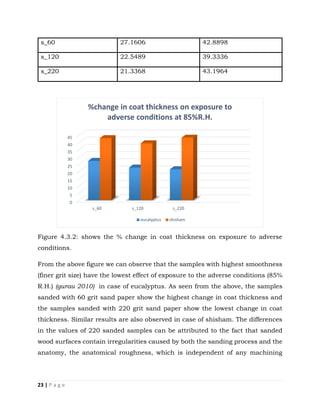
Figure 4.3.2: shows the % change in coat thickness on exposure to adverse
conditions.
From the above figure we can observe that the samples with highest smoothness
(finer grit size) have the lowest effect of exposure to the adverse conditions (85%
R.H.) (gurau 2010) in case of eucalyptus. As seen from the above, the samples
sanded with 60 grit sand paper show the highest change in coat thickness and
the samples sanded with 220 grit sand paper show the lowest change in coat
thickness. Similar results are also observed in case of shisham. The differences
in the values of 220 sanded samples can be attributed to the fact that sanded
wood surfaces contain irregularities caused by both the sanding process and the
anatomy, the anatomical roughness, which is independent of any machining
0
5
10
15
20
25
30
35
40
45
s_60 s_120 s_220
%change in coat thickness on exposure to
adverse conditions at 85%R.H.
eucalyptus shisham
24 | P a g e
operation.(gurau 2013). For this reason, evaluation of quality of sanding often
excludes anatomical irregularities (westkamper and riegel 1992)
Change in gloss studies:
Table 4.3.5: comparison of coat thickness before and after exposure to adverse
Condition (85% R.H)
Grit Size eucalyptus shisham
s_60 52.7401 51.9072
s_120 43.543 49.3508
s_220 20.7147 39.6689
nsc 49.7109 44.2011
Figure 4.3.3: shows the % change in gloss on exposure to adverse conditions.
0
10
20
30
40
50
60
s_60 s_120 s_220 nsc
% change in gloss on exposure to adverse
conditions
eucalyptus shisham
25 | P a g e
From the above figure we can observe that samples sanded with coarser grit size
show lowest resistance to change in gloss due to change in weather conditions
whereas samples sanded with higher grit sizes show higher retention of gloss
even in adverse conditions. We can look at the eucalyptus and shisham
differential grit size sanded samples, the eucalyptus 220 sanded samples show
highest gloss retention whereas the 60 sanded samples show lowest resistance
to change in gloss levels. A similar effect is also observed in case of shisham
samples.
26 | P a g e
Chapter 5
Conclusions:
 Sanding with 120 grit size sand paper has resulted in least coat thickness
in both of the species. In Shisham, the other 2 grits, viz., 60 and 220 and
the non-sanded surfaces seem to form similar thicknesses of shellac
(around 56 µm). In eucalyptus however the 60 grit size seems to result in
making thick coats. However, all the coat thicknesses all between 54 and
57.5 µm apparently.
This is the demonstration that the rougher surface can help in better
adhesion of the coats applied.
 Sanding with 60 grit size sand paper has resulted in highest gloss in
both of the species. However in Shisham, the other 120 grits also seem
to result in a high gloss. In eucalyptus however there seems to be not
much difference in the glosses except for the highest gloss provided by
60 grit size.
 The rougher surface caused by 60 grit sand paper gave highest thickness
as well as gloss values. Surfaces smoothened by 120 grit size gave lower
thicknesses and lower gloss.
 Over the all data collected and analysed non sanded non coated samples
of eucalyptus are prone to absorb more moisture than at par. There is a
significant difference in moisture intake of eucalyptus and shisham
samples.
 The samples with highest smoothness (finer grit size) have the lowest
effect of exposure to the adverse conditions (85% R.H.) in case of
eucalyptus. The samples sanded with 60 grit sand paper show the highest
change in coat thickness and the samples sanded with 220 grit sand
paper show the lowest change in coat thickness. Similar results are also
observed in case of shisham.
 Samples sanded with coarser grit size show lowest resistance to change
in gloss due to change in weather conditions whereas samples sanded
27 | P a g e
with higher grit sizes show higher retention of gloss even in adverse
conditions. The eucalyptus 220 sanded samples show highest gloss
retention whereas the 60 sanded samples show lowest resistance to
change in gloss levels. A similar effect is also observed in case of shisham
samples.
28 | P a g e
References:
Krish, J. & Csiha, C. (1999) “Analysing Wood Surface Roughness Using an S3P
Perthometer and Computer Based Data Processing”. In:Proc. XIII Sesja Naukowa
“Badania dla Meblarstwa”. Poland. pp.145-154.
Benny et all (2004) “Characterisation of Surface Finishing Processes in Wood
Furniture Manufacturing” Industrial Research Institute, Swinburne pp. 45-50.
Gurau, L., Mansfield-Williams, H. & Irle, M. (2005) “Processing Roughness of
Sanded Wood Surfaces”. Holz als Roh- und Werkstoff. 63(1), pp.43-52.
Rybaczyk, W. & Wojciechowski, Z. 1978. Predicting the effect of face veneering
on mechanical properties of furniture panels. Technologie Drewna 25(11): 49–77
Chow, P. & Redmond, M.R.1981. Humidity and temperature effects on MOR and
MOE of hard maple veneered medium density fiberboard. Forest Products
Journal 31(6): 54–58.
Vansteenkiste, R. 1981. Surface treatment of wood based panels. Seminar in
wood based panels and furniture industries, Beijing, China
Grigoriou, A. 1987. Formaldehyde emission from the edges and faces of various
wood based materials. Holz als Roh-und Werkstoff 45(2): 63–67.
Sparkes, T. 1993. Substrate selection for end use applications. European Plastic
Laminates Forum, Köln, Germany. p. 27–31.
Nemli, G. & Çolakoglu, G. 2005. The influence of lamination technique on the
properties of particleboard. Building and Environment 40(1): 83–87.
Tanritanir, E., Hiziroglu, S. & As, N. 2006. Effect of steaming time on surface
roughness of beech veneer. Building and Environment 41(11): 1494– 1497.
29 | P a g e
Badoni, S.P., and K.S. Shukla S.N. Sharma (1990) Wood finishing some aspect.
Presented in Third Forest Product Conference held on 26-28 June at F.R.I.
Dehradun.

Ranj Full D1

  • 1.
    1 | Pa g e EFFECT OF SANDING ON FINISHING PROPERTIES OF SHELLAC ON EUCALYPTUS AND SHISHAM A Dissertation report submitted in partial fulfilment of the requirement for the degree of Master of Science in Wood Science and Technology at Forest Research Institute (Deemed) University, Dehradun By RANJEETA DASH Forest Research Institute, Dehradun May, 2015
  • 2.
    2 | Pa g e CHAPTER 1 1.1 Introduction: Wood finishing basically refers to the process of embellishing and/or protecting the surface. The process starts with surface preparation, either by sanding by hand (typically using a sanding block) or power sander, scraping, or planing. Imperfections or nail holes on the surface may be filled using wood putty and pores may be filled using grain filler. The quality and the grit size of sanding is one of the most important factors in wood finishing which determines the final quality of a finished wood surface. The principal measure of the quality of sanding is the surface roughness, so a greater understanding of the effect of process parameters on surface roughness would encourage the optimization of sanding operations. Though methods for quantification of surface roughness have been standardized for homogenous materials, they are not applicable to wood, and no other specific guidelines have been developed (Krish and Csiha 1999). A key problem encountered in sanding wood lies with classification of the wood. Each wood is different: different density, hardness, grain orientation, pore size, contrast of young and old wood, and different response to the sanding process and therefore different grades and sequences of sandpaper grits are required for different type of wood (Benny et al 2004). Roughness represents the finer irregularities of the surface texture that are inherent in a sanding process. However, profile data from any nominally flat surface contains not only roughness, but also form errors and waviness that do not characterize the processing (Gurau, 2010) The two principal aspects that make it necessary to apply a suitable finish to wood are dimensional stability and aesthetics. Wood needs to be sheltered from changes in atmospheric humidity, microorganisms, insects, dirt and surface wear, and from mechanical damage of its surface. The functional aspects of finishing therefore should take into account all these factors in the service life
  • 3.
    3 | Pa g e of a product and choose coatings appropriately. Aesthetics is the other aspect of finishing. Wood in its naturally occurring form and color often needs to be decorated, tainted for a more appealing look. Sometimes a suitable finish may improve the surface look manifolds. Defects have to be covered for better look and inferior grade timbers can be correctly processed to look like superior grade timber. Wood is a porous material. It contains countless holes of various sizes. Wood being hygroscopic absorbs and releases moisture. Moisture within wood is called moisture content. Moisture in the environment is either liquid water or water vapor (humidity). Wood responds to changes in the level of moisture around it. To increase the durability of the wood product it needs to be treated and different coatings need to be applied. The aims of the coating on wood surfaces are to increase the dimensional stability and mechanical properties of the panels (Rybaczyk and Wojciechowski 1978, Chow and Redmond 1981, Vansteenkiste 1981, Grigoriou 1987, Sparkes 1993, Nemli and Çolakoglu 2005, Nemli et al. 2005, Tanritanir et al. 2006). Any finish is only as good as the surface on which it is applied. Therefore preparation of the surface is very important to obtain a good finish. Surface preparation involves a number of steps such as sanding, bleaching wherever necessary, staining, filling and sealing. Once the surface is prepared, top coats of finish are applied. The spectrum of finishes available is very wide and an appropriate finish for the end user needs to be carefully selected. The finishes of wood can be divided into two major groups – penetrating and film forming finishes. Penetrating finishes are typically oils that do not heal as hard surface layers. Film forming finishes cure into hard surface layers and can be built up
  • 4.
    4 | Pa g e into any preferred thickness. Finishes can also be divided into evaporative (like lacquer, shellac, and water based finishes) and reactive finishes (like linseed or tung oil, catalyzed lacquers, varnishes) on the basis of how they cure or dry. They can further be classified on a practical level as traditional and modern finishes. All treatments and methods are aimed at controlling the possible extent of shrinking or swelling that the wood can undergo when in service. Coatings, on the other hand, have only very little effect on the total amount of shrinking or swelling, but can have a major effect on the rate of exchange of water vapour between wood and the surrounding atmosphere. There is no known coating which adheres to wood completely and is also completely impervious to water vapour. Even the most effective coating will permit the eventual equilibration of a coated wood object to the relative humidity and temperature conditions of its surroundings (Badoni et al. 1990). The effectiveness of a finish in stopping external water vapour from entering the wood is usually expressed as its moisture excluding effectiveness (MEE). Finishes that block all moisture will be 100% effective, but in general practice no coating is 100% effective. Another method to determine efficiency of a coating in blocking liquid water entry is to calculate the water uptake coefficient (WUC) It is a measure of the change in weight per square root of time Mathematically it can be expressed as: Wt = δ weight/t½ Its unit is kg hr -½ Lower value of WUC will reflect efficient moisture blocking 1.2 WOOD GLOSS/SHINE: Usually gloss is considered to be an important factor while choosing paints, lacquers and polishing formulations for their interior and exterior
  • 5.
    5 | Pa g e locations of use. It is preferred to use low gloss paints because touch-ups are easier and imperfections in the finish are less apparent. Gloss is basically the specular reflection of light from the finished wood surface. Gloss of the surface is measured by gloss meter defining gloss level using 60o gloss head angle. Gloss of the surface depends on the use for which it is to be prepared, for instance, the gloss of the surface in a well lit room should be kept low in contrary to the dim lit room where furniture and panels are made with high gloss. 1.3 PROTECTION OF WOOD SURFACE BY APPLYING FINISHES: The primary function of any wood finish (paint, varnish, and stain, for example) is to protect the wood surface, help maintain a certain appearance, and provide a cleanable surface. However, wood can be used for both outdoors and indoors without finishing but may result in any of the following:  Unfinished wood surfaces exposed to the weather change colour, are roughened by photo- degradation and surface checking, and erode slowly.  Unfinished wood surfaces exposed indoors may also change colour;  Unfinished wood is more difficult to clean than is finished wood. Wood and wood-based products in a variety of species, grain patterns, textures, and colours can be finished effectively by many different methods. Selection of a finish will depend on the appearance and degree of protection desired and on the substrates used. Because different finishes give varying degrees of protection, the type of finish, its quality and quantity, and the method used to apply the finish must be considered when finishing or refinishing wood and wood products. The present study aims in studying the effect of Differential Grit Sized Sanding on Wood Finishing properties. The following specific objectives were envisaged in the study:
  • 6.
    6 | Pa g e 1. To determine the different in moisture intake capacity between the two species (Eucalyptus spp. and Dalbergia sisoo) of wood taken under the study. 2. To determine the effect of differential grit size sanding in wood finish of the each species. 3. To compare the effect of differential grit size sanding in wood finish of the two different species under study.
  • 7.
    7 | Pa g e CHAPTER 2 2.1 Review of Literature The present study aims to analyze the “EFFECT OF SANDING ON FINISHING PROPERTIES OF SHELLAC ON EUCALYPTUS AND SHISHAM” on polish in the finish of the wood surface on different samples of Eucalyptus spp. and Dalbergia sisoo. Wood and wood-based products in a variety of species, grain patterns, textures, and colors can be finished effectively by many different methods. Selection of a finish will depend on the appearance and degree of protection desired and on the substrates used. Because different finishes give varying degrees of protection, the type of finish, its quality and quantity, and the method used to apply the finish must be considered when finishing or refinishing wood and wood products.  A study conducted by Nadir et-all (2010) focuses on surface absorption and surface roughness of the MDF panels were determined based on EN 382-1 standard and ISO 4287 by using a fine stylus profilometer, respectively. Sessile water drop technique was used to determine contact angle values of the panel surface. The results indicated that sanding process improved the surface smoothness of the panels. However, the wettability and surface absorption of the panels were negatively affected by increasing grit size.  Sanding has a significant effect on the wettability, surface roughness, and surface absorption of the wood, which could provide useful information on the bonding and finishing of the wood. Nadir et-all (2010)  A study conducted by Gurau (2010) indicate sanding with finishing grit sizes P120, P150 and P180 produced very close roughness values for oak. This indicates that for oak it is not economical to have a sequence of sanding operations in the domain of fine grit sizes.
  • 8.
    8 | Pa g e  According to Dr. Arganbright & Dr. Schniewind (1983) the permeability of various plastic films and coatings, and the moisture-excluding effectiveness (MEE) of some coatings.  A study conducted by (Krish & Csiha 1999) indicates that the quality of sanding determines the final quality of a finished wood surface and influences the finishing costs.  Chang (2000) has evaluated the dimensional stability and moisture excluding efficiencies (MEEs) of wood after acetylation, butyrylation, and hexanoylation, after three acylation treatments, an excellent anti-swelling efficiency of modified wood specimens was obtained. All the equilibrium moisture contents of acylated wood at three categories of relative humidity (RHs) (33% RH, 65% RH, and 93% RH) were significantly reduced, as compared to those of untreated wood in the same RH, and the MEEs of acylated wood were greatly improved.  A study conducted by Badoni-et-al (1990) on a preliminary on moisture excluding efficiency of some pore filling treatments & polishing of Terminalia mannii (black chuglam). Since wood finishing is a two-step operation: Surface preparation or pore filling followed by application of coating of choice. Both these steps are complimentary to each other & contribute to the efficiency of the coating system. Therefore, they considered it worth-while to assess MEE of some pore filling treatments for their comparative performance after subsequent polishing. They conducted Preliminary studies for various polished surface of black Chuglam samples which revealed marked variations when exposed to 60% and 90% R.H. conditioned at 350 C. They observed that:  Linseed oil application gave higher protection against moisture as it possessed moisture curbing properties.  Two coats of spirit polish on wood surface were also effective.
  • 9.
    9 | Pa g e  Chalk powder filler treatments giver good initial gloss but do not possess moisture curbing properties and should be applied judiciously for polishing wood.  According to Miller and Boxall, (1984) paint performance in exterior exposure was improved by the use of suitable engrains sealers under the paint. The sealer provided a more effective exclusion of moisture.  According to Gurau (2013) all roughness parameters have decreased with the grit size, showing smoother surfaces of oak compared to beech when judged from processing roughness parameters.  Arno et- all (1984) in their study found that coatings can be effective in achieving a measure of dimensional stability for wood objects. Their effectiveness depends on their permeability, which can differ widely among various types of coatings, and on the thickness of the film. Localized moisture changes, unless they are balanced within the object, lead to internal stresses which result in warpage.  Grit sizes of the belts, feeding speed of the panels and the feed power of the heads of the sander are the main considerations for a successful sanding operation Nemli, G., Akbulut, T. & Zekoviç, E. (2007).  A study by Sonmez et-al (2009) concluded that the moisture content, the type of wood and the type of varnish all have significant effect on the adhesion. In the layers where high adhesion strength is desired, the moisture content of the wood material should not exceed 8%.  The stress under a grit, as a spherical edge, is depending on the surface pressure and the modulus of elasticity of the wood material, but does not depend on the grit size (Endre Magoss)  According to (Jiří Michalec, Sylvie Niklasová, 2006) Water uptake behavior is widely affected by the microstructure of wood e.g. number of vessels that are not sealed by tyloses and their distribution within the mass, diameter of the vessel lumens, type of perforation between vessel elements and type
  • 10.
    10 | Pa g e of pitting. Furthermore presence of extractives and encrustations in cell walls might have some influence.
  • 11.
    11 | Pa g e Chapter 3 Materials and methods The broad objective of this study was to analyze the “EFFECT OF SANDING ON FINISHING PROPERTIES OF SHELLAC ON EUCALYPTUS AND SHISHAM” on different polish in the finish of the wood surface on different samples of Eucalyptus spp. and Dalbergia sisoo. A total of 50 sample planks of Eucalyptus spp. and Dalbergia sisoo were taken for the study with an average dimension of about 15 X 7 X 22 cm3 Eucalyptus spp. and 15 X 7 X 22 cm3 Dalbergia sisoo. These samples were converted from dried logs from store. Then sanding were done for all 10 samples each with sandpapers of 60(samples named s_60), 120(samples named s_120), and 220(samples named s_220) grit size making a total of 60 samples. 20 samples were kept control with 10 samples as non-sanded and coated (named ns_c) and 10 samples as non- sanded non-coated(ns_nc) The dimensions and weight data for all the samples were taken. All the samples were weighed and placed in the humidity chamber for conditioning at 35°c and 30% R.H. till the weight got uniform and stable. The water level was maintained in the humidity chamber always. Proper care has been taken while placing the samples in the humidity chamber that the samples should not touch each other; and no samples should be placed in the bottom shelf where water accumulates in case of leakage. Then the data regarding weight and dimension has been taken on daily basis. Than shellac solution was prepared by mixing 60 gm of shellac in 1 l of spirit and placing it in sun for 24 hours or till the shellac granules get mixed. Proper care has been taken so that shellac should not be applied when the weather is cloudy or when it is raining. The bottle should be kept closed when not in use to avoid drying of spirit. The solution was applied by using muslin cloth to maintain the uniformity in application. A total of 6 coating of shellac solution has been
  • 12.
    12 | Pa g e applied on each samples. Gloss and film thickness data was measured in 2 randomly selected samples after each coat was applied. Of the total 50 samples of Eucalyptus spp. and Dalbergia sisoo 10 samples of each were coated with shellac without sanding and 10 samples of each were kept as control without sanding and coating. Then the weight, gloss, film thickness data has been recorded for all the samples. The samples are than placed in the humidity chamber again at elevated humidity levels, i.e., at 35°c and 85% R.H. till it got stable for estimating the moisture uptake. For that daily weight data of the samples were recorded and observed. After it got stabilized the final gloss and film thickness data has been recorded. 4 samples of each species were oven dried at 101 +- 3 degree Celsius to calculate the moisture content of each species.
  • 13.
    13 | Pa g e CHAPTER 4 Results and Discussion 4.1: Film Thickness: Fig. 4.1.1 Average coat thicknesses of shellac coatings on the samples of Shisham and Eucalyptus. Table 4.1.1 Average coat Thickness of Shisham and Eucalyptus. Average Thickness Grit size Shisham Eucalyptus S_60 56.4 57.4 S_120 54.2 54 S_220 56 54.4 NSC 56.2 55.7 *S_60-Grit size 60, S_120-Grit size, S_220- Grit size, NSC- Non sanded and coated From the above graph we can clearly observe that sanding with 120 grit size sand paper has resulted in least coat thickness in both of the species. In Shisham, the other 2 grits and the non-sanded surfaces seem to form similar thicknesses of shellac (around 56 µm). In eucalyptus however the 60 grit size seems to result in making thick coats. However, all the coat thicknesses all between 54 and 57.5 µm apparently. In a first look this may seem of suggest that the coat thicknesses 52 53 54 55 56 57 58 S_60 S_120 S_220 NSC Thickness Grit size Shisham Eucalyptus
  • 14.
    14 | Pa g e as such do not vary much in the present study. The difference in S_60 and NSC data appears to suggest the following: a. In a 60 grit surface there will be total absence of cutter mars and as such a “grid” type surface will emerge where the thickness measurements are expected to be precise. b. In NSC samples the presence of cutter marks will show a corrugated type of coating in place of grid type and in such a case the measurement bias (depth bias) is expected to exit. To verify this the coat thicknesses were analysed through 0ne-way ANOVA and the results are given in Tables 4.2. TABLE 4.1.2: ANOVA of measured film thicknesses on Shisham and Eucalyptus surfaces. species Source of variation df Mean Square F Sig. Shisham sanding 3 10.317 2.873 0.050 error 35 3.591 Eucalyptus sanding 3 23.191 4.530 0.009 error 36 5.120 Table 4.1.2 reveals that the sanding operations carried out indeed have an effect on the thickness of the shellac film formed on the surfaces of the two species. To understand the exact role of sanding practice in the film thickness formation, Duncan’s subsets were formed through SPSS package. The subsets formed for each of the species are given in tables 4.1.3 and 4.1.4. Table 4.1.3: Duncan’s subsets for film thicknesses on Shisham surface
  • 15.
    15 | Pa g e Sanding No of samples Thickness subsets (µm) 1 2 S_120 10 54 S_220 10 56 S_0 9 56 S_60 10 56 Sig. 1.000 0.681
  • 16.
    16 | Pa g e Table 4.1.4: Duncan’s subsets for film thicknesses on eucalyptus surface Sanding No of samples Thickness subsets (µm) 1 2 S_120 10 54 S_220 10 54 S_0 10 56 56 S_60 10 57 Sig. 0.102 0.120 (* S_0- Non sanded) From the above tables it is very clear that sanding with 120 grit resulted in least thickness on both the species whereas the 60 grit sand paper gave the highest thickness in either case. This is the demonstration that the rougher surface can help in better adhesion of the coats applied. It is known that eucalyptus usually sands to smooth surfaces. Thus the nearness of thickness values with higher grit sizes of 120 and 220 (54 µm) is not too surprising. (ce.construction.com) However, the absence of any pattern in the higher grit sizes of 120 and 220 can be attributed to the fact that the shellac was applied manually onto the surface. More interesting is to note that the unsanded surfaces (S_0) has resulted in thick coatings in either case this again illustrates the fact that the coating adhesion and hence the thickness will be better on unsmoothened surfaces. Having looked at the thickness of the shellac film formed, let’s now have a look at the gloss behavior of the samples. 4.2: Gloss Table 4.2.1: Average gloss of Shisham and Eucalyptus
  • 17.
    17 | Pa g e Grit size Shisham Eucalyptus S_60 29 31.8 S_120 29.2 27.7 S_220 27.5 30 NSC 22.3 29.3 Fig. 4.2.1: Average gloss on the different gloss surfaces of Shisham and Eucalyptus Figure 4.2.1 gives the average gloss values measured on the different gloss surfaces. From the above graph we can observe that sanding with 60 grit size sand paper has resulted in highest gloss in both of the species. However in Shisham, the other 120 grits also seem to result in a high gloss. The unsanded surfaces seem to form lowest gloss in Shisham. In eucalyptus however there seems to be not much difference in the glosses except for the highest provided by 60 grit size. To verify this the coat thicknesses were analysed through 0ne- way ANOVA and the results are given in tables 4.2.2. Table 4.2.2: ANOVA of measured gloss on Shisham and eucalyptus surfaces. 0 5 10 15 20 25 30 35 S_60 S_120 S_220 NSC Gloss(GU) Grit size Shisham Eucalyptus
  • 18.
    18 | Pa g e Source of variation df Mean Square F Sig. Shisham sanding 3 95.148 79.830 .000 error 35 1.192 Eucalyptus sanding 3 28.722 18.041 .000 error 36 1.592 Table 4.2.2 reveals that the sanding operations carried out have an effect on the gloss of the shellac film formed on the surfaces of the two species. To investigate the actual role of sanding practice on the gloss of the coat formed, Duncan’s subsets were formed through SPSS package. The subsets formed for each of the species are given in tables 4.2.3 and 4.2.4. Table 4.2.3: Duncan’s subsets for film gloss on Shisham surface sanding No of samples Gloss Subsets (GU) 1 2 3 S_0 9 22 S_220 10 27 S_60 10 29 S_120 10 29 Sig. 1.000 1.000 0.689 Table 4.2.4: Duncan’s subsets for film gloss on eucalyptus surface
  • 19.
    19 | Pa g e sanding No of samples Gloss Subsets (gu) 1 2 3 S_120 10 27.7300 S_0 10 29.2600 S_220 10 30.0000 S_60 10 31.8100 Sig. 1.000 0.198 1.000 From the Duncan’s subsets for thicknesses and gloss values given in tables 4.1.3, 4.1.4, 4.2.3 & 4.2.4 very interesting and contrasting results can be observed. In Shisham, samples sanded with 120 grit size had the lowest film thickness but yielded the highest gloss. However, the rougher surfaces formed by 60 grit size gave higher film thickness and higher gloss also. The unsanded surfaces which was devoid of any smoothening though gave higher film thickness, resulted in lowest gloss. This can be probably explained by the rather darker natural shade which Shisham possess. Even after smoothening with 220 sand paper these samples still gave lower glosses. The results on eucalyptus surfaces however are much more evident. The rougher surface caused by 60 grit sand paper gave highest thickness as well as gloss values. Surfaces smoothened by 120 grit size gave lower thicknesses and lower gloss. It can thus be inferred that apart from the smoothness/roughness of the surface, the substrate material (wood species) also plays a role in deciding the gloss provided by a top coat. 4.3: MOISTURE STUDIES
  • 20.
    20 | Pa g e Table 4.3.1: Gives the moisture contents attained by the samples at the beginning and end of the experiment. SPECIES Conditioned MC FMC MC Incr EUCALYPTUS 12.69 13.4 5.5 ShISHAM 10.69 11.9 8.5 The EMC of Shisham at 35oC and 30 % RH was found to be 10.69 % which is much higher than the value reported 5.5 % for this species (Rehman and Singh, 1969). The EMC of Shisham reported in an early work at 35oC and 95 % RH is 17.6 % (Rehman and Singh, 1969). The present results however, show only 11.9 % . The deviations in the present values may due to the fact that the RH was a bit lower at 85 % and the exposure may not be sufficient in both conditions. Grit size effect on Eucalyptus – Moisture increment Figure 4.3.1: shows the comparative figure of moisture gain of shisham and eucalyptus 0.0 5.0 10.0 15.0 20.0 25.0 30.0 S_60 S_120 S_220 NSC NSNC Moisture Gain Eucalyptus Shisham
  • 21.
    21 | Pa g e The graph above represent the comparative figure of moisture gain. It represent there is a considerable difference in moisture gain in the non-sanded non coated samples as compared to the coated samples. With respect to differential grit size sanding no visible difference is observed. (Ahrens et al 1990) It means coating plays an important role to restrict the moisture intake. It is also observed that over the all data collected and analysed non sanded non coated samples of eucalyptus are prone to absorb more moisture than at par. According to hagenmaier and Shaw 1991 shellac film is seen to have reduced the moisture intake in eucalyptus to a large extent. This can be attributed to the low permeability of water vapour of shellac films. (Hagenmaier and Shaw 1991) Table 4.3.2: ANOVA of Moisture increments transformed to square roots Species Source of variation df Mean Square F Sig. Eucalyptus moisture 3 0.011 0.043 0.988 error 36 0.251 shisham Moisture 3 .055 .431 .732 error 36 .127 The fact that there minimal or no effect of differential grit size sanding on moisture uptake of wood in shisham and eucalyptus. (Ahrens et al 1990) Effect of coating on non-sanded samples We have compared the effect of moisture gain between the samples without coating and with coating of eucalyptus and shisham. The details comparison between non sanded vs sanded of both the species are as follows:
  • 22.
    22 | Pa g e Table 4.3.3: ANOVA for moisture increment in eucalyptus and shisham samples Sum of Squares df Mean Square F Sig. eucalyptus moisture 1 41.812 154.965 .000 error 18 .270 shisham moisture error 1 .476 6.370 .021 18 .075 The above test shows there is a significant difference in moisture intake of eucalyptus and shisham samples. This difference is seen in the non-sanded and the non- sanded-non coated samples of both the species. Surprising results are obtained in the case of eucalyptus. Similar results are not obtained in shisham. This can be explained on the basis that efficiency of coatings in reducing water vapour entry into wood surface substrates depends on the wood species along with the coatings used and the atmospheric conditions. The wood of shisham and eucalyptus all under the diffused porous category (quirk1983, lei et al 2011.) the water uptake capacity of such hardwoods are reported to be higher. (michalec and niklasova 2006) Coat thickness studies: Table 4.3.4: comparison of coat thickness before and after exposure to adverse Condition (85% R.H) eucalyptus shisham
  • 23.
    23 | Pa g e s_60 27.1606 42.8898 s_120 22.5489 39.3336 s_220 21.3368 43.1964 Figure 4.3.2: shows the % change in coat thickness on exposure to adverse conditions. From the above figure we can observe that the samples with highest smoothness (finer grit size) have the lowest effect of exposure to the adverse conditions (85% R.H.) (gurau 2010) in case of eucalyptus. As seen from the above, the samples sanded with 60 grit sand paper show the highest change in coat thickness and the samples sanded with 220 grit sand paper show the lowest change in coat thickness. Similar results are also observed in case of shisham. The differences in the values of 220 sanded samples can be attributed to the fact that sanded wood surfaces contain irregularities caused by both the sanding process and the anatomy, the anatomical roughness, which is independent of any machining 0 5 10 15 20 25 30 35 40 45 s_60 s_120 s_220 %change in coat thickness on exposure to adverse conditions at 85%R.H. eucalyptus shisham
  • 24.
    24 | Pa g e operation.(gurau 2013). For this reason, evaluation of quality of sanding often excludes anatomical irregularities (westkamper and riegel 1992) Change in gloss studies: Table 4.3.5: comparison of coat thickness before and after exposure to adverse Condition (85% R.H) Grit Size eucalyptus shisham s_60 52.7401 51.9072 s_120 43.543 49.3508 s_220 20.7147 39.6689 nsc 49.7109 44.2011 Figure 4.3.3: shows the % change in gloss on exposure to adverse conditions. 0 10 20 30 40 50 60 s_60 s_120 s_220 nsc % change in gloss on exposure to adverse conditions eucalyptus shisham
  • 25.
    25 | Pa g e From the above figure we can observe that samples sanded with coarser grit size show lowest resistance to change in gloss due to change in weather conditions whereas samples sanded with higher grit sizes show higher retention of gloss even in adverse conditions. We can look at the eucalyptus and shisham differential grit size sanded samples, the eucalyptus 220 sanded samples show highest gloss retention whereas the 60 sanded samples show lowest resistance to change in gloss levels. A similar effect is also observed in case of shisham samples.
  • 26.
    26 | Pa g e Chapter 5 Conclusions:  Sanding with 120 grit size sand paper has resulted in least coat thickness in both of the species. In Shisham, the other 2 grits, viz., 60 and 220 and the non-sanded surfaces seem to form similar thicknesses of shellac (around 56 µm). In eucalyptus however the 60 grit size seems to result in making thick coats. However, all the coat thicknesses all between 54 and 57.5 µm apparently. This is the demonstration that the rougher surface can help in better adhesion of the coats applied.  Sanding with 60 grit size sand paper has resulted in highest gloss in both of the species. However in Shisham, the other 120 grits also seem to result in a high gloss. In eucalyptus however there seems to be not much difference in the glosses except for the highest gloss provided by 60 grit size.  The rougher surface caused by 60 grit sand paper gave highest thickness as well as gloss values. Surfaces smoothened by 120 grit size gave lower thicknesses and lower gloss.  Over the all data collected and analysed non sanded non coated samples of eucalyptus are prone to absorb more moisture than at par. There is a significant difference in moisture intake of eucalyptus and shisham samples.  The samples with highest smoothness (finer grit size) have the lowest effect of exposure to the adverse conditions (85% R.H.) in case of eucalyptus. The samples sanded with 60 grit sand paper show the highest change in coat thickness and the samples sanded with 220 grit sand paper show the lowest change in coat thickness. Similar results are also observed in case of shisham.  Samples sanded with coarser grit size show lowest resistance to change in gloss due to change in weather conditions whereas samples sanded
  • 27.
    27 | Pa g e with higher grit sizes show higher retention of gloss even in adverse conditions. The eucalyptus 220 sanded samples show highest gloss retention whereas the 60 sanded samples show lowest resistance to change in gloss levels. A similar effect is also observed in case of shisham samples.
  • 28.
    28 | Pa g e References: Krish, J. & Csiha, C. (1999) “Analysing Wood Surface Roughness Using an S3P Perthometer and Computer Based Data Processing”. In:Proc. XIII Sesja Naukowa “Badania dla Meblarstwa”. Poland. pp.145-154. Benny et all (2004) “Characterisation of Surface Finishing Processes in Wood Furniture Manufacturing” Industrial Research Institute, Swinburne pp. 45-50. Gurau, L., Mansfield-Williams, H. & Irle, M. (2005) “Processing Roughness of Sanded Wood Surfaces”. Holz als Roh- und Werkstoff. 63(1), pp.43-52. Rybaczyk, W. & Wojciechowski, Z. 1978. Predicting the effect of face veneering on mechanical properties of furniture panels. Technologie Drewna 25(11): 49–77 Chow, P. & Redmond, M.R.1981. Humidity and temperature effects on MOR and MOE of hard maple veneered medium density fiberboard. Forest Products Journal 31(6): 54–58. Vansteenkiste, R. 1981. Surface treatment of wood based panels. Seminar in wood based panels and furniture industries, Beijing, China Grigoriou, A. 1987. Formaldehyde emission from the edges and faces of various wood based materials. Holz als Roh-und Werkstoff 45(2): 63–67. Sparkes, T. 1993. Substrate selection for end use applications. European Plastic Laminates Forum, Köln, Germany. p. 27–31. Nemli, G. & Çolakoglu, G. 2005. The influence of lamination technique on the properties of particleboard. Building and Environment 40(1): 83–87. Tanritanir, E., Hiziroglu, S. & As, N. 2006. Effect of steaming time on surface roughness of beech veneer. Building and Environment 41(11): 1494– 1497.
  • 29.
    29 | Pa g e Badoni, S.P., and K.S. Shukla S.N. Sharma (1990) Wood finishing some aspect. Presented in Third Forest Product Conference held on 26-28 June at F.R.I. Dehradun.