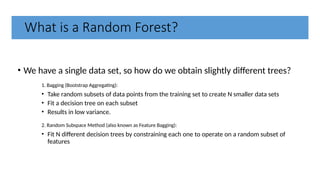
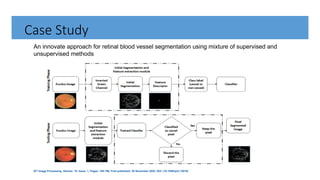
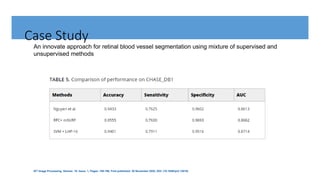
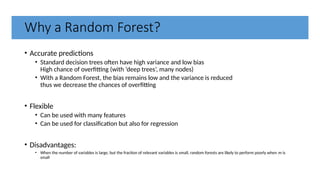
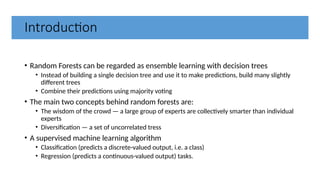
The document outlines random forests as an ensemble learning method that builds multiple decision trees and combines their predictions through majority voting. It discusses the historical development of random forests, key concepts like bagging and the random subspace method, and their applications in classification and regression tasks. A case study on retinal blood vessel segmentation using these methods is also highlighted, emphasizing the benefits of improved accuracy and reduced overfitting compared to traditional decision trees.

![History of Random Forests
• Introduction of the Random Subspace Method
• “Random Decision Forests” [Ho, 1995] and “The Random Subspace Method for
Constructing Decision Forests” [Ho, 1998]
• Motivation:
• Trees derived with traditional methods often cannot be grown to arbitrary complexity for
possible loss of generalization accuracy on unseen data.
• The essence of the methods are to build multiple trees in randomly selected subspaces of the
feature space.
• Trees in, different subspaces generalize their classification in complementary
ways, and their combined classification can be monotonically improved.](https://image.slidesharecdn.com/randomforest-250130053311-f968eaba/85/Random-ForestRandomForestsRandomForests-pptx-4-320.jpg)
![What is a Random Forest?
• Combined the Random Subspace Method with Bagging. Introduce the
term Random Forest (a trademark of Leo Breiman and Adele Cutler,
2001)
• “Random Forests” [1]
• The generalization error of a forest of tree classifiers depends on the strength of the individual trees in the forest
and the correlation between them.](https://image.slidesharecdn.com/randomforest-250130053311-f968eaba/85/Random-ForestRandomForestsRandomForests-pptx-5-320.jpg)